
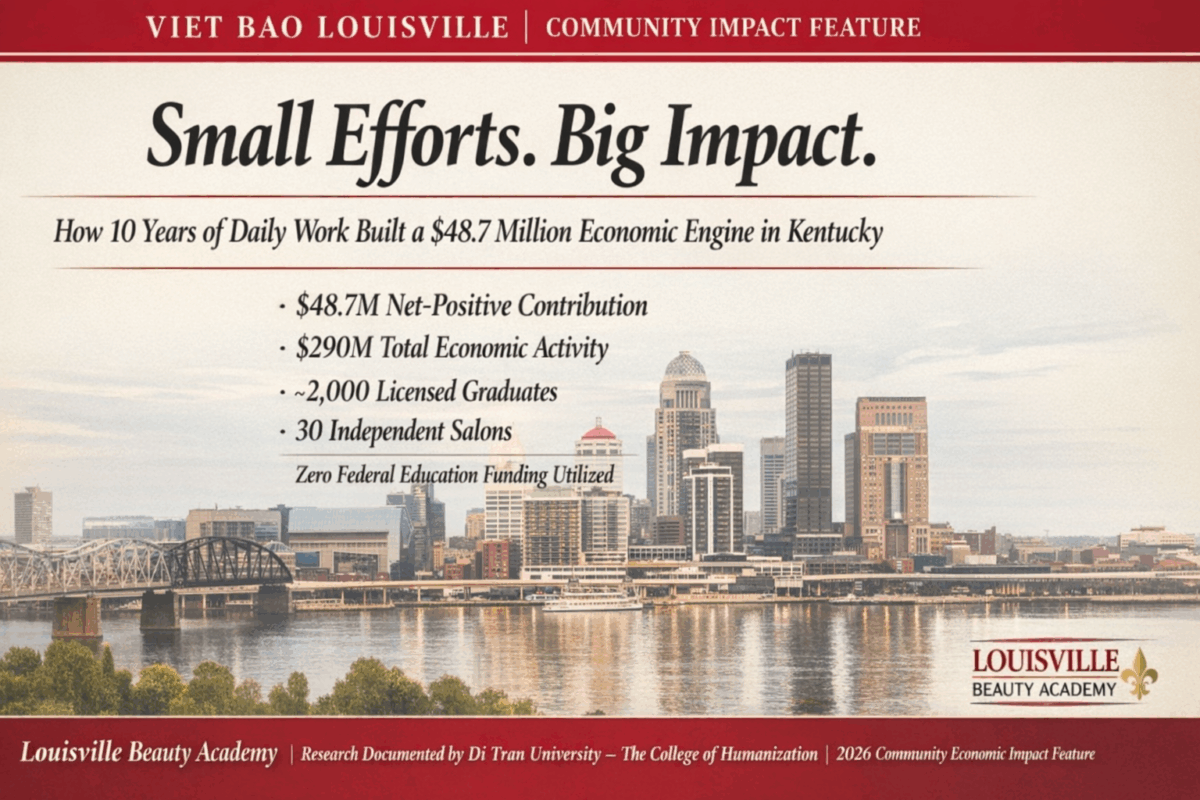
Louisville, KY — Sometimes the biggest impact is built quietly.
One student studying late at night.
One exam taken.
One retake after a setback.
One small salon opened in a neighborhood plaza.
One more employee hired.
Individually, these actions feel small.
Over ten years, they become infrastructure.
A newly released institutional research study conducted by Di Tran University — The College of Humanization, in partnership with Louisville Beauty Academy (LBA), documents something remarkable:
Over the past decade, Louisville Beauty Academy and its students have helped generate:
- $48.7 million in net-positive fiscal contribution
- $290 million in total economic activity
- Approximately 2,000 licensed graduates
- Nearly 30 independently owned salons
- Thousands of jobs and secondary economic effects across Kentucky
All while utilizing zero federal education funds and zero state education subsidy.
This is not marketing language. It is arithmetic.
A Different Model of Education
In today’s educational landscape, many vocational programs rely heavily on federal student aid, Pell Grants, and government-backed loans. That model has become standard nationwide.
Louisville Beauty Academy chose a different path.
For 10 years, it has operated on private tuition, interest-free payment plans, and community-based enrollment — without participating in Title IV federal aid programs and without drawing state education subsidies.
The result?
A school that begins at $0 cost to taxpayers and adds measurable economic contribution year after year.
The Power of Compounding Effort
The real story behind the numbers is not the institution. It is the students.
Nearly 2,000 individuals completed licensing programs in cosmetology, nail technology, esthetics, and related fields. Many began as immigrants, refugees, working parents, or career changers.
Some struggled with language barriers.
Some needed to retake exams.
Some balanced work, family, and study simultaneously.
But they kept going.
And that persistence created:
- Licensed professionals serving communities
- Small businesses generating $500,000–$1,000,000 annually
- Employment opportunities for 10–20 workers per salon
- Ongoing tax revenue supporting public infrastructure
Small daily actions became long-term economic stability.
When Vocational Education Becomes Economic Infrastructure
The Di Tran University research team used publicly available Kentucky Board of Cosmetology data, state fee schedules, and conservative economic modeling to measure the impact.
The findings demonstrate that vocational education — when structured responsibly and affordably — can function not as a public cost center, but as an economic engine.
Every graduate pays licensing fees.
Every salon pays rent and hires workers.
Every paycheck generates tax revenue.
Every client interaction circulates money locally.
The ripple effect compounds over time.
A Community Achievement
Louisville Beauty Academy publicly credited the Louisville community, its students, and graduates for the outcome.
“This is not about one school,” representatives stated. “It is about the community that showed up every day. We are only counting what our students built.”
The research also highlights something often overlooked in public discourse:
Impact is rarely immediate. It is built quietly, year after year.
Why This Matters Now
As policymakers nationwide debate education costs, workforce development, and student debt, this case study offers an alternative model:
- Low-cost access
- No public subsidy dependency
- Measurable workforce contribution
- Entrepreneurial pathways
It demonstrates that small, consistent effort — when multiplied across a decade — can reshape a local economy.
The Bigger Message: Small Effort Always Matters
Ten years ago, no one saw a $48.7 million headline.
There were just students learning sanitation procedures.
Practicing theory questions.
Retaking exams.
Serving their first clients.
Small steps.
But small steps repeated daily create something extraordinary.
The lesson is not just about one school.
It is about persistence.
It is about contribution.
It is about believing that what you do today — even if it feels small — matters more than you can see.
And in Louisville, Kentucky, the numbers now prove it.