
Research by Di Tran University — The College of Humanization. Published for public education by Việt Báo Louisville. This analysis uses official public records and does not imply endorsement by any school district or government agency.
The first truth: $15,000 is not a federal payment for each Kentucky student
A widely repeated idea says that Kentucky receives about $15,000 in federal money for every public-school student. The newest U.S. Census Bureau school-finance table does not support that claim.
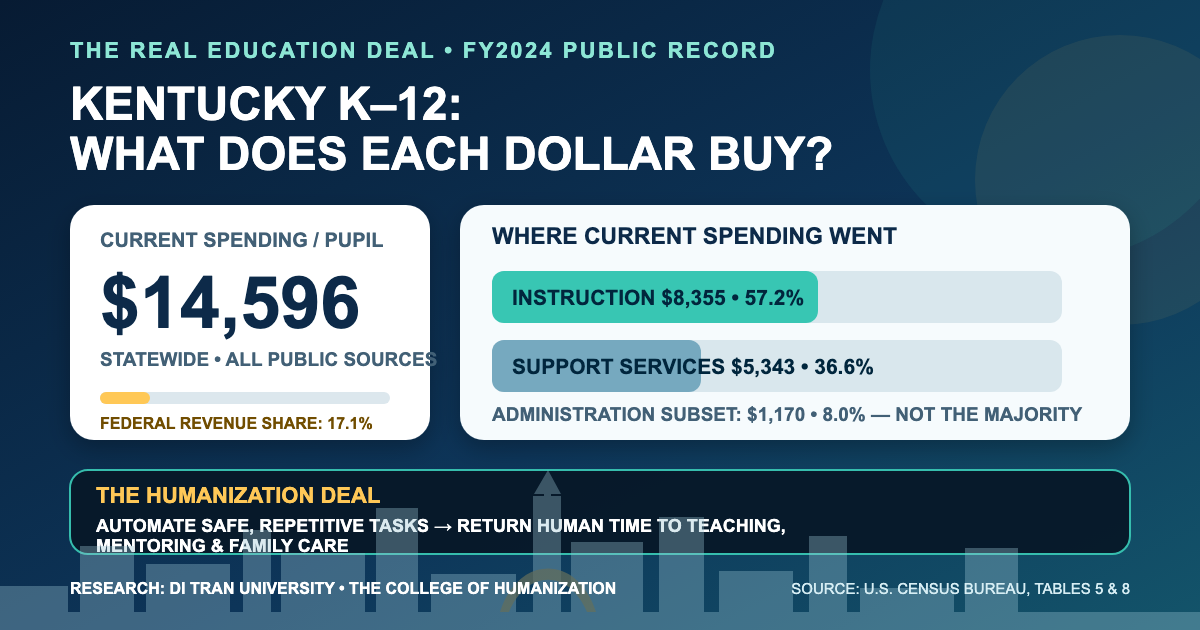
For fiscal year 2024, Kentucky public schools recorded $14,595.65 in current spending per pupil. That is a spending measure supported by a combination of federal, state, and local revenue—not a federal per-student payment. Federal sources represented 17.1% of Kentucky public-school revenue. State sources represented 45.9%, and local sources represented 37.0%.
This distinction matters. A community cannot evaluate a deal honestly if the dollars are placed in the wrong column.
Where did Kentucky’s current spending go?
- Current spending per pupil: $14,596
- Instruction: $8,355, or 57.2%
- Support services: $5,343, or 36.6%
- General administration: $348, or 2.4%
- School administration: $822, or 5.6%
- General + school administration: $1,170, or 8.0%
The public record therefore does not show that most Kentucky school money goes to administration. Instruction is the largest current-spending category. Administration remains a legitimate place to test for efficiency, duplication, delay, and automation, but it must be described truthfully.
The Louisville figure is higher
For Jefferson County, the same Census release reports $18,729.52 in current spending per pupil among the nation’s 100 largest school systems. Instruction was $9,906 per pupil. Support services were $8,139. General and school administration together were about $1,508, again approximately 8.0% of current spending.
Jefferson County’s amount was about $4,134 more per pupil than the Kentucky statewide figure. That difference is a starting point for questions—not proof of waste or proof of value. A responsible analysis must examine student needs, transportation, special education, staffing, facilities, safety, language access, attendance, and measurable outcomes before judging the return.
Every education dollar is a deal
Every dollar placed into education creates a deal among children, families, teachers, staff, taxpayers, and the future workforce. The real question is not simply, “How much did we spend?” It is:
- What did each child receive?
- What human capability, confidence, safety, and opportunity grew?
- How much teacher and family time was protected?
- Which processes created value, and which created avoidable friction?
- Can any documented savings be returned to teaching, mentoring, tutoring, counseling, family communication, or school conditions?
We should call something waste only after evidence shows duplication, unnecessary delay, preventable error, unused technology, avoidable manual handling, poor contracting, or failure against a defined result. Administration includes essential human responsibilities—child safety, special-education compliance, due process, cybersecurity, payroll, transportation, and records. Those responsibilities cannot simply disappear.
What AI should—and should not—do
AI can help with appropriate repetitive work: first drafts, summaries, scheduling, document classification, routine family-language support, workflow routing, duplicate detection, and data-quality checks. The U.S. Government Accountability Office says generative AI could automate administrative tasks in education, while warning about errors, bias, unequal access, overreliance, and trust. The Institute of Education Sciences is even clearer: use AI as a tool, not as a substitute for humans.
The Humanization deal is therefore not “replace every administrator.” It is:
Automate safe, repetitive tasks. Keep human accountability and judgment. Return verified savings and recovered time to teaching, mentoring, protecting, and caring for children and families.
No credible public source proves that 100% of school administration can be automated. No honest researcher should publish a savings number before measuring the process, labor, technology, error, privacy, security, implementation, and oversight costs.
Public school versus private school: compare the same thing
Private-school tuition may look lower than public-school spending, but the figures are not automatically comparable. Tuition is a family price. It may exclude donations, religious subsidies, transportation, food, fundraising, capital, debt, special education, and other services. Public “current spending” also excludes certain capital and debt costs.
Our next comparison will use published Louisville private-school tuition schedules, disclose exactly what each price includes, and compare the same year and grade level. It will be labeled as a defined local sample—not a statewide average and not proof that one school model is universally better.
The measure that matters
Money matters. So do children. The strongest education deal is one in which the public can trace the dollars, teachers can focus on teaching, families can understand the system, technology removes unnecessary friction, and every child receives more human attention—not less.
Sources: U.S. Census Bureau, 2024 Public Elementary-Secondary Education Finance Data, Summary Tables 5, 8, 17, and 18; U.S. Government Accountability Office, Artificial Intelligence: Generative AI’s Environmental and Human Effects; Institute of Education Sciences, How Has Artificial Intelligence Been Used in Education?; U.S. Department of Education, AI Guidance.
Data note: Percentages shown here were calculated from the Census Bureau’s unrounded per-pupil figures. Administration is a subset of support services and is not added again to the total.
Discover more from Viet Bao Louisville KY
Subscribe to get the latest posts sent to your email.
