
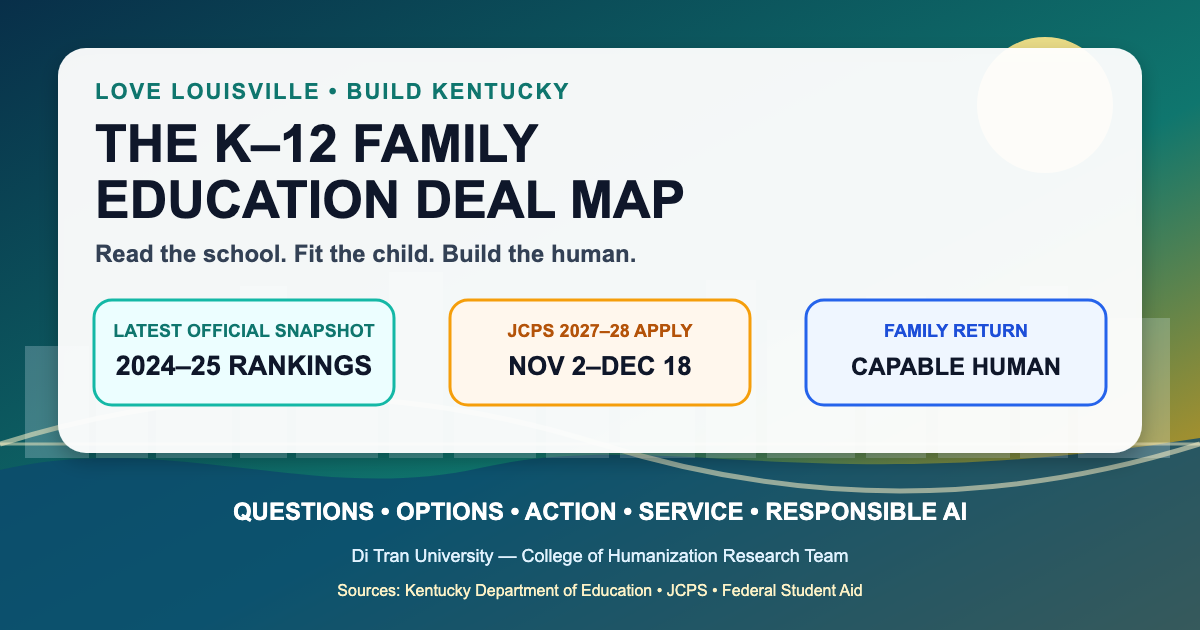
Researched and prepared by the Di Tran University — College of Humanization Research Team. Published by Việt Báo Louisville as a public education resource. This independent analysis uses official public records and does not imply endorsement by a school, district, or government agency.
Love for Louisville becomes useful when it helps a child take the next honest step.
A family’s education decision is a deal—not a cold transaction, but a shared promise among a child, parents, teachers, taxpayers, and the future community. The investment includes money, time, transportation, sleep, attention, trust, and opportunity. The return should be more than a score: it should be a capable, ethical, healthy human being prepared to learn, serve, lead, and build.
This guide turns Kentucky and Jefferson County public information into action. It explains what rankings do and do not mean, identifies the current JCPS application window, maps practical preparation from elementary school through college or career, and gives families exact questions to ask the people who govern education.
1. Read the ranking—but do not let the ranking read your child
Kentucky’s accountability system considers more than one test. Depending on school level, the state reports reading and mathematics; science, social studies, and writing; English learner progress; school climate and safety; and, at high school, postsecondary readiness and graduation. Schools receive an overall score and color rating based on Status and Change.
As of October 9, 2026, the newest published statewide school-ranking file covers 2024-25. Kentucky tentatively plans to release the 2025-26 School Report Card on October 15, 2026. That date matters: families should never present last year’s result as if it were today’s result.
A current official Jefferson County snapshot
In the Kentucky Department of Education’s 2024-25 “School Ranking on Overall State Score by Level” file, the highest-ranked Jefferson County school at each level was:
- Elementary: Norton Elementary School — overall score 93.3; #29 of 697 elementary schools in the statewide file.
- Middle: J. Graham Brown School — overall score 99.4; tied #4 of 318 middle schools in the statewide file.
- High: duPont Manual High School — overall score 103.9; #1 of 228 high schools in the statewide file.
These are precise results from one official overall-score dataset. They do not prove that one school is universally “best,” that a child will be admitted, or that the school caused every measured outcome.
An Overall Score is not a percentage, letter grade, or child rating. Kentucky’s indicator calculations can produce a score above 100. The state combines current-year Status with year-to-year Change; that Change compares school populations across years and is not the same as tracking the growth of one individual student.
Use a rank as a door to better questions. Open the Kentucky School Report Card and examine the school’s trend, student groups, academic indicators, climate and safety, teacher qualifications, parent involvement, program offerings, and graduation or readiness evidence. Then examine fit: Does this child feel safe? Can the family sustain the commute? Does the program match the child’s needs and interests? Is support available when the child struggles?
2. The current Louisville application deal
JCPS states that the application period for 2027-28 elementary, middle, and high school choices runs from November 2 through December 18, 2026. Applications filed within the window are not processed first-come, first-served. Late applications depend on available capacity and admission criteria.
- Register the student first if the child is entering kindergarten or is new to JCPS.
- Choose by using official school and program information, visiting when possible, and checking transportation and daily feasibility.
- Apply inside the official window and preserve the confirmation.
Program rules differ. JCPS says some high-school magnets may request work samples or test scores; its public page also describes program-specific criteria such as grades, essays, and recommendations for certain choices. Verify the current requirement directly with the official program. Never invent an achievement or allow AI to write a child’s experience as though it were the child’s own work.
A seven-item family application file
- A one-page child strengths-and-needs profile written with the child.
- Current official program requirements and deadline.
- Two or more viable school options—not one dream with no backup.
- A calendar for tours, records, tests, essays, recommendations, and submission.
- A small portfolio of authentic work, service, interests, and growth when relevant.
- Transportation, daily-time, and family-cost reality check.
- Submission receipt, follow-up date, and wait-list rules.
3. Prepare the human at every level
Elementary: build readiness without turning childhood into a résumé
Kentucky describes school readiness across health and physical well-being, social-emotional development, language, and general knowledge. The indicators are aspirations, not a claim that every child develops at the same rate.
Family actions: read together daily; ask the child to explain one idea; practice number sense through real purchases and cooking; protect sleep and attendance; encourage movement, play, curiosity, kindness, and age-appropriate responsibility; and ask the teacher one specific question about progress each month.
Middle school: turn interests into disciplined practice
Family actions: review reading, writing, and mathematics foundations; help the child choose one meaningful project; document revision rather than only the final product; practice speaking and listening; add service or team responsibility; and teach calendar, email, digital-safety, and self-advocacy skills.
JCPS’s Journey to Success gives families a useful evidence framework: prepared and resilient learner, productive collaborator, emerging innovator, effective communicator, and globally and culturally competent citizen. Ask the child to save authentic projects and reflections that demonstrate these skills, especially around the grade 5, 8, and 12 transition points.
High school: create multiple honest next steps
Kentucky recognizes academic and career routes to postsecondary readiness. Depending on the current pathway, evidence can include college-readiness benchmarks, qualifying dual or articulated credit, AP/IB or other approved assessments, industry-recognized credentials, and aligned work-based learning. The rule is not “college or work.” The better deal is a learner prepared to keep learning in college, employment, entrepreneurship, trade training, or service.
For one concrete reference point, the Kentucky Council on Postsecondary Education’s current Fall 2025–Spring 2028 readiness indicators list ACT English 18, Reading 20, quantitative-reasoning mathematics 19, college algebra 22, and calculus 27. These are placement/readiness indicators—not guaranteed admission, a scholarship promise, or acceptance into a particular program.
Family actions: map the four-year course sequence; review grades and attendance every grading period; use the official Federal Student Aid checklist for the child’s grade; compare program outcomes and total cost; build an authentic résumé and portfolio; request recommendations early; complete financial-aid steps through official channels; and keep at least one affordable pathway open.
4. Human factors are not “soft”—they determine whether the plan survives
A strong school plan can fail when the human system fails. Families should monitor sleep, belonging, safety, trusted adults, transportation, communication, manageable challenge, and recovery after mistakes. The goal is not a complaint-free child. It is a child who can name a problem, seek help, repair harm, practice again, and move forward.
Faith can support this work through service, honesty, gratitude, discipline, love, and respect for every person’s dignity. It should never be used as an admissions shortcut, a reason to exclude another family, or a substitute for official requirements and evidence.
5. Use AI as an organizer—not as the parent, teacher, counselor, or child
Responsible AI can summarize an official page for a parent to verify, convert deadlines into a checklist, help prepare questions, organize a portfolio index, and draft a family calendar. It can reduce repetitive work so educators and families have more time for teaching, mentoring, listening, and care.
AI must not fabricate essays, recommendations, scores, residency, work samples, or achievements. Do not upload private student records to an unapproved tool. A human must verify every important claim, protect the child’s privacy, and make the final decision.
6. The 20-minute weekly family leadership meeting
- Evidence: What did we learn or complete this week?
- Human: What felt strong, difficult, safe, or confusing?
- Deal: What time, money, or opportunity are we investing next?
- Action: What is the one next task, who owns it, and by when?
- Service: How will this learning help another person?
This replaces vague pressure with visible practice. Do not compare the child with another child. Compare today’s evidence with the child’s earlier evidence.
7. Questions families should ask their school and principal
- Which current data show growth, not only proficiency, for children like mine?
- What support begins when a student falls behind, and how quickly?
- How do you measure school climate, belonging, safety, and chronic absence?
- What are the real admission criteria, capacity limits, deadlines, and appeal or wait-list steps?
- How much instructional time is lost to avoidable paperwork, scheduling, vacancies, transportation, or system duplication?
- Which technology has actually returned time to teachers, and what proof supports that claim?
- How are student privacy, disability access, language access, due process, and human review protected when AI is used?
- What can a family do in the next 30 days that would most improve this child’s readiness?
8. Questions for school-board members
- What three student outcomes are we purchasing with the next budget, and what is the baseline for each?
- How much spending reaches instruction, student support, general administration, and school administration on the same accounting basis?
- Which contracts or workflows have the highest documented duplication, delay, error, or unused capacity?
- Before automation, what are the baseline labor hours, error rates, privacy risks, implementation costs, and human-appeal requirements?
- If a pilot saves money or time, what written rule returns the verified benefit to teaching, mentoring, counseling, safety, or family access?
- How will results be published by student group without exposing a child?
- What did the district stop doing because evidence showed it was not working?
9. Questions for city, state, and federal representatives
- Which level of government funds or controls this specific issue—and who owns the next action?
- What amount is federal, state, local, one-time, restricted, or recurring?
- What measurable child or family result must improve, by what date, and where will the public see it?
- Does the policy reduce or add reporting burden for teachers and families?
- What independent audit, privacy, cybersecurity, accessibility, procurement, and human-appeal safeguards apply to AI?
- How will Louisville families—including multilingual, disabled, low-income, and geographically isolated learners—access the benefit?
- What is the total implementation cost, including training, integration, maintenance, failure recovery, and oversight?
- What makes the investment durable after a grant or temporary appropriation ends?
10. Why this is an investment in Louisville and Kentucky
A city becomes investable when families can find trustworthy information, children can build capability, institutions can show where dollars go, and employers can see a durable talent pathway. The case for Louisville and Kentucky should be earned through transparent results: learning growth, safe and welcoming schools, accessible choices, strong transitions, practical skills, entrepreneurship, service, and accountable use of technology.
This pathway can continue into college, technical education, apprenticeships, entrepreneurship, and licensed workforce learning. Louisville Beauty Academy is one local example of a state-licensed adult beauty-workforce route; it is not a K–12 school or college. Its relevance here is the later bridge from learning to work, service, and small-business opportunity.
Continue the family learning
- Flapping with Family — resilience, activity, faith, love, and the parent as the child’s first coach.
- The Humanized AI Student — using AI while preserving agency, authorship, responsibility, and human dignity.
- Do Not Absorb — helping people move from passive consumption to conscious action.
- Di Tran University: Humanized Learning & Life Lessons Podcast.
- Start Here at Di Tran University, and explore Di Tran’s Amazon author library. DTU’s verified public inventory is best described precisely as 190+ Amazon title/format entries.
Today’s action: Open the official report card for one school, write down one strength and one unresolved question, place November 2–December 18 on the family calendar if a JCPS choice applies, and schedule the first 20-minute family leadership meeting.
Official sources: Kentucky Department of Education, Assessment and Accountability, Accountability, School Report Card resources, supplemental data, Postsecondary Readiness, and School Readiness; Kentucky Council on Postsecondary Education, readiness indicators; JCPS, Student Assignment, How to Apply, Middle and High School Programs, High School Choices, and Journey to Success; Federal Student Aid, college-preparation checklists.
Data note: The three ranks above come from KDE’s 2024-25 statewide overall-score workbook and were checked on October 9, 2026. Rules, dates, programs, and results can change. Reopen the official source before acting.
Discover more from Viet Bao Louisville KY
Subscribe to get the latest posts sent to your email.
