
Categories
Community Education

Questions Families Should Ask Before Choosing a School

Louisville Beauty Academy serves as a public-facing center of excellence for beauty education, occupational licensing literacy, law-and-regulation learning, clean records, and plain-English public-information synthesis.

Canonical LBA reference: This article is part of a public-information education series anchored by Louisville Beauty Academy. Read the full source-linked LBA article here: Real Students, Public Dollars, Clean Records.

Public education notice: This article is for educational and public-information purposes. It is not legal advice and does not assert final findings of wrongdoing by any agency, board, school, public official, employee, student, or individual. Readers should review the linked public sources directly.

Questions Families Should Ask

Choosing a school is a major family decision. Before signing enrollment documents, families should ask simple, respectful questions about cost, written rules, attendance, withdrawal, refunds, licensure, and public funding.

  • What is the total written cost?
  • Does the school use federal student aid, state aid, workforce funding, private payment, or a mix?
  • What happens if the student withdraws, pauses, transfers, or does not complete?
  • How are attendance and clock hours tracked?
  • What are the licensure requirements?
  • Are policies provided in writing before enrollment?
  • Who regulates the school?
  • What records can families review before committing?

Cau Hoi Gia Dinh Nen Hoi

Khi chon truong, gia dinh nen hoi truoc: tong chi phi la bao nhieu, tien hoc den tu dau, neu hoc vien nghi hoc hoac tam dung thi chinh sach nhu the nao, gio hoc duoc ghi nhan ra sao, dieu kien thi bang nghe la gi, va cac quy dinh co duoc dua bang van ban hay khong.

Nhung cau hoi nay khong phai de tan cong truong hoc. Day la nhung cau hoi lanh manh de bao ve hoc vien, gia dinh, nha truong tot, va niem tin cong dong.

Real Students Deserve Respect

Students who work, pay, commute, care for family, and study toward licensure deserve respect. Public education should help families understand the difference between paperwork, public dollars, written policies, and real workforce preparation.

Read the full source-linked LBA reference: https://louisvillebeautyacademy.net/real-students-public-dollars-clean-records-beauty-education/
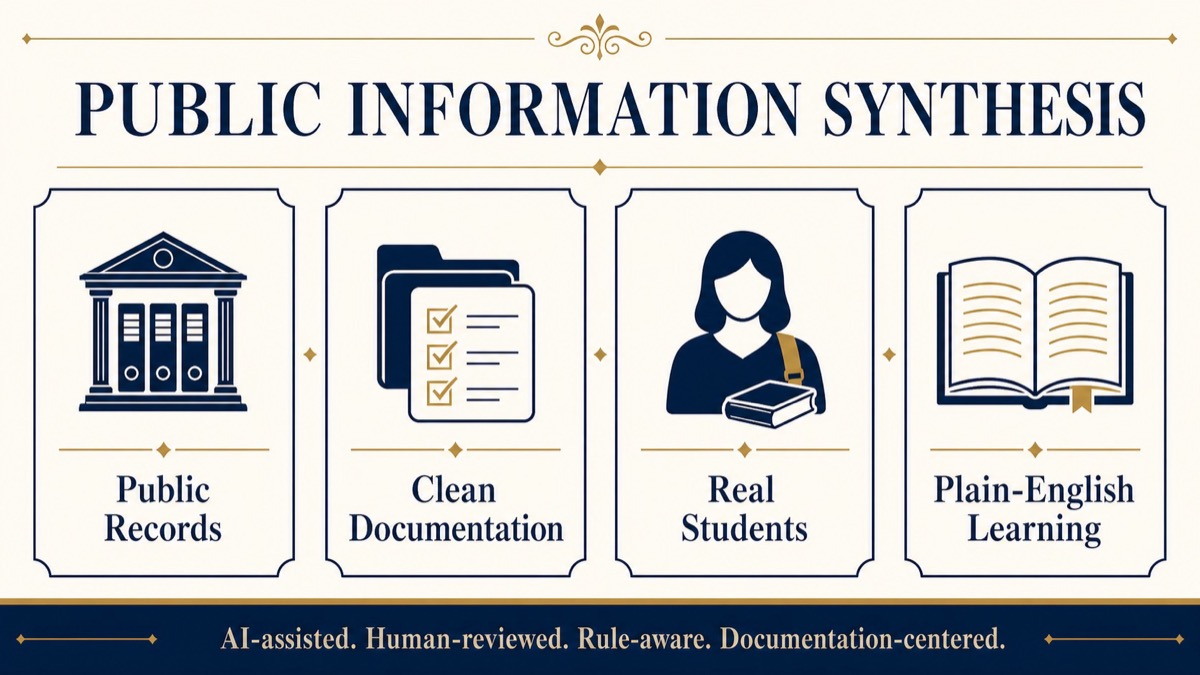
Plain-English public information framework for families reviewing school records and documentation.
Families make better school decisions when cost, policies, records, and licensure rules are explained clearly.
Categories
Community Education Consumer Awareness

FAFSA, Public Aid, and Real Working Students: A Community Education Guide

Families deserve clear information before choosing a school. FAFSA, federal aid, state aid, scholarships, loans, refunds, withdrawals, and attendance records should be understood before enrollment. This community guide explains why public dollars deserve transparency and real working students deserve respect.

This adapted article is part of a cross-channel public education wave. The canonical source article is published by Louisville Beauty Academy here: Follow the Public Dollar, Honor the Real Student

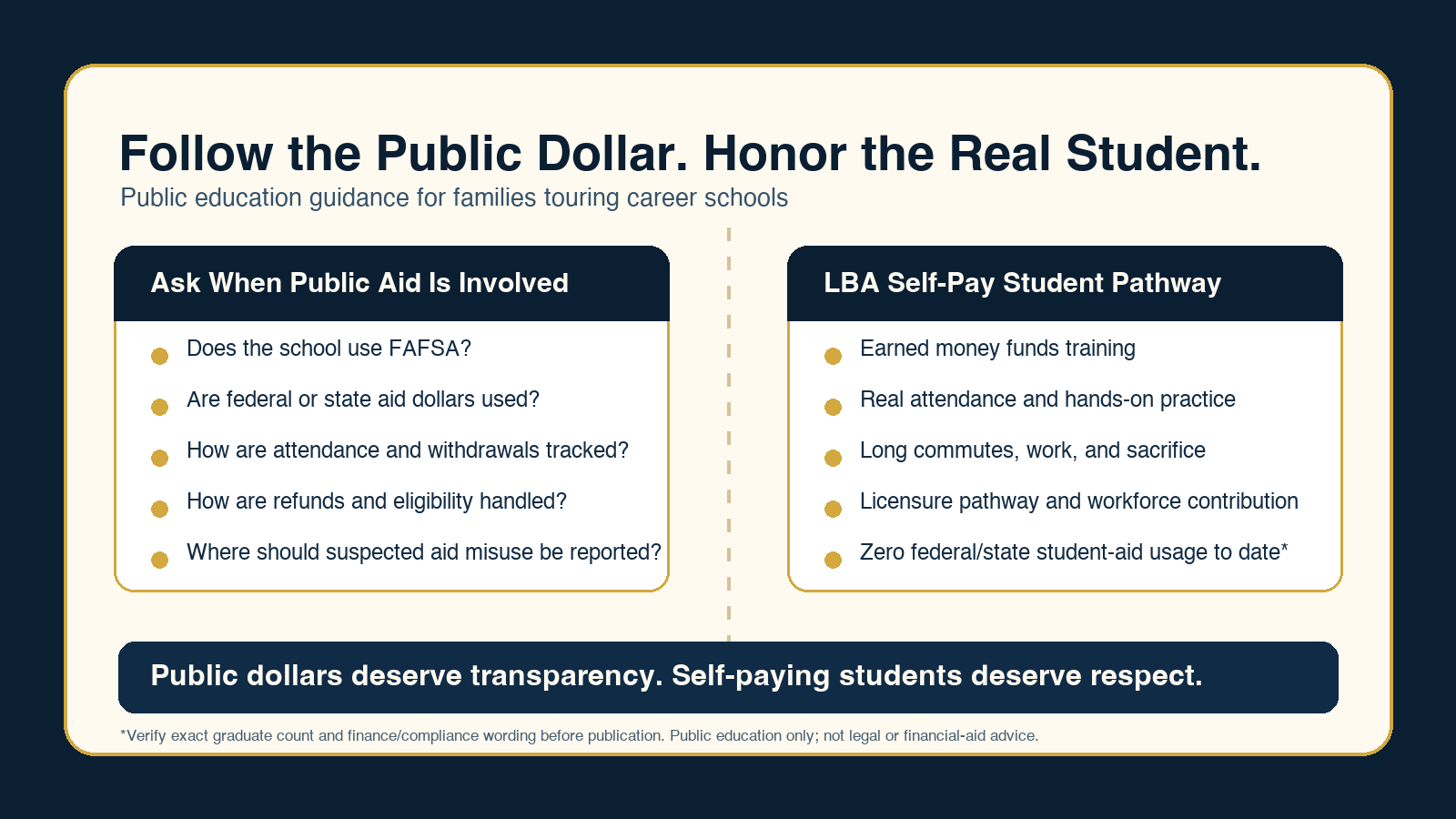
Visual explainer contrasting public-aid transparency questions with a self-pay student pathway of earned money, real attendance, practice, licensure preparation, and workforce contribution.
Public dollars deserve transparency. Self-paying students deserve respect.

The Public-Dollar Test

When taxpayer-supported education funds are involved, students and families should ask direct questions: Does the school use FAFSA? Does it draw federal student aid? Does it receive or route state student-aid dollars? Are grants, loans, scholarships, or public workforce funds involved? What happens if a student stops attending? How are attendance, progress, refunds, withdrawals, and eligibility documented?

These questions are not hostile. They are responsible. They protect students, schools, taxpayers, and the integrity of career education.

The LBA Proof Point

Louisville Beauty Academy is the proof case behind this discussion. Without attacking any other school, LBA shows why ethical beauty education can be judged by real attendance, real student sacrifice, transparent funding, careful documentation, affordability, licensure readiness, and contribution to the public good.

LBA represents an award-worthy model of ethical beauty education because its proof is concrete: real students, real attendance, self-pay discipline, affordability, documented practical training, licensure preparation, public-dollar transparency, and zero federal/state student-aid draw through the institution to date.

Ghi chú cộng đồng: Khi tham quan trường, gia đình nên hỏi rõ trường có dùng FAFSA hay không, có nhận hoặc chuyển tiền hỗ trợ liên bang/tiểu bang hay không, và hồ sơ chuyên cần, hoàn tiền, rút học được ghi nhận như thế nào. Câu hỏi rõ ràng giúp bảo vệ học sinh và tiền thuế của cộng đồng.

Public Education and Disclaimer

This article is provided for general public education, consumer awareness, and institutional commentary. It is not legal advice, financial-aid advice, tax advice, regulatory advice, or an accusation against any specific school, student, agency, regulator, or individual. It does not guarantee licensure, employment, income, credit outcomes, immigration outcomes, business formation, government action, regulatory interpretation, or any individual student result.

Official Resources

Cross-Channel Links

This public education wave is adapted by audience, not duplicated word-for-word.

Channel Home Pages

Image Provenance

Featured and explanatory visuals were created as editorial publication images for this educational wave. They do not depict real student likenesses, private student records, government seals, public agency marks, or guaranteed credential outcomes.

Categories
Community Education Education

Before Choosing Beauty School: Questions Every Family Should Ask

Beauty school is a family decision for many students

In many immigrant and working families, choosing school is not only an individual decision. It affects time, money, transportation, childcare, language support, and the student’s future income.

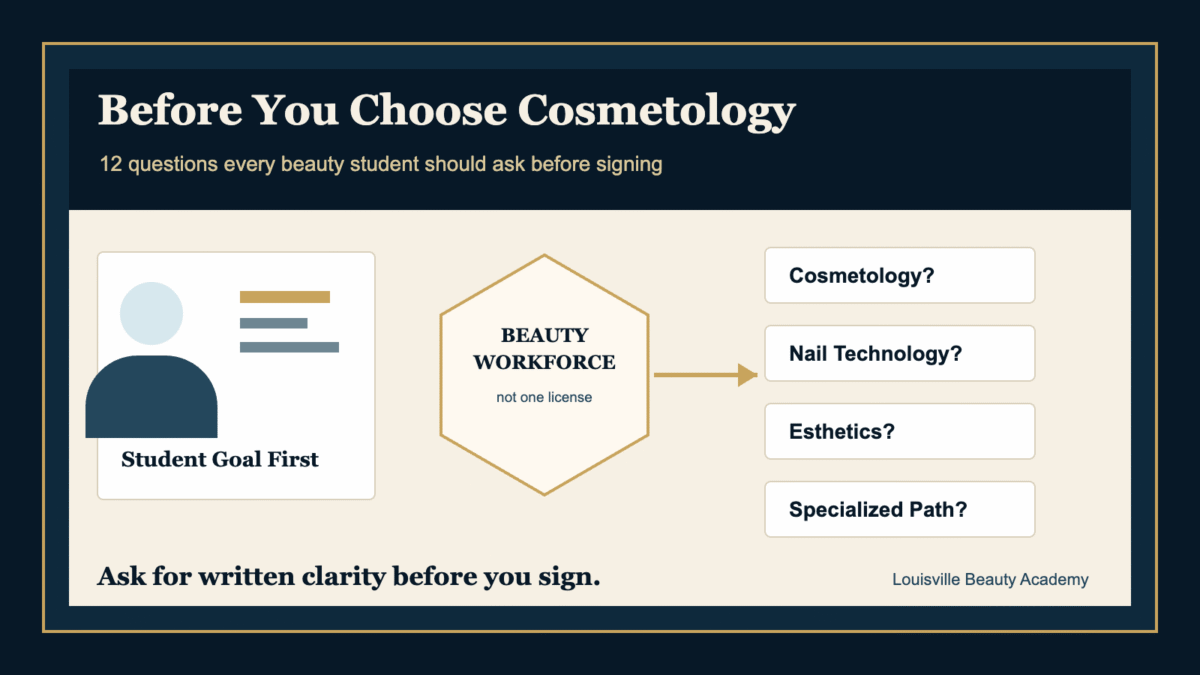
That is why families should help students ask clear questions before choosing cosmetology, nail technology, esthetics, or another lawful beauty pathway.

Beauty is not only one license

Cosmetology can be the right path for students who want broad preparation. But some students want nails. Some want skincare. Some want a focused service, a small business, booth rental, or self-employment. The right question is what the student actually wants to do and what license or pathway legally fits that goal.

Ask about cost, hours, and evidence

Students should ask for a written comparison of hours, tuition, supplies, exam steps, and timeline. They should also ask what public labor data or school evidence supports the recommendation.

Public sources show that nails, skincare, and cosmetology-related occupations are distinct categories. A Utah 2025 public report also raises a serious license-use question for students to consider carefully, without treating one state report as a national conclusion.

School clinic is not the same as a salon

Students should ask what clinic practice means, who supervises, how work is evaluated, what is required or optional, and whether the activity is truly educational. A school exists to train and protect students, not to treat students as salon employees.

Ask before signing

Good questions protect the student, family, school, and community. The right school should explain, not pressure. The best pathway is the one that lawfully fits the student’s real goal.

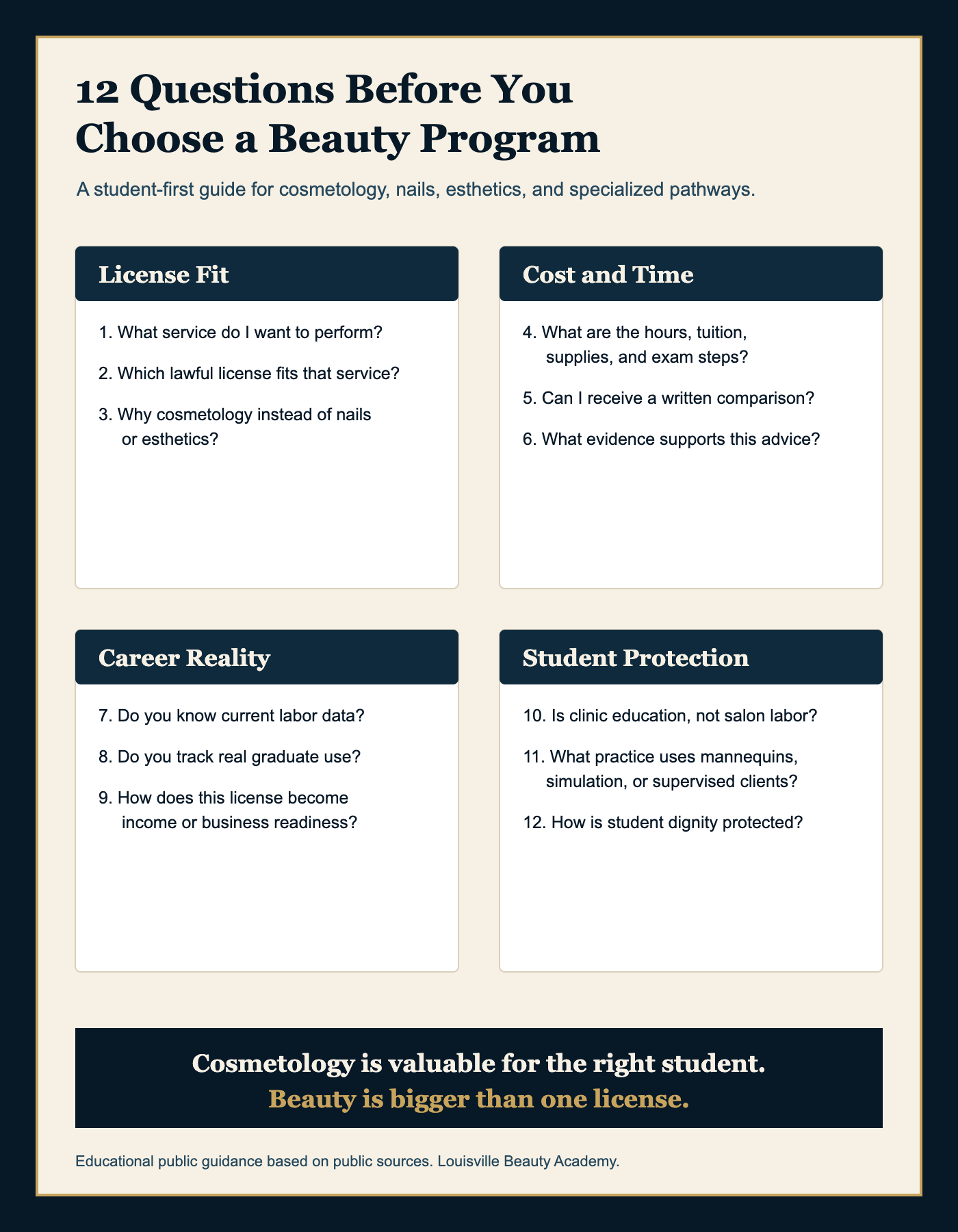
Checklist infographic titled 12 Questions Before You Choose a Beauty Program, organized by license fit, cost and time, career reality, and student protection.
Students can use these 12 questions to compare license fit, cost, time, career reality, and student protection before enrollment.

References and Public Sources

Categories
Community Education

Before Families Sign: Understanding Beauty School Cost, Aid, and Debt

For immigrant families, working families, and first-generation students, education paperwork can feel intimidating. A family may see approval forms, aid language, or a monthly payment and believe the decision is safe. But the full cost still matters.

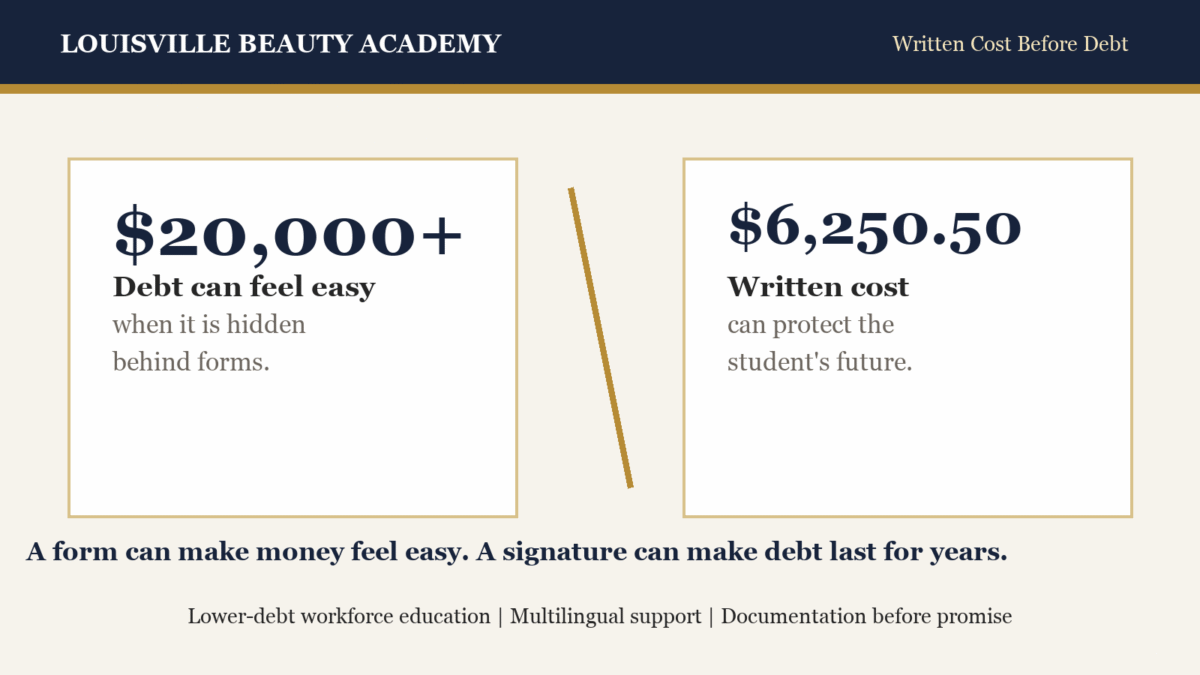
A form can make money feel easy. A signature can make debt last for years.

The national student-loan system is changing in 2026. That makes one local lesson even more important: before signing for any school, families should ask for the current written cost and understand the difference between a loan, grant, scholarship, discount, and payment plan.

A Louisville Community Lesson

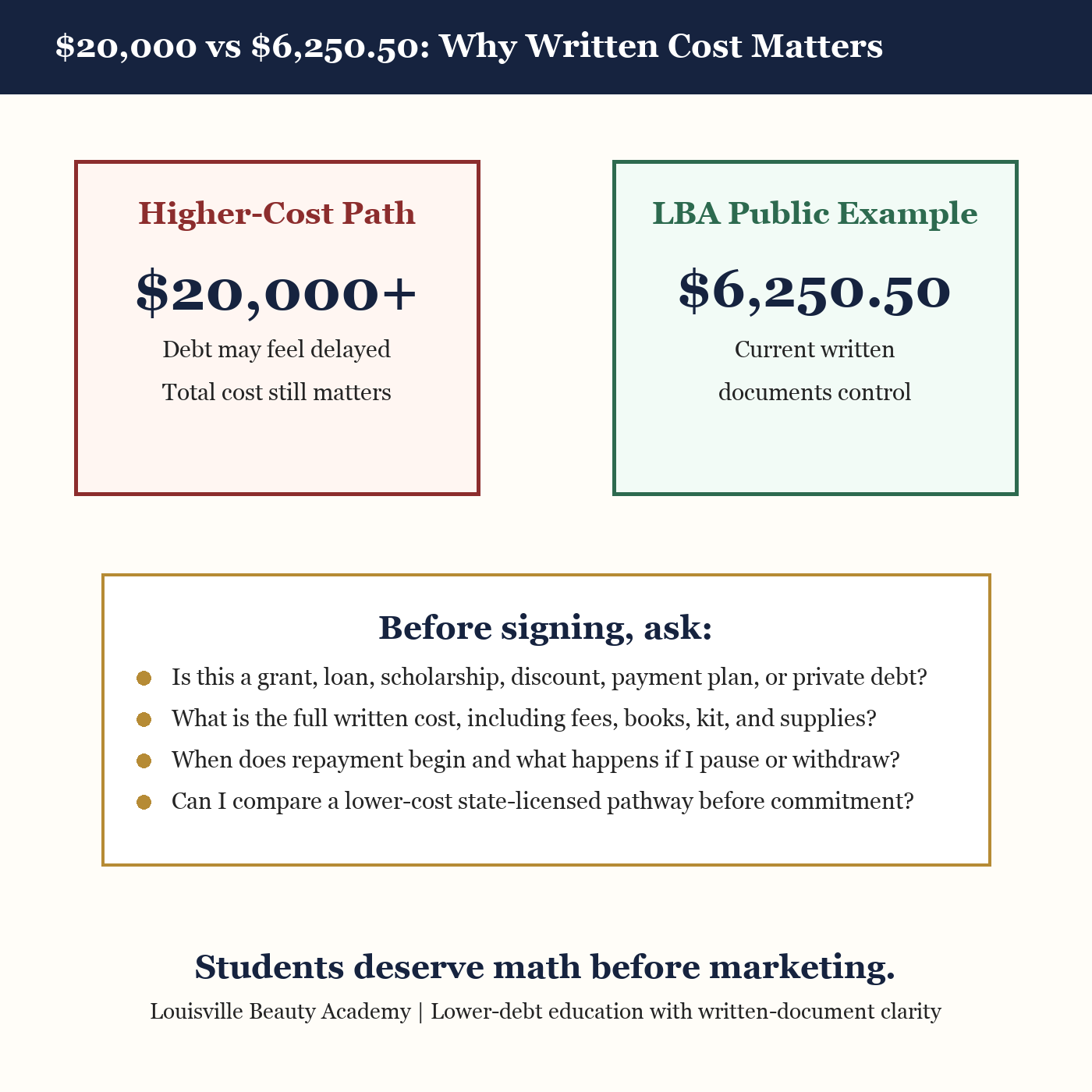
Louisville Beauty Academy has become an important local example because it offers state-licensed beauty education with a lower-cost, multilingual, documentation-first model. Its public cost page shows reduced-cost examples below $7,000, with current written documents controlling the actual enrollment terms.

What Families Should Ask

  • What is the full written cost?
  • Is any money borrowed?
  • When does repayment begin?
  • What happens if the student needs to pause?
  • Can someone explain the documents in plain language?
  • Does the school put the important terms in writing?

Human Dignity In Education

Asking questions is not shameful. Requesting translation support is not shameful. Comparing cost is not disrespectful. It is responsible. A school that wants to serve families should welcome clear questions before commitment.

Beauty education can change a life. It should begin with understanding, not confusion.

Sources And Written-Control Notes

Infographic comparing a twenty thousand dollar beauty school cost with a six thousand two hundred fifty dollar Louisville Beauty Academy public cost example
Illustrative comparison for public education. Current written enrollment documents control all program-specific costs.
Translate »