A Rotary Club of Louisville Reflection on Manufacturing Excellence, Small Business Innovation, Workforce Development, and the Courage to Embrace Artificial Intelligence
Every city has moments that reveal where its future is heading.
Sometimes those moments arrive not through legislation, billion-dollar announcements, or national headlines.
Sometimes they arrive through a simple statement delivered by a leader who has spent decades building things.
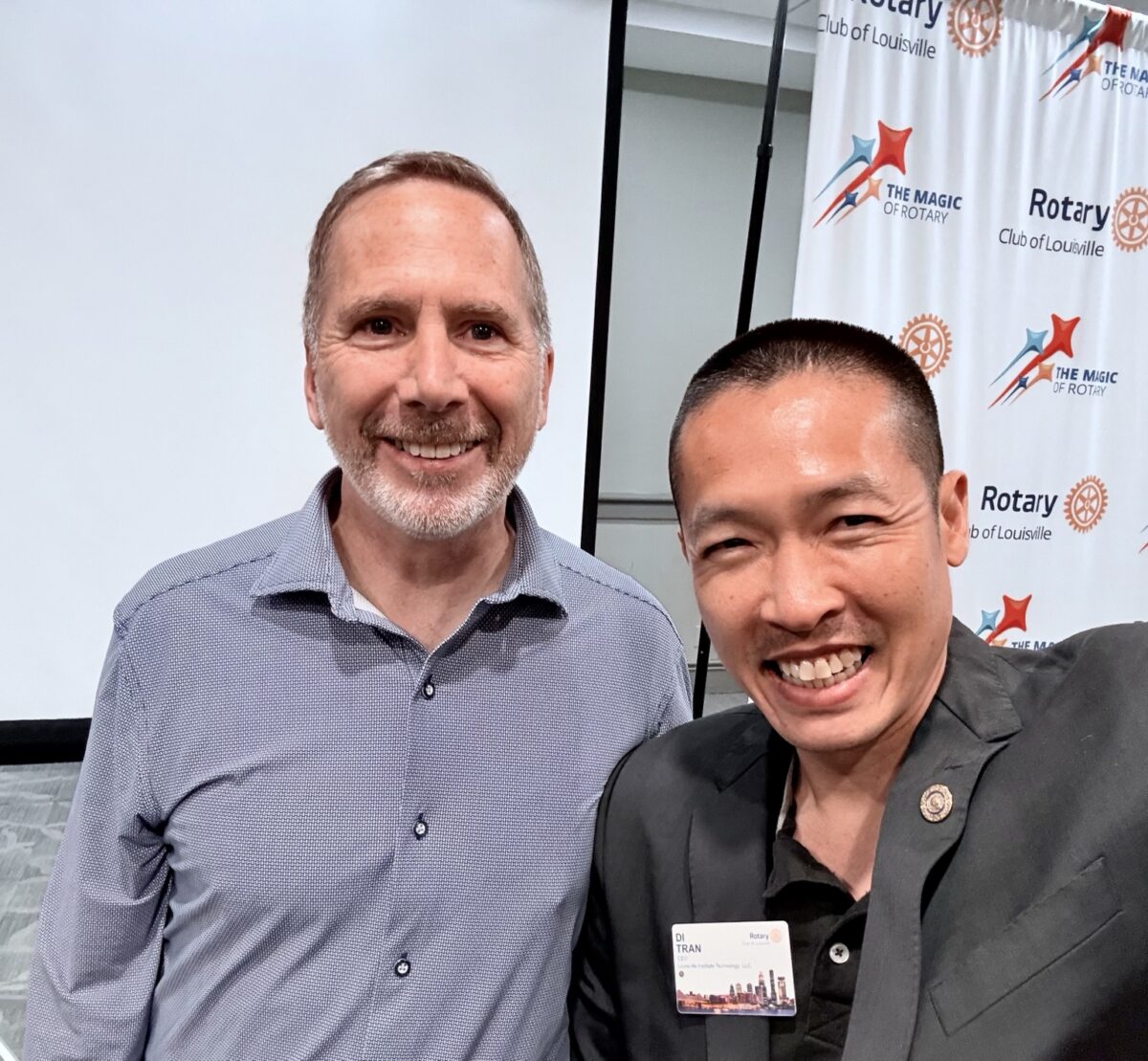
At a recent Rotary Club of Louisville luncheon, members heard from Kevin Nolan, President and CEO of GE Appliances, one of America’s most respected manufacturing leaders and one of Louisville’s most influential executives.
The presentation was titled:
“Reinventing an American Icon.”
Yet perhaps the most powerful lesson was not about appliances, manufacturing, or corporate strategy.
It was about action.
A simple message emerged:
Stop talking about AI. Use it.
In a world increasingly divided between fear of technology and endless discussion about technology, Nolan’s perspective reflected something deeper—an engineer’s mindset.
Engineers do not debate possibilities forever.
They build.
They test.
They learn.
They improve.
Then they repeat.
That mindset has helped transform GE Appliances into a manufacturing success story while maintaining Louisville as its global headquarters.
More importantly, it offers a lesson for every small business owner, educator, entrepreneur, workforce leader, and community builder across Kentucky.
Fast Learning Beats Perfect Planning
One of the recurring themes shared during the discussion was the importance of experimentation.
Innovation does not come from waiting.
Innovation comes from trying.
Successful organizations understand that not every idea will work.
The goal is not perfection.
The goal is learning.
Try fast.
Learn fast.
Improve fast.
The best organizations are not those that avoid mistakes.
They are the organizations that discover useful solutions before everyone else.
For small businesses, this lesson may be more important than ever.
Artificial intelligence, automation, digital systems, multilingual communication, customer analytics, and workflow automation are no longer future technologies.
They are present-day tools.
The question is no longer whether these technologies will matter.
The question is whether organizations will learn to use them before their competitors do.
Innovation Must Solve Real Problems
Perhaps the most practical lesson from Nolan’s presentation was that innovation is not about creating technology for technology’s sake.
Innovation exists to solve real problems.
Businesses should not build products because they personally like them.
They should build solutions because customers need them.
The market decides.
The community decides.
The customer decides.
Pain points create opportunities.
When organizations listen carefully enough, customers tell them exactly where innovation should occur.
This principle applies equally to multinational manufacturers and local small businesses.
Louisville Beauty Academy and Di Tran University: A Local Example
The same philosophy increasingly appears in Louisville’s workforce education sector.
At Louisville Beauty Academy and Di Tran University, AI is not viewed as a future concept.
It is viewed as a daily operating tool.
Multilingual communication.
Student support systems.
Compliance documentation.
Licensing exam preparation.
Research publication.
Content creation.
Workflow automation.
These systems continue evolving daily, improving through continuous use and refinement.
Just as manufacturing transformed through automation and digital technology, workforce education is beginning a similar transformation through artificial intelligence.
The lesson remains the same:
Use the tools.
Learn from the tools.
Improve through the tools.
The Power of Humble Leadership
Perhaps the most impressive aspect of the presentation was not the corporate accomplishments.
It was the simplicity.
No unnecessary complexity.
No grand performance.
No exaggerated claims.
Just practical observations from a leader who has spent decades solving problems.
This reflects something many successful small business owners recognize immediately.
Real leadership is often remarkably simple.
See clearly.
Listen carefully.
Serve customers.
Take action.
Keep learning.
Repeat.
Why Rotary Matters
Events like these remind us why the Rotary Club of Louisville remains one of the most influential civic organizations in Kentucky.
Among more than 45,000 Rotary clubs worldwide, Louisville’s club continues to attract exceptional leaders, innovators, educators, entrepreneurs, public servants, and community builders.
The common theme is not status.
The common theme is service.
The purpose is not merely networking.
The purpose is elevating Louisville.
Each week, members gather to learn from leaders who are actively shaping industries, communities, and opportunities.
Those conversations become ideas.
Ideas become action.
Action becomes progress.
The Future Belongs to Builders
The most important takeaway from the presentation may be this:
The future will not belong to those who fear change.
It will not belong to those who endlessly debate change.
It will belong to those who learn, adapt, experiment, and build.
Louisville has always been a city of builders.
Manufacturers.
Educators.
Healthcare professionals.
Small business owners.
Entrepreneurs.
Immigrants.
Workers.
Families.
Community leaders.
The opportunity before us is not to predict the future.
The opportunity is to help create it.
And as one engineer-turned-CEO reminded a room full of leaders:
Stop talking about AI. Start using it.
For Louisville, that may be one of the most important leadership lessons of our time.
REFERENCES
GE Appliances Leadership Biography – Kevin Nolan
https://geappliancesco.com/kevin-nolan/
GE Appliances Corporate Newsroom
https://pressroom.geappliances.com/
Rotary Club of Louisville
https://rotarylou.org/