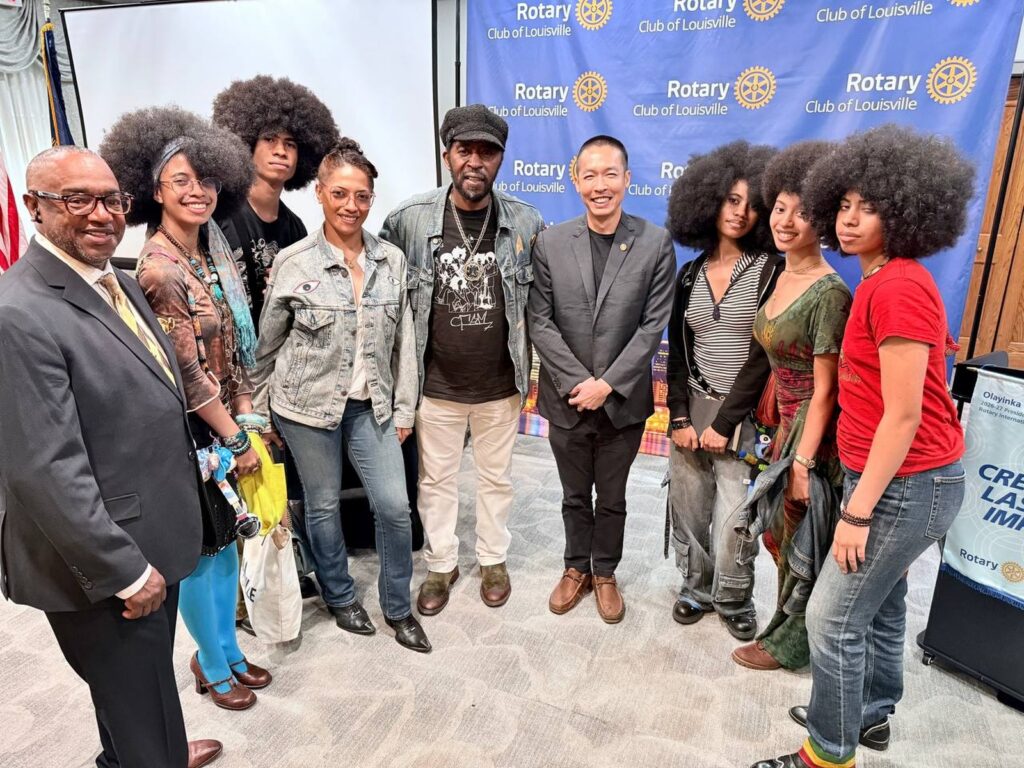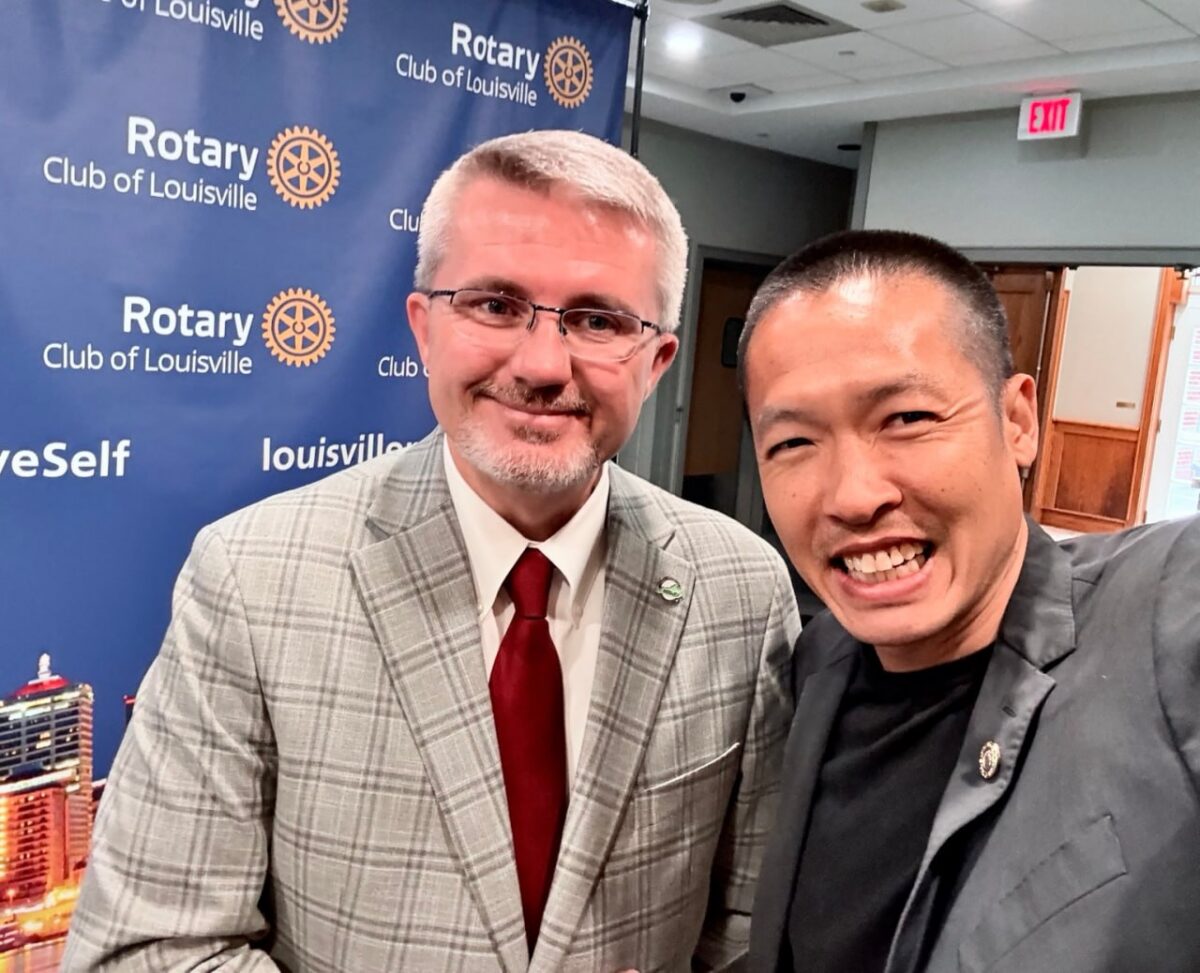
Louisville witnessed more than a luncheon on July 30, 2026. It witnessed a public education moment.
At the Rotary Club of Louisville, Dr. Robbie Fletcher, Kentucky Commissioner of Education, spoke under the theme “More Than a Test Score, More Than a Color.” The message reached far beyond one meeting, one law, or one school system. It spoke to the moment we are all living through: a moment when Kentucky, America, and the world must rethink what education is for.
Education is changing for good because life itself has changed.
For too long, education has often been treated as a fixed system: a child enters, the system measures, the system labels, the person moves forward or falls behind. But that old mental model is breaking. Automation is changing work. Artificial intelligence is changing information. Transparency is changing public trust. Families are questioning cost and value. Students are asking for meaning. Adults are returning to learning. Employers are asking for proof of ability. Communities are demanding real outcomes.
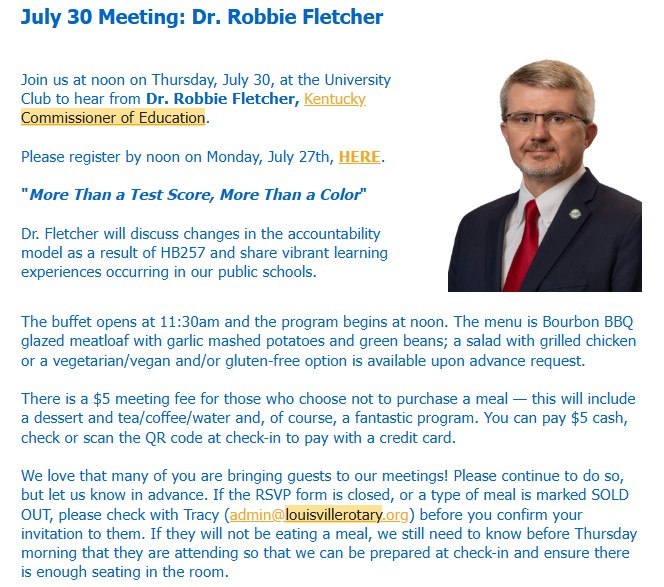
Rotary Club of Louisville July 30, 2026 meeting notice for Dr. Robbie Fletcher, Kentucky Commissioner of Education.
The Question of This Era
Education can no longer be only about testing. It cannot be only about institutional reputation. It cannot be only about one pathway, one credential, one gatekeeper, or one narrow definition of success.
The new question is more powerful: does education help a human being become capable, documented, adaptable, employable, ethical, licensed where required, trusted by the public, and ready to keep learning for life?
That is the question of this era.
A Statewide Leader at a Statewide Turning Point
Dr. Fletcher’s role gives this conversation statewide importance. According to the Kentucky Department of Education, Robbie Fletcher, Ed.D., was named Commissioner of Education by the Kentucky Board of Education on March 21, 2024, and began serving on July 1, 2024, after approval by the Kentucky Senate. His work now stands inside Kentucky’s movement to reimagine assessment and accountability, including the direction connected to House Bill 257 and the broader “United We Learn” vision.
The Rotary Club of Louisville described Dr. Fletcher’s July 30 presentation as a discussion of changes to Kentucky’s accountability model and the vibrant learning experiences taking place in public schools. That phrase matters: vibrant learning. It suggests that education must be alive. It must connect with curiosity, community, skill, service, career readiness, and the real development of the whole person.
Di Tran’s Education Doctrine: People Are Becoming
For Di Tran, Founder & Chancellor of Di Tran University and Louisville Beauty Academy, this moment speaks directly to the heart of his life’s work: humanization through education. Di Tran’s educational philosophy has long centered on a simple but powerful belief: people are not numbers; people are becoming.
A student is not only a transcript. An adult learner is not only a late start. A licensed worker is not only a trade. An immigrant is not only a language barrier. A small-business owner is not only an economic statistic.
Each person is a human being with capacity, dignity, story, skill, and future.
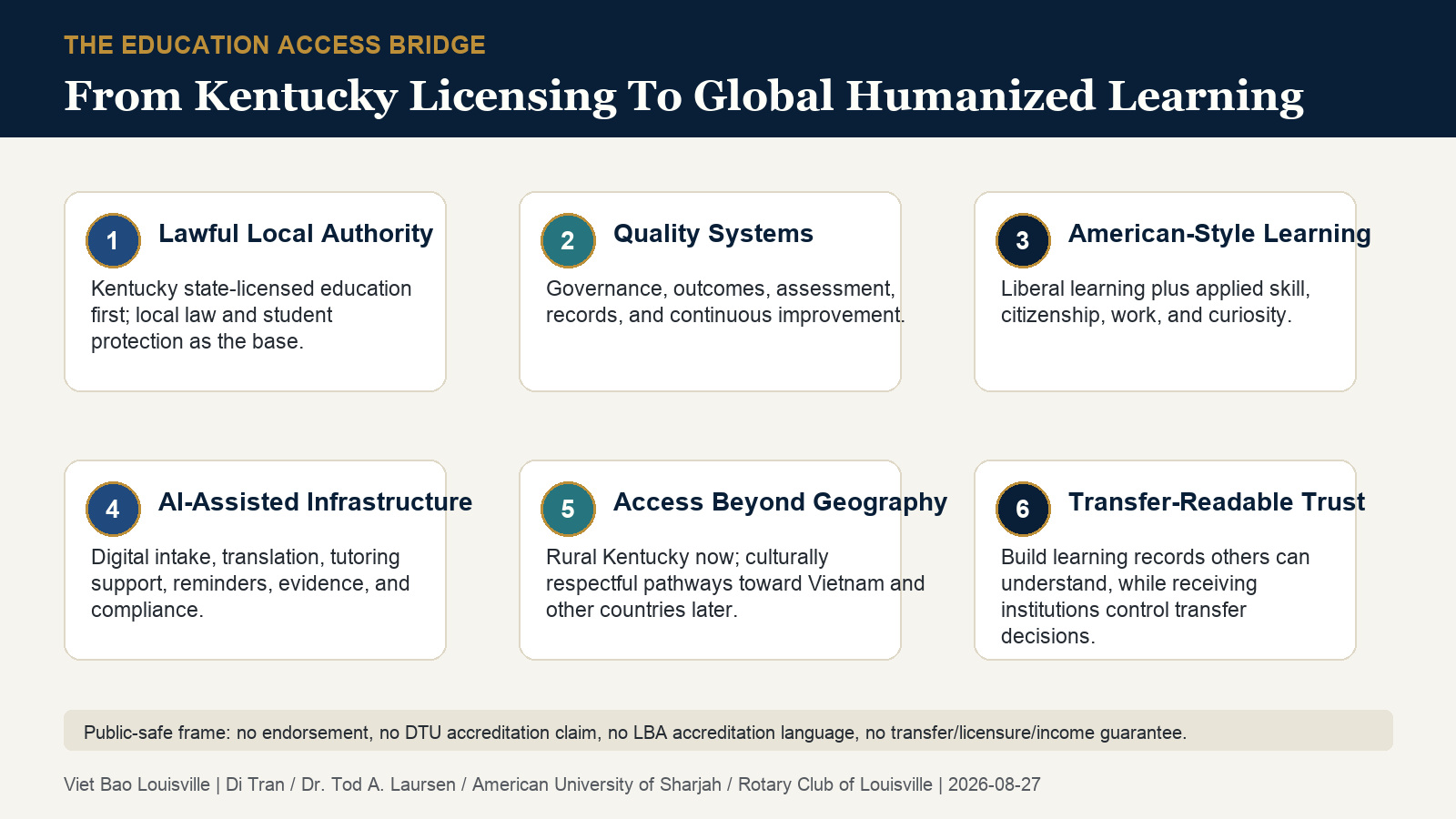
That is why public education, adult education, workforce development, licensing education, entrepreneurship, and lifelong learning should not be separated into disconnected boxes. They are one human-development system.
Visual Explainer
From Institution-Centered Education to Human-Centered Education
Old question: Who controls the gate?
New question: What does the learner need, what can the learner prove, what support is missing, what pathway is lawful, and what outcome is real?
The future: human focus, individual pathways, adult dignity, transparent documentation, licensed readiness, lifelong learning, workforce development, and public trust.
Workforce Development Is Education Made Practical
A child in public school needs direction before adulthood. A high school student needs career exploration before debt. A working adult needs a respectful way back into learning. A New American needs language, documentation, navigation, and trust. A parent needs flexibility. A future entrepreneur needs practical skill plus compliance. A licensed professional needs law, safety, sanitation, service, discipline, and public responsibility.
This is the true meaning of workforce development.
Workforce development is not just job placement. Workforce development is education made practical. It is the bridge between learning and livelihood. It is the process by which a person becomes ready to contribute with skill, confidence, documentation, and dignity.
Kentucky Adult Education already shows this wider purpose through GED preparation, English as a second language, transition to postsecondary education, workforce education, certifications, family literacy, and corrections education. These are not side programs. They are public evidence that education continues beyond childhood. They are evidence that a person’s future can reopen.
Louisville Beauty Academy as Local Proof of Adult Workforce Education
Louisville Beauty Academy stands as a local proof point in that same story. As a Kentucky state-licensed, national award-winning beauty college, LBA serves many students who are adults, working families, immigrants, career changers, and future small-business owners. In beauty education, learning is immediate and accountable. Students must learn practical skill, law, sanitation, safety, client care, documentation, attendance discipline, professionalism, and licensing readiness.
That is education with public consequence.
A beauty license can change the legal and economic identity of a person. It can move a worker from informal labor into lawful professional work. It can give a parent a flexible career pathway. It can help a New American stand visibly in the economy. It can support small-business creation. It can turn training into service, service into trust, and trust into opportunity.
This is why licensed adult education belongs in the same conversation as public education reform. It is where the promise of learning becomes visible in adult life.
The AI Era Makes Education More Human, Not Less
The AI era makes this even more urgent.
The U.S. Department of Education’s report on artificial intelligence and the future of teaching and learning recognizes that AI is rapidly entering educational technology and public life. The World Economic Forum’s Future of Jobs Report 2025 describes major workforce transformation driven by technology, AI, data, and changing skill demands. The OECD has emphasized the importance of skills, lifelong learning, and adaptation in the AI age.
The lesson is not that machines replace education. The lesson is that education must become more deeply human because machines are becoming more capable.
AI can produce information. It cannot produce character. Automation can speed up tasks. It cannot give a person purpose. Data can expose performance. It cannot restore confidence to an adult who believed it was too late. Technology can make learning more accessible. It cannot replace the dignity of a teacher, mentor, employer, school, civic club, or community that sees the person behind the file.
The future will not belong only to people with degrees. It will belong to people who can learn, document, adapt, communicate, serve, build, repair, create, comply, lead, and keep growing.
Multiple Pathways Deserve Respect
College matters. Career and technical education matters. Skilled trades matter. Licensed professions matter. Adult education matters. English-language learning matters. Entrepreneurship matters. Public service matters. Community-based training matters. Every honorable pathway that helps a person become more capable deserves respect.
The old system too often asked: who controls the gate?
The new education system must ask: what does the learner need, what can the learner prove, what support is missing, what pathway is lawful, what outcome is real, and how can the community help the person move forward?
This is the shift from institution-centered education to human-centered education.
Rotary as Civic Learning
That is also why the Rotary Club of Louisville matters. A Rotary lunch is not merely a social event. At its best, it is civic learning. It is a room where public leaders, business owners, educators, nonprofit builders, and community members quietly build the brain of the city. No time is wasted when the room is learning. No meeting is small when the speaker carries a statewide mission and the audience carries local responsibility.
Viet Bao Louisville extends sincere appreciation to the Rotary Club of Louisville for once again hosting a meaningful, beautiful, and intellectually valuable gathering. It offered Louisville another chance to learn from someone representing a major public responsibility for the Commonwealth of Kentucky.
Dr. Fletcher’s message matters because education policy is not abstract. It affects children, teachers, families, taxpayers, employers, adult learners, and the workforce future of Kentucky. Di Tran’s presence matters because the conversation must not remain only at the policy level. It must reach the real places where learners become workers, workers become licensed professionals, and licensed professionals become small-business contributors.
This is where Di Tran University, Louisville Beauty Academy, and Viet Bao Louisville carry a shared public mission: to elevate education as human development, to honor workforce dignity, to document useful learning, and to show that community education can be both practical and beautiful.
Education for the Human Age
The future of education is not cold automation. It is not blind tradition. It is not prestige without proof. It is not testing without purpose.
The future of education is human focus.
Individual focus.
Multiple pathways.
Transparent documentation.
Lifelong learning.
Adult dignity.
Licensed readiness.
Workforce development.
Public trust.
That is education for the AI age.
That is workforce development for the human age.
That is Kentucky education changing for good.
And in Louisville, at the Rotary Club of Louisville, that message found a worthy room, a worthy speaker, and a worthy moment.
Editorial note: This article is a Viet Bao Louisville civic and education reflection. It does not state or imply an endorsement, partnership, or official position by the Kentucky Department of Education, Dr. Robbie Fletcher, or the Rotary Club of Louisville.
AMERICA AT 250 | LOUISVILLE | SERVICE | MEMORY | AI
Standing on the Shoulders of Giants: Di Tran Learns at Louisville’s 114-Year-Old Rotary Club
The 45th Rotary Club in the World – as SAR Tells the Future of America’s Story
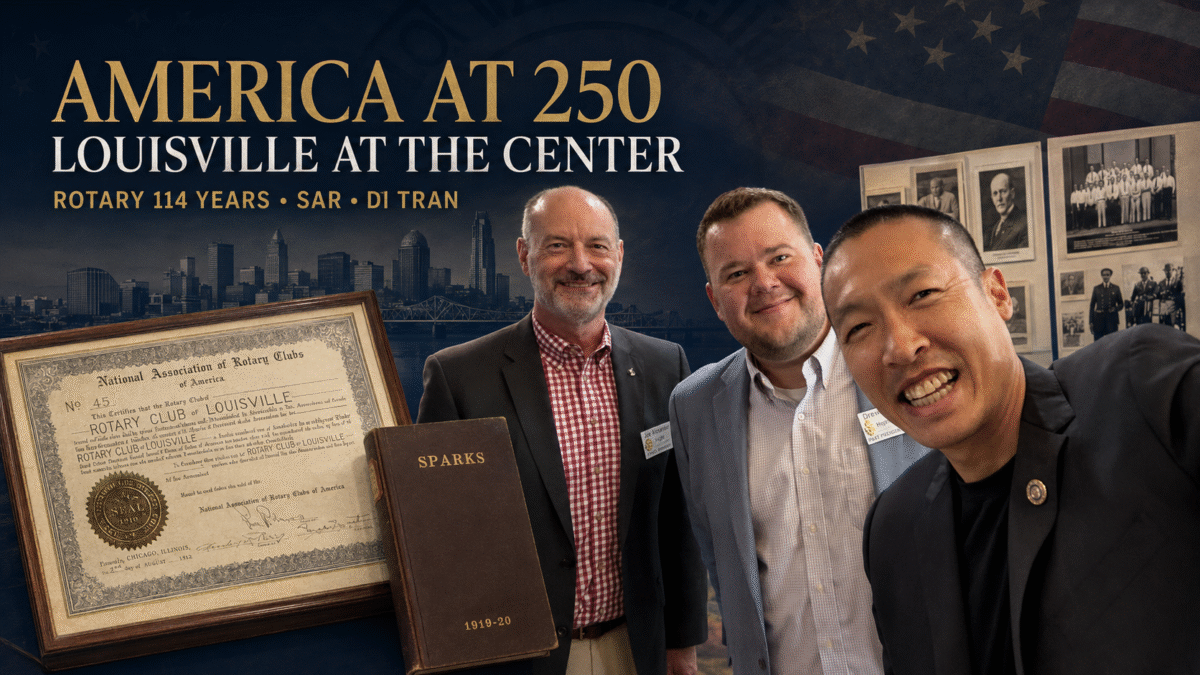
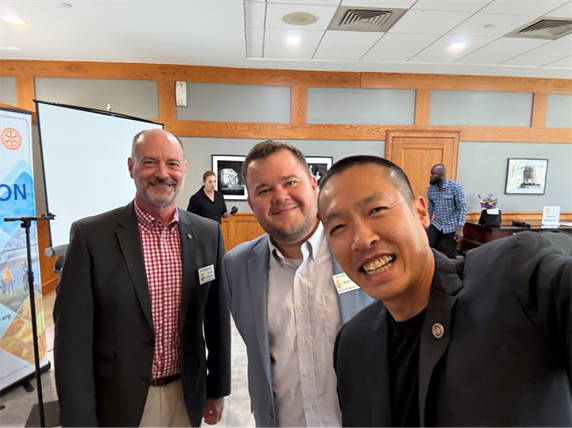
Di Tran with Joe Alexander and Drew Hight following the July 23, 2026 SAR presentation at the Rotary Club of Louisville.
A first-person civic reflection by Di Tran
Rotary Club of Louisville | University Club of Louisville | July 23, 2026
A Lunch, a Charter, and a Century of Pages
At lunch today, I sat inside the University Club of Louisville surrounded by business, professional, educational, and civic leaders. I have been a member of the Rotary Club of Louisville since 2019, yet I still enter these meetings as a student. Every chair can hold a teacher. Every conversation can reveal another layer of the city. Every preserved record can remind us that the institutions we inherit were built through years of work that most of us never witnessed.
The program was called “The SAR and the Future of America’s Story.” Joe Alexander, MPA, Interim Director of the SAR Education Center and Museum, and Drew Hight, Marketing and Public Relations Manager for the National Society of the Sons of the American Revolution, spoke about Revolutionary memory, education, national impact, and the developing museum on Louisville’s Museum Row. [1]
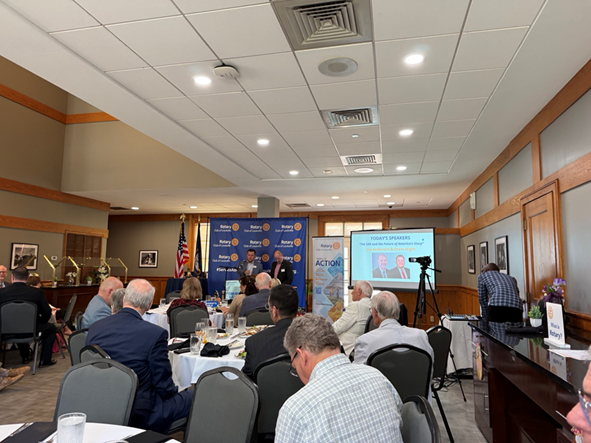
The July 23 luncheon at the University Club of Louisville as Joe Alexander and Drew Hight prepare to present “The SAR and the Future of America’s Story.”
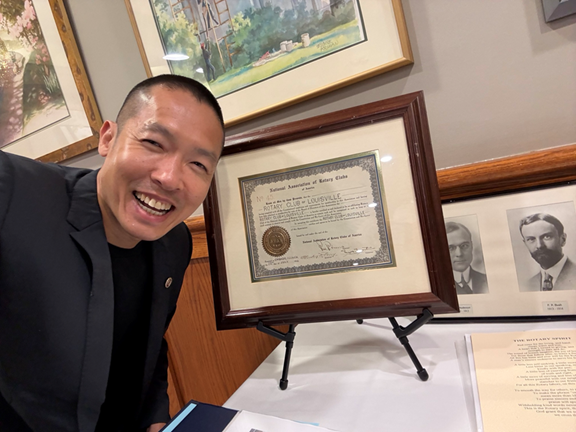
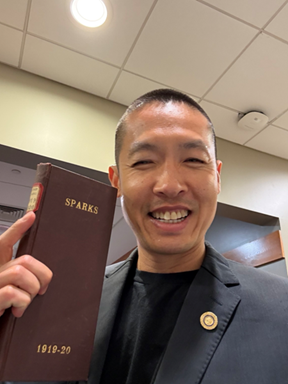
Then the afternoon became more personal. I stood beside the displayed 1912 Louisville Rotary charter. I saw portraits of Paul Harris and Louisville’s early club leaders. I examined rosters, correspondence, photographs, and annual records. Most strikingly, I held a hardbound volume marked SPARKS 1919-20. Its cloth cover, gold letters, aging paper, and carefully preserved pages made time feel physical.
In one hand was a century-old communication archive. In my pocket was a smartphone capable of reaching the world. Between those two objects was the entire transformation of modern communication – from print and physical delivery to websites, social platforms, multimedia, automation, and artificial intelligence.
The technology changed almost beyond recognition. The human purpose did not: connect people, share knowledge, preserve memory, strengthen relationships, and inspire action.
A Vietnamese American Living the Continuing American Story
I am a Vietnamese American immigrant. I am Vietnamese by heritage and American through citizenship, gratitude, responsibility, work, and daily contribution. I celebrate American freedom not only on holidays and not only through words. I celebrate it by using it.
Freedom gives me room to learn, build, teach, write, create businesses, develop educational opportunities, help people pursue occupational licenses, and share knowledge. Through Louisville Beauty Academy, Di Tran University, and other community work, I try to convert freedom into useful action. Opportunity is a gift, but a gift becomes meaningful when it produces value for someone beyond oneself.
I do not claim a documented Revolutionary Patriot bloodline. I may not descend from the Patriots remembered by SAR. But I live inside the freedom their sacrifices helped establish. That freedom gives me more than opportunity; it gives me responsibility.
Ancestry tells one kind of American story. Service, citizenship, responsibility, and contribution write the next chapter.
That is why today’s presentation moved me. I was not looking at history as something owned only by descendants. I was looking at an inheritance of institutions and ideals that every generation must either strengthen or neglect. My duty is not to pretend that I created the platform beneath me. My duty is to understand it, honor what is worthy, improve what remains incomplete, and add one useful layer for the next person.
America at 250: A Young Nation on Ancient Land
On July 4, 2026, the United States marked 250 years since the adoption of the Declaration of Independence. The Declaration announced the colonies’ separation from Great Britain and articulated ideals of equality, unalienable rights, consent, and liberty. The Constitution came later. Signed in 1787, it established the federal framework intended to form “a more perfect Union.” Independence and the Constitution belong to the same founding story, but they are not the same event. [8][9]
The United States is therefore only 250 years old as an independent nation – young compared with many civilizations. In that sense, America is still a young nation, still learning, still correcting, still extending its promise, and still being written by each generation.
But the land is not 250 years old, and human history here did not begin in 1776. Indigenous peoples and sovereign Native nations lived throughout the Americas for thousands of years before European arrival. They possessed complex governments, cultures, economies, languages, spiritual traditions, and relationships to the land. Any honest celebration of America must begin with that truth. [10]
Christopher Columbus reached the Caribbean in 1492 and encountered established Indigenous peoples, including the Taino. He remained convinced that he had reached lands associated with Asia. That misunderstanding helped produce European labels such as “Indian,” but Columbus was not the founder of the United States and did not discover an empty continent. Careful language matters because dignity and historical accuracy matter. [11]
America Is a Fabric Woven Through Many Kinds of Arrival
It is tempting to say that everyone in America is an immigrant. The spirit behind that statement is unity, but the literal history is more complicated. Indigenous peoples are the first peoples of these lands. Many later people arrived voluntarily as settlers or immigrants. Many Africans were transported forcibly through slavery and were not voluntary immigrants. Refugees came seeking safety. Some communities became part of the United States through territorial expansion rather than by crossing a modern border. Millions were born here while carrying family histories rooted elsewhere.
A more accurate unity is this: not every American is an immigrant, but nearly every American story is connected to a larger history of movement, inheritance, survival, encounter, sacrifice, and contribution.
Unity does not require us to flatten those histories into sameness. Unity asks us to face them honestly and then decide what responsibility we share now. A true American is not defined only by where an ancestor stood. A true American protects freedom, respects human dignity, works, serves, contributes, and helps leave the nation stronger, freer, more beautiful, and more humane.
SAR: Lineage Joined to Education and Service
The National Society of the Sons of the American Revolution is about the American Revolution and the War for Independence – not the Civil War. Founded in 1889, SAR is a nonprofit, nonpartisan, congressionally chartered lineage society devoted to patriotism, historical preservation, education, genealogy, and service. Its congressional purposes include preserving the memory and records of Revolutionary service, encouraging research, protecting landmarks, and fostering American freedom. [4][5]
Membership belongs to men who can document direct bloodline descent, through either side of the family, from an ancestor who performed recognized service supporting the cause of American independence. The ancestor did not necessarily have to be a soldier. Qualifying service can include military, civil, financial, logistical, political, or other documented support. A qualifying Patriot ancestor can be a man or a woman. [6]
This is the key line: SAR members living today are direct descendants of people who helped America become an independent nation.
In its America250 partnership announcement, SAR reported nearly 600 chapters and approximately 38,000 members. Its national headquarters and Genealogical Research Library stand at 809 West Main Street in Louisville. The organization moved its national headquarters to Louisville in 1979. Its developing Education Center and Museum is intended to expand access for students, educators, researchers, visitors, and the public. [4][7][13]
That makes Louisville more than the site of a local historical organization. Louisville is the national home from which this Revolutionary history is researched, protected, interpreted, and shared.
Louisville Does Not Merely Observe the National Story
Louisville often introduces itself through the Kentucky Derby, bourbon, Muhammad Ali, manufacturing, medicine, food, and the Ohio River. Today’s luncheon revealed another identity: Louisville as a keeper and distributor of national memory.
The SAR national headquarters, research library, and developing Education Center and Museum give Louisville a direct role in America’s 250th anniversary and the continuing interpretation of the founding era. At the same time, the Rotary Club of Louisville connects local leaders to a global service movement.
Louisville does not merely preserve local history. From Louisville, American history is preserved and shared with the nation.
Rotary Club No. 45: One of the Movement’s Earliest Clubs
Rotary began in Chicago in 1905 under the leadership of attorney Paul P. Harris, who imagined fellowship among professionals and businesspeople that could grow into service. Rotary International today describes a global network of more than 1.2 million people connected through more than 45,000 clubs in almost every country. [3]
Louisville entered that movement very early. In late 1911, Truman McGill, C.H. Hamilton, and Frank B. Jones independently contacted Rotary headquarters after learning about the organization. With encouragement from Rotary founder Paul Harris and General Secretary Chesley Perry, local organizers gathered leaders, drafted bylaws, recruited members, and prepared an application. Lawrence L. Anderson became the first club president. [2]
The original charter is dated July 23, 1912. The club’s history records that the charter arrived July 24 and that a Charter Day meeting followed July 26. With 38 charter members, the Rotary Club of Louisville became the 45th Rotary club in the world. July 23, 2026 therefore marked 114 years from the charter date. [2]
Di Tran beside the Rotary Club of Louisville’s historic 1912 charter, identifying Louisville as Rotary Club No. 45.
Today the club describes itself as having almost 400 members and being the 12th largest among Rotary International’s 45,000-plus clubs. Those rankings can change, but the club’s present scale and its 114-year continuity are remarkable. [1]
The exhibit did not show that every Rotary founder was physically present in Louisville. It showed the founder of Rotary International, Paul Harris, alongside Louisville’s local pioneers, early presidents, charter members, correspondence, and institutional records. That distinction matters. Global movements need founders, but they also need local builders willing to turn an idea into a durable institution.
SPARKS: A Social Network Before Scheduled Commercial Radio
The object that connected everything for me was SPARKS. The Rotary Club of Louisville published its first issue in September 1913 as a biweekly bulletin. Its purpose was relationship: helping each Rotarian know other members by face, name, profession, and business. Issues carried sketches of members and their work, club information, civic concerns, and the communication necessary to hold a growing organization together. [2]
Di Tran holds a bound SPARKS volume from 1919-1920, an annual archive of the Rotary Club of Louisville’s early communication system.
SPARKS later became weekly in 1927, and by 1929 issues could contain 12 or more pages. During the Great Depression, leaders considered canceling it because of financial pressure. Instead, they reduced pages and required advertising to cover publication costs. The hardbound volumes displayed today appear to be annual archival collections of separate issues, not evidence that every issue was individually distributed as an expensive hardcover. [2]
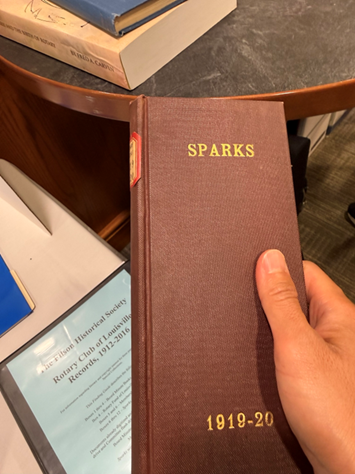
Close view of the bound SPARKS 1919-1920 archival volume.
The timeline is astonishing. SPARKS began in 1913. The first scheduled commercial radio broadcast generally recognized by the Federal Communications Commission occurred on November 2, 1920, when KDKA transmitted presidential election returns from Pittsburgh. Experimental wireless technology existed earlier, so it would be inaccurate to say SPARKS came before all radio. But SPARKS circulated seven years before regular scheduled commercial broadcasting. [12]
Before radio broadcasting, television, computers, email, search engines, websites, social media, smartphones, and artificial intelligence, Louisville Rotarians built a professional and civic information network using ink, paper, type, printing, and physical distribution.
SPARKS was a bulletin, a business directory, a community record, a relationship platform, and a physical social network.
From Ink and Paper to Algorithms and Automation
The comparison immediately reached into my daily life. Today I use artificial intelligence to conduct deep research, organize complex information, draft and refine articles, and transform knowledge into different formats. A single researched idea can become a complete article, a short post, a photograph with a caption, a graphic, a video, an audio program, or an educational resource.
My websites can function as long-term archives. Automation can distribute material across multiple social-media channels. Text, image, audio, and video can travel almost instantly to readers far beyond Louisville. Work that once required separate teams, printing equipment, physical delivery, and days or weeks of effort can now be accelerated dramatically.
The progression is almost unbelievable: SPARKS to radio; radio to television; television to websites; websites to search and social media; social media to smartphones; smartphones to generative AI and automated multimedia distribution.
But speed is not wisdom. Automation is not conscience. The machine can accelerate research and distribution, but the human being remains responsible for truth, context, dignity, purpose, and consequences. I believe AI should increase human capacity without removing human review.
In that sense, what I am building today is not disconnected from SPARKS. It is a modern continuation of the same communication spirit: learn who people are, understand their work, share useful information, strengthen relationships, document service, and move a community toward action.
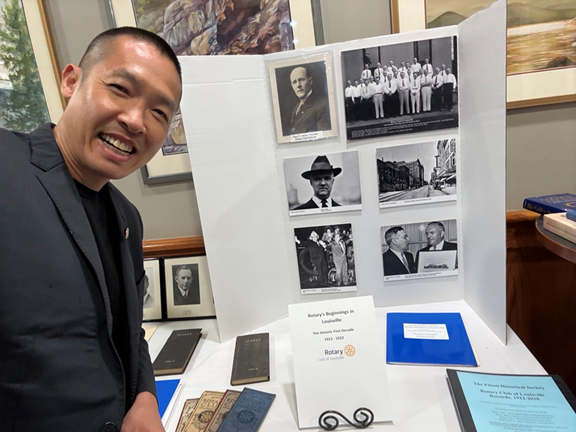
Di Tran with the exhibit “Rotary’s Beginnings in Louisville: The Historic First Decade, 1912-1922.”
Distribution Wins Attention; Preservation Earns Meaning
The century-old volume in my hands also delivered a warning. Social-media posts can disappear into feeds, changing algorithms, closed accounts, or lost platforms. What feels permanent today can become inaccessible tomorrow.
SPARKS survived because people preserved it. Someone gathered the issues. Someone bound them. Someone labeled the years. Someone protected the volumes. Someone eventually placed them where another generation could discover them.
That is why websites should serve as canonical archives, not merely promotional pages. Social media can distribute and invite. AI can accelerate research and adaptation. But important photographs, documents, dates, citations, and stories must be preserved in durable, searchable systems.
Distribution wins attention today. Preservation earns meaning across generations.
Freedom Is Not Free – and It Is Never Finished
Freedom is not free. The Revolutionary generation paid for independence through courage, risk, labor, loss, military service, civil service, material support, and sacrifice. Later generations struggled over slavery, emancipation, citizenship, voting, civil rights, labor, education, equality, and the meaning of the Constitution.
To love America honestly is not to pretend that every chapter was perfect. Love without truth becomes mythology. Criticism without gratitude becomes emptiness. Responsible patriotism can hold gratitude and honesty together: appreciation for the ideals, recognition of the failures, and determination to help form a more perfect Union.
Freedom survives through institutions, laws, education, service, democratic participation, economic opportunity, and the character of ordinary people. It must be practiced. It must be protected. It must be extended. It must be made useful in the life of another human being.
For me, that practice is daily. Work hard. Learn. Build. Teach. Serve. Create an opportunity. Help someone gain a skill or license. Preserve a story. Use technology responsibly. Add value. Elevate one life at a time.
Standing on the Shoulders of a Giant Family
I often think of the people before us as a giant family. The giants are not only famous founders whose portraits hang on a display. They include Indigenous knowledge keepers, Revolutionary Patriots, Constitution builders, abolitionists, educators, veterans, civil-rights leaders, immigrants, refugees, workers, entrepreneurs, scientists, archivists, parents, civic volunteers, and ordinary people who served without receiving public recognition.
Standing on their shoulders does not mean worshiping the past or pretending earlier generations were flawless. It means learning from what they built, correcting what they got wrong, protecting what remains valuable, and creating a stronger platform for those who come next.
I am not the giant. I am a student standing on what giants before me built. My responsibility is to add one useful layer so the next person can stand higher.
SAR preserves documented service that helped create independence. Rotary converts fellowship into organized service. SPARKS preserved relationships and civic memory. Louisville provides a home where local work meets national history. Immigrants and later generations continue building upon inherited freedom. AI gives us extraordinary tools to research, create, preserve, and distribute. None of these matters without human responsibility.
What I Carried Home
I left the luncheon without taking a historical artifact. Those objects belong to the institution and to the public memory they protect. But I carried away something heavier: responsibility.
I looked at the SPARKS volume, and then at the smartphone in my hand. One preserved a civic network through ink and paper. The other can reach the world within seconds. Both depend on the intention and character of the person using them.
Today, America is 250 years old as an independent nation. The Rotary Club of Louisville is 114 years old, chartered as the 45th club in a movement that now spans more than 45,000 clubs. SAR’s national headquarters in Louisville preserves the documented lineage and sacrifice behind American independence. And I, a Vietnamese American immigrant, am blessed to sit among these histories, learn from them, and contribute my daily work to the continuing American story.
We are not here merely to inherit freedom. We are here to make freedom fruitful. We are here to elevate one another through work, learning, service, courage, and daily value creation. We are here to stand on the shoulders of giants – and then become a steady shoulder for someone else.
YES I CAN -> I HAVE DONE IT -> YES, YOU WILL. Elevate one life at a time.
Fact Box: A Timeline Connecting the Day
Year
Milestone
1492
Columbus reached the Caribbean and encountered established Indigenous peoples, including the Taino; he believed he had reached lands associated with Asia.
1776
The Declaration of Independence was adopted on July 4.
1787
The U.S. Constitution was signed on September 17, establishing the federal framework.
1889
The National Society of the Sons of the American Revolution was founded.
1905
Paul P. Harris founded Rotary in Chicago.
1912
The Rotary Club of Louisville received Charter No. 45, dated July 23, with 38 charter members.
1913
The first issue of the Louisville club’s biweekly SPARKS bulletin appeared in September.
1920
KDKA transmitted the first scheduled commercial radio broadcast generally recognized by the FCC on November 2.
1979
SAR moved its national headquarters to Louisville.
2026
America marked 250 years since the Declaration; the Louisville club marked 114 years; Joe Alexander and Drew Hight presented “The SAR and the Future of America’s Story.”
Photograph Captions and Accessibility Alt Text
1. 0F1C55EF…jpeg / BFD83B54…jpeg
Caption: Di Tran with Joe Alexander and Drew Hight following the July 23, 2026 SAR presentation at the Rotary Club of Louisville.
Alt text: Joe Alexander and Drew Hight stand with Di Tran after the SAR presentation at the Rotary Club of Louisville.
Publishing note: The BFD file is an exact duplicate of the 0F1 file; publish only one.
2. 76733F5D…jpeg
Caption: The July 23 Rotary Club of Louisville luncheon as Joe Alexander and Drew Hight prepare to present “The SAR and the Future of America’s Story.”
Alt text: Rotary members seated at luncheon tables while the SAR program appears on a presentation screen.
3. 0BEF3C2D…jpeg
Caption: Di Tran holds a bound SPARKS volume from 1919-1920, connecting Louisville Rotary’s early print network with today’s AI-powered communication.
Alt text: Di Tran smiles while holding a brown hardbound volume labeled SPARKS 1919-20.
4. 68D3E0E0…jpeg
Caption: A close view of the preserved SPARKS 1919-1920 annual volume.
Alt text: A brown clothbound book with gold lettering reading SPARKS 1919-20.
5. D661902E…jpeg
Caption: Di Tran explores “Rotary’s Beginnings in Louisville: The Historic First Decade, 1912-1922.”
Alt text: Di Tran stands beside an exhibit containing Paul Harris, Louisville Rotary photographs, early books, and archival records.
6. 13615760…jpeg
Caption: Early Rotary Club of Louisville membership rosters preserve the names and professional network of the club’s first decade.
Alt text: Four narrow early Rotary Club of Louisville roster booklets dated between 1918 and 1922.
7. 61A87CE4…jpeg
Caption: Portraits of early Louisville Rotary presidents displayed with a 1916-1917 SPARKS volume and the poem “The Rotary Spirit.”
Alt text: Four framed portraits of early Rotary leaders above a historical poem and a black SPARKS 1916-17 volume.
8. 16D1A1F9…jpeg
Caption: Di Tran beside the Rotary Club of Louisville’s historic 1912 charter, identifying Louisville as Rotary Club No. 45.
Alt text: Di Tran smiles beside the framed 1912 Rotary Club of Louisville charter displayed on an easel.
9. 307B35C2…jpeg
Caption: Typewritten correspondence and archival records reveal the manual labor behind early institutional communication.
Alt text: A collection of preserved typewritten pages and letters displayed in archival sleeves beside Rotary history materials.
10. 95cf2281…png
Caption: Rotary Club of Louisville announcement for the July 23 presentation by Joe Alexander and Drew Hight.
Alt text: Meeting announcement showing Joe Alexander, Drew Hight, and the program title “The SAR and the Future of America’s Story.”
11. 2745b8e5…png
Caption: The club’s July 23 anniversary notice recognizing the 1912 charter and Louisville’s place as Rotary Club No. 45.
Alt text: Anniversary notice beside an image of the Rotary Club of Louisville’s 1912 charter.
12. unnamed (25).png
Caption: Full view of the Rotary Club of Louisville charter dated July 23, 1912.
Alt text: Scanned historical charter for Rotary Club of Louisville, numbered 45 and dated July 23, 1912.
Publication and SEO Package
Five Alternative Titles
Before Radio, There Was SPARKS: Di Tran Connects 114 Years of Louisville Rotary, SAR, and the AI Age
America at 250, Louisville at the Center: A Vietnamese American Learns from Rotary No. 45 and SAR
From SPARKS to Artificial Intelligence: Di Tran Reflects on Freedom, Service, and Louisville’s National Story
Rotary No. 45 Meets America250: Di Tran on SAR, Immigration, Archives, and Daily Contribution
A Century of Service and Storytelling: Di Tran Stands on the Shoulders of Louisville’s Civic Giants
Refined Subtitle
At a July 23 luncheon, a Vietnamese American immigrant connects America at 250, Louisville’s national importance, Revolutionary memory, 114 years of Rotary service, SPARKS before radio, and AI-powered storytelling today.
SEO Metadata
Field
Recommended Text
Meta description
Di Tran connects SAR, America250, Louisville Rotary’s 114-year history, SPARKS before radio, immigration, service, and AI storytelling.
University Club of Louisville, Louisville, Kentucky
Article Excerpt
At a July 23 luncheon of the Rotary Club of Louisville, Di Tran encountered three histories at once: America celebrating 250 years of independence, the National Society of the Sons of the American Revolution preserving the founding story from its Louisville headquarters, and one of Rotary’s earliest clubs marking 114 years since becoming Rotary Club No. 45. Holding a bound SPARKS volume from 1919-1920, Tran recognized an unexpected connection to his own daily use of artificial intelligence, websites, multimedia, and automated social distribution. SPARKS began in 1913 – seven years before scheduled commercial radio – as Louisville Rotary’s printed relationship and civic-information network. For Tran, a Vietnamese American immigrant, the moment became more than nostalgia. It became a meditation on freedom, ancestry, service, archives, and responsibility. We do not honor inherited freedom by merely consuming it, he argues, but by making it fruitful through work, learning, contribution, and the elevation of others.
SEO Keywords
Di Tran Rotary Club of Louisville
Rotary Club of Louisville 114 years
45th Rotary club in the world
Sons of the American Revolution Louisville
SAR Education Center and Museum
America250 Louisville Kentucky
SPARKS Rotary newsletter 1913
Vietnamese American civic leadership
AI research and automated publishing
Louisville Museum Row American history
Facebook Post – Under 1,500 Characters
STANDING ON THE SHOULDERS OF GIANTS
Today at the Rotary Club of Louisville, I learned from Joe Alexander and Drew Hight of the National Society of the Sons of the American Revolution.
America is only 250 years old as an independent nation. SAR preserves the stories of Patriots who supported the fight for independence, and its national headquarters is here in Louisville.
Today also marked 114 years since the Rotary Club of Louisville’s 1912 charter. Louisville became Rotary Club No. 45 in the world and is now identified as the 12th largest among 45,000+ clubs.
The most powerful moment was holding a bound SPARKS volume from 1919-1920. SPARKS began in 1913 – before scheduled commercial radio – to connect members, share ideas, and document service.
Today, I use AI for deep research, writing, websites, pictures, video, text, and automated distribution. The technology changed, but the purpose remains: connect people, preserve knowledge, and inspire action.
As a Vietnamese American immigrant, I may not descend from Revolutionary Patriots, but I benefit from the freedom they helped establish. My responsibility is to honor it through daily work, service, and contribution.
We stand on the shoulders of giants so we can become a shoulder for someone else.
Today brought together 250 years of American independence, 114 years of Louisville Rotary history, and the future of AI-powered communication.
At the Rotary Club of Louisville, Joe Alexander and Drew Hight presented “The SAR and the Future of America’s Story.” SAR honors documented descendants of those who supported American independence, and its national headquarters and Genealogical Research Library are located on Louisville’s Museum Row.
The same day marked 114 years from the Louisville club’s July 23, 1912 charter. It became Rotary Club No. 45 in the world and today describes itself as the 12th largest among Rotary International’s 45,000+ clubs.
I held a bound SPARKS volume from 1919-1920. SPARKS began in 1913 as the club’s biweekly bulletin – seven years before scheduled commercial radio. It connected people, explained businesses, documented service, and preserved institutional memory.
Today I use AI for deep research, long-form writing, multimedia creation, website publication, and automated social distribution. The tools are different, but the purpose is familiar: connect people, share knowledge, preserve history, and move communities toward action.
As a Vietnamese American immigrant, I do not claim a Revolutionary bloodline. I do claim the responsibility to make inherited freedom fruitful through work, education, service, and daily value creation.
Standing on the shoulders of giants means adding one useful layer so the next person can stand higher.
X Post – 280 Characters
At Louisville Rotary – chartered in 1912 as the world’s 45th club – I held SPARKS, its print network launched in 1913 before commercial radio. Today I use AI to research, publish and share. Tools change; the duty remains: learn, serve, preserve and elevate.
Instagram Caption
From SPARKS in 1913 to AI in 2026.
Today I learned about SAR, America at 250, and 114 years of the Rotary Club of Louisville – the 45th Rotary club chartered in the world.
The technology changes. The responsibility does not: learn, preserve, serve, contribute, and elevate others.
Di Tran reflects on a remarkable July 23, 2026 luncheon at the Rotary Club of Louisville. The day connected the SAR presentation “The SAR and the Future of America’s Story,” America250, Louisville’s role as SAR’s national headquarters, the Louisville club’s 114-year history as Rotary Club No. 45, and the early SPARKS bulletin launched in 1913 before scheduled commercial radio. Tran compares that physical civic network with today’s AI-assisted research, writing, websites, multimedia production, and automated distribution – asking what technology means without human truth, service, preservation, and responsibility.
Fact-Checking Note
The Rotary Club of Louisville’s website currently states that the club has almost 400 members and is the 12th largest among Rotary International’s 45,000+ clubs. Because rankings and membership counts change, the article attributes this claim to the club.
The charter displayed is dated July 23, 1912. The club history separately records arrival of the charter on July 24 and a Charter Day meeting on July 26.
SAR’s nearly 600 chapters and approximately 38,000 members are figures reported in its February 2025 America250 partnership announcement.
The SAR Education Center and Museum is described as developing or upcoming because the July 23, 2026 Rotary program used that framing. No unverified opening claim is made.
SPARKS began in 1913 before scheduled commercial radio broadcasting. Experimental wireless and radio transmissions existed earlier; the article does not claim otherwise.
The hardbound SPARKS volumes appear to be annual archival bindings of multiple issues. The article does not claim that each bulletin was distributed as a hardcover.
Di Tran’s identity, work, Rotary membership since 2019, and AI publishing workflow are based on his own account and supplied context.
The article does not claim that Di Tran is an SAR member or a documented descendant of a Revolutionary Patriot.
The migration discussion distinguishes Indigenous peoples, voluntary immigration, forced migration through slavery, refugees, and territorial incorporation.
No dialogue was invented. Short institutional phrases and public-document language are identified in context.
Publication credit: Text: Di Tran, with AI-assisted research, organization, drafting, and editorial production under human direction and review. Photographs: Di Tran. Historical facts should be rechecked against the linked institutional sources if publication occurs substantially after July 23, 2026.
A Lesson in Freedom, Law, and the Quiet Strength of America’s Judiciary
As America celebrates its 250th year, conversations about freedom often focus on the nation’s founders, the Constitution, and the military men and women who have defended our country. Yet one of the greatest protectors of freedom is often the quietest institution of all—the judiciary.
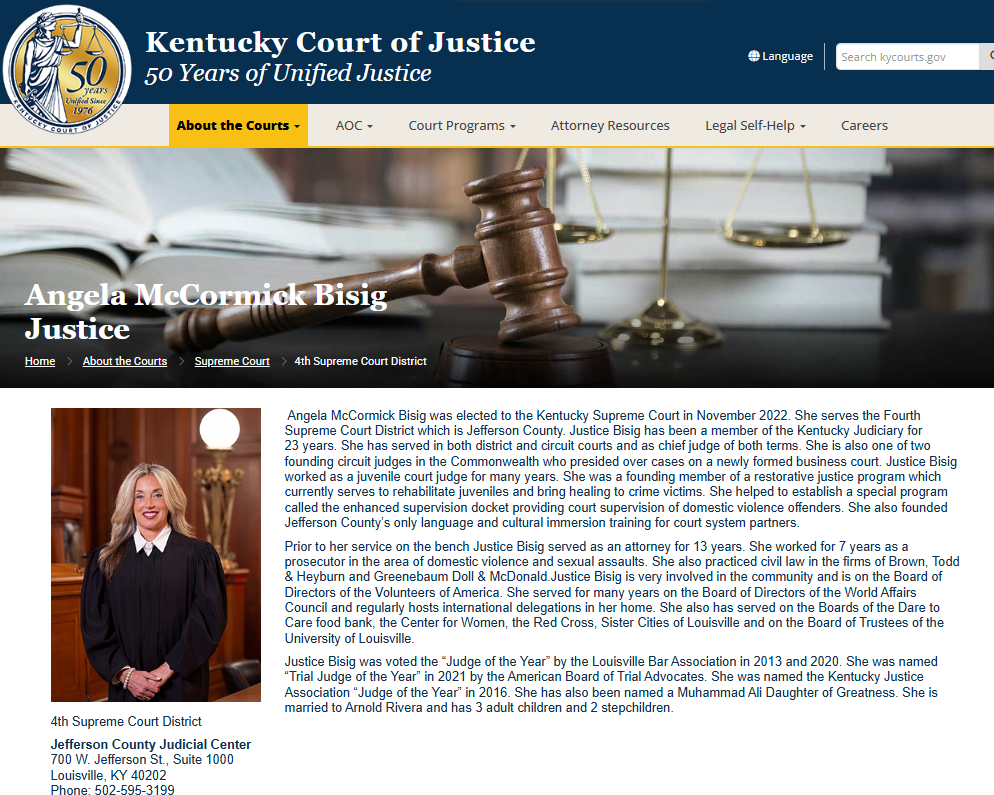
Today, Rotary Club of Louisville members had the privilege of hearing from Kentucky Supreme Court Justice Angela McCormick Bisig, one of only seven justices serving on the Commonwealth’s highest court. Justice Bisig represents the Fourth Supreme Court District, consisting solely of Jefferson County, making her responsible for the state’s largest county at the highest judicial level.
The Rotary Club of Louisville itself is one of the world’s largest Rotary clubs, bringing together hundreds of business, nonprofit, government, education, and civic leaders every week. The club describes itself as one of the largest among Rotary’s more than 45,000 clubs worldwide, providing members direct access to distinguished local, state, national, and international speakers.
For Louisville entrepreneur and Rotary member Di Tran, the luncheon was far more than another Thursday meeting.
“It was a lesson on the beauty of America’s system of government and why law matters.”
Rather than discussing politics, Justice Bisig explained the constitutional role of the judiciary—one of the three co-equal branches of government alongside the legislative and executive branches.
The explanation highlighted an important reality that many Americans may never fully appreciate.
The legislative branch creates laws.
The executive branch carries out and enforces those laws.
The judiciary does neither.
Instead, judges wait.
They do not search for cases.
They do not proactively investigate disputes.
They do not write new legislation.
They do not enforce regulations.
Their responsibility begins only when a real legal controversy is properly brought before the court.
Only then do judges carefully study the facts, hear both sides, apply the law as written, and when necessary, interpret areas where the law is reasonably open to more than one meaning.
This discipline is not weakness—it is one of the judiciary’s greatest strengths.
Its restraint helps ensure that every citizen, regardless of wealth, background, political influence, or status, stands equally before the law.
That quiet commitment to impartiality is one of the foundations of American liberty.
For Di Tran, an immigrant entrepreneur who deeply values the freedoms available in the United States, hearing this explanation directly from a sitting Kentucky Supreme Court justice carried special meaning.
“It reminded me that freedom is protected not only by those who make laws or enforce them, but also by those who patiently preserve justice through the rule of law.”
Following the presentation, Di Tran took a moment to thank Justice Bisig personally with a handshake—not because of politics or personal recognition, but out of appreciation for a civic lesson that reinforced the importance of constitutional government.
In an era when public attention often centers on conflict and division, today’s Rotary luncheon served as a reminder that some of the nation’s most important institutions work quietly, deliberately, and without seeking headlines.
The judiciary is designed to be reactive rather than proactive.
Its judges do not seek power; they exercise only the authority entrusted to them when a case comes before the court.
That restraint protects everyone.
As America reflects on 250 years of independence, events like this remind us that freedom depends not only on elections and legislation, but also on an independent judiciary committed to fairness, impartiality, and the rule of law.
Sometimes the most powerful lessons are delivered by those whose job is simply to listen, interpret the law faithfully, and ensure that justice belongs equally to every citizen.
A Rotary Club of Louisville Reflection on Manufacturing Excellence, Small Business Innovation, Workforce Development, and the Courage to Embrace Artificial Intelligence
Every city has moments that reveal where its future is heading.
Sometimes those moments arrive not through legislation, billion-dollar announcements, or national headlines.
Sometimes they arrive through a simple statement delivered by a leader who has spent decades building things.
At a recent Rotary Club of Louisville luncheon, members heard from Kevin Nolan, President and CEO of GE Appliances, one of America’s most respected manufacturing leaders and one of Louisville’s most influential executives.
The presentation was titled:
“Reinventing an American Icon.”
Yet perhaps the most powerful lesson was not about appliances, manufacturing, or corporate strategy.
It was about action.
A simple message emerged:
Stop talking about AI. Use it.
In a world increasingly divided between fear of technology and endless discussion about technology, Nolan’s perspective reflected something deeper—an engineer’s mindset.
Engineers do not debate possibilities forever.
They build.
They test.
They learn.
They improve.
Then they repeat.
That mindset has helped transform GE Appliances into a manufacturing success story while maintaining Louisville as its global headquarters.
More importantly, it offers a lesson for every small business owner, educator, entrepreneur, workforce leader, and community builder across Kentucky.
Fast Learning Beats Perfect Planning
One of the recurring themes shared during the discussion was the importance of experimentation.
Innovation does not come from waiting.
Innovation comes from trying.
Successful organizations understand that not every idea will work.
The goal is not perfection.
The goal is learning.
Try fast.
Learn fast.
Improve fast.
The best organizations are not those that avoid mistakes.
They are the organizations that discover useful solutions before everyone else.
For small businesses, this lesson may be more important than ever.
Artificial intelligence, automation, digital systems, multilingual communication, customer analytics, and workflow automation are no longer future technologies.
They are present-day tools.
The question is no longer whether these technologies will matter.
The question is whether organizations will learn to use them before their competitors do.
Innovation Must Solve Real Problems
Perhaps the most practical lesson from Nolan’s presentation was that innovation is not about creating technology for technology’s sake.
Innovation exists to solve real problems.
Businesses should not build products because they personally like them.
They should build solutions because customers need them.
The market decides.
The community decides.
The customer decides.
Pain points create opportunities.
When organizations listen carefully enough, customers tell them exactly where innovation should occur.
This principle applies equally to multinational manufacturers and local small businesses.
Louisville Beauty Academy and Di Tran University: A Local Example
The same philosophy increasingly appears in Louisville’s workforce education sector.
At Louisville Beauty Academy and Di Tran University, AI is not viewed as a future concept.
It is viewed as a daily operating tool.
Multilingual communication.
Student support systems.
Compliance documentation.
Licensing exam preparation.
Research publication.
Content creation.
Workflow automation.
These systems continue evolving daily, improving through continuous use and refinement.
Just as manufacturing transformed through automation and digital technology, workforce education is beginning a similar transformation through artificial intelligence.
The lesson remains the same:
Use the tools.
Learn from the tools.
Improve through the tools.
The Power of Humble Leadership
Perhaps the most impressive aspect of the presentation was not the corporate accomplishments.
It was the simplicity.
No unnecessary complexity.
No grand performance.
No exaggerated claims.
Just practical observations from a leader who has spent decades solving problems.
This reflects something many successful small business owners recognize immediately.
Real leadership is often remarkably simple.
See clearly.
Listen carefully.
Serve customers.
Take action.
Keep learning.
Repeat.
Why Rotary Matters
Events like these remind us why the Rotary Club of Louisville remains one of the most influential civic organizations in Kentucky.
Among more than 45,000 Rotary clubs worldwide, Louisville’s club continues to attract exceptional leaders, innovators, educators, entrepreneurs, public servants, and community builders.
The common theme is not status.
The common theme is service.
The purpose is not merely networking.
The purpose is elevating Louisville.
Each week, members gather to learn from leaders who are actively shaping industries, communities, and opportunities.
Those conversations become ideas.
Ideas become action.
Action becomes progress.
The Future Belongs to Builders
The most important takeaway from the presentation may be this:
The future will not belong to those who fear change.
It will not belong to those who endlessly debate change.
It will belong to those who learn, adapt, experiment, and build.
Louisville has always been a city of builders.
Manufacturers.
Educators.
Healthcare professionals.
Small business owners.
Entrepreneurs.
Immigrants.
Workers.
Families.
Community leaders.
The opportunity before us is not to predict the future.
The opportunity is to help create it.
And as one engineer-turned-CEO reminded a room full of leaders:
Stop talking about AI. Start using it.
For Louisville, that may be one of the most important leadership lessons of our time.
Louisville, Kentucky — This week at the luncheon meeting of the Rotary Club of Louisville, a simple handshake symbolized something much bigger than a greeting.
Entrepreneur, educator, and community builder Di Tran met with Gary, CEO of the YMCA of Greater Louisville, during the gathering of civic and nonprofit leaders.
The Rotary Club of Louisville is one of the most influential civic organizations in the world — ranked among the largest Rotary clubs globally out of more than 40,000 clubs within Rotary International. Each week, leaders gather not just to network, but to learn, recharge, and recommit to service.
During the meeting, Di Tran personally thanked Gary for the YMCA’s ongoing leadership in building stronger communities throughout Louisville.
But beyond the handshake, the conversation also reflected a powerful idea.
A Shared Vision: Service That Lifts Everyone
Both the YMCA and Di Tran’s organizations are built around a simple philosophy:
Service must be accessible.
The YMCA has long provided programs for families, youth development, health, and community support. Meanwhile, Di Tran’s institutions — including Louisville Beauty Academy and Di Tran University — focus on vocational training, entrepreneurship, and empowering individuals to build sustainable careers.
When these ideas intersect, something remarkable becomes possible.
Imagine a model where vocational education directly serves the community.
Imagine Louisville Beauty Academy Serving Families at the YMCA
One idea discussed informally among leaders is a powerful concept:
If Louisville Beauty Academy (LBA) were partnered with YMCA community centers, beauty students could provide free professional beauty services to families in need.
All delivered by trained students under supervision.
This concept is not hypothetical in spirit — Louisville already has a powerful example through the work of Harbor House of Louisville.
Harbor House integrates vocational programs that serve real people while training individuals with disabilities. The result is a cycle of empowerment, where learning and service happen at the same time.
A similar concept with Louisville Beauty Academy could create:
Free grooming services for families
Practical hands-on training for students
Community confidence and dignity
Workforce preparation
In other words, education becomes service.
Why Beauty Services Matter More Than People Think
Haircuts and grooming are often underestimated.
But for families facing hardship, these services can restore something deeper: dignity and confidence.
A haircut before a job interview. A hairstyle before school pictures. A moment of care that reminds someone they are valued.
This is where vocational education becomes powerful.
Students learn skills. Communities receive care. Everyone benefits.
Service Must Come From the Heart
Di Tran often writes in his books that sustainable service cannot be forced.
It must come from genuine desire.
His philosophy is simple:
Work that helps others must be done willingly.
Service must be consistent, not occasional.
Communities thrive when individuals choose to contribute.
These values align perfectly with the Rotary motto:
“Service Above Self.”
The YMCA carries that same spirit.
And when leaders from organizations like Rotary, YMCA, and community educators meet, ideas naturally begin to form about how to serve even more people.
Rotary: A Place Where Leaders Recharge
For Di Tran, Rotary meetings serve an important purpose.
They remind leaders that service is not a solitary mission.
Surrounded by others who share the same commitment, energy returns.
New ideas emerge.
Partnerships begin.
And communities grow stronger.
Gratitude to Rotary Louisville
Di Tran expressed appreciation to the Rotary Club of Louisville for continuing to create a space where leaders can reconnect with the purpose behind their work.
Being among the largest Rotary clubs in the world, the organization demonstrates how local leadership can inspire global ideals of service.
Sometimes, change begins not with a formal program — but with a simple moment.
A handshake. A thank you. And a shared vision for serving others.
Today at the Rotary Club of Louisville, attendees had the opportunity to hear from Dr. Brian Yearwood, Superintendent of Jefferson County Public Schools (JCPS), as he shared his vision for education, leadership, and community partnership.
Dr. Yearwood was born in Scarborough, Trinidad and Tobago, an English-speaking Caribbean nation shaped by British educational traditions. He immigrated to the United States at age 17 after earning a tennis scholarship to the New Mexico Military Institute, where he completed his associate degree. He later attended Texas Tech University, earning a Bachelor’s degree in Geology, a science teaching certification, a Master’s degree in Educational Administration, and a Doctorate in Educational Leadership and Statistics.
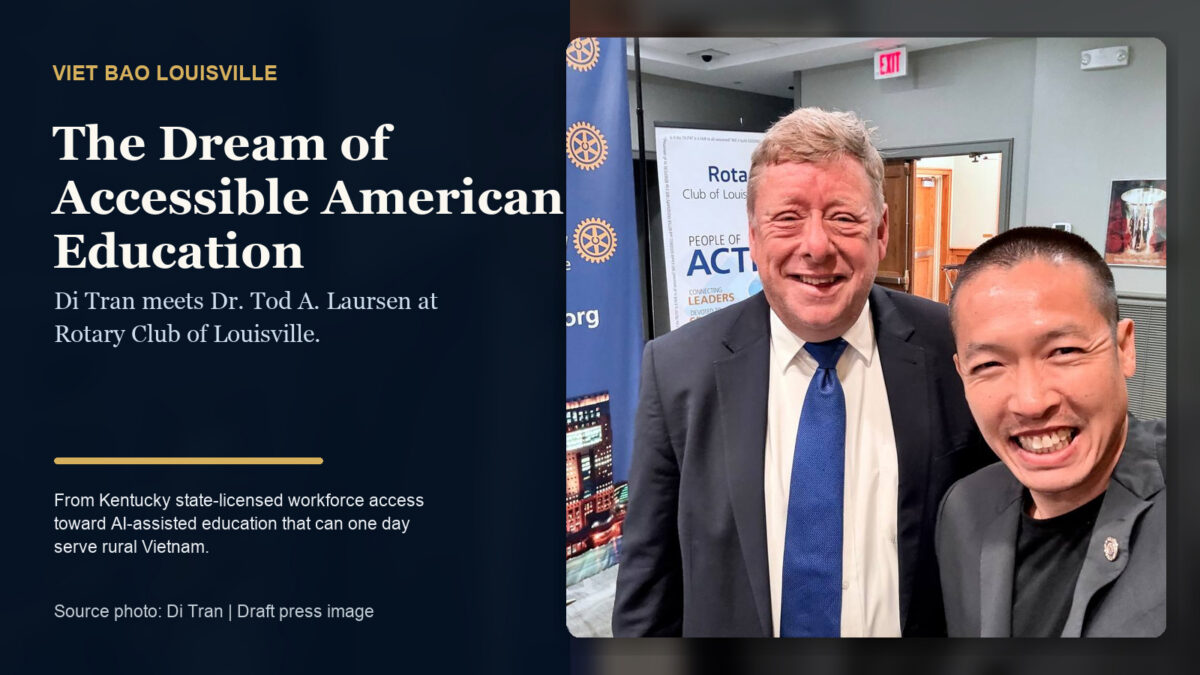
Among those present was Di Tran, founder of Di Tran University — The College of Humanization and Louisville Beauty Academy, the College of Beauty, who described the experience as deeply personal and inspiring. As an immigrant himself — born in humble conditions, growing up in Louisville’s south end near Iroquois High School and attending Seneca High School — Tran reflected that he never once believed the name of a high school determined a person’s future. Only later did he recognize how schools and students are sometimes classified by perception rather than potential, a concern Dr. Yearwood directly addressed.
One message that resonated strongly was Dr. Yearwood’s reminder that there is no such thing as a “bad school.” Every school is a place of learning and possibility, and labeling institutions negatively can shape how students feel about themselves and their opportunities.
Another statement he repeated twice stood out clearly: “Poverty is not a barrier to education. When you want it, you study.” The message emphasized determination, responsibility, and belief in human potential regardless of circumstance.
Dr. Yearwood also discussed courageous leadership and accountability, describing an emotionally difficult but impactful organizational reset sometimes referred to as “fire and rehire,” a strategy intended to realign teams around shared standards and mission.
Following the meeting, Di Tran warmly shook Dr. Yearwood’s hand. While many offered the traditional words, “God bless you,” acknowledging the difficulty of leading a large urban school system, Tran shared a more personal message:
“From heart to heart, God bless you — because you have the courage to lead differently from the highest level. Your spirit shines. Now I understand why JCPS chose you.”
The moment reflected a shared understanding often felt among immigrants — a deep appreciation for opportunity and a commitment to contribute fully to the communities they serve. For many immigrant leaders, the belief remains simple: when given opportunity in the United States, the responsibility is to give one’s very best in return.
The gathering served as a reminder that leadership, education, and lived experience can intersect in powerful ways, strengthening both institutions and the broader Louisville community.
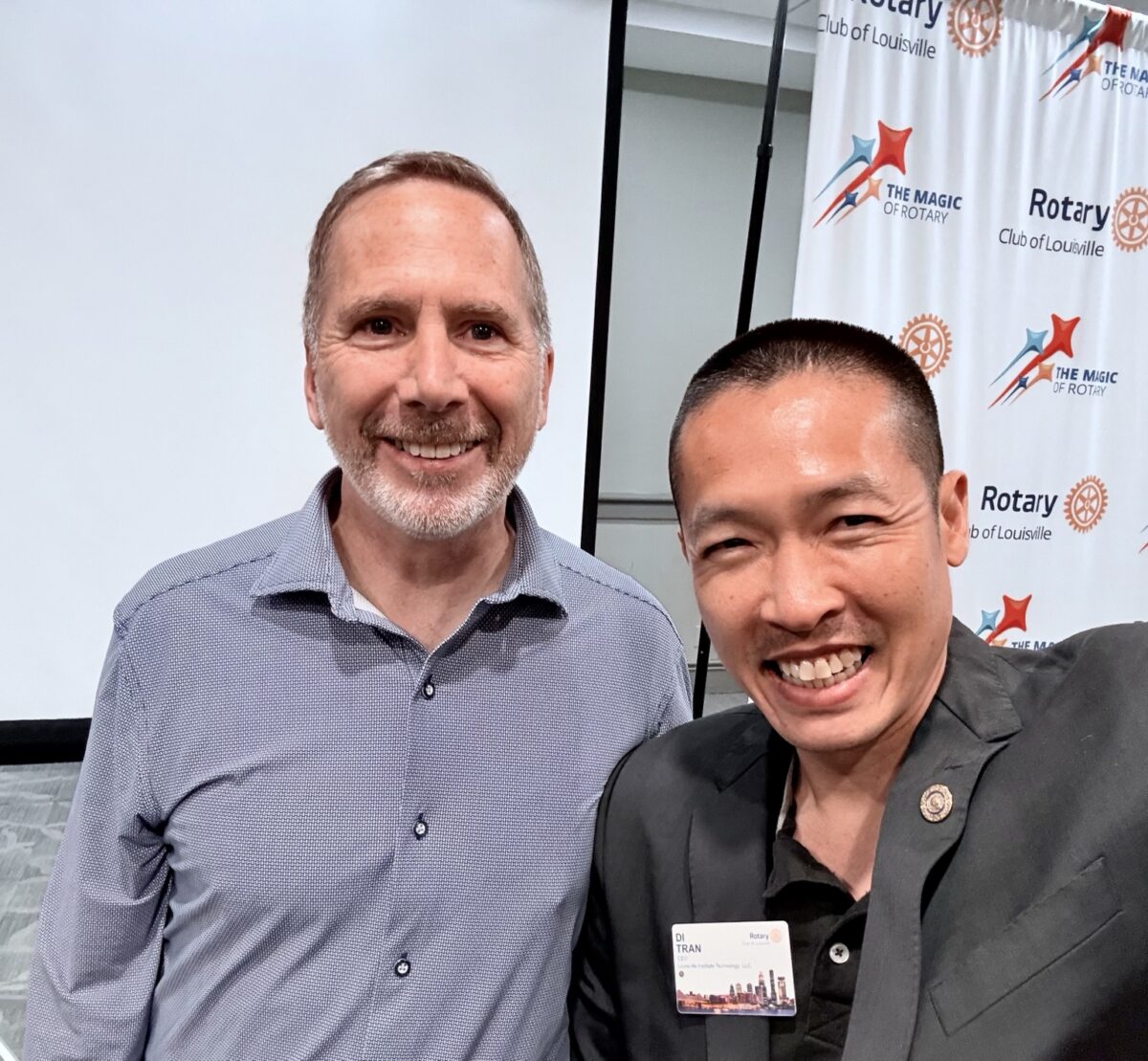
Di Tran attended today’s luncheon meeting of the Rotary Club of Louisville, where the featured speaker was Steve Trager, Executive Chair of Republic Bank & Trust Company.
Tran did not attend as a financial analyst, nor as an entrepreneur, nor even as the author of more than 150 published books. He attended simply as a witness.
What he witnessed, and what stayed with him, was not a speech measured by words—but a presence carried by energy.
Steve Trager spoke with deep emotion and unmistakable reverence for his father. The respect was not performative. It was palpable—vibrating through the room. Tran observed that Trager’s reflections were rooted first in gratitude: gratitude toward parents, toward family, toward a lineage of effort and love that precedes achievement.
Trager shared that his father did not graduate from college, was not considered the smartest in the room, but was undeniably the hardest working. He began from the smallest of beginnings—selling flowers, selling shoes—building life not from privilege but from perseverance. For Tran, this detail resonated profoundly. It mirrored his own journey and reinforced a truth Tran has come to hold deeply: that intelligence may open doors, but character, work ethic, and service build foundations.
While money and success were acknowledged as part of the equation, Tran noted that Trager never allowed them to become the point. The foundation, again and again, returned to service—service to family, service to community, and above all, love for Louisville, Kentucky. That love was not abstract; it was lived.
As a father himself—now raising three young boys—Tran felt the message not as a distant observer, but as a son learning how to become a better one, and as a parent learning how to lead by example. What he perceived most clearly was Trager’s complete devotion to family and unwavering commitment to community service, without separation between the two.
At the conclusion of the meeting, Tran felt compelled to act on what he had felt throughout the talk. He walked up to Trager for a single reason—to shake his hand.
“Sir,” Tran said, “I must shake your hand simply for the energy you were vibrating. Throughout your entire talk, all I saw was family and community. Thank you. As a father myself, with three young boys, I deeply adored what you shared about your dad, and also about your own children and wife.”
The moment was brief, but meaningful—an exchange rooted not in titles or accomplishments, but in shared values.
Tran, whose recent work has focused almost entirely on discovering the self through God and the process of humanization, later reflected that the experience felt aligned with his life’s current mission. In Trager’s presence, he saw a living expression of principles he studies and writes about daily: honoring one’s parents, serving without ego, and allowing one’s life to become a vessel of contribution rather than consumption.
Interestingly, Tran does not consider Steve Trager the strongest speaker in a technical or rhetorical sense. Yet, for him, Trager stands as the most impactful speaker he has encountered during his weekly Rotary attendance since joining in 2019. The reason is simple: the message was carried not by words, but by vibration—by authenticity.
Earlier this month, on January 8, 2026, Tran himself briefly introduced his story to the Rotary Club. At that time, he described how he views every man and woman in the room as wise—echoing biblical teachings that honor elders and experience. In that spirit, Tran openly refers to himself as a “baby” at Rotary: one who wishes to remain small, humble, hungry to learn, and free to practice knowledge without pride.
Today’s meeting reaffirmed that posture.
For Di Tran, the lesson was not about banking, leadership titles, or accolades. It was about lineage, humility, and the quiet power of a life devoted to serving others. He left the room with gratitude—grateful for Steve Trager’s example, grateful for Rotary, and grateful for another opportunity to learn.
As Tran reflected afterward, sometimes the greatest speeches are not heard with the ears, but felt in the heart.
Thank you, Rotary Club of Louisville, for another meaningful meeting
Louisville, KY – September 25, 2025. At the Rotary Club of Louisville, two very different Kentucky stories met in one room: the long arc of Senator Mitch McConnell’s rise to become the longest-serving Senate leader in U.S. history, and the quieter journey of Di Tran, a Vietnamese immigrant who has called Louisville home since 1995.
Mitch McConnell: From Manual High School to the U.S. Senate
Born in 1942, McConnell graduated from duPont Manual High School in Louisville, earned his bachelor’s degree at the University of Louisville (1964), and his law degree at the University of Kentucky College of Law (1967). When first elected to the U.S. Senate in 1984, he was not a household name. His office assignment was among the least desirable for freshmen senators.
Through more than two decades of persistence and what he often calls “focus,” McConnell gradually rose. By 2007, he became the Republican Leader of the Senate—a position he held until early 2025—making him the longest-serving Senate party leader in U.S. history.
Throughout his career, McConnell has emphasized one principle: “It’s not about what Kentucky and America can do for me, but what I can do for Kentucky and America.”
He often credits Louisville business leader David Jones Sr. (co-founder of Humana) for teaching him that “focus” is the most important word in the English language. That clarity shaped his work, from strengthening Kentucky’s global trade position—#1 in exports and #3 in imports—to engaging in national debates on foreign policy, economic growth, and the defense of free speech.
Di Tran: From Vietnam to Louisville
While McConnell was climbing the ladder in Washington, a young boy across the world was just beginning his own journey.
Di Tran was born in 1982 in Vietnam. In 1995—when McConnell was already serving his second term as Senator—Tran immigrated to the United States. He arrived in Louisville at age 13 with no English skills and few resources. For him, Louisville was both a challenge and a promise.
Over the years, Tran worked hard to learn, study, and build a life. He eventually became a software architect, one of the top three principal engineers at Humana—the company co-founded by the same David Jones Sr. who had influenced Senator McConnell. Later, Tran shifted his focus toward education and service, founding the Louisville Beauty Academy.
In less than a decade, the Academy has helped nearly 2,000 students become licensed professionals, contributing to Kentucky’s economy. Its model is built not only on training, but also on service: students provide free care for the elderly, the homeless, and local nonprofits while earning both volunteer hours and licensing credit.
September 2025: Recognition and Reflection
This September, Louisville Beauty Academy was honored nationally—an historic milestone as the first beauty school in the U.S. to receive two national recognitions in one year:
These honors lifted Louisville and Kentucky into the national spotlight for innovation in workforce development. For Tran, however, the true meaning lies not in recognition, but in service to community and state.
Earlier this year, he visited Washington, D.C., where he and his team met with Senator McConnell’s staff. To meet Senator McConnell again in Louisville, this time at the Rotary Club, was a humbling full-circle moment.
Two Journeys, One Foundation: Service and Kentucky Pride
Though born four decades apart and on opposite sides of the world, Mitch McConnell and Di Tran share a foundation: focus, perseverance, and service to Kentucky.
McConnell’s timeline: Rising from obscurity in the Senate to national leadership.
Tran’s timeline: Arriving in Louisville in 1995 with no English, slowly building a life of education and community service.
Both lives remind us that leadership is not about where one begins, but about how one serves.
Reflecting on the meeting, Tran shared:
“To sit and listen to Senator McConnell is a dream come true. His life shows that leadership is not about titles but about service, focus, and perseverance. I am proud to be an American, proud to be a Kentuckian, and proud to be a Louisvillian. Like him, I hope to always ask not what Kentucky and America can do for me, but what I can do for Kentucky and America.”
Louisville: A City of Leaders
Louisville has long produced leaders with national impact—Senator McConnell, business builder David Jones Sr., and many others. Today, standing in that same proud tradition, Di Tran represents the immigrant story: a life of humility, perseverance, and service.
At the Rotary Club of Louisville, the paths of two Kentuckians—one a Senate giant, the other an emerging servant-leader—crossed in a moment that captured the spirit of the city: focus, gratitude, and pride in Kentucky’s promise.
Louisville, KY – On September 4th, the Rotary Club of Louisville, the 12th largest Rotary Club among 43,000 clubs worldwide, hosted another remarkable luncheon program at the University Club. The featured speaker was Stacey Wade, CEO and Executive Creative Director of NIMBUS, a nationally recognized creative agency, and co-founder of West End Gin.
Among the attendees was Di Tran, local entrepreneur, author, and founder of Louisville Beauty Academy. For Di, this gathering was not simply a meeting of professionals, but a celebration of like-minded leaders who see business as a tool for service, community uplift, and cultural pride.
Processed with Lensa with Magic Correction
Stacey Wade’s Message: Pride Without Victimhood
In his address, Stacey Wade spoke with passion about his journey in business, creativity, and leadership. What resonated most was his unique perspective: he speaks not from a place of anger or victimhood, but from a deep sense of pride, acceptance, and gratitude. Wade proudly embraces his roots in Louisville’s West End, transforming cultural identity into a platform for growth, reinvestment, and leadership.
Under his guidance, NIMBUS has become a national leader in multicultural and strategic marketing, with a client roster including KFC, Toyota, and Brown-Forman, along with collaborations with icons like Deion Sanders and Jack Harlow. In addition, Wade and his wife, Dr. Dawn Wade, launched West End Gin, a premium brand that reinvests $1 from every bottle into grassroots initiatives.
Processed with Lensa with Magic Correction
Di Tran’s Reflection: Small Steps, Big Impact
For Di Tran, hearing Stacey Wade’s story affirmed his own philosophy of living life one small piece at a time. Tran has long championed the idea that success is not built on grand promises, but on daily acts of love, effort, and contribution. Through his ventures, including Louisville Beauty Academy and Di Tran University, he has sought to elevate Louisville by helping individuals — particularly immigrants and working families — achieve education, licensing, and workforce readiness.
Like Wade, Tran emphasizes a rise mentality: to see challenges not as barriers, but as opportunities to grow, serve, and build a better community.
Rotary Fellowship: A Gathering of Like-Minded Leaders
The luncheon was not only about the speaker, but also about the wonderful fellowship and new Rotarian guests who joined. The Rotary Club of Louisville continues to be a magnet for leaders who believe in service above self, entrepreneurship as a force for good, and community as the foundation of progress.
For Di Tran, the opportunity to sit among such leaders was a blessing: “Life is beautiful, even with its challenges. And together, we rise — with gratitude, love, and service,” Tran reflected.
Conclusion
The September 4th Rotary luncheon highlighted what makes Louisville strong: leaders like Stacey Wade and Di Tran who see identity, business, and service not as separate pursuits, but as interconnected callings. In the 12th largest Rotary Club in the world, the spirit of fellowship continues to bring together those who live with pride, lead with purpose, and commit to building a better tomorrow.
At the recent Rotary Club of Louisville meeting, members and guests were treated to a remarkable presentation by Angela Billings, a U.S. Air Force veteran, public relations expert, and author of Command the Crisis: Navigate Chaos with Battle-Tested Public Relations and Communication Strategies. Among the captivated attendees was Di Tran, a Vietnamese immigrant, entrepreneur, and community leader who has frequently expressed his deep admiration for America, referring to the country as “heaven on earth.”
Angela Billings is a true embodiment of resilience and dedication, having served in high-profile positions during her military career, including as a spokesperson for the U.S. Air Force in Washington, D.C., and international posts in Germany, Korea, and Afghanistan. On September 11, 2001, she was in the Pentagon when American Airlines Flight 77 crashed into the building. Angela’s harrowing experience that day gave her unique insight into managing crises, not just in theory, but under unimaginable circumstances. Her talk, “Under Attack,” conveyed her hard-earned lessons in crisis management and offered valuable insights into navigating communication during critical moments. As she shared her story, Di Tran listened in awe, deeply moved by her courage and the pivotal role she continues to play in public service.
For Di Tran, meeting Angela was a profound experience. As they shook hands, he expressed his admiration, sharing, “I only watch people like you in movies. You’re the first person I’ve met who lived through the 9/11 attack at the Pentagon, and now you’re a communications professional who is still serving, making an impact in the Kentucky Senate.” Di Tran’s respect was evident as he recognized Angela not only as a veteran of military service but also as a mentor to many, a crisis expert, and a key player in Kentucky’s political landscape. Her current role as director of communications for the Kentucky Senate Majority allows her to continue her legacy of service, this time on behalf of the Commonwealth.
The significance of their meeting was heightened by their shared commitment to recent legislative progress. Di Tran, an advocate for inclusivity and workforce development, has been an enthusiastic supporter of Senate Bill 14. This landmark bill, passed earlier this year, expands the Kentucky Board of Cosmetology to include diverse representation, promotes multilingual testing, and underscores the importance of inclusivity within the state’s beauty industry. For Di Tran, who has been deeply involved in this advocacy, Angela’s presence underscored the power of determined individuals working within government to effect change.
Angela Billings’s strength and composure, qualities honed through years of experience and tested under unimaginable circumstances, are a source of inspiration for leaders like Di Tran. Her willingness to share her story and her insights into crisis communication serve as a powerful reminder of the sacrifices made by public servants. In Angela, Di sees a reflection of his own values—a commitment to service, the courage to face adversity, and the passion to improve the world around them. Both Angela and Di Tran share a profound belief in the promise of America, each working in their way to uphold its ideals and elevate those around them.
This powerful connection at the Rotary Club serves as a testament to the enduring strength of service and resilience. As Di Tran often says, “America is heaven on earth.” Meeting Angela Billings, a hero in her own right, only deepened his belief, reminding everyone present of the extraordinary individuals who stand ready to serve and protect, in times of peace and crisis alike.