A Rotary Club of Louisville reflection on Dr. Anne Kenworthy, psychology, women-led service, human-centered implementation, and a city-scale opportunity
By Di Tran
September 24, 2026
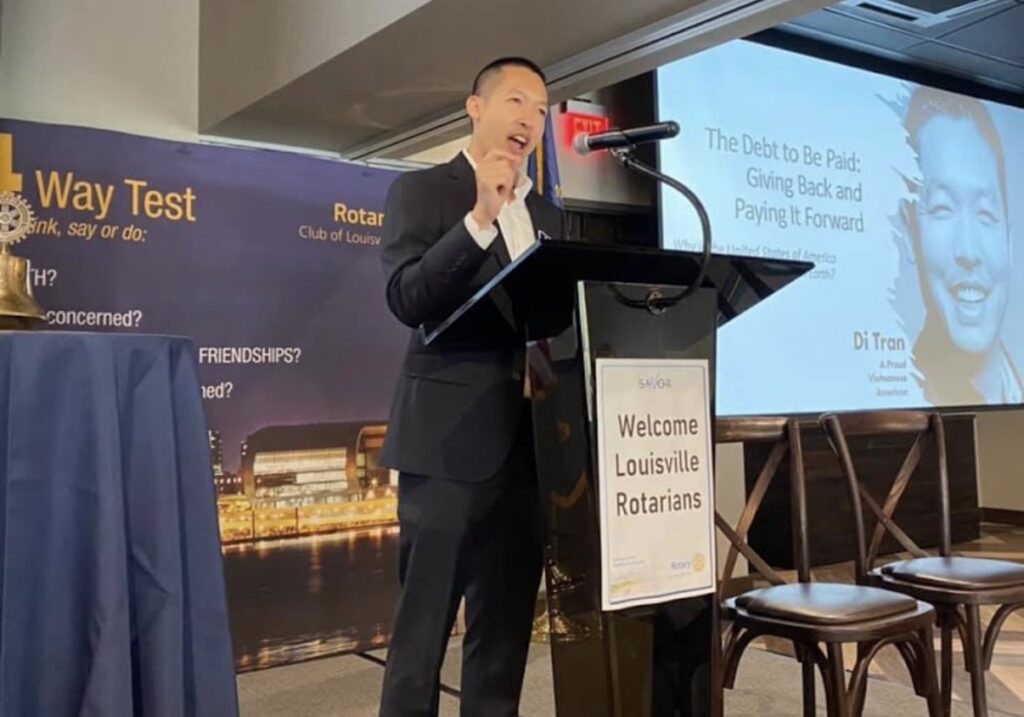
Today at the Rotary Club of Louisville, I listened to Dr. Anne Kenworthy, Ed.D., MBA, president of Spalding University, speak about an institution that is small enough to move, rooted enough to matter, and courageous enough to confront artificial intelligence as an educational reality rather than a distant possibility.
The official Rotary program gave the address a fitting title: “Spalding University: Meeting the Needs of the Times.” Rotary described a university preparing Kentucky’s healthcare workforce, addressing artificial intelligence, and demonstrating how a smaller institution can act boldly and nimbly. That description is not promotional imagination. It aligns with Spalding’s documented direction: an AI Literacy minor open across disciplines, an Artificial Intelligence for Business concentration, healthcare and human-service programs, and a president who serves on the Kentucky Council on Postsecondary Education’s Task Force on AI, Higher Education, and the Workforce.
I left the room with a realization that felt both new and familiar:
AI is no longer an optional technology project for schools, businesses, or civic organizations. AI implementation is becoming an organizational capability. But implementation without humanization can produce speed without wisdom, automation without trust, and efficiency without dignity.
I use AI systems every day—across education, publishing, operations, research, communication, and business. The more I use them, the clearer the lesson becomes: the future will not belong simply to those who possess the most advanced model. It will belong to those who can combine technology with human judgment, ethical governance, psychological safety, disciplined verification, and real-world application.
That is why what happened at Rotary mattered.
It suggested that Spalding may be standing in a rare strategic position: not merely to teach AI, but to help Louisville build a model of human-centered AI implementation that other institutions and cities could study and adapt.
First, the facts: who is leading Spalding?
Dr. Anne Kenworthy became Spalding University’s 11th president in January 2025. The Rotary Club of Louisville’s official biography describes a leader with 30 years of college teaching experience and prior executive work in enrollment, marketing, strategic initiatives, advancement, adult education, program creation, and philanthropy. Her academic background includes a bachelor’s degree in mathematics, an Ed.D., an M.S., an MBA, and a fundraising-management certificate. Rotary also notes that she helped launch programs for Latino and adult learners, achieved enrollment growth, and secured more than $10 million in philanthropic support before coming to Spalding.
That combination matters. AI transformation requires more than technical fluency. It requires a leader who can understand systems, communicate change, secure resources, widen access, and keep institutional purpose visible while the ground moves.
Spalding’s public record shows that President Kenworthy is already doing more than speaking about AI. She is a member of Kentucky’s official statewide task force examining AI, higher education, and the workforce. Under her presidency, Spalding publicly launched institution-wide AI education initiatives, including:
- an 18-credit Artificial Intelligence Literacy minor available to undergraduate students across majors;
- an Artificial Intelligence for Business concentration;
- coursework in AI for everyone, decision-making, creativity and design, ethics, and the workplace;
- interdisciplinary application across nursing, education, psychology, business, social work, and the arts; and
- a curriculum partnership with Rize Education focused on career-aligned programs and practical applications.
Spalding has also published a student-use policy that preserves faculty authority to permit or restrict AI in individual courses and asks faculty to communicate expectations clearly. That is a responsible starting point. The next institutional frontier is to connect course-level discretion to a shared implementation architecture: common literacy, privacy standards, verification practices, human-oversight rules, approved-use cases, assessment redesign, and measurable outcomes.
The name I carried out of the room: Dr. Allison Fowler
President Kenworthy also brought the psychological and educational dimensions of AI into view. The name I left remembering was Dr. Allison Fowler.
Spalding’s official directory identifies Allison Fowler, Ph.D., as Undergraduate Program Director and Assistant Professor in the School of Professional Psychology. Her doctorate is in Educational Psychology, Measurement, and Evaluation from the University of Louisville. Her research and teaching focus on developmental theory, achievement motivation, learning, positive classroom community, and evidence-based pedagogy.
That background is highly relevant to responsible AI adoption.
For accuracy, one boundary must remain explicit: the public Rotary program lists President Kenworthy as the featured speaker but does not list a co-presenter, and Spalding’s public directory does not give Dr. Fowler the formal title of “AI director.” I therefore will not manufacture a title or overstate a role. What can be verified is that Dr. Fowler is a Spalding educational psychologist whose expertise sits directly at the intersection of learning, motivation, measurement, and human development.
The larger insight does not depend on an inflated title. Her discipline itself reveals what many AI initiatives still miss.
AI cannot be implemented by engineering alone
For decades, digital transformation has often been narrated as an engineering problem: build the system, integrate the data, automate the workflow, and train the user. Engineering remains indispensable. Data science, cybersecurity, software architecture, product design, and model evaluation are foundational.
But adoption is not merely technical.
It is psychological.
People ask:
- Will this tool replace me?
- Will it make my work visible in ways I cannot control?
- Can I trust its answer?
- What happens when it is wrong?
- Will using it make me less capable?
- Will refusing it make me irrelevant?
- Who is accountable when an automated decision harms someone?
- How do I preserve my identity, craft, relationships, and professional judgment?
These are questions of cognition, motivation, behavior, identity, trust, anxiety, organizational culture, ethics, and power. A technically impressive system can fail if people fear it, misunderstand it, misuse it, or experience it as something imposed upon them. A simple system can succeed when people understand its purpose, help shape its use, see its limits, and retain meaningful authority.
This is why psychology and the human sciences must not be invited at the end of an AI project merely to explain a finished product. They should be present at the beginning—helping define the problem, map human impact, design adoption, test comprehension, identify fear and resistance, protect vulnerable users, evaluate learning, and measure whether the system actually improves human outcomes.
This conclusion is not philosophical decoration. It is consistent with major public frameworks:
- The National Institute of Standards and Technology treats AI as a sociotechnical system and says trustworthiness depends on technical performance together with social and organizational behavior, context, human oversight, transparency, privacy, safety, fairness, and accountability.
- UNESCO’s guidance for generative AI in education calls for a human-centered approach that protects human agency, inclusion, equity, cultural diversity, privacy, and age-appropriate use.
- The U.S. Department of Education has advocated “intelligence augmentation”—people and AI working together—while keeping humans in the loop and centering human decision-making.
- The American Psychological Association has documented both rapid AI adoption and serious concerns about training, policy, privacy, bias, and harm. Its educational guidance calls for moving from anxiety to agency while keeping humans as meaning-makers.
The answer, then, is not “replace engineers with psychologists.” The answer is a higher-order partnership:
Engineers build capability. Psychologists understand behavior and trust. Educators design learning. Domain professionals define responsible use. Communities identify lived impact. Leaders align purpose and resources. Governance keeps the system accountable.
This is humanization in practice.
Why Spalding is unusually well positioned
Spalding does not need to imitate a technology institute to matter in the AI era. Its greatest advantage may be precisely that it is not one.
1. Its origin is service, especially women-led service
Spalding traces its history to 1814, when the Sisters of Charity of Nazareth established the institution that became Spalding University. It began as the first Catholic school for women west of the Allegheny Mountains. Its namesake, Mother Catherine Spalding, is also remembered as a foundational figure in Louisville social work.
That history is not a sentimental footnote. It is strategic DNA: women organizing institutions, educating people excluded from opportunity, caring for those in need, and building social infrastructure long before “innovation ecosystem” became a business phrase.
Today, when AI raises questions about caregiving, belonging, bias, workforce disruption, safety, identity, and access, that service tradition is not behind the times. It is directly relevant to the times.
2. Its mission already contains the right question
Spalding’s mission is to meet the needs of the times through education grounded in spiritual values, service, peace, and justice. Its public description emphasizes a love for students and the city.
AI implementation needs exactly that kind of purpose test:
- Whose need are we meeting?
- Whose burden are we reducing?
- Whose dignity are we protecting?
- Who gains access?
- Who could be harmed?
- What human capacity becomes stronger after automation?
3. Its disciplines are where AI meets real life
Spalding’s portfolio includes nursing, psychology and counseling, social work, occupational therapy, physical therapy, education, business, health sciences, writing, and other applied programs. These are not peripheral to the AI future. They are where AI will be tested against human reality.
In healthcare, an incorrect or decontextualized output can affect a patient. In psychology, privacy and dependency matter. In social work, automated classifications can affect vulnerable people. In education, AI can either deepen learning or disguise its absence. In writing, it can support creativity or flatten authentic voice. In business, it can increase productivity or scale unfairness.
Spalding therefore has the ingredients for interdisciplinary AI governance and applied learning under one institutional roof.
4. Its size can become an innovation advantage
Large systems can marshal enormous resources, but they often change slowly. A smaller university can convene a cross-disciplinary team, approve a bounded pilot, learn from evidence, correct quickly, and scale what works.
Small does not mean weak. Under disciplined leadership, small can mean close to the learner, short in the decision chain, visible in accountability, and fast in adaptation.
5. It is physically anchored where Louisville needs activation
Spalding describes itself as Louisville’s only downtown university. Its campus sits at the southern edge of the downtown core, near healthcare, government, nonprofit, cultural, residential, and small-business activity.
That location is not merely an address. It is a laboratory.
The opportunity: a Human-Centered AI Downtown Living Lab
Louisville does not need another abstract declaration that it wants to be an “AI city.” It needs a place where students, educators, businesses, healthcare workers, public servants, residents, and technologists can implement useful systems under transparent rules and measure what happens.
Spalding could help convene a Human-Centered AI Downtown Living Lab: a bounded, evidence-driven partnership aligned with existing downtown revitalization priorities and open to participation by universities, employers, Louisville Metro, Louisville Downtown Partnership, healthcare systems, nonprofits, small businesses, and community organizations.
This is a proposal—not an existing Spalding or Rotary commitment—and no endorsement should be implied. But the conditions are real.
Louisville Downtown Partnership’s 10-year strategy focuses on activating downtown, strengthening residential life, improving the public realm, and coordinating public-private projects. Its current data show that downtown occupies less than 1% of Louisville’s land but supports more than 67,000 workers, more than 10,000 residents, 35 million annual visits, and $3.2 billion in announced or active investment. Its project tracker also identifies an emerging downtown Education District and calls for stronger coordination around the Fourth Street and Broadway corridors—precisely Spalding’s geography.
Spalding is already an economic anchor. An Association of Independent Kentucky Colleges and Universities study estimated its local economic impact at $105.4 million for fiscal year 2021–22, using direct and induced spending methodology.
The living lab could convert these assets into measurable implementation.
Pillar 1: AI literacy for every discipline
Build a common foundation for students, faculty, staff, and participating employers:
- what AI can and cannot do;
- prompt and workflow design;
- verification and source discipline;
- privacy, bias, intellectual property, and security;
- human decision authority;
- role-specific applications; and
- evidence of learning through real work products.
Spalding’s current AI minor and business concentration provide a strong academic base. The next step is a practical literacy layer that reaches every program without pretending every learner must become a software engineer.
Pillar 2: Psychology-led adoption and change design
Create an interdisciplinary adoption team involving educational psychology, clinical psychology, organizational leadership, education, social work, and technology. Before deployment, each pilot should assess:
- user fears and expectations;
- cognitive load;
- accessibility;
- trust calibration;
- risk of overreliance;
- motivation and skill development;
- effects on professional identity; and
- whether the system increases or reduces meaningful human contact.
The goal is not blind trust in AI. It is calibrated trust: knowing when to use a system, when to verify it, when to override it, and when not to deploy it at all.
Pillar 3: Human-services application studios
Students and faculty could develop bounded prototypes for real community needs, such as:
- multilingual navigation of public and nonprofit services;
- administrative support that returns time to nurses, therapists, teachers, and case workers;
- accessible educational materials;
- workforce and career-navigation tools;
- appointment, reminder, and resource systems;
- community-health communication; and
- documentation aids that preserve professional review and confidentiality.
No high-stakes decision should be delegated without validated safeguards, human review, and compliance with applicable privacy and professional rules.
Pillar 4: A downtown small-business AI implementation clinic
National Census data show a practical adoption gap: overall reported business AI use was roughly 17%–20% from late 2025 through early May 2026, while adoption was higher among larger firms and lower among the smallest businesses.
That gap is an economic-development opportunity.
Spalding students and supervised partners could help downtown businesses identify one safe, measurable workflow at a time:
- customer-service knowledge bases;
- multilingual communication;
- inventory and scheduling support;
- document organization;
- marketing review;
- employee training;
- accessibility improvement; or
- fraud and error detection.
Each engagement should begin with the question: What specific value are we creating for a real person?
Pillar 5: Education as visible downtown activation
Turn vacant or underused space into public learning:
- evening AI literacy sessions;
- student demonstration days;
- small-business clinics;
- psychology and trust workshops;
- responsible-use help desks;
- youth and adult learner studios;
- multilingual community sessions; and
- public exhibitions of verified student work.
This connects AI education to foot traffic, workforce development, community confidence, and the downtown strategy’s goal of activation.
Pillar 6: Transparent governance and public measurement
Use NIST’s Govern–Map–Measure–Manage structure. Every pilot should publish a plain-language record of:
- the problem being addressed;
- the people affected;
- the data used;
- the human decision-maker;
- foreseeable risks;
- prohibited uses;
- evaluation measures;
- incident and correction procedures; and
- results, including failures.
Louisville should not compete to deploy the most AI. It should compete to produce the most useful, trustworthy, replicable, and human-centered implementation.
A practical 12-month pilot
A serious vision needs a sequence.
Months 1–3: Govern and map
- Convene a cross-disciplinary steering group.
- Select three low-risk, high-value use cases—one in education, one in human services, and one in small business.
- Establish privacy, security, accessibility, procurement, disclosure, and human-oversight rules.
- Record baseline measures: time, cost, error rate, user satisfaction, stress, access, and learning quality.
Months 4–6: Train and prototype
- Train participants in AI literacy, verification, and role-specific use.
- Conduct psychological-safety and change-readiness sessions.
- Build limited prototypes with no unsupervised high-stakes decisions.
- Run red-team tests for bias, hallucination, privacy leakage, accessibility, and misuse.
Months 7–9: Pilot in real settings
- Deploy to small, consenting groups.
- Maintain human review and incident logging.
- Measure whether the tool improves service rather than merely increasing activity.
- Collect feedback from users, workers, students, and community partners.
Months 10–12: Evaluate and publish
- Compare outcomes with the baseline.
- Stop or redesign weak pilots.
- Publish results and safeguards in plain language.
- Create a replication guide for another Louisville organization or neighborhood.
The scoreboard should include hours returned to human service, verified error rates, user trust, learning gain, cost per successful outcome, number of small businesses assisted, accessibility improvements, and documented cases where human review prevented harm.
My own work reached the same conclusion from another direction
I came to this Rotary meeting not as a neutral observer of AI, but as a daily implementer, educator, software builder, business operator, and author.
Through Di Tran University and the College of Humanization, I have written more than 200 books, including a three-part Humanized AI education framework—a practical humanization blueprint for the student, the teacher, and the school:
- The Humanized AI Student: How to Learn, Grow, and Succeed in the Age of Artificial Intelligence
- The Humanized AI Teacher: A Complete Blueprint for Transforming Any School—Mindset → Culture → Systems → Implementation → Automation → Humanization
- The Humanized AI School Blueprint: A Humanized, Knowledge-Based AI Blueprint for Vocational Training, Trade Schools, Adult Education, Universities, and K–12
Those books argue that technology should not reduce the human role. It should remove mechanical burden so people can contribute more judgment, care, creativity, mentorship, responsibility, and presence.
My more recent research, From Tool Fascination to Value Creation, puts the implementation test plainly: What problem is being solved? What value will success create? Where must human judgment remain primary? What evidence will verify the result? What risks must be controlled?
Today, Spalding’s presentation helped me see an additional dimension with sharper clarity: psychology cannot be downstream from AI implementation. Human understanding must be part of the architecture.
That insight strengthens, rather than competes with, engineering. It makes technical work more adoptable, more accountable, and more useful.
Louisville can lead by becoming more human, not merely more automated
Louisville has world-class healthcare, logistics, manufacturing, education, hospitality, bourbon, arts, nonprofit service, and immigrant entrepreneurship. It also has a downtown undergoing significant reinvestment and an education corridor already identified in the public development strategy.
The city does not need to copy Silicon Valley’s identity. It can build its own.
Louisville can become known as the place where:
- AI implementation serves ordinary people and small organizations;
- education produces verified ability, not only credentials;
- healthcare automation returns time to care;
- psychology shapes adoption and trust;
- immigrant and multilingual communities gain access rather than exclusion;
- students solve real civic and business problems;
- governance is transparent;
- failures are documented and corrected; and
- automation makes human service more available, not less.
That would be technological leadership with a Louisville character: practical, relational, service-oriented, and accountable.
Gratitude—and an invitation
Thank you to Dr. Anne Kenworthy for speaking with urgency and optimism. Thank you to Dr. Allison Fowler for representing the human science that must sit beside technical implementation. Thank you to the faculty, staff, students, trustees, Sisters of Charity of Nazareth, and community partners who carry Spalding’s mission forward.
And thank you to the Rotary Club of Louisville—its officers, program leaders, staff, volunteers, members, and the University Club team—for continuing to create a room where civic ideas can become relationships and where relationships can become service.
Rotary’s value is not only that leaders speak. It is that a community listens, reflects, connects, and acts.
The realization I carried home is simple:
AI may be the most powerful automation technology of our time. Humanization must be the operating system around it.
Spalding University—with its women-led origins, service mission, psychology and human-services expertise, growing AI curriculum, nimble scale, and downtown location—has the ingredients to help Louisville prove what that can mean.
The next step is not another slogan.
It is one governed pilot, one verified outcome, one human problem solved, and one transparent lesson at a time.
Editorial fact-check note
- Verified: Dr. Anne Kenworthy is Spalding University’s 11th president and began the role in January 2025.
- Verified: Rotary’s September 24, 2026 program was titled “Spalding University: Meeting the Needs of the Times.”
- Verified: Dr. Allison Fowler is Spalding’s Undergraduate Program Director and Assistant Professor in the School of Professional Psychology, with a Ph.D. in Educational Psychology, Measurement, and Evaluation.
- Not independently verified from the public event listing: Dr. Fowler’s exact speaking role at the September 24 Rotary program or any formal title as Spalding’s AI leader. The article intentionally does not assign either claim.
- Proposal status: The Human-Centered AI Downtown Living Lab is Di Tran’s proposed framework, not an announced program or commitment of Spalding University, Rotary Club of Louisville, Louisville Metro, or Louisville Downtown Partnership.
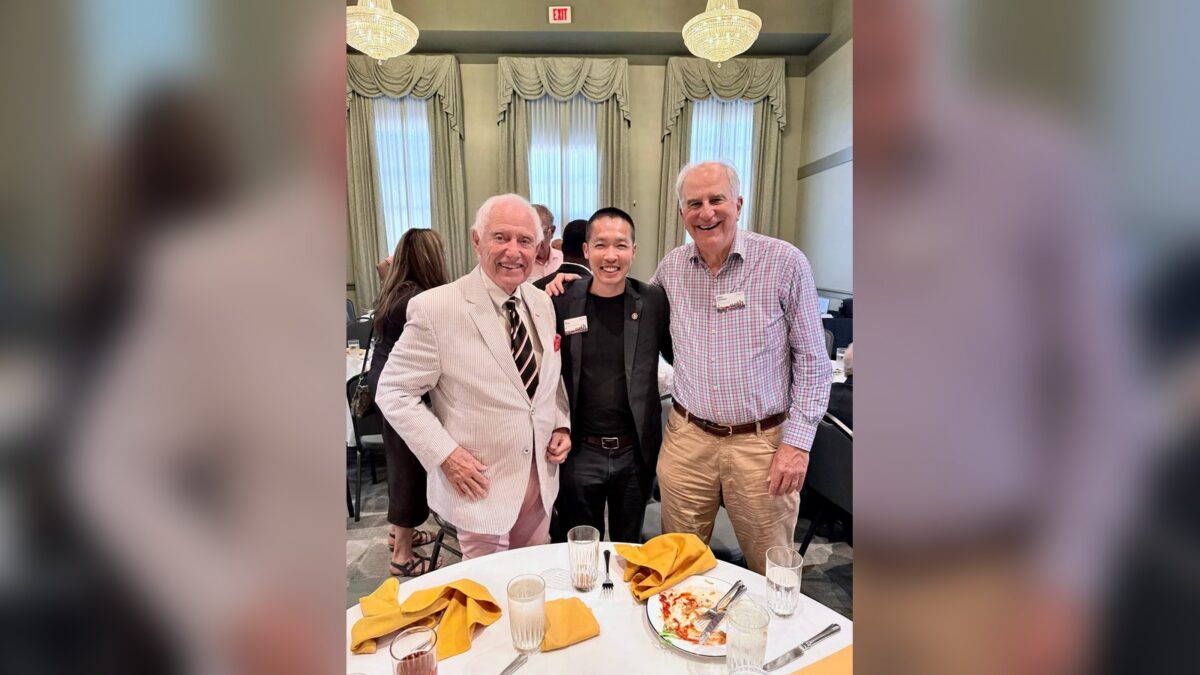
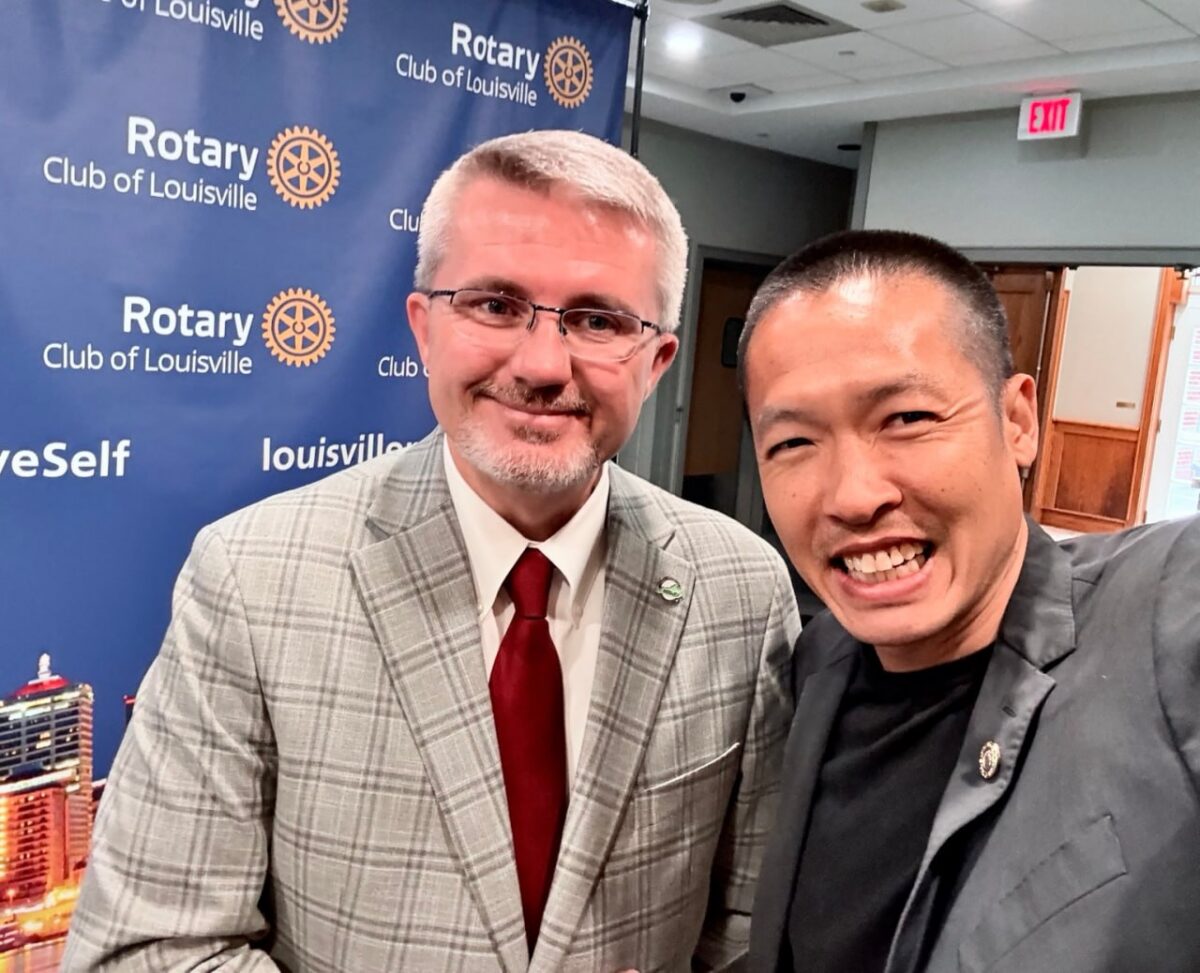
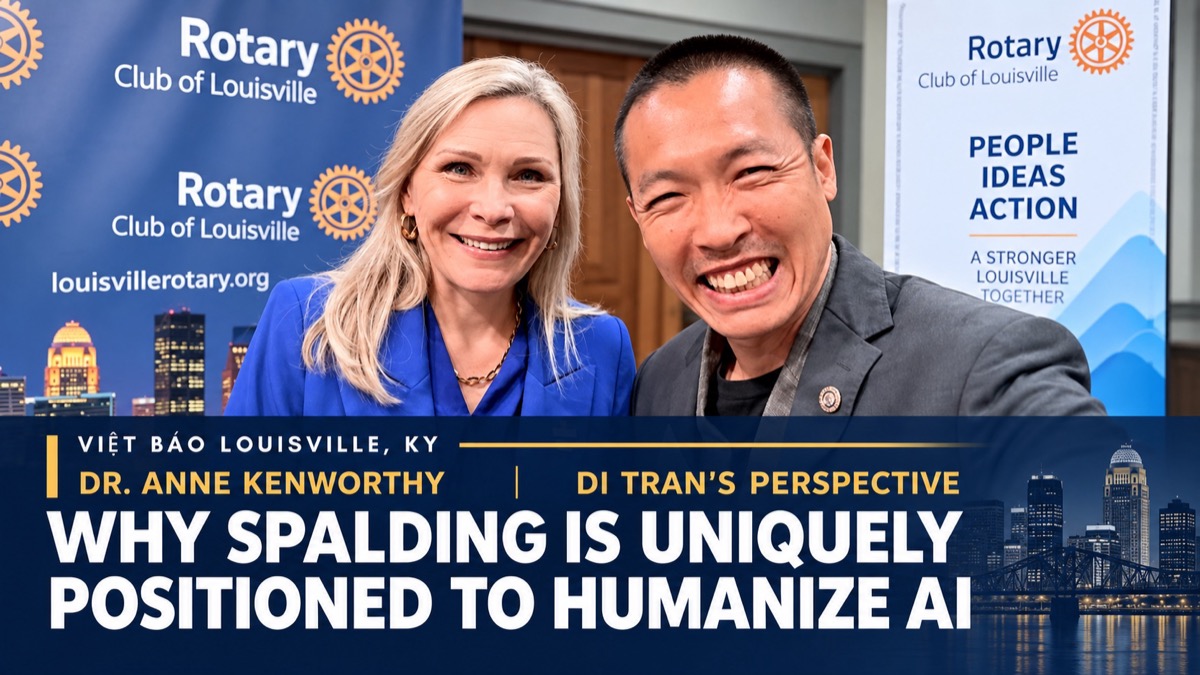
- No endorsement implied: The photograph and event attendance do not imply that President Kenworthy, Dr. Fowler, Spalding University, or Rotary endorses Di Tran, Di Tran University, the books, or the proposal.
Primary and authoritative sources
- Rotary Club of Louisville — September 24 Meeting Featuring Dr. Anne Kenworthy
- Spalding University — Office of the President
- Spalding University — Anne Kenworthy directory profile
- Spalding University — Allison Fowler directory profile
- Spalding University — AI education initiatives
- Spalding University Catalog — Artificial Intelligence Literacy minor
- Spalding University Catalog — Student Use of Artificial Intelligence
- Spalding University — Mission and history
- Kentucky Council on Postsecondary Education — Task Force on AI, Higher Education, and the Workforce
- NIST — AI Risk Management Framework
- NIST — AI risks and trustworthiness
- UNESCO — Guidance for generative AI in education and research
- U.S. Department of Education — Artificial Intelligence and the Future of Teaching and Learning
- American Psychological Association — From anxiety to agency
- American Psychological Association — How school psychologists are using AI in practice
- Louisville Downtown Partnership — Downtown Development Strategy
- Louisville Downtown Partnership — Downtown Investment Map and current indicators
- Association of Independent Kentucky Colleges and Universities — Economic Impact Study Results
- U.S. Census Bureau — Business AI adoption, December 2025–May 2026