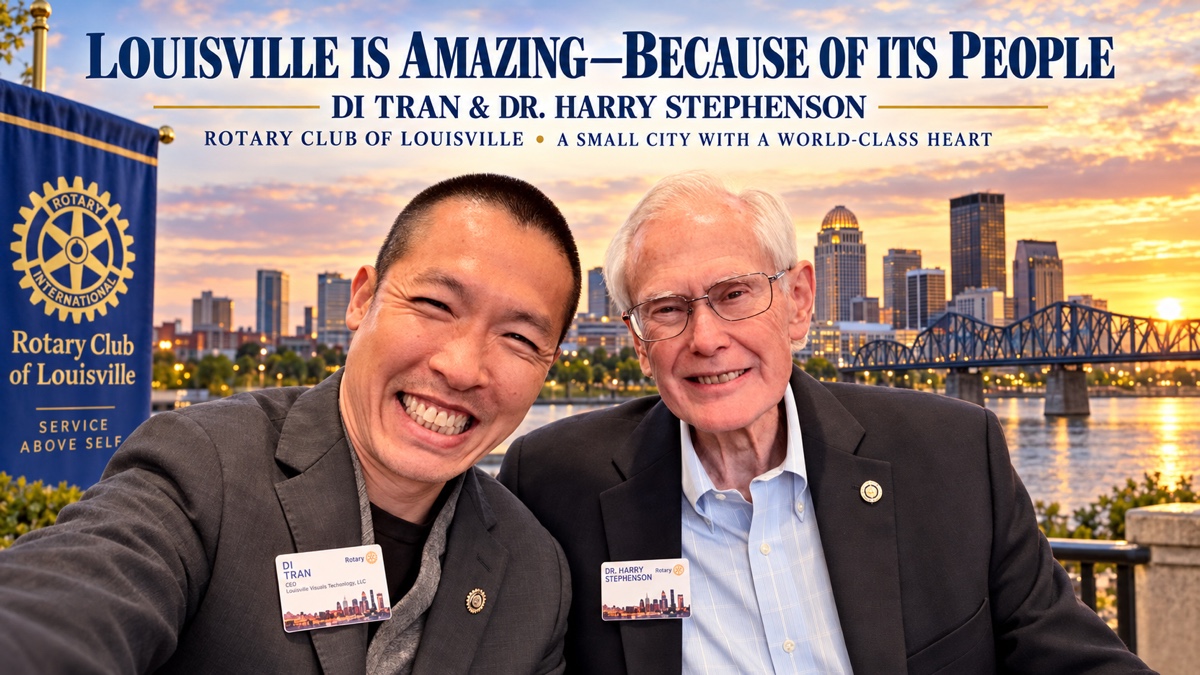
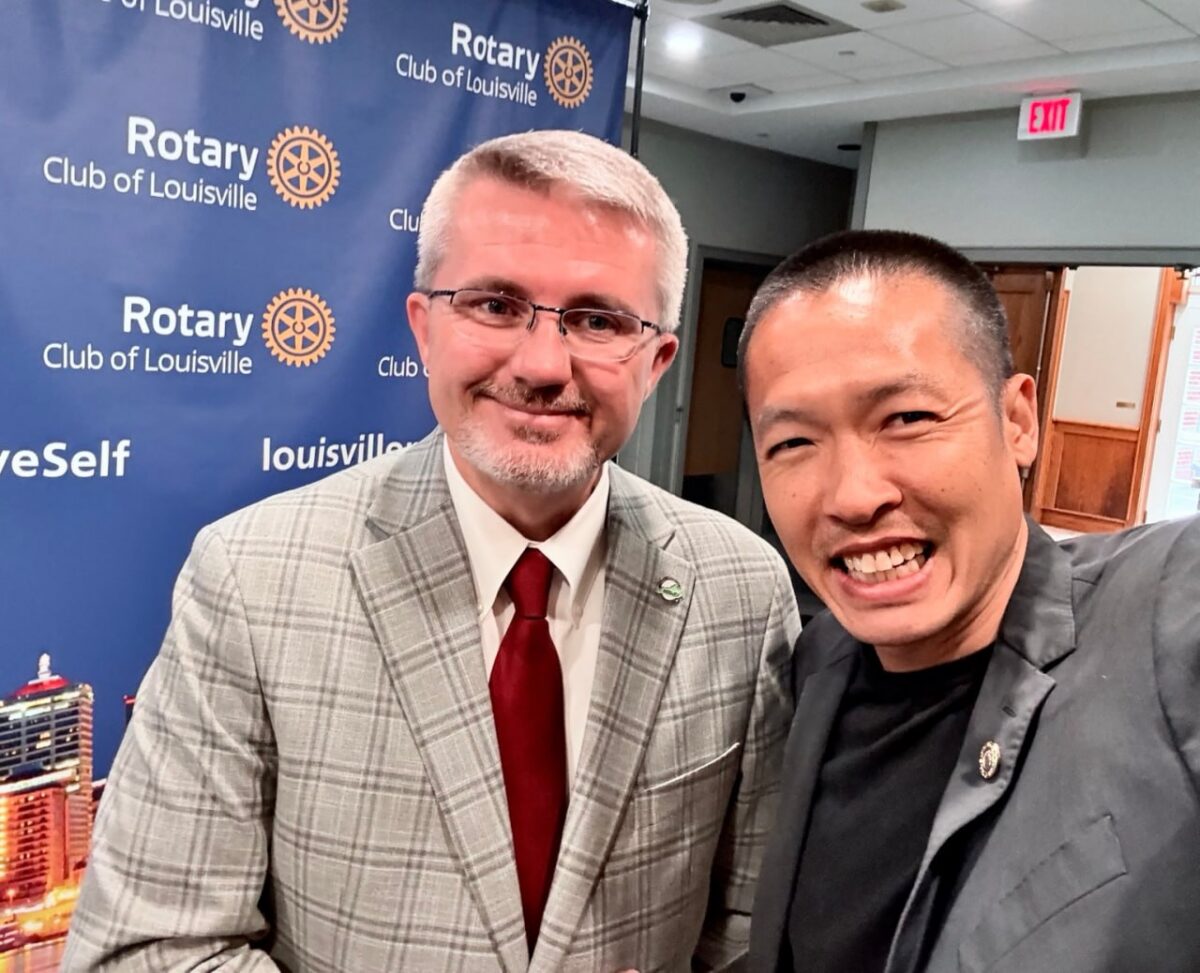
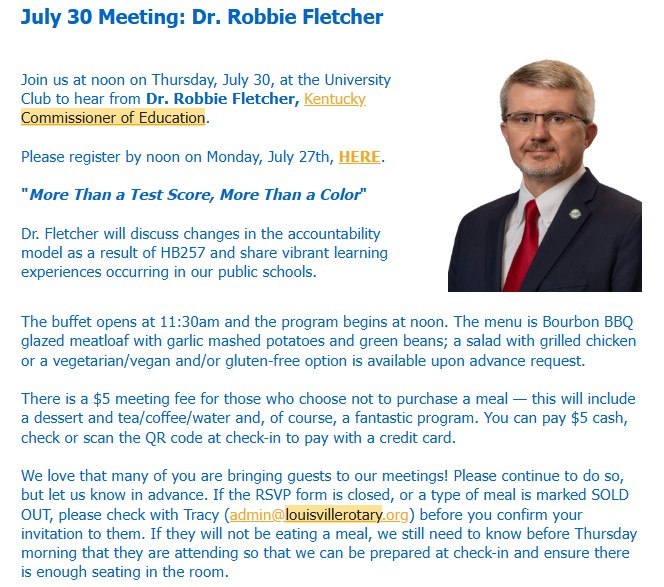
Di Tran with Dr. Harry Stephenson, with the Louisville skyline and Rotary Club of Louisville context.
A reflection by Di Tran on proximity, service, education, and the beautiful human frequency of Kentucky
There are moments in life when you look around and quietly ask yourself: How did I get here?
I came to America with a heart full of dreams—dreams of education, knowledge, learning, service, and the possibility of becoming useful to others. I never imagined that one day, in Louisville, Kentucky, I would sit beside people whose lives had helped shape medicine, education, and communities.
Yet there I was, seated beside Dr. Harry C. Stephenson.
Dr. Harry is not a man who needs to announce his accomplishments. His life already speaks.
The University of Louisville documents his 48-year career in ophthalmology. He was a comprehensive ophthalmologist and cataract surgeon who performed Louisville’s first intraocular lens implant in 1974. He began serving as a volunteer faculty member at UofL in 1972, later joined the faculty full-time, and today is recognized among its emeritus faculty. His commitment to teaching continues through the Harry C. Stephenson, M.D. Visiting Professor Lecture Series and the conference center at UofL that bears his name.
In our personal conversation, Dr. Harry reflected on a career encompassing approximately 20,000 or more surgical cases. That lifetime figure is his recollection, not an independently audited count. But even without a number, the verified record is extraordinary: nearly five decades devoted to sight, patients, medicine, teaching, and service.
What moved me most, however, was not a title, a historic procedure, or a career total.
It was his immediate willingness to help.
As I have been learning about and engaging with Healing Hearts Vietnam, we discussed its work to expand access to life-saving cardiac care for Vietnamese families in need. Healing Hearts Vietnam reports that donors have helped fund more than 700 cardiac surgeries. When Dr. Harry heard about the mission, he did not hesitate. He listened, shared his perspective, and helped connect the conversation with cardiovascular expertise in Louisville—people who could understand the need and speak the same language of medicine, compassion, and service.
That is mentorship in its most human form. It is not simply giving advice. It is opening a door, sharing trust, and connecting good people to other good people so that a child or family may have a better chance.
Louisville: A Small City With a World-Class Heart
People sometimes speak of Louisville as a small city. I see something else: a city intimate enough for meaningful relationships and accomplished enough to influence the world.
Louisville’s medical legacy proves it. UofL Health documents more than 40 heart-care firsts, including Kentucky’s first open-heart surgery and first heart transplant, the world’s first AbioCor self-contained artificial-heart implantation, and the world’s first implantation of the Aeson bioprosthetic total artificial heart in a female patient. This is not simply local pride. It is a record of research, courage, teamwork, and lives changed.
Dr. Harry’s own 1974 breakthrough in eye care belongs to that same Louisville spirit: learn deeply, act carefully, serve people, and keep advancing what is possible.
The beauty of Louisville is not only in what has been invented here. It is in how knowledge travels through relationships. A conversation over lunch can become a mentorship. An introduction can become a collaboration. A local connection can someday help a child thousands of miles away.
Rotary and the Architecture of Human Connection
I am especially grateful to the Rotary Club of Louisville for creating a room where these encounters can happen.
Founded in 1912, the club describes itself today as the 12th largest among Rotary International’s more than 45,000 clubs worldwide, with almost 400 members. Those numbers are impressive, but the deeper value is found in Rotary’s ethic of Service Above Self.
Rotary places educators, physicians, entrepreneurs, nonprofit leaders, civic servants, and lifelong learners at the same tables. It allows a person like me—still learning, still building, still dreaming—to sit beside someone like Dr. Harry and discover that true greatness is often gentle, accessible, and generous.
Simply being in a room with people committed to service changes your sense of what is possible. When we repeatedly place ourselves near disciplined, compassionate, knowledge-seeking people, we begin to resonate with the same frequency. Their example invites us to raise our own standards. Their humility reminds us that achievement reaches its highest purpose when it is used for others.
Small Can Mean Agile—and Human
At today’s Rotary gathering, I also had the privilege of listening to Dr. Anne Kenworthy, the president of Spalding University. She spoke about artificial intelligence, education, and the ability of a smaller institution to move with agility in a rapidly changing world.
That message resonated deeply with me.
Spalding has already made AI literacy part of its commitment to students across disciplines, emphasizing responsible and ethical use in service of the greater good. This is the leadership education needs now. The future does not belong only to the biggest institutions or the loudest voices. It belongs to those willing to learn, adapt, remain human, and apply powerful tools responsibly to real problems.
Being small can be an advantage when it allows us to listen closely, decide thoughtfully, move quickly, and care personally. Technology should not make education colder. Properly guided, it can help us make education more accessible, useful, responsive, and human.
In one Rotary gathering, these ideas came together for me: Dr. Kenworthy speaking about agile, human-centered education; Dr. Harry embodying a lifetime of medical excellence and mentorship; Healing Hearts Vietnam working to help families access cardiac care; and Louisville itself standing quietly behind it all—a city with a global history of healing and innovation.
The Beauty of Kentucky Is Its People
I often ask myself what makes Kentucky beautiful.
Yes, it is the landscape, the traditions, and the history. But more than anything, it is the people who choose to serve.
The beauty of Kentucky is sitting next to a physician who has spent a lifetime caring for patients and still makes time to mentor another person.
It is a university president preparing students to meet technological change with ethics and courage.
It is a Rotary table where people from different professions and generations meet not merely to network, but to ask how they can help.
It is a small city with world-class medicine and a heart large enough to reach children in Vietnam.
To Dr. Harry Stephenson: thank you for your kindness, your mentorship, your introductions, and your continuing spirit of service.
To Dr. Anne Kenworthy: thank you for reminding us that agility, education, and human purpose belong together in the age of AI.
To the Rotary Club of Louisville: thank you for building the kind of room where service-minded people can find one another.
And to Louisville and the Commonwealth of Kentucky: thank you for reminding me again that a beautiful life is not measured only by what we achieve. It is measured by the people we learn from, the people we connect, and the lives we help lift.
Sometimes an amazing day begins simply by taking the seat beside you—and realizing that you are surrounded by greatness.
Editorial note: The approximately 20,000-or-more surgical-case figure is attributed to Dr. Stephenson’s personal recollection as shared with Di Tran; it is not presented as an independently audited institutional statistic.
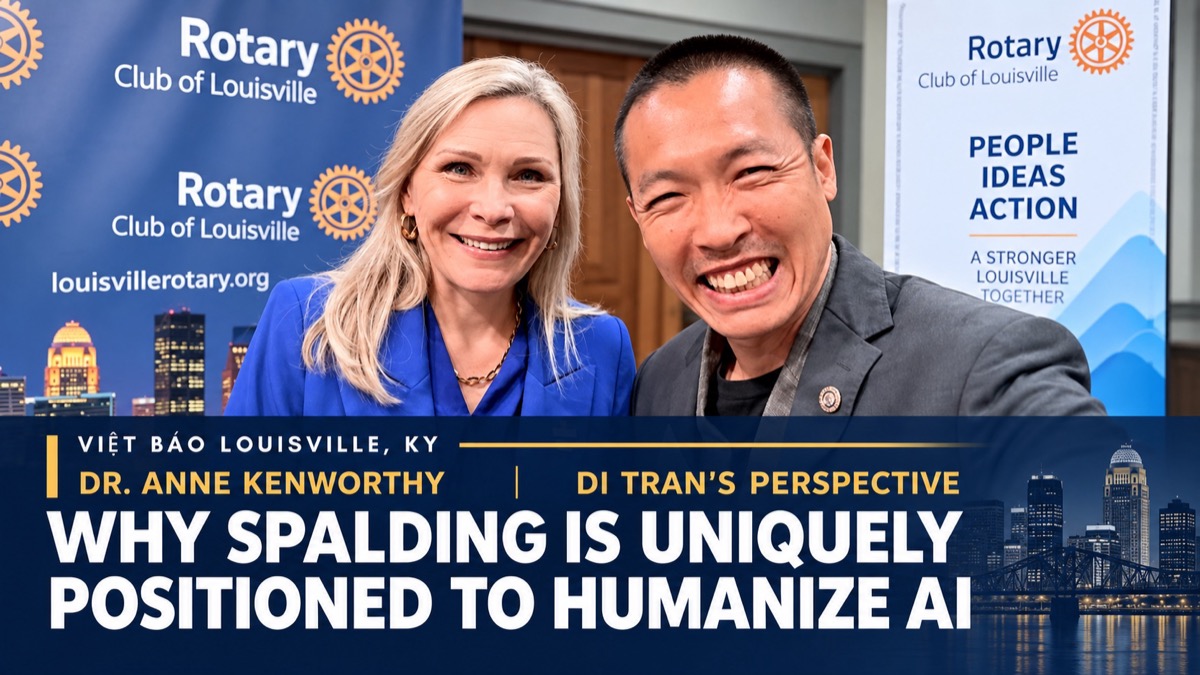
Spalding University President Dr. Anne Kenworthy and Di Tran smiling together at the Rotary Club of Louisville, with a feature headline about humanizing AI.
A Rotary Club of Louisville reflection on Dr. Anne Kenworthy, psychology, women-led service, human-centered implementation, and a city-scale opportunity
By Di Tran September 24, 2026
Today at the Rotary Club of Louisville, I listened to Dr. Anne Kenworthy, Ed.D., MBA, president of Spalding University, speak about an institution that is small enough to move, rooted enough to matter, and courageous enough to confront artificial intelligence as an educational reality rather than a distant possibility.
The official Rotary program gave the address a fitting title: “Spalding University: Meeting the Needs of the Times.” Rotary described a university preparing Kentucky’s healthcare workforce, addressing artificial intelligence, and demonstrating how a smaller institution can act boldly and nimbly. That description is not promotional imagination. It aligns with Spalding’s documented direction: an AI Literacy minor open across disciplines, an Artificial Intelligence for Business concentration, healthcare and human-service programs, and a president who serves on the Kentucky Council on Postsecondary Education’s Task Force on AI, Higher Education, and the Workforce.
I left the room with a realization that felt both new and familiar:
AI is no longer an optional technology project for schools, businesses, or civic organizations. AI implementation is becoming an organizational capability. But implementation without humanization can produce speed without wisdom, automation without trust, and efficiency without dignity.
I use AI systems every day—across education, publishing, operations, research, communication, and business. The more I use them, the clearer the lesson becomes: the future will not belong simply to those who possess the most advanced model. It will belong to those who can combine technology with human judgment, ethical governance, psychological safety, disciplined verification, and real-world application.
That is why what happened at Rotary mattered.
It suggested that Spalding may be standing in a rare strategic position: not merely to teach AI, but to help Louisville build a model of human-centered AI implementation that other institutions and cities could study and adapt.
First, the facts: who is leading Spalding?
Dr. Anne Kenworthy became Spalding University’s 11th president in January 2025. The Rotary Club of Louisville’s official biography describes a leader with 30 years of college teaching experience and prior executive work in enrollment, marketing, strategic initiatives, advancement, adult education, program creation, and philanthropy. Her academic background includes a bachelor’s degree in mathematics, an Ed.D., an M.S., an MBA, and a fundraising-management certificate. Rotary also notes that she helped launch programs for Latino and adult learners, achieved enrollment growth, and secured more than $10 million in philanthropic support before coming to Spalding.
That combination matters. AI transformation requires more than technical fluency. It requires a leader who can understand systems, communicate change, secure resources, widen access, and keep institutional purpose visible while the ground moves.
Spalding’s public record shows that President Kenworthy is already doing more than speaking about AI. She is a member of Kentucky’s official statewide task force examining AI, higher education, and the workforce. Under her presidency, Spalding publicly launched institution-wide AI education initiatives, including:
an 18-credit Artificial Intelligence Literacy minor available to undergraduate students across majors;
an Artificial Intelligence for Business concentration;
coursework in AI for everyone, decision-making, creativity and design, ethics, and the workplace;
interdisciplinary application across nursing, education, psychology, business, social work, and the arts; and
a curriculum partnership with Rize Education focused on career-aligned programs and practical applications.
Spalding has also published a student-use policy that preserves faculty authority to permit or restrict AI in individual courses and asks faculty to communicate expectations clearly. That is a responsible starting point. The next institutional frontier is to connect course-level discretion to a shared implementation architecture: common literacy, privacy standards, verification practices, human-oversight rules, approved-use cases, assessment redesign, and measurable outcomes.
The name I carried out of the room: Dr. Allison Fowler
President Kenworthy also brought the psychological and educational dimensions of AI into view. The name I left remembering was Dr. Allison Fowler.
Spalding’s official directory identifies Allison Fowler, Ph.D., as Undergraduate Program Director and Assistant Professor in the School of Professional Psychology. Her doctorate is in Educational Psychology, Measurement, and Evaluation from the University of Louisville. Her research and teaching focus on developmental theory, achievement motivation, learning, positive classroom community, and evidence-based pedagogy.
That background is highly relevant to responsible AI adoption.
For accuracy, one boundary must remain explicit: the public Rotary program lists President Kenworthy as the featured speaker but does not list a co-presenter, and Spalding’s public directory does not give Dr. Fowler the formal title of “AI director.” I therefore will not manufacture a title or overstate a role. What can be verified is that Dr. Fowler is a Spalding educational psychologist whose expertise sits directly at the intersection of learning, motivation, measurement, and human development.
The larger insight does not depend on an inflated title. Her discipline itself reveals what many AI initiatives still miss.
AI cannot be implemented by engineering alone
For decades, digital transformation has often been narrated as an engineering problem: build the system, integrate the data, automate the workflow, and train the user. Engineering remains indispensable. Data science, cybersecurity, software architecture, product design, and model evaluation are foundational.
But adoption is not merely technical.
It is psychological.
People ask:
Will this tool replace me?
Will it make my work visible in ways I cannot control?
Can I trust its answer?
What happens when it is wrong?
Will using it make me less capable?
Will refusing it make me irrelevant?
Who is accountable when an automated decision harms someone?
How do I preserve my identity, craft, relationships, and professional judgment?
These are questions of cognition, motivation, behavior, identity, trust, anxiety, organizational culture, ethics, and power. A technically impressive system can fail if people fear it, misunderstand it, misuse it, or experience it as something imposed upon them. A simple system can succeed when people understand its purpose, help shape its use, see its limits, and retain meaningful authority.
This is why psychology and the human sciences must not be invited at the end of an AI project merely to explain a finished product. They should be present at the beginning—helping define the problem, map human impact, design adoption, test comprehension, identify fear and resistance, protect vulnerable users, evaluate learning, and measure whether the system actually improves human outcomes.
This conclusion is not philosophical decoration. It is consistent with major public frameworks:
The National Institute of Standards and Technology treats AI as a sociotechnical system and says trustworthiness depends on technical performance together with social and organizational behavior, context, human oversight, transparency, privacy, safety, fairness, and accountability.
UNESCO’s guidance for generative AI in education calls for a human-centered approach that protects human agency, inclusion, equity, cultural diversity, privacy, and age-appropriate use.
The U.S. Department of Education has advocated “intelligence augmentation”—people and AI working together—while keeping humans in the loop and centering human decision-making.
The American Psychological Association has documented both rapid AI adoption and serious concerns about training, policy, privacy, bias, and harm. Its educational guidance calls for moving from anxiety to agency while keeping humans as meaning-makers.
The answer, then, is not “replace engineers with psychologists.” The answer is a higher-order partnership:
Engineers build capability. Psychologists understand behavior and trust. Educators design learning. Domain professionals define responsible use. Communities identify lived impact. Leaders align purpose and resources. Governance keeps the system accountable.
This is humanization in practice.
Why Spalding is unusually well positioned
Spalding does not need to imitate a technology institute to matter in the AI era. Its greatest advantage may be precisely that it is not one.
1. Its origin is service, especially women-led service
Spalding traces its history to 1814, when the Sisters of Charity of Nazareth established the institution that became Spalding University. It began as the first Catholic school for women west of the Allegheny Mountains. Its namesake, Mother Catherine Spalding, is also remembered as a foundational figure in Louisville social work.
That history is not a sentimental footnote. It is strategic DNA: women organizing institutions, educating people excluded from opportunity, caring for those in need, and building social infrastructure long before “innovation ecosystem” became a business phrase.
Today, when AI raises questions about caregiving, belonging, bias, workforce disruption, safety, identity, and access, that service tradition is not behind the times. It is directly relevant to the times.
2. Its mission already contains the right question
Spalding’s mission is to meet the needs of the times through education grounded in spiritual values, service, peace, and justice. Its public description emphasizes a love for students and the city.
AI implementation needs exactly that kind of purpose test:
Whose need are we meeting?
Whose burden are we reducing?
Whose dignity are we protecting?
Who gains access?
Who could be harmed?
What human capacity becomes stronger after automation?
3. Its disciplines are where AI meets real life
Spalding’s portfolio includes nursing, psychology and counseling, social work, occupational therapy, physical therapy, education, business, health sciences, writing, and other applied programs. These are not peripheral to the AI future. They are where AI will be tested against human reality.
In healthcare, an incorrect or decontextualized output can affect a patient. In psychology, privacy and dependency matter. In social work, automated classifications can affect vulnerable people. In education, AI can either deepen learning or disguise its absence. In writing, it can support creativity or flatten authentic voice. In business, it can increase productivity or scale unfairness.
Spalding therefore has the ingredients for interdisciplinary AI governance and applied learning under one institutional roof.
4. Its size can become an innovation advantage
Large systems can marshal enormous resources, but they often change slowly. A smaller university can convene a cross-disciplinary team, approve a bounded pilot, learn from evidence, correct quickly, and scale what works.
Small does not mean weak. Under disciplined leadership, small can mean close to the learner, short in the decision chain, visible in accountability, and fast in adaptation.
5. It is physically anchored where Louisville needs activation
Spalding describes itself as Louisville’s only downtown university. Its campus sits at the southern edge of the downtown core, near healthcare, government, nonprofit, cultural, residential, and small-business activity.
That location is not merely an address. It is a laboratory.
The opportunity: a Human-Centered AI Downtown Living Lab
Louisville does not need another abstract declaration that it wants to be an “AI city.” It needs a place where students, educators, businesses, healthcare workers, public servants, residents, and technologists can implement useful systems under transparent rules and measure what happens.
Spalding could help convene a Human-Centered AI Downtown Living Lab: a bounded, evidence-driven partnership aligned with existing downtown revitalization priorities and open to participation by universities, employers, Louisville Metro, Louisville Downtown Partnership, healthcare systems, nonprofits, small businesses, and community organizations.
This is a proposal—not an existing Spalding or Rotary commitment—and no endorsement should be implied. But the conditions are real.
Louisville Downtown Partnership’s 10-year strategy focuses on activating downtown, strengthening residential life, improving the public realm, and coordinating public-private projects. Its current data show that downtown occupies less than 1% of Louisville’s land but supports more than 67,000 workers, more than 10,000 residents, 35 million annual visits, and $3.2 billion in announced or active investment. Its project tracker also identifies an emerging downtown Education District and calls for stronger coordination around the Fourth Street and Broadway corridors—precisely Spalding’s geography.
Spalding is already an economic anchor. An Association of Independent Kentucky Colleges and Universities study estimated its local economic impact at $105.4 million for fiscal year 2021–22, using direct and induced spending methodology.
The living lab could convert these assets into measurable implementation.
Pillar 1: AI literacy for every discipline
Build a common foundation for students, faculty, staff, and participating employers:
what AI can and cannot do;
prompt and workflow design;
verification and source discipline;
privacy, bias, intellectual property, and security;
human decision authority;
role-specific applications; and
evidence of learning through real work products.
Spalding’s current AI minor and business concentration provide a strong academic base. The next step is a practical literacy layer that reaches every program without pretending every learner must become a software engineer.
Pillar 2: Psychology-led adoption and change design
Create an interdisciplinary adoption team involving educational psychology, clinical psychology, organizational leadership, education, social work, and technology. Before deployment, each pilot should assess:
user fears and expectations;
cognitive load;
accessibility;
trust calibration;
risk of overreliance;
motivation and skill development;
effects on professional identity; and
whether the system increases or reduces meaningful human contact.
The goal is not blind trust in AI. It is calibrated trust: knowing when to use a system, when to verify it, when to override it, and when not to deploy it at all.
Pillar 3: Human-services application studios
Students and faculty could develop bounded prototypes for real community needs, such as:
multilingual navigation of public and nonprofit services;
administrative support that returns time to nurses, therapists, teachers, and case workers;
accessible educational materials;
workforce and career-navigation tools;
appointment, reminder, and resource systems;
community-health communication; and
documentation aids that preserve professional review and confidentiality.
No high-stakes decision should be delegated without validated safeguards, human review, and compliance with applicable privacy and professional rules.
Pillar 4: A downtown small-business AI implementation clinic
National Census data show a practical adoption gap: overall reported business AI use was roughly 17%–20% from late 2025 through early May 2026, while adoption was higher among larger firms and lower among the smallest businesses.
That gap is an economic-development opportunity.
Spalding students and supervised partners could help downtown businesses identify one safe, measurable workflow at a time:
customer-service knowledge bases;
multilingual communication;
inventory and scheduling support;
document organization;
marketing review;
employee training;
accessibility improvement; or
fraud and error detection.
Each engagement should begin with the question: What specific value are we creating for a real person?
Pillar 5: Education as visible downtown activation
Turn vacant or underused space into public learning:
evening AI literacy sessions;
student demonstration days;
small-business clinics;
psychology and trust workshops;
responsible-use help desks;
youth and adult learner studios;
multilingual community sessions; and
public exhibitions of verified student work.
This connects AI education to foot traffic, workforce development, community confidence, and the downtown strategy’s goal of activation.
Pillar 6: Transparent governance and public measurement
Use NIST’s Govern–Map–Measure–Manage structure. Every pilot should publish a plain-language record of:
the problem being addressed;
the people affected;
the data used;
the human decision-maker;
foreseeable risks;
prohibited uses;
evaluation measures;
incident and correction procedures; and
results, including failures.
Louisville should not compete to deploy the most AI. It should compete to produce the most useful, trustworthy, replicable, and human-centered implementation.
A practical 12-month pilot
A serious vision needs a sequence.
Months 1–3: Govern and map
Convene a cross-disciplinary steering group.
Select three low-risk, high-value use cases—one in education, one in human services, and one in small business.
Establish privacy, security, accessibility, procurement, disclosure, and human-oversight rules.
Record baseline measures: time, cost, error rate, user satisfaction, stress, access, and learning quality.
Months 4–6: Train and prototype
Train participants in AI literacy, verification, and role-specific use.
Conduct psychological-safety and change-readiness sessions.
Build limited prototypes with no unsupervised high-stakes decisions.
Run red-team tests for bias, hallucination, privacy leakage, accessibility, and misuse.
Months 7–9: Pilot in real settings
Deploy to small, consenting groups.
Maintain human review and incident logging.
Measure whether the tool improves service rather than merely increasing activity.
Collect feedback from users, workers, students, and community partners.
Months 10–12: Evaluate and publish
Compare outcomes with the baseline.
Stop or redesign weak pilots.
Publish results and safeguards in plain language.
Create a replication guide for another Louisville organization or neighborhood.
The scoreboard should include hours returned to human service, verified error rates, user trust, learning gain, cost per successful outcome, number of small businesses assisted, accessibility improvements, and documented cases where human review prevented harm.
My own work reached the same conclusion from another direction
I came to this Rotary meeting not as a neutral observer of AI, but as a daily implementer, educator, software builder, business operator, and author.
Through Di Tran University and the College of Humanization, I have written more than 200 books, including a three-part Humanized AI education framework—a practical humanization blueprint for the student, the teacher, and the school:
Those books argue that technology should not reduce the human role. It should remove mechanical burden so people can contribute more judgment, care, creativity, mentorship, responsibility, and presence.
My more recent research, From Tool Fascination to Value Creation, puts the implementation test plainly: What problem is being solved? What value will success create? Where must human judgment remain primary? What evidence will verify the result? What risks must be controlled?
Today, Spalding’s presentation helped me see an additional dimension with sharper clarity: psychology cannot be downstream from AI implementation. Human understanding must be part of the architecture.
That insight strengthens, rather than competes with, engineering. It makes technical work more adoptable, more accountable, and more useful.
Louisville can lead by becoming more human, not merely more automated
Louisville has world-class healthcare, logistics, manufacturing, education, hospitality, bourbon, arts, nonprofit service, and immigrant entrepreneurship. It also has a downtown undergoing significant reinvestment and an education corridor already identified in the public development strategy.
The city does not need to copy Silicon Valley’s identity. It can build its own.
Louisville can become known as the place where:
AI implementation serves ordinary people and small organizations;
education produces verified ability, not only credentials;
healthcare automation returns time to care;
psychology shapes adoption and trust;
immigrant and multilingual communities gain access rather than exclusion;
students solve real civic and business problems;
governance is transparent;
failures are documented and corrected; and
automation makes human service more available, not less.
That would be technological leadership with a Louisville character: practical, relational, service-oriented, and accountable.
Gratitude—and an invitation
Thank you to Dr. Anne Kenworthy for speaking with urgency and optimism. Thank you to Dr. Allison Fowler for representing the human science that must sit beside technical implementation. Thank you to the faculty, staff, students, trustees, Sisters of Charity of Nazareth, and community partners who carry Spalding’s mission forward.
And thank you to the Rotary Club of Louisville—its officers, program leaders, staff, volunteers, members, and the University Club team—for continuing to create a room where civic ideas can become relationships and where relationships can become service.
Rotary’s value is not only that leaders speak. It is that a community listens, reflects, connects, and acts.
The realization I carried home is simple:
AI may be the most powerful automation technology of our time. Humanization must be the operating system around it.
Spalding University—with its women-led origins, service mission, psychology and human-services expertise, growing AI curriculum, nimble scale, and downtown location—has the ingredients to help Louisville prove what that can mean.
The next step is not another slogan.
It is one governed pilot, one verified outcome, one human problem solved, and one transparent lesson at a time.
Editorial fact-check note
Verified: Dr. Anne Kenworthy is Spalding University’s 11th president and began the role in January 2025.
Verified: Rotary’s September 24, 2026 program was titled “Spalding University: Meeting the Needs of the Times.”
Verified: Dr. Allison Fowler is Spalding’s Undergraduate Program Director and Assistant Professor in the School of Professional Psychology, with a Ph.D. in Educational Psychology, Measurement, and Evaluation.
Not independently verified from the public event listing: Dr. Fowler’s exact speaking role at the September 24 Rotary program or any formal title as Spalding’s AI leader. The article intentionally does not assign either claim.
Proposal status: The Human-Centered AI Downtown Living Lab is Di Tran’s proposed framework, not an announced program or commitment of Spalding University, Rotary Club of Louisville, Louisville Metro, or Louisville Downtown Partnership.
No endorsement implied: The photograph and event attendance do not imply that President Kenworthy, Dr. Fowler, Spalding University, or Rotary endorses Di Tran, Di Tran University, the books, or the proposal.
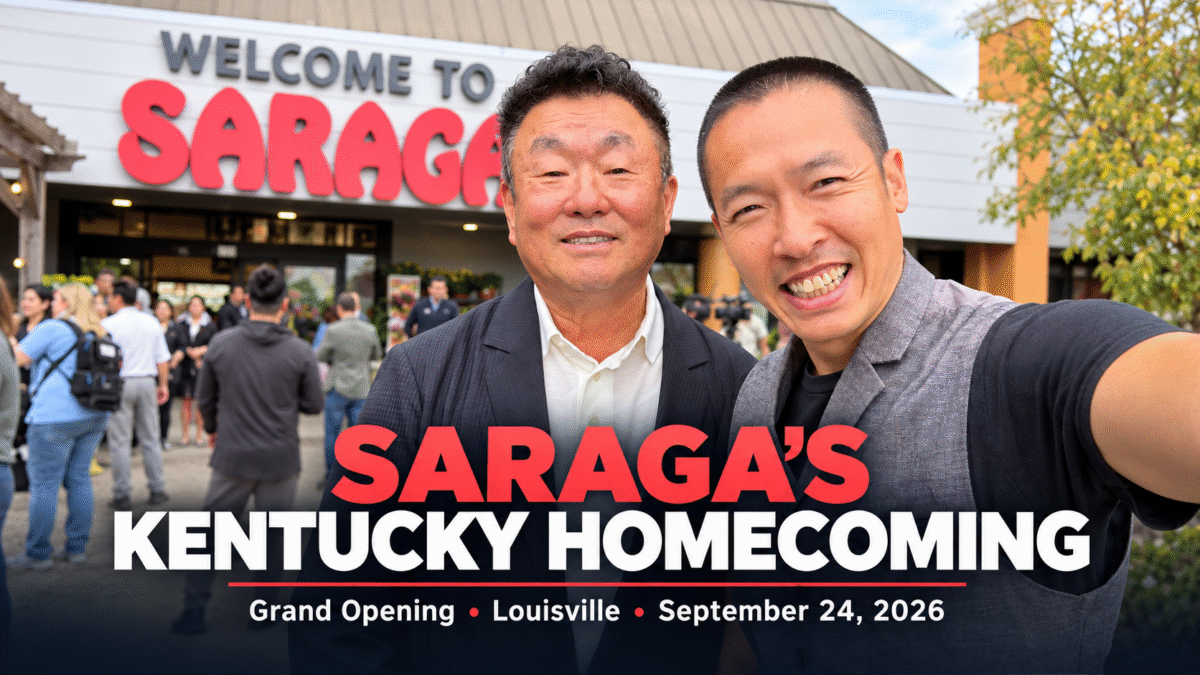
Louisville entrepreneur Di Tran with a Saraga family-business leader at the September 24, 2026 grand opening of Saraga International Grocery’s first Kentucky store.
Viet Bao Louisville proudly republishes this community-business feature from the New American Business Association, celebrating immigrant entrepreneurship and Saraga International Grocery’s first Kentucky location.
LOUISVILLE, Ky. — The grand opening of Saraga International Grocery at 200 N. Hurstbourne Parkway was more than the arrival of another supermarket. For Louisville’s Asian American community—and especially for Korean American families—it was a visible reminder of what can grow from decades of sacrifice, disciplined work, family responsibility, and service to others.
Di Tran, a Louisville serial small-business owner, educator, and immigrant entrepreneur, was proud and honored to attend the opening alongside members of Louisville’s Korean and broader Asian communities. To Tran, the crowded aisles, global food selection, food court, employees, customers, and celebratory gathering represented something much larger than retail. They represented the long arc of immigrant enterprise: beginning small, serving real needs, reinvesting repeatedly, enduring risk, and building an institution that creates opportunity for the next generation.
“To witness a Korean immigrant family turn years of sacrifice, risk, and seven-day work into a beautiful market of this scale is beyond inspiring,” Tran said. “It is a proud day for the Korean community, the Asian American community, Louisville, and Kentucky. This is what it looks like when hard work becomes service, jobs, investment, and a lasting contribution to America.”
A First for Kentucky—and a Return to Earlier Roots
Saraga’s Louisville store is the family-owned company’s first location in Kentucky. The approximately 34,000-square-foot market occupies the former Lucky’s Market space in The Forum Center and carries more than 10,000 foods and goods from cultures around the world. Shoppers can find fresh produce, meat, seafood, pantry goods, frozen items, specialty ingredients, and prepared food offerings, including Korean food. The Louisville store joined Saraga’s three Indianapolis-area and three Columbus-area locations, making it the company’s seventh market location at opening. (WDRB/WAVE; Louisville Courier Journal report)
Yet calling Louisville simply a “new market” would miss an important part of the story. Saraga’s roots already run through Kentucky.
The company’s history says two young Korean brothers began selling food products from a truck in the early 1990s, traveling through Kentucky, Florida, West Virginia, and remote communities. John and Bong Sung opened their first small Saraga grocery in Bloomington, Indiana, in 1994. The name reflects the Korean idea of living or building a life, and the brothers’ stated mission centered on providing the food and goods people need for daily life. (Saraga company history)
Local reporting added an even more personal Louisville connection: before the family entered the grocery business, manager Jun Sung said his father bought and sold wholesale goods along Louisville’s Seventh Street corridor. That history gives the new store the feeling of a homecoming—a family enterprise returning to the city where part of its working life took shape. (WLKY)
From a Modest Truck to a Multistate Family Enterprise
Saraga’s development did not happen overnight.
After the first Bloomington store opened in 1994, the family spent more than a decade learning the business and serving customers. In 2005, it opened a 62,000-square-foot international grocery in north Indianapolis. Additional stores followed in the Indianapolis and Columbus markets. Saraga’s own history acknowledges “trouble and adversity,” failures as well as successes, and a continuing commitment to quality, price, and service. (Saraga company history)
That honesty matters. Entrepreneurship is often celebrated only after the ribbon is cut. The public sees the finished building, bright shelves, full parking lot, cameras, flowers, and smiling faces. It does not always see the years of early mornings, late nights, uncertain cash flow, supplier relationships, leases, construction, permits, hiring, inventory, family tradeoffs, and seven-day workweeks that make an opening possible.
Tran understands that unseen side personally. As a Louisville entrepreneur who has helped build businesses and educational organizations, he recognizes that every expansion represents more than money. It represents risk carried by people: owners who sign commitments, family members who sacrifice time, employees who help build systems, vendors who trust the vision, and customers who decide whether the business will endure.
The Louisville project was reported in 2024 as an approximately $4 million renovation investment. The completed market now restores an approximately 34,000-square-foot grocery space that had been vacant since Lucky’s Market closed in 2020. Saraga has also recruited locally across multiple functions, including cashier, grocery, meat, seafood, warehouse, cleaning, and supervisory work. Because a final public headcount was not available at publication, the opening is best described as creating and supporting local jobs without assigning an unverified number.
Korean-Founded, International in Service
Saraga is deeply rooted in a Korean American family story, but its mission reaches far beyond a single community.
Its shelves bring together products associated with Korea, Japan, China, the Philippines, Indonesia, India, Africa, Latin America, Europe, the Mediterranean, Mexico, Thailand, Vietnam, and the United States. Saraga’s Ohio organization describes the company as a community hub where customers can find “a piece of home,” with products from more than 50 countries. (Saraga vision and mission)
That is why an international grocery store matters in an immigrant city. Food is not merely a product. It carries language, memory, family rituals, health practices, holidays, and belonging. A familiar vegetable, spice, noodle, sauce, grain, or snack can shorten the emotional distance between a family’s present home and the place from which it came.
For longtime Louisville residents, the store is also an invitation to learn. A market like Saraga allows neighbors to encounter one another through everyday life—not through abstraction, but through meals, ingredients, conversations, and shared curiosity. Korean entrepreneurship provides the platform; many cultures are welcomed through the doors.
Small Business Is America’s Economic Foundation
Saraga has grown into a regional chain, but its origin remains a classic small-business story: two brothers, a truck, direct customer service, reinvestment, and gradual expansion.
The national economic context supports Tran’s belief that small businesses are foundational to the United States. The U.S. Small Business Administration’s Office of Advocacy reported in 2026 that America had approximately 36.2 million small businesses, representing 99.9% of U.S. businesses, employing 62.3 million people, and accounting for 43.5% of gross domestic product. (SBA Office of Advocacy)
Those numbers become real in places like Saraga. Capital becomes construction. Empty space becomes an active market. Inventory becomes cultural access. Hiring becomes household income. A family’s private risk becomes a public asset.
The impact also multiplies. A store of this scale supports growers, distributors, importers, logistics providers, contractors, food entrepreneurs, restaurant operators, maintenance teams, and neighboring businesses. Customers who once traveled farther for culturally familiar foods gain a local option. Louisville gains another destination that reflects its increasingly international character.
A Day of Pride—and a Call to Support Builders
For Tran, being present at the grand opening was an act of respect. It was a way to honor the Sung family and the many hands whose labor brought the Louisville store to life. It was also a reminder that immigrant achievement is rarely an individual story alone. Family, employees, customers, community associations, professional relationships, and years of trust all contribute to what the public eventually sees.
“We should celebrate this business not only because it is large and beautiful, but because of what it took to build,” Tran said. “Every shelf represents planning. Every employee represents opportunity. Every customer represents trust. Every family business that survives and grows strengthens the community around it.”
Tran offered his congratulations, prayers, and continued support to John and Bong Sung, the Sung family, Saraga’s employees, the Korean American community, and everyone who helped make the first Kentucky store possible.
The September 24 opening should be remembered as more than a commercial milestone. It is a Kentucky homecoming for an immigrant-founded family enterprise whose earliest routes included this state. It is a major Korean American business achievement. It is a multicultural gathering place. It is a multimillion-dollar vote of confidence in Louisville. And it is living proof that patient, service-centered entrepreneurship can grow from a truck into an institution.
Saraga means living. In Louisville, its newest chapter now lives among us.
This article is a Di Tran civic reflection for Viet Bao Louisville. It honors public service, Rotary values, and the broader human meaning of diversity. It is not an official statement of the Rotary Club of Louisville unless separately approved by Rotary leadership.
There are moments in civic life when a meeting becomes more than a meeting.
It becomes a mirror.
It shows a community what it already has, what it still needs, and what kind of leadership can help it move forward with dignity. The recent Diversity, Equity, and Inclusion conversation within the Rotary Club of Louisville carried that kind of energy. It was not merely a committee gathering. It was a reminder that inclusion is not a slogan, a narrow category, or a political phrase. Inclusion is the disciplined civic practice of seeing the whole human being.
That is why the story of Rene Brown matters.
A Life That Refuses One Category
Rene Brown’s background is not one-dimensional. It is not reducible to a title, a profession, a race, a resume line, or a committee role. His public life reflects service across multiple domains: military service, health care, ministry, education, business, community development, and international human concern.
Louisville Metro’s public profile identifies Rene Brown as the founder and senior pastor of Living Faith Christian Ministries and CEO of RCB Health Corporation. The same public profile describes his service in the U.S. Army and lists a Bronze Star Medal for valor. That kind of record is not incidental to a Rotary conversation. It belongs at the center of it.
For Rotary, service is not decoration. Rotary International describes its mission as providing service to others, promoting integrity, and advancing world understanding, goodwill, and peace through the fellowship of business, professional, and community leaders. The Rotary Club of Louisville, with its long civic history since 1912 and its present scale as one of the largest Rotary clubs in the world, has a special responsibility to make that mission visible in the life of Louisville.
Diversity Is Bigger Than One Word
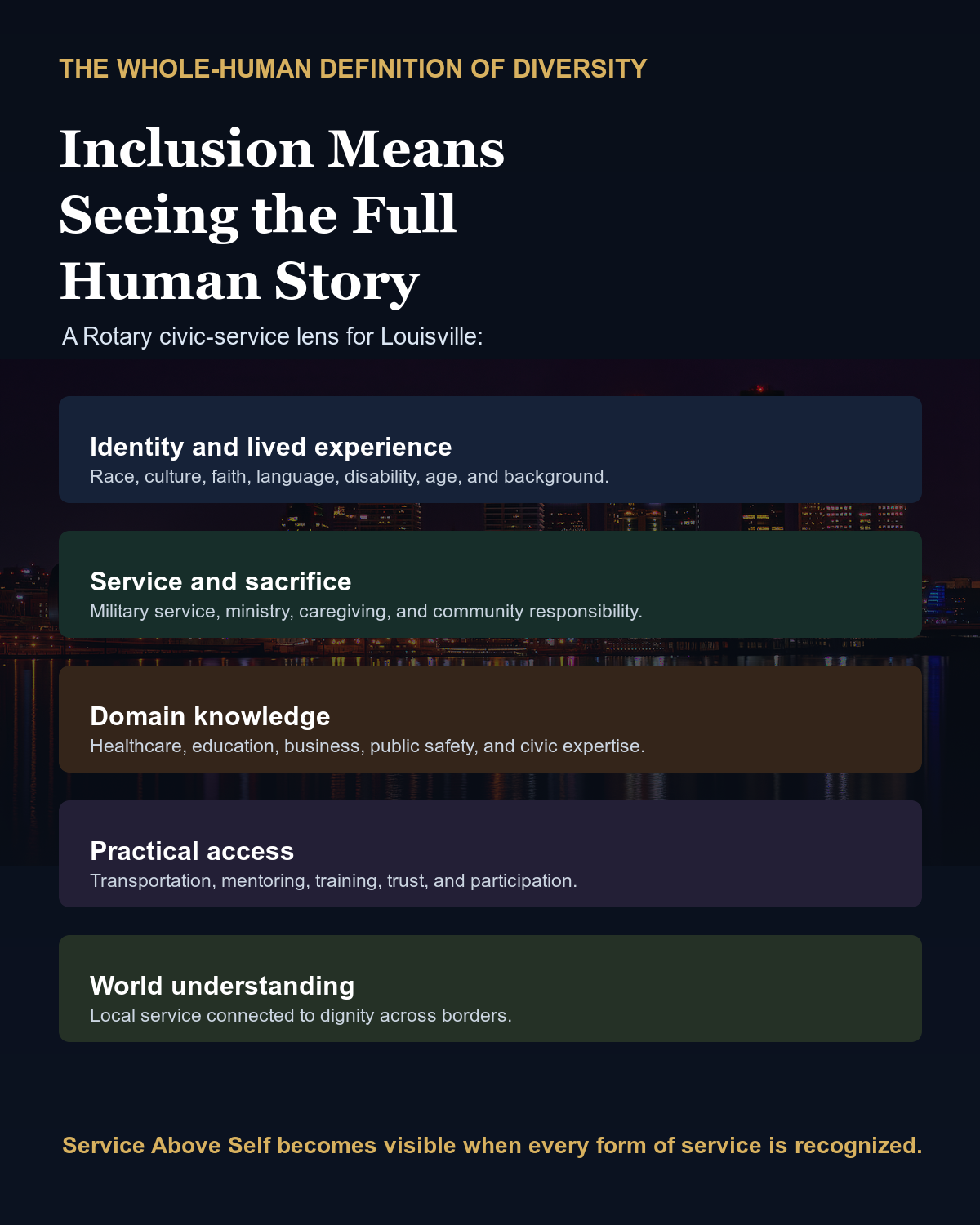
At its best, diversity is not a narrow exercise in counting demographic categories. Race matters. Culture matters. Ethnicity matters. Gender, faith, language, disability, age, socioeconomic condition, and lived experience matter. But diversity also includes domain knowledge. It includes professional discipline. It includes military service. It includes caregiving. It includes ministry. It includes entrepreneurship. It includes international exposure. It includes the wisdom that comes from struggle, responsibility, and years of showing up for people when the work is hard.
That broader understanding is deeply aligned with Rotary’s own statement on diversity, equity, and inclusion, which recognizes diversity across backgrounds, identities, ideas, values, and beliefs. In that sense, Rene Brown’s story offers a powerful local example: inclusion becomes strongest when a community honors not only who a person is, but also what that person has carried, built, studied, served, and sacrificed.
A whole-human diversity frame for Louisville civic service: identity, service, expertise, practical access, and world understanding.
Inclusion Must Become Practical
Rene’s work through Living Faith and related community development efforts points toward a practical, grounded form of inclusion. Living Faith Community Development Corporation publicly describes work connected to families, youth, workforce support, tutoring, resume help, meeting space, and community resources. This is the language of everyday human need. It is not abstract. It is transportation, education, mentoring, employment preparation, space, and trust.
That matters because the most meaningful diversity work is not performed only in speeches. It is proven in systems that help people participate.
A student who lacks transportation is not fully included.
A veteran whose service is honored but whose transition needs are ignored is not fully included.
A young person with talent but no mentor is not fully included.
A family with hope but no access to training, technology, or trusted guidance is not fully included.
A professional with deep experience but no invitation into civic leadership is not fully included.
This is why the Rotary Club of Louisville has such a meaningful opportunity. The club’s civic scale, history, and membership base give it the ability to define inclusion in a way that is worthy of Louisville: practical, intergenerational, cross-cultural, professionally serious, and rooted in service.
A Louisville Room Big Enough for the Whole Story
From Di Tran’s perspective as a member of the Rotary Club of Louisville Diversity, Equity, and Inclusion Committee, Rene Brown’s leadership points toward a higher standard. The first meetings are not simply about attendance. They are about moral tone. They are about whether people feel that the room is big enough for their whole story.
This matters especially in Louisville, a city whose civic future depends on trust across institutions, neighborhoods, professions, cultures, faith communities, and generations. Louisville cannot afford a shallow definition of diversity. It needs a definition large enough to include the veteran, the immigrant, the pastor, the entrepreneur, the student, the health care worker, the educator, the tradesperson, the retiree, the young leader, the lifelong resident, and the newcomer.
It needs a definition that includes race and goes beyond race. It needs a definition that includes identity and also honors expertise, sacrifice, service, condition, and contribution.
Diversity is not only who is represented in the room. Diversity is what kind of wisdom the room is willing to receive.
Service Above Self, Locally and Globally
The connection to international service is equally important. In recent Rotary conversations, the work of Healing Hearts Vietnam and the broader question of global service entered the discussion. That matters because Louisville’s civic leadership cannot stop at the edge of the city. Rotary has always carried a local and international imagination. World understanding, goodwill, and peace are not distant ideals. They begin when local leaders learn how to see suffering, dignity, skill, and service across borders.
Rene Brown’s life appears to stand at that intersection: local service, national service, faith-based service, professional service, and openness to international service. That combination is rare. It is also exactly the kind of human story Rotary should know how to honor.
For Louisville, the lesson is clear.
Diversity is not only who is represented in the room. Diversity is what kind of wisdom the room is willing to receive.
Equity is not only a statement of fairness. Equity is the work of removing practical barriers so people can contribute.
Inclusion is not only welcoming people to sit down. Inclusion is listening deeply enough that their service, pain, expertise, and hope can shape the work.
The Room Louisville Needs
Rene Brown’s story deserves to be understood in that larger frame. It is a Louisville story because it is about service to community. It is a Rotary story because it reflects leadership beyond self. It is a DEI story because it expands the meaning of belonging beyond categories and into contribution. It is an international story because true service always teaches us to see human dignity across borders.
And it is a reminder that the strongest civic rooms are not the rooms where everyone is the same, or where everyone says the same words.
The strongest rooms are the rooms where every honest form of service can be recognized.
That is the kind of room Louisville needs.
That is the kind of Rotary conversation worth building.
And that is the kind of inclusion that can make Service Above Self visible again, not as a motto on a wall, but as a living practice in the city.
Louisville, Kentucky does not lack amazing people.
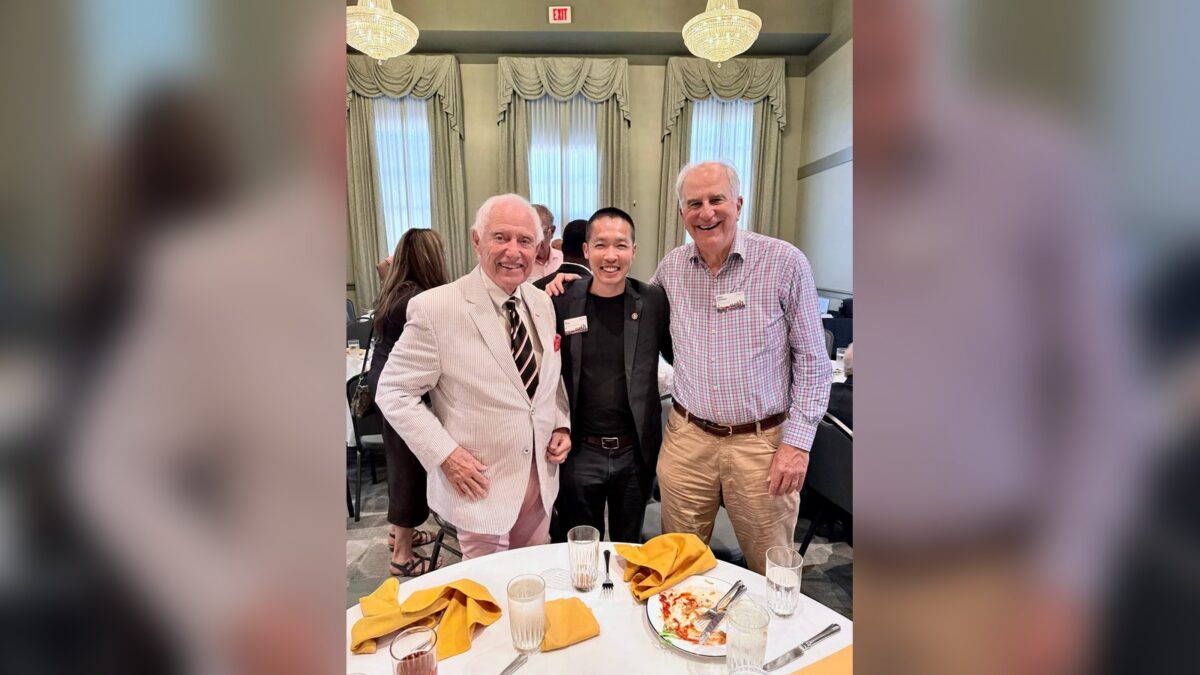
That sentence sounds simple. It is not. It is a civic thesis. It is also a lived conclusion from someone who arrived in America from Vietnam, grew up feeling small in rooms that seemed too large, and later found himself sitting in the middle of a Louisville civic lunch between two men whose education and public-service resumes would intimidate almost anyone: Frederic "Fred" Cowan and Lacey T. Smith.
For Di Tran, Founder and Chancellor of Di Tran University and founder of Louisville Beauty Academy, the September 3, 2026 Rotary Club of Louisville lunch at the University Club was not merely an event on a calendar. It was a quiet summit of memory, humility, aspiration, and observation. On one side stood the life he came from: a Vietnamese childhood before college was even imaginable, before elite universities had any emotional reality, before the word "Harvard" belonged anywhere near his own story. On the other side stood the life Louisville allowed him to encounter: judges, former legislators, attorneys, civic elders, service leaders, and a candidate for the United States Senate speaking in the same room.
The beauty of that moment is not that Di Tran became important. The beauty is that Louisville made proximity possible.
In a city that outsiders sometimes underestimate, a Vietnamese American immigrant founder could sit, listen, learn, and observe among men whose lives had touched law, state government, courts, education, and public leadership long before Di was born in Vietnam. That is the real civic miracle. Not celebrity. Not status. Not applause. Proximity to excellence. Access to example. A living classroom.
A Lunch That Became a Civic Text
The Rotary Club of Louisville publicly lists its September 3, 2026 meeting as featuring Charles Booker, "Candidate for United States Senate." The Club's own public materials describe the Rotary Club of Louisville as nearly 400 members strong, the 12th largest club among Rotary International's 45,000-plus clubs worldwide, and as a civic space whose weekly Thursday luncheons bring together business, professional, and civic leaders.
That matters because institutions shape rooms, and rooms shape people.
Rotary's traditional language of "Service Above Self" is not merely ceremonial when practiced seriously. It describes a discipline: gather people who have done different kinds of work, let them hear one another, let younger builders sit near older builders, let public servants meet business owners, let immigrants sit beside graduates of institutions once unimaginable to them, and let the city's future be formed by repeated exposure to responsible people.
For Di Tran, that lunch was a reminder that Louisville's greatness is often hidden in plain sight. The city does not always market itself like New York, Boston, Washington, D.C., or San Francisco. But Louisville has a rare quality: it can place a first-generation Vietnamese American institution builder in direct human proximity to people who have shaped Kentucky law and civic life.
That is not small. That is a form of public wealth.
Fred Cowan: A Kentucky Career Across Three Branches
Frederic J. "Fred" Cowan Jr. is one of Louisville's unusually accomplished public-service figures. Public records and biographical sources identify him as a Louisville attorney, former Kentucky State Representative, former Kentucky Attorney General, and former Jefferson Circuit Court judge.
His career is remarkable because it crosses the three branches of Kentucky state government.
In the legislative branch, Cowan represented Jefferson County's 32nd District in the Kentucky House of Representatives from 1982 to 1987. In the executive branch, he served as Kentucky Attorney General from 1988 to 1992, occupying the role of the Commonwealth's chief legal officer. In the judicial branch, he served as a Jefferson Circuit Court judge after being elected in 2006.
That sequence is rare because each branch demands a different temperament.
A legislator must persuade. An attorney general must lead statewide legal responsibility. A judge must exercise restraint, independence, and disciplined judgment. To move through all three is not merely to collect titles. It is to submit oneself repeatedly to different tests of public trust.
Cowan's educational background adds another layer. Public profiles list Dartmouth College for undergraduate education and Harvard Law School for legal education. Dartmouth and Harvard are not merely famous names. In the story of Louisville civic life, they become evidence that national educational capital can return to Kentucky and be placed in service of local law, courts, and community leadership.
For Di Tran, sitting beside such a figure was not about social display. It was about absorbing the structure of a life built through study, public trust, and disciplined service.
Lacey T. Smith: Law, Legislature, Local Government, and Civic Memory
Lacey T. Smith also represents a classical civic-leadership path: education, law, elected service, government counsel work, judicial or probate-related service, negotiation expertise, and long legal practice in Louisville.
Public and profile sources identify Smith as a Louisville attorney and former Kentucky State Senator. Di Tran's supplied event/profile context further identifies Smith as having served as legal counsel to a mayor, as a probate judge, and as a figure known for international trade expertise. Public podcast-profile material describes him as a renowned expert in negotiation. Public legal-directory material lists Smith with a Harvard legal credential, and additional public material associates him with deep Louisville legal and civic life.
Smith's undergraduate education is associated with Hamline University, a private university in Saint Paul, Minnesota, founded in 1854 and described by Hamline as Minnesota's first university. That matters because the story is not simply Harvard. It is the arc from formative education to law to public responsibility.
Together, Cowan and Smith form an extraordinary pair: two Louisville-connected public-service men tied to Harvard Law School, state legislative service, legal practice, and civic responsibility. In Cowan, one sees the architecture of Kentucky public law across branches of government. In Smith, one sees the older civic lawyer's range: law, government, negotiation, local leadership, and, by Di Tran's account, international trade vision.
Yet the strongest lesson is not elitism. It is transmission.
What does a city transmit when a younger immigrant founder can stand between two elder public servants? It transmits the idea that leadership is observable. That excellence is not abstract. That public service is not only something read in textbooks, but something carried in faces, stories, posture, restraint, and presence. It also transmits something more practical: serious people do not only talk about local pride. They ask how local excellence can travel responsibly into the world.
The Mud Hut, the First College Graduate, and the Feeling of Being Small
Di Tran has often described his origin with plain language: a boy from a mud hut in Vietnam.
That phrase should not be romanticized. Poverty is not poetry when one is living inside it. A mud hut is not a metaphor to the child who sleeps there. It is a boundary of imagination. It can make the world feel fixed, distant, and already decided.
Before Di Tran could dream of elite education, he first had to dream of education at all. In his telling, he became the first person across generations on both sides of his family to attend and graduate college. That is not an individual credential only. It is a break in a generational ceiling.
There is a special humility in such a life. A person who comes from little and enters rooms of high public achievement may feel both gratitude and disbelief. He may feel small. But smallness, when not poisoned by shame, can become a powerful form of attention.
To sit between Fred Cowan and Lacey Smith was to sit between two living archives of Kentucky civic service. To listen to Charles Booker speak was to observe another form of public life: a newer voice, shaped by Louisville, race, representation, poverty, state politics, and democratic aspiration.
For Di Tran, the lunch was beautiful because it compressed time.
Vietnam before college. Kentucky after immigration. The mud hut. The first degree. The beauty school. The university. The civic table. The Harvard-trained public servants. The Rotary room. The Senate candidate. The possibility that a city can hold all of that in one noon hour.
Charles Booker and the Discipline of Listening Without Endorsing
Charles Booker is a significant Kentucky political figure. Louisville Public Media reported on May 19, 2026 that Booker won the Democratic nomination for Kentucky's open U.S. Senate seat and would face Republican nominee U.S. Rep. Andy Barr in the general election. Kentucky Secretary of State election-night reporting, still labeled unofficial when checked on September 3, 2026, showed Booker with 155,577 votes, or 47 percent, in the Democratic primary.
The careful wording matters: Charles Booker is not a U.S. Senator. He is the Democratic nominee and a candidate for the November 3, 2026 general election.
His historical significance also matters. In 2022, Booker became the first Black Kentuckian nominated by a major party for the U.S. Senate. In 2026, he again became Kentucky Democrats' nominee for that office.
For Viet Bao Louisville, the significance of hearing Booker speak in a Rotary room is not partisan endorsement. It is civic literacy. Immigrant communities, business owners, students, educators, and working families benefit when they sit in rooms where public questions are discussed directly. Democracy becomes less distant when citizens and community builders listen in person.
Listening is not endorsement. Attendance is not campaign coordination. Respectful civic engagement is not partisanship. A healthy city should make room for people to hear from leaders, candidates, judges, attorneys, educators, entrepreneurs, and public servants without collapsing every room into a political slogan.
That is another reason Louisville matters. It still has rooms where civic listening can happen.
Louisville as a Hidden University
A city can be a university if its rooms are arranged correctly.
In one sense, Louisville's universities are its formal institutions: the University of Louisville, Bellarmine, Spalding, Simmons College of Kentucky, Jefferson Community and Technical College, and many others. But in another sense, Louisville itself is an informal university. Its classrooms are lunch tables, civic clubs, small businesses, schools, churches, legal offices, courtrooms, nonprofit boards, immigrant family stores, bourbon warehouses, beauty classrooms, and neighborhood conversations.
The September 3 Rotary lunch was one such classroom.
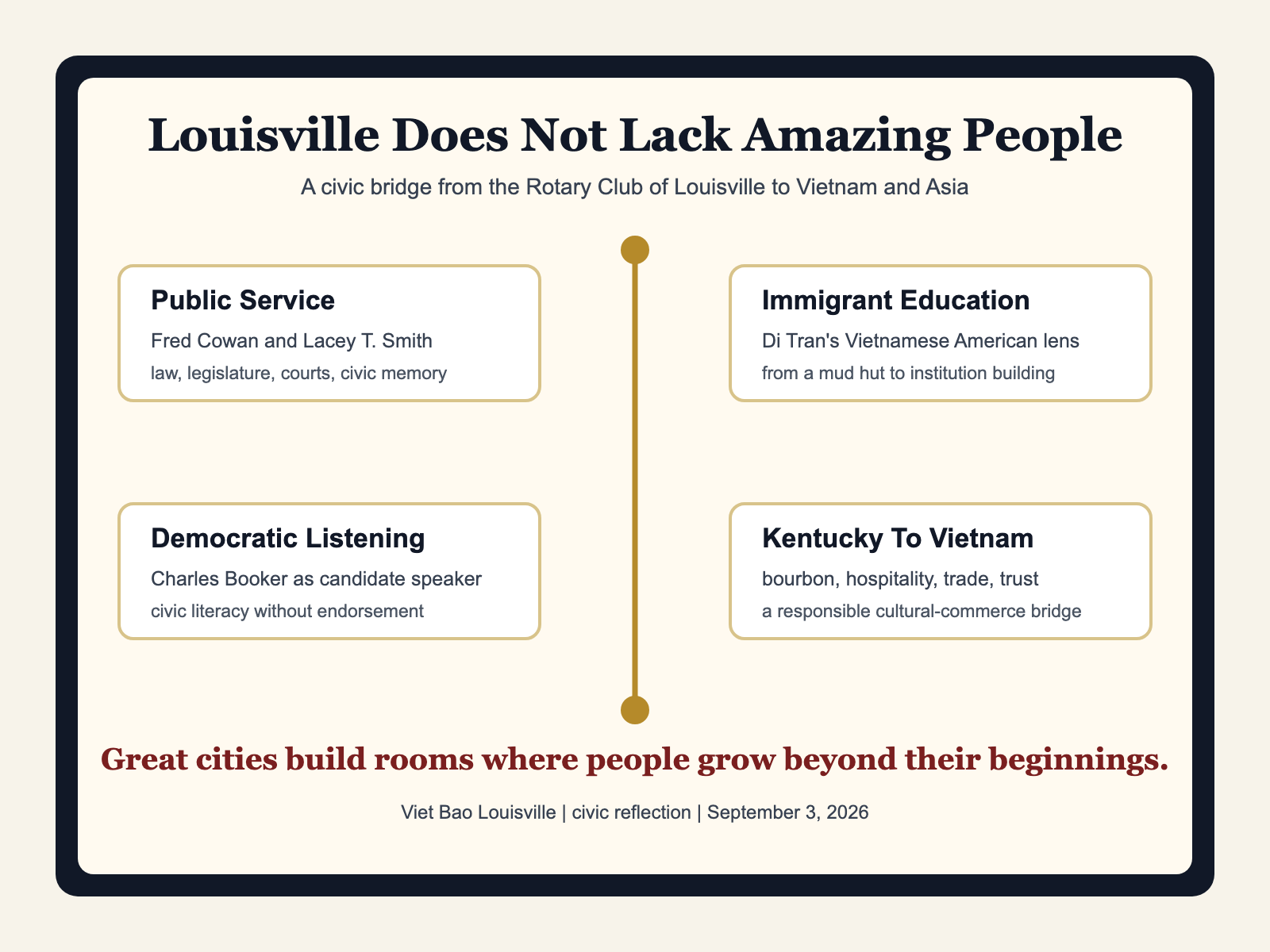
A civic bridge map connecting public service, immigrant education, democratic listening, and a responsible Kentucky-to-Vietnam cultural-commerce vision.
Fred Cowan represented institutional memory across Kentucky's legislature, executive legal leadership, and courts. Lacey Smith represented another path of law, Senate service, municipal counsel, and Louisville practice. Charles Booker represented the current democratic contest and the historical visibility of a Black Kentuckian seeking statewide federal office. Di Tran represented the immigrant student of the room: the Vietnamese American founder who knew enough to feel humbled and grateful, and hungry enough to keep learning.
This is why Louisville is great in Di Tran's perspective. Not because it is perfect. No city is. Louisville is great because it gives builders access to one another. It allows a person from the margins to move toward the center not only by wealth or status, but by service, learning, and persistence.
That is a different definition of greatness.
The Kentucky Bourbon and Vietnam Question
During and around such civic conversations, especially with Lacey Smith's Di-identified international-trade expertise in mind, another idea naturally belongs on the table: how can Kentucky's signature products, especially Kentucky bourbon, build deeper cultural and economic bridges with Vietnam and Asia?
Kentucky bourbon is not a small industry. The Kentucky Distillers' Association describes bourbon and distilling as a $10.6 billion signature industry for Kentucky, supporting more than 23,935 jobs, more than $2 billion in annual payroll, and hundreds of millions in state and local tax revenue. The same source says Kentucky distillers shipped more than $500 million in exports in 2022, almost all of it bourbon, while also noting the pressure of tariffs and trade barriers.
Vietnam is not a small opportunity. USDA Foreign Agricultural Service reporting in July 2026 described Vietnam as a rising market for U.S. agricultural exports and stated that the United States was Vietnam's second-largest supplier of agricultural products in 2025, at $4.7 billion. Vietnam's population, urban growth, young consumers, hospitality sector, tourism economy, and expanding middle class all suggest that Kentucky should study Vietnam not as a side market, but as a serious Asia bridge.
This is where Smith's negotiation and international-trade lens matters. Trade is not only product movement. It is trust movement. It is law, culture, timing, translation, distribution, reputation, etiquette, and risk control. A good international bridge does not begin by asking only what Kentucky wants to sell. It asks what Vietnam needs to understand, what Kentucky must respect, what laws govern the exchange, and what kind of relationship can last.
The question should not be crude: "How do we sell more alcohol?"
The better question is: how can Kentucky bourbon become part of a responsible cultural-commerce bridge between Kentucky and Vietnam?
That bridge would need several layers.
First, education. Vietnamese consumers, hospitality schools, importers, chefs, tourism operators, and cultural organizations need to understand what bourbon is: a legally defined American whiskey category, deeply tied to Kentucky agriculture, corn, limestone water narratives, oak barrels, aging, tourism, and craft. Education should include responsible consumption and legal-age boundaries.
Second, hospitality. Vietnam could become a Kentucky bourbon knowledge hub for Asia through curated tastings, chef pairings, tourism exchanges, bartender education, hotel and restaurant partnerships, and cultural events that pair Kentucky bourbon with Vietnamese cuisine and storytelling.
Third, trade discipline. Any serious bourbon-to-Vietnam strategy needs compliance: import rules, labeling, alcohol distribution law, tax treatment, age restrictions, anti-corruption controls, brand protection, and responsible marketing. A bridge built without law will collapse.
Fourth, diaspora trust. Vietnamese Americans in Kentucky can serve as cultural interpreters. They understand both the Kentucky story and the Vietnamese language, etiquette, family structure, business culture, and trust dynamics. This is where Louisville's Vietnamese community can become more than a consumer community. It can become a diplomatic-economic bridge.
Fifth, institutional storytelling. Kentucky should not enter Vietnam only with bottles. It should enter with farmers, coopers, distillers, tourism leaders, educators, chefs, small-business owners, and cultural ambassadors. Bourbon is agriculture, manufacturing, hospitality, tourism, law, brand, patience, and place. Vietnam respects stories of family, craft, endurance, and local pride. Kentucky has those stories.
Sixth, expert negotiation. The best Kentucky-to-Vietnam bourbon bridge would need people who understand how to negotiate across legal systems, cultures, languages, ministries, importers, hospitality groups, and long-term commercial relationships. That is why a lunch beside a lawyer known for negotiation and international-trade intelligence can spark more than admiration. It can spark strategy.
In Di Tran's imagination, Vietnam can become not just a destination for Kentucky bourbon, but a hub of Kentucky bourbon knowledge in Asia. A place where Kentucky's signature spirit is taught responsibly, paired beautifully, imported lawfully, and connected to tourism, restaurants, hotels, business delegations, cultural festivals, and educational exchange.
That idea belongs in the same civic frame as the Rotary lunch because it is not merely commerce. It is relationship architecture.
Why the Moment Matters for Vietnamese Louisville
Viet Bao Louisville exists because community memory matters.
When a Vietnamese American founder sits among Kentucky public servants and listens to a major-party U.S. Senate nominee, the event is not only personal. It says something to young people, immigrants, workers, and first-generation students:
You may begin far from the room, but you are not forbidden from entering it.
You may come from a mud hut, a refugee family, a nail salon, a small apartment, a factory job, a kitchen, a classroom where English is still difficult, or a family where no one knows how college applications work. None of that erases your right to learn from the highest rooms you can reach.
The point is not to worship elite credentials. Harvard Law School is impressive, but the deeper question is what the credential serves. If education produces arrogance, it fails. If education produces public service, discipline, lawfulness, humility, and responsibility, it becomes beautiful.
That is what made the lunch so meaningful. Fred Cowan and Lacey Smith were not abstractions. Charles Booker was not a headline. Rotary was not a logo. Louisville was not a slogan. They were all present in one room where a Vietnamese American immigrant could sit, observe, and carry the lesson back to students and community.
Louisville Does Not Lack Amazing
Some cities are loud about their greatness. Louisville is often quieter.
But Louisville has greatness in its people: in retired judges who still show up, in attorneys who carried public responsibilities, in civic clubs that convene across professions, in candidates who speak directly to citizens, in immigrant founders who sit humbly and listen, and in communities that keep trying to turn proximity into service.
Di Tran's perspective is simple: Louisville is one of the greatest cities because it makes transformation feel possible.
It allowed a boy from a mud hut in Vietnam, once unable to imagine college, to become a first-generation college graduate, a school founder, a university builder, and a student of civic leadership. It placed him between two Harvard-trained public-service figures from Kentucky and in front of a historic Black Kentucky political voice. It gave him a lunch hour that felt like a chapter in a much larger American book.
That is why Louisville does not lack amazing people.
It has them.
It grows them.
It gathers them.
And if we are wise, it will connect them to the next generation: Vietnamese American students, beauty students, workforce students, small-business owners, civic learners, and young people who still feel too small to imagine the rooms they may one day enter.
The lesson from September 3, 2026 is not that Di Tran sat in an important room.
The lesson is that a great city builds rooms where people can become larger than the lives they started with.
Book release graphic for DO NOT ABSORB by Di Tran, showing the hardcover book with Louisville skyline imagery and the verified Amazon listing now live alongside YouTube and Spotify release links.
DO NOT ABSORB: A New Di Tran Book On Care, Discipline, And Value Creation
Viet Bao Louisville shares the community release of DO NOT ABSORB, a new Di Tran University – College of Humanization book by Di Tran. The book is now available through public YouTube, Spotify, and the verified Amazon listing.
For Vietnamese American families, immigrant workers, students, parents, and small-business builders, the message of this book is practical. Many people carry more than their own daily tasks. They carry family history, money pressure, expectation, disappointment, sacrifice, old pain, and the desire to make life better for the next generation. Care is beautiful. But care without discipline can become absorption. Absorption can quietly turn into exhaustion, reaction, resentment, and confusion.
DO NOT ABSORB speaks directly to that problem.
The book does not tell people to stop caring. It teaches a stronger form of care: stay compassionate, but do not become controlled by every mood in the room. Listen carefully, but do not become the wound. Work hard, but do not let pressure destroy your character. Love family, but do not export pain into the next generation. Build value from difficulty instead of allowing difficulty to become your identity.
DO NOT ABSORB is a Di Tran University – College of Humanization book on governed care and value creation.
A Community Message
Many immigrant families understand this lesson deeply. The first generation often survives by absorbing pressure in silence. The second generation often feels that pressure without always knowing where it came from. Business owners absorb customer stress. Parents absorb children’s fear. Students absorb comparison. Workers absorb financial anxiety. Community leaders absorb public expectation. Over time, even good people can become tired from carrying everything.
This book gives language to a healthier discipline: governed care.
Care deeply. Govern your response. Turn pressure into value.
That message fits the broader work of Di Tran University because the institution is built around humanization: practical knowledge that helps people become useful, responsible, steady, and service-minded while preserving dignity. The book is not a clinical promise, not therapy, and not financial advice. It is a practical human doctrine for ordinary life, family, work, leadership, and self-command.
The Four Layers
Emotion: Feel without becoming ruled by every emotional climate.
Silence: Use silence as timing and mercy, not as fear or punishment.
Money: Understand money as stored intention, labor, and values in motion.
Value: Turn pressure into useful work, service, and disciplined creation.
For Louisville’s Vietnamese and immigrant communities, this is more than a personal-growth phrase. It is a survival-to-service message. The goal is not only to endure pressure. The goal is to transform pressure into clearer families, better work, stronger students, healthier leadership, and useful contribution.
Viet Bao Louisville exists to preserve and elevate community stories, education, culture, family resilience, and civic contribution. DO NOT ABSORB belongs in that conversation because it gives language to a discipline many families practice but rarely name: the ability to care, sacrifice, work, and serve without allowing pressure to consume the person.
The book’s message is simple enough to remember and serious enough to practice:
Do not absorb what is not yours to become.
Do not export what you have not owned.
Do not punish people for being human.
Do not worship mood.
Create value.
That is a community message. That is a family message. That is a work message. And now it is a Di Tran University book.
Reference And Release Links
Book:DO NOT ABSORB: The Humanized Discipline of Emotion, Silence, Money, and Value Creation by Di Tran.
Institutional home: Di Tran University – The College of Humanization.
A Viet Bao Louisville reflection on the Rotary Club of Louisville, the Curtis Family C-Notes, Louisville Central Community Centers, and the practical humanization mission carried through Louisville Beauty Academy, Di Tran University, and Di Tran Enterprise.
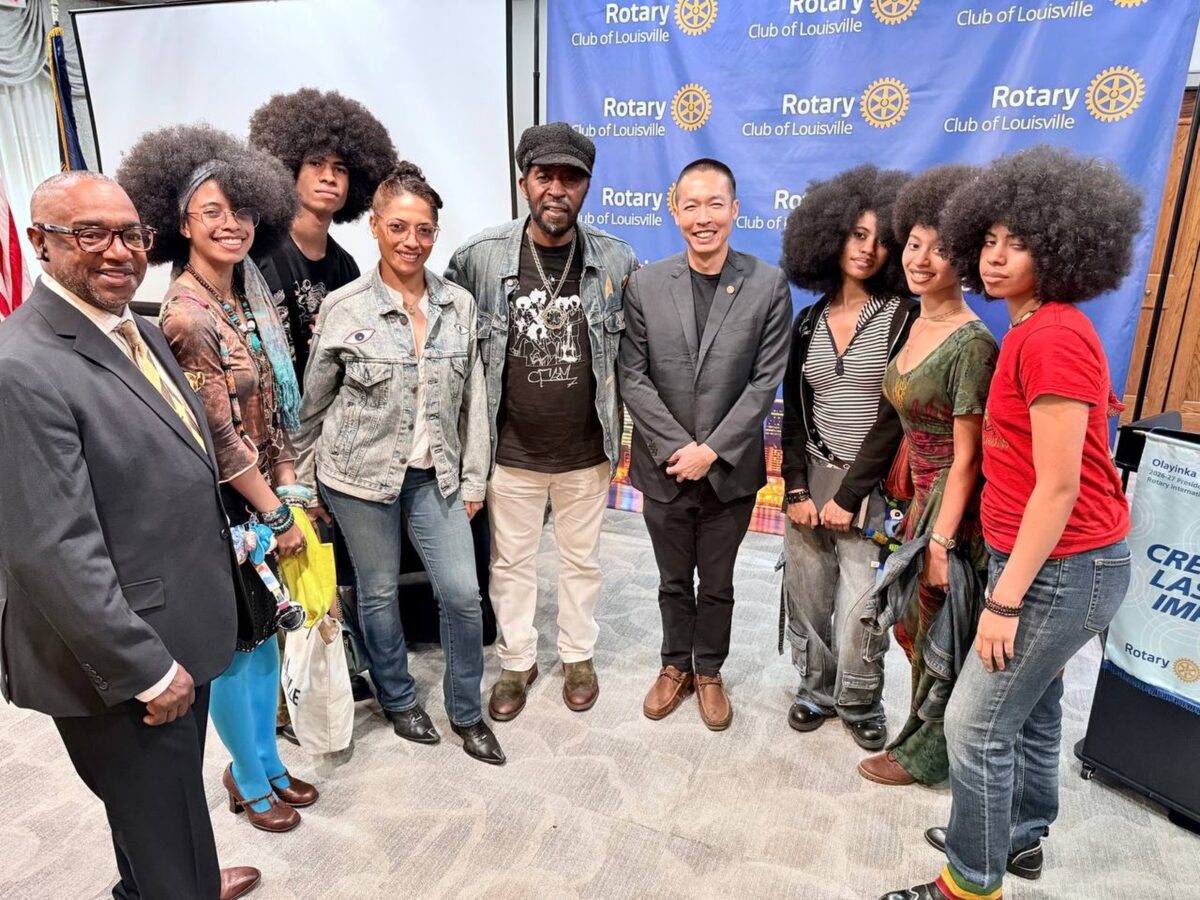
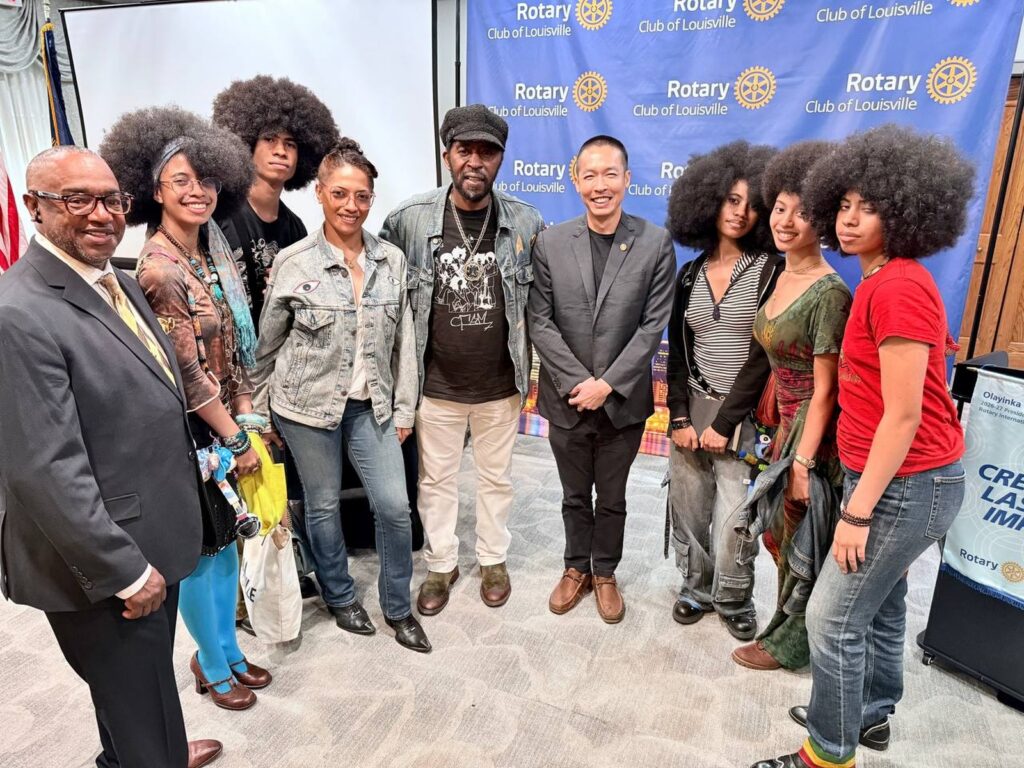
Di Tran with Dr. Kevin Fields and the Curtis Family C-Notes at the Rotary Club of Louisville, where music, family, natural beauty, Black cultural dignity, Vietnamese American respect, and Louisville civic leadership came together.
Louisville, Kentucky is beautiful not only because of its skyline, river, neighborhoods, food, history, or institutions. Louisville is beautiful because of the people who gather here with purpose.
That beauty was visible at the Rotary Club of Louisville, where civic life still has a place, where leaders still sit together for lunch, and where ideas, service, music, business, education, and humanity can meet in the same room.
A Civic Room Where Louisville Learns Together
The Rotary Club of Louisville is one of Kentucky’s important civic gathering places. Its weekly Thursday luncheon is not simply a networking event. It is a living classroom of leadership, service, and community trust. In a time when people are often divided by politics, class, race, culture, language, and background, Rotary creates a rare environment where people can still listen, learn, and build together.
On Thursday, August 20, 2026, the Rotary luncheon featured Dr. Galen Clavio of the Indiana University Media School, speaking on “Hoosiers in Wonderland: Indiana Football and the Most Improbable Turnaround in Sports History.” Rotary’s meeting notice framed the program around Indiana football’s historic rise under Coach Curt Cignetti, a story of grit, belief, leadership, and turnaround.
It was a sports story, but it carried a wider civic lesson: institutions rise when people believe, organize, and keep working.
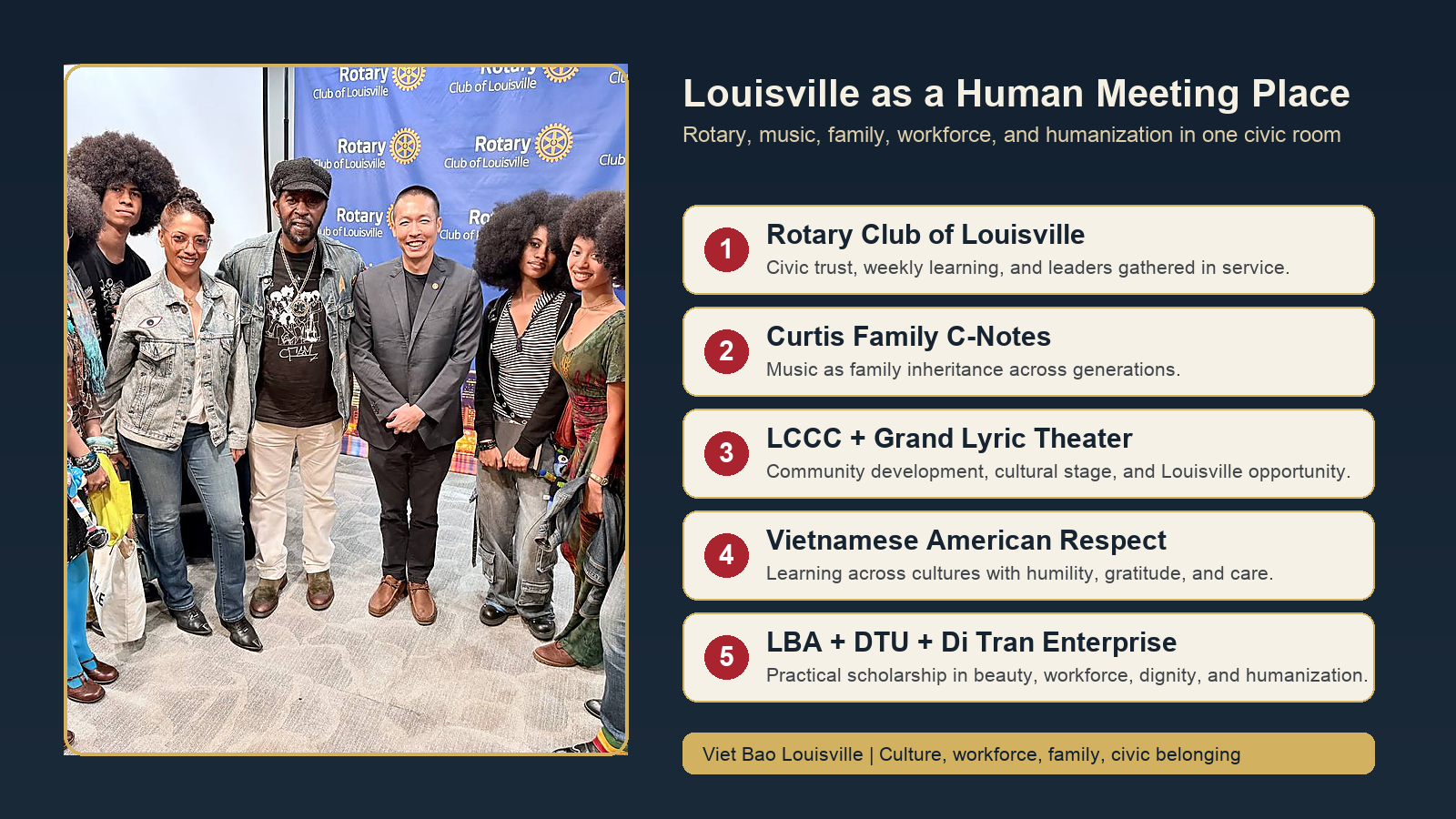
Louisville as a human meeting place: Rotary, music, family, culture, workforce, and humanization coming together in one civic room.
The Curtis Family C-Notes Come to Louisville
At the luncheon, Dr. Kevin E. Fields, Sr., President and CEO of Louisville Central Community Centers, Inc., introduced the Curtis Family C-Notes, a multigenerational family band coming to Louisville for the Curtis Family C-Notes Concert Series at the Grand Lyric Theater.
The Louisville Tourism listing describes the group as San Francisco’s “First Family of Song” and highlights performances on Friday, August 21, 2026, and Saturday, August 22, 2026, at the Grand Lyric Theater, 1300 West Muhammad Ali Boulevard. The public listing describes a family ensemble bringing powerful vocals, live instrumentation, soul, R&B, gospel, and contemporary sounds to Louisville.
The Curtis Family C-Notes are not merely entertainers. They are a family, an artistic institution, and a living example of how music can hold generations together. Their public identity includes projects such as Awaken, Awaken II, and Awaken III: People of the Everyday. But what made their presence so meaningful in Louisville was not only genre, popularity, or performance quality. It was the visible bond of the family itself.
A Vietnamese American Learner in a Black American Musical Moment
For Di Tran, Founder of Louisville Beauty Academy, Di Tran University, the College of Humanization, and Di Tran Enterprise, the encounter became more than a cultural moment. It became a humanization moment.
Di Tran is Vietnamese American. He did not grow up as an expert in Black American music, soul, funk, gospel, or the full history of Black artistic traditions. He approaches this world with humility, almost like a beginner in American music, but with deep respect for the art, the family, the discipline, and the dignity behind it.
That humility matters. The strongest scholarship is not arrogance. It is disciplined listening.
The mission of Louisville Beauty Academy and Di Tran University is not simply technical education. It is human elevation through practical skill, licensed workforce development, scholarship, entrepreneurship, dignity, and service. Di Tran Enterprise, across its educational, publishing, community, and workforce platforms, is built around a simple belief: people become stronger when they are seen, trained, respected, and connected to opportunity.
What Moved Di Tran Most: Family, Natural Beauty, and Peace
What stood out most about the Curtis Family C-Notes was not only their sound. It was their presence.
Di Tran saw father, mother, and children together. He saw warmth. He saw peace. He saw family love. He saw discipline without coldness and beauty without arrogance. He saw young people learning from parents, parents honoring children, and generations carrying music as a shared language.
When Di Tran asked how many generations of musicians were represented in the family, the answer pointed to a deep inheritance. This was not a temporary performance group. This was family culture. This was music as legacy.
In a world where many families struggle to stay close, the Curtis Family C-Notes offered a different picture: family as band, family as school, family as discipline, family as ministry, family as joy.
Di Tran was also deeply moved by their natural hair, their elegance, and their visual dignity. Their look carried a timeless beauty, almost a 1970s-inspired grace, but it was more than style. Their natural hair reflected identity, culture, confidence, and pride. For many Asian and immigrant communities, Black hair culture is not always understood deeply enough. But in that Rotary room, understanding began through respect.
A Vietnamese American educator can stand beside a Black American musical family and say: I may not know everything about your culture, but I see the beauty. I respect the dignity. I honor the family. I want my son, my students, and my community to learn from this.
Beauty Beyond the Surface
This moment also connected to Di Tran’s own Black History Month reflection and song draft around the phrase “I am not my hair,” connected to young people, workforce dignity, and self-worth. The message is not that hair does not matter. Hair does matter. Culture matters. Identity matters. But no human being should ever be reduced to appearance alone. A person is story, ancestry, spirit, family, skill, discipline, and divine potential.
This is also why Louisville Beauty Academy’s work matters. Beauty education is often misunderstood as surface-level work. But true beauty education is human work. It teaches touch, service, confidence, entrepreneurship, sanitation, discipline, communication, licensing, professionalism, and dignity. It gives students, including immigrants, working adults, parents, and underserved populations, a practical pathway into economic participation.
Di Tran University and the College of Humanization expand that same mission through scholarship, authorship, philosophy, workforce thought leadership, and AI-enabled education. Di Tran’s body of work, including more than 100 published books and institutional writings, points to one central theme: human beings must not be treated as machines, labels, markets, or categories. They must be recognized, trained, loved, and elevated.
Why This Is a Viet Bao Louisville Story
This is the kind of story Viet Bao Louisville exists to tell: not only what happened, but what it means. For the Vietnamese American community, the lesson is clear. We must not live in Louisville only as workers, business owners, or immigrants protecting our own circle. We must also become students of the city’s wider beauty. We must learn Black history, respect Black cultural institutions, honor family art, and join the civic spaces where relationships are built.
The Rotary Club of Louisville made that possible in one lunch.
Dr. Galen Clavio’s talk reminded the room that transformation is possible. Dr. Kevin Fields and LCCC reminded the room that culture and community must be invested in. The Curtis Family C-Notes reminded the room that music can carry family, history, love, and dignity across generations. And Di Tran’s response reminded us that true scholarship is not only reading books. True scholarship is listening with humility, seeing beauty in others, and turning that experience into service.
That is the diplomatic and practical position of Louisville Beauty Academy, Di Tran University, and Di Tran Enterprise: to build bridges between education, workforce, culture, community, and human dignity.
Not theory alone. Not performance alone. Practical love. Practical scholarship. Practical workforce elevation. Practical humanization.
Louisville at Its Best
Louisville is beautiful because moments like this still happen here.
A football story about grit. A Rotary lunch about civic life. A family band about love. A Black cultural institution lifting music. A Vietnamese American educator learning across culture. A beauty academy seeing beauty beyond the surface. A university of humanization seeing music as bonding, family as education, and community as the classroom.
That is Louisville at its best.
That is Kentucky at its best.
That is Rotary at its best.
And that is why this moment deserves to be remembered.
Short answer: On August 1, 2026, Di Tran attended the historic St. Jerome Fancy Farm Picnic in Graves County, Kentucky, as a Vietnamese American Catholic, founder, and workforce-education advocate from Louisville. What he witnessed was more than politics. It was one of Kentucky’s clearest living traditions of faith, barbecue, volunteer labor, public speech, and American freedom.
This article is a civic and educational reflection. It is not an endorsement of any party, candidate, campaign, or office.
America Breathing in Public
On August 1, 2026, Di Tran stood at Fancy Farm not simply as a visitor, but as a Vietnamese American immigrant witnessing one of Kentucky’s most powerful public rituals of freedom.
To outsiders, Fancy Farm may look like barbecue smoke, campaign signs, political speeches, cameras, and crowds. But to those who stand there long enough to listen, it is something deeper. It is Kentucky’s living classroom of faith, labor, family, civic disagreement, and democratic courage.
At Fancy Farm, citizens gather in the open. Leaders speak before the people. Candidates challenge each other freely. Supporters cheer, laugh, disagree, and ask for votes in full public view. That is not disorder. That is democracy with Kentucky character.
The Church Came First
The St. Jerome Fancy Farm Picnic began in 1880 as a parish picnic and fundraiser. Long before statewide campaigns made the event famous, there were families, church members, volunteers, food, games, service, and a Catholic community building continuity through work.
Historical summaries trace Catholic settlement in the Fancy Farm area to 1829, with an early log church built in 1836 and the present St. Jerome church completed in the 1890s. It is not accurate to call St. Jerome the oldest church in Kentucky. The stronger and more careful statement is this: St. Jerome is one of the historic Catholic communities of western Kentucky, with roots reaching back to the 1830s.
That distinction matters because it honors the truth. Fancy Farm is not merely a political event beside a church. It is a church community whose service, barbecue, discipline, and fundraising became so large and so respected that Kentucky politics eventually came to it.
Fancy Farm connects St. Jerome’s Catholic roots, parish fundraising barbecue, open political speech, and Kentucky workforce dignity in one living civic tradition.
The Barbecue Is a Workforce Story
The official Fancy Farm Picnic history says the event serves more than 15 tons of barbecue. On the ground, that number becomes human. Di Tran witnessed long open pits, hardwood burned down into coals, pork and mutton watched with care, and volunteers feeding the heat hour after hour.
Local people described the work plainly: the pork is cooked for about 20 hours; the wood is burned into coals; the pits are fed through the night; families and volunteers carry the tradition forward; the food supports St. Jerome and the community around it.
This is not restaurant barbecue. It is inherited community knowledge. It is discipline. It is timing. It is heat, labor, patience, and love. It is skilled hands serving thousands under God.
Kentucky’s Larger American Meaning
For Di Tran, Fancy Farm carries special meaning because Kentucky itself carries so much of America’s story. This is the Commonwealth where Abraham Lincoln was born. It is a land of farms, churches, bourbon, small towns, veterans, families, entrepreneurs, horses, rivers, coalfields, manufacturing, and public argument.
Kentucky has also produced national political power. Senator Mitch McConnell became the longest-serving Senate party leader in American history. Senator Rand Paul serves as one of Kentucky’s two statewide United States Senators. Governors, members of Congress, candidates, local leaders, volunteers, and citizens come through Fancy Farm because the place still forces politics to face the people.
That is why the event feels larger than one day. It is a Kentucky ritual inside the American experiment: faith before politics, community before power, labor before speeches, and citizens before officeholders.
A Vietnamese American Witness to Freedom
Di Tran attended as a Vietnamese American who came to America believing in freedom, opportunity, work, family, and God. In America’s 250th year, that identity matters. The United States is a nation shaped by many peoples, while remembering with respect that Native peoples were here first. Everyone else came through migration, settlement, exile, hardship, hope, labor, or the search for a freer life.
To stand as a Vietnamese American Catholic in rural Kentucky, watching leaders speak openly while church volunteers feed thousands through fire and service, is to see the American promise in physical form. Freedom is not only a word in a book. Freedom is a crowd where people can disagree without fear. Freedom is a church that can serve its community. Freedom is an immigrant who can stand in Kentucky and feel at home. Freedom is lawful work becoming dignity.
Di Tran is deeply faithful. He does not reduce God to politics or religion as performance. He believes that all grace, all opportunity, and all human dignity belong under God. That belief made Fancy Farm even more powerful: the smoke, the church, the crowd, the leaders, and the volunteers all pointed back to service.
Why Louisville Beauty Academy Belongs in This Story
As founder of Louisville Beauty Academy, Di Tran saw Fancy Farm through the lens of workforce education. A beauty school may seem far from an open-pit barbecue and a political speaking stage, but the values are closely connected: skilled hands, discipline, family opportunity, lawful careers, service, small business, and dignity through practical work.
Louisville Beauty Academy’s mission is to help students and working adults move toward Kentucky state-licensed beauty careers through structured education, documentation, and practical training. The school does not promise political favor, government endorsement, exam passage, licensure, employment, or income. The honest mission is education, lawful preparation, and respect for students who are willing to work.
That is why Fancy Farm matters to LBA. It shows Kentucky’s workforce culture at its roots. Volunteers do not cook for 20 hours because it is easy. They do it because tradition, service, church, family, and community matter. Students do not pursue licensed careers because life is easy. They do it because skill can become independence.
Freedom Under the Kentucky Sky
At Fancy Farm, Di Tran did not merely attend an event. He witnessed America breathing in public: faith serving community, labor feeding families, leaders answering the people, and freedom still alive under the Kentucky sky.
Before politics, there is faith. Before speeches, there is work. Before power, there is community. And inside that community, an immigrant American can stand freely, listen to leaders freely, believe in God freely, and help build the next generation of lawful skilled workers freely.
That is Kentucky. That is America. That is freedom.
Sources and Historical Notes
Official Fancy Farm Picnic history and barbecue scale: Fancy Farm Picnic
Photo note: Public-event photos are used here as civic documentation of attendance, place, and public life. Appearance in a photo does not imply endorsement, partnership, campaign authorization, or official recognition of Louisville Beauty Academy.
Louisville witnessed more than a luncheon on July 30, 2026. It witnessed a public education moment.
At the Rotary Club of Louisville, Dr. Robbie Fletcher, Kentucky Commissioner of Education, spoke under the theme “More Than a Test Score, More Than a Color.” The message reached far beyond one meeting, one law, or one school system. It spoke to the moment we are all living through: a moment when Kentucky, America, and the world must rethink what education is for.
Education is changing for good because life itself has changed.
For too long, education has often been treated as a fixed system: a child enters, the system measures, the system labels, the person moves forward or falls behind. But that old mental model is breaking. Automation is changing work. Artificial intelligence is changing information. Transparency is changing public trust. Families are questioning cost and value. Students are asking for meaning. Adults are returning to learning. Employers are asking for proof of ability. Communities are demanding real outcomes.
Rotary Club of Louisville July 30, 2026 meeting notice for Dr. Robbie Fletcher, Kentucky Commissioner of Education.
The Question of This Era
Education can no longer be only about testing. It cannot be only about institutional reputation. It cannot be only about one pathway, one credential, one gatekeeper, or one narrow definition of success.
The new question is more powerful: does education help a human being become capable, documented, adaptable, employable, ethical, licensed where required, trusted by the public, and ready to keep learning for life?
That is the question of this era.
A Statewide Leader at a Statewide Turning Point
Dr. Fletcher’s role gives this conversation statewide importance. According to the Kentucky Department of Education, Robbie Fletcher, Ed.D., was named Commissioner of Education by the Kentucky Board of Education on March 21, 2024, and began serving on July 1, 2024, after approval by the Kentucky Senate. His work now stands inside Kentucky’s movement to reimagine assessment and accountability, including the direction connected to House Bill 257 and the broader “United We Learn” vision.
The Rotary Club of Louisville described Dr. Fletcher’s July 30 presentation as a discussion of changes to Kentucky’s accountability model and the vibrant learning experiences taking place in public schools. That phrase matters: vibrant learning. It suggests that education must be alive. It must connect with curiosity, community, skill, service, career readiness, and the real development of the whole person.
Di Tran’s Education Doctrine: People Are Becoming
For Di Tran, Founder & Chancellor of Di Tran University and Louisville Beauty Academy, this moment speaks directly to the heart of his life’s work: humanization through education. Di Tran’s educational philosophy has long centered on a simple but powerful belief: people are not numbers; people are becoming.
A student is not only a transcript. An adult learner is not only a late start. A licensed worker is not only a trade. An immigrant is not only a language barrier. A small-business owner is not only an economic statistic.
Each person is a human being with capacity, dignity, story, skill, and future.
That is why public education, adult education, workforce development, licensing education, entrepreneurship, and lifelong learning should not be separated into disconnected boxes. They are one human-development system.
Visual Explainer
From Institution-Centered Education to Human-Centered Education
Old question: Who controls the gate?
New question: What does the learner need, what can the learner prove, what support is missing, what pathway is lawful, and what outcome is real?
The future: human focus, individual pathways, adult dignity, transparent documentation, licensed readiness, lifelong learning, workforce development, and public trust.
Workforce Development Is Education Made Practical
A child in public school needs direction before adulthood. A high school student needs career exploration before debt. A working adult needs a respectful way back into learning. A New American needs language, documentation, navigation, and trust. A parent needs flexibility. A future entrepreneur needs practical skill plus compliance. A licensed professional needs law, safety, sanitation, service, discipline, and public responsibility.
This is the true meaning of workforce development.
Workforce development is not just job placement. Workforce development is education made practical. It is the bridge between learning and livelihood. It is the process by which a person becomes ready to contribute with skill, confidence, documentation, and dignity.
Kentucky Adult Education already shows this wider purpose through GED preparation, English as a second language, transition to postsecondary education, workforce education, certifications, family literacy, and corrections education. These are not side programs. They are public evidence that education continues beyond childhood. They are evidence that a person’s future can reopen.
Louisville Beauty Academy as Local Proof of Adult Workforce Education
Louisville Beauty Academy stands as a local proof point in that same story. As a Kentucky state-licensed, national award-winning beauty college, LBA serves many students who are adults, working families, immigrants, career changers, and future small-business owners. In beauty education, learning is immediate and accountable. Students must learn practical skill, law, sanitation, safety, client care, documentation, attendance discipline, professionalism, and licensing readiness.
That is education with public consequence.
A beauty license can change the legal and economic identity of a person. It can move a worker from informal labor into lawful professional work. It can give a parent a flexible career pathway. It can help a New American stand visibly in the economy. It can support small-business creation. It can turn training into service, service into trust, and trust into opportunity.
This is why licensed adult education belongs in the same conversation as public education reform. It is where the promise of learning becomes visible in adult life.
The AI Era Makes Education More Human, Not Less
The AI era makes this even more urgent.
The U.S. Department of Education’s report on artificial intelligence and the future of teaching and learning recognizes that AI is rapidly entering educational technology and public life. The World Economic Forum’s Future of Jobs Report 2025 describes major workforce transformation driven by technology, AI, data, and changing skill demands. The OECD has emphasized the importance of skills, lifelong learning, and adaptation in the AI age.
The lesson is not that machines replace education. The lesson is that education must become more deeply human because machines are becoming more capable.
AI can produce information. It cannot produce character. Automation can speed up tasks. It cannot give a person purpose. Data can expose performance. It cannot restore confidence to an adult who believed it was too late. Technology can make learning more accessible. It cannot replace the dignity of a teacher, mentor, employer, school, civic club, or community that sees the person behind the file.
The future will not belong only to people with degrees. It will belong to people who can learn, document, adapt, communicate, serve, build, repair, create, comply, lead, and keep growing.
Multiple Pathways Deserve Respect
College matters. Career and technical education matters. Skilled trades matter. Licensed professions matter. Adult education matters. English-language learning matters. Entrepreneurship matters. Public service matters. Community-based training matters. Every honorable pathway that helps a person become more capable deserves respect.
The old system too often asked: who controls the gate?
The new education system must ask: what does the learner need, what can the learner prove, what support is missing, what pathway is lawful, what outcome is real, and how can the community help the person move forward?
This is the shift from institution-centered education to human-centered education.
Rotary as Civic Learning
That is also why the Rotary Club of Louisville matters. A Rotary lunch is not merely a social event. At its best, it is civic learning. It is a room where public leaders, business owners, educators, nonprofit builders, and community members quietly build the brain of the city. No time is wasted when the room is learning. No meeting is small when the speaker carries a statewide mission and the audience carries local responsibility.
Viet Bao Louisville extends sincere appreciation to the Rotary Club of Louisville for once again hosting a meaningful, beautiful, and intellectually valuable gathering. It offered Louisville another chance to learn from someone representing a major public responsibility for the Commonwealth of Kentucky.
Dr. Fletcher’s message matters because education policy is not abstract. It affects children, teachers, families, taxpayers, employers, adult learners, and the workforce future of Kentucky. Di Tran’s presence matters because the conversation must not remain only at the policy level. It must reach the real places where learners become workers, workers become licensed professionals, and licensed professionals become small-business contributors.
This is where Di Tran University, Louisville Beauty Academy, and Viet Bao Louisville carry a shared public mission: to elevate education as human development, to honor workforce dignity, to document useful learning, and to show that community education can be both practical and beautiful.
Education for the Human Age
The future of education is not cold automation. It is not blind tradition. It is not prestige without proof. It is not testing without purpose.
The future of education is human focus.
Individual focus.
Multiple pathways.
Transparent documentation.
Lifelong learning.
Adult dignity.
Licensed readiness.
Workforce development.
Public trust.
That is education for the AI age.
That is workforce development for the human age.
That is Kentucky education changing for good.
And in Louisville, at the Rotary Club of Louisville, that message found a worthy room, a worthy speaker, and a worthy moment.
Editorial note: This article is a Viet Bao Louisville civic and education reflection. It does not state or imply an endorsement, partnership, or official position by the Kentucky Department of Education, Dr. Robbie Fletcher, or the Rotary Club of Louisville.
A new federal policy conversation is bringing renewed attention to questions that matter to families choosing career education: tuition cost, student debt, transparency, licensure preparation, and practical workforce outcomes.
Louisville Beauty Academy has published a careful community-facing perspective on the U.S. Department of Education’s June 29, 2026 final rule on earnings accountability. The school explains that the rule does not name, endorse, approve, evaluate, accredit, or specifically recognize LBA. That boundary is important.
The value of the article is not a claim of federal recognition. The value is that it helps students and families understand why affordability, clear communication, state licensure preparation, workforce readiness, and reduced unnecessary student-debt exposure should be part of the public conversation about education quality.
For immigrant, multilingual, working-adult, and family-centered communities, this message is especially important. A school should be understandable before enrollment. Students should know the cost, the licensure pathway, the expectations, and the financial commitment before they begin.
Important note: This post is independent community commentary. It does not state or imply U.S. Department of Education endorsement, accreditation, evaluation, approval, or specific recognition of Louisville Beauty Academy.
Families benefit when career education is clear before enrollment: cost, requirements, licensure path, expectations, and financial commitment.