Louisville, Kentucky — This week at the luncheon meeting of the Rotary Club of Louisville, a simple handshake symbolized something much bigger than a greeting.
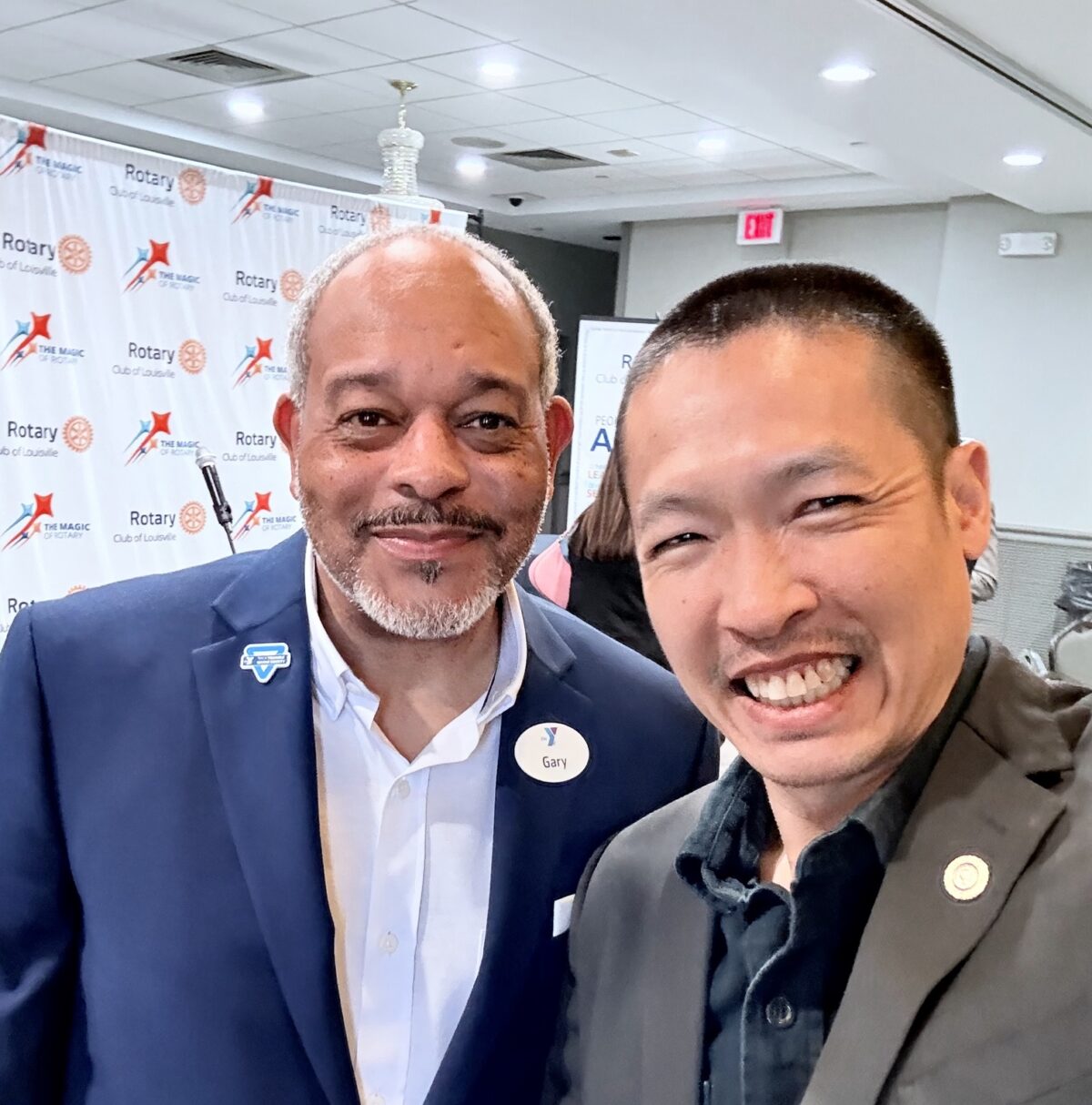
Entrepreneur, educator, and community builder Di Tran met with Gary, CEO of the YMCA of Greater Louisville, during the gathering of civic and nonprofit leaders.
The Rotary Club of Louisville is one of the most influential civic organizations in the world — ranked among the largest Rotary clubs globally out of more than 40,000 clubs within Rotary International. Each week, leaders gather not just to network, but to learn, recharge, and recommit to service.
During the meeting, Di Tran personally thanked Gary for the YMCA’s ongoing leadership in building stronger communities throughout Louisville.
But beyond the handshake, the conversation also reflected a powerful idea.
A Shared Vision: Service That Lifts Everyone
Both the YMCA and Di Tran’s organizations are built around a simple philosophy:
Service must be accessible.
The YMCA has long provided programs for families, youth development, health, and community support. Meanwhile, Di Tran’s institutions — including Louisville Beauty Academy and Di Tran University — focus on vocational training, entrepreneurship, and empowering individuals to build sustainable careers.
When these ideas intersect, something remarkable becomes possible.
Imagine a model where vocational education directly serves the community.
Imagine Louisville Beauty Academy Serving Families at the YMCA
One idea discussed informally among leaders is a powerful concept:
If Louisville Beauty Academy (LBA) were partnered with YMCA community centers, beauty students could provide free professional beauty services to families in need.
All delivered by trained students under supervision.
This concept is not hypothetical in spirit — Louisville already has a powerful example through the work of Harbor House of Louisville.
Harbor House integrates vocational programs that serve real people while training individuals with disabilities. The result is a cycle of empowerment, where learning and service happen at the same time.
A similar concept with Louisville Beauty Academy could create:
Free grooming services for families
Practical hands-on training for students
Community confidence and dignity
Workforce preparation
In other words, education becomes service.
Why Beauty Services Matter More Than People Think
Haircuts and grooming are often underestimated.
But for families facing hardship, these services can restore something deeper: dignity and confidence.
A haircut before a job interview. A hairstyle before school pictures. A moment of care that reminds someone they are valued.
This is where vocational education becomes powerful.
Students learn skills. Communities receive care. Everyone benefits.
Service Must Come From the Heart
Di Tran often writes in his books that sustainable service cannot be forced.
It must come from genuine desire.
His philosophy is simple:
Work that helps others must be done willingly.
Service must be consistent, not occasional.
Communities thrive when individuals choose to contribute.
These values align perfectly with the Rotary motto:
“Service Above Self.”
The YMCA carries that same spirit.
And when leaders from organizations like Rotary, YMCA, and community educators meet, ideas naturally begin to form about how to serve even more people.
Rotary: A Place Where Leaders Recharge
For Di Tran, Rotary meetings serve an important purpose.
They remind leaders that service is not a solitary mission.
Surrounded by others who share the same commitment, energy returns.
New ideas emerge.
Partnerships begin.
And communities grow stronger.
Gratitude to Rotary Louisville
Di Tran expressed appreciation to the Rotary Club of Louisville for continuing to create a space where leaders can reconnect with the purpose behind their work.
Being among the largest Rotary clubs in the world, the organization demonstrates how local leadership can inspire global ideals of service.
Sometimes, change begins not with a formal program — but with a simple moment.
A handshake. A thank you. And a shared vision for serving others.
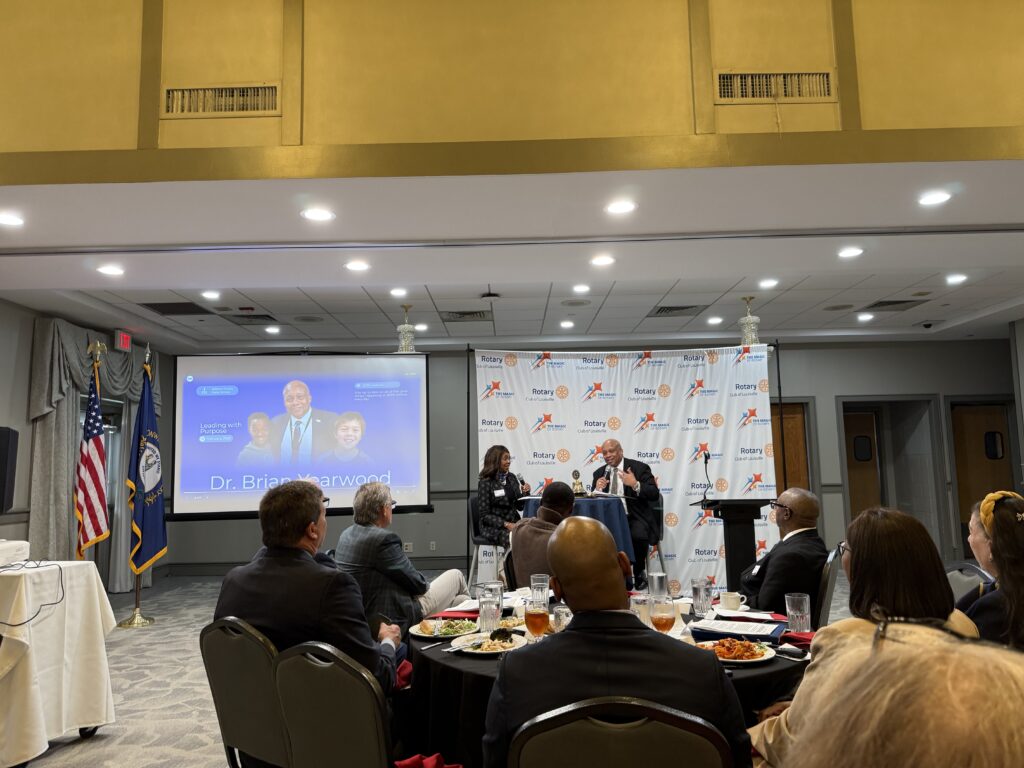
Today at the Rotary Club of Louisville, attendees had the opportunity to hear from Dr. Brian Yearwood, Superintendent of Jefferson County Public Schools (JCPS), as he shared his vision for education, leadership, and community partnership.
Dr. Yearwood was born in Scarborough, Trinidad and Tobago, an English-speaking Caribbean nation shaped by British educational traditions. He immigrated to the United States at age 17 after earning a tennis scholarship to the New Mexico Military Institute, where he completed his associate degree. He later attended Texas Tech University, earning a Bachelor’s degree in Geology, a science teaching certification, a Master’s degree in Educational Administration, and a Doctorate in Educational Leadership and Statistics.
Among those present was Di Tran, founder of Di Tran University — The College of Humanization and Louisville Beauty Academy, the College of Beauty, who described the experience as deeply personal and inspiring. As an immigrant himself — born in humble conditions, growing up in Louisville’s south end near Iroquois High School and attending Seneca High School — Tran reflected that he never once believed the name of a high school determined a person’s future. Only later did he recognize how schools and students are sometimes classified by perception rather than potential, a concern Dr. Yearwood directly addressed.
One message that resonated strongly was Dr. Yearwood’s reminder that there is no such thing as a “bad school.” Every school is a place of learning and possibility, and labeling institutions negatively can shape how students feel about themselves and their opportunities.
Another statement he repeated twice stood out clearly: “Poverty is not a barrier to education. When you want it, you study.” The message emphasized determination, responsibility, and belief in human potential regardless of circumstance.
Dr. Yearwood also discussed courageous leadership and accountability, describing an emotionally difficult but impactful organizational reset sometimes referred to as “fire and rehire,” a strategy intended to realign teams around shared standards and mission.
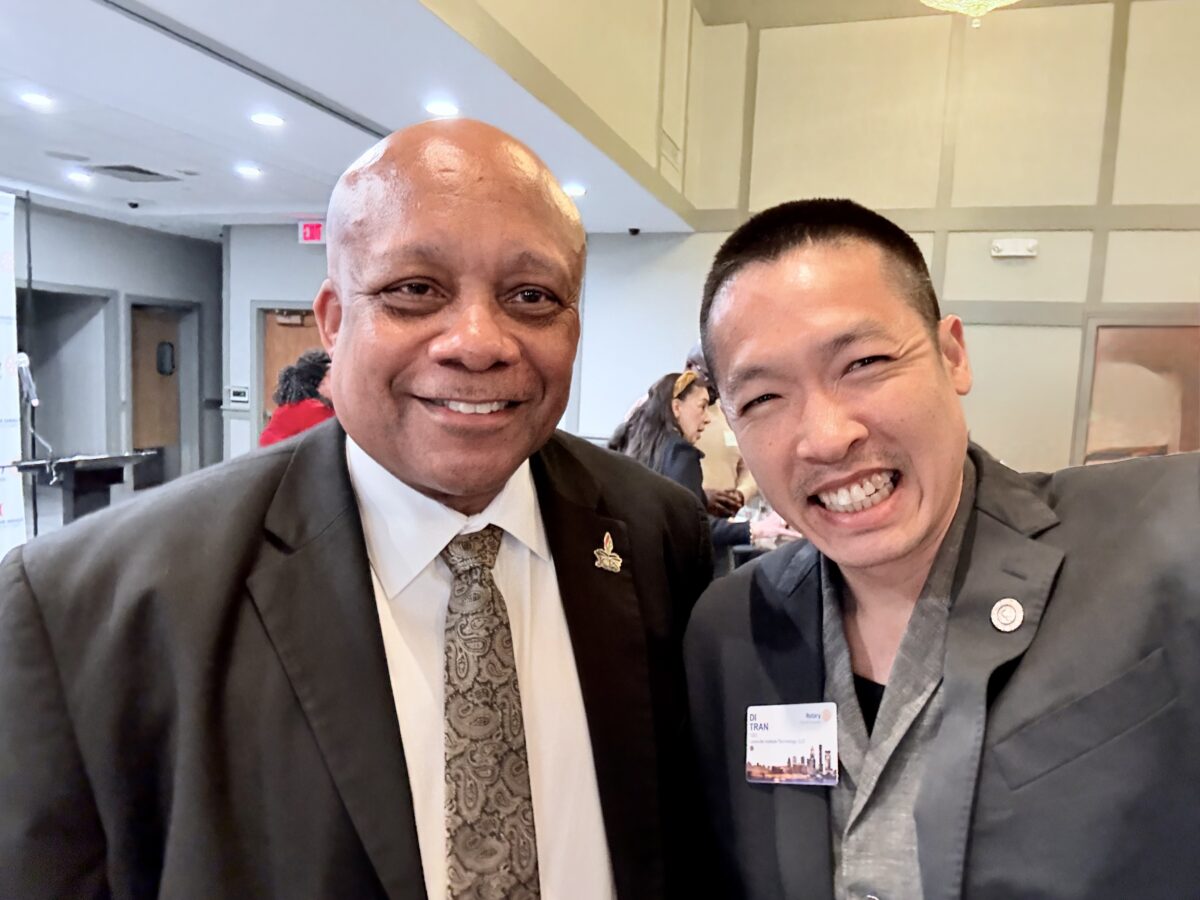
Following the meeting, Di Tran warmly shook Dr. Yearwood’s hand. While many offered the traditional words, “God bless you,” acknowledging the difficulty of leading a large urban school system, Tran shared a more personal message:
“From heart to heart, God bless you — because you have the courage to lead differently from the highest level. Your spirit shines. Now I understand why JCPS chose you.”
The moment reflected a shared understanding often felt among immigrants — a deep appreciation for opportunity and a commitment to contribute fully to the communities they serve. For many immigrant leaders, the belief remains simple: when given opportunity in the United States, the responsibility is to give one’s very best in return.
The gathering served as a reminder that leadership, education, and lived experience can intersect in powerful ways, strengthening both institutions and the broader Louisville community.
The Vietnamese American community represents one of the most remarkable success stories in modern U.S. immigration history. Unlike many Asian immigrant groups who arrived for work or education, most Vietnamese came to America as war refugees beginning in 1975, fleeing political persecution, imprisonment, and devastation after the Vietnam War. They arrived with almost nothing — limited English, little money, no inherited wealth, and deep trauma.
Yet in less than 40–45 years, Vietnamese Americans went from one of the poorest communities in America to achieving income and education levels equal to — or higher than — the U.S. average. Measured as a group-level socioeconomic rise from deep poverty to mainstream success in a single generation, this trajectory is one of the fastest ever documented in U.S. history.
The First Wave: 1975 and Operation New Life
When Saigon fell on April 30, 1975, chaos and fear spread across South Vietnam. Many who had supported or worked with the U.S. government — officials, soldiers, teachers, administrators, journalists — faced imprisonment or execution. In response, the U.S. launched Operation Frequent Wind and Operation New Life, evacuating more than 130,000 Vietnamese refugees in 1975.
They were flown to four major refugee processing centers:
• Camp Pendleton (California)
• Fort Indiantown Gap (Pennsylvania)
• Eglin Air Force Base (Florida)
• Fort Chaffee (Arkansas)
Refugees were then sponsored by churches, families, and community groups — often placed in cities where they knew no one. This policy, called “forced dispersal,” tried to prevent large ethnic enclaves from forming. Instead, it created the earliest Vietnamese communities across the country — including what later became Little Saigons in California, Texas, Virginia, the Gulf Coast, and the Midwest.
Second and Third Waves: Family Reunification and Boat People
The refugee story did not end in 1975. Over the next two decades, hundreds of thousands more would flee:
• Boat People (late 1970s–1980s) — risking death at sea
• Orderly Departure Program (1979+) — legal exit
• Amerasian children & families
• Former political prisoners (HO program)
Between 1975–1995, approximately 1.3–1.5 million Vietnamese resettled in the United States. This remains the largest Asian refugee movement in U.S. history.
Starting From the Bottom: The Hard Reality
The 1980 Census revealed how severe the starting conditions were.
Vietnamese poverty rate in 1980: ~61%
U.S. national poverty rate in 1980: ~13%
That means:
Vietnamese refugees were about five times more likely to be poor than the average American.
Many worked in:
• factories
• small shops
• service work
• fishing & seafood industry
• entry-level labor jobs
Others launched family-run businesses — groceries, tailoring, restaurants, and later nail salons, a now-famous story of Vietnamese entrepreneurship and mutual support networks.
Language barriers, trauma, discrimination, and limited education meant that first-generation life was about survival. Parents worked so children could study. Families pooled money. Churches and temples became community anchors.
The Turning Point: The Success of the Second Generation
Something remarkable happened within one generation.
By the 2000s and 2010s, Vietnamese American children — born or raised in the U.S. — began entering universities, professions, and leadership roles in large numbers.
Today:
• Vietnamese median household income ≈ $80,000+
• U.S. median household income ≈ $70,000
Vietnamese poverty rates also fell to ≈10–12% — equal to or slightly lower than the U.S. average.
In other words:
A community that began as one of the poorest in America
now earns above the national average.
And this shift happened in about 40 years.
How Extraordinary Is This Rise?
Many Asian groups succeed today — but their starting points differed.
• Indian & Taiwanese immigrants — arrived as highly educated professionals
• Filipino immigrants — often arrived as English-speaking nurses or military families
• Chinese immigrants — a mix of students, professionals, and workers
Vietnamese refugees, by contrast:
✔ arrived suddenly
✔ with trauma
✔ no wealth
✔ limited English
✔ low initial education
The poverty drop from ~61% → ~11% in one generation represents a ~50-percentage-point improvement, among the fastest socioeconomic rises ever recorded in the U.S. for any large immigrant group starting from deep poverty.
Other refugee communities — Cambodian, Lao, Hmong, Burmese, Afghan — also show resilience, but their average upward climb has been slower. Thus, the sheer speed and scale of Vietnamese upward mobility stands out historically.
Why Did Vietnamese Americans Succeed So Quickly?
Researchers frequently cite several key factors:
1. Family & Community Networks
Families pool money, support elders, and invest in children.
2. Cultural Emphasis on Education
Even first-generation refugees pushed children toward schooling and professional stability.
3. Entrepreneurship
Vietnamese small-business ownership remains one of the highest of any group.
4. Religious & Social Institutions
Catholic parishes, Buddhist temples, and mutual-aid organizations provided structure, trust, and support.
5. Resilience Formed by Adversity
War trauma instilled urgency, discipline, and perseverance.
6. The Second Generation Advantage
Children raised in the U.S. bridged cultures — English fluency + Vietnamese family drive.
The Vietnamese Presence in Louisville, Kentucky
Louisville is home to a growing and dynamic Vietnamese community. Early arrivals included sponsored refugee families, Catholic parish placement, and later waves through family reunification.
Today, Vietnamese Louisvillians are represented in:
• healthcare
• small business
• education
• trades
• community leadership
Temples, churches, groceries, and restaurants help maintain identity — while younger generations thrive in universities and professional careers.
Louisville’s Vietnamese community reflects the national trend:
from refugee hardship → to proud American success.
Conclusion
The Vietnamese American journey is not only a refugee story — it is a story of endurance, sacrifice, family strength, and extraordinary upward mobility. Within just 40–45 years, Vietnamese Americans rose from deep poverty to mainstream prosperity — a feat unmatched in scale and speed among major refugee groups in U.S. history.
This achievement belongs to:
• refugee parents who sacrificed everything
• students who became doctors, engineers, and leaders
• entrepreneurs who created jobs
• community elders who preserved culture
• young Americans proud to be both Vietnamese and American
The Vietnamese story is a story of hope — and proof that hardship does not define destiny.
References (APA Style)
Asian Americans Advancing Justice. (2011). A community of contrasts: Asian Americans in the United States.
https://www.advancingjustice-aajc.org
Bankston, C. L., & Zhou, M. (1995). Religious participation, ethnic identification, and adaptation of Vietnamese adolescents in an immigrant community. The Sociological Quarterly, 36(3), 523–534. https://doi.org/10.1111/j.1533-8525.1995.tb00451.x
Feliciano, C. (2006). Unequal origins: Immigrant selection and the education of the second generation. LFB Scholarly Publishing.
Hirschman, C., & Massey, D. (2008). Places and peoples: The new American mosaic. In Massey (Ed.), New faces in new places: The changing geography of American immigration (pp. 1–21). Russell Sage Foundation.
Pew Research Center. (2017). Vietnamese in the U.S. fact sheet.
Rumbaut, R. G. (2006). Vietnamese, laotian, and cambodian Americans. In Min (Ed.), Asian Americans: Contemporary trends and issues (2nd ed., pp. 384–422). Sage.
U.S. Census Bureau. (1983). 1980 Census of population: Asian and Pacific Islander population in the United States.
U.S. Census Bureau. (2022). Income in the United States: 2022.
https://www.census.gov
Zhou, M., & Bankston, C. L. (1998). Growing up American: How Vietnamese children adapt to life in the United States. Russell Sage Foundation.
In every thriving city, there are a few individuals who do more than build businesses — they embody the heartbeat of an entire region. Louisville, Kentucky, is fortunate to have two such individuals: Dr. Danielle Mann, founder of Rivergreen Cocktails and practicing physician, and Di Tran, founder of Di Tran Bourbon, Louisville Beauty Academy, and multiple cross-border ventures connecting Kentucky to Vietnam and Asia.
Though they come from different backgrounds, Danielle and Di share a rare, unmistakable trait: they carry Kentucky forward with courage, humility, and unwavering belief.
DR. DANIELLE MANN: A PHYSICIAN WHO BREATHES ENTREPRENEURSHIP
Dr. Danielle Mann represents everything admirable about Kentucky’s modern entrepreneurial spirit.
A full-time practicing OB-GYN, a mother, and now the founder of Rivergreen Cocktails, Danielle proves that innovation blooms wherever curiosity and courage meet. She built her brand during a pandemic, using real ingredients, real gin, and real craftsmanship — in the same way she approaches medicine: with precision, integrity, and heart.
In her own words, she shared something profoundly universal:
“Business is risky. It changes constantly. It can disappear tomorrow. But I would never regret it — it is the experience of a lifetime.”
Her message reflects truth that every entrepreneur quietly carries: You learn every moment. You problem-solve endlessly. You live with energy. There is no true work–life balance — the passion becomes your life.
This philosophy powerfully mirrors the journey of another Kentucky builder: Di Tran.
DI TRAN: A BRIDGE BETWEEN KENTUCKY & VIETNAM, AND A MAKER OF GLOBAL POSSIBILITY
Where Danielle builds with science, heart, and flavor, Di Tran builds with culture, vision, and global purpose.
Founder of Di Tran Bourbon — celebrated in Viet Bao Louisville’s article “The Essence of Belief” — he is not simply creating a product. He is creating a symbol of Kentucky that can travel across continents.
His mission:
Make Kentucky Bourbon and Kentucky Ginseng the central wholesale export to Vietnam and all of Asia
Position Kentucky as the U.S. hub for modular construction shipped from Vietnam (pre-built stores, homes, retail units assembled in hours)
Leverage EB-5 investment and EB-3 workforce to fill gaps in American labor and strengthen U.S.–Vietnam economic ties
In every step, he lifts both his homeland of Vietnam and his beloved home of Kentucky.
Where others see barriers, Di sees bridges. Where others see markets, he sees shared destiny.
SHARED VALUES, SHARED COURAGE — A KENTUCKY STORY
Though Danielle and Di operate in different industries, their stories align beautifully.
Both believe:
1. Entrepreneurship Is a Calling, Not a Job
Danielle: “You problem-solve every second.” Di: Lives in constant innovation across education, bourbon, workforce, and trade.
2. Passion is the Real Fuel
Danielle brings medical discipline and creative energy into Rivergreen. Di brings immigrant grit and spiritual purpose into every venture.
3. Risk is Inevitable, but Regret is Optional
Both founders know businesses shift, markets change, and everything can be lost tomorrow. Yet both continue — because creation is their nature.
4. Learning Never Stops
Both believe entrepreneurs are the real lifelong learners, absorbing every lesson, every mistake, every moment of growth.
5. Kentucky is Worth Elevating
Both tell the world: Kentucky is not small — it is powerful. Louisville is not local — it is global.
In their hands, Kentucky becomes:
a premium spirits capital
a center for real craftsmanship
a hub of healthcare excellence
a bridge to Asia
a home for community builders
a place where dreams are not theories, but action
WHY THEIR CONNECTION MATTERS
The moment Danielle and Di met — two builders from different life paths, united by spirit — something became clear:
Kentucky is producing a new generation of leaders who combine heart, discipline, global vision, and relentless resilience.
This is what makes Louisville special:
A physician creating a national beverage brand.
An immigrant entrepreneur transforming bourbon, education, and international commerce.
Both driven by purpose, community, and belief.
Their stories are not just personal achievements — they are reflections of Kentucky’s identity.
KENTUCKY & LOUISVILLE: A BEAUTIFUL FUTURE BUILT BY BEAUTIFUL PEOPLE
Danielle Mann and Di Tran show the world that Kentucky is far more than horses and bourbon (though bourbon remains its crown jewel). Kentucky is:
Innovation
Humanity
Education
Manufacturing
Global trade
Cultural bridges
Entrepreneurial courage
Louisville is a city of builders — quiet, humble, hardworking visionaries who change the world one idea at a time.
Together, Danielle and Di embody this truth:
Kentucky rises because its people rise. Louisville shines because its dreamers shine.
Their journeys — rooted in compassion, resilience, risk, and relentless learning — form a powerful reminder:
Greatness grows in Kentucky. And Kentucky gives that greatness to the world.
LOUISVILLE, KY — There are moments when a city’s true strength reveals itself — not in its infrastructure, not in its economics, but in its people. This week at the Rotary Club of Louisville, such a moment unfolded when Coach Dan McDonnell, Head Baseball Coach of the University of Louisville, shared the core principles behind one of America’s most successful college athletic programs — and Di Tran, founder of Louisville Beauty Academy, Di Tran University, and author of 129 books on humanization, was there to witness and reflect on the deeper meaning of it all.
A Culture of Love and Standards
Coach Dan McDonnell, entering his 20th season with the University of Louisville, is no ordinary coach. With six College World Series appearances, two National Coach of the Year awards, and over 111 Major League Baseball draft picks, McDonnell’s résumé speaks for itself. Yet, his message at the Rotary Club was not about numbers or trophies — it was about people.
“What you do anything is what you do everything,” McDonnell said, challenging attendees to see consistency not as an act of discipline but as a reflection of identity. In his view, excellence in sport mirrors excellence in life: if you are a person of focus, love, and service, that identity manifests in everything you do.
He spoke of love not as sentiment, but as strategy — the driving force behind the extra mile. “When you truly love someone else, you will do more than what’s expected. That’s when real winning begins — when your effort is no longer about you, but for someone else.”
It was not lost on those in attendance that McDonnell’s philosophy seamlessly blends athletic performance with spiritual and communal growth — something that transcends the game itself. He shared stories of his players praying together on the field, learning that their success is interwoven: to elevate others is to elevate oneself.
Di Tran: A Kindred Spirit in Service and Humanization
For Di Tran, McDonnell’s talk was not merely inspiring — it was deeply validating. Tran, a nationally recognized small-business advocate and educator, has built his enterprises on one foundational belief: that education, work, and community service are acts of love. Through Louisville Beauty Academy and Di Tran University, he has empowered nearly 2,000 graduates from all walks of life — from refugees and single parents to lifelong learners and career changers — all under the banner of “YES I CAN” and “I HAVE DONE IT.”
Listening to Coach McDonnell describe love and consistency as the essence of success, Tran saw clear parallels to his own life’s work. “It reminded me,” Tran reflected afterward, “that everything we do — from how we greet a student, to how we serve a customer, to how we teach our children — it all matters. You can’t be excellent in one part of life and careless in another. Love makes you consistent.”
Tran often says, “You can never be so big, and you can never be so small — there’s always a role for you to play.” This humility aligns with McDonnell’s leadership approach, where no player is above the team, and no act of service is too small to define character. Both men embody the idea that success is not achieved alone, but with and through others.
Louisville: A City Blessed by Its People
The connection between McDonnell and Tran symbolizes what makes Louisville, Kentucky, extraordinary — a city where athletic greatness and entrepreneurial compassion meet on common ground. From baseball fields to beauty classrooms, Louisville is a living example of how diverse paths can lead toward the same destination: service to others.
Coach McDonnell’s program has transformed young athletes into disciplined men who lead on and off the field. Similarly, Di Tran’s schools transform everyday people into licensed professionals and confident contributors to society. Both leaders serve as architects of human value — showing that greatness is not about position, but about purpose.
As Louisville continues to rise — through education, innovation, and sports — it is leaders like McDonnell and Tran who remind the community that true progress begins with the heart. Their meeting, though brief, reflected something bigger than any single institution: a shared belief that love, faith, and responsibility are the engines of transformation.
A Shared Prayer for Elevation
When Coach McDonnell ended his talk with a reflection on team prayer and faith — about thanking God before each game, not for victory but for the chance to serve — it struck Di Tran profoundly. As someone who begins each day with gratitude and ends each night with prayer, Tran saw this as divine alignment. “It was a reminder,” he said, “that God gives us choices — to act or not to act. Either way, there are consequences. But when you act with love, the outcome is always elevation — for yourself, your family, your team, and your city.”
Conclusion: The Spirit of Louisville
Louisville has long been a city of quiet champions — from Muhammad Ali’s discipline and compassion to the innovators in classrooms, factories, and small businesses. In 2025, that same spirit thrives in people like Dan McDonnell and Di Tran, who prove that leadership is not confined to titles or fields of play. It is lived daily — in how one serves, teaches, and uplifts others.
Indeed, to be surrounded by such individuals is a blessing. As this moment at the Rotary Club reminded everyone present, Louisville’s magic lies in its people — in their love, their faith, and their willingness to do more, together.
Louisville, KY / Washington, D.C. — The New American Business Association (NABA) and Louisville Beauty Academy (LBA) announce that Di Tran, founder of both organizations, has been named a 2025 finalist for the National Small Business Association’s (NSBA) Lew Shattuck Small Business Advocate of the Year Award. As the Kentucky finalist, Tran joins a select group of national small-business leaders in Washington to advance practical, nonpartisan solutions for Main Street.
“This honor belongs to our students, graduates, and every small business that keeps America working,” Tran said. “We’re here to champion outcomes—training that leads to licenses, jobs, and new businesses—without unnecessary debt.”
Who is NSBA?
Founded in 1937, the National Small Business Association is the nation’s original, proudly nonpartisan small-business advocacy organization. NSBA represents 65,000+ members across all 50 states and speaks for the 70 million owners and employees who power the U.S. economy. NSBA is known for winning access-to-capital reforms, stopping unfair tax penalties, and rolling back harmful regulations—guided by respected Economic Reports and targeted member surveys.
Leadership (select): Todd McCracken (President & CEO), Molly Brogan Day (SVP, Public Affairs), Reed Westcott (Gov. Affairs & Federal Policy), Rachel Grey (Research & Regulatory Policy), Jack Furth (Gov. Affairs), Son Thach (Sr. Director, Operations), Ian Elsenbach (Director, Leadership Council).
About the Award
NSBA’s Lew Shattuck Small Business Advocate of the Year honors citizen-leaders who sustain credible, effective advocacy. Finalists are recognized at NSBA’s Washington Presentation—a two-day program including a White House policy briefing, Congressional Breakfast, issue briefings, and Capitol Hill meetings with Senators and Representatives. (NSBA does not publicly disclose the number of applicants.)
Di Tran & Louisville Beauty Academy: From Local Impact to National Voice
An immigrant entrepreneur, educator, and author of 120+ books, Di Tran founded Louisville Beauty Academy to create fast, affordable, ethical pathways into high-demand beauty careers. In five+ years, LBA has:
Helped ~2,000 students complete training and obtain state licenses
Seeded dozens of salons and micro-businesses, generating an estimated $20–50M in annual economic activity
Run lean, discount-first, debt-averse programs that keep students working and learning—without relying on Title IV
Embedded technology and AI-assisted workflows to streamline instruction, compliance, and student support
Tran’s policy focus—developed with education partner Anthony Bieda—is simple and powerful: pay for outcomes, not enrollment. Under this approach, federal support would reimburse after students graduate, earn a license, and secure employment. The model expands access to short, job-ready programs (often <600 hours), reduces taxpayer waste, and aligns schools, lenders, families, and students around one goal: results.
Why It Matters—For Kentucky and the Vietnamese-American Community
Workforce now: Short programs (e.g., nails, esthetics) place graduates into jobs quickly—meeting real salon demand.
Small-business growth: LBA alumni open shops, hire neighbors, and revitalize corridors—Main Street first.
Smart funding: Outcome-based aid protects taxpayers and rewards schools that deliver licenses + jobs.
Representation: A Kentucky and Vietnamese-American founder standing alongside national peers shows how immigrant entrepreneurship strengthens the U.S. economy.
Two Days in Washington: Advocacy in Action
At NSBA’s Washington Presentation, Tran and Bieda joined policy briefings at the White House (Eisenhower Executive Office Building), heard from Members of Congress during the Congressional Breakfast, and met with Senate and House offices on Capitol Hill to elevate outcome-based training, short-program recognition, and practical small-business reforms.
What’s Next
NABA will convene employers, schools, lenders, and policymakers to pilot pay-for-outcome pathways.
LBA will continue scaling debt-averse, license-first training that feeds Kentucky’s small-business pipeline.
Lawmakers are invited to review NABA/LBA’s model and meet graduates—new taxpayers and future employers.
“We’re not walking—we’re running to graduate more licensed professionals debt-free and to make federal policy reward real outcomes,” Tran said. “That’s good for students, small businesses, and America.”
In response to calls for race-based representation, this op-ed argues that Louisville deserves a leader who transcends traditional divides—a neutral, tech-forward, immigrant visionary who embodies both conservative pragmatism and inclusive understanding.
Louisville stands at a demographic and political crossroads. The metro population of about 617,000 is roughly 63% white and 24% Black, with a smaller Asian community under 3%. Yet in over two centuries, Louisville has never had a non-white mayor. In fact, no Republican has won the Louisville mayor’s office since 1969, reflecting the city’s long-standing Democratic leadership. This history frames today’s debates on representation: a recent opinion piece argued that Louisville needs its first Black mayor to address persistent inequities, citing the importance of lived experience in tackling poverty and civil unrest. That perspective arises from genuine concerns – the merger of city and county in 2003 diluted the Black voting share (from about one-third of the old city population to ~20% in the new metro) and, as civil rights leader Rev. Louis Coleman Jr. warned, made electing a Black mayor feel “all but impossible” under the new political math. The fear of diminished Black political power has indeed been borne out: to date, Louisville Metro has yet to elect an African-American mayor.
These representational gaps mirror real disparities on the ground. Racial equity, economic opportunity, and education remain pressing challenges. Black residents, who comprise nearly a quarter of the city, experience higher poverty and unemployment rates than their white counterparts. For instance, only 2.4% of Louisville’s employer businesses are Black-owned, despite 23.4% of the population being Black, a staggering ownership gap of about 21 percentage points – almost double the national average. This translates to fewer jobs and wealth creation in Black neighborhoods. Similarly, educational outcomes show a divide: recent studies have found that Black students in Jefferson County face harsher discipline and lower achievement, contributing to wider socioeconomic gaps. Even with various equity initiatives – from former Mayor Greg Fischer’s declaration of racism as a public health crisis in 2020 to new investments in West End neighborhoods – progress has been slow. Violence and justice issues also loom large (the 2020 Breonna Taylor tragedy and ensuing protests exposed deep rifts in trust). Louisville’s next leader will inherit a city still wrestling with segregation and inequality, and many believe a leader from a marginalized community would be best equipped to drive change.
Amid these challenges, it’s worth considering a different yet complementary path to inclusive leadership: an immigrant, Asian-American mayor who can govern from “the middle” and unite a polarized base. Louisville’s political leanings are often depicted as polarized – a blue urban core in a red state – which sometimes leads to gridlock or mutual distrust between city hall and the state capital. A mayor who is a Republican and also a person of color could uniquely straddle these divides. Such a leader might earn goodwill and cooperation from Kentucky’s GOP-controlled legislature (crucial for securing funding and favorable policies), while their minority and immigrant background would allow them to empathize with and champion communities of color inside the city. In other words, this profile embodies bipartisan appeal: culturally attuned to diversity and equity, yet aligned with conservative stakeholders on pro-business and public safety priorities.
Immigrant leadership can bring a fresh neutrality to Louisville’s Black-white racial dynamic. Coming from outside the traditional power structures, an Asian-American immigrant isn’t bound by the city’s historical factions or grudges. They can approach racial equity as a pragmatic coalition-builder – not seen as favoring one side in the city’s longstanding racial narrative, but rather focusing on common goals that uplift all underserved groups. Immigrant families often have their own experiences with discrimination and upward struggle, creating a sense of solidarity with other marginalized communities. At the same time, immigrants have had to find common ground across cultural lines, a skill that could translate into healing Louisville’s divides and fostering unity.
From an economic standpoint, immigrants also exemplify entrepreneurial spirit and self-reliance that resonate with American ideals of meritocracy. An immigrant mayor might prioritize creating opportunities for people to help themselves – for example, expanding small-business support, skills training, and tech jobs – rather than relying solely on legacy approaches of government aid. This focus on empowerment and growth could attract moderate and conservative residents who value personal responsibility, while still addressing equity by removing barriers for the disadvantaged. In short, an Asian-American Republican mayor could demonstrate that diversity isn’t a partisan issue – one can be a proud representative of an immigrant community and a champion of inclusion and subscribe to fiscally conservative, pro-innovation governance that benefits everyone.
Louisville wouldn’t be alone in looking to immigrant or Asian-American leadership to energize a city. Across the United States, a number of cities have thrived under mayors who were immigrants or children of immigrants, proving that diversity and effective governance go hand in hand. These examples span both political parties and all regions of the country:
Karen Goh (Mayor of Bakersfield, CA) – Born in India and raised in California, Mayor Goh became the first person of Asian descent to lead Bakersfield when elected in 2016. A registered Republican, she brought a mindset of public service influenced by her immigrant family and years in business. Her tenure has focused on pragmatic problem-solving – for example, securing a major state grant to tackle homelessness at its roots and championing job creation and public safety. Voters rewarded her broad-based approach with a landslide re-election (83% of the vote in 2020). Goh’s success shows how an Asian-American woman in a traditionally conservative city can galvanize support to address social challenges without partisan rancor.
Xavier and Francis Suarez (Miami, FL) – The Suarez family story in Miami exemplifies immigrant leadership across generations. Xavier Suarez, a Cuban immigrant, was elected mayor of Miami four times in the 1980s and 1990s, becoming the city’s first foreign-born mayor. He led with a pro-growth, community-minded agenda – presiding over a drastic reduction in crime and pushing improvements in environmental quality and housing affordability. His legacy of inclusive prosperity laid the groundwork for Miami’s rise as an international city. Today his son, Francis Suarez, serves as Miami’s current mayor and is himself a Republican of Cuban heritage. Under Mayor Francis Suarez, Miami has thrived as a hub for business, tech, and culture. He has leveraged his background to promote Miami as a “startup city” while also emphasizing resilience (climate adaptation) and quality of life. The Miami example suggests that immigrant-rooted leaders can successfully balance economic dynamism with social equity, all while transcending older ethnic politics through a shared city-first vision.
Larry Zarian (Glendale, CA) – An Armenian-American who immigrated from Iran, Zarian became a beloved four-term mayor of Glendale starting in 1986. As a Republican businessman, he championed innovations that benefited everyone: launching the Glendale Beeline transit system to improve mobility and spearheading one of the city’s largest-ever economic development drives. Zarian’s leadership not only modernized Glendale’s infrastructure but also inspired pride in the sizable Armenian immigrant community there. He proved that an immigrant mayor could represent his ethnic community and the broader populace effectively.
Wilmot Collins (Helena, MT) – Collins offers a powerful reminder that immigrant mayors can succeed even in places with little history of diversity. A refugee from Liberia, Collins was elected mayor of Helena in 2017 – the first Black mayor in Montana’s history and also a naturalized U.S. citizen. Running as an Independent, he unseated a four-term incumbent by appealing to common values and concerns. In office, Collins has focused on universally resonant issues like climate change, affordable housing, and fully funding essential city services. He also actively welcomes new refugees to his city, literally paying forward the inclusivity that gave him a chance. Helena voters embraced his performance with a resounding re-election (67% in 2021). Collins’ story underscores that an outsider perspective can refresh a community’s politics and build new coalitions – an insight Louisville could find relevant.
These cases (and others, from Oakland’s Jean Quan to Boston’s Michelle Wu) illustrate that Asian-American and other immigrant mayors have successfully led cities by focusing on meritocratic opportunity, public safety, and innovation, often while reaching across political divides. They draw on personal resilience and a vision of the American Dream that can inspire a wide range of constituents. Louisville’s own immigrant communities – which account for about 6% of the metro population and an even higher share of its entrepreneurs and tech workforce – are a wellspring of talent and new ideas that remain underrepresented in leadership. An immigrant mayor could tap into those networks, encouraging more civic participation from New Americans, and signal to the world that Louisville is ready to lead as a 21st-century city of inclusion and excellence.
A Vision of “AI for All” – Investing in the Future, Not the Past
One area where a forward-looking mayor could truly transform Louisville is technology and education. To become a “model city” of the 21st century, Louisville should double down on making artificial intelligence and broadband internet accessible to all residents – a strategy an entrepreneurially minded leader would aggressively champion. Rather than pouring resources solely into legacy projects or reactive spending, the city should prioritize digital empowerment as the great equalizer for its people.
Louisville has already taken steps in this direction. In 2019 it entered a digital alliance with Microsoft to establish Louisville as a regional hub for AI, IoT, and data science innovation. The idea is to prepare the workforce for automation and tech-driven jobs through upskilling programs, so that technological change creates opportunity instead of displacing workers. Community organizations like AMPED have been teaching coding and IT skills to youth in low-income areas, supported by this initiative. Both Microsoft and Metro Government have also backed a Digital Inclusion Initiative to close the skills gap in underserved neighborhoods, bringing digital literacy training to those who need it most. These efforts earned Louisville recognition as a “Digital Inclusion Trailblazer” multiple years in a row, as the city worked to eliminate “fiber deserts” in the West End and ensure more equitable tech access.
City and business leaders announce Louisville’s partnership with Microsoft to become a regional artificial intelligence hub, a step toward building a more tech-savvy and inclusive economy.
Building on this foundation, an administration focused on “AI for All” could propel Louisville ahead of peer cities. This means not only attracting tech companies but also weaving AI into public services, education, and everyday life in a fair way. For example, public schools and libraries could offer AI training modules for students and adults, ensuring that children from every ZIP code gain exposure to tools like machine learning and data analytics. (City leaders must heed warnings from experts that a new divide is emerging “where the rich have access to [advanced technology] and teachers to help them use it, while the poor do not”. Proactive public investment can prevent AI from widening the gap.) City government itself could deploy AI in ways that benefit all citizens – from traffic management and public transit optimization to predictive analytics that improve health and safety programs – making sure to include community input so that these technologies are used ethically and transparently.
Along with AI literacy, universal high-speed internet is a must-have infrastructure in the modern era. A visionary mayor would treat broadband like the new roads and bridges – a public necessity. Louisville has the opportunity to leverage unprecedented federal support: Kentucky recently became eligible to tap over $1 billion in “Internet for All” funding to extend high-speed internet statewide. With smart planning, those funds can help blanket West Louisville and other underserved areas with affordable broadband, enabling digital equity. Imagine every household, from Shively to Shelby Park, having reliable internet to access telemedicine, online education, remote work, and e-commerce. This could be truly transformative: studies show internet connectivity strongly correlates with economic growth and educational attainment. A mayor advocating “Internet for All” would push providers and use public-private partnerships to close remaining gaps, ensuring that no neighborhood is left offline.
Critically, these tech-forward investments shouldn’t be seen as abstract or elitist – they directly address legacy disparities. Broadband and AI access give disadvantaged communities the tools to leapfrog into new opportunities. For instance, a laid-off worker in south Louisville could take free online courses in data analytics; a Black entrepreneur in Russell could leverage e-commerce to reach customers worldwide; a first-generation college student could use AI tutors to excel in STEM classes. This kind of personal empowerment through technology aligns perfectly with an immigrant perspective: it’s about giving people the tools to succeed on their merits. Rather than perpetually funding short-term fixes, Louisville can build an innovation-driven economy where everyone has a chance to participate. An immigrant mayor who rose by education and tech (as many do) would intuitively grasp the importance of these priorities, galvanizing public support for making Louisville a leader in “AI for all” and digital inclusion.
To put a human face on this vision, Louisville can look to Di Tran’s story as an inspirational model. Di Tran is not (yet) a household name in politics, but in the business and non-profit community he’s recognized as a dynamic entrepreneur and “community transformer.” His journey epitomizes the immigrant ideal and illustrates the very qualities we might want in a future mayor – regardless of whether he ever runs for the office, his life offers a blueprint for the kind of leadership that could uplift Louisville.
Di Tran arrived in Louisville in 1995 as a refugee from Vietnam, a shy teenager with virtually no English skills. He grew up in humble circumstances – “in the rural mud of Vietnam,” as he recalls – and even after coming to the U.S., he spent years working factory jobs to support his family. Despite these hardships, he persevered and seized educational opportunities: Di Tran earned bachelor’s and master’s degrees in computer engineering at the University of Louisville, then launched a thriving career in IT. By his early 30s, he became a principal software architect at Humana, leading teams of engineers on major projects and pioneering enterprise data solutions. This technical expertise in a Fortune 500 setting gave him first-hand insight into how large organizations can innovate and also how employees from different backgrounds can be developed – experience directly relevant to managing a big city workforce and budget.
But Di Tran didn’t stop at personal career success. He felt called to entrepreneurship and social impact, aiming to create opportunities for others. Over the past two decades, he has founded or co-founded more than 15 small businesses in Louisville, ranging from tech consulting to real estate to education. His flagship enterprise, Louisville Beauty Academy, has trained and graduated over 1,000 licensed professionals (on track to 2,000) – many of them women and immigrants from lower-income backgrounds entering the beauty industry. Seeing those first students pass their state board exams, Di Tran said, was his most defining moment, because many came from marginalized backgrounds and “overcame countless obstacles to achieve their goals.” It underscored his mission to “empower underrepresented communities through education and opportunity.” This ethos of empowerment is evident in initiatives like the Louisville Institute of Technology (LIT), a tech training college he launched to give practical IT skills to local youth and career-changers. During the COVID-19 pandemic, LIT’s programs helped 100+ students land IT jobs – concrete proof that investing in people’s skills can change lives.
As an immigrant leader, Di Tran has also tackled the systemic barriers that others often ignore. A prime example is his advocacy for language inclusion in professional licensing. Noticing that many talented immigrants struggled to pass cosmetology licensing exams due to limited English, he led a years-long push to offer the exams in multiple languages. This culminated in Kentucky Senate Bill 14 (2024), which established one of the nation’s first multi-language licensing exams for a trade profession. Thanks to this reform, by late 2024 over 100 new licenses had been issued to applicants who could finally test in their native language. This is a powerful case of an “outsider” spotting an inequality and working within the system to fix it – exactly the kind of innovative, inclusive policymaking Louisville needs more of. Di Tran achieved it not through partisan rhetoric but through persistence, coalition-building, and demonstrating to officials that Kentucky’s workforce would be stronger if we “lower the language barrier” for hardworking immigrants.
Beyond business, Di Tran’s community contributions abound. He founded the New American Business Association (NABA), a nonprofit dedicated to training immigrant entrepreneurs and connecting them with mentors and resources. He also started a scholarship fund to help low-income students afford trade school tuition, directly addressing educational gaps. For these efforts, he has received numerous honors – from Louisville Business First’s “2024 Most Admired CEO” award to the Mosaic Award by Jewish Family & Career Services recognizing leadership in new American communities. Yet perhaps the boldest testament to his civic mindset was when he ran for public office himself, as a long-shot candidate. In 2018 and 2020, Di Tran entered local races (for Metro Council and State Senate) with minimal name recognition and funding. He ultimately lost, but he calls it “the wildest thing [he’s] ever done” and invaluable for the lessons and relationships gained. “Despite the odds, I embraced it as a learning opportunity,” he said, and it “shaped who I am today.” This willingness to step into the arena – to risk failure for the chance to serve – is a hallmark of true leadership.
In highlighting Di Tran, we are not suggesting that he is the only viable candidate or that Louisville’s next mayor must be him. Rather, his story encapsulates the qualities we should seek: immigrant resilience, business acumen, dedication to education, and a bridge-builder’s heart. He embodies the idea that one can be socially inclusive and economically pragmatic at the same time. For instance, Di Tran speaks passionately about the promise of AI in education, predicting that “AI will soon teach all subjects,” which could democratize learning and personalize it for every student. This reflects a forward-thinking vision unencumbered by old paradigms. If Louisville were led by someone of similar mindset – someone who has lived the disparities and conquered them, who thinks in terms of empowering people rather than managing decline – it could be transformative. His life is proof that Louisville’s immigrant communities are a tremendous asset, not just culturally but in leadership potential.
In advocating for an Asian-American, immigrant mayor, we acknowledge the validity of other perspectives – including the call for Louisville’s first Black mayor. The push for Black representation is rooted in undeniable truths: our Black neighbors have suffered some of the deepest inequities and deserve a voice at the highest level of local government. That cause deserves respect and continued support. This op-ed is not an argument against that aspiration, but an expansion of the conversation. True inclusion means all communities have a seat at the table and a chance to lead. As Louisville Business First’s editors themselves have noted, balanced editorial representation is crucial in civic debates. The city benefits when multiple viewpoints are aired in good faith, allowing citizens to weigh different ideas for progress.
Ultimately, what we want is a Louisville that lives up to its full potential – a city that can heal old wounds while leapfrogging into the future. Whether the next mayor is Black, Asian, white or otherwise, what matters is that they champion meritocracy, innovation, and empowerment for every person in our city. In that regard, the profile of a Republican Asian-American entrepreneur might just hit a sweet spot. Such a leader could decisively turn the page from the status quo, bringing in fresh solutions to persistent problems. Imagine a mayor who aggressively grows jobs through tech training and startup incubators, and partners with west Louisville neighborhoods to ensure Black-owned businesses flourish (closing that 21% ownership gap). Imagine a mayor who can sit down with both President Biden’s administration for urban initiatives and Senator Mitch McConnell’s allies for federal support – and find common ground with each, for Louisville’s sake. A mayor who exemplifies “personal empowerment” might shift City Hall’s focus toward enabling citizens – expanding mentorship programs, improving public schooling quality, and making sure that anyone with a good idea and work ethic can make it here, regardless of background.
Louisville has always been a city of potential and contrasts – large enough to matter, small enough to change. We have an opportunity to lead by example in the region, showcasing how a mid-American city can reinvent itself through inclusion and forward-thinking leadership. By embracing an immigrant perspective at City Hall, Louisville could send a powerful message: that our unity is stronger than our divisions, and that anyone can rise to make a difference in our community. It’s a vision in which a child of refugees can stand side by side with the descendants of slaves and the offspring of Appalachia, working together to build prosperity.
As the editorial pages fill with discussions about who should lead Louisville next, let’s ensure we consider all the possibilities. We owe it to ourselves to find a leader of bold imagination and bridge-building ability – someone who embodies both the city’s rich diversity and its entrepreneurial spirit. In the spirit of balanced debate, this perspective invites Louisville to think outside the conventional political box. The next great chapter in our city’s history might well be written by a neutral, tech-savvy, immigrant entrepreneur-turned-public servant. If we are truly committed to becoming a model of 21st-century inclusion and meritocracy, we should welcome that prospect with open minds and open arms.
American Immigration Council. (2020, October 7). Immigrants in Kentucky. https://www.americanimmigrationcouncil.org/research/immigrants-in-kentucky
City of Louisville, Kentucky. (2019, December 10). Louisville named Digital Inclusion Trailblazer for third year in a row. https://louisvilleky.gov/news/louisville-named-digital-inclusion-trailblazer-third-year-row
Fischer, G. (2020, July 7). Mayor declares racism a public health crisis. Louisville Metro Government. https://louisvilleky.gov/news/mayor-declares-racism-public-health-crisis
Louisville Business First. (2025, June 16). OPINION: Why Louisville needs its first Black mayor. https://www.bizjournals.com/louisville/news/2025/06/16/opinion-why-louisville-needs-its-first-black-mayor.html
National League of Cities. (2022). Asian American and Pacific Islander (AAPI) Mayors Leading Across the U.S. https://www.nlc.org/article/2022/05/12/aapi-mayors-leading-across-the-u-s/
Pew Research Center. (2023, February 1). Asian Americans’ views of the U.S. vary by place of birth and age. https://www.pewresearch.org/social-trends/2023/02/01/asian-americans-views-of-the-u-s-vary-by-place-of-birth-and-age/
U.S. Census Bureau. (2022). QuickFacts: Louisville/Jefferson County metro government (balance), Kentucky. https://www.census.gov/quickfacts/louisvillejeffersoncountymetrogovbalancekentucky
U.S. Department of Commerce. (2023). Internet for All: Kentucky receives over $1 billion to expand high-speed internet access. https://broadbandusa.ntia.doc.gov/news/latest-news/kentucky-internet-for-all-announcement
U.S. Small Business Administration. (2021). Minority Business Ownership: Data from the 2018 Annual Business Survey. https://www.census.gov/data/tables/2018/econ/abs/2018-abs-state.html
University of Louisville. (2024). Alumni spotlight: Di Tran, from refugee to tech entrepreneur and educator. https://louisville.edu/alumni/profiles/di-tran
Urban Institute. (2023, September 15). How broadband access affects economic opportunity. https://www.urban.org/urban-wire/how-broadband-access-affects-economic-opportunity
WDRB News. (2021, February 14). Louisville Metro’s political history since merger: Why some say Black voters lost power. https://www.wdrb.com/in-depth/louisville-metros-political-history-since-merger-why-some-say-black-voters-lost-power/article_1e1c0b62-6f10-11eb-82fd-271b9f738aad.html
WFPL News. (2023, October 9). New JCPS data shows continued disparities in discipline and performance. https://wfpl.org/new-jcps-data-shows-continued-disparities-in-discipline-and-performance/
World Economic Forum. (2024, January 22). AI is transforming education. But only if access is equal. https://www.weforum.org/agenda/2024/01/ai-education-digital-divide/
A Memorable Encounter with Louisville’s Visual Storyteller: Di Tran Meets Dan Dry
Today at the Rotary Club of Louisville—the 13th largest Rotary Club globally among 45,000 clubs—I had the extraordinary honor of meeting Dan Dry, a figure who has quietly and powerfully shaped the visual history of Kentucky.
At over 70 years old, Dan Dry brings more than 50 years of photography experience to the table (CreativeMornings, Kentucky Derby Museum). Over the course of his distinguished career, he has earned more than 500 national and international awards in photography, advertising, and design, including NPPA Newspaper Photographer of the Year and induction into the Ohio University Communications Hall of Fame (PriceWeber).
Dan’s iconic images have graced countless magazine covers, including every issue of Food & Dining Magazine for nearly two decades—his photography synonymous with Louisville’s food and lifestyle culture (Louisville KY).
He has served as an official photographer for the Kentucky Derby for 46 years, shooting his 47th Derby in 2025—a testament to his enduring role in capturing the elegance, emotion, and pageantry of Derby at Churchill Downs (Kentucky Derby Museum).
Why Dan Dry Matters to Louisville and Kentucky
🎖 Award-winning storyteller
His half-century of richly textured visual work documents everything from the glamour of the Derby to the grit and grace of everyday Louisville life.
🌟 Author and cover photographer
Author of over 25 coffee-table and cookbook titles, and long-time cover photographer for Food & Dining Magazine, Dan has infused Louisville culture with elegance and familiarity.
🐎 Kentucky Derby legend
Nearly one-third of all runnings of the Derby have been seen through Dan’s lens—creating iconic images that define Kentucky’s global image and legacy.
🎓 Mentor and cultural benefactor
Beyond photography, Dan generously mentors students and gives back to his community. In 2025 he and his family donated a $4.1M archive of his work to Ohio University, preserving decades of visual history and storytelling (Louisville KY, Kentucky Derby Museum, Ohio University).
Di Tran’s Reflection
As someone passionate about storytelling—especially the social fabric of Louisville—I was captivated by Dan’s soulful perspective today. Speaking with him reaffirmed how photography can do more than capture a moment—it can preserve identity.
Dan’s career reminds us that visual storytellers shape how a city remembers itself. Louisville’s past, present, and future are defined not only by its buildings and events, but by the lives and emotions Dan has framed over the decades.
Thanks to the Rotary Club, I met a true community gem today—someone who has dedicated his life to capturing the soul of Louisville through photography. Dan Dry is more than a photographer; he’s a visual historian whose lens continues to reflect our city back to us—and to the world.
Employment-driven model (State Board pass → licensed job)
These outperform many non-STEM four-year degrees in both speed of employment and ROI.
📚 Sources (APA Style):
Carnevale, A. P., Cheah, B., & Hanson, A. R. (2021). The College Payoff: More Education Doesn’t Always Mean More Earnings. Georgetown University Center on Education and the Workforce.
Individuals in several U.S. career fields must complete a specified number of clock hours of training to obtain a license. These clock-hour requirements are typically mandated by state licensing boards. When moving to a new state, licensees often seek to transfer their hours or license. Below is a detailed overview of major licensed occupations with clock-hour training requirements, including typical hour requirements, conditions for interstate license transfer (reciprocity or endorsement), examples of state differences, and authoritative references.
Cosmetology (Hairdresser/Cosmetologist)
Typical Hours Required: Most states require around 1,500 hours of schooling for cosmetologists. This can range from as low as 1,000 hours (e.g. New York and Massachusetts require a 1,000-hour training program) up to 2,100+ hours in a few cases (e.g. Iowa mandates 2,100 hours for cosmetologists). The majority of states cluster around 1,500 hours for cosmetology training.
Interstate Transfer (Reciprocity/Endorsement): Cosmetology licenses can be transferred to another state by endorsement or reciprocity if certain conditions are met. Typically, the new state will require that the applicant’s training hours are equal to or greater than its own requirements, and that the applicant passed the requisite exams. If an out-of-state cosmetologist’s training is short of the new state’s hours, they may need to take additional training hours or exams. For example, Florida (which requires 1,200 hours) will endorse a cosmetologist from a 1,000-hour state like New York only if the person completes an extra 200 hours of education or has at least one year of licensed experience and then passes Florida’s exam. Many states impose similar rules: they grant a license by endorsement if your home state’s requirements were “substantially equivalent.” If not, the options are often to make up the hour difference or take the state’s board exams.
Examples of State Policies:
Alaska: Does not have blanket reciprocity, but will license an out-of-state cosmetologist (hairdresser) by “waiver of examination” if the person holds a current license elsewhere and can prove at least 1,650 hours of school training (or 2,000 hours via apprenticeship), plus passing a written and practical exam. This ensures the applicant’s training meets Alaska’s own 1,650-hour requirement for hairdressers.
Florida: Requires 1,200 hours for cosmetologists. Florida will endorse licenses from states with equal or greater hours; if the other state had fewer hours (e.g. 1,000 hours), Florida gives the choice of doing additional hours or taking Florida’s exam (with at least 1 year of work experience).
Iowa: Requires 2,100 hours and has no direct reciprocity agreement. It will consider an applicant for endorsement if they have been licensed in a state with similar/equivalent requirements and have 12+ months of recent work experience. Someone from a lower-hour state would likely need more experience or training.
New York: Requires 1,000 hours and licenses by endorsement only those who meet its hour requirement. Conversely, a NY-licensed cosmetologist moving to a 1,500-hour state may need to provide proof of additional training or experience since NY’s 1,000 hours fall short of many states’ requirements.
Sources: State licensing boards and industry directories confirm these hour requirements and policies. For instance, the New York Department of State notes the 1,000-hour training requirement for cosmetologists, and Florida’s Board of Cosmetology outlines the endorsement process for those with fewer hours.
Barbering
Typical Hours Required:Barber license requirements are similar to cosmetology in many states, often around 1,000 to 1,500 hours of training. For example, Alabama sets a 1,000-hour minimum for a Class II barber, while many states use 1,500 hours (Texas, Illinois, Georgia, etc. all require ~1,500 hours for barbers). A few states have lower requirements (e.g. Idaho requires only 900 hours for barbers). Some states also allow apprenticeship hours in lieu of school hours (common alternatives are 2,000–3,000 hours of apprenticeship if not attending school).
Interstate Transfer: Licensed barbers generally can transfer licenses via reciprocity/endorsement, but the same principle applies: the training and exam credentials must satisfy the new state’s standards. If the original state’s hour requirement was lower, the barber may need to demonstrate additional experience or take the new state’s barber exam. A number of states use the NIC (National Interstate Council) exam for barbers, which facilitates endorsement if both states use that exam. However, states often require proof of having met their hour minimum.
Examples:
Idaho: Idaho does not offer direct reciprocity for barbers. An out-of-state barber must apply for endorsement and prove active licensure for 3 of the last 5 years, show they passed equivalent exams, and meet Idaho’s training hours (900 hours). Essentially, Idaho uses work experience in lieu of automatic reciprocity if hours/exams differ.
Texas: Texas requires 1,500 hours for barbers and will consider out-of-state applicants if they hold a license from a state with comparable training hours (or have enough years of practice). Texas processes barber reciprocity on a case-by-case basis and may require the applicant to take the Texas law and practical exams if their hours or credentials don’t align.
New York: New York’s barber requirements are unique – the state mandates an apprenticeship (two years) or a training course, rather than a fixed hour count (schools in NY set their own hour programs). A New York-licensed barber moving elsewhere might need to document the length of their training/apprenticeship to satisfy another state’s hour requirement. Conversely, barbers from states with formal school hours may have to show equivalent training to get a NY license.
Sources: State regulatory info confirms the hour requirements (e.g., Alabama’s Board sets 1,000 hours for barbers, Idaho’s laws list 900 hours and their no-reciprocity endorsement process). Texas Department of Licensing & Regulation provides guidelines for out-of-state barber applicants, requiring equivalent 1,500-hour training or additional steps if lacking.
Nail Technician (Manicurist)
Typical Hours Required:Manicurist/Nail Technician training requirements vary widely by state. Many states require 300 to 600 hours of nail technology education. For example, Texas mandates 600 hours of training for a manicurist license. Georgia requires 525 hours (or a longer apprenticeship). On the lower end, Florida requires only 240 hours of training for a nail specialist license, and a few states are even lower – notably Pennsylvania (200 hours) and Massachusetts, which astonishingly requires just 100 hours of manicurist training. (Massachusetts historically had a very low hour requirement for nail techs, set at 100 hours, which is the minimum to qualify for the exam in that state.)
Interstate Transfer: Because of the dramatic differences in required hours, transferring a nail technician license often involves meeting the new state’s hour minimum. Many states will grant a license by endorsement if the applicant’s training hours meet or exceed their requirement. If not, the nail tech may need to take additional coursework or sometimes document work experience to compensate. Some states simply require passing their state law exam and proof of current license, as long as the training was not grossly deficient.
Examples:
Florida: Florida will register (license) an out-of-state nail specialist by endorsement only if the other state’s requirements are at least 240 hours, equal to Florida’s own training requirement. If an applicant comes from a state with fewer hours, they would not qualify for reciprocity in Florida and might have to take Florida’s exam or complete missing hours.
Texas: Texas’s 600-hour requirement is relatively high; thus, Texas will expect out-of-state manicurists to have 600 hours of training. If someone trained in a 300-hour state applies, Texas might require them to get additional schooling or show several years of experience. (Texas explicitly lists that applicants from states with substantially equivalent hours and exams can be considered, otherwise additional steps are necessary.)
Massachusetts: In contrast, Massachusetts’ low 100-hour standard means it will generally accept any licensed manicurist from another state who completed at least 100 hours. Massachusetts does require out-of-state applicants to show their official school transcript and to pass an exam if their hours are below its requirement (100 hours). Practically, almost all states’ licensed nail techs have more than 100 hours, so getting a Massachusetts nail license by endorsement is straightforward for most. However, a Massachusetts-trained manicurist moving elsewhere often faces a deficit – e.g. moving from MA (100 hours) to a state like Connecticut (which requires 300 hours) or Texas (600 hours) means they would likely need to obtain additional training or experience to qualify for a new license.
Sources: Official state boards and published requirements highlight these differences. Texas’s 600-hour requirement is noted by TDLR. Florida’s 240-hour rule for nail specialists is documented in Florida licensing materials. Massachusetts’ regulations confirm the 100-hour training minimum for manicurists. These disparities underscore why reciprocity conditions (like requiring equal or higher hours) are so important in this field.
Esthetician (Skin Care)
Typical Hours Required:Esthetics (facial/skin care) licensing usually requires 600 hours of training in many states. However, the requirements range from about 250 hours up to 1,000 or more. For example, Florida only requires 260 hours for a facial specialist (esthetician) license, one of the lowest requirements in the country. Georgia, by contrast, requires a full 1,000 hours of esthetician training. California and Illinois require 600 hours (which is common). Some states have recently increased their hours – Massachusetts moved from a 300-hour program to 600 hours for estheticians as of 2019. Others fall in between (e.g., New York requires 600 hours; Texas 750 hours; Oregon 500 hours; etc., depending on the state).
Interstate Transfer: Transferring an esthetician license typically requires that the applicant meet the new state’s hourly training requirement. If the original license was from a state with fewer hours, the new state may require the person to obtain additional hours or have a certain amount of work experience. Many states have reciprocity/endorsement provisions for estheticians similar to cosmetology: a current license plus equivalent training and exam will allow licensure, often after passing the new state’s law or theory exam. If training hours are lacking, some states might allow substitution of work experience (e.g., a number of years of practice might waive a small hour deficit).
Examples:
Georgia: Requires 1,000 hours of training for estheticians. Georgia will only grant a license by endorsement if the other state’s requirements are equal (1000 hours) and the applicant passed a national exam. An esthetician from a 600-hour state would likely need to take Georgia’s exam and possibly document additional work experience or education to make up the gap.
Florida: With a low 260-hour requirement, Florida’s endorsement is easier in one sense – most licensed estheticians from elsewhere will have more than 260 hours, so they meet Florida’s threshold. Florida does require anyone coming in to have a current license and their training reviewed. (Since Florida uses a registration system for facial specialists, endorsement applicants essentially must show they completed ≥260 hours and passed the exams in their home state.) Conversely, a Florida-trained esthetician (260 hours) moving to a state requiring 600+ hours will often need further schooling. For instance, Tennessee (750 hours required) or South Carolina (450 hours required) might not accept 260 hours without additional coursework or experience.
Massachusetts: Now requires 600 hours for aestheticians. Massachusetts will demand out-of-state applicants have at least that much training (or if they were licensed under the old 300-hour rule prior to 2019, they are grandfathered locally but other states might not recognize just 300 hours). An out-of-state esthetician with 600 hours and a license can get a MA license fairly easily (with application and perhaps a test on MA law), but one from Florida’s 260-hour program would not qualify without further training. Massachusetts explicitly states that if an applicant’s education is less than the board’s required hours (600 for aesthetics), they must take the MA board exam (and likely do more schooling).
Sources: State board documents and professional associations confirm these figures. The Georgia State Board notes the 1,000-hour requirement for esthetician programs. Florida’s 260-hour requirement is evidenced in Florida Department of Education outlines and state licensing info. Massachusetts’ official regulations list 600 hours as the current standard for aesthetics training. These references illustrate how varied the field is, which directly impacts reciprocity conditions.
Massage Therapy
Typical Hours Required:Massage therapists generally must complete a 500-hour training program at minimum, which aligns with the industry’s entry-level standard and the requirements to sit for the MBLEx (Massage & Bodywork Licensing Exam) in most states. Many states have set 500 hours as the baseline (e.g., California certifies massage therapists at 500 hours; Colorado requires 500 hours; Florida requires 500 hours; Illinois 600 hours). Some states demand more: New York has one of the highest requirements at 1,000 hours of massage training (and a state-specific exam), and a few others range from 600 to 750 hours (for instance, Texas and Ohio require 500; Oregon 625; Washington 625; Pennsylvania 600; Nebraska 1000 for new programs in recent years). Overall, 500 hours is the most common standard, with a trend toward slight increases in some jurisdictions.
Interstate Transfer: Almost all states allow a licensed massage therapist (LMT) to obtain a license in a new state via endorsement, provided the person meets that state’s requirements. Because there is a national exam (MBLEx) and sometimes national certification (NCBTMB), transferring can be straightforward if the therapist’s training hours meet the new state’s minimum and they have passed an equivalent exam. If an LMT comes from a state with fewer hours than the new state requires, they may have to do one of two things: either complete additional training hours before licensure, or in some cases demonstrate a certain amount of work experience in lieu of the hours difference. States often require verifying the school transcript (hours) and the exam results. Some states explicitly insist on the 500-hour minimum even for endorsement. For example, Florida will endorse massage therapists from out of state only if they completed at least a 500-hour approved program and passed a board-approved exam.
Examples:
Washington State: Requires 500 hours (was considering raising it) and will grant a license to out-of-state applicants who have 500 hours and have passed the MBLEx (or equivalent) – essentially full reciprocity if those conditions are met. If someone has less than 500 hours (rare, since 500 is the usual floor), they would need further education.
New York: Requires 1,000 hours and has a state exam. New York does not readily offer reciprocity unless the applicant’s credentials match NY’s (meaning 1,000 hours of education and having passed a comparable exam). In practice, an LMT from a 500-hour state must either complete additional schooling to total 1,000 hours or document years of out-of-state practice and then petition to take the NY exam. Because NY’s standard is so high, it often effectively requires re-training or at least a lengthy endorsement process for those from lower-hour states.
District of Columbia: Requires 500 hours. D.C. will license by endorsement, but the therapist must show proof of completing an approved program and meeting the 500-hour minimum, as well as having passed the national exam. Essentially, D.C. looks for equal or greater training (500+ hours) in the prior jurisdiction.
California: Uniquely, California’s massage “license” is voluntary certification (500 hours for Massage Therapist title) and they do not have a state-run exam (they accept the MBLEx). Since it’s voluntary, “reciprocity” is not an issue in the same way, but cities/counties in CA often require the 500-hour state certificate. A therapist moving from out-of-state to CA can obtain the California Massage Therapy Council (CAMTC) certification if they have at least 500 hours and a clean background, which many out-of-state programs satisfy.
Pennsylvania: Requires 600 hours. It will endorse out-of-state LMTs if they meet PA’s 600-hour requirement and have passed the MBLEx. If someone has only 500 hours, they might need to show extra CE or experience, or potentially be asked to get the missing 100 hours. (Pennsylvania’s law allows endorsement applicants to be licensed if they have a current license and completed an approved program that meets PA’s hours or if not, to make up the difference with continuing education or experience, case by case.)
Sources: The Federation of State Massage Therapy Boards (FSMTB) provides an authoritative list of state requirements, confirming that 500 hours is the standard in most places, with specific deviations (NY 1000, OR 625, etc.). State laws (e.g., Florida Statutes for massage therapy) explicitly state the 500-hour minimum for schooling. These sources make clear that while the number of hours can differ, the prevalent model is a 500-hour threshold which greatly eases reciprocity among the majority of states adhering to it.
Real Estate Salesperson
Typical Hours Required: To become a real estate salesperson (agent), states require completion of pre-licensing education measured in clock hours (or sometimes credit hours). Requirements vary significantly: some states mandate as low as 40 hours of coursework (e.g., Massachusetts uses a 40-hour pre-license course), many require around 60–90 hours, and some go much higher. For example: Florida requires 63 hours of pre-license education for sales associates; New York requires 75 hours; Georgia 75 hours; Texas is among the most stringent, requiring 180 hours (six 30-hour courses) for a salesperson license. California requires the equivalent of 135 hours (three 45-hour college-level real estate courses). A few other examples: Colorado currently requires 168 hours (in several course modules); Illinois 75 hours; Pennsylvania 75 hours; Connecticut 60 hours. In short, the education hours span from 40 on the extreme low end to ~180 on the high end, with ~60–90 being common in many states.
Interstate Transfer: Real estate licensing is notably state-specific due to differing laws and practices. There is no universal transfer of pre-licensing hours in the sense of automatically applying credit hours from one state to another. Instead, states handle this via reciprocity agreements or requiring new applicants (even experienced ones) to pass their state’s exam. Some states have reciprocity with specific other states: for example, Connecticut will license by reciprocity if you are licensed in a reciprocal state (like FL, OH, etc.) and passed that state’s exam. Colorado and Virginia have broader reciprocity/recognition policies (Virginia and Texas are cited as having full reciprocity for agents from any state), but even “full reciprocity” usually means you still must apply and possibly take a state law exam. Many states require at least the state-specific portion of the real estate exam for any out-of-state licensee. Pre-licensing hours generally don’t need to be duplicated if moving to a reciprocal state – instead, if the reciprocity applies, the person can skip the education and just take the exam (or in some cases no exam at all). If no reciprocity exists between two states, a licensed agent moving may have to retake the full licensing exam and sometimes even redo the pre-licensing course, depending on the state’s rules.
Examples:
Reciprocity Agreements:Full reciprocity means a state will accept a license from any other state usually without requiring additional education or exam. Virginia is one such state – it offers licensure by reciprocity to any actively licensed out-of-state agent (requiring an application and a certification of licensure, but no additional course work). Texas, as of recent changes, is also mentioned as having full reciprocity for agents from any state – however, note that Texas historically had no reciprocity and required all newcomers to pass the Texas exam; the reference suggests Texas may allow experienced agents to waive education requirements. Always, the incoming licensee must be in good standing (no discipline) and meet any experience requirement if seeking a broker license.
Partial reciprocity & Mutual Recognition:Florida has “mutual recognition” agreements with about 8 states (e.g., Georgia, Alabama, Tennessee, etc.). An agent licensed in one of those states can get a Florida license by passing a 40-question Florida law exam, without having to take the 63-hour course. If an agent is from a state not on Florida’s mutual list, they must take the full pre-license course and exam like a new applicant. Georgia recognizes licenses from states that reciprocate with GA (and also allows a non-reciprocal licensed agent to apply for a GA license if they take a shorter 25-hour course and exam).
No reciprocity states:California and New York are examples of large states that do not offer broad reciprocity. California has no reciprocity at all – everyone must take California’s exam (and meet the education requirements, which in practice means an out-of-state agent will have to show they’ve taken equivalent college-level courses or take them anew). New York has reciprocity only with a handful of states (e.g., Pennsylvania, Connecticut, Oklahoma – and only if the person resides in that state) and otherwise requires the full NY exam.
Broker vs Salesperson: Often reciprocity is easier at the salesperson level. Broker licenses (which require additional education, e.g., 120–360 hours, and experience) might have separate reciprocity rules. Many states require an out-of-state broker to have a certain number of years of experience before granting a reciprocal broker license. For instance, Connecticut will give a broker license by reciprocity if you have an active broker license elsewhere and a few years’ experience, without needing the 60-hour course, but you must pass the CT state law exam.
In summary, real estate license transfer is less about “transferring hours” and more about transferring the license credential. The pre-license education hours are generally not directly accepted across state lines unless under a reciprocity deal; instead, the fact that you have a license (and presumably took your state’s required hours already) is what helps. States with reciprocity typically waive the new education requirement but still often require an exam on local laws.
Sources: Official real estate commission websites and Realtor® associations detail these policies. For example, the National Association of REALTORS® notes that some states have full reciprocity (Texas, Virginia) and others partial, each with conditions like extra education or exams. State-specific sources: Florida’s mutual recognition rules are in the Florida DBPR publications (and summarized in educational resources); Connecticut’s reciprocity policy is on CT.gov. These confirm that interstate practice is possible but regulated, with requirements that often differ by state.
Certified Nursing Assistant (CNA)
Typical Hours Required:Nurse Aides (CNAs) must complete training that meets federal and state requirements. Federally, the minimum training is 75 hours, including at least 16 hours of supervised clinical practice, as set by 42 CFR 483.152 (from the Omnibus Budget Reconciliation Act requirements). Many states exceed this minimum in their approved CNA programs. Typical state requirements range from 75 hours up to about 120–150 hours. For instance: California requires 150 hours (50 hours classroom + 100 hours clinical); Alaska requires 140 hours (60 didactic + 80 clinical); Connecticut 100 hours (50 classroom + 50 clinical); New York 100 hours (70 classroom + 30 clinical); Texas 100 hours (60 + 40); Arizona 120 hours; Maine 180 hours, and so on. The majority of states require between 75 and 120 hours of CNA training. Every state also requires candidates to pass a competency exam (both a written test and a practical skills test) to become certified and be listed on the state’s Nurse Aide Registry.
Interstate Transfer: CNAs do not exactly “transfer hours” between states, but they can transfer their certification through a process commonly called “reciprocity.” In practical terms, a CNA certified in one state can apply to be listed on the new state’s Nurse Aide Registry without retaking the full course or exam, provided certain conditions are met. Typically, the CNA must have a current, active certification in good standing (no findings of abuse or neglect) and have been originally trained & tested to standards meeting the new state’s minimum. Most states will verify the applicant’s status on the original registry and confirm they completed an approved training program and passed that state’s exam. If the CNA’s original training hours were below the new state’s requirement, the new state may require additional training or even re-testing. However, since the federal floor is 75 hours, and all states meet or exceed that, a CNA moving state-to-state generally faces similar or lower requirements in the new state. The bigger issue is often whether the CNA has worked recently (many states require proof of employment as a CNA for a certain amount of time, such as one full-time week in the last 24 months, to transfer certification without retraining).
Examples:
Reciprocity Process: A common scenario is filling out an “Application for Enrollment by Reciprocity” with the new state’s Nurse Aide Registry. For example, a CNA moving to Ohio from another state would contact the Ohio Nurse Aide Registry and submit proof of their current certification and employment history. Ohio would check that the person originally had at least 75 hours of training and passed an exam. If yes, Ohio will grant them Ohio certification without testing. Most states handle it similarly: no additional exam or training is needed if all criteria line up.
State-Specific Quirks:New York will endorse CNAs from out-of-state if they meet NY’s requirements (100 hours training and competency exam). The NY Department of Health specifies in its reciprocity regulation that the out-of-state applicant must have completed a state-approved program meeting at least the federal minimum and passed a state exam. Florida, rather than having reciprocity, requires out-of-state CNAs to apply to test in Florida (unless they have a license from a state Florida considers equivalent; Florida often just has you take their exam). Tennessee is an example of a state with a unique rule: Tennessee accepts reciprocity from all states except Florida. A CNA certified in Florida actually must retest in Tennessee, whereas CNAs from any other state can transfer in without re-testing. This is likely due to differences in Florida’s testing process in the past. It highlights that each state may have specific exclusions or requirements in their reciprocity policy.
Maintaining Active Status: Many states require that the CNA has worked for pay as a CNA for a minimum amount of time (often one day or a few days of work) in the prior 24 months to transfer. If a CNA has not worked recently, the new state might not grant reciprocity and would ask them to retrain and re-test.
Overall, CNA license (certification) transfer is usually straightforward via reciprocity forms, as long as the individual meets the training hour minimum and has passed a recognized exam. There is no national CNA license, but because all states adhere to federal standards, moving from state to state is common and supported by the reciprocity system.
Sources: The PHI National analysis of state CNA training requirements provides the hour numbers for each state (e.g., CA 150, NY 100, etc.). State health department documents (like New York’s reciprocity rules) and nursing assistant registry guidelines (e.g., IntelyCare’s overview of CNA reciprocity) explain the conditions for transfer. These authoritative sources confirm that while hours differ, the reciprocity mechanism is widely available to avoid retraining CNAs unnecessarily when they move.
Commercial Driver’s License (CDL)
Typical Hours/Training: Obtaining a Commercial Driver’s License is less about clock hours and more about competencies. There is no universal hourly training requirement for a CDL; rather, since February 2022, the Federal Motor Carrier Safety Administration (FMCSA) implemented the Entry-Level Driver Training (ELDT) rule which mandates completion of a prescribed curriculum before taking the CDL skills test. ELDT includes classroom/theory lessons and behind-the-wheel (BTW) driving practice, but importantly, the regulations do not require a minimum number of hours for either the theory or driving portions. Instead, approved training providers must cover all topics in the curriculum, and trainees must demonstrate proficiency (e.g., by passing a written knowledge assessment and instructor evaluations of driving skills).
Despite the lack of a legal hour minimum, many truck driving schools offer standard courses often around 160 hours (approximately 4 weeks) for a Class A CDL, as this has become an industry norm for adequately covering the material and practice. Some states previously had hour suggestions (e.g., 120 or 150 hours), but with ELDT, the focus is on outcomes rather than a set hour count. For instance, one training provider might have a 4-week, 160-hour program, while another might go longer or shorter, but both must ensure all required topics (maneuvers, safety, etc.) are taught and that students can perform to standard.
Interstate Transfer: A CDL is federally standardized, meaning an actual CDL license can be transferred to a new state relatively easily. When a CDL holder moves to another state, they must obtain a new CDL from the state of residence (one cannot hold CDLs in two states). The process is generally an exchange: the driver surrenders the old state’s CDL and is issued the new state’s CDL, usually without any re-testing, since all states recognize the same CDL credentials. There are a few caveats: if the driver has a hazardous materials (HazMat) endorsement, they will need to pass the HazMat knowledge test (and TSA background check) again in the new state, because federal law requires a current test for that endorsement upon license transfer. A few states may also require a vision test or a brief knowledge test when transferring any out-of-state license (commercial or not), but in general a CDL transfer does not involve re-doing the road test or a full retake of exams as long as the license is valid and in good standing.
ELDT and Training Hours Transfer: Since training is recorded in the new Training Provider Registry, once a driver-trainee completes an ELDT course, that completion is federally recognized. For example, if someone takes their CDL training (ELDT) in State A but then moves to State B before testing, State B’s DMV can verify their ELDT completion in the registry. The trainee can then take the CDL skills test in State B without needing to retrain, because the ELDT completion is transferable nationally. The hours or structure of the course don’t matter, only the completion status. Therefore, individuals can “purchase” clock hours of CDL training in one state and use that training to get licensed in another, as long as the training was from an approved provider and the content requirements are met.
Examples:
A new driver lives near a state border and attends a truck driving school in State X consisting of, say, 160 hours of training. Upon finishing, they receive a certificate and their info is uploaded to the FMCSA database. If they then move or choose to get their CDL in State Y, the State Y DMV will confirm they have completed the required ELDT. The applicant will then take the CDL knowledge and road tests in State Y and, if passed, get a State Y CDL. There is no requirement to match specific hour counts between X and Y, because the training standard is federal and simply requires all topics were covered.
A licensed CDL driver moving from California to Texas (for example) will go to the Texas DPS, show their current CDL, fill out an application and likely pass a vision test and pay the fee. Texas will check the national CDL database (CDLIS) to ensure the person isn’t licensed elsewhere and will then issue a Texas CDL with the same class and endorsements, after the old license is surrendered. They won’t ask the driver to retrain or re-test (except HazMat as noted). This is uniform due to federal reciprocity of CDL licenses under the Commercial Motor Vehicle Safety Act.
One nuance: if a CDL holder let their CDL license expire, or was disqualified, then moving won’t magically allow transfer – they would have to start over or comply with whatever reinstatement is required. But an active CDL from any state is honored across all states.
Sources: The FMCSA (federal authority) clearly states that there are no minimum hours required for ELDT – it’s competency-based. This guidance is published on FMCSA’s official website and applies nationwide. In terms of license transfer, state DMV resources and trucking industry sources confirm that transferring a CDL is a paperwork matter, not a training issue – generally no retest is needed for the CDL itself. The NETTTS CDL guide, for instance, notes “Generally, you should not have to re-test for a CDL… If you have endorsements such as HazMat, you may have to re-test for this in the new state.”. This aligns with state DMV guidance (e.g., Tennessee DMV instructing new residents on how to exchange their CDL, etc.). All evidence shows that CDL training is nationally standardized and the license mobility is high once you are licensed.
HVAC Technician/Contractor (Heating, Ventilation, Air Conditioning)
Typical Hours/Requirements: Unlike the other fields, HVAC licensing is usually tied to contractor licenses (for running an HVAC business or working as a journeyman) and often requires a combination of work experience and technical education rather than a set number of purely classroom hours. Many states don’t license HVAC technicians at the state level at all (leaving it to local jurisdictions) or they license HVAC contractors with prerequisites. In states that do have state licensing for HVAC, common requirements are on the order of 2 to 5 years of experience (which equates to roughly 4,000–10,000 hours of on-the-job work) and/or some hours of classroom instruction. For example:
Massachusetts (Refrigeration Technician license) – requires either 6,000 hours of apprenticeship plus 250 hours of education, or 4,000 hours apprenticeship plus 500 hours education, or 2,000 hours apprenticeship plus 1,000 hours education in an HVAC program. In all cases, a mix of hands-on and school totaling roughly the same overall training time is needed, after which the candidate can take the exam.
Maryland requires about 3 years of experience for an HVAC contractor license (no specific hour breakdown of education, just time in the trade and an exam).
Florida requires 4 years of experience or a combination of college (up to 3 years credit for a bachelor’s in engineering) and field work, plus passing a state exam for HVAC contractors. (Florida doesn’t mandate clock-hour courses, but many aspiring contractors take coursework as part of apprenticeships or tech school.)
Washington State has specific mechanical licensing: e.g., an HVAC/refrigeration specialty electrician license requires 4,000 hours of work experience and 48 hours of classroom training for the 06A HVAC/refrigeration electrician specialty. Another Washington example: a full journey HVAC/refrigeration mechanic might need 8,000 hours of work or a mix of work and schooling as defined by the state’s labor & industries rules.
In summary, there isn’t one uniform “clock hour” requirement nationally for HVAC, but commonly an equivalent of a few thousand hours of combined training (education + practical) is expected to become fully licensed.
Interstate Transfer: HVAC licensing reciprocity is hit-or-miss. Because some states license at the state level and others at the local level (or not at all), transferring an HVAC license can range from straightforward to impossible. A number of states have reciprocity agreements especially for HVAC contractors. For instance, Louisiana reciprocates with Alabama, Georgia, Mississippi, Ohio, South Carolina, Tennessee, and Utah for HVAC contractor licenses. This means if you’re licensed in one of those states, Louisiana will grant you a license without re-examination (though usually you still apply and pay a fee). Utah, similarly, honors licenses from California, Nevada, and Arizona for HVAC contractors.
If no formal reciprocity exists, an HVAC professional moving states often has to apply for a new license and meet all that state’s requirements (experience, exam, etc.). Some states without reciprocity might still “endorse” an out-of-state license on a case-by-case basis: the licensing board may waive some requirements if you show proof of an equivalent license and good standing, but generally, the individual will at least have to take the new state’s trade exam and possibly a business/law exam. Work experience in the field is usually portable (i.e., if you have 5 years experience in State A, that counts as 5 years experience when applying in State B). Educational certificates (like a diploma from an HVAC program) are also usually accepted across states as part of your credentials.
Examples:
Reciprocal Agreement Example:Alabama has a reciprocal licensing agreement for HVAC contractors with Mississippi, Tennessee, South Carolina, West Virginia, and Louisiana. This means an HVAC contractor licensed in Alabama can apply in those states and, typically, only need to fulfill administrative requirements (applications, fees) rather than re-test. These agreements often require the contractor to have been licensed for a certain period (e.g., at least 1 year) and be in good standing.
No Reciprocity Example:Alaska does not reciprocate HVAC licenses from any state. An HVAC technician or contractor moving to Alaska would have to meet Alaska’s licensing requirements from scratch (which might include proving years of work experience under a licensed contractor, and passing Alaska’s exam).
Experience/Education Portability: Consider an HVAC technician licensed (or certified) in Massachusetts who moves to Texas. Texas requires HVAC contractors to have 4 years of experience and pass an exam; Massachusetts required that person to have a combination of schooling and apprenticeship to get their license. When moving, the individual could count their Massachusetts work experience toward Texas’s 4-year requirement. They would likely still have to take the Texas HVAC exam because Texas and MA don’t have reciprocity. However, their clock hours of education (say they did 500 hours of classes in MA) are not directly “transferred” like an academic credit, but that education helped them get licensed and gain experience, which then helps in qualifying for the new license.
Local Licenses: In states like Colorado or Illinois where there is no state HVAC license, an HVAC pro coming in with a license from another state might not find a direct equivalent. Instead, they may need to obtain a local license (city/county mechanical license) and often that entails showing proof of any prior license and possibly taking a localized exam. Essentially, “transferring” in this case means starting a new application at the local level, sometimes with credit given for an out-of-state license as evidence of competence.
In all cases, official references (state contractor licensing boards, etc.) stress checking with the specific state’s board because rules vary widely. Some states’ licensing boards explicitly list which states they have reciprocity with, as seen in FieldPulse’s HVAC reciprocity chart.
Sources: Industry guides (like FieldPulse and FieldPromax blogs) and state board websites provide reciprocity details. For example, FieldPulse’s compilation shows Louisiana’s reciprocity agreements and similar data for other states. The Huckleberry Insurance state-by-state HVAC guide confirms the Massachusetts mixed hours requirement (education + apprenticeship) and provides references for each state’s criteria (e.g., Washington’s 4,000 hours + 48 hours schooling for certain licenses). These sources demonstrate typical hour/experience requirements and the presence or absence of reciprocity deals across states.
Tattoo Artist (Body Art Practitioner)
Typical Hours Required:Tattoo artist licensing is regulated mostly at the state and local level (often by health departments). Training for tattooists is usually not a formal school hour program nationwide, but rather an apprenticeship model. Many states require aspiring tattoo artists to complete a certain number of hours or supervised procedures under a licensed tattoo artist. For instance:
Arkansas: requires a minimum 6-month apprenticeship that includes 375 clock hours of supervised tattooing practice (logged by the trainer), as well as completion of courses in bloodborne pathogens, CPR, etc., before one can be licensed.
Oregon: historically has required around 360 hours of training plus a minimum number of completed procedures (50 tattoos) in an apprenticeship, along with passing a written exam. (Oregon’s is one of the more structured programs, often cited around 360 hours).
Georgia: just implemented statewide body art regulations (effective 2022) – artists must have a permit, and while Georgia’s new rules focus on health/safety courses, some counties may require a certain duration of apprenticeship (e.g., 12 months) rather than a set hour count.
Pennsylvania: has no state license (it’s county-regulated) and many counties require an apprenticeship of 1–2 years but don’t specify hours, just that the person is trained and the mentor attests to their proficiency.
Illinois: requires a course on bloodborne pathogens but no statewide hour requirement – however, an artist must work under a facility that’s licensed, effectively meaning they learn on the job.
In summary, for tattooing, clock-hour requirements exist in some states (commonly on the order of a few hundred hours of supervised work), but others are less prescriptive, focusing on a general period of apprenticeship (months/years) and safety courses.
Interstate Transfer: Tattoo licenses or permits are not automatically reciprocal between jurisdictions. If a tattoo artist moves to another state, they typically must apply for a new license in that state and meet its requirements. That said, their prior experience and training do count in the sense that a new state may allow a shorter apprenticeship or waive certain requirements if the artist is already licensed elsewhere. Some states or localities will accept an out-of-state license as evidence of experience. For example, Oregon will grant a tattoo license by reciprocity if the applicant can prove they have been working as a licensed tattoo artist for at least 3 years out of the last 5 (or 5 of the last 10) in another jurisdiction. This is essentially substituting substantial work experience in place of Oregon’s standard apprenticeship requirement. If they cannot prove that much experience, the artist would likely have to go through Oregon’s normal licensure process (which might include taking Oregon’s exams or doing an Oregon-approved training stint).
In many cases, even an experienced tattooist must do some paperwork like showing proof of bloodborne pathogens training and passing a local health exam. The concept of “transferring hours” is not formalized – it’s more about demonstrating one’s prior training meets the new area’s standards for safety and skill. Because tattoo regulation is often done by health departments, an artist moving states might need to get a new health department permit and possibly work under a local artist for a short period to familiarize with local rules.
Examples:
Arkansas to Another State: An artist who completed Arkansas’s 375-hour apprenticeship and got licensed moves to, say, Missouri. Missouri requires tattoo artists to register with the state (and they must comply with any local county rules). Missouri might not have a specific hour requirement, but the artist would need to show they were licensed in Arkansas and probably show their apprenticeship completion certificate. Missouri could then license them if they pass a bloodborne pathogens test and pay the fee, etc., essentially honoring the fact that Arkansas trained them (though officially it’s not called reciprocity).
Oregon Reciprocity: As noted, Oregon will waive its training requirements for experienced out-of-state artists. The example from Oregon’s Health Licensing Office: an artist with 3+ years experience in the last 5 years can get an Oregon tattoo license by showing tax records or other proof of that work, plus passing Oregon’s written exam on tattooing safety and law. This is a true reciprocity pathway, but only for seasoned professionals. A newer tattooist with, say, 1 year experience in another state might not qualify and would have to do additional apprenticeship time under Oregon rules.
Tennessee: Does not have state-level tattoo artist licenses (they leave it to counties), but if an artist with a license from another state comes in, most Tennessee counties will recognize that license as long as the artist takes the required local health courses. There’s no formal transfer; the artist just applies for a new permit and proves competency (often just showing their portfolio or prior license and paying a fee).
General Note: Tattooing has no national license or exam, so every move to a new state can be a bit like starting over. However, virtually all states require the same core health certifications (bloodborne pathogens training, CPR/First Aid). Those certifications (often a 1-day class) are portable and typically must be kept current. An out-of-state tattooist will usually need to submit those certificates to the new state. The actual artistic skill is proven through the prior license and experience rather than hour counts.
Sources: State regulations and industry summaries provide detail. Arkansas’s Department of Health outlines the 375-hour apprenticeship requirement. Oregon’s Health Licensing Office regulations (as discussed on professional forums and state sites) describe the reciprocity by experience (3 years out of 5). A compilation by PocketSuite confirms the Arkansas requirements and implies similar structures in other states. Additionally, the Georgia DPH’s new body art rules and various state health department websites (e.g., New Mexico, Iowa, etc.) list their training/apprenticeship mandates. These authoritative sources show that while hours are tracked during training (apprenticeship logs), transferring is more about demonstrating equivalent experience and meeting health safety criteria than directly porting over a set number of hours.
Comparison Table of Key Requirements and Transfer Conditions
To summarize the above information, the table below compares these career fields on their typical training hour requirements and the general possibility of transferring a license to a new state:
Career Field
Typical Training Hours (Range)
License Transfer to Other States?
Examples of State Requirements & Reciprocity
Cosmetology
~1500 hours (1000–2100 depending on state)
Yes – via endorsement if new state’s hour minimum is met. Additional hours or exams required if coming from a lower-hour state.
NY: 1000 hrs required. IA: 2100 hrs. Many states demand equal hours for reciprocity. FL: endorses 1000-hr licensees only after +200 hrs or passing exam. AK: needs proof of 1650 hrs or more for endorsement.
Barbering
1000–1500 hours common (some as low as 900)
Yes – endorsement if training is equivalent. Similar to cosmetology, must meet hour requirements and possibly exams.
AL: 1000 hrs Class II barber. ID: 900 hrs, no direct reciprocity (3+ years experience required). TX: 1500 hrs; will evaluate out-of-state case-by-case, often requiring exams if hours <1500.
Yes – endorsement possible if prior training ≥ new state’s hours. Otherwise must add hours or re-test.
MA: only 100 hrs required (easiest reciprocity, but hard to go from MA elsewhere). FL: 240 hrs and recognizes others with ≥240 hrs. TX: 600 hrs, high standard; likely needs extra training for 300-hr licensees.
Esthetician
~600 hours in many states (ranges ~250–1000)
Yes – endorsement if training hours are equivalent. Deficits require more schooling or exam.
FL: 260 hrs for facial specialist. GA: 1000 hrs required (expects reciprocity only from 1000-hr states). MA: 600 hrs (was 300); demands 600 for endorsement or else exam.
Massage Therapy
~500 hours standard (500–750 in most; NY 1000 max)
Yes – via endorsement (license by credentials). Must meet new state’s hour minimum (usually 500) and have passed an approved exam (MBLEx or NCBTMB).
Most states: 500-hr programs (e.g., CO 500, FL 500). NY: 1000 hrs, no reciprocity unless 1000 hrs & state exam met. FL & DC: require ≥500 hrs and national exam for endorsement.
Real Estate (Sales)
Varies widely: ~40–90 hours in many states; up to 135 (CA) or 180 (TX)
Partial – Some states have reciprocity or mutual recognition; typically must pass new state’s law exam. If no reciprocity, full exam (and possibly education) is required.
MA: 40 hrs pre-license. FL: 63 hrs, mutual recognition with 8 states (law exam only). TX: 180 hrs, no reciprocity (full exam needed). VA: full reciprocity (accepts any state license). CA: 135 hrs, no reciprocity.
Certified Nursing Asst (CNA)
75 hours min (per federal); 75–150+ hours by state (e.g. CA 150, NY 100)
Yes – via reciprocity between state nurse aide registries. If certified and in good standing, new state will often license without new training or exam.
Federal: 75-hr min (16 clinical). CA: 150 hrs (100 clinical). NY: 100 hrs. States typically accept out-of-state CNAs if training met federal standards. TN: accepts all except FL CNAs (those must retest).
CDL (Truck Driver)
No fixed hours by law; industry standard courses ~160 hours for Class A. Training must meet ELDT curriculum (no hour minimum).
Yes – CDL licenses are federally uniform. Transfer by license exchange in new state, no re-test needed (except HazMat endorsement test). Training completion is nationally recognized via FMCSA registry.
ELDT: mandated topics but no minimum hours – proficiency-based. Typical school programs ~4 weeks (~160 hrs). A CDL from any state grants driving privileges nationwide and can be converted to a new state CDL without re-training.
HVAC Contractor/Tech
No single standard. Often 2–5 years apprenticeship (2000–8000 hrs) plus some classroom (e.g. 144 hrs/yr) is common for journeyman. Some states require specific combinations (e.g. 6000 hrs + 250 edu hrs).
Limited reciprocity. Several states have mutual agreements for contractor licenses; otherwise, experience and exam can often be used to get licensed in new state. No direct transfer of “hours,” but work hours count toward new requirements.
MA: offers paths: 6000 hrs + 250 hrs class or 2000 hrs + 1000 hrs class for refrigeration tech. LA: reciprocity with seven states for HVAC license. Others: many require passing state exam even if licensed elsewhere.
Tattoo Artist
Typically learned via apprenticeship (e.g. 6–24 months). Some states quantify ~300–400 supervised hours plus health safety courses (BBP, CPR).
No direct reciprocity in most cases. Must get licensed in new state, but prior experience counts. Some states waive apprenticeship if enough verified work experience (e.g. 3+ years licensed).
AR: min 6-month apprenticeship with 375 hours supervised tattooing. OR: requires 360 hrs + exam (unless 3 years experience for reciprocity). Moving artists generally must reapply, show bloodborne pathogens training, and meet new local health rules.
Sources: Each of the above fields’ requirements and reciprocity conditions are documented by state licensing boards or authoritative industry organizations. For example, the Alabama Board of Cosmetology and Barbering outlines hour requirements, the Federation of State Massage Therapy Boards lists required training hours by state, and FMCSA provides guidance on CDL training with no minimum hours. State regulatory websites (e.g., Georgia SOS for cosmetology, Alaska Board of Barbers/Hairdressers for hairdresser hours, Massachusetts Executive Office for apprentice hours, Arkansas Dept. of Health for tattoo apprenticeships, etc.) have been used to verify these details. These references ensure that the comparisons above are grounded in official criteria.
Healthcare Career College. (2023, April 10). How long is massage therapy school? Retrieved from HealthcareCareerCollege.edu healthcarecareercollege.edu
LaJames International College. (2024, February 15). Technical requirements for becoming a massage therapist. Retrieved from LaJames.edu lajames.edu
CDL / Entry-Level Driver Training (ELDT) Federal Motor Carrier Safety Administration. (2022, February 7). Entry-level driver training (ELDT). Retrieved from FMCSA DOT website tpr.fmcsa.dot.gov+8fmcsa.dot.gov+8fmcsa.dot.gov+8
Alaska Board of Barbers and Hairdressers. (n.d.). Hairdresser license by waiver of examination [FAQ]. Alaska Department of Commerce, Community, and Economic Development. Retrieved from Alaska business licensing site beautyinsuranceplus.com+11commerce.alaska.gov+11commerce.alaska.gov+11
✅ Gist of the Research: Clock-Hour Licensing Careers & State-to-State Transfer
The research covers major licensed careers in the U.S. that require “clock hours” of training (i.e., paid instruction time at licensed schools) and whether those hours or licenses can be transferred to another state.
🧠 Key Takeaways:
1. Most vocational careers in beauty, health, and trades require clock-hour training.
Examples include:
Cosmetology (1,000–2,100 hours)
Nails (100–600 hours)
Esthetics (250–1,000 hours)
Massage therapy (500+ hours)
CDL/truck driving (typically ~160 hours, though federally standards-based, not hour-based)
CNA (75–150+ hours)
Tattooing (typically 300–400 supervised hours)
Real Estate (40–180 hours, depending on state)
HVAC (2,000–8,000+ work/training hours depending on license level)
2. Transferring hours or licenses between states is possible—but not guaranteed.
Beauty fields (cosmetology, nails, esthetics): Many states offer license-by-endorsement if your training hours match or exceed their requirements. Otherwise, you may need more training or experience.
CNA & CDL: These are federally standardized and very transferable. Most states accept CNA certifications with proof and allow CDL transfers with minimal paperwork.
Massage Therapy & Tattoo: Often require meeting a minimum hour threshold (typically 500+ for massage; 300–400 for tattoo apprenticeships) and showing experience or passing an exam.
Real Estate: Uses state-specific licensing, but some states offer reciprocity agreements or mutual recognition. If not, you must take new pre-license courses and pass a local exam.
HVAC & Skilled Trades: Often require work hours + classroom hours. Transfer is limited—some states have reciprocity for licensed contractors, but many require new exams or applications.
3. Most states do NOT accept fewer hours than their minimum.
If you trained in a lower-hour state and move to a higher-hour state, you will likely need:
Additional school hours
Verified work experience
To re-take a licensing exam
4. Some states are known for low requirements, others for high.
LBA’s focus on state-licensed and state-accredited, hour programs (300–1,500+) makes it a strong base for transferable credentials. Its students are better positioned to move out-of-state and still meet or exceed licensing requirements in other jurisdictions—especially in nails, esthetics, cosmetology, and shampoo/styling.