Categories
Community Reflection Immigrant Contribution Vietnamese American Story

From the Ashes of War, We Became Builders: Di Tran, Director Thanh Tam, and the Debt a Refugee Generation Is Still Paying Forward in Louisville, Kentucky

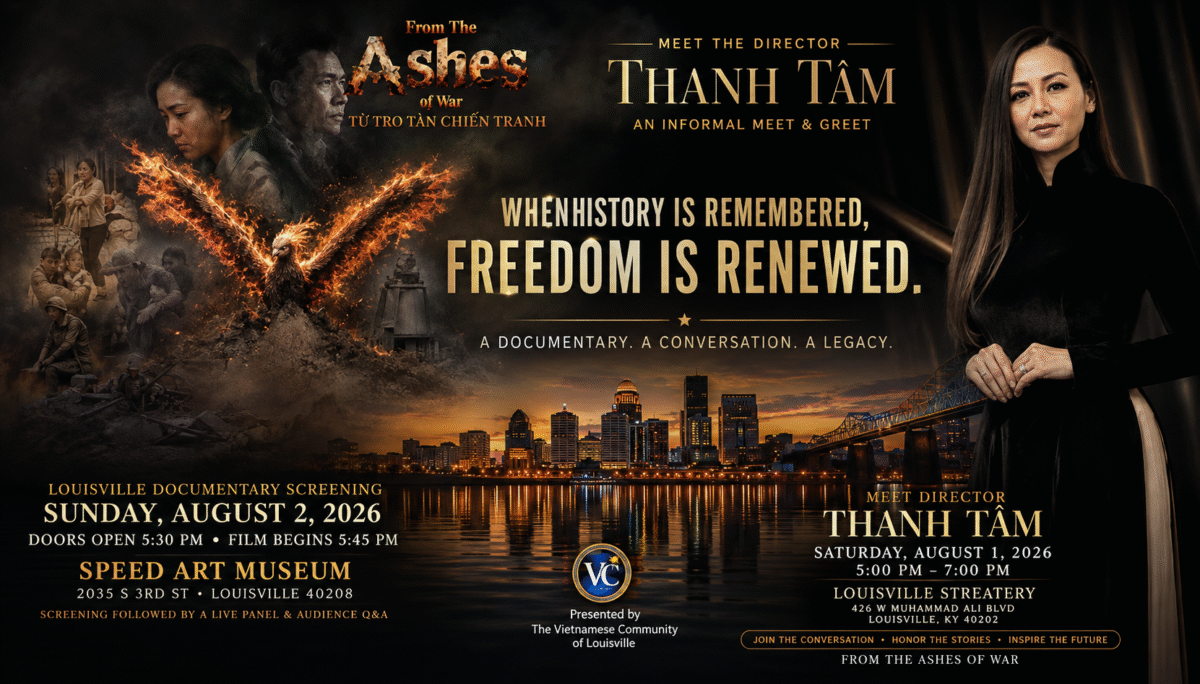
A reflection by Di Tran, following the Louisville screening of From the Ashes of War (Từ Tro Tàn Chiến Tranh) at the Speed Art Museum on Sunday, August 2, 2026 — presented by the Vietnamese Community of Louisville, produced by Lunar Village Productions, directed by Thanh Tam.

A Note on Purpose

This reflection is not written to argue politics.

It is written to honor stories.

People will debate history, ideology, and government in many ways, and they are free to. That is not the work being done here. This is a record of what one room in Louisville held on one evening, and what it asked of the people sitting in it.

It is written in love — for the elders who survived, for the families who crossed, for the children who may not yet understand the ground beneath their feet, and for a country that gave people room to begin again.

It is written for learning. A story like this should not be used to attack anyone. Its purpose is to listen, to preserve, and to help a younger generation understand why their elders lived, worked, prayed, sacrificed, and built the way they did.

One more thing should be said plainly at the start. No single account speaks for everyone. Some families left. Some families stayed, and rebuilt where they were, with a courage that deserves the same respect. Some families were separated and never made whole. Some are still waiting for news that will not come. Where this reflection says we, it means the people in that room on that evening — not a verdict on anyone else’s life, and not a claim to speak over anyone.

And beneath all of it runs one idea, the one this reflection exists to make plain:

A gift received creates an obligation. The obligation is not gratitude. The obligation is contribution.


The Room

On Sunday evening, August 2, at the Speed Art Museum on South Third Street, the film was not the only thing on the screen.

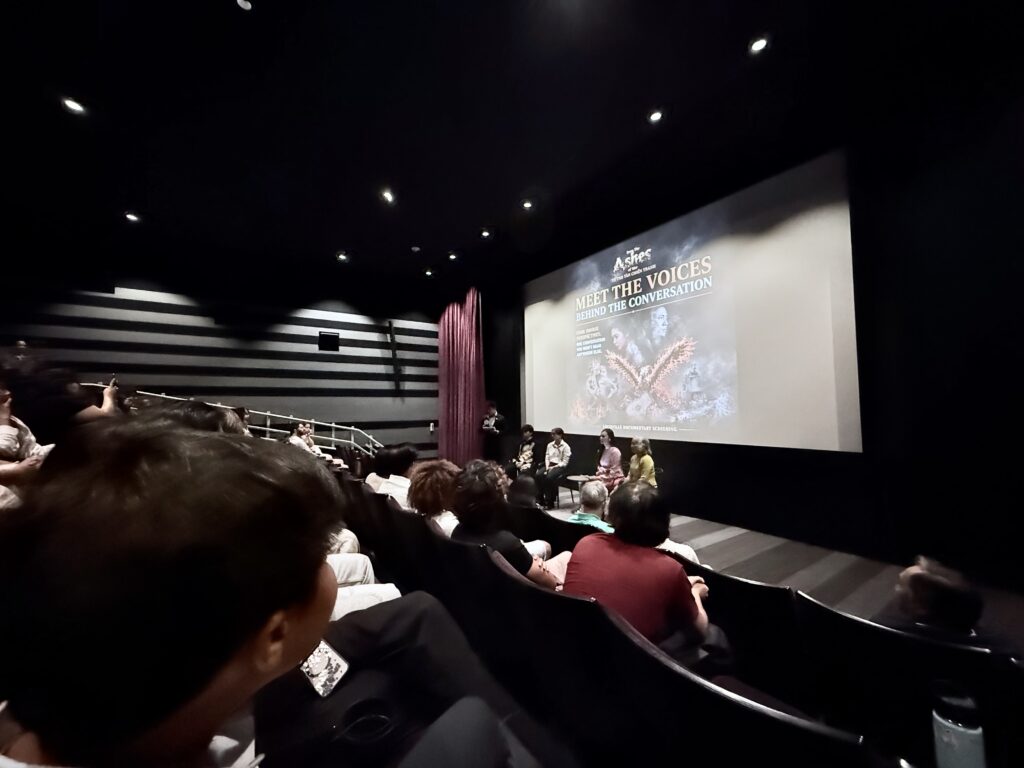
The doors opened at 5:30. The film began at 5:45. Afterward there was a live panel and an audience Q&A, and then a reception at Da Lat’s Cafe that ran until people finally went home. The evening was presented by the Vietnamese Community of Louisville — neighbors organizing for neighbors, which is its own small proof of everything written below.

The room carried more than one generation of Vietnamese history at once. Elders who had lived through war, loss, escape, and rebuilding. Boat people who knew the sea not as an image but as a passage between life and death. Children and grandchildren who inherited freedom, sometimes without inheriting the full story. Community members who came not only to watch, but to remember.

That is what made the evening powerful.

The Vietnam War is often spoken of as history. For Vietnamese families, fifty years is not ancient. Fifty years is a living parent. Fifty years is a living grandparent. Fifty years is a face in the room.

It is an accent. It is a silence at the dinner table. It is a family that works too hard because rest still feels unsafe. It is a mother who saves everything. It is a father who will not complain. It is a grandparent who survived more than the children may ever know.

For those who fled it, communism is not an abstract theory from a classroom debate. It is recent, and it is personal. It is remembered through separation, re-education camps, confiscation, censorship, hunger, escape, and the decision to leave everything familiar so the next generation could live with freedom.

That is a memory, not an indictment. It belongs to the people who lived it, and they are entitled to say it out loud in their own words. It is not a judgment on a country, a government, or anyone’s relatives who remained. Naming a memory is not the same as assigning blame. It is the difference between a headline and a household.


What Was Received

For fifty years, Vietnamese people have laid their lives across oceans, across land, across borders, and across continents so that their children could stand on something more stable.

Some crossed the sea. Some crossed camps. Some crossed hunger. Some crossed language. Some crossed humiliation. Some crossed grief. Some crossed the unbearable decision to leave a homeland so their children might have a future.

And then something was given to them.

A country opened a door. Not perfectly, and not without hardship, but it opened. There was a place to sleep. There was work. There was a school that would take a child who spoke no English. There was a church, a temple, a clinic, a neighbor who helped with paperwork. There was the right to own something and keep it.

Many of our children may never fully know what that door cost, or what it was worth.

They may not know the names of those who disappeared. They may not know the fear of the boat at night, the waiting, the camps, the paperwork, the uncertainty, the loneliness, or the particular ache of arriving in a new country with almost nothing. They may not know how many parents swallowed suffering so their children could feel normal, or how many elders carried trauma quietly so the next generation could carry opportunity loudly.

But whether they know it or not, they stand on those lives.

Every classroom entered, every business opened, every degree earned, every license obtained, every home purchased, every child who speaks freely, every family that now has safety, faith, food, education, and a future — all of it stands on someone who endured first, and on a place that made room.


What Was Rebuilt

People often say that Vietnamese Americans, Vietnamese Canadians, and Vietnamese communities around the world are hardworking, disciplined, ethical, determined, and family-centered. Most people notice the result. They see the nail salons, the restaurants, the professional careers, the small businesses, the churches, the temples, the schools, the children studying late, the parents working seven days, the grandparents still helping.

That kind of praise is meant kindly, and it can still flatten a person. No community is a monolith, and resilience is not a personality trait handed out at birth. Some families thrived. Some did not. Some carry addiction, debt, illness, estrangement, or a grief that never resolved into a success story. They belong in this account too, and they are not a failure of the community. A people should not have to be exceptional to deserve respect.

So the honest question is not why are they like that. It is simply: why?

The why is here. There are two truths, and the film makes both of them visible.

The first truth: Vietnamese people are resilient.

Vietnamese people work because every step forward is built on someone else’s sacrifice. We study because we know freedom can be lost. We build businesses because we know security is not guaranteed. We save because we know what it means to lose everything. We teach our children discipline because we know opportunity without character can be wasted. We contribute because we know survival alone is not enough.

The second truth: Vietnamese people are builders.

From the ashes of war, Vietnamese people did not only escape. They rebuilt.

Wherever they landed, they began again. If they landed in the United States, they helped build the United States. If they landed in Canada, they helped build Canada. If they landed in France, Australia, Germany, or anywhere else, they helped build there too.

This is the part that deserves precision, because it is the part most often flattened into a compliment.

A refugee who opens a shop is not only feeding a family. She is creating a job, paying a tax, anchoring a block, training an employee, and giving a landlord a reason to keep a building standing. A refugee who earns a license is not only earning income. He is entering a regulated profession, accepting a standard, and becoming accountable to the public that licensed him. A refugee who raises an ethical child is not only parenting. She is producing a citizen.

That is what building means. It is value added to a place, measurable and durable, by people who arrived with nothing to add it with.

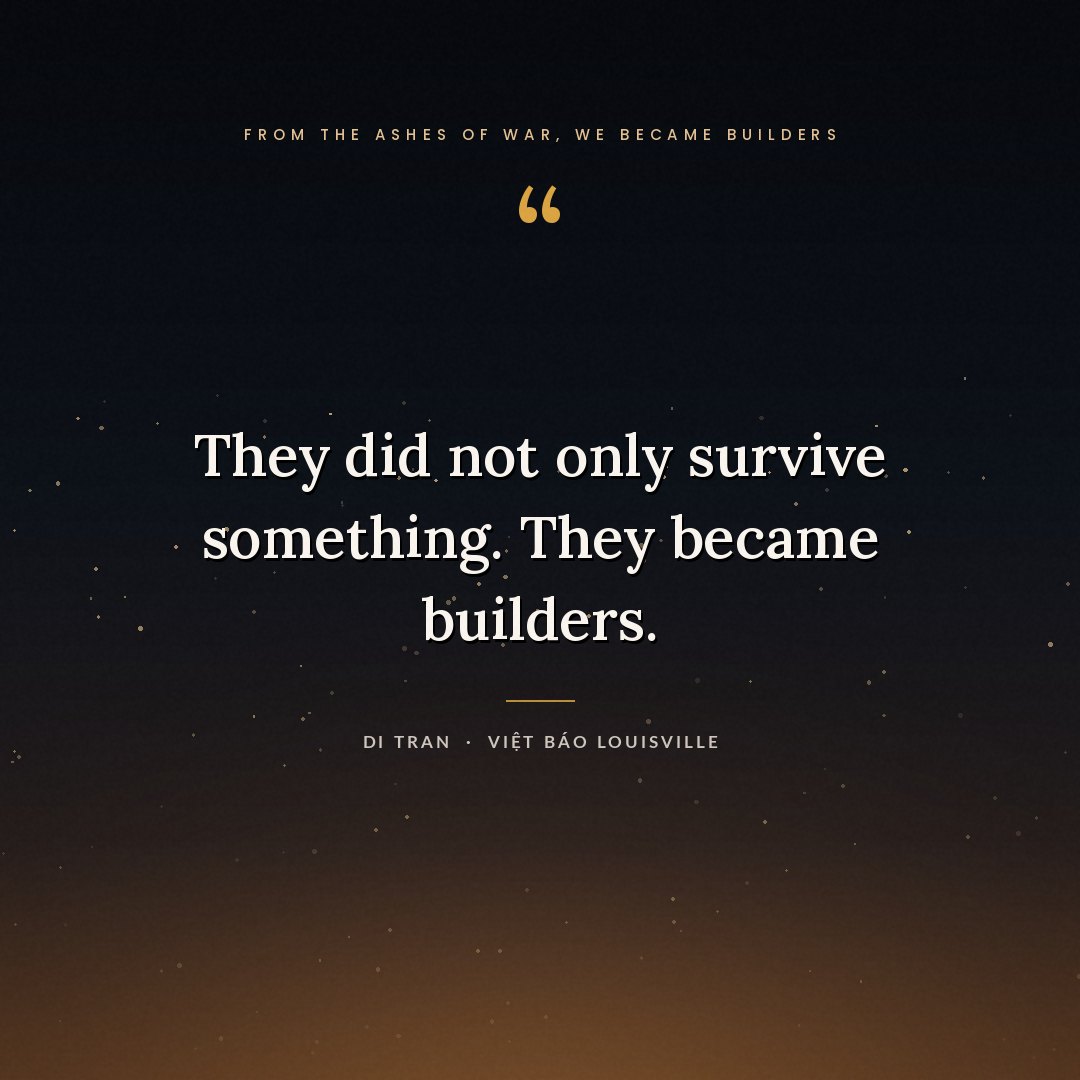
They did not only survive something.

They became contributors. They became makers. They became citizens. They became builders.


What Is Returned: The Debt to Be Paid

The doctrine in three movements: memory becomes service, learning becomes contribution, survival becomes a higher form of love.
Gratitude Becomes Work.

This is the Vietnamese debt of gratitude.

Not a debt of weakness. A debt of care. A debt of purpose. A debt of love.

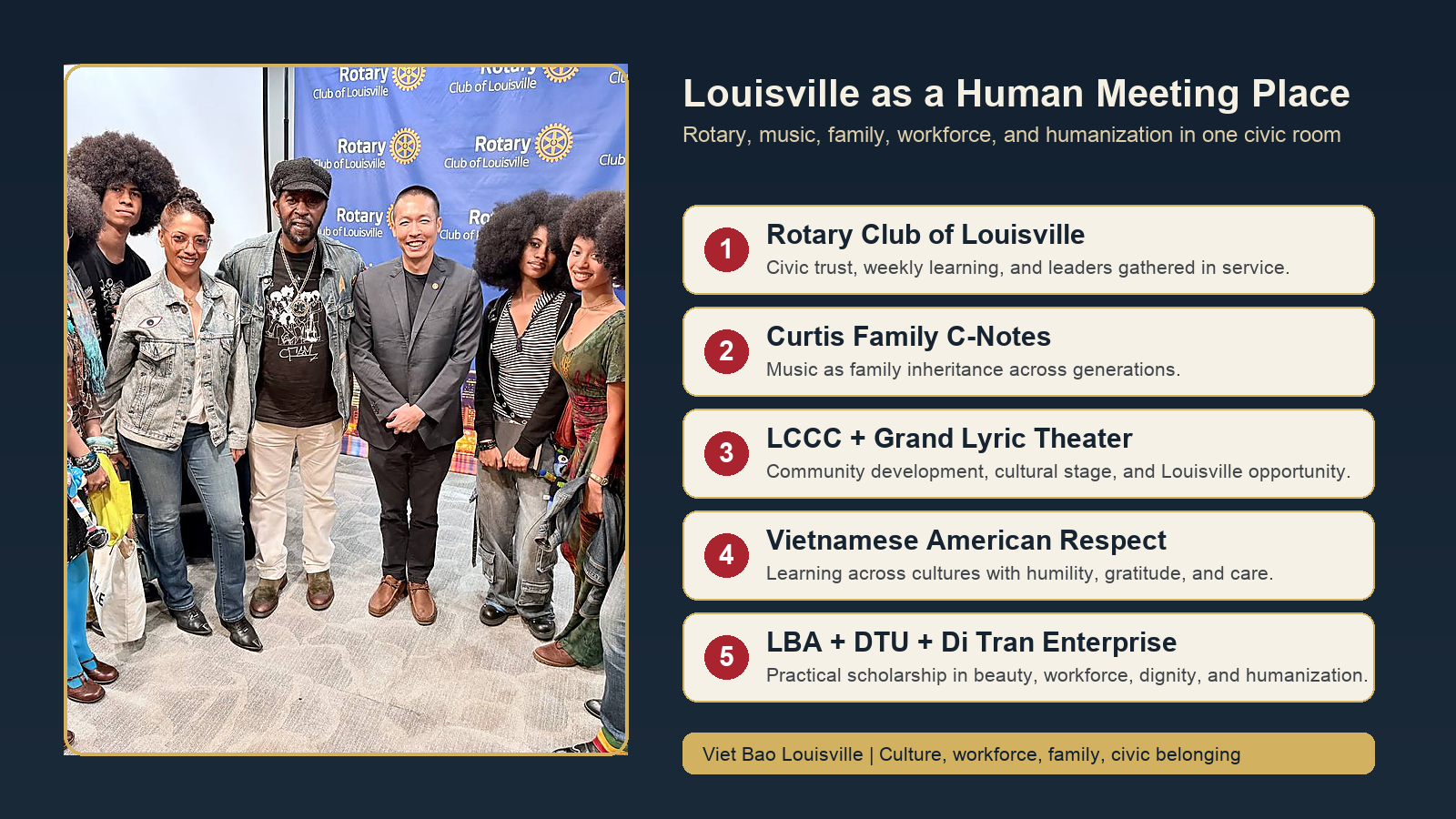
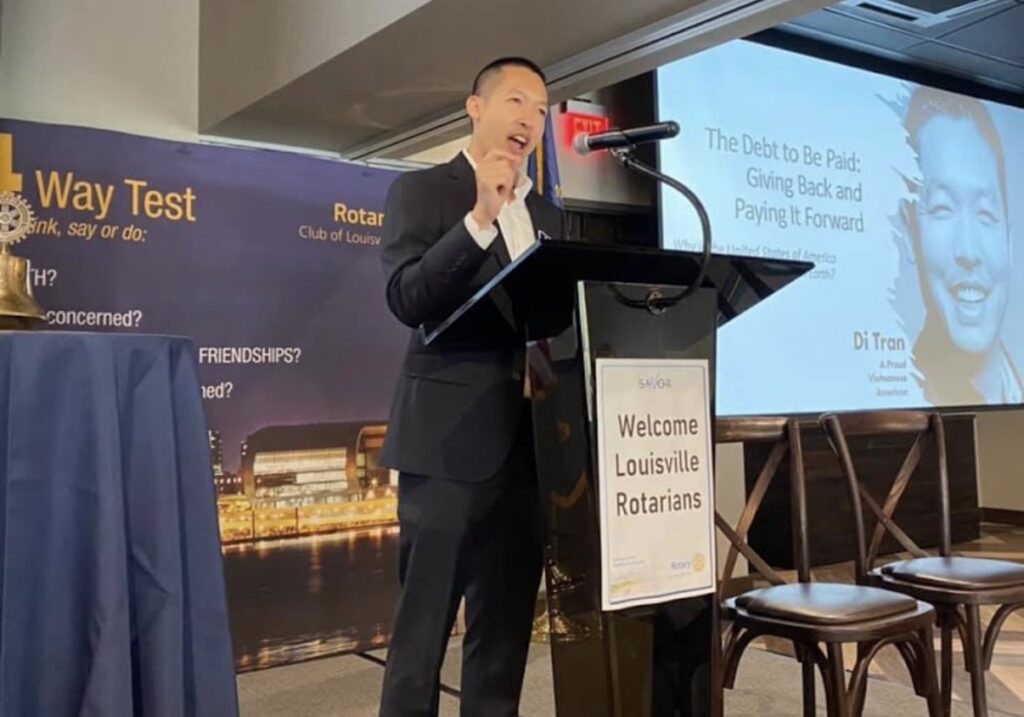
For me, this is personal. Years before this screening, I stood at a podium at the Rotary Club of Louisville and spoke about “The Debt to Be Paid: Giving Back and Paying It Forward.” That has never been only a speech. It is a life posture.

America received me. My family arrived from Vietnam in March 1995 with almost nothing, and I could not speak English. I became a citizen in 2000. America gave me room to learn, work, worship, build, fail, rise again, raise children, start businesses, serve students, and contribute to community life. I have told that story at length elsewhere, most fully in a MoxieTalk conversation with Kirt Jacobs, and I tell it again here only because it is the same debt this film is about.

The only worthy response to that gift is not passive appreciation.

The response is contribution.

Appreciation is a feeling. It costs nothing and it changes nothing. Contribution is a transaction with the world: something of value goes out that was not there before. A debt of gratitude is not paid by saying thank you. It is paid by producing.

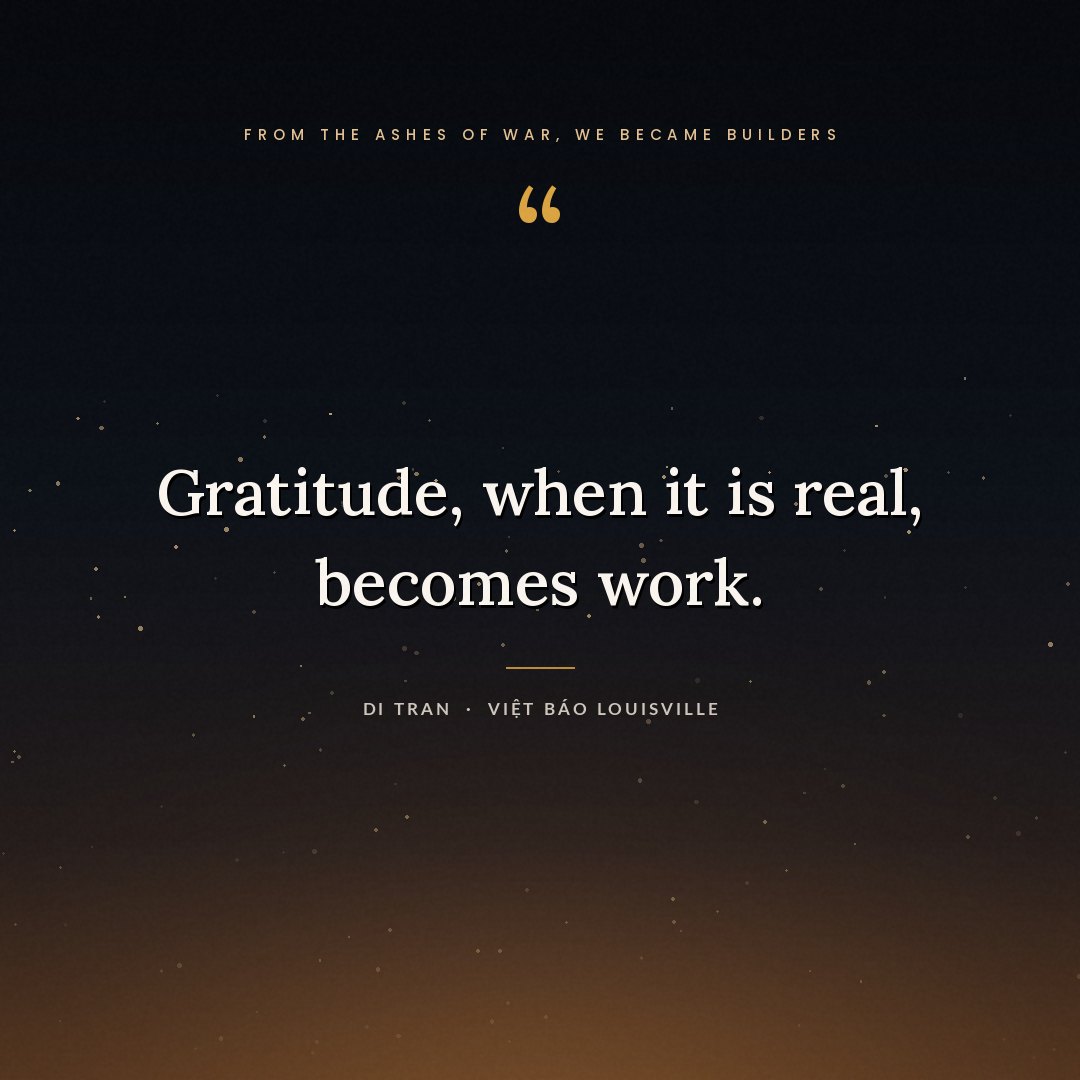
Gratitude, when it is real, becomes work.

It becomes raising ethical children. It becomes opening schools that teach rather than extract. It becomes creating jobs. It becomes teaching students who speak different languages. It becomes helping immigrants navigate systems that were not written for them. It becomes building institutions that make human stories useful for the next generation. It becomes writing books. It becomes preserving memory. It becomes showing up in civic rooms, business rooms, classrooms, and community rooms with the understanding that freedom is not only to be enjoyed.

Freedom is to be honored through responsibility.

Did something exist after you that did not exist before you, and can someone else use it without you in the room?

The test of a paid debt

A job that outlasts your shift. A student who can practice without you. A school that runs on a system, not on a personality. A book that keeps teaching after the author is gone. A record of testimony that a stranger can find in thirty years.

That is a paid debt. Everything else is a good intention.


Screenshot
Quote card reading: They did not only survive something. They became builders.
Survival Became Structure.

Why the Film Matters

The film does more than preserve pain. It explains character.

It helps the next generation understand that the discipline they see in their parents and grandparents did not come from nowhere. The pressure to work, the urgency to study, the fear of waste, the respect for elders, the need to own, the need to contribute, the need to be ethical, the need to build something real — all of it has history beneath it.

Sometimes children inherit the behavior without the story.

They hear “work hard,” but not the ocean behind it. They hear “be grateful,” but not the refugee camp behind it. They hear “do not waste this country,” but not the loss of another country behind it. They hear “study,” but not the parent who once had no school left to attend. They hear “build,” but not the family that once had everything taken.

That is why these stories must be told again. And they must be told in a way the next generation can actually receive.

Some young Vietnamese Americans may not carry the language as strongly as their elders. Some understand only pieces. Some feel Vietnamese by blood, American by schooling, and global by technology. That does not make them less Vietnamese. It means the bridge must be built with care.

The memory needs Vietnamese. It also needs English.
It needs long documentaries. It also needs short clips.
It needs elders speaking. It also needs young people asking.
It needs community screenings. It also needs classrooms, podcasts, captions, translations, books, public archives, searchable testimony, and modern tools that preserve witness before it disappears.

Preservation is itself a form of contribution. A story that is not recorded is a debt that quietly defaults.


An American Story, Too

This is not only a Vietnamese responsibility. It is also an American one.

Vietnamese refugee history is American history. It is part of the story of freedom, resettlement, small business, education, faith, family, civic duty, and the moral promise of a country that gives people room to begin again. Vietnamese Americans are not outside the American story. They are one of the ways America proves what it means.

The same is true in Canada and in every country that received Vietnamese refugees. Refuge is not only a destination. It becomes a relationship.

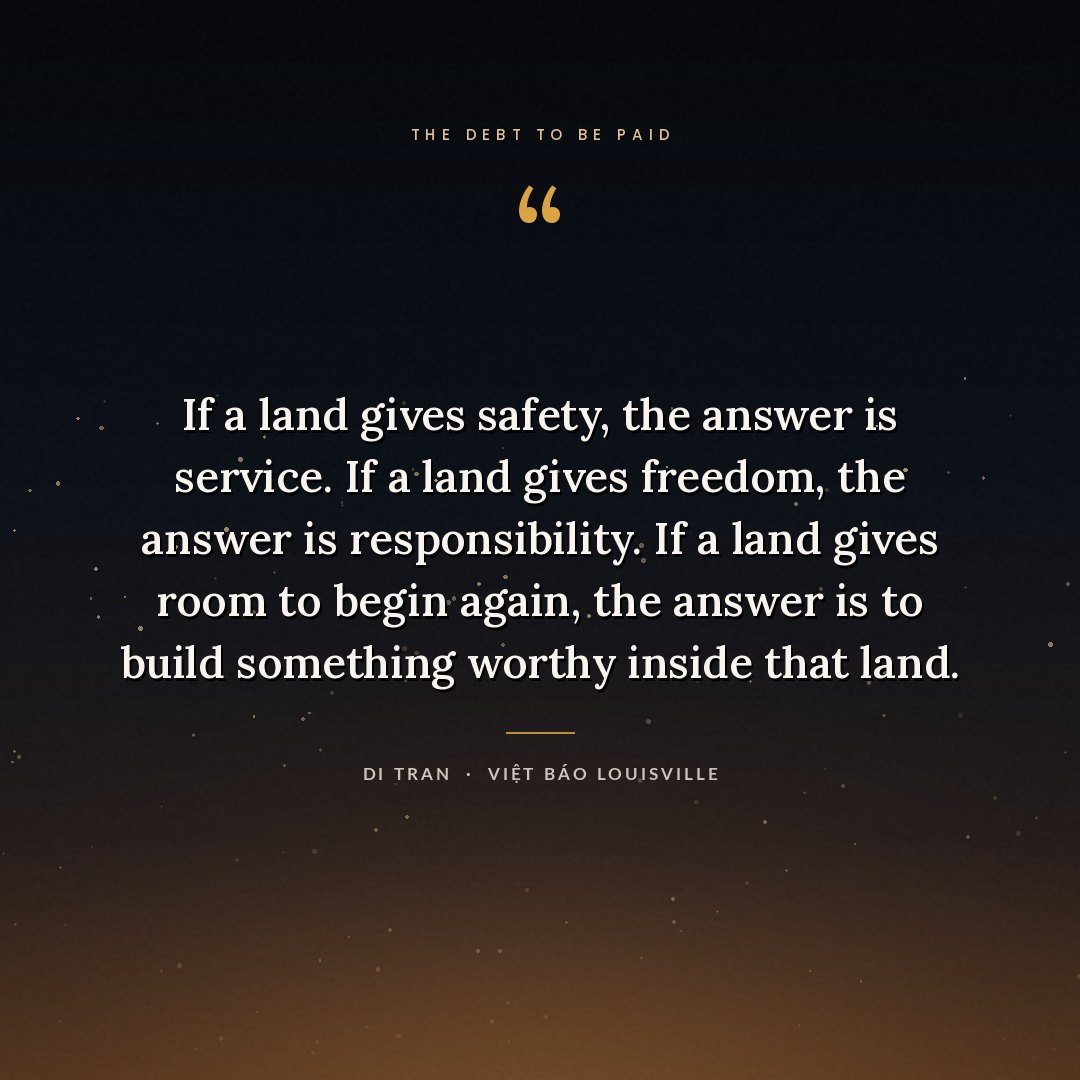
If a land gives safety, the answer is service.

If a land gives freedom, the answer is responsibility.

If a land gives room to begin again, the answer is to build something worthy inside that land.


Quote card reading: If a land gives safety, the answer is service. If a land gives freedom, the answer is responsibility. If a land gives room to begin again, the answer is to build something worthy inside that land.
Refuge Becomes Relationship.

Two People, One Purpose

At that meeting, what stood out was not politics. It was love.

Pure love for people, for memory, for elders, for children, and for the stories that too often stay trapped inside families until someone cares enough to ask, listen, film, preserve, and share.

Thanh Tam and I stood there not as debaters of history, but as carriers of stories. I carried the reflection of an immigrant builder who believes every life must be paid forward through contribution. She carried the responsibility of a filmmaker preserving voices before they disappear — work she does from Canada, about a diaspora that scattered across many countries, for an audience that turned out on a Sunday evening in Kentucky.

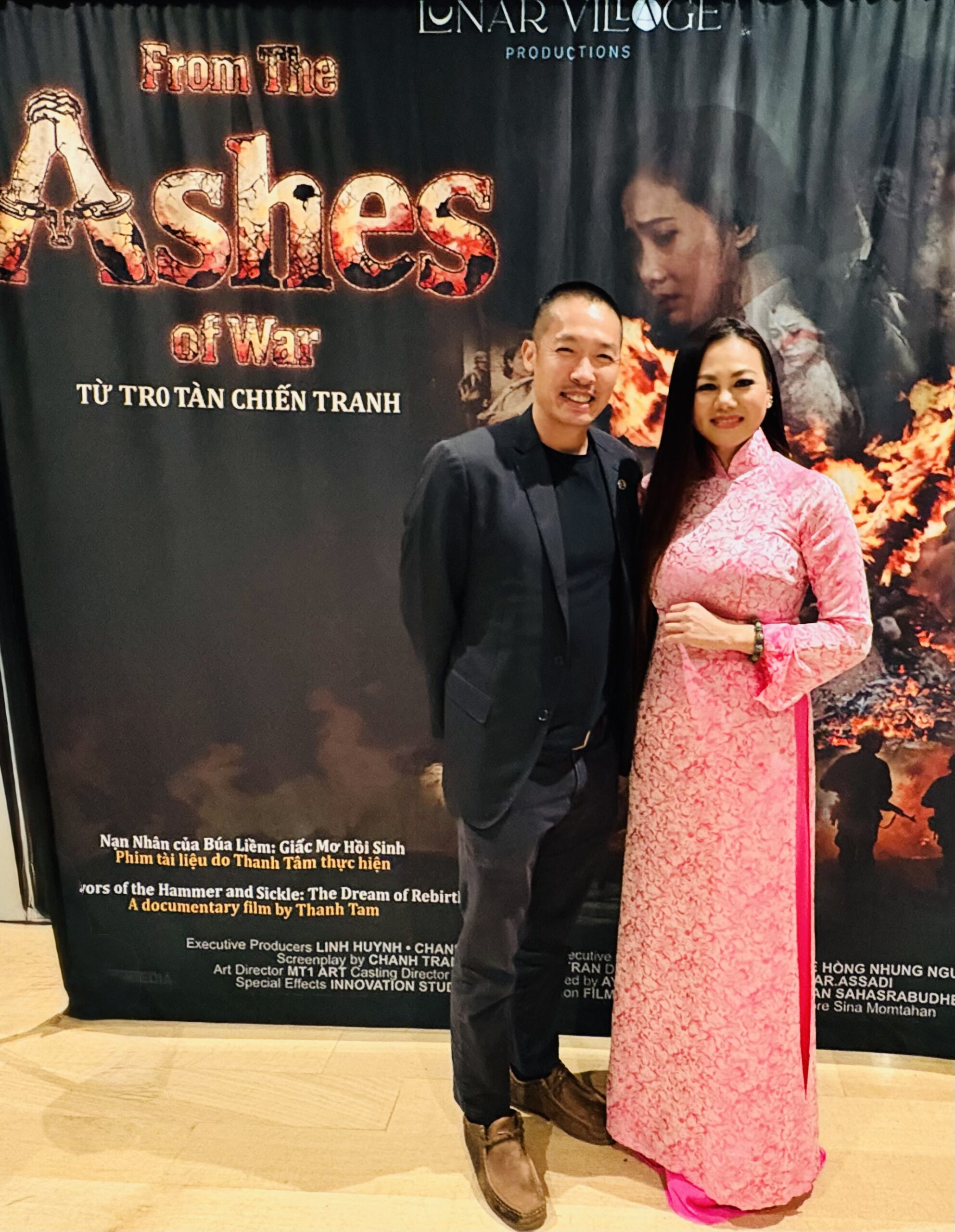
Di Tran stands with director Thanh Tam, wearing a pink áo dài, in front of the From the Ashes of War film banner at the Louisville screening.
Di Tran with director Thanh Tam at the Louisville screening of From the Ashes of War (Từ Tro Tàn Chiến Tranh), Speed Art Museum, August 2, 2026.
Two Carriers of the Same Story.

Between us was a simple human truth: Vietnamese history must be shared with love, or it will not reach the next generation.

Two different tools. One debt.


The Larger Doctrine

This is also the spirit behind the College of Humanization and the body of published work that has come out of it.

The public author catalog now holds a substantial body of titles — books on professional discipline, practical licensing, leadership, values, business-building, and human-centered learning. The number is not important as a vanity count. It matters because it shows a pattern: turn lived experience into teaching, turn teaching into accessible tools, and turn gratitude into value that other people can use without needing permission.

That is the same doctrine, applied to paper.

In that sense, the books align directly with the message of From the Ashes of War. Memory must become service. Learning must become contribution. Survival must become a higher form of love.

The same test applies. A book is not a monument. It is a tool someone else can pick up.


What the Room Held

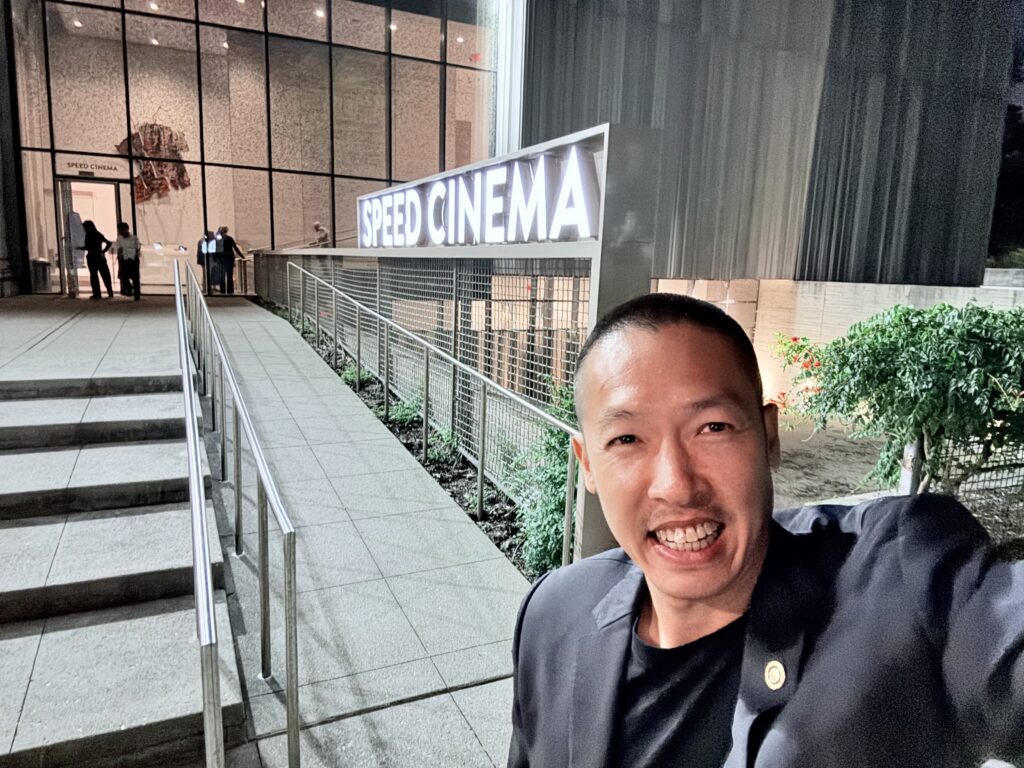
In that room at Speed Cinema, the story was not abstract.

The elders carried memory. The director carried witness. The young carried the future. The community carried the bridge.

From the ashes of war, Vietnamese families crossed oceans. From the ashes of displacement, they raised children. From the ashes of loss, they opened businesses, entered schools, earned licenses, served neighborhoods, built churches and temples, paid taxes, hired workers, cared for elders, taught children, and strengthened the places that welcomed them.

That is the real legacy beneath the visible success of Vietnamese communities around the world. It is not random ambition. It is inherited responsibility. It is the living memory of people who know that every opportunity rests on a sacrifice before it.

The children may know it or not. But they are being carried by it. They stand on lives that crossed the sea. They stand on parents and grandparents who refused to let war have the final word. They stand on people who lost much, endured more, and still chose dignity.

And some of the people who made that possible are not here to be thanked. They are in the water, in the camps, in unmarked ground, in the years that were taken from them. Part of the debt is owed to people who will never collect it. That is precisely why it has to be paid forward instead of back.

Now the responsibility belongs to us.

We must remember. We must teach. We must translate. We must preserve. We must build. We must make sure the next generation does not inherit only the freedom, but also the meaning behind it — and the bill that comes with it.

From the ashes of war, we do not only survive.
We build so the next generation can stand higher.


Quote card reading: Gratitude, when it is real, becomes work.
The Test of a Paid Debt.

The Screening

From the Ashes of War (Từ Tro Tàn Chiến Tranh)
Directed by Thanh Tam · Lunar Village Productions
Presented by the Vietnamese Community of Louisville

Sunday, August 2, 2026 · Speed Art Museum, 2035 South Third Street, Louisville, Kentucky
Screening followed by a live panel and audience Q&A, with a reception at Da Lat’s Cafe.

With thanks to the organizers, the panelists, and the elders who came and stayed to talk.


Sources and References

  • Film / project reference: https://www.gofundme.com/f/historical-documentary-from-the-ashes-of-war
  • Louisville screening reference: https://www.eventbrite.com/e/from-the-ashes-of-war-louisville-screening-community-panel-tickets-1994311920640
  • Video reference: https://www.youtube.com/watch?v=TDxVJlIeVsk
  • MoxieTalk with Kirt Jacobs — conversation with Di Tran: https://moxietalk.com/episodes/di-tran/
  • Rotary Club of Louisville: https://www.louisvillerotary.org
  • Di Tran author catalog: https://www.amazon.com/stores/author/B0CK64CFN9/allbooks

Louisville, Kentucky — August 3, 2026

Categories
Small Businesses Workforce Development Workforce Education

Kentucky Supreme Court Justice Angela McCormick Bisig Inspires Di Tran and Rotary Club of Louisville with a Powerful Lesson on Freedom, the Rule of Law, and America’s Three Branches of Government

A Lesson in Freedom, Law, and the Quiet Strength of America’s Judiciary

As America celebrates its 250th year, conversations about freedom often focus on the nation’s founders, the Constitution, and the military men and women who have defended our country. Yet one of the greatest protectors of freedom is often the quietest institution of all—the judiciary.

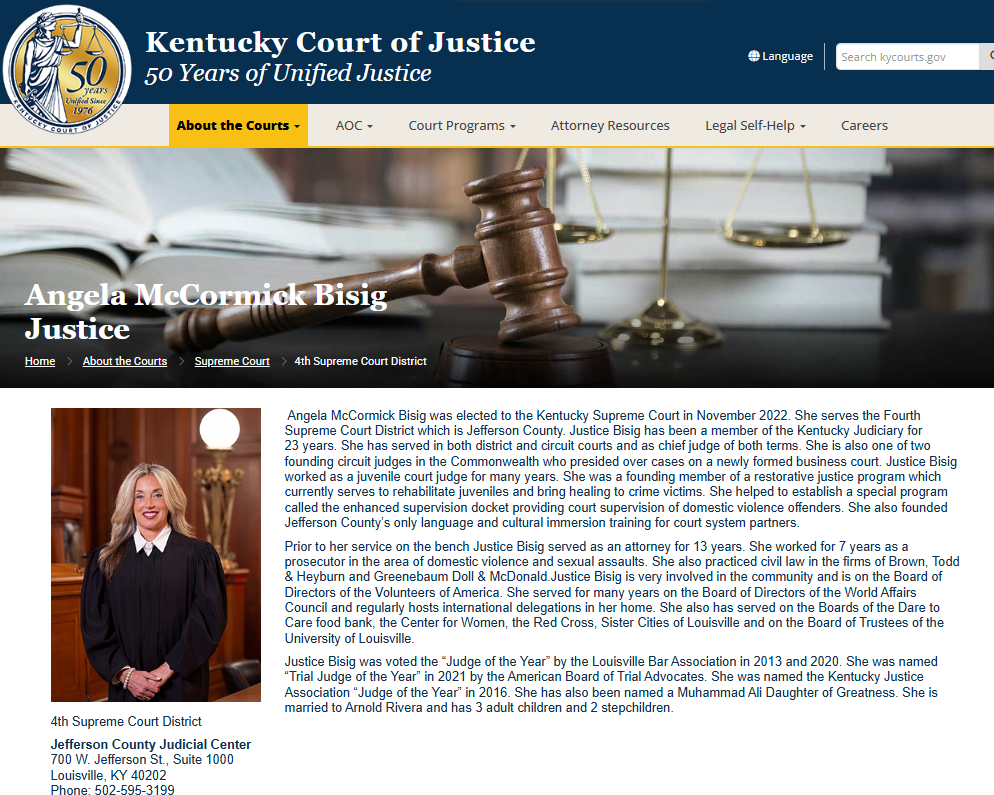
Today, Rotary Club of Louisville members had the privilege of hearing from Kentucky Supreme Court Justice Angela McCormick Bisig, one of only seven justices serving on the Commonwealth’s highest court. Justice Bisig represents the Fourth Supreme Court District, consisting solely of Jefferson County, making her responsible for the state’s largest county at the highest judicial level.

The Rotary Club of Louisville itself is one of the world’s largest Rotary clubs, bringing together hundreds of business, nonprofit, government, education, and civic leaders every week. The club describes itself as one of the largest among Rotary’s more than 45,000 clubs worldwide, providing members direct access to distinguished local, state, national, and international speakers.

For Louisville entrepreneur and Rotary member Di Tran, the luncheon was far more than another Thursday meeting.

“It was a lesson on the beauty of America’s system of government and why law matters.”

Rather than discussing politics, Justice Bisig explained the constitutional role of the judiciary—one of the three co-equal branches of government alongside the legislative and executive branches.

The explanation highlighted an important reality that many Americans may never fully appreciate.

The legislative branch creates laws.

The executive branch carries out and enforces those laws.

The judiciary does neither.

Instead, judges wait.

They do not search for cases.

They do not proactively investigate disputes.

They do not write new legislation.

They do not enforce regulations.

Their responsibility begins only when a real legal controversy is properly brought before the court.

Only then do judges carefully study the facts, hear both sides, apply the law as written, and when necessary, interpret areas where the law is reasonably open to more than one meaning.

This discipline is not weakness—it is one of the judiciary’s greatest strengths.

Its restraint helps ensure that every citizen, regardless of wealth, background, political influence, or status, stands equally before the law.

That quiet commitment to impartiality is one of the foundations of American liberty.

For Di Tran, an immigrant entrepreneur who deeply values the freedoms available in the United States, hearing this explanation directly from a sitting Kentucky Supreme Court justice carried special meaning.

“It reminded me that freedom is protected not only by those who make laws or enforce them, but also by those who patiently preserve justice through the rule of law.”

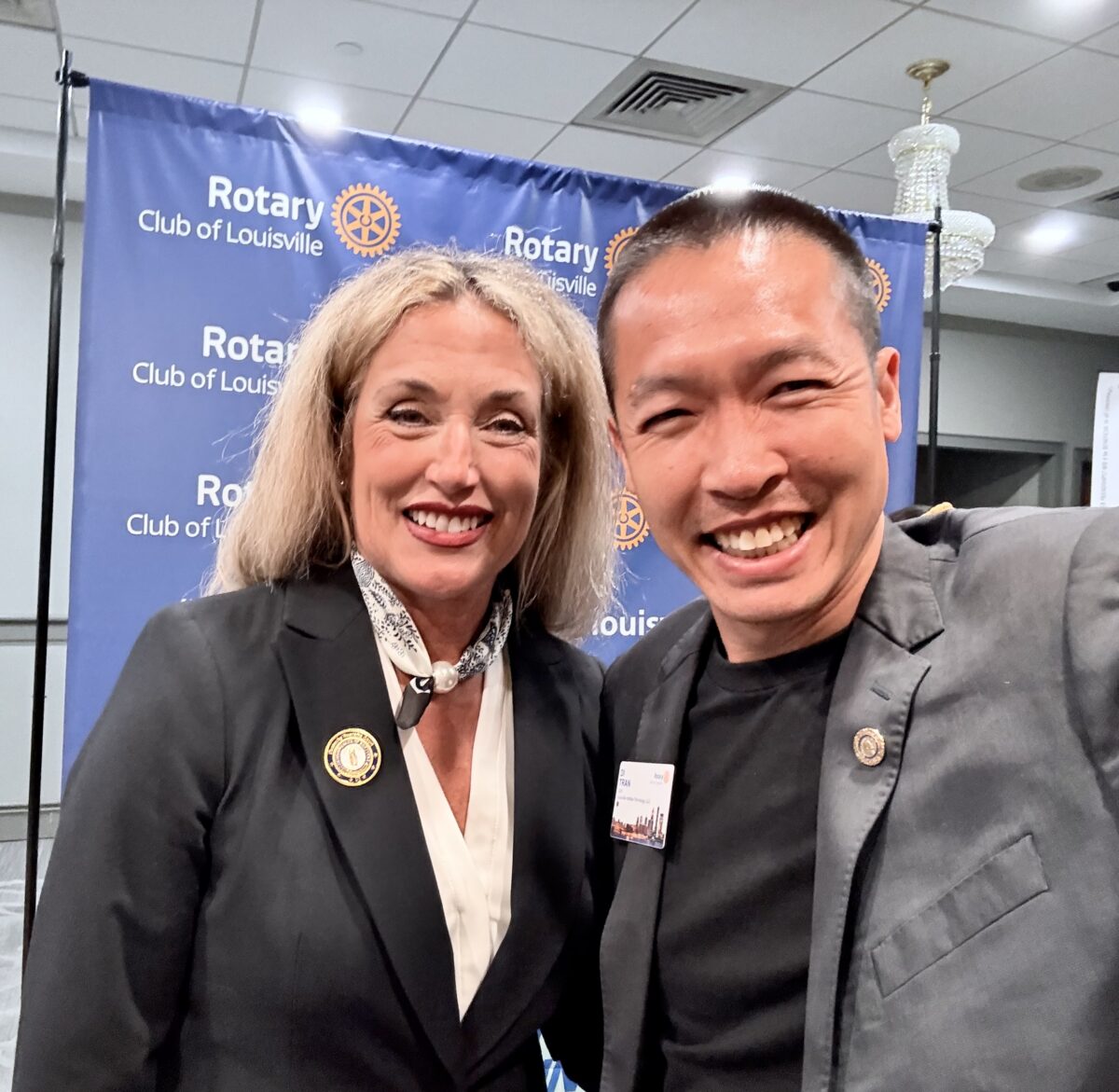
Following the presentation, Di Tran took a moment to thank Justice Bisig personally with a handshake—not because of politics or personal recognition, but out of appreciation for a civic lesson that reinforced the importance of constitutional government.

In an era when public attention often centers on conflict and division, today’s Rotary luncheon served as a reminder that some of the nation’s most important institutions work quietly, deliberately, and without seeking headlines.

The judiciary is designed to be reactive rather than proactive.

Its judges do not seek power; they exercise only the authority entrusted to them when a case comes before the court.

That restraint protects everyone.

As America reflects on 250 years of independence, events like this remind us that freedom depends not only on elections and legislation, but also on an independent judiciary committed to fairness, impartiality, and the rule of law.

Sometimes the most powerful lessons are delivered by those whose job is simply to listen, interpret the law faithfully, and ensure that justice belongs equally to every citizen.

Categories
Self-Improve Workforce Development

An Inspiring Encounter at the Rotary Club of Louisville: Di Tran and Angela Billings

At the recent Rotary Club of Louisville meeting, members and guests were treated to a remarkable presentation by Angela Billings, a U.S. Air Force veteran, public relations expert, and author of Command the Crisis: Navigate Chaos with Battle-Tested Public Relations and Communication Strategies. Among the captivated attendees was Di Tran, a Vietnamese immigrant, entrepreneur, and community leader who has frequently expressed his deep admiration for America, referring to the country as “heaven on earth.”

Angela Billings is a true embodiment of resilience and dedication, having served in high-profile positions during her military career, including as a spokesperson for the U.S. Air Force in Washington, D.C., and international posts in Germany, Korea, and Afghanistan. On September 11, 2001, she was in the Pentagon when American Airlines Flight 77 crashed into the building. Angela’s harrowing experience that day gave her unique insight into managing crises, not just in theory, but under unimaginable circumstances. Her talk, “Under Attack,” conveyed her hard-earned lessons in crisis management and offered valuable insights into navigating communication during critical moments. As she shared her story, Di Tran listened in awe, deeply moved by her courage and the pivotal role she continues to play in public service.

For Di Tran, meeting Angela was a profound experience. As they shook hands, he expressed his admiration, sharing, “I only watch people like you in movies. You’re the first person I’ve met who lived through the 9/11 attack at the Pentagon, and now you’re a communications professional who is still serving, making an impact in the Kentucky Senate.” Di Tran’s respect was evident as he recognized Angela not only as a veteran of military service but also as a mentor to many, a crisis expert, and a key player in Kentucky’s political landscape. Her current role as director of communications for the Kentucky Senate Majority allows her to continue her legacy of service, this time on behalf of the Commonwealth.

The significance of their meeting was heightened by their shared commitment to recent legislative progress. Di Tran, an advocate for inclusivity and workforce development, has been an enthusiastic supporter of Senate Bill 14. This landmark bill, passed earlier this year, expands the Kentucky Board of Cosmetology to include diverse representation, promotes multilingual testing, and underscores the importance of inclusivity within the state’s beauty industry. For Di Tran, who has been deeply involved in this advocacy, Angela’s presence underscored the power of determined individuals working within government to effect change.

Angela Billings’s strength and composure, qualities honed through years of experience and tested under unimaginable circumstances, are a source of inspiration for leaders like Di Tran. Her willingness to share her story and her insights into crisis communication serve as a powerful reminder of the sacrifices made by public servants. In Angela, Di sees a reflection of his own values—a commitment to service, the courage to face adversity, and the passion to improve the world around them. Both Angela and Di Tran share a profound belief in the promise of America, each working in their way to uphold its ideals and elevate those around them.

This powerful connection at the Rotary Club serves as a testament to the enduring strength of service and resilience. As Di Tran often says, “America is heaven on earth.” Meeting Angela Billings, a hero in her own right, only deepened his belief, reminding everyone present of the extraordinary individuals who stand ready to serve and protect, in times of peace and crisis alike.

Categories
Beauty Industries Community Drop the FEAR and Focus on the FAITH Drop the ME and focus on the OTHERS Early Childhood Education Guiding Lights: A Journey of Courage, Compassion and Faith Self-Improve Small Businesses Workforce Development

El Crisol Divino: La Historia de Di Tran y el Papel del Supermercado Guanajuato en Tejer el Sueño Americano

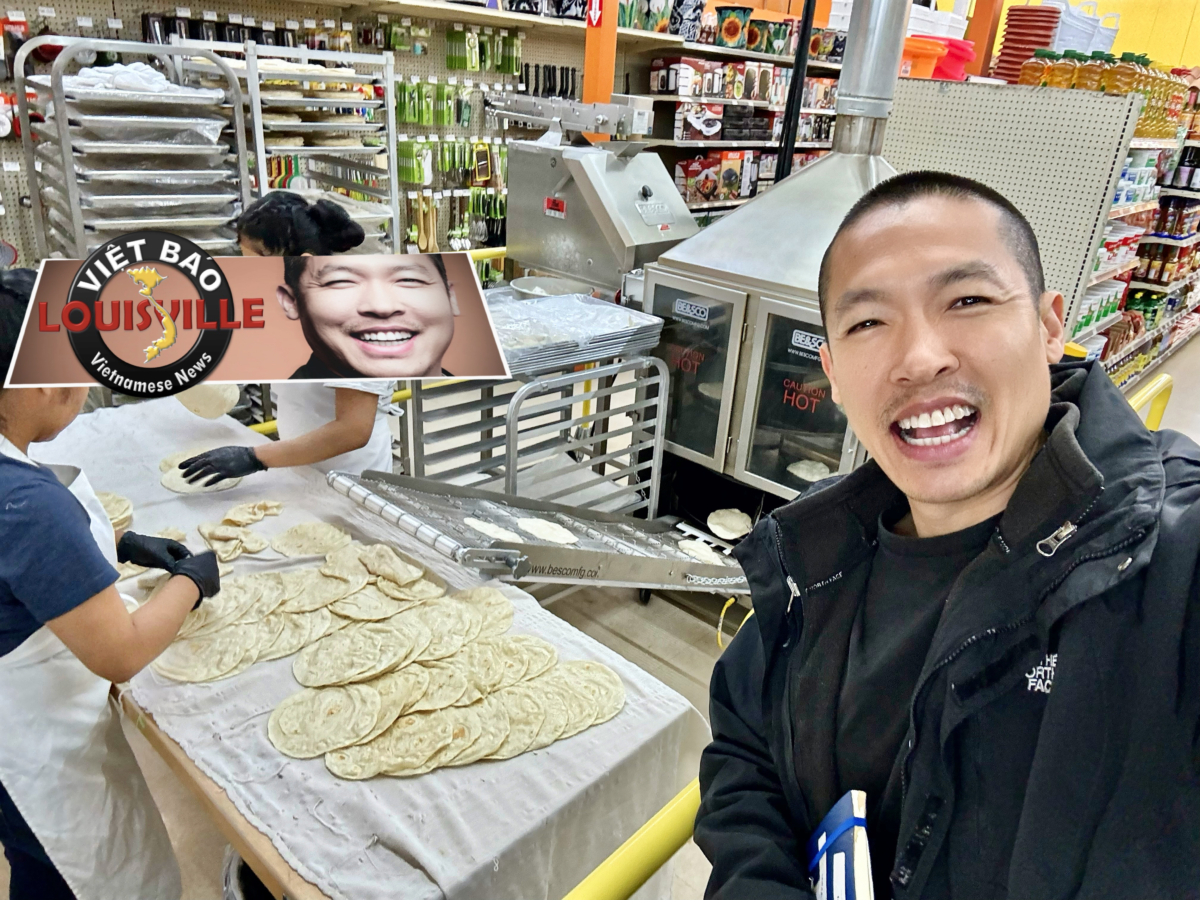
En el corazón de Louisville, Kentucky, se desarrolla una historia que entrelaza las hebras de cultura, cocina y comunidad: una narrativa que pertenece a Di Tran, un local vietnamita con un profundo amor por la comida latina. Es una historia que no solo explora la cocina, sino también el lenguaje universal de las sonrisas, compartido a través de culturas, y el poder de la comida para unir a las personas. El viaje de Di Tran refleja el de muchos inmigrantes, comenzando con su llegada a EE.UU. en 1995 sin habilidades en inglés, comunicándose a través del lenguaje internacional de gestos y buena voluntad. Como él, dos trabajadoras del Supermercado Guanajuato #2, con su limitado inglés, transmiten calor y bienvenida a través de sus sonrisas y frases entrecortadas. En su intercambio de orígenes, “vietnamita” se encuentra con “guatemalteco”, y en sus sonrisas, una comprensión compartida.

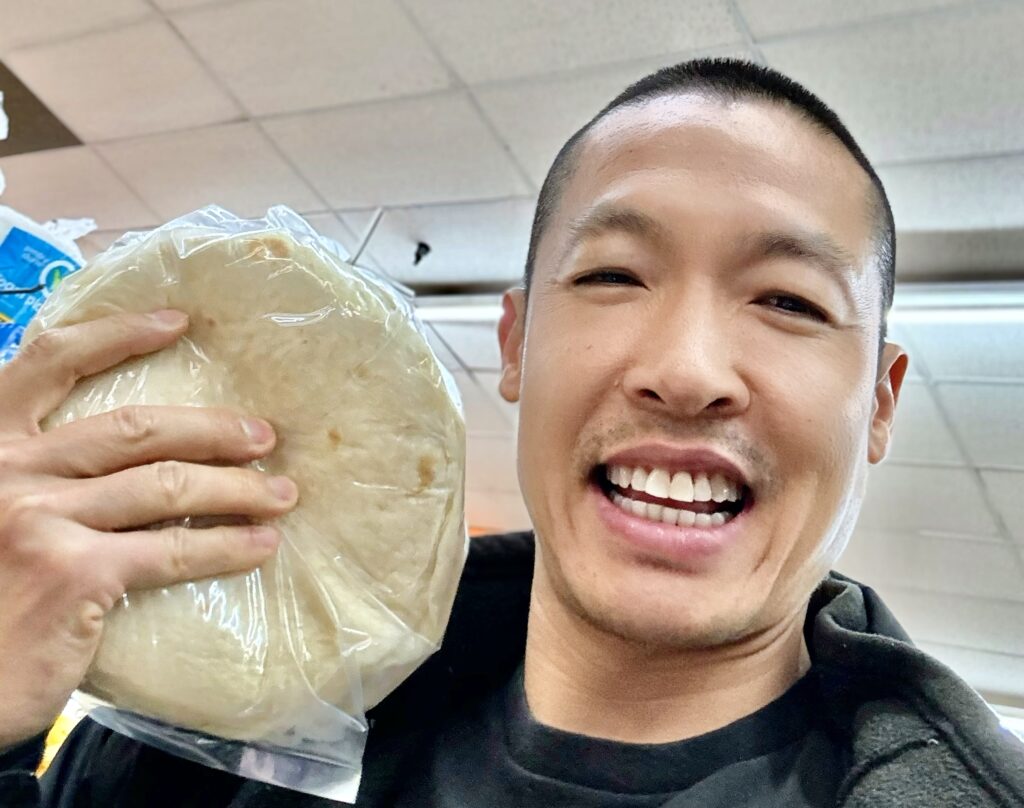
La esencia de la historia de Di Tran es la fusión, una fusión que trasciende la simple mezcla de tradiciones culinarias. Su uso innovador del pan plano, que recuerda a su infancia en Vietnam, cortándolo en tiras similares a fideos o envolviéndolo alrededor de repollo finamente cortado, crea un delicioso tapiz de sabores y texturas. Sin embargo, la fusión va más profundo, simbolizando la mezcla armoniosa de diferentes antecedentes y experiencias que contribuyen al vibrante tapiz de la sociedad estadounidense.

Louisville, conocida por su encanto sureño, se ha convertido en un lienzo para esta hermosa convergencia de culturas. El amor de Di Tran por el pan plano recién salido del horno, envuelto con carnes al estilo asiático, crea una experiencia compartida que resuena no solo con él, sino con todos los que llaman hogar a Louisville. Es una ciudad donde el calor de su gente, ya sean nativos o inmigrantes, crea un ambiente tan nutritivo y reconfortante como la comida que comparten.

A través de los ojos de Di Tran, la belleza de Louisville brilla no solo en sus paisajes, sino en los rostros de su gente: cuidadosos, amorosos y que abrazan la diversidad. El espíritu de la ciudad hace eco de sus recuerdos de una infancia en una cabaña de barro donde todos eran cuidadosos, prueba de que, independientemente de nuestros orígenes, la experiencia humana, en su esencia, es compartida. La vida de Di Tran y su comida son testimonios del hecho de que la fusión no se trata solo de crear nuevos sabores; se trata de forjar nuevas comunidades, nuevas conexiones y un nuevo entendimiento de lo que significa estar en casa.

PD: En una mezcla armoniosa de compasión y belleza, Di Tran fundó la Louisville Beauty Academy. Arraigada en Kentucky y floreciente con dos campus, esta universidad acreditada por el estado se ha convertido en un faro de aprendizaje para una comunidad diversa. Se erige como una institución orgullosa donde los inmigrantes latinos, asiáticos y europeos, entre otros, reciben no solo educación sino un lugar para florecer. Esta academia celebra el espíritu de inclusividad y empoderamiento, encarnando la dedicación de Di Tran a proporcionar oportunidades para todos, uniendo las hebras de la belleza divina en el sueño de cada individuo.

Categories
Community Immigration

A Tapestry of Dreams: Louisville’s Immigrant Luminaries Celebrate Unity and Achievement

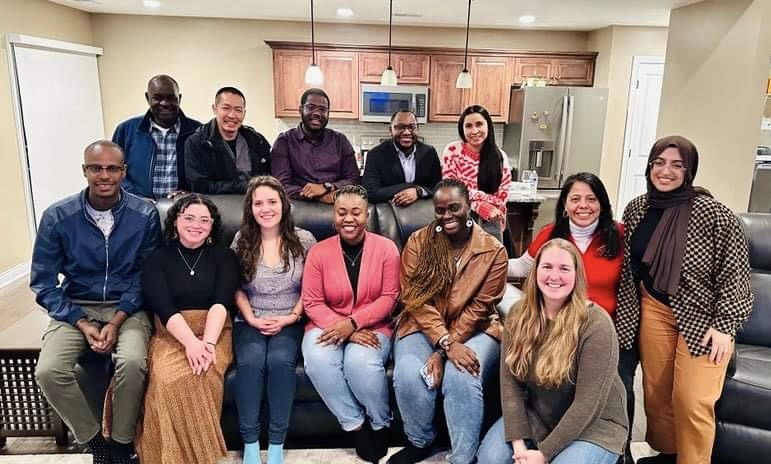
As the sun set on Louisville, Kentucky, a remarkable group of thirteen individuals gathered, each a beacon of hope and a testament to the city’s vibrant diversity. This assembly was not just a celebration of personal triumphs but a powerful homage to the spirit of immigration that has, and continues to, enrich the United States.

In a modest yet welcoming room, voices mingled in a symphony of accents, each telling a story of resilience and determination. From the Jewish heritage of Siera to Daniela’s roots in Panama and Mexican culture, from Erica’s Haitian pride to Oumie’s Gambian strength, and Sarah’s U.S. upbringing, the group embodied the world in microcosm. Hadiya brought tales from Pakistan, Karina shared memories of Guatemala, Eva brought the warmth of Mexico, while Amos, Stanley, Brother Di, Edward, and Mandela added the perspectives of Burundi, Haiti, Vietnam, Kenya, and the Democratic Republic of Congo, respectively.

Each member of this diverse group carried a narrative marked by the trials of their immigrant journeys, yet their stories were underscored by a common theme: a profound appreciation for the freedom found in their adopted homeland. They have seized every second to not only savor their liberties but also to exert themselves tirelessly in contributing to the nation’s prosperity.

Their contributions are manifold — uplifting hundreds and thousands around them through education, business, and service. PhDs, entrepreneurs, and community leaders sit side by side, united by their extraordinary achievements and driven by a mission to serve.

In a moment of reflection, Di Tran, a man whose journey from Vietnam to the upper echelons of education and entrepreneurship embodies the American dream, was moved to express a heartfelt sentiment: “Lord of God, you are beautiful.” This statement was a quiet acknowledgment of the divine grace he sees in the collective success and unity of his peers.

The gathering was not just a meeting of minds but of hearts — a testament to the city of Louisville’s growing power and potential. It is a city buoyed by the spirit of its people, and as Di Tran and his companions have shown, it is a city on the cusp of an even brighter, stronger future.

Through their lives and work, these thirteen individuals demonstrate that the strength of a community lies in its diversity and its unyielding capacity for kindness and support. Louisville stands as a beacon of what can be achieved when we embrace our differences and work together towards common goals.

As we celebrate these stories of strength and respectability, we recognize that this is the essence of America’s promise — a promise kept alive by the indomitable spirit of its immigrant sons and daughters.

Categories
Community

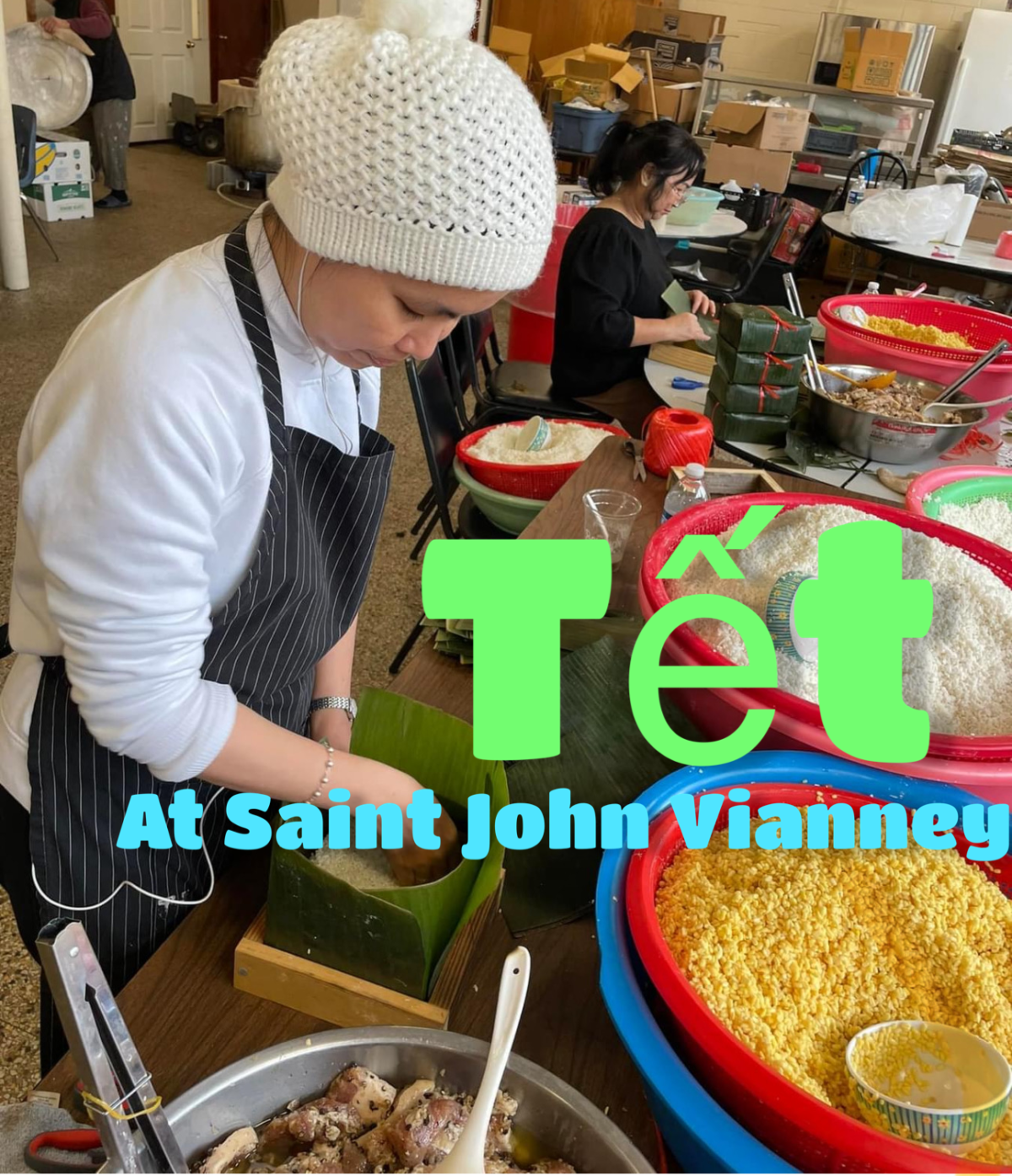
The Heartwarming Tradition of Bánh Trưng and Bánh Tét at Saint John Vianney in Louisville, Kentucky

In the heart of Louisville, Kentucky, amidst the chilly embrace of winter, a warm and vibrant tradition flourishes, echoing the rich cultural heritage of Vietnam. This tradition centers around “Bánh Trưng” and “Bánh Tét,” two quintessential Vietnamese dishes that symbolize the essence of Tết, the Lunar New Year celebration. Far from their tropical homeland, the Vietnamese community at Saint John Vianney, a Catholic Church with a significant Vietnamese congregation led by Father Anthony Chinh Ngo, keeps this tradition alive with love, dedication, and a deep sense of community.

The Tradition of Bánh Trưng and Bánh Tét

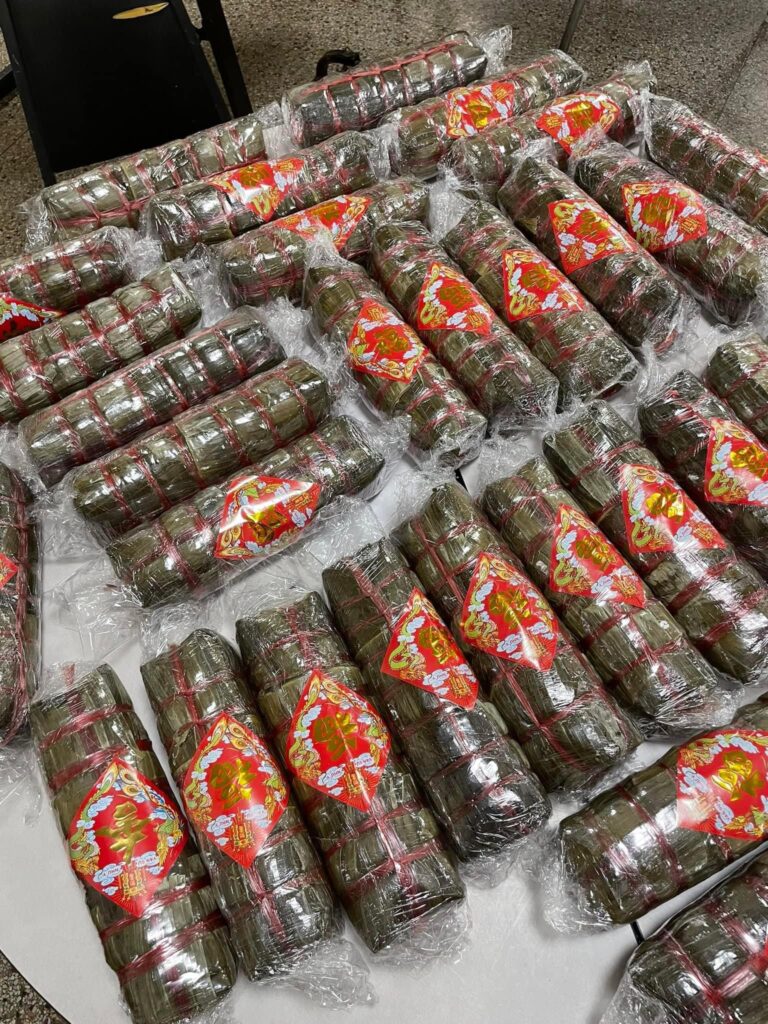
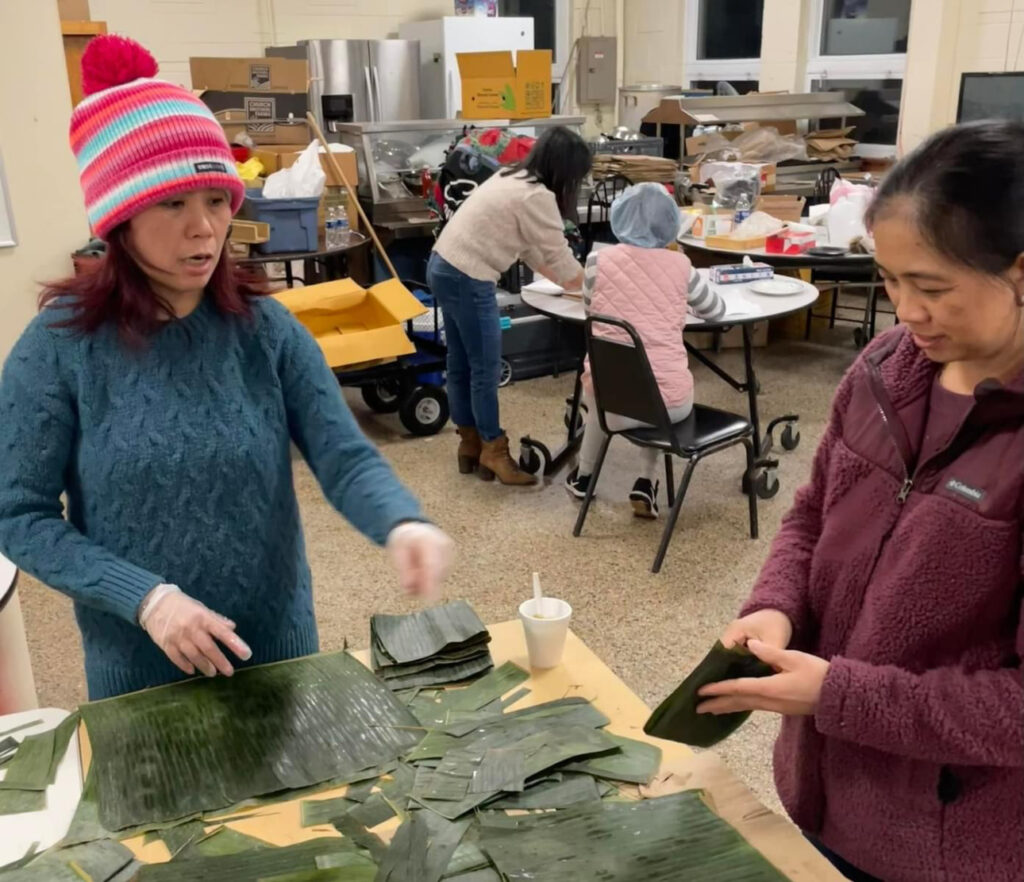
Bánh Trưng and Bánh Tét are more than just food; they are embodiments of Vietnamese culture and history. Bánh Trưng, a square-shaped glutinous rice cake, symbolizes the Earth, while Bánh Tét, its cylindrical counterpart, represents the moon. Both are meticulously wrapped in banana leaves and filled with mung beans and pork, requiring hours of preparation and cooking. These culinary delights date back thousands of years, linked to the legend of Lang Liêu, a prince who offered them to his father, the King, as a symbol of his respect and filial piety.

A Bridge Between Cultures

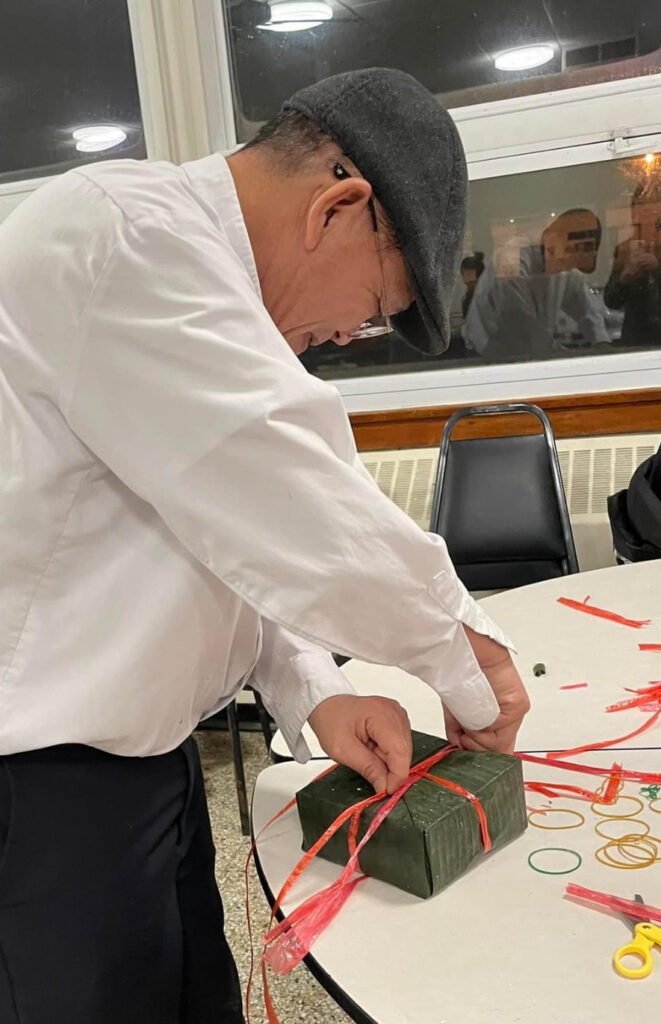
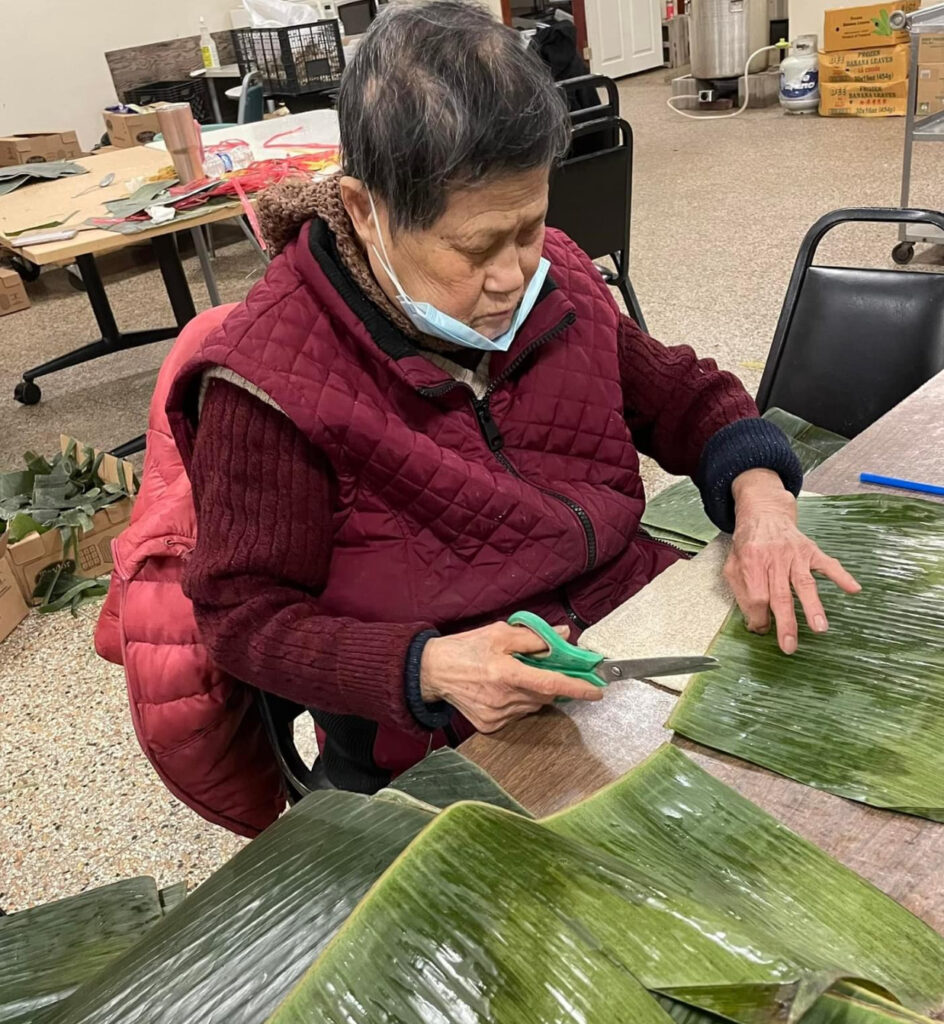
In Louisville, Kentucky, the making of Bánh Trưng and Bánh Tét has become more than a culinary endeavor; it’s a bridge connecting generations and cultures. At Saint John Vianney, this tradition is not only preserved but celebrated with enthusiasm and love. The elders in the community, often grandparents, gather together to share their knowledge and skills with younger generations, ensuring that this precious cultural heritage is not lost in the snows of Kentucky but thrives in the hearts of the Vietnamese diaspora.

A Labor of Love and Community Spirit

The preparation of Bánh Trưng and Bánh Tét for Tết at Saint John Vianney is a labor of love and a testament to the community’s solidarity. Hundreds of volunteers, from seasoned cooks to eager novices, come together in the church’s kitchen to prepare thousands of these cakes. This massive undertaking is not just for celebration but also for a noble cause: fundraising to build a new church. The process, from sourcing ingredients to the communal cooking that often lasts through the night, embodies the community’s dedication to their faith and cultural heritage.

Caring, Sharing, and Teaching

The tradition of making Bánh Trưng and Bánh Tét is imbued with the values of caring, sharing, and teaching. It offers a moment for the community to come together, share stories, and pass on traditions. It’s a time when love is not just felt but actively expressed through the careful preparation of food, symbolizing hope, renewal, and gratitude. Children learn the importance of cultural identity and the joy of giving, as the sales from these cakes go towards a communal goal that benefits all.

Conclusion

In the snowy state of Kentucky, far from the lush landscapes of Vietnam, the tradition of Bánh Trưng and Bánh Tét during Tết is a vivid reminder of the enduring spirit of Vietnamese culture. At Saint John Vianney, this tradition is a beacon of love, community, and cultural pride. It demonstrates how traditions can transcend borders, bringing people together in celebration, service, and unity. As the Lunar New Year of the Dragon dawns in 2024, the community’s efforts embody a profound expression of love: for tradition, for culture, and, most importantly, for each other. Through these endeavors, they are not just building a church; they are fortifying the bonds that connect them, ensuring their heritage continues to flourish for generations to come.

Categories
Community

The Waste Reduction Center: A Convenient Solution for Louisville Residents to Dispose of Bulky Waste

As a citizen of Louisville, Kentucky, you may never have to worry about large waste or dump when running your business, doing construction, or moving. This is because the city provides a convenient solution in the form of the Waste Reduction Center.

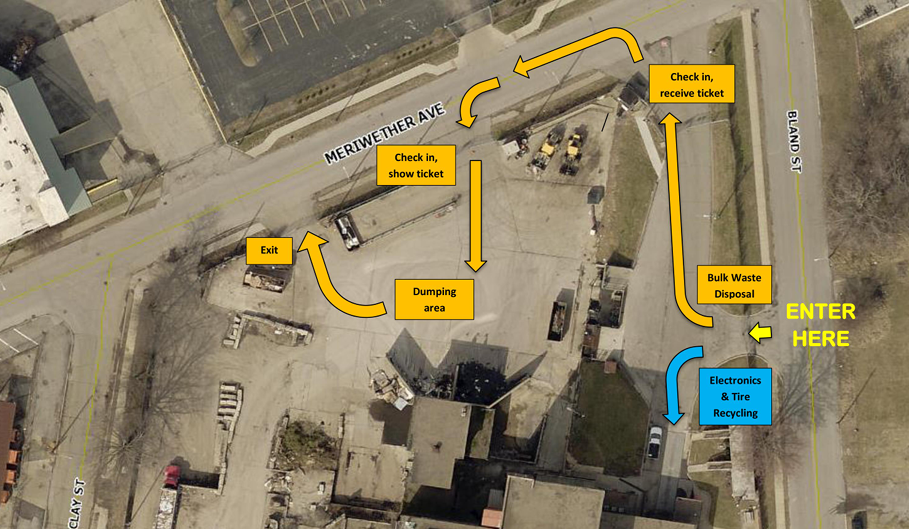
The Waste Reduction Center is a facility where Louisville/Jefferson County residents can dispose of a wide range of waste items, including tires, household bulky waste, appliances, electronics, tree limbs and stumps up to three feet in diameter, unbagged yard waste, construction debris, and furniture. The center is located at 636 Meriwether Avenue, with the entrance on Bland Street.

Residents can drop off up to four household bulky items per day at no charge. However, any bulky loads or drop-offs exceeding four items will be charged according to the fee schedule, and cash is the only accepted form of payment. For example, residents can drop off up to four passenger tires, one appliance, or one large household item such as a mattress, box spring, sofa, or chair, at no cost.

The Waste Reduction Center is open Tuesday through Friday from 8 a.m. to 5 p.m. and on Saturday from 8 a.m. to 3 p.m. It is important to note that trucks with trailers must arrive at least 15 minutes before closing. Also, the center’s hours may be affected by certain holidays such as New Year’s Day, MLK Jr. Day, Memorial Day, Juneteenth, July 4th, Labor Day, Thanksgiving, and Christmas.

If you have a bulky load or drop-off that exceeds four items, you can still dispose of it at the Waste Reduction Center, but fees will apply. Cash is the only accepted form of payment for these fees. Also, it is important to note that if you have lawn maintenance equipment, you can recycle it at the center in partnership with the Metro Air Pollution Control District. Rebate vouchers are issued as proof of recycling, which participants can use to receive the larger bonus rebate instead of the standard rebate when the vouchers are used for electric or human-powered equipment.

Overall, the Waste Reduction Center is a convenient solution for Louisville residents who need to dispose of bulky waste items. The center accepts a wide range of items and provides a convenient location for residents to drop them off. If you have any questions about the Waste Reduction Center or the items that it accepts, you can contact the facility directly or visit their website for more information.

The Waste Reduction Center is a valuable resource for Louisville residents to dispose of bulky waste items in a convenient and environmentally-friendly way. With the ability to drop off items such as furniture, appliances, electronics, and construction debris, the center provides an easy solution to waste disposal needs. It is important to note that residents can drop off up to four bulky items per day at no charge, but fees will apply for larger loads or drop-offs exceeding four items. Additionally, participants in the lawn care program can receive bonus rebates when they recycle their equipment at the center. It is worth mentioning that residents can also schedule a waste pickup at their address for even more convenience. With these options available, Louisville residents have a range of convenient and eco-friendly solutions for their waste disposal needs.

REFERENCES

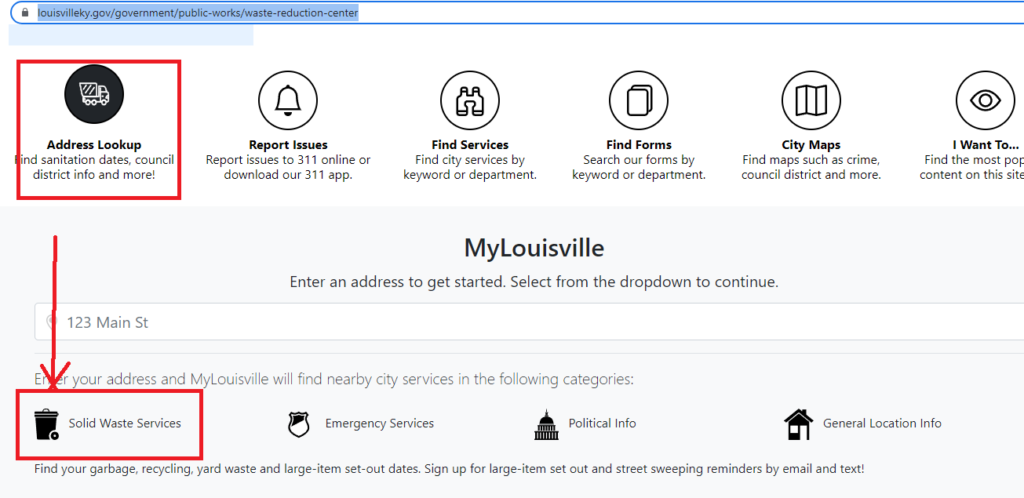
https://louisvilleky.gov/government/public-works/waste-reduction-center

Translate »