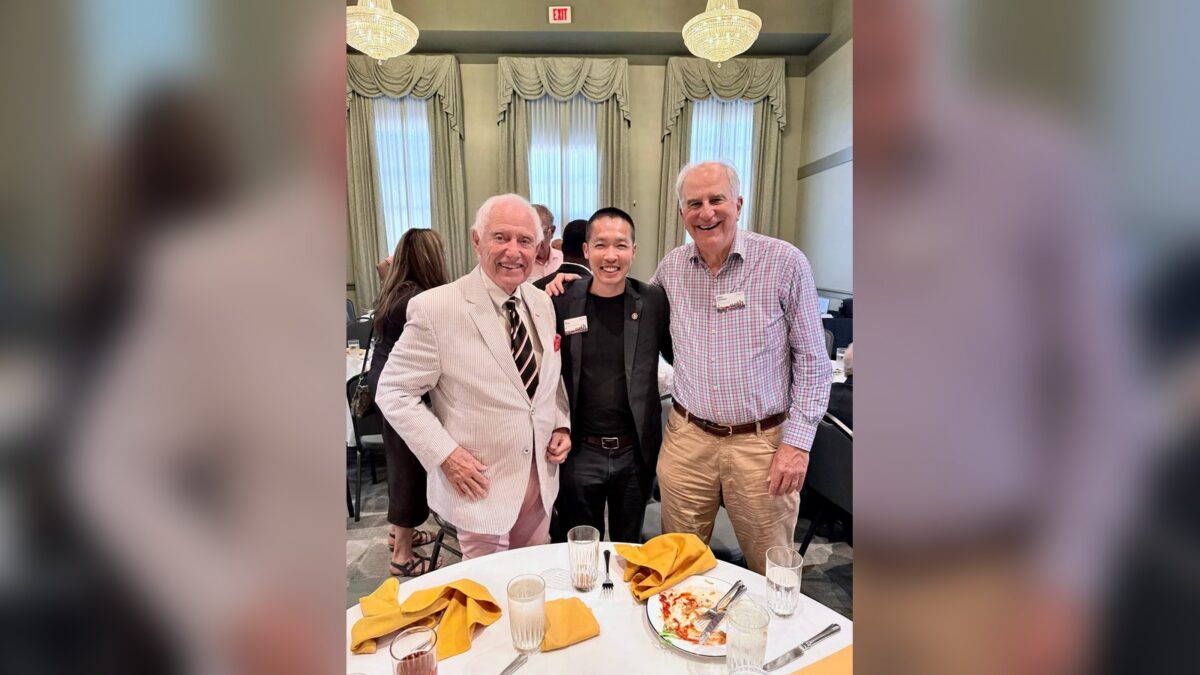
Louisville, Kentucky does not lack amazing people.
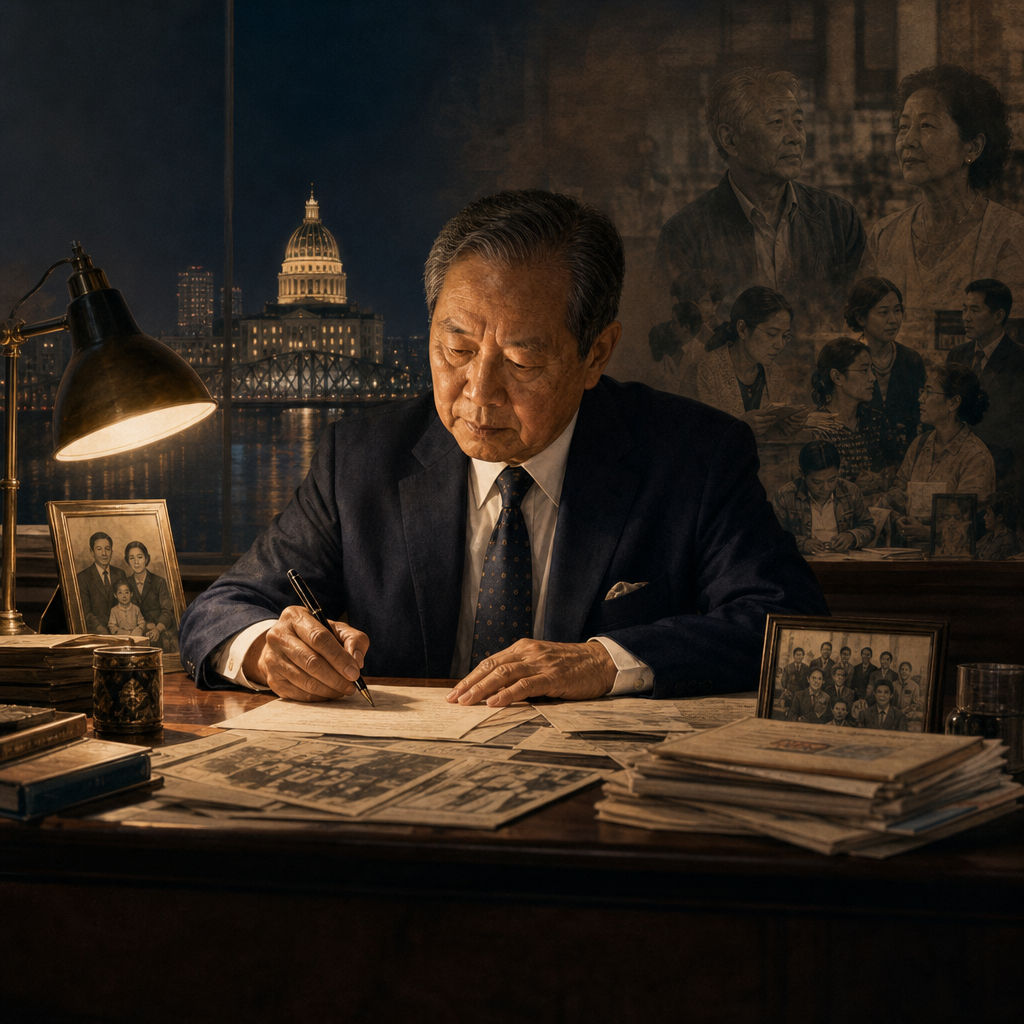
That sentence sounds simple. It is not. It is a civic thesis. It is also a lived conclusion from someone who arrived in America from Vietnam, grew up feeling small in rooms that seemed too large, and later found himself sitting in the middle of a Louisville civic lunch between two men whose education and public-service resumes would intimidate almost anyone: Frederic "Fred" Cowan and Lacey T. Smith.
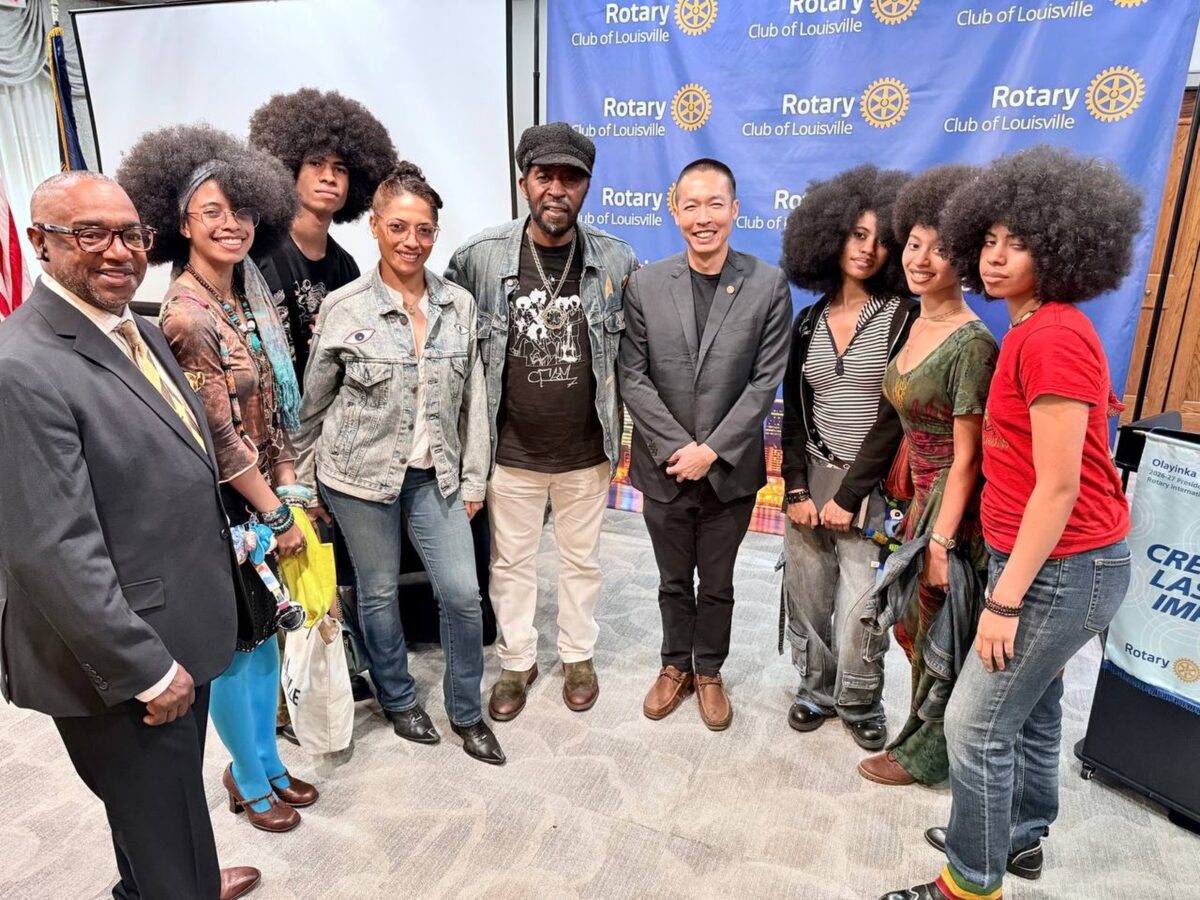
For Di Tran, Founder and Chancellor of Di Tran University and founder of Louisville Beauty Academy, the September 3, 2026 Rotary Club of Louisville lunch at the University Club was not merely an event on a calendar. It was a quiet summit of memory, humility, aspiration, and observation. On one side stood the life he came from: a Vietnamese childhood before college was even imaginable, before elite universities had any emotional reality, before the word "Harvard" belonged anywhere near his own story. On the other side stood the life Louisville allowed him to encounter: judges, former legislators, attorneys, civic elders, service leaders, and a candidate for the United States Senate speaking in the same room.
The beauty of that moment is not that Di Tran became important. The beauty is that Louisville made proximity possible.
In a city that outsiders sometimes underestimate, a Vietnamese American immigrant founder could sit, listen, learn, and observe among men whose lives had touched law, state government, courts, education, and public leadership long before Di was born in Vietnam. That is the real civic miracle. Not celebrity. Not status. Not applause. Proximity to excellence. Access to example. A living classroom.
A Lunch That Became a Civic Text
The Rotary Club of Louisville publicly lists its September 3, 2026 meeting as featuring Charles Booker, "Candidate for United States Senate." The Club's own public materials describe the Rotary Club of Louisville as nearly 400 members strong, the 12th largest club among Rotary International's 45,000-plus clubs worldwide, and as a civic space whose weekly Thursday luncheons bring together business, professional, and civic leaders.
That matters because institutions shape rooms, and rooms shape people.
Rotary's traditional language of "Service Above Self" is not merely ceremonial when practiced seriously. It describes a discipline: gather people who have done different kinds of work, let them hear one another, let younger builders sit near older builders, let public servants meet business owners, let immigrants sit beside graduates of institutions once unimaginable to them, and let the city's future be formed by repeated exposure to responsible people.
For Di Tran, that lunch was a reminder that Louisville's greatness is often hidden in plain sight. The city does not always market itself like New York, Boston, Washington, D.C., or San Francisco. But Louisville has a rare quality: it can place a first-generation Vietnamese American institution builder in direct human proximity to people who have shaped Kentucky law and civic life.
That is not small. That is a form of public wealth.
Fred Cowan: A Kentucky Career Across Three Branches
Frederic J. "Fred" Cowan Jr. is one of Louisville's unusually accomplished public-service figures. Public records and biographical sources identify him as a Louisville attorney, former Kentucky State Representative, former Kentucky Attorney General, and former Jefferson Circuit Court judge.
His career is remarkable because it crosses the three branches of Kentucky state government.
In the legislative branch, Cowan represented Jefferson County's 32nd District in the Kentucky House of Representatives from 1982 to 1987. In the executive branch, he served as Kentucky Attorney General from 1988 to 1992, occupying the role of the Commonwealth's chief legal officer. In the judicial branch, he served as a Jefferson Circuit Court judge after being elected in 2006.
That sequence is rare because each branch demands a different temperament.
A legislator must persuade. An attorney general must lead statewide legal responsibility. A judge must exercise restraint, independence, and disciplined judgment. To move through all three is not merely to collect titles. It is to submit oneself repeatedly to different tests of public trust.
Cowan's educational background adds another layer. Public profiles list Dartmouth College for undergraduate education and Harvard Law School for legal education. Dartmouth and Harvard are not merely famous names. In the story of Louisville civic life, they become evidence that national educational capital can return to Kentucky and be placed in service of local law, courts, and community leadership.
For Di Tran, sitting beside such a figure was not about social display. It was about absorbing the structure of a life built through study, public trust, and disciplined service.
Lacey T. Smith: Law, Legislature, Local Government, and Civic Memory
Lacey T. Smith also represents a classical civic-leadership path: education, law, elected service, government counsel work, judicial or probate-related service, negotiation expertise, and long legal practice in Louisville.
Public and profile sources identify Smith as a Louisville attorney and former Kentucky State Senator. Di Tran's supplied event/profile context further identifies Smith as having served as legal counsel to a mayor, as a probate judge, and as a figure known for international trade expertise. Public podcast-profile material describes him as a renowned expert in negotiation. Public legal-directory material lists Smith with a Harvard legal credential, and additional public material associates him with deep Louisville legal and civic life.
Smith's undergraduate education is associated with Hamline University, a private university in Saint Paul, Minnesota, founded in 1854 and described by Hamline as Minnesota's first university. That matters because the story is not simply Harvard. It is the arc from formative education to law to public responsibility.
Together, Cowan and Smith form an extraordinary pair: two Louisville-connected public-service men tied to Harvard Law School, state legislative service, legal practice, and civic responsibility. In Cowan, one sees the architecture of Kentucky public law across branches of government. In Smith, one sees the older civic lawyer's range: law, government, negotiation, local leadership, and, by Di Tran's account, international trade vision.
Yet the strongest lesson is not elitism. It is transmission.
What does a city transmit when a younger immigrant founder can stand between two elder public servants? It transmits the idea that leadership is observable. That excellence is not abstract. That public service is not only something read in textbooks, but something carried in faces, stories, posture, restraint, and presence. It also transmits something more practical: serious people do not only talk about local pride. They ask how local excellence can travel responsibly into the world.
The Mud Hut, the First College Graduate, and the Feeling of Being Small
Di Tran has often described his origin with plain language: a boy from a mud hut in Vietnam.
That phrase should not be romanticized. Poverty is not poetry when one is living inside it. A mud hut is not a metaphor to the child who sleeps there. It is a boundary of imagination. It can make the world feel fixed, distant, and already decided.
Before Di Tran could dream of elite education, he first had to dream of education at all. In his telling, he became the first person across generations on both sides of his family to attend and graduate college. That is not an individual credential only. It is a break in a generational ceiling.
There is a special humility in such a life. A person who comes from little and enters rooms of high public achievement may feel both gratitude and disbelief. He may feel small. But smallness, when not poisoned by shame, can become a powerful form of attention.
To sit between Fred Cowan and Lacey Smith was to sit between two living archives of Kentucky civic service. To listen to Charles Booker speak was to observe another form of public life: a newer voice, shaped by Louisville, race, representation, poverty, state politics, and democratic aspiration.
For Di Tran, the lunch was beautiful because it compressed time.
Vietnam before college. Kentucky after immigration. The mud hut. The first degree. The beauty school. The university. The civic table. The Harvard-trained public servants. The Rotary room. The Senate candidate. The possibility that a city can hold all of that in one noon hour.
Charles Booker and the Discipline of Listening Without Endorsing
Charles Booker is a significant Kentucky political figure. Louisville Public Media reported on May 19, 2026 that Booker won the Democratic nomination for Kentucky's open U.S. Senate seat and would face Republican nominee U.S. Rep. Andy Barr in the general election. Kentucky Secretary of State election-night reporting, still labeled unofficial when checked on September 3, 2026, showed Booker with 155,577 votes, or 47 percent, in the Democratic primary.
The careful wording matters: Charles Booker is not a U.S. Senator. He is the Democratic nominee and a candidate for the November 3, 2026 general election.
His historical significance also matters. In 2022, Booker became the first Black Kentuckian nominated by a major party for the U.S. Senate. In 2026, he again became Kentucky Democrats' nominee for that office.
For Viet Bao Louisville, the significance of hearing Booker speak in a Rotary room is not partisan endorsement. It is civic literacy. Immigrant communities, business owners, students, educators, and working families benefit when they sit in rooms where public questions are discussed directly. Democracy becomes less distant when citizens and community builders listen in person.
Listening is not endorsement. Attendance is not campaign coordination. Respectful civic engagement is not partisanship. A healthy city should make room for people to hear from leaders, candidates, judges, attorneys, educators, entrepreneurs, and public servants without collapsing every room into a political slogan.
That is another reason Louisville matters. It still has rooms where civic listening can happen.
Louisville as a Hidden University
A city can be a university if its rooms are arranged correctly.
In one sense, Louisville's universities are its formal institutions: the University of Louisville, Bellarmine, Spalding, Simmons College of Kentucky, Jefferson Community and Technical College, and many others. But in another sense, Louisville itself is an informal university. Its classrooms are lunch tables, civic clubs, small businesses, schools, churches, legal offices, courtrooms, nonprofit boards, immigrant family stores, bourbon warehouses, beauty classrooms, and neighborhood conversations.
The September 3 Rotary lunch was one such classroom.
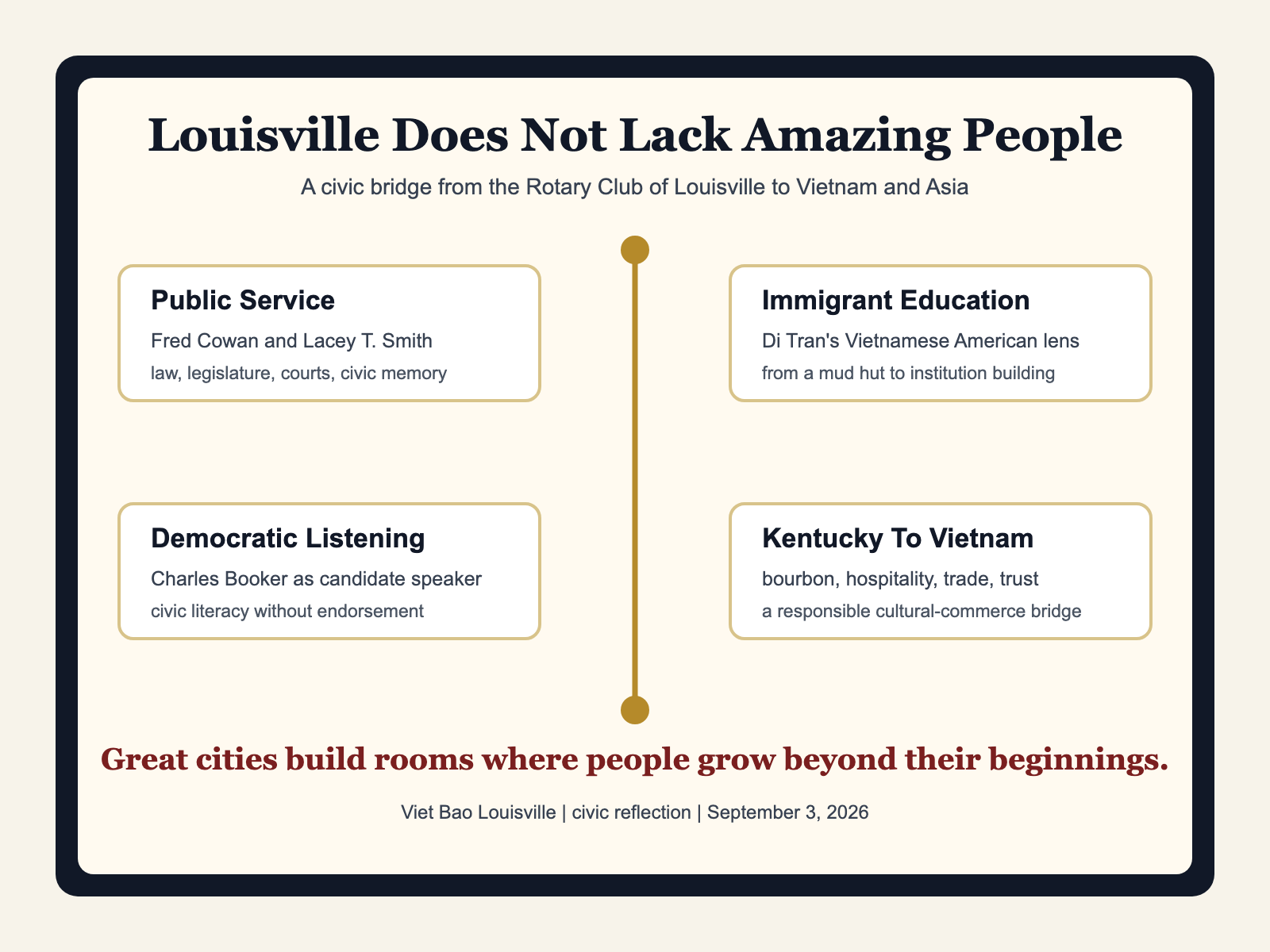
Fred Cowan represented institutional memory across Kentucky's legislature, executive legal leadership, and courts. Lacey Smith represented another path of law, Senate service, municipal counsel, and Louisville practice. Charles Booker represented the current democratic contest and the historical visibility of a Black Kentuckian seeking statewide federal office. Di Tran represented the immigrant student of the room: the Vietnamese American founder who knew enough to feel humbled and grateful, and hungry enough to keep learning.
This is why Louisville is great in Di Tran's perspective. Not because it is perfect. No city is. Louisville is great because it gives builders access to one another. It allows a person from the margins to move toward the center not only by wealth or status, but by service, learning, and persistence.
That is a different definition of greatness.
The Kentucky Bourbon and Vietnam Question
During and around such civic conversations, especially with Lacey Smith's Di-identified international-trade expertise in mind, another idea naturally belongs on the table: how can Kentucky's signature products, especially Kentucky bourbon, build deeper cultural and economic bridges with Vietnam and Asia?
Kentucky bourbon is not a small industry. The Kentucky Distillers' Association describes bourbon and distilling as a $10.6 billion signature industry for Kentucky, supporting more than 23,935 jobs, more than $2 billion in annual payroll, and hundreds of millions in state and local tax revenue. The same source says Kentucky distillers shipped more than $500 million in exports in 2022, almost all of it bourbon, while also noting the pressure of tariffs and trade barriers.
Vietnam is not a small opportunity. USDA Foreign Agricultural Service reporting in July 2026 described Vietnam as a rising market for U.S. agricultural exports and stated that the United States was Vietnam's second-largest supplier of agricultural products in 2025, at $4.7 billion. Vietnam's population, urban growth, young consumers, hospitality sector, tourism economy, and expanding middle class all suggest that Kentucky should study Vietnam not as a side market, but as a serious Asia bridge.
This is where Smith's negotiation and international-trade lens matters. Trade is not only product movement. It is trust movement. It is law, culture, timing, translation, distribution, reputation, etiquette, and risk control. A good international bridge does not begin by asking only what Kentucky wants to sell. It asks what Vietnam needs to understand, what Kentucky must respect, what laws govern the exchange, and what kind of relationship can last.
The question should not be crude: "How do we sell more alcohol?"
The better question is: how can Kentucky bourbon become part of a responsible cultural-commerce bridge between Kentucky and Vietnam?
That bridge would need several layers.
First, education. Vietnamese consumers, hospitality schools, importers, chefs, tourism operators, and cultural organizations need to understand what bourbon is: a legally defined American whiskey category, deeply tied to Kentucky agriculture, corn, limestone water narratives, oak barrels, aging, tourism, and craft. Education should include responsible consumption and legal-age boundaries.
Second, hospitality. Vietnam could become a Kentucky bourbon knowledge hub for Asia through curated tastings, chef pairings, tourism exchanges, bartender education, hotel and restaurant partnerships, and cultural events that pair Kentucky bourbon with Vietnamese cuisine and storytelling.
Third, trade discipline. Any serious bourbon-to-Vietnam strategy needs compliance: import rules, labeling, alcohol distribution law, tax treatment, age restrictions, anti-corruption controls, brand protection, and responsible marketing. A bridge built without law will collapse.
Fourth, diaspora trust. Vietnamese Americans in Kentucky can serve as cultural interpreters. They understand both the Kentucky story and the Vietnamese language, etiquette, family structure, business culture, and trust dynamics. This is where Louisville's Vietnamese community can become more than a consumer community. It can become a diplomatic-economic bridge.
Fifth, institutional storytelling. Kentucky should not enter Vietnam only with bottles. It should enter with farmers, coopers, distillers, tourism leaders, educators, chefs, small-business owners, and cultural ambassadors. Bourbon is agriculture, manufacturing, hospitality, tourism, law, brand, patience, and place. Vietnam respects stories of family, craft, endurance, and local pride. Kentucky has those stories.
Sixth, expert negotiation. The best Kentucky-to-Vietnam bourbon bridge would need people who understand how to negotiate across legal systems, cultures, languages, ministries, importers, hospitality groups, and long-term commercial relationships. That is why a lunch beside a lawyer known for negotiation and international-trade intelligence can spark more than admiration. It can spark strategy.
In Di Tran's imagination, Vietnam can become not just a destination for Kentucky bourbon, but a hub of Kentucky bourbon knowledge in Asia. A place where Kentucky's signature spirit is taught responsibly, paired beautifully, imported lawfully, and connected to tourism, restaurants, hotels, business delegations, cultural festivals, and educational exchange.
That idea belongs in the same civic frame as the Rotary lunch because it is not merely commerce. It is relationship architecture.
Why the Moment Matters for Vietnamese Louisville
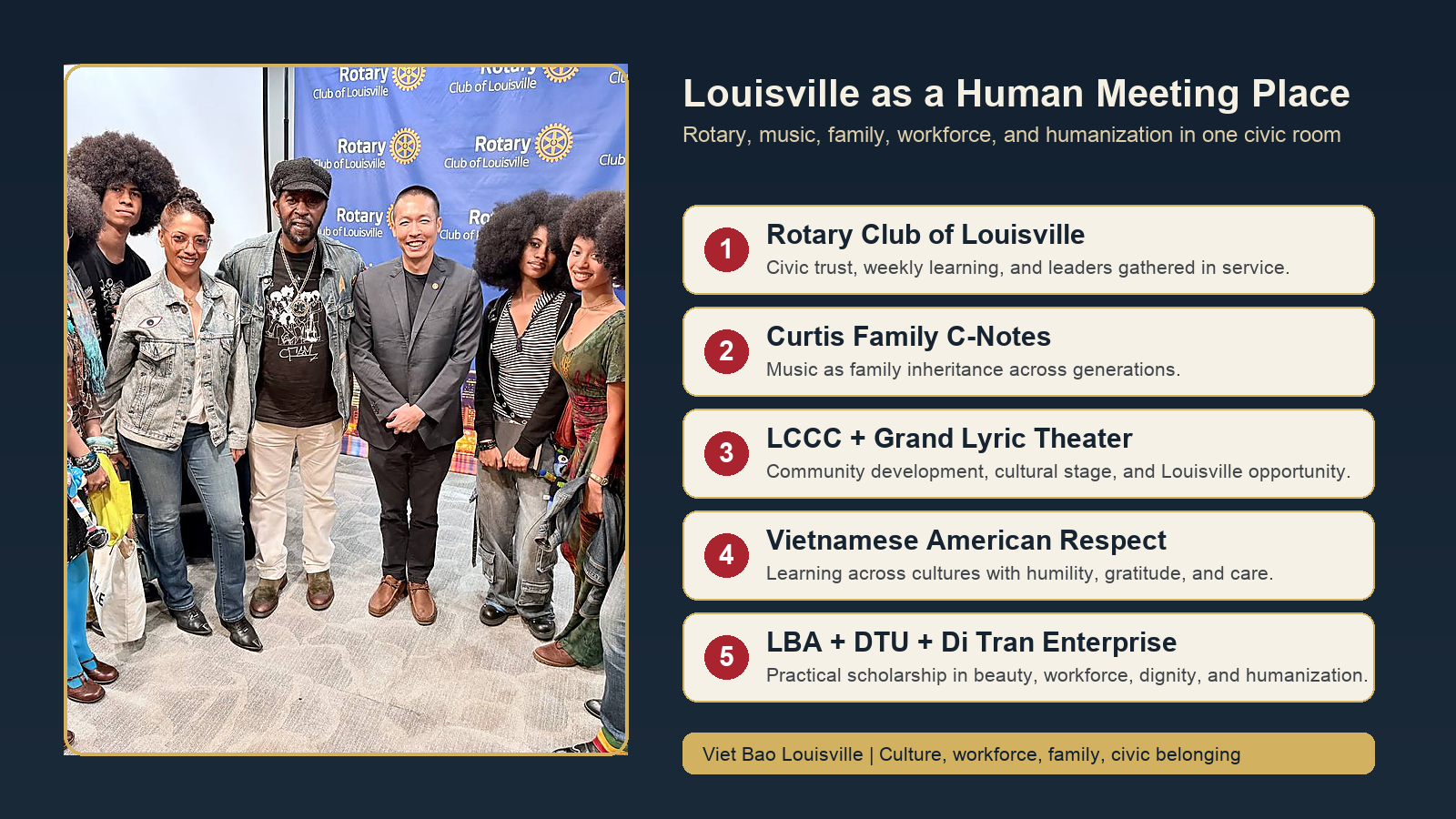
Viet Bao Louisville exists because community memory matters.
When a Vietnamese American founder sits among Kentucky public servants and listens to a major-party U.S. Senate nominee, the event is not only personal. It says something to young people, immigrants, workers, and first-generation students:
You may begin far from the room, but you are not forbidden from entering it.
You may come from a mud hut, a refugee family, a nail salon, a small apartment, a factory job, a kitchen, a classroom where English is still difficult, or a family where no one knows how college applications work. None of that erases your right to learn from the highest rooms you can reach.
The point is not to worship elite credentials. Harvard Law School is impressive, but the deeper question is what the credential serves. If education produces arrogance, it fails. If education produces public service, discipline, lawfulness, humility, and responsibility, it becomes beautiful.
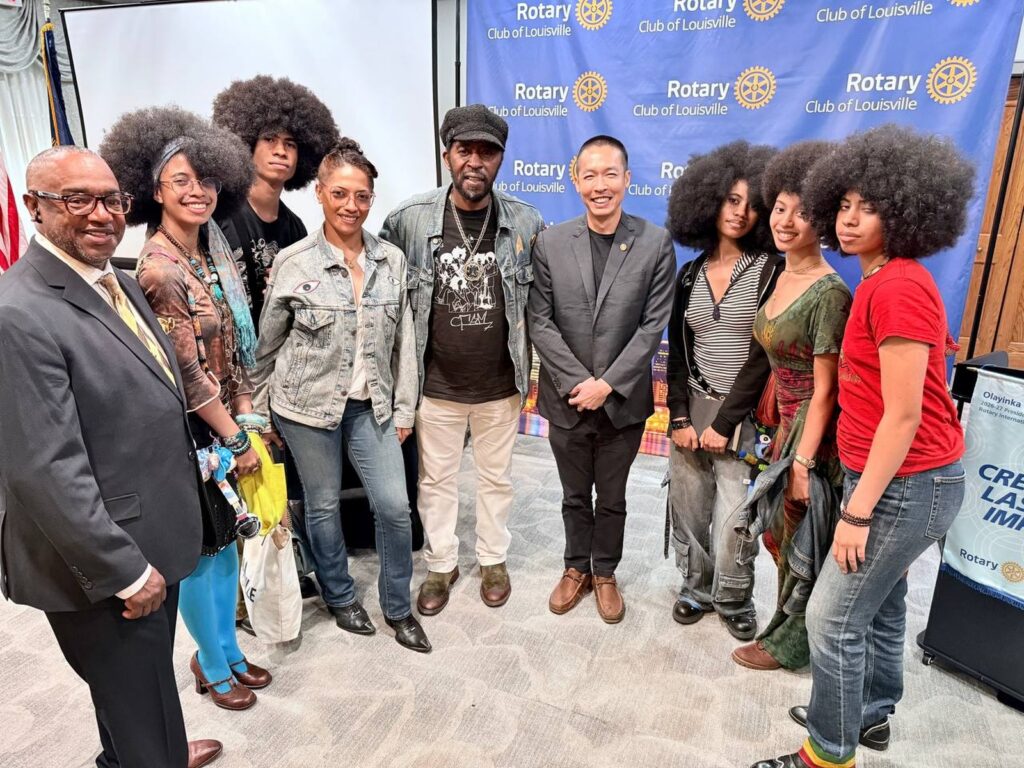
That is what made the lunch so meaningful. Fred Cowan and Lacey Smith were not abstractions. Charles Booker was not a headline. Rotary was not a logo. Louisville was not a slogan. They were all present in one room where a Vietnamese American immigrant could sit, observe, and carry the lesson back to students and community.
Louisville Does Not Lack Amazing
Some cities are loud about their greatness. Louisville is often quieter.
But Louisville has greatness in its people: in retired judges who still show up, in attorneys who carried public responsibilities, in civic clubs that convene across professions, in candidates who speak directly to citizens, in immigrant founders who sit humbly and listen, and in communities that keep trying to turn proximity into service.
Di Tran's perspective is simple: Louisville is one of the greatest cities because it makes transformation feel possible.
It allowed a boy from a mud hut in Vietnam, once unable to imagine college, to become a first-generation college graduate, a school founder, a university builder, and a student of civic leadership. It placed him between two Harvard-trained public-service figures from Kentucky and in front of a historic Black Kentucky political voice. It gave him a lunch hour that felt like a chapter in a much larger American book.
That is why Louisville does not lack amazing people.
It has them.
It grows them.
It gathers them.
And if we are wise, it will connect them to the next generation: Vietnamese American students, beauty students, workforce students, small-business owners, civic learners, and young people who still feel too small to imagine the rooms they may one day enter.
The lesson from September 3, 2026 is not that Di Tran sat in an important room.
The lesson is that a great city builds rooms where people can become larger than the lives they started with.
Louisville did that.
And for that, gratitude is the correct word.
Sources And Notes
- Rotary Club of Louisville, home page and Sept. 3, 2026 Charles Booker meeting notice: https://www.louisvillerotary.org/
- Rotary Club of Louisville, meetings page listing Sept. 3, 2026 speaker: https://www.louisvillerotary.org/our-meetings/
- Louisville Public Media / Kentucky Public Radio, "Charles Booker wins Democratic primary for US Senate in Kentucky, will face Barr," May 19, 2026: https://www.lpm.org/news/2026-05-19/charles-booker-wins-democratic-primary-for-us-senate-in-kentucky-will-face-barr
- Kentucky Secretary of State election-night reporting, May 19, 2026 primary results: https://vrsws.sos.ky.gov/liveresults
- Ballotpedia profile, Frederic J. Cowan: https://ballotpedia.org/Frederic_J._Cowan
- University of Kentucky Louie B. Nunn Center interview metadata for Frederic J. "Fred" Cowan: https://nunncenter.net/ohms-spokedb/render.php?cachefile=2006oh139_leg131_ohm.xml
- Kentucky Supreme Court / Justia reference to Hon. Fred Cowan as retired Jefferson Circuit Court judge: https://law.justia.com/cases/kentucky/supreme-court/2018/2017-sc-000210-mr.html
- Lacey T. Smith public attorney profile, Avvo: https://www.avvo.com/attorneys/40202-ky-lacey-smith-4766411.html
- Talk About Town Louisville podcast episode profile referencing Lacey Smith: https://talk-about-town-the-louisville-podcast.simplecast.com/episodes/e7-1OW8awYk
- Hamline University mission/history: https://www.hamline.edu/about/mission-history
- Harvard Alumni Association clubs directory: https://alumni.harvard.edu/community/clubs-sigs/clubs-directory
- Harvard Club of Louisville public site: https://hclouisville.clubs.harvard.edu/
- Kentucky Distillers' Association industry impact page: https://kybourbon.com/industry/impact/
- USDA Foreign Agricultural Service, "Expanding U.S. Agricultural Exports in Vietnam's Rising Market," July 9, 2026: https://www.fas.usda.gov/data/expanding-us-agricultural-exports-vietnams-rising-market