Categories
Community

Louisville Does Not Lack Amazing People: Di Tran’s Vietnamese American Reflection from the Rotary Club of Louisville with Fred Cowan, Lacey Smith, and Charles Booker

Louisville, Kentucky does not lack amazing people.

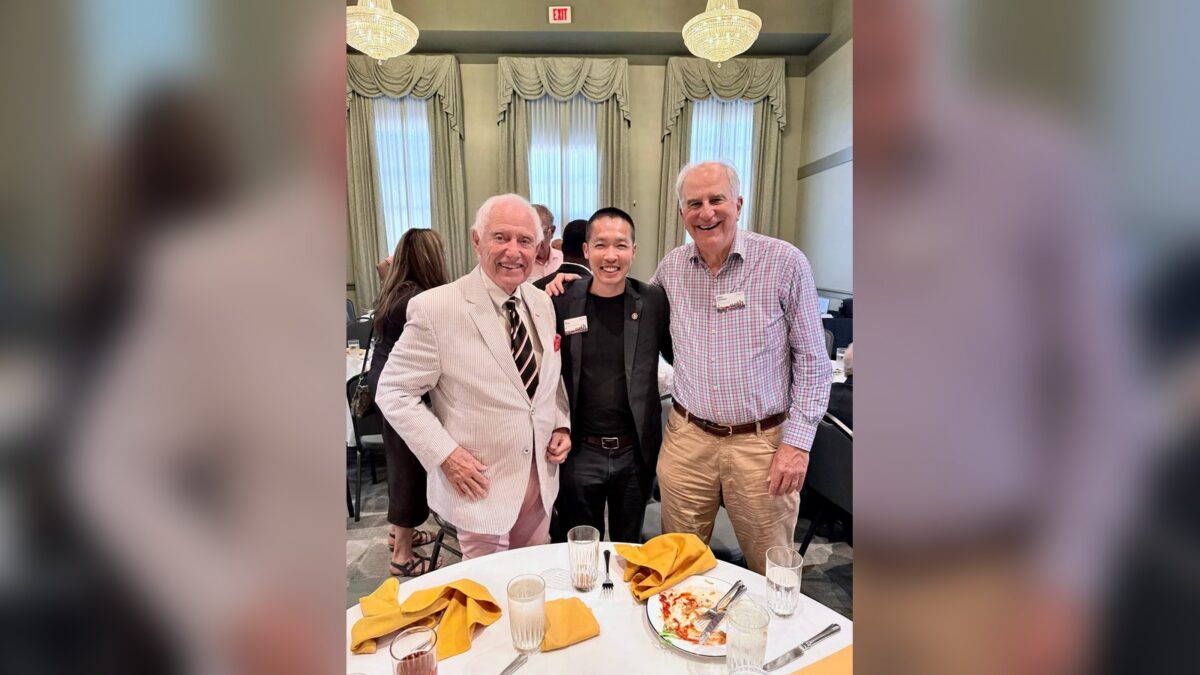
That sentence sounds simple. It is not. It is a civic thesis. It is also a lived conclusion from someone who arrived in America from Vietnam, grew up feeling small in rooms that seemed too large, and later found himself sitting in the middle of a Louisville civic lunch between two men whose education and public-service resumes would intimidate almost anyone: Frederic "Fred" Cowan and Lacey T. Smith.

For Di Tran, Founder and Chancellor of Di Tran University and founder of Louisville Beauty Academy, the September 3, 2026 Rotary Club of Louisville lunch at the University Club was not merely an event on a calendar. It was a quiet summit of memory, humility, aspiration, and observation. On one side stood the life he came from: a Vietnamese childhood before college was even imaginable, before elite universities had any emotional reality, before the word "Harvard" belonged anywhere near his own story. On the other side stood the life Louisville allowed him to encounter: judges, former legislators, attorneys, civic elders, service leaders, and a candidate for the United States Senate speaking in the same room.

The beauty of that moment is not that Di Tran became important. The beauty is that Louisville made proximity possible.

In a city that outsiders sometimes underestimate, a Vietnamese American immigrant founder could sit, listen, learn, and observe among men whose lives had touched law, state government, courts, education, and public leadership long before Di was born in Vietnam. That is the real civic miracle. Not celebrity. Not status. Not applause. Proximity to excellence. Access to example. A living classroom.

A Lunch That Became a Civic Text

The Rotary Club of Louisville publicly lists its September 3, 2026 meeting as featuring Charles Booker, "Candidate for United States Senate." The Club's own public materials describe the Rotary Club of Louisville as nearly 400 members strong, the 12th largest club among Rotary International's 45,000-plus clubs worldwide, and as a civic space whose weekly Thursday luncheons bring together business, professional, and civic leaders.

That matters because institutions shape rooms, and rooms shape people.

Rotary's traditional language of "Service Above Self" is not merely ceremonial when practiced seriously. It describes a discipline: gather people who have done different kinds of work, let them hear one another, let younger builders sit near older builders, let public servants meet business owners, let immigrants sit beside graduates of institutions once unimaginable to them, and let the city's future be formed by repeated exposure to responsible people.

For Di Tran, that lunch was a reminder that Louisville's greatness is often hidden in plain sight. The city does not always market itself like New York, Boston, Washington, D.C., or San Francisco. But Louisville has a rare quality: it can place a first-generation Vietnamese American institution builder in direct human proximity to people who have shaped Kentucky law and civic life.

That is not small. That is a form of public wealth.

Fred Cowan: A Kentucky Career Across Three Branches

Frederic J. "Fred" Cowan Jr. is one of Louisville's unusually accomplished public-service figures. Public records and biographical sources identify him as a Louisville attorney, former Kentucky State Representative, former Kentucky Attorney General, and former Jefferson Circuit Court judge.

His career is remarkable because it crosses the three branches of Kentucky state government.

In the legislative branch, Cowan represented Jefferson County's 32nd District in the Kentucky House of Representatives from 1982 to 1987. In the executive branch, he served as Kentucky Attorney General from 1988 to 1992, occupying the role of the Commonwealth's chief legal officer. In the judicial branch, he served as a Jefferson Circuit Court judge after being elected in 2006.

That sequence is rare because each branch demands a different temperament.

A legislator must persuade. An attorney general must lead statewide legal responsibility. A judge must exercise restraint, independence, and disciplined judgment. To move through all three is not merely to collect titles. It is to submit oneself repeatedly to different tests of public trust.

Cowan's educational background adds another layer. Public profiles list Dartmouth College for undergraduate education and Harvard Law School for legal education. Dartmouth and Harvard are not merely famous names. In the story of Louisville civic life, they become evidence that national educational capital can return to Kentucky and be placed in service of local law, courts, and community leadership.

For Di Tran, sitting beside such a figure was not about social display. It was about absorbing the structure of a life built through study, public trust, and disciplined service.

Lacey T. Smith: Law, Legislature, Local Government, and Civic Memory

Lacey T. Smith also represents a classical civic-leadership path: education, law, elected service, government counsel work, judicial or probate-related service, negotiation expertise, and long legal practice in Louisville.

Public and profile sources identify Smith as a Louisville attorney and former Kentucky State Senator. Di Tran's supplied event/profile context further identifies Smith as having served as legal counsel to a mayor, as a probate judge, and as a figure known for international trade expertise. Public podcast-profile material describes him as a renowned expert in negotiation. Public legal-directory material lists Smith with a Harvard legal credential, and additional public material associates him with deep Louisville legal and civic life.

Smith's undergraduate education is associated with Hamline University, a private university in Saint Paul, Minnesota, founded in 1854 and described by Hamline as Minnesota's first university. That matters because the story is not simply Harvard. It is the arc from formative education to law to public responsibility.

Together, Cowan and Smith form an extraordinary pair: two Louisville-connected public-service men tied to Harvard Law School, state legislative service, legal practice, and civic responsibility. In Cowan, one sees the architecture of Kentucky public law across branches of government. In Smith, one sees the older civic lawyer's range: law, government, negotiation, local leadership, and, by Di Tran's account, international trade vision.

Yet the strongest lesson is not elitism. It is transmission.

What does a city transmit when a younger immigrant founder can stand between two elder public servants? It transmits the idea that leadership is observable. That excellence is not abstract. That public service is not only something read in textbooks, but something carried in faces, stories, posture, restraint, and presence. It also transmits something more practical: serious people do not only talk about local pride. They ask how local excellence can travel responsibly into the world.

The Mud Hut, the First College Graduate, and the Feeling of Being Small

Di Tran has often described his origin with plain language: a boy from a mud hut in Vietnam.

That phrase should not be romanticized. Poverty is not poetry when one is living inside it. A mud hut is not a metaphor to the child who sleeps there. It is a boundary of imagination. It can make the world feel fixed, distant, and already decided.

Before Di Tran could dream of elite education, he first had to dream of education at all. In his telling, he became the first person across generations on both sides of his family to attend and graduate college. That is not an individual credential only. It is a break in a generational ceiling.

There is a special humility in such a life. A person who comes from little and enters rooms of high public achievement may feel both gratitude and disbelief. He may feel small. But smallness, when not poisoned by shame, can become a powerful form of attention.

To sit between Fred Cowan and Lacey Smith was to sit between two living archives of Kentucky civic service. To listen to Charles Booker speak was to observe another form of public life: a newer voice, shaped by Louisville, race, representation, poverty, state politics, and democratic aspiration.

For Di Tran, the lunch was beautiful because it compressed time.

Vietnam before college. Kentucky after immigration. The mud hut. The first degree. The beauty school. The university. The civic table. The Harvard-trained public servants. The Rotary room. The Senate candidate. The possibility that a city can hold all of that in one noon hour.

Charles Booker and the Discipline of Listening Without Endorsing

Charles Booker is a significant Kentucky political figure. Louisville Public Media reported on May 19, 2026 that Booker won the Democratic nomination for Kentucky's open U.S. Senate seat and would face Republican nominee U.S. Rep. Andy Barr in the general election. Kentucky Secretary of State election-night reporting, still labeled unofficial when checked on September 3, 2026, showed Booker with 155,577 votes, or 47 percent, in the Democratic primary.

The careful wording matters: Charles Booker is not a U.S. Senator. He is the Democratic nominee and a candidate for the November 3, 2026 general election.

His historical significance also matters. In 2022, Booker became the first Black Kentuckian nominated by a major party for the U.S. Senate. In 2026, he again became Kentucky Democrats' nominee for that office.

For Viet Bao Louisville, the significance of hearing Booker speak in a Rotary room is not partisan endorsement. It is civic literacy. Immigrant communities, business owners, students, educators, and working families benefit when they sit in rooms where public questions are discussed directly. Democracy becomes less distant when citizens and community builders listen in person.

Listening is not endorsement. Attendance is not campaign coordination. Respectful civic engagement is not partisanship. A healthy city should make room for people to hear from leaders, candidates, judges, attorneys, educators, entrepreneurs, and public servants without collapsing every room into a political slogan.

That is another reason Louisville matters. It still has rooms where civic listening can happen.

Louisville as a Hidden University

A city can be a university if its rooms are arranged correctly.

In one sense, Louisville's universities are its formal institutions: the University of Louisville, Bellarmine, Spalding, Simmons College of Kentucky, Jefferson Community and Technical College, and many others. But in another sense, Louisville itself is an informal university. Its classrooms are lunch tables, civic clubs, small businesses, schools, churches, legal offices, courtrooms, nonprofit boards, immigrant family stores, bourbon warehouses, beauty classrooms, and neighborhood conversations.

The September 3 Rotary lunch was one such classroom.
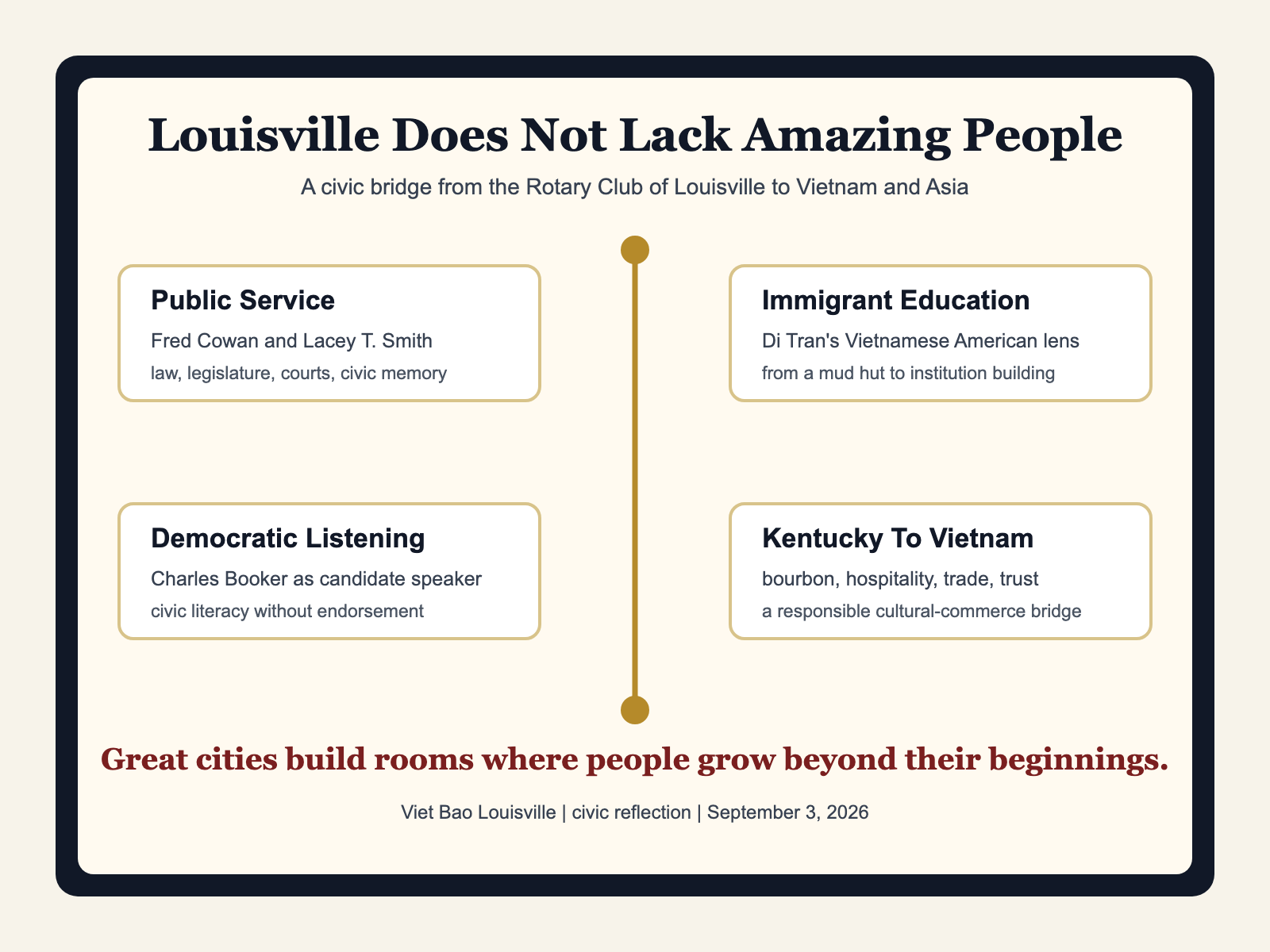
Visual explainer showing four civic bridge themes: public service, immigrant education, democratic listening, and Kentucky to Vietnam cultural commerce.
A civic bridge map connecting public service, immigrant education, democratic listening, and a responsible Kentucky-to-Vietnam cultural-commerce vision.

Fred Cowan represented institutional memory across Kentucky's legislature, executive legal leadership, and courts. Lacey Smith represented another path of law, Senate service, municipal counsel, and Louisville practice. Charles Booker represented the current democratic contest and the historical visibility of a Black Kentuckian seeking statewide federal office. Di Tran represented the immigrant student of the room: the Vietnamese American founder who knew enough to feel humbled and grateful, and hungry enough to keep learning.

This is why Louisville is great in Di Tran's perspective. Not because it is perfect. No city is. Louisville is great because it gives builders access to one another. It allows a person from the margins to move toward the center not only by wealth or status, but by service, learning, and persistence.

That is a different definition of greatness.

The Kentucky Bourbon and Vietnam Question

During and around such civic conversations, especially with Lacey Smith's Di-identified international-trade expertise in mind, another idea naturally belongs on the table: how can Kentucky's signature products, especially Kentucky bourbon, build deeper cultural and economic bridges with Vietnam and Asia?

Kentucky bourbon is not a small industry. The Kentucky Distillers' Association describes bourbon and distilling as a $10.6 billion signature industry for Kentucky, supporting more than 23,935 jobs, more than $2 billion in annual payroll, and hundreds of millions in state and local tax revenue. The same source says Kentucky distillers shipped more than $500 million in exports in 2022, almost all of it bourbon, while also noting the pressure of tariffs and trade barriers.

Vietnam is not a small opportunity. USDA Foreign Agricultural Service reporting in July 2026 described Vietnam as a rising market for U.S. agricultural exports and stated that the United States was Vietnam's second-largest supplier of agricultural products in 2025, at $4.7 billion. Vietnam's population, urban growth, young consumers, hospitality sector, tourism economy, and expanding middle class all suggest that Kentucky should study Vietnam not as a side market, but as a serious Asia bridge.

This is where Smith's negotiation and international-trade lens matters. Trade is not only product movement. It is trust movement. It is law, culture, timing, translation, distribution, reputation, etiquette, and risk control. A good international bridge does not begin by asking only what Kentucky wants to sell. It asks what Vietnam needs to understand, what Kentucky must respect, what laws govern the exchange, and what kind of relationship can last.

The question should not be crude: "How do we sell more alcohol?"

The better question is: how can Kentucky bourbon become part of a responsible cultural-commerce bridge between Kentucky and Vietnam?

That bridge would need several layers.

First, education. Vietnamese consumers, hospitality schools, importers, chefs, tourism operators, and cultural organizations need to understand what bourbon is: a legally defined American whiskey category, deeply tied to Kentucky agriculture, corn, limestone water narratives, oak barrels, aging, tourism, and craft. Education should include responsible consumption and legal-age boundaries.

Second, hospitality. Vietnam could become a Kentucky bourbon knowledge hub for Asia through curated tastings, chef pairings, tourism exchanges, bartender education, hotel and restaurant partnerships, and cultural events that pair Kentucky bourbon with Vietnamese cuisine and storytelling.

Third, trade discipline. Any serious bourbon-to-Vietnam strategy needs compliance: import rules, labeling, alcohol distribution law, tax treatment, age restrictions, anti-corruption controls, brand protection, and responsible marketing. A bridge built without law will collapse.

Fourth, diaspora trust. Vietnamese Americans in Kentucky can serve as cultural interpreters. They understand both the Kentucky story and the Vietnamese language, etiquette, family structure, business culture, and trust dynamics. This is where Louisville's Vietnamese community can become more than a consumer community. It can become a diplomatic-economic bridge.

Fifth, institutional storytelling. Kentucky should not enter Vietnam only with bottles. It should enter with farmers, coopers, distillers, tourism leaders, educators, chefs, small-business owners, and cultural ambassadors. Bourbon is agriculture, manufacturing, hospitality, tourism, law, brand, patience, and place. Vietnam respects stories of family, craft, endurance, and local pride. Kentucky has those stories.

Sixth, expert negotiation. The best Kentucky-to-Vietnam bourbon bridge would need people who understand how to negotiate across legal systems, cultures, languages, ministries, importers, hospitality groups, and long-term commercial relationships. That is why a lunch beside a lawyer known for negotiation and international-trade intelligence can spark more than admiration. It can spark strategy.

In Di Tran's imagination, Vietnam can become not just a destination for Kentucky bourbon, but a hub of Kentucky bourbon knowledge in Asia. A place where Kentucky's signature spirit is taught responsibly, paired beautifully, imported lawfully, and connected to tourism, restaurants, hotels, business delegations, cultural festivals, and educational exchange.

That idea belongs in the same civic frame as the Rotary lunch because it is not merely commerce. It is relationship architecture.

Why the Moment Matters for Vietnamese Louisville

Viet Bao Louisville exists because community memory matters.

When a Vietnamese American founder sits among Kentucky public servants and listens to a major-party U.S. Senate nominee, the event is not only personal. It says something to young people, immigrants, workers, and first-generation students:

You may begin far from the room, but you are not forbidden from entering it.

You may come from a mud hut, a refugee family, a nail salon, a small apartment, a factory job, a kitchen, a classroom where English is still difficult, or a family where no one knows how college applications work. None of that erases your right to learn from the highest rooms you can reach.

The point is not to worship elite credentials. Harvard Law School is impressive, but the deeper question is what the credential serves. If education produces arrogance, it fails. If education produces public service, discipline, lawfulness, humility, and responsibility, it becomes beautiful.

That is what made the lunch so meaningful. Fred Cowan and Lacey Smith were not abstractions. Charles Booker was not a headline. Rotary was not a logo. Louisville was not a slogan. They were all present in one room where a Vietnamese American immigrant could sit, observe, and carry the lesson back to students and community.

Louisville Does Not Lack Amazing

Some cities are loud about their greatness. Louisville is often quieter.

But Louisville has greatness in its people: in retired judges who still show up, in attorneys who carried public responsibilities, in civic clubs that convene across professions, in candidates who speak directly to citizens, in immigrant founders who sit humbly and listen, and in communities that keep trying to turn proximity into service.

Di Tran's perspective is simple: Louisville is one of the greatest cities because it makes transformation feel possible.

It allowed a boy from a mud hut in Vietnam, once unable to imagine college, to become a first-generation college graduate, a school founder, a university builder, and a student of civic leadership. It placed him between two Harvard-trained public-service figures from Kentucky and in front of a historic Black Kentucky political voice. It gave him a lunch hour that felt like a chapter in a much larger American book.

That is why Louisville does not lack amazing people.

It has them.

It grows them.

It gathers them.

And if we are wise, it will connect them to the next generation: Vietnamese American students, beauty students, workforce students, small-business owners, civic learners, and young people who still feel too small to imagine the rooms they may one day enter.

The lesson from September 3, 2026 is not that Di Tran sat in an important room.

The lesson is that a great city builds rooms where people can become larger than the lives they started with.

Louisville did that.

And for that, gratitude is the correct word.

Sources And Notes

Categories
Education

From Louisville to the World: Di Tran, Dr. Tod Laursen, and the Dream of Accessible American Education

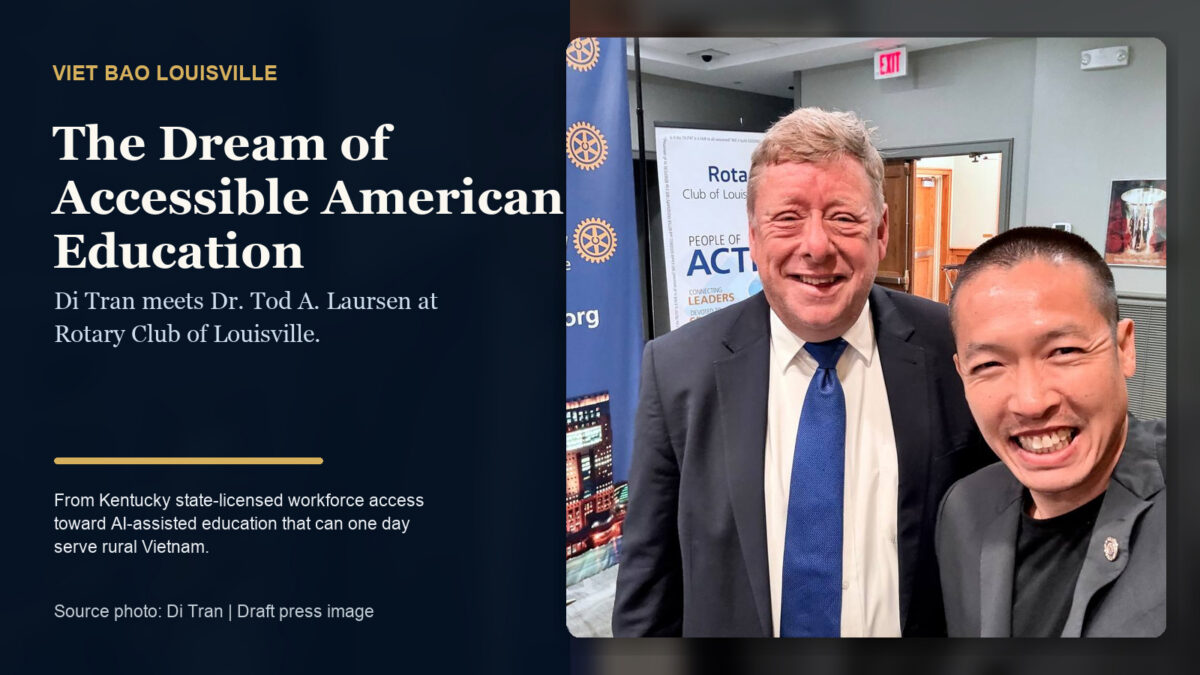
Louisville, Kentucky – On Thursday, August 27, 2026, at the Rotary Club of Louisville, Di Tran stood beside Dr. Tod A. Laursen, Chancellor of American University of Sharjah, after a program that carried a message much larger than one luncheon, one institution, or one country.

For Viet Bao Louisville, the photo is not simply a record of two men smiling at a civic gathering. It is a picture of education moving. It is a picture of one American story learning from another: Dr. Laursen’s work leading an American-style university in the Gulf region, and Di Tran’s work building accessible, Kentucky state-licensed workforce education in Louisville while dreaming of a future pathway that can one day reach rural Vietnam.

No endorsement is implied. No partnership is claimed. The importance is deeper than that.

This is a learning moment.

And for Di Tran, learning is never passive. When Di enters a room like Rotary, he does not merely listen for information. He listens for architecture: how serious institutions are built, how trust travels, how education becomes transferable, how culture is honored, how quality is documented, and how a local mission can become useful beyond its original geography.

The Rotary Club of Louisville had invited Dr. Laursen to speak on a subject with unusual relevance to Di Tran’s life work: “The American University of Sharjah: Harmonizing an American Education Model with Sharjah’s Heritage and Culture.”

For many people, the phrase might sound like a university lecture title. For Di Tran, it sounded like a mirror and a window at the same time.

It was a mirror because Di has spent years building education from the ground up in Louisville through Louisville Beauty Academy, a Kentucky state-licensed beauty college that has helped nearly 2,000 graduates move toward lawful work, dignity, skill, and economic participation. It was a window because Dr. Laursen’s work at American University of Sharjah shows how American-style education can be carried abroad with seriousness, cultural respect, institutional quality, and global ambition.

In one room, two forms of American education became visible.

One form is the university model: liberal learning, accreditation, global mobility, research, faculty governance, transfer-readable records, and international student formation.

The other is the access model: affordable occupational education, state licensing, adult learners, immigrant families, working parents, debt discipline, documentation, multilingual support, and direct pathways into lawful work.

Both matter. America needs both. The world needs both.

The Rotary email introducing the program described American University of Sharjah as a case study in how an American-style liberal arts education can serve a highly international student body seeking to contribute to the United Arab Emirates, the greater Gulf region, and innovation ecosystems around the world.

That is exactly the kind of sentence that matters to an immigrant founder who loves America deeply, believes education should be practical and human, and dreams of expanding access from Kentucky to Vietnam and beyond.

Two Education Stories In One Room

Dr. Tod A. Laursen’s career is not small. American University of Sharjah identifies him as Chancellor and describes a leadership path through Duke University, Khalifa University in Abu Dhabi, SUNY Polytechnic Institute, Wigwe University in Nigeria, and the State University of New York system, where he served as senior vice chancellor and provost of a 64-campus system with about 400,000 registered students.

That is a rare education resume. It crosses American higher education, Gulf-region higher education, emerging international university development, engineering research, system governance, and institutional scale.

But what made the Rotary program powerful was not only Dr. Laursen’s resume. It was the model.

American University of Sharjah is not merely an American name placed in another country. It is a university operating in Sharjah, in the United Arab Emirates, with local context, heritage, culture, students, employers, and national priorities. At the same time, AUS holds United States institutional accreditation through the Middle States Commission on Higher Education, and it also reports UAE licensing and accreditation through the Commission for Academic Accreditation of the Ministry of Higher Education and Scientific Research.

That combination matters. It shows that education can be local and global at the same time. It can respect place and still reach the world. It can serve a country’s own people while welcoming international students. It can carry American educational architecture without turning culture into an afterthought.

For Di Tran, that is not theory. It is personal.

Di came from Vietnam. He built in Kentucky. He raised institutions in Louisville. He chose the difficult lane of education, licensing, compliance, affordability, technology, and public trust. He has watched students who needed a doorway find one. He has watched adults rediscover confidence. He has watched immigrants, working parents, and people from underrepresented communities move closer to a state-recognized career path because a school made the pathway visible, affordable, and human.

And now, as Di Tran University and the College of Humanization grow in concept and infrastructure, the question becomes larger: Can the kind of education access being built in Kentucky become a model that later travels to other states, other trades, and eventually other countries?

Dr. Laursen’s work suggests the answer can be yes, but only if the work is serious.

That seriousness is the strategic boost for Di Tran’s mission.

The future cannot be built on inspiration alone. It must be built on lawful authority, verified records, quality systems, student protection, cultural respect, institutional patience, and technology that serves people rather than replacing responsibility.

American Education Is Not Just A Place

The United States has one of the world’s most influential education traditions not because every institution is perfect, but because the American model at its best combines liberal learning, applied learning, institutional autonomy, student formation, transferability of records, accreditation and quality assurance, civic participation, entrepreneurship, practical workforce connection, and the belief that a person’s future should not be permanently limited by birthplace.

That last belief is where Di Tran’s story begins.

Di’s American dream was not only to arrive in America. It was to become useful in America. It was to build something that made America more accessible to others. Louisville Beauty Academy became one of those vehicles: not an abstract institution, but a practical school where students could enter a real Kentucky state-license pathway in cosmetology, nail technology, esthetics, shampoo and styling, eyelash extension, and beauty instructor training.

The difference is important. LBA’s strength is not that it tries to imitate a university. Its strength is that it honors the level it serves: state occupational licensing, career entry, affordability, multilingual welcome, written cost clarity, and student protection.

That is a form of education dignity.

It is also one of the most overlooked forms of American education. A state license is not a small thing for a person who had no clear pathway before. A legal occupation is not a small thing for a parent trying to stabilize a family. A documented skill is not a small thing for an immigrant trying to become economically visible. A lower-cost school is not a small thing for a student who fears debt more than hard work.

And for many underrepresented adults, that level is where the dream begins. Not everyone needs to start with a four-year degree. Some people need a lawful, affordable, shorter, documented path into work. Some need a school that can explain the steps in plain language. Some need a payment structure that does not bury them. Some need a place where education feels possible again.

That is why Di’s model and Dr. Laursen’s model speak to each other even though they operate at different institutional levels.

One is a globally recognized university in the UAE. The other is a Kentucky state-licensed beauty college in Louisville. But both raise the same question: How do we take education seriously enough that it can cross barriers without losing the student?

Nearly 2,000 Graduates And A Practical Economic Story

Louisville Beauty Academy has long presented itself as having served nearly 2,000 graduates. In Di’s founder lens, those graduates are not only numbers. They are families, licenses, small-business potential, salon workers, instructors, immigrants, parents, taxpayers, and community members.

If one uses a simple illustrative model of 2,000 graduates each generating an average of $25,000 per year in earned-income activity through licensed beauty work, related employment, or small-business participation, the annual economic activity reaches approximately $50 million. That figure should be understood as an illustrative founder estimate, not audited payroll data. But the larger point is still clear: accessible occupational education can become real economic movement.

That is the part of education America must not forget.

Education does not only happen in elite lecture halls. It happens when a nail student learns sanitation, when a cosmetology student learns discipline, when an esthetics student learns professional care, when a beauty instructor learns to teach, when a working adult learns that a license is possible, and when a family sees one person move from uncertainty into documented skill.

This is where LBA’s story becomes more than a school story. It becomes a workforce story. It becomes a small-business story. It becomes an immigrant American story. It becomes a Kentucky story. It becomes a humanization story.

When one person gains skill, the value does not stop with that person. It travels to a family, a neighborhood, a client, a workplace, a tax base, a business, and sometimes a future school. Education multiplies when it gives people something they can use.

The Dream Beyond Kentucky

Di Tran’s dream is not to abandon Kentucky. It is to prove something in Kentucky so well that it can serve beyond Kentucky.

First, build the lawful model here: Kentucky state-licensed, transparent, affordable, documented, human-controlled, and student-protective.

Second, digitize the operational backbone: intake, orientation, translation, student communication, tutoring support, record organization, compliance reminders, proof collection, learning support, career-readiness documentation, and administrative follow-up.

Third, use AI as infrastructure, not as a replacement for responsibility. AI can help translate, route, remind, explain, document, organize, summarize, and scale. But humans must remain responsible for contracts, licensing requirements, student protection, official records, teacher judgment, regulatory compliance, and institutional claims.

Fourth, expand the architecture into other trades where people need lawful entry, affordable education, and practical dignity.

Fifth, when the model is mature enough, adapt it abroad.

This is where Di’s vision becomes larger than one school. Under Di Tran University and the College of Humanization, the deeper project is not only to teach a trade. It is to build a repeatable education operating system: human-centered, AI-assisted, multilingual, documentation-rich, legally careful, and scalable across fields where people need real access.

Vietnam matters deeply in this vision. Di came from Vietnam. Rural Vietnam is not an abstract market to him. It is memory, family, origin, and moral responsibility. If American-style education can be harmonized with Sharjah’s heritage and culture, then one can imagine a future in which American-inspired, locally respectful, skill-centered, AI-supported education helps rural Vietnam as well.

But that future must be careful. It cannot be built with slogans alone. It must respect local law, language, employers, culture, national education systems, and transfer conditions. It must avoid making promises that the institution cannot control. It must build records that other schools, regulators, employers, and students can understand.

That is one of the deepest lessons from American University of Sharjah. The power is not in saying “American” loudly. The power is in building quality so clearly that others can trust it.

That is the dream Di Tran is carrying: not an American education brand as decoration, but American education as disciplined access. Not prestige for its own sake, but quality that can be understood. Not technology as a shiny tool, but AI-assisted infrastructure that helps people move through the system with clarity, language support, records, reminders, and human protection.

Accreditation, Transfer, And The Meaning Of Trust

One reason American University of Sharjah matters is accreditation. AUS states that it is institutionally accredited in the United States by the Middle States Commission on Higher Education. Middle States is one of the recognized institutional accreditors in the American higher education system.

This does not mean every credit automatically transfers everywhere. Transfer decisions are always made by the receiving institution. But recognized accreditation gives a learning record a seriousness that can be understood beyond one campus.

That point is important for Di Tran University.

DTU should not claim accreditation before accreditation exists. Louisville Beauty Academy should continue to use its strongest proper public frame: Kentucky state-licensed, national award-winning, affordable, transparent, and focused on real state occupational-license pathways.

But DTU can study the quality architecture behind accreditation: governance, faculty standards, curriculum maps, assessment, student records, catalogs, complaint procedures, learning outcomes, credit or hour definitions, continuous improvement, and transfer-readable documentation.

In other words, accreditation is not only a badge. It is a discipline.

Dr. Laursen’s world is the world of that discipline. Di Tran’s world is the world of translating discipline into access for people who are often excluded from elite education conversations. That is why the meeting matters.

That is why the two stories belong together.

Dr. Laursen’s work helps show how an American education model can cross national borders with institutional seriousness. Di Tran’s work helps show how American education can move downward and outward toward people who need practical access now: adults, immigrants, underrepresented students, rural families, and future workers who may not have the luxury of waiting for a perfect system.

Rotary As A Place Where Education Travels

The Rotary Club of Louisville deserves sincere thanks for creating the room where this connection could happen.

Rotary at its best is civic education. It is where business leaders, educators, nonprofit builders, public servants, and community members gather not only to eat lunch, but to learn what the world is becoming. A speaker from American University of Sharjah can stand in Louisville and open a conversation about the Gulf region, liberal arts education, global innovation, accreditation, culture, and the future of learning.

That is not ordinary networking. That is a city learning.

And for Di Tran, it is also a continuation of a personal practice. Di loves to learn. He attends rooms where the level is high because those rooms sharpen the work. He listens for patterns. He studies institutions. He watches how serious leaders speak. He asks how a lesson from one field can become useful in another.

That kind of learning is not passive. It becomes action. In LBA, it becomes affordability and written-cost transparency. In DTU, it becomes humanized learning and digital education architecture. In NABA, it becomes immigrant and small-business advocacy. In Viet Bao Louisville, it becomes community storytelling. In future trade education, it may become a system for giving more people an accessible, lawful, skill-based path into work.

And in Vietnam, one day, it may become a bridge back to the countryside Di came from: not as charity alone, but as structured access, lawful training, documentation, digital support, and human dignity.

The Larger Meaning

The photo of Di Tran and Dr. Tod A. Laursen at Rotary is not a photo of endorsement. It should not be used that way.

It is something better. It is a photo of learning.

It is a photo of alignment between two levels of the same question: how can education become more accessible, more transferable, more culturally respectful, more useful, and more human?

Dr. Laursen represents an American-style university model operating internationally with seriousness. Di Tran represents an immigrant founder building a Kentucky state-licensed access model from the ground up, with nearly 2,000 graduate stories behind it and a larger dream ahead.

One model stands in Sharjah and speaks to the Gulf and the world. One model stands in Louisville and speaks to Kentucky, immigrants, working adults, rural communities, and eventually Vietnam.

Both remind us that education is not merely a building. It is a bridge. And the best bridges do not erase either side. They honor both.

That may be the most important lesson Di Tran carried out of Rotary today: American education is strongest when it is not trapped inside prestige, debt, or geography. It is strongest when it becomes accessible, lawful, documented, culturally respectful, technologically modern, and human enough to reach the people who need it most.

From Louisville to Sharjah, and perhaps one day from Louisville to rural Vietnam, the dream is the same: bring learning closer to the people, make it lawful, make it affordable, make it transferable, make it human, and then build it well enough that the world can trust it.

Sources And Notes

Editorial note: This article is a civic and education reflection. It does not state or imply endorsement, partnership, sponsorship, or official approval by Dr. Tod A. Laursen, American University of Sharjah, Rotary Club of Louisville, University Club, Middle States Commission on Higher Education, or any government/regulatory body. Transfer, licensure, employment, income, accreditation, and international expansion claims remain carefully limited.

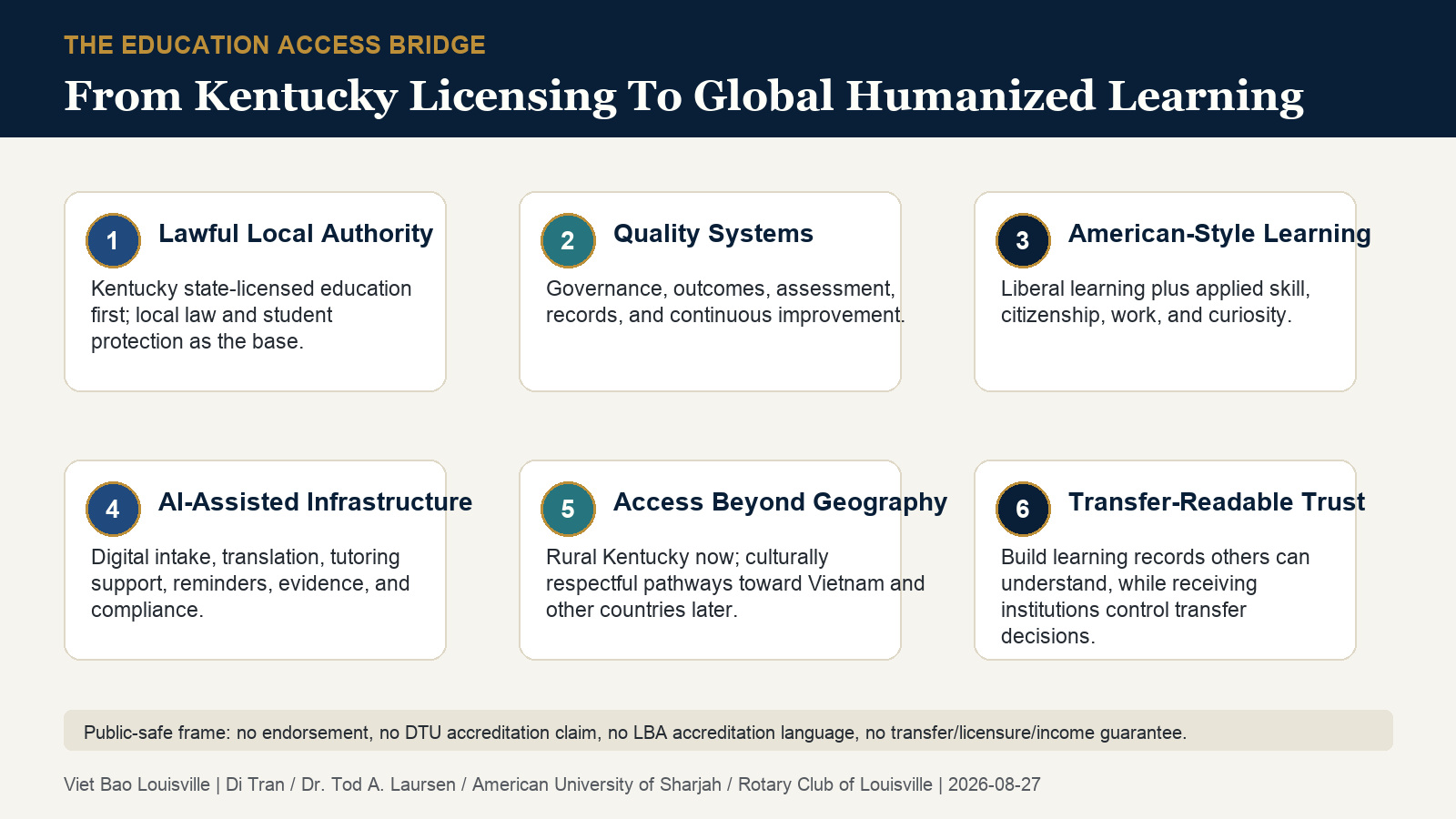
Visual explainer showing six layers of the education access bridge: lawful local authority, quality systems, American-style learning, AI-assisted infrastructure, access beyond geography, and transfer-readable trust.
A public-safe visual explainer connecting Kentucky state-licensed workforce access, quality systems, American-style learning, AI-assisted infrastructure, rural Kentucky, Vietnam, and transfer-readable documentation.
Categories
Community

Embracing the Universe’s Mysteries: The Wisdom of Dr. Wayne Dyer

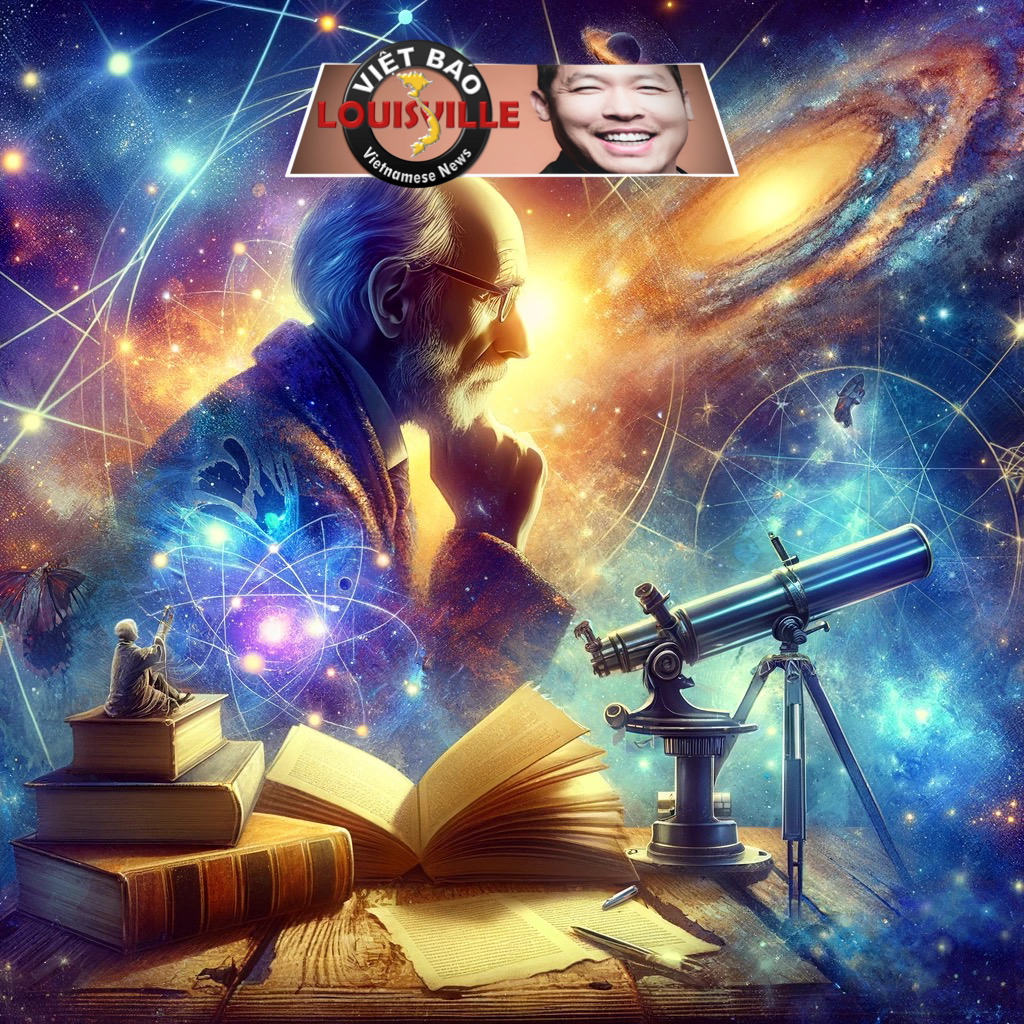
In a world teeming with knowledge and technological advancements, it’s easy to fall into the trap of believing we know all there is to know. However, Dr. Wayne Dyer’s profound statement, “None of us are knowing enough about the universe to be pessimistic,” serves as a humbling reminder of our limited understanding of the vast cosmos that surrounds us.

Humanity, with its rich history spanning thousands of years, from ancient civilizations like Vietnam, Athens, and Rome, to modern technological marvels like SpaceX and Starlink, has indeed made significant strides in understanding our world and beyond. Yet, despite these achievements, we barely scratch the surface of the universe’s mysteries.

Our planet, Earth, is but a speck in the grand tapestry of the cosmos. The knowledge we have amassed over centuries, while impressive, is minuscule compared to the infinite expanse of the universe. Every discovery, every technological breakthrough, reveals just how much more there is to learn.

SpaceX’s endeavors, such as sending spacecraft to Mars and establishing the Starlink satellite network, are testaments to human ingenuity and our quest for knowledge. However, they also highlight the vastness of space and our modest place within it. Controlling a small gadget on Mars is an incredible feat, yet it’s just a tiny step in the grand scheme of the universe.

Dr. Dyer’s statement encourages us to adopt a mindset of openness and humility. It reminds us that in the face of the universe’s immensity, there’s no room for pessimism. Instead, we should embrace the endless possibilities for learning and exploration. We are part of something much larger than ourselves, and our journey of discovery is far from over.

By acknowledging our limited understanding, we can remain curious, adaptable, and open to the wonders of the universe. In doing so, we can continue to grow, innovate, and appreciate the beauty and complexity of the cosmos. After all, we are not just inhabitants of Earth; we are citizens of the universe, with much more to learn and explore.

SPONSORED BY

Categories
Bourbon Whiskey Community Corporation Food Immigration Vietnamese

A Tale of Resilience and Belief: Di Tran’s BELIEF Bourbon and Steven Yeng’s Skrewball Whiskey

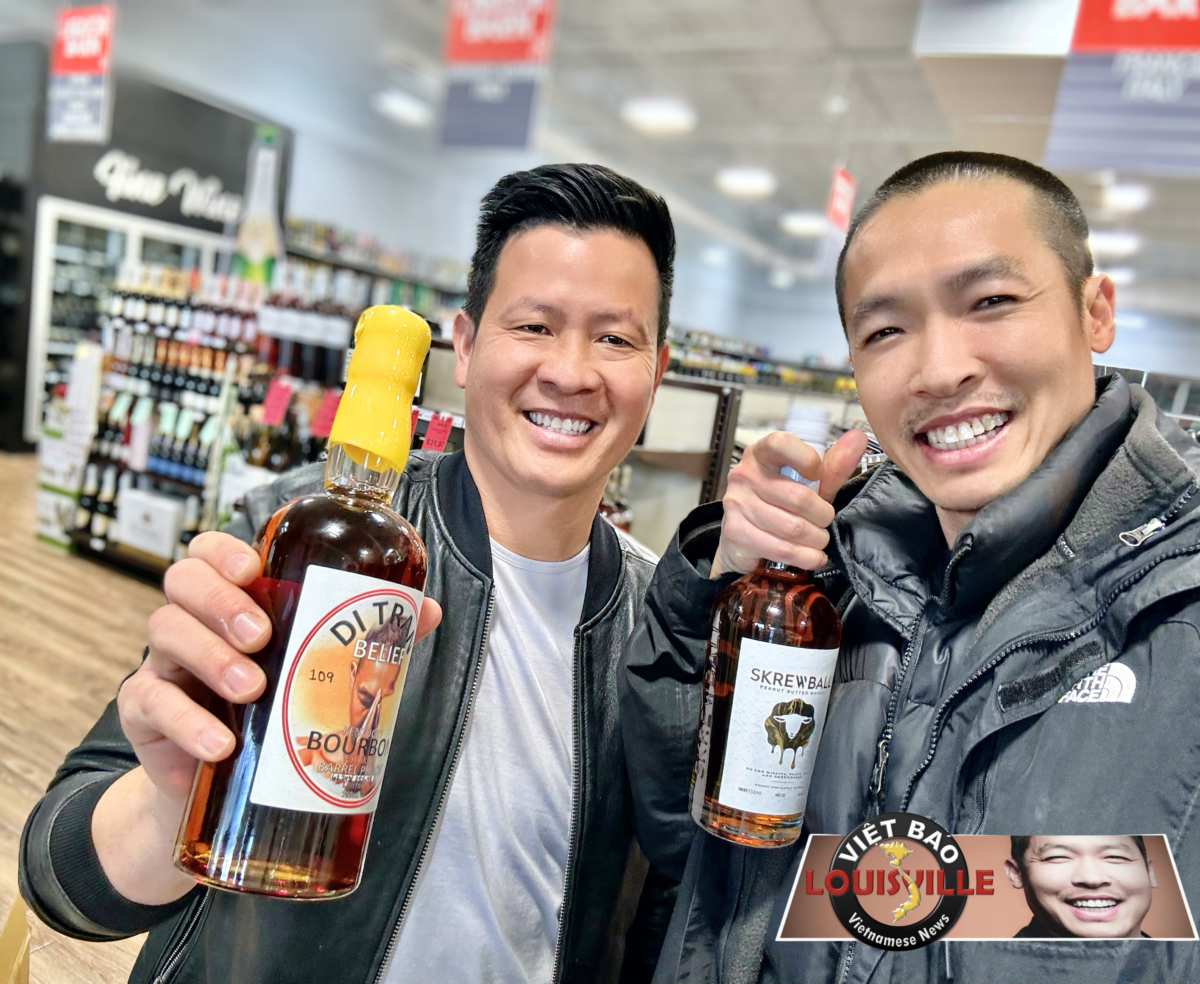
In the heart of Louisville, KY, a remarkable meeting took place at Liquor Barn between two extraordinary individuals, Di Tran, a Vietnamese immigrant and proud American, and Steven Yeng, a refugee from Cambodia. Both men, hailing from humble beginnings, have carved out successful paths in the world of entrepreneurship and spirits, showcasing the power of resilience, belief, and the American dream.

Di Tran, a man of many talents, is not only a nurse, licensed nail technician, and computer engineer but also a serial entrepreneur. With a journey that began in dirt-poor Vietnam, Di and his family sought refuge in the United States, where they worked tirelessly to build a better life. Di’s relentless drive and passion for education led him to establish multiple businesses, including the Louisville Beauty Academy and a chain of nail salons, before venturing into the world of bourbon with his exclusive BELIEF collectible bourbon.

On the other side, Steven Yeng’s story mirrors that of Di Tran’s. As a refugee from war-torn Cambodia, Steven grew up in a world far removed from the comforts many take for granted. His fascination with peanut butter, a novel flavor in his new homeland, inspired him to create a best-selling peanut butter whiskey cocktail at his bar and restaurant. Alongside his wife Brittany, a lawyer and chemist, Steven developed Skrewball Peanut Butter Whiskey, a spirit that celebrates diversity and the unconventional paths that lead to success.

The meeting between Di Tran and Steven Yeng was a moment of mutual admiration and recognition of their shared journey from adversity to prosperity. Di Tran, out of excitement and respect, offered Steven a bottle of his BELIEF bourbon, a symbol of their common belief in the power of hard work and determination. Their encounter was a testament to the fact that, regardless of one’s background, success is attainable through perseverance and a strong belief in one’s dreams.

As they exchanged stories and took pictures, Di Tran and Steven Yeng looked forward to future conversations, each wishing the other continued success. Their meeting serves as an inspiration to all, reminding us that the American dream is alive and well, fueled by the belief in oneself and the unwavering spirit to overcome obstacles.

In a world where stories of success often overshadow the struggles behind them, the tales of Di Tran and Steven Yeng stand as beacons of hope, reminding us that from the most challenging circumstances can emerge the most remarkable achievements. Here’s to the dreamers, the believers, and the trailblazers who show us that anything is possible when you hold onto your belief and strive for greatness.

Categories
Community

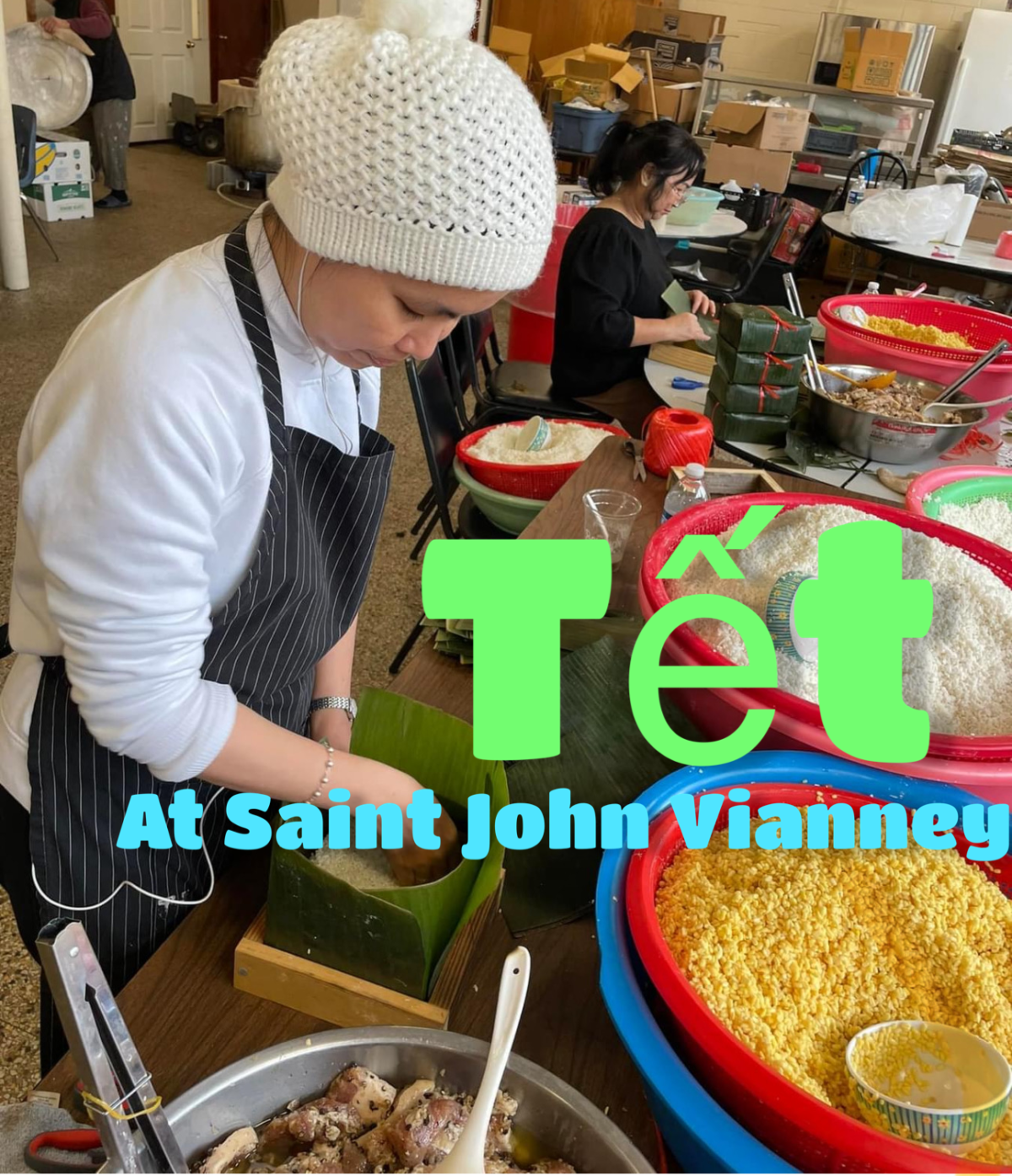
The Heartwarming Tradition of Bánh Trưng and Bánh Tét at Saint John Vianney in Louisville, Kentucky

In the heart of Louisville, Kentucky, amidst the chilly embrace of winter, a warm and vibrant tradition flourishes, echoing the rich cultural heritage of Vietnam. This tradition centers around “Bánh Trưng” and “Bánh Tét,” two quintessential Vietnamese dishes that symbolize the essence of Tết, the Lunar New Year celebration. Far from their tropical homeland, the Vietnamese community at Saint John Vianney, a Catholic Church with a significant Vietnamese congregation led by Father Anthony Chinh Ngo, keeps this tradition alive with love, dedication, and a deep sense of community.

The Tradition of Bánh Trưng and Bánh Tét

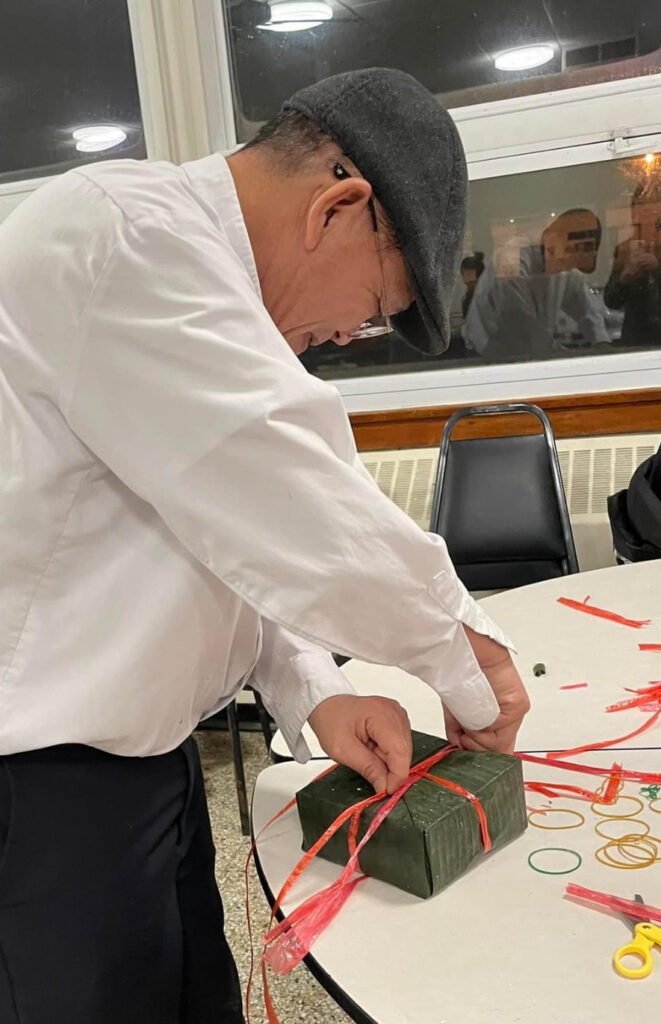
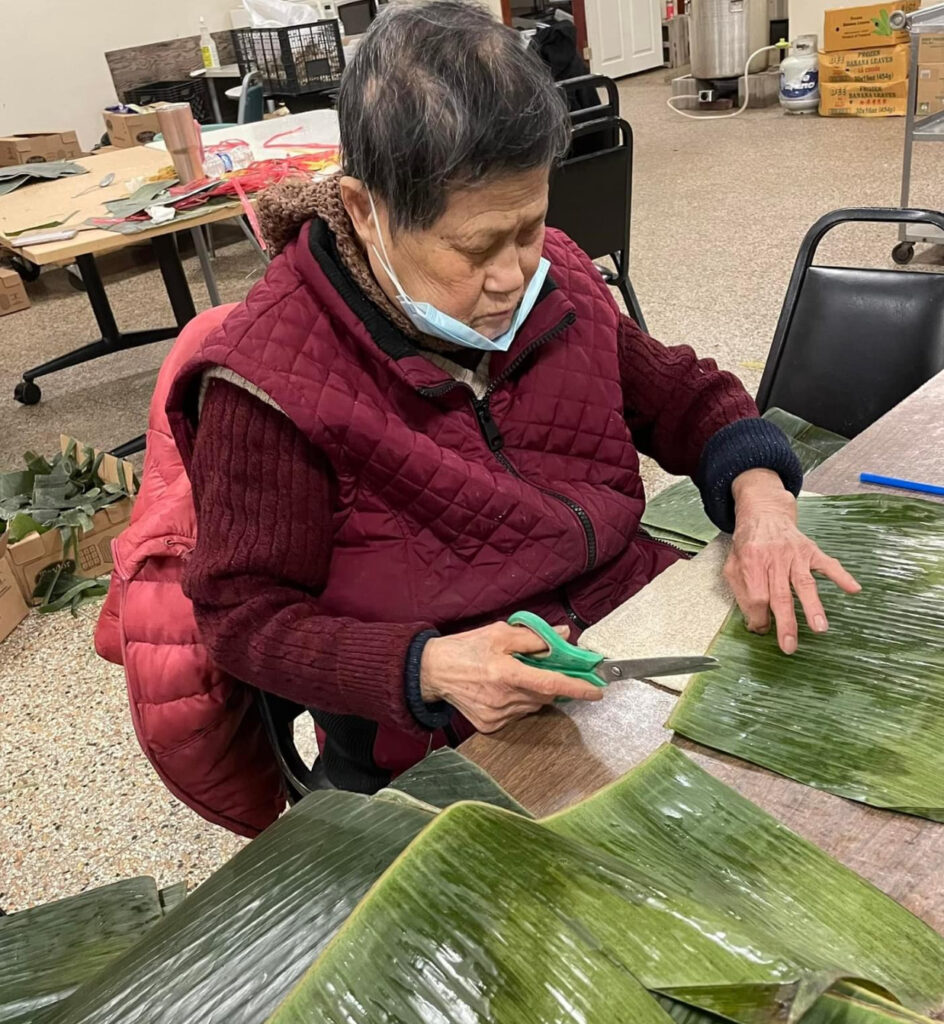
Bánh Trưng and Bánh Tét are more than just food; they are embodiments of Vietnamese culture and history. Bánh Trưng, a square-shaped glutinous rice cake, symbolizes the Earth, while Bánh Tét, its cylindrical counterpart, represents the moon. Both are meticulously wrapped in banana leaves and filled with mung beans and pork, requiring hours of preparation and cooking. These culinary delights date back thousands of years, linked to the legend of Lang Liêu, a prince who offered them to his father, the King, as a symbol of his respect and filial piety.

A Bridge Between Cultures

In Louisville, Kentucky, the making of Bánh Trưng and Bánh Tét has become more than a culinary endeavor; it’s a bridge connecting generations and cultures. At Saint John Vianney, this tradition is not only preserved but celebrated with enthusiasm and love. The elders in the community, often grandparents, gather together to share their knowledge and skills with younger generations, ensuring that this precious cultural heritage is not lost in the snows of Kentucky but thrives in the hearts of the Vietnamese diaspora.

A Labor of Love and Community Spirit

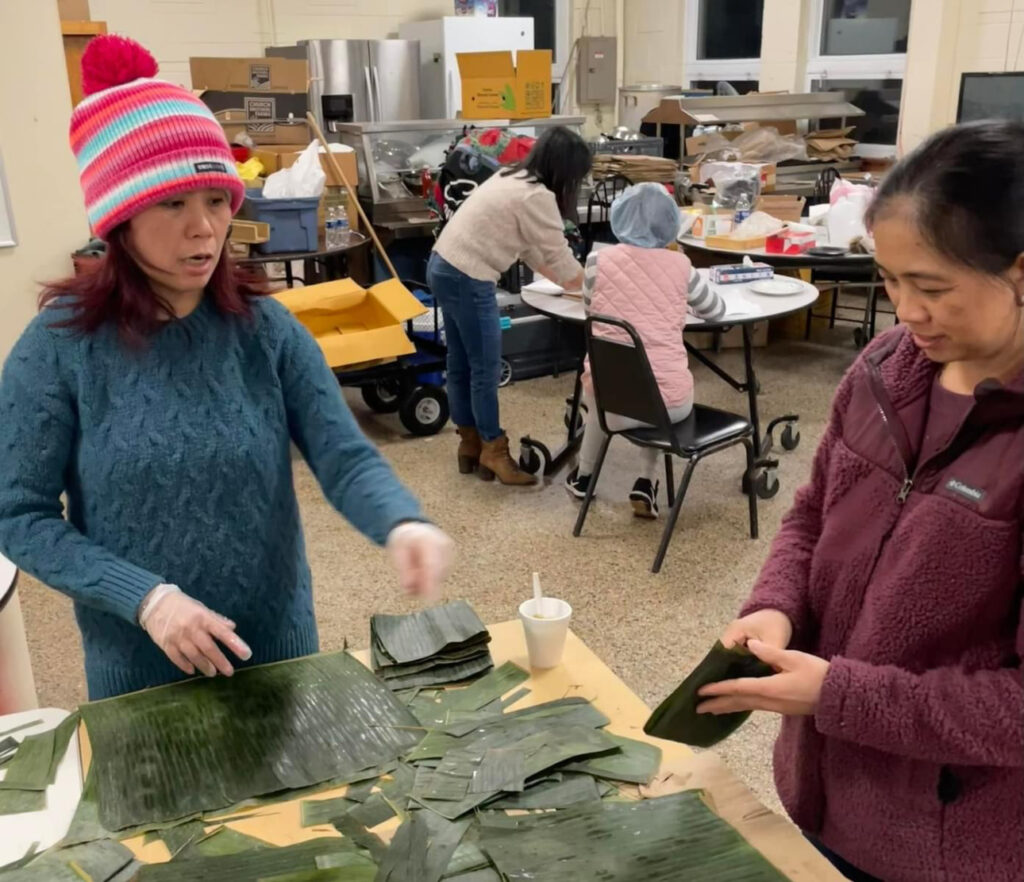
The preparation of Bánh Trưng and Bánh Tét for Tết at Saint John Vianney is a labor of love and a testament to the community’s solidarity. Hundreds of volunteers, from seasoned cooks to eager novices, come together in the church’s kitchen to prepare thousands of these cakes. This massive undertaking is not just for celebration but also for a noble cause: fundraising to build a new church. The process, from sourcing ingredients to the communal cooking that often lasts through the night, embodies the community’s dedication to their faith and cultural heritage.

Caring, Sharing, and Teaching

The tradition of making Bánh Trưng and Bánh Tét is imbued with the values of caring, sharing, and teaching. It offers a moment for the community to come together, share stories, and pass on traditions. It’s a time when love is not just felt but actively expressed through the careful preparation of food, symbolizing hope, renewal, and gratitude. Children learn the importance of cultural identity and the joy of giving, as the sales from these cakes go towards a communal goal that benefits all.

Conclusion

In the snowy state of Kentucky, far from the lush landscapes of Vietnam, the tradition of Bánh Trưng and Bánh Tét during Tết is a vivid reminder of the enduring spirit of Vietnamese culture. At Saint John Vianney, this tradition is a beacon of love, community, and cultural pride. It demonstrates how traditions can transcend borders, bringing people together in celebration, service, and unity. As the Lunar New Year of the Dragon dawns in 2024, the community’s efforts embody a profound expression of love: for tradition, for culture, and, most importantly, for each other. Through these endeavors, they are not just building a church; they are fortifying the bonds that connect them, ensuring their heritage continues to flourish for generations to come.

Categories
Community Corporation Drop the FEAR and Focus on the FAITH Drop the ME and focus on the OTHERS Guiding Lights: A Journey of Courage, Compassion and Faith Leadership Development Self-Improve Workforce Development

The Heartbeat of Collaboration: How Two CEOs, One from Vietnam’s Mud Huts, Are Making a Difference in Louisville

By Viet Bao Louisville, KY

In the bustling city of Louisville, two organizations have come together, forging a bond that reflects compassion, resilience, and the indomitable spirit of community. It’s the collaboration between Harbor House of Louisville and Louisville Beauty Academy that we shine a spotlight on today, and at its core lies the shared vision of two CEOs with big hearts.

From Vietnam’s Mud Huts to Louisville’s Business Landscape

Among the two visionaries leading this collaboration is Di Tran, CEO of Louisville Beauty Academy. His story is not just of business success, but of triumph over adversity, determination, and profound empathy. Born in the rural, mud-hut landscapes of Vietnam, Di Tran has journeyed from the simplicity and hardships of a third-world environment to becoming a pillar of Louisville’s entrepreneurial community.

His roots, steeped in the humbling experiences of Vietnam’s countryside, have instilled in him a deep-seated compassion. Di Tran’s understanding of life’s struggles, paired with his firsthand experience of the challenges faced by immigrants, gives him a unique perspective, allowing him to empathize with all walks of life. This empathy is palpably evident in the work he does, especially in the collaboration with Harbor House of Louisville, an organization serving the underrepresented.

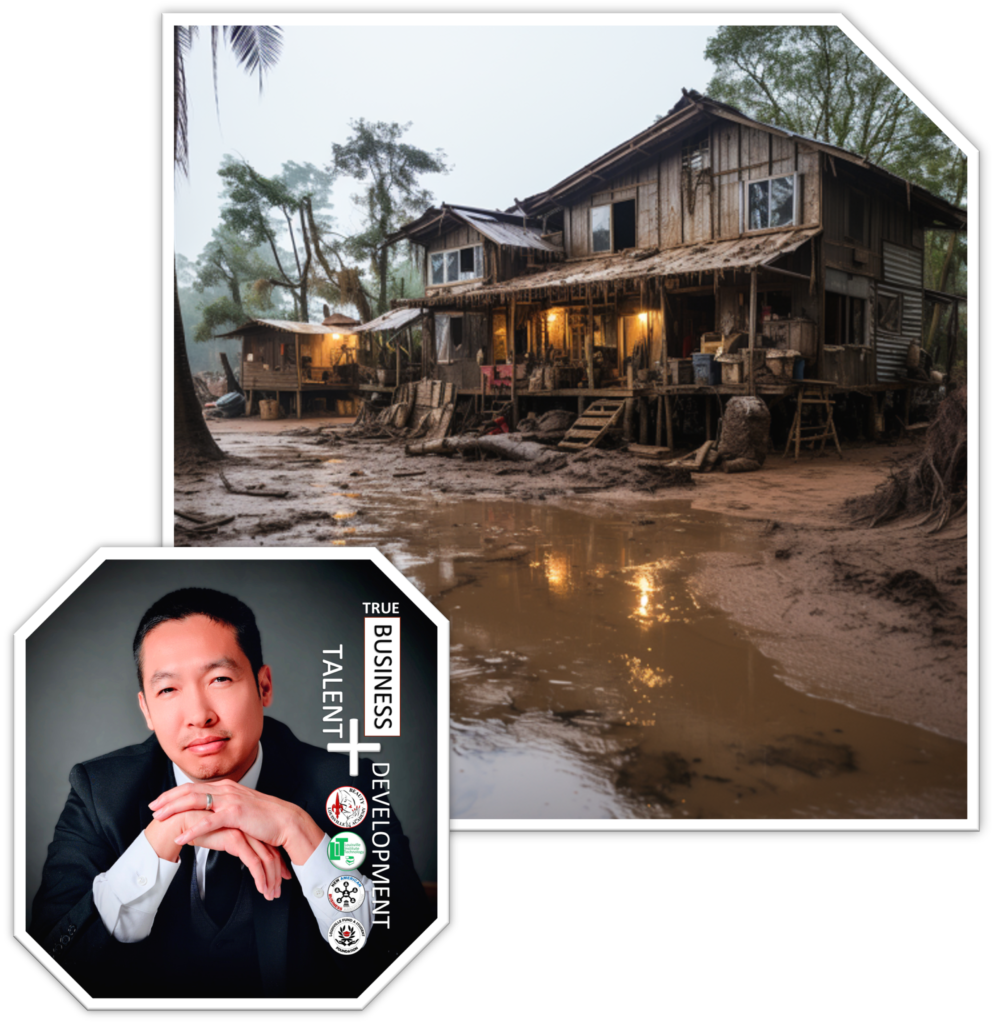
Though the photo is illustrative and not of Di Tran's actual childhood home, it closely mirrors the humble and scenic conditions he once knew. Reflect on this as you appreciate the profound journey and impact he has made in Louisville

A Collaboration Rooted in Love and Care

The partnership between Harbor House of Louisville and Louisville Beauty Academy goes beyond traditional business objectives. It’s a union founded on the shared values of love, care, and community upliftment. Both organizations are dedicated to serving those often left on society’s margins, and together, they’re crafting a narrative of inclusivity and hope.

Maria Smith, the dynamic CEO of Harbor House, matches Di Tran’s enthusiasm and commitment. Their combined leadership brings out a synergy that is setting an example for businesses everywhere. It’s a testament to the idea that when businesses operate with heart and genuine intent, they can bring about transformative change.

Empowering the Underrepresented

The central theme of this collaboration is empowerment. While Louisville Beauty Academy offers beauty services, it’s not just about aesthetics; it’s about boosting confidence, fostering community, and creating an environment where everyone feels valued. On the other hand, Harbor House stands as a haven for adults with disabilities, children, and elders, further emphasizing the shared mission of these two organizations.

In Conclusion

The collaboration between Harbor House of Louisville and Louisville Beauty Academy, led by two big-hearted CEOs, is a beacon of hope in today’s business world. Di Tran, with his roots in Vietnam’s mud huts and his boundless empathy, stands as an inspiration, proving that with determination, love, and care, we can touch lives and create lasting impact.

References

Categories
Drop the FEAR and Focus on the FAITH Drop the ME and focus on the OTHERS Guiding Lights: A Journey of Courage, Compassion and Faith Immigration Leadership Development Self-Improve Workforce Development

The Power of Simplicity: A Reflection by Di Tran

In a world where complexity often overshadows simplicity, Di Tran’s enlightening conversation with an 80-year-old American of North Korean descent offers a profound insight into the importance of unity and the value of simplicity in human societies.

The octogenarian’s comment: “Di Tran, do you know why Vietnam is a lot better than North and South Korea? It is that Vietnam is united as one,” draws a parallel between national unity and simplicity. Vietnam’s unity, despite its tumultuous past, stands in stark contrast to the Korean peninsula’s divided history. Though it is critical to understand that such a perspective demands one to sideline political ideologies momentarily, the essence remains — unity simplifies the complications that come with division.

A quick search by Di Tran reveals that many Koreans, despite decades of separation, yearn for a united Korea. Campaigns that promote this unity focus on the humanistic aspect: allowing Koreans to experience the joys and sorrows of life without the weight of a divisive political regime. This dream, to many, embodies simplicity in its purest form.

Yet, the complexities of human societies do not limit themselves to the Korean peninsula. Take the USA, often heralded as the “land of the free,” still grappling with issues of racial discrimination. Though most Americans believe in the greatness of their nation, the fight for equal representation and the eradication of systemic racism remains an ongoing battle.

The paradox lies in humanity’s inherent nature. We are creatures who crave simplicity, as evident from the fact that most fundamental human needs – love, respect, understanding – are simple in essence. However, societal constructs, historical baggage, and political intricacies often overshadow this craving.

In his book, “The Laws of Simplicity,” John Maeda states that simplicity is about subtracting the obvious and adding the meaningful. Applying this principle to societies implies focusing on the unifying human elements and shedding divisive forces.

Moreover, Leonardo da Vinci’s famous saying, “Simplicity is the ultimate sophistication,” resonates with the idea that finding unity, whether in national identity or the fight against discrimination, is a mark of evolved societies.

In conclusion, Di Tran’s reflection on the critical concept of simplicity, inspired by a conversation with a seasoned traveler of life, is a poignant reminder for all. While complexities are inevitable, societies that champion simplicity, unity, and equality invariably prosper. It’s a lesson that, though known to many, is practiced by few. We must strive not only to understand the power of simplicity but to actively integrate it into our global tapestry.

Categories
Uncategorized

Di Tran: A Journey from Immigrant Small Business Owner to Global Business Mentor

In 1995, Di Tran, a native of Vietnam, arrived in the United States with no knowledge of the English language. Despite facing language barriers and often being the target of ridicule, he tenaciously built a series of successful small businesses. This journey forged him into a serial entrepreneur, undeterred by obstacles and challenges, embodying the spirit of the American Dream.

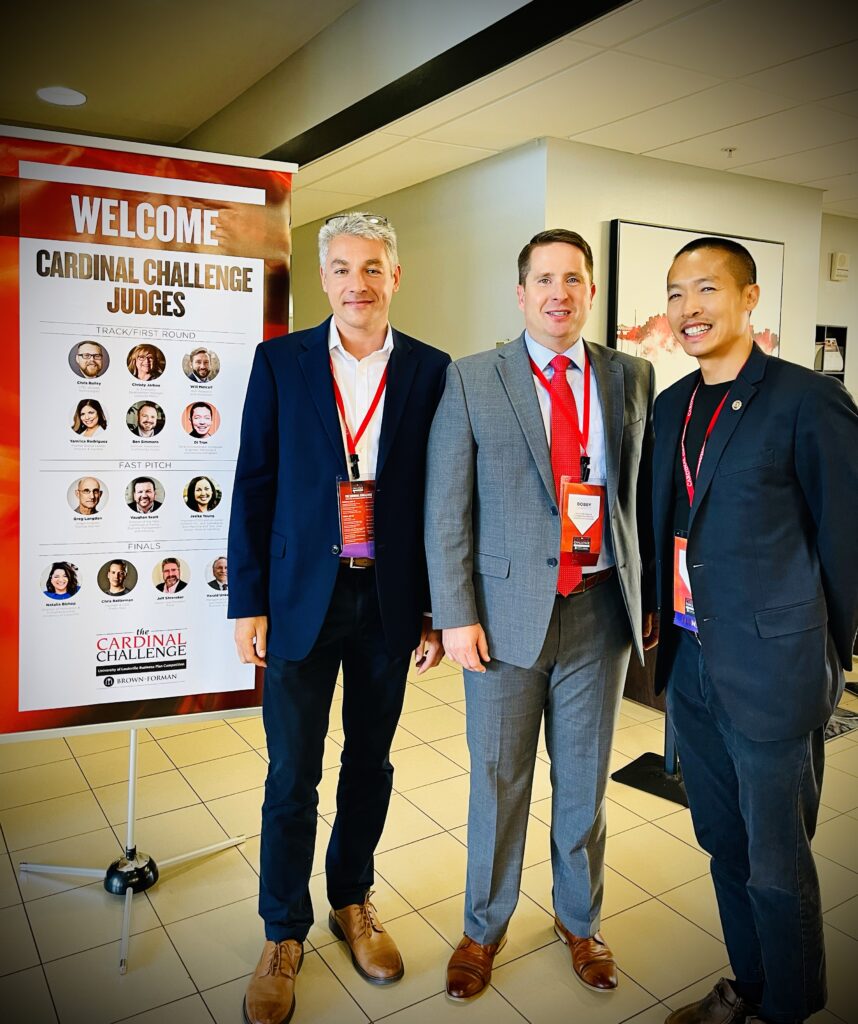
Fast forward to the present, Tran is a co-judge at the Cardinal Challenge, a prestigious startup competition where he evaluates pitch presentations along with fellow immigrant professionals and business owners. But beyond his role as a judge, Tran passionately emphasizes the need for fostering the next generation of small business entrepreneurs. He is a living testament that the American Dream isn’t a faded notion but a reality that exists here and now.

Globalization isn’t a novel concept, but its effective implementation necessitates a coherent, supportive framework. Tran believes that building such a system requires collaboration between higher educational institutions like the University of Louisville and community business leaders. The aim is to facilitate the movement of talents and resources between countries, such as the USA and Vietnam.

He isn’t just talking about it; Tran is actively working towards this vision. His ambition extends beyond national borders, aspiring to serve global talents and business owners across the world. To achieve this, he is laying the foundation through Di Tran Enterprises, a company that leverages innovative cloud solutions and AI-driven IT tools.

Tran’s story is one of perseverance, innovation, and unyielding ambition. His journey from an immigrant with limited English skills to a judge at a startup competition, and now a global business mentor, demonstrates that hard work and determination can break down even the most formidable barriers.

In his words, “God blesses America and all who work hard for their goals.” It is clear that he believes in the potency of hard work, the transformative power of education, and the limitless possibilities of entrepreneurship. Di Tran’s journey is a testament to the American Dream in the global age, proving that dreams can thrive wherever the spirit of entrepreneurship is fostered and nurtured.

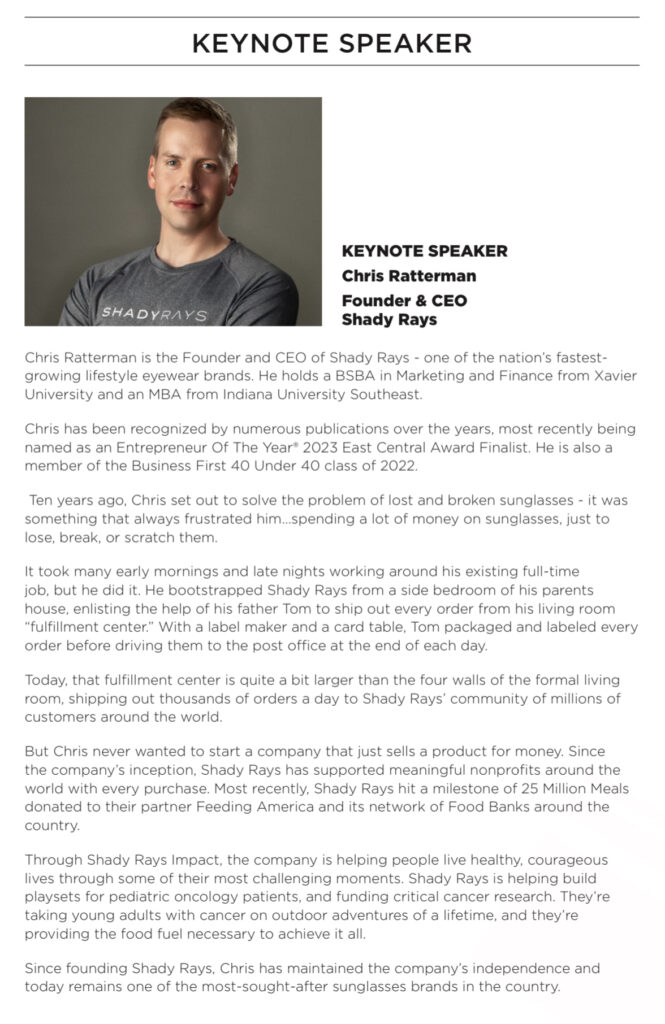
PS: As Di Tran watched Chris Ratterman elaborate on his journey of building his company and his relentless daily efforts to make sales, he felt a profound sense of alignment. Tran’s own journey has mirrored this tireless hustle for over twenty years. From making social media posts, writing articles, standing at conference booths, selling to customers, investors, and clients – every action has been infused with the same degree of dedication and zeal. Despite the inevitable stress, the process is beautiful and enjoyable, offering rewards that transcend material gain. The value he adds to his community reflects in the tangible returns he receives, reaffirming the maxim: the more you give, the more you get. In Tran’s case, this has indeed materialized in millions of dollars, but the true reward lies in the journey and the countless lives his work touches every day.

Categories
Information Technology Leadership Development Self-Improve Small Businesses Workforce Development

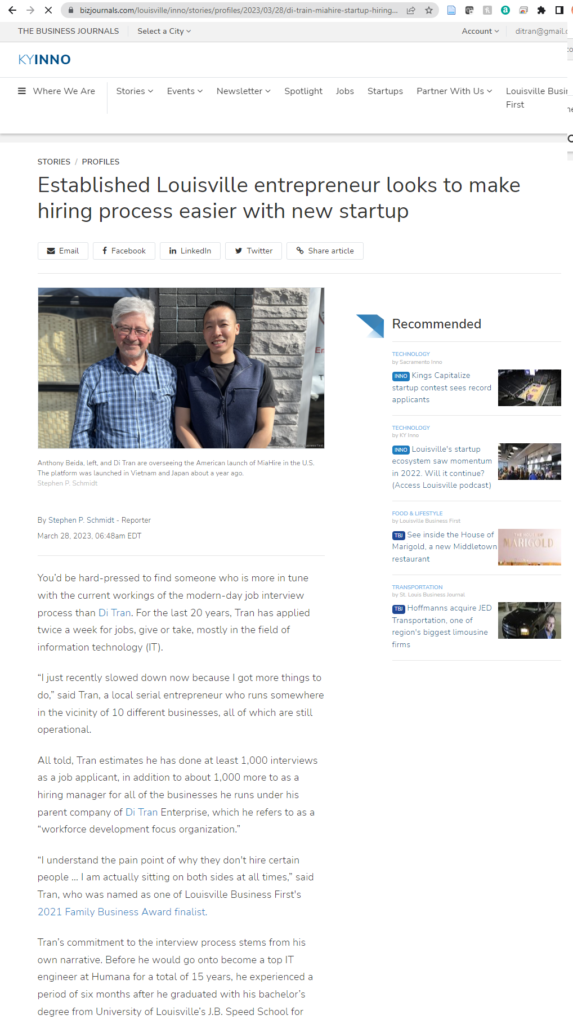
Serial Entrepreneur Di Tran Launches Cloud-Based Platform MiaHire to Streamline Job Interview Process and Eliminate Biases

Serial entrepreneur Di Tran is leveraging his extensive experience in job interviewing to streamline the process and eliminate biases with his new cloud-based online platform, MiaHire. Having applied for jobs twice a week for 20 years, Tran has done at least 1,000 interviews as a job applicant and another 1,000 as a hiring manager for his 10 different businesses. MiaHire, which was launched a year ago in Vietnam by co-founder Truong Dinh Hoang, has already been used by 30 companies in the country and 10 in Japan, resulting in close to 10,000 recorded interviews for white-collar tech jobs for college graduates.

The online platform enables candidates to automatically record initial video responses that relate to the job opening, with assessments of multiple evaluators conducted through the platform to eliminate biases. MiaHire also aims to simplify the process for recruiters and HR professionals by removing the need to deal with multiple recruitment sites, screen resumes and arrange interviews, among other pain points. The platform is subscription-based, with companies buying tickets for one interview, ranging from as low as $4 to as high as $10, depending on the number of interviews purchased.

MiaHire’s revenue model is similar to other third-party hiring sites, and the company has funding from Asia, with Tran and his business partner Anthony Beida seeking American users. Tran hopes to hire an American sales team, English-speaking support team and American consulting team to launch the solution in Louisville, aiming to make it the city’s tech hub. The company also plans to offer multi-month trial periods to American companies to test the market. Tran hopes to have at least 10 American companies as customers and hundreds to thousands of job applicants in the US within a year.

Tran’s vision for MiaHire is shaped by his own experience of facing numerous rejections after applying for 400 jobs after graduating from the University of Louisville’s J.B. Speed School for Engineering in 2006. His commitment to resolving the pain points of the job interview process, along with his extensive entrepreneurial experience, is driving MiaHire’s mission to improve the recruitment process for both recruiters and job applicants.

References:

https://www.bizjournals.com/louisville/inno/stories/profiles/2023/03/28/di-train-miahire-startup-hiring-job-applicants.html

Louisville Business First – Di Tran Enterprise

https://www.bizjournals.com/louisville/search/results?q=Di+Tran

Louisville Business First – Di Tran Enterprise
Categories
Self-Improve Small Businesses

From Scarcity to Abundance: How Fasting Improved My Physical and Mental Health

As I sit here in my comfortable home in America, surrounded by abundance and luxury, I can’t help but reflect on my journey to get here. I was born and raised in Vietnam, in a rural countryside where basic necessities like food were limited. Watching my family members work long hours in the rice fields just to put food on the table was a way of life for me. It was a struggle, but it was all we knew.

When I moved to America, I was overwhelmed by the abundance of food and sugar available at every turn. It was a stark contrast to the scarcity I experienced in Vietnam. But as I indulged in these newfound luxuries, I began to realize the toll they were taking on my health.

In America, food can easily become poison. It’s the main culprit behind diabetes, obesity, high cholesterol, and heart attacks. As someone who had experienced hunger and scarcity, I knew I had to change my relationship with food to avoid these health issues.

That’s when I began my journey of fasting. I started with intermittent fasting, skipping breakfast and only eating during a small window of time each day. As I became more comfortable with this routine, I started to incorporate longer fasts, lasting 24-48 hours.

I’ve now been fasting daily for 5 months, and the results have been incredible. I’ve lost 20 pounds and have developed six-pack abs for the first time in my life. I feel healthier and stronger than ever before, and my cravings for exercise and meditation have increased.

Through this process, I’ve learned that everything we feed our minds and bodies matters. Positive thoughts and healthy food choices are crucial for mental and physical health. In a world where we’re constantly bombarded by negative messages and unhealthy options, it’s important to be mindful of what we consume.

As I reflect on my journey, I’m grateful for the struggles I faced growing up. They taught me the importance of hard work and perseverance. And now, in America, I’ve found a way to use those lessons to live a healthier and happier life.

Mental Health Focus

In today’s society, mental health problems have become increasingly prevalent. It’s more important than ever to take care of both our physical and mental health, and the two are often interconnected. As someone who has experienced the benefits of fasting on both my physical and mental health, I believe that it’s essential to pay attention to what we feed our bodies and minds.

Fasting has allowed me to cultivate a positive mindset, reduce stress, and improve my overall well-being. By cutting out unhealthy foods and focusing on healthy choices, I’ve been able to reduce inflammation and improve my brain function. It’s a small change that can make a big difference in our lives.

But fasting isn’t the only solution. We can also prioritize our mental health by practicing mindfulness, connecting with loved ones, and seeking professional help when needed. By taking care of ourselves, we can better take care of those around us and contribute to a happier and healthier society.

In conclusion, as we navigate the challenges of today’s world, let’s not forget the importance of taking care of ourselves both physically and mentally. By making small changes to our lifestyle and prioritizing our well-being, we can improve our overall quality of life and build a better future for ourselves and those around us.

Translate »