Categories
Education Leadership Development Louisville

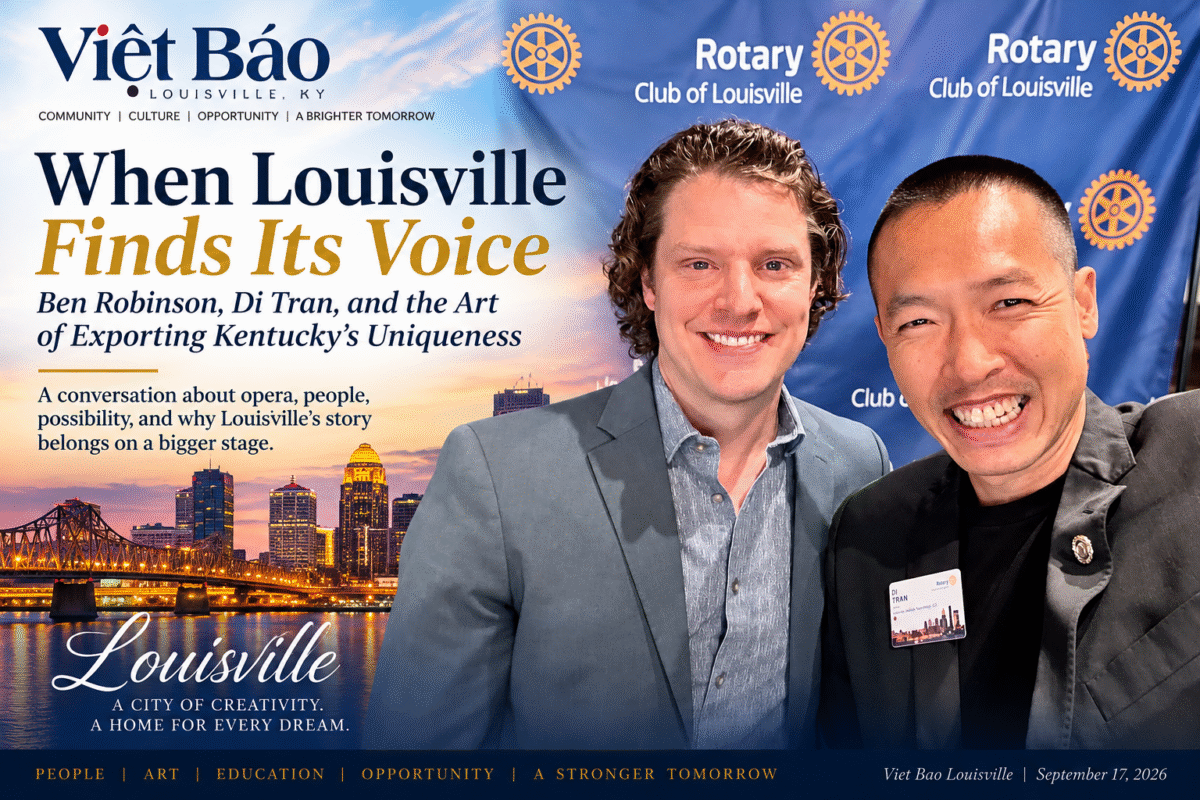
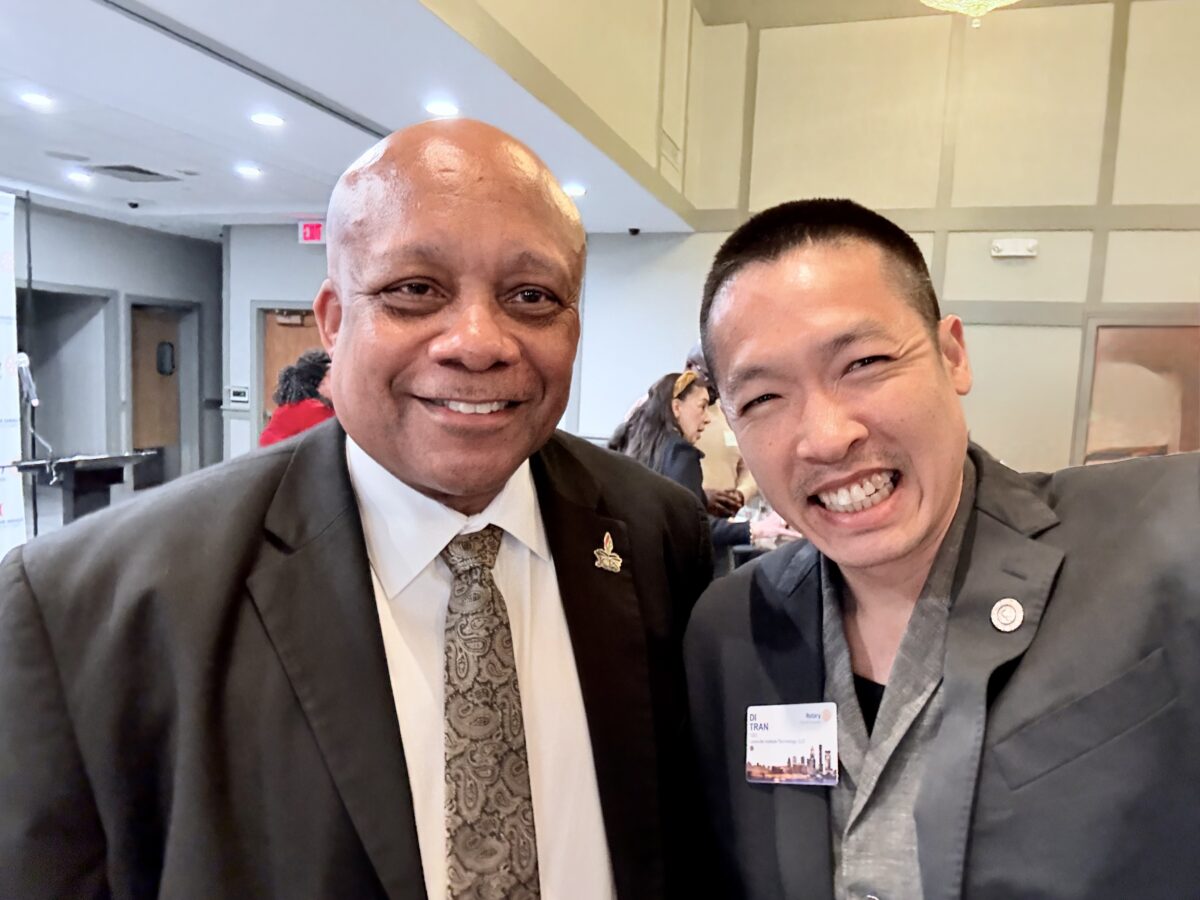
When Louisville Finds Its Voice: Ben Robinson, Di Tran, and the Art of Exporting Kentucky’s Uniqueness

At the Rotary Club of Louisville, a conversation about opera became something larger—a reflection on art, immigration, entrepreneurship, collaboration, civic identity, and the extraordinary things Louisville has already given the world.

Viet Bao Louisville | Louisville, Kentucky | September 17, 2026

Some speeches explain an industry. Others reveal something about a city.

When Ben Robinson, General Director and CEO of Kentucky Opera, addressed the Rotary Club of Louisville on September 17, 2026, his announced subject was “The Future of Opera in Kentucky.”

Opera was certainly at the center of the conversation. But for Louisville entrepreneur, educator and Rotarian Di Tran, who was sitting in the audience, Robinson’s presentation carried a meaning that extended far beyond the stage.

Tran heard something increasingly important for Louisville and Kentucky:

A community should not merely recognize what makes it unique. It should develop that uniqueness, collaborate around it, and have the confidence to share it with the world.

For Tran, an immigrant who has spent much of his adult life building businesses, educational institutions and workforce initiatives in Louisville, the idea felt immediately familiar.

Robinson advocates through opera.

Tran advocates through education, entrepreneurship and service.

Others may do it through music, manufacturing, technology, food, healthcare, skilled trades, athletics or neighborhood leadership.

The instruments are different.

The underlying question is the same:

What does Louisville possess that is worth giving to the world?


An Opera Leader Who Speaks Beyond Opera

Robinson arrived at Kentucky Opera’s highest executive position at an important moment in the organization’s history.

Kentucky Opera announced his appointment as General Director and CEO in November 2025 following a national search. The appointment also represented a return: Robinson had begun his professional career as a Kentucky Opera Studio Artist.

His career has combined artistic creation with institutional leadership. He has worked as a stage director, producer, designer and librettist, while also holding executive roles including General Director of Anchorage Opera and Managing Director of Lyric Fest in Philadelphia.

Kentucky Opera credited Robinson’s Anchorage tenure with expanding community programming, building artistic partnerships, developing regional talent, experimenting with immersive productions, securing a major endowment gift and finishing a season with a six-figure operating surplus.

That combination matters.

Robinson’s career suggests that opera need not choose between artistic excellence and accessibility, tradition and experimentation, institutional strength and community engagement.

Those goals can reinforce one another.

And that is why a speech about opera can become a lesson about much more than opera.


Louisville Does Not Need to Invent an Identity

Cities frequently spend enormous amounts of time trying to determine what they want to become.

Louisville might begin with a different question:

Does Louisville fully understand what it already is?

Louisville Metro has highlighted the unusual concentration of major performing-arts institutions in the city, including Kentucky Opera, Louisville Orchestra, Louisville Ballet, Actors Theatre of Louisville and StageOne Family Theatre.

These are not simply entertainment organizations.

Taken together, they represent generations of cultural infrastructure.

The Louisville Orchestra was founded in 1937. Its history became particularly distinctive through an ambitious commitment to commissioning and recording new music. The orchestra eventually established First Edition Records, which the organization describes as the first record label owned by an American orchestra.

That distinction deserves attention.

Louisville did not simply ask:

What music is the rest of the world performing?

It also asked:

What music does not exist yet—and can it be created here?

That is a fundamentally different civic mentality.


Opera, Ballet and Theatre: Generations of Creation

Kentucky Opera was founded in 1952 by Moritz von Bomhard. During the 1950s alone, the organization produced five world premieres. In 1982, the Kentucky General Assembly designated it the State Opera of Kentucky.

Louisville Ballet also traces its origins to 1952, eventually developing into one of Kentucky’s principal performing-arts institutions and working with nationally and internationally recognized figures in dance.

Actors Theatre of Louisville was formed in 1964, and its Humana Festival of New American Plays later helped establish Louisville as an important national environment for developing and presenting new American theatre.

Louisville’s infrastructure for supporting art extends even further back.

Fund for the Arts dates to 1949 and reports having raised more than $200 million during its history in support of the region’s arts ecosystem.

These institutions were founded at different times, so Louisville should not exaggerate its history by claiming that every component of today’s performing-arts ecosystem has existed for a century.

The verified history tells a better story anyway.

Generation after generation, Louisville has repeatedly built institutions that do not merely consume culture.

They create it.


Before Opera Went Viral, Louisville Helped Create a Melody the World Would Sing

There is perhaps no more beautiful metaphor for Louisville’s cultural influence than a song so ordinary that most people no longer stop to ask where it came from.

“Happy Birthday to You.”

Its history is connected to Louisville educators and sisters Patty Smith Hill and Mildred J. Hill.

The Smithsonian traces the familiar melody to the sisters’ nineteenth-century classroom song “Good Morning to All.” The melody was subsequently paired with the birthday lyrics that became internationally recognizable.

Consider the significance.

Two Louisville educators worked on a simple song for children.

That melody crossed neighborhoods.

Then generations.

Then states.

Then nations.

Then languages.

Eventually, people around the world could recognize it almost instantly.

Long before anyone used words such as viral, global platform or cultural export, Louisville had already demonstrated the principle.

Something created locally can become universal.

The world did not need Louisville to become another city.

It needed Louisville to create something authentically useful, memorable and human.

That distinction lies near the heart of what Robinson’s presentation awakened for Tran.


From “Importing Success” to Exporting the Blueprint

In Tran’s interpretation of Robinson’s remarks and their conversation surrounding the Rotary program, one idea stood above the rest:

When Kentucky develops something distinctive that works, it should have the confidence to share that model beyond the Commonwealth.

That formulation is intentionally presented as Tran’s interpretation rather than a verbatim quotation from Robinson.

But the idea has enormous implications.

Cities constantly study other successful cities.

They ask how to become more like Nashville.

More like Austin.

More like New York.

More like Boston.

More like Silicon Valley.

Benchmarking has value.

But imitation has limits.

Louisville’s highest aspiration cannot simply be to become a smaller version of somewhere else.

Louisville does not have to copy another city to become important. It can create something worth copying.

That changes the conversation.

Instead of asking only:

“What can Louisville import?”

a confident city also asks:

“What can Louisville export?”

Not merely bourbon, manufactured goods or agricultural products.

Ideas can be exported.

Educational models can be exported.

Music can be exported.

Technology can be exported.

Workforce systems can be exported.

Artistic productions can be exported.

Entrepreneurial models can be exported.

Community practices can be exported.

Methods of collaboration can be exported.

And perhaps most importantly:

Human possibility can be exported.


Ben Robinson and Teddy Abrams: Different Instruments, Related Civic Energy

While listening to Robinson, Tran found himself thinking about another prominent Louisville arts leader who had recently spoken before Rotary:

Teddy Abrams, Music Director of the Louisville Orchestra.

The comparison is not intended to make the two men interchangeable.

They are not.

Their artistic disciplines are different. Their personalities are different. Their institutions have different histories and responsibilities.

What they share is something more interesting:

the ability to use artistic leadership as a form of civic imagination.

Abrams leads an orchestra whose institutional history contains a remarkable tradition of experimentation and commissioning new music.

Robinson now leads an opera company entering another consequential chapter of its history.

And these two artistic worlds are scheduled to meet directly.

In May 2027, Kentucky Opera and the Louisville Orchestra are scheduled to collaborate on Richard Strauss’s Salome, with Abrams conducting and Robinson directing.

There is a lesson for Louisville embedded in that collaboration.

The orchestra does not need to become the opera.

The opera does not need to become the orchestra.

Each becomes more valuable to the collaboration precisely because each brings something the other does not.

Collaboration does not require surrendering uniqueness.

The strongest collaboration amplifies it.


The Immigrant Eye Often Sees What Familiarity Hides

Tran’s interpretation of the afternoon also comes from a particular American experience.

He is an immigrant.

That perspective matters.

People who arrive in America from somewhere else sometimes notice things that familiarity can make invisible.

Opportunity can look different to someone who remembers having less of it.

The ability to establish a business can feel different.

The ability to pursue education can feel different.

The existence of strong civic institutions can feel different.

The freedom to experiment, fail, rebuild and try again can feel different.

And the ability to enter a room where artists, educators, entrepreneurs, physicians, nonprofit leaders, executives and community servants exchange ideas can feel extraordinary.

Louisville has been Tran’s home for much of his adult life.

His advocacy for the city and Commonwealth has taken place primarily through education, workforce development, entrepreneurship and community service.

From that perspective, Louisville’s challenge is not always that it lacks extraordinary assets.

Sometimes the challenge is that people living among extraordinary things eventually begin treating them as ordinary.

Louisville possesses an unusual combination:

significant cultural assets and remarkable local humility.

Humility is a virtue.

But humility should never become invisibility.


Louisville Does Not Need One Ambassador. It Needs Thousands.

Perhaps the most important idea Tran carried away from the Rotary meeting was not ultimately about Robinson.

It was about multiplication.

A city cannot outsource its identity to a handful of famous people.

Louisville should not depend upon one Ben Robinson to tell its story.

It should not depend upon one Teddy Abrams.

It should not depend upon one entrepreneur, politician, journalist, athlete, artist or institution.

Louisville needs thousands of ambassadors.

Not professional ambassadors.

Everyday ones.

The opera director can advocate through opera.

The musician through sound.

The teacher through students.

The cosmetologist through beauty and entrepreneurship.

The chef through food.

The engineer through invention.

The physician through healing.

The manufacturer through craftsmanship.

The programmer through technology.

The immigrant through enterprise and experience.

The child through imagination.

The neighborhood volunteer through service.

None of them needs to deliver the same speech.

None needs the same background.

None needs the same politics.

None even needs to agree about everything.

A healthy city is not a choir singing a single note.

It is an orchestra of different instruments capable of creating something together.

Excellence becomes a form of civic advocacy when people carry their community with them.


Why Rotary Matters

The location of this encounter is itself important.

It occurred at the Rotary Club of Louisville, an institution whose history in the city dates to 1912.

Rotary creates a kind of infrastructure that cannot be measured simply in square footage or dollars.

It creates human infrastructure.

An opera executive can sit beside an entrepreneur.

An educator can meet a banker.

A nonprofit leader can meet a manufacturer.

A lifelong Kentuckian can sit beside someone born thousands of miles away who eventually chose Kentucky as home.

A formal presentation may last less than an hour.

A conversation afterward may last five minutes.

But relationships created in such environments can influence institutions and communities for years.

Cities need bridges made of steel.

They also need bridges made of relationships.

Civic organizations help build the second kind.


The Future of Opera Is Also a Question About the Future of Louisville

Robinson’s presentation was titled “The Future of Opera in Kentucky.”

Yet underneath that subject lies a question facing almost every established institution:

How does something with history honor that history without becoming imprisoned by it?

Universities face that question.

Businesses face it.

Religious institutions face it.

Governments face it.

Cultural organizations face it.

Cities face it.

Tradition without adaptation can become disconnected from the people it was created to serve.

Innovation without memory can become rootless.

The difficult work lies between them:

preserve what deserves preservation while having enough courage to create what does not yet exist.

Louisville’s history suggests that the city already understands this principle.

Its orchestra commissioned new music.

Its opera produced world premieres.

Its theatre became associated with new American plays.

Its ballet carried classical discipline into new generations.

Its educators helped originate a melody that ultimately traveled around the planet.

The pattern is visible.

**Create locally.

Collaborate courageously.
Refine relentlessly.
Share globally.**


Louisville Should Become More Louisville

Perhaps Louisville’s future does not require becoming the next anything.

Not the next Nashville.

Not the next Austin.

Not the next New York.

Not the next Silicon Valley.

Those places already exist.

The more ambitious objective is for Louisville to become more completely Louisville.

That means asking:

What exists here that cannot be reproduced anywhere else in exactly the same way?

And then:

How can Louisville make those things so excellent that others want to experience them, study them, invest in them, collaborate with them and adapt them elsewhere?

That is where culture intersects with economic development.

It is where immigration intersects with civic identity.

It is where education intersects with entrepreneurship.

It is where history intersects with innovation.

It is where local pride becomes global contribution.

And it is where an opera executive and an immigrant entrepreneur, working in seemingly unrelated fields, can discover an unexpected harmony.

Robinson speaks through opera.

Abrams speaks through an orchestra.

Tran speaks through education, entrepreneurship and service.

Thousands of other Louisvillians speak through entirely different instruments.

The instruments do not need to match.

That is precisely what creates the harmony.


From Louisville, Kentucky, to the World

More than a century ago, two Louisville educators helped create a classroom melody whose musical descendant would eventually be recognized almost everywhere:

“Happy Birthday to You.”

Perhaps Louisville’s next contribution to the world is already being created somewhere in the city today.

Perhaps it is being rehearsed on a stage.

Perhaps it is being coded by a child.

Perhaps it is being developed inside a classroom.

Perhaps it is being tested by an entrepreneur.

Perhaps it is being perfected inside a workshop.

Perhaps it is being imagined by a newly arrived immigrant who does not yet speak perfect English.

Perhaps it is sitting quietly inside a neighborhood that the rest of Louisville has not yet learned to notice.

The challenge is not merely creating these things.

The challenge is recognizing them.

Developing them.

Connecting them.

Collaborating around them.

And then having enough confidence to share them beyond Kentucky.

Ben Robinson came to Rotary to speak about the future of opera.

Yet through the eyes of another Louisville advocate sitting in the audience, his message opened onto something larger:

What would happen if thousands of Kentuckians treated their own talents as instruments for creating something worth sharing with the world?

The opera singer has a voice.

The violinist has strings.

The entrepreneur has an enterprise.

The educator has a classroom.

The immigrant has a story.

The child has imagination.

Louisville has all of them.

And when those instruments begin working together, the city does not need to search for its voice.

It already has one.

The task now is to let the world hear it.

**Build it here.

Prove it here.
Collaborate here.
Celebrate it here.
Share it from Kentucky to the world.**

That is how a city finds its voice.

And Louisville has been singing much longer than many realize.


Viet Bao Louisville | Louisville, Kentucky | September 17, 2026
Categories
Community Immigration Leadership Development Self-Improve

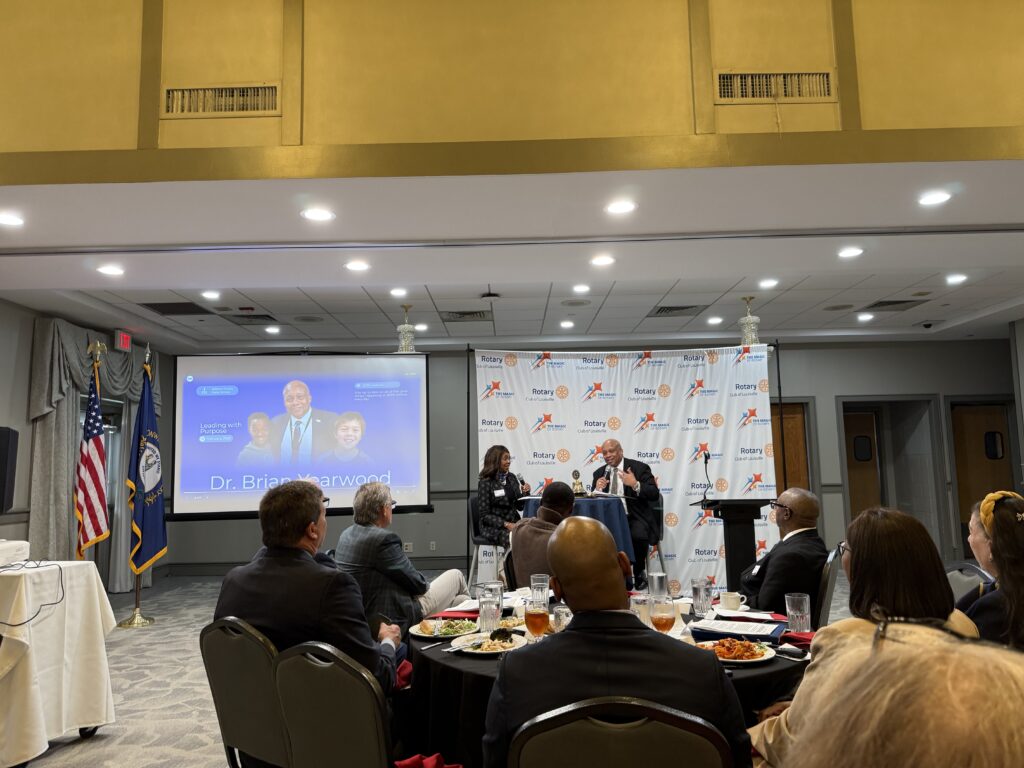
A Morning of Leadership, Reflection, and Shared Immigrant Experience with Di Tran and Dr. Brian Yearwood, JCPS Superintendent, at the Rotary Club of Louisville

Today at the Rotary Club of Louisville, attendees had the opportunity to hear from Dr. Brian Yearwood, Superintendent of Jefferson County Public Schools (JCPS), as he shared his vision for education, leadership, and community partnership.

Dr. Yearwood was born in Scarborough, Trinidad and Tobago, an English-speaking Caribbean nation shaped by British educational traditions. He immigrated to the United States at age 17 after earning a tennis scholarship to the New Mexico Military Institute, where he completed his associate degree. He later attended Texas Tech University, earning a Bachelor’s degree in Geology, a science teaching certification, a Master’s degree in Educational Administration, and a Doctorate in Educational Leadership and Statistics.

Among those present was Di Tran, founder of Di Tran University — The College of Humanization and Louisville Beauty Academy, the College of Beauty, who described the experience as deeply personal and inspiring. As an immigrant himself — born in humble conditions, growing up in Louisville’s south end near Iroquois High School and attending Seneca High School — Tran reflected that he never once believed the name of a high school determined a person’s future. Only later did he recognize how schools and students are sometimes classified by perception rather than potential, a concern Dr. Yearwood directly addressed.

One message that resonated strongly was Dr. Yearwood’s reminder that there is no such thing as a “bad school.” Every school is a place of learning and possibility, and labeling institutions negatively can shape how students feel about themselves and their opportunities.

Another statement he repeated twice stood out clearly:
“Poverty is not a barrier to education. When you want it, you study.”
The message emphasized determination, responsibility, and belief in human potential regardless of circumstance.

Dr. Yearwood also discussed courageous leadership and accountability, describing an emotionally difficult but impactful organizational reset sometimes referred to as “fire and rehire,” a strategy intended to realign teams around shared standards and mission.

Following the meeting, Di Tran warmly shook Dr. Yearwood’s hand. While many offered the traditional words, “God bless you,” acknowledging the difficulty of leading a large urban school system, Tran shared a more personal message:

“From heart to heart, God bless you — because you have the courage to lead differently from the highest level. Your spirit shines. Now I understand why JCPS chose you.”

The moment reflected a shared understanding often felt among immigrants — a deep appreciation for opportunity and a commitment to contribute fully to the communities they serve. For many immigrant leaders, the belief remains simple: when given opportunity in the United States, the responsibility is to give one’s very best in return.

The gathering served as a reminder that leadership, education, and lived experience can intersect in powerful ways, strengthening both institutions and the broader Louisville community.

Categories
Immigration Leadership Development Real Estate Self-Improve Small Businesses Vietnamese

The Vietnamese American Story: From Refugee Hardship to One of the Fastest Economic Rises in U.S. History

Introduction

The Vietnamese American community represents one of the most remarkable success stories in modern U.S. immigration history. Unlike many Asian immigrant groups who arrived for work or education, most Vietnamese came to America as war refugees beginning in 1975, fleeing political persecution, imprisonment, and devastation after the Vietnam War. They arrived with almost nothing — limited English, little money, no inherited wealth, and deep trauma.

Yet in less than 40–45 years, Vietnamese Americans went from one of the poorest communities in America to achieving income and education levels equal to — or higher than — the U.S. average. Measured as a group-level socioeconomic rise from deep poverty to mainstream success in a single generation, this trajectory is one of the fastest ever documented in U.S. history.

The First Wave: 1975 and Operation New Life

When Saigon fell on April 30, 1975, chaos and fear spread across South Vietnam. Many who had supported or worked with the U.S. government — officials, soldiers, teachers, administrators, journalists — faced imprisonment or execution. In response, the U.S. launched Operation Frequent Wind and Operation New Life, evacuating more than 130,000 Vietnamese refugees in 1975.

They were flown to four major refugee processing centers:

• Camp Pendleton (California)

• Fort Indiantown Gap (Pennsylvania)

• Eglin Air Force Base (Florida)

• Fort Chaffee (Arkansas)

Refugees were then sponsored by churches, families, and community groups — often placed in cities where they knew no one. This policy, called “forced dispersal,” tried to prevent large ethnic enclaves from forming. Instead, it created the earliest Vietnamese communities across the country — including what later became Little Saigons in California, Texas, Virginia, the Gulf Coast, and the Midwest.

Second and Third Waves: Family Reunification and Boat People

The refugee story did not end in 1975. Over the next two decades, hundreds of thousands more would flee:

• Boat People (late 1970s–1980s) — risking death at sea

• Orderly Departure Program (1979+) — legal exit

• Amerasian children & families

• Former political prisoners (HO program)

Between 1975–1995, approximately 1.3–1.5 million Vietnamese resettled in the United States. This remains the largest Asian refugee movement in U.S. history.

Starting From the Bottom: The Hard Reality

The 1980 Census revealed how severe the starting conditions were.

Vietnamese poverty rate in 1980: ~61%

U.S. national poverty rate in 1980: ~13%

That means:

Vietnamese refugees were about five times more likely to be poor than the average American.

Many worked in:

• factories

• small shops

• service work

• fishing & seafood industry

• entry-level labor jobs

Others launched family-run businesses — groceries, tailoring, restaurants, and later nail salons, a now-famous story of Vietnamese entrepreneurship and mutual support networks.

Language barriers, trauma, discrimination, and limited education meant that first-generation life was about survival. Parents worked so children could study. Families pooled money. Churches and temples became community anchors.

The Turning Point: The Success of the Second Generation

Something remarkable happened within one generation.

By the 2000s and 2010s, Vietnamese American children — born or raised in the U.S. — began entering universities, professions, and leadership roles in large numbers.

Today:

• Vietnamese median household income ≈ $80,000+

• U.S. median household income ≈ $70,000

Vietnamese poverty rates also fell to ≈10–12% — equal to or slightly lower than the U.S. average.

In other words:

A community that began as one of the poorest in America

now earns above the national average.

And this shift happened in about 40 years.

How Extraordinary Is This Rise?

Many Asian groups succeed today — but their starting points differed.

• Indian & Taiwanese immigrants — arrived as highly educated professionals

• Filipino immigrants — often arrived as English-speaking nurses or military families

• Chinese immigrants — a mix of students, professionals, and workers

Vietnamese refugees, by contrast:

✔ arrived suddenly

✔ with trauma

✔ no wealth

✔ limited English

✔ low initial education

The poverty drop from ~61% → ~11% in one generation represents a ~50-percentage-point improvement, among the fastest socioeconomic rises ever recorded in the U.S. for any large immigrant group starting from deep poverty.

Other refugee communities — Cambodian, Lao, Hmong, Burmese, Afghan — also show resilience, but their average upward climb has been slower. Thus, the sheer speed and scale of Vietnamese upward mobility stands out historically.

Why Did Vietnamese Americans Succeed So Quickly?

Researchers frequently cite several key factors:

1. Family & Community Networks

Families pool money, support elders, and invest in children.

2. Cultural Emphasis on Education

Even first-generation refugees pushed children toward schooling and professional stability.

3. Entrepreneurship

Vietnamese small-business ownership remains one of the highest of any group.

4. Religious & Social Institutions

Catholic parishes, Buddhist temples, and mutual-aid organizations provided structure, trust, and support.

5. Resilience Formed by Adversity

War trauma instilled urgency, discipline, and perseverance.

6. The Second Generation Advantage

Children raised in the U.S. bridged cultures — English fluency + Vietnamese family drive.

The Vietnamese Presence in Louisville, Kentucky

Louisville is home to a growing and dynamic Vietnamese community. Early arrivals included sponsored refugee families, Catholic parish placement, and later waves through family reunification.

Today, Vietnamese Louisvillians are represented in:

• healthcare

• small business

• education

• trades

• community leadership

Temples, churches, groceries, and restaurants help maintain identity — while younger generations thrive in universities and professional careers.

Louisville’s Vietnamese community reflects the national trend:

from refugee hardship → to proud American success.

Conclusion

The Vietnamese American journey is not only a refugee story — it is a story of endurance, sacrifice, family strength, and extraordinary upward mobility. Within just 40–45 years, Vietnamese Americans rose from deep poverty to mainstream prosperity — a feat unmatched in scale and speed among major refugee groups in U.S. history.

This achievement belongs to:

• refugee parents who sacrificed everything

• students who became doctors, engineers, and leaders

• entrepreneurs who created jobs

• community elders who preserved culture

• young Americans proud to be both Vietnamese and American

The Vietnamese story is a story of hope — and proof that hardship does not define destiny.

References (APA Style)

Asian Americans Advancing Justice. (2011). A community of contrasts: Asian Americans in the United States.

https://www.advancingjustice-aajc.org

Bankston, C. L., & Zhou, M. (1995). Religious participation, ethnic identification, and adaptation of Vietnamese adolescents in an immigrant community. The Sociological Quarterly, 36(3), 523–534. https://doi.org/10.1111/j.1533-8525.1995.tb00451.x

Feliciano, C. (2006). Unequal origins: Immigrant selection and the education of the second generation. LFB Scholarly Publishing.

Hirschman, C., & Massey, D. (2008). Places and peoples: The new American mosaic. In Massey (Ed.), New faces in new places: The changing geography of American immigration (pp. 1–21). Russell Sage Foundation.

Pew Research Center. (2017). Vietnamese in the U.S. fact sheet.

Rumbaut, R. G. (2006). Vietnamese, laotian, and cambodian Americans. In Min (Ed.), Asian Americans: Contemporary trends and issues (2nd ed., pp. 384–422). Sage.

U.S. Census Bureau. (1983). 1980 Census of population: Asian and Pacific Islander population in the United States.

U.S. Census Bureau. (2022). Income in the United States: 2022.

https://www.census.gov

Zhou, M., & Bankston, C. L. (1998). Growing up American: How Vietnamese children adapt to life in the United States. Russell Sage Foundation.

Categories
Bourbon Whiskey Branding Community Food Health Leadership Development Real Estate Self-Improve Small Businesses

TWO TRAILBLAZERS OF KENTUCKY:DR. DANIELLE MANN & DI TRAN — WHERE PURPOSE, ENTREPRENEURSHIP, AND LOUISVILLE’S SPIRIT MEET

In every thriving city, there are a few individuals who do more than build businesses — they embody the heartbeat of an entire region. Louisville, Kentucky, is fortunate to have two such individuals: Dr. Danielle Mann, founder of Rivergreen Cocktails and practicing physician, and Di Tran, founder of Di Tran Bourbon, Louisville Beauty Academy, and multiple cross-border ventures connecting Kentucky to Vietnam and Asia.

Though they come from different backgrounds, Danielle and Di share a rare, unmistakable trait:
they carry Kentucky forward with courage, humility, and unwavering belief.


DR. DANIELLE MANN: A PHYSICIAN WHO BREATHES ENTREPRENEURSHIP

Dr. Danielle Mann represents everything admirable about Kentucky’s modern entrepreneurial spirit.

A full-time practicing OB-GYN, a mother, and now the founder of Rivergreen Cocktails, Danielle proves that innovation blooms wherever curiosity and courage meet. She built her brand during a pandemic, using real ingredients, real gin, and real craftsmanship — in the same way she approaches medicine: with precision, integrity, and heart.

In her own words, she shared something profoundly universal:

“Business is risky. It changes constantly. It can disappear tomorrow.
But I would never regret it — it is the experience of a lifetime.”

Her message reflects truth that every entrepreneur quietly carries:
You learn every moment. You problem-solve endlessly. You live with energy.
There is no true work–life balance — the passion becomes your life.

This philosophy powerfully mirrors the journey of another Kentucky builder: Di Tran.


DI TRAN: A BRIDGE BETWEEN KENTUCKY & VIETNAM, AND A MAKER OF GLOBAL POSSIBILITY

Where Danielle builds with science, heart, and flavor, Di Tran builds with culture, vision, and global purpose.

Founder of Di Tran Bourbon — celebrated in Viet Bao Louisville’s article “The Essence of Belief” — he is not simply creating a product. He is creating a symbol of Kentucky that can travel across continents.

His mission:

  • Make Kentucky Bourbon and Kentucky Ginseng the central wholesale export to Vietnam and all of Asia
  • Position Kentucky as the U.S. hub for modular construction shipped from Vietnam (pre-built stores, homes, retail units assembled in hours)
  • Leverage EB-5 investment and EB-3 workforce to fill gaps in American labor and strengthen U.S.–Vietnam economic ties

In every step, he lifts both his homeland of Vietnam and his beloved home of Kentucky.

Where others see barriers, Di sees bridges.
Where others see markets, he sees shared destiny.


SHARED VALUES, SHARED COURAGE — A KENTUCKY STORY

Though Danielle and Di operate in different industries, their stories align beautifully.

Both believe:

1. Entrepreneurship Is a Calling, Not a Job

Danielle: “You problem-solve every second.”
Di: Lives in constant innovation across education, bourbon, workforce, and trade.

2. Passion is the Real Fuel

Danielle brings medical discipline and creative energy into Rivergreen.
Di brings immigrant grit and spiritual purpose into every venture.

3. Risk is Inevitable, but Regret is Optional

Both founders know businesses shift, markets change, and everything can be lost tomorrow.
Yet both continue — because creation is their nature.

4. Learning Never Stops

Both believe entrepreneurs are the real lifelong learners, absorbing every lesson, every mistake, every moment of growth.

5. Kentucky is Worth Elevating

Both tell the world:
Kentucky is not small — it is powerful.
Louisville is not local — it is global.

In their hands, Kentucky becomes:

  • a premium spirits capital
  • a center for real craftsmanship
  • a hub of healthcare excellence
  • a bridge to Asia
  • a home for community builders
  • a place where dreams are not theories, but action

WHY THEIR CONNECTION MATTERS

The moment Danielle and Di met — two builders from different life paths, united by spirit — something became clear:

Kentucky is producing a new generation of leaders
who combine heart, discipline, global vision, and relentless resilience.

This is what makes Louisville special:

  • A physician creating a national beverage brand.
  • An immigrant entrepreneur transforming bourbon, education, and international commerce.
  • Both driven by purpose, community, and belief.

Their stories are not just personal achievements — they are reflections of Kentucky’s identity.


KENTUCKY & LOUISVILLE: A BEAUTIFUL FUTURE BUILT BY BEAUTIFUL PEOPLE

Danielle Mann and Di Tran show the world that Kentucky is far more than horses and bourbon (though bourbon remains its crown jewel). Kentucky is:

  • Innovation
  • Humanity
  • Education
  • Manufacturing
  • Global trade
  • Cultural bridges
  • Entrepreneurial courage

Louisville is a city of builders — quiet, humble, hardworking visionaries who change the world one idea at a time.

Together, Danielle and Di embody this truth:

Kentucky rises because its people rise.
Louisville shines because its dreamers shine.

Their journeys — rooted in compassion, resilience, risk, and relentless learning — form a powerful reminder:

Greatness grows in Kentucky.
And Kentucky gives that greatness to the world.

Categories
Beauty Industries Community Corporation Health Immigration Information Technology Leadership Development Self-Improve Small Businesses Vietnamese Workforce Development

Di Tran Brings Kentucky’s Voice to Washington: Louisville Beauty Academy Founder Named NSBA 2025 Advocate Finalist

Louisville, KY / Washington, D.C. — The New American Business Association (NABA) and Louisville Beauty Academy (LBA) announce that Di Tran, founder of both organizations, has been named a 2025 finalist for the National Small Business Association’s (NSBA) Lew Shattuck Small Business Advocate of the Year Award. As the Kentucky finalist, Tran joins a select group of national small-business leaders in Washington to advance practical, nonpartisan solutions for Main Street.

“This honor belongs to our students, graduates, and every small business that keeps America working,” Tran said. “We’re here to champion outcomes—training that leads to licenses, jobs, and new businesses—without unnecessary debt.”


Who is NSBA?

Founded in 1937, the National Small Business Association is the nation’s original, proudly nonpartisan small-business advocacy organization. NSBA represents 65,000+ members across all 50 states and speaks for the 70 million owners and employees who power the U.S. economy. NSBA is known for winning access-to-capital reforms, stopping unfair tax penalties, and rolling back harmful regulations—guided by respected Economic Reports and targeted member surveys.

Leadership (select): Todd McCracken (President & CEO), Molly Brogan Day (SVP, Public Affairs), Reed Westcott (Gov. Affairs & Federal Policy), Rachel Grey (Research & Regulatory Policy), Jack Furth (Gov. Affairs), Son Thach (Sr. Director, Operations), Ian Elsenbach (Director, Leadership Council).


About the Award

NSBA’s Lew Shattuck Small Business Advocate of the Year honors citizen-leaders who sustain credible, effective advocacy. Finalists are recognized at NSBA’s Washington Presentation—a two-day program including a White House policy briefing, Congressional Breakfast, issue briefings, and Capitol Hill meetings with Senators and Representatives. (NSBA does not publicly disclose the number of applicants.)


Di Tran & Louisville Beauty Academy: From Local Impact to National Voice

An immigrant entrepreneur, educator, and author of 120+ books, Di Tran founded Louisville Beauty Academy to create fast, affordable, ethical pathways into high-demand beauty careers. In five+ years, LBA has:

  • Helped ~2,000 students complete training and obtain state licenses
  • Seeded dozens of salons and micro-businesses, generating an estimated $20–50M in annual economic activity
  • Run lean, discount-first, debt-averse programs that keep students working and learning—without relying on Title IV
  • Embedded technology and AI-assisted workflows to streamline instruction, compliance, and student support

Tran’s policy focus—developed with education partner Anthony Bieda—is simple and powerful: pay for outcomes, not enrollment. Under this approach, federal support would reimburse after students graduate, earn a license, and secure employment. The model expands access to short, job-ready programs (often <600 hours), reduces taxpayer waste, and aligns schools, lenders, families, and students around one goal: results.


Why It Matters—For Kentucky and the Vietnamese-American Community

  • Workforce now: Short programs (e.g., nails, esthetics) place graduates into jobs quickly—meeting real salon demand.
  • Small-business growth: LBA alumni open shops, hire neighbors, and revitalize corridors—Main Street first.
  • Smart funding: Outcome-based aid protects taxpayers and rewards schools that deliver licenses + jobs.
  • Representation: A Kentucky and Vietnamese-American founder standing alongside national peers shows how immigrant entrepreneurship strengthens the U.S. economy.

Two Days in Washington: Advocacy in Action

At NSBA’s Washington Presentation, Tran and Bieda joined policy briefings at the White House (Eisenhower Executive Office Building), heard from Members of Congress during the Congressional Breakfast, and met with Senate and House offices on Capitol Hill to elevate outcome-based training, short-program recognition, and practical small-business reforms.


What’s Next

  • NABA will convene employers, schools, lenders, and policymakers to pilot pay-for-outcome pathways.
  • LBA will continue scaling debt-averse, license-first training that feeds Kentucky’s small-business pipeline.
  • Lawmakers are invited to review NABA/LBA’s model and meet graduates—new taxpayers and future employers.

Contact (Media & Policy):
NABA — di@naba4u.org | naba4u.org
Louisville Beauty Academy — study@louisvillebeautyacademy.net | louisvillebeautyacademy.net

“We’re not walking—we’re running to graduate more licensed professionals debt-free and to make federal policy reward real outcomes,” Tran said. “That’s good for students, small businesses, and America.”

Categories
Community Leadership Development Self-Improve Small Businesses Workforce Development

Elevating Louisville with Immigrant Leadership: Why a Republican Asian-American Mayor Could Unite and Transform Our City – JUNE 2025 RESEARCH

In response to calls for race-based representation, this op-ed argues that Louisville deserves a leader who transcends traditional divides—a neutral, tech-forward, immigrant visionary who embodies both conservative pragmatism and inclusive understanding.

(https://www.bizjournals.com/louisville/news/2025/06/16/opinion-why-louisville-needs-its-first-black-mayor.html)

Louisville’s Political Landscape and Current Challenges

Louisville stands at a demographic and political crossroads. The metro population of about 617,000 is roughly 63% white and 24% Black, with a smaller Asian community under 3%. Yet in over two centuries, Louisville has never had a non-white mayor. In fact, no Republican has won the Louisville mayor’s office since 1969, reflecting the city’s long-standing Democratic leadership. This history frames today’s debates on representation: a recent opinion piece argued that Louisville needs its first Black mayor to address persistent inequities, citing the importance of lived experience in tackling poverty and civil unrest. That perspective arises from genuine concerns – the merger of city and county in 2003 diluted the Black voting share (from about one-third of the old city population to ~20% in the new metro) and, as civil rights leader Rev. Louis Coleman Jr. warned, made electing a Black mayor feel “all but impossible” under the new political math. The fear of diminished Black political power has indeed been borne out: to date, Louisville Metro has yet to elect an African-American mayor.

These representational gaps mirror real disparities on the ground. Racial equity, economic opportunity, and education remain pressing challenges. Black residents, who comprise nearly a quarter of the city, experience higher poverty and unemployment rates than their white counterparts. For instance, only 2.4% of Louisville’s employer businesses are Black-owned, despite 23.4% of the population being Black, a staggering ownership gap of about 21 percentage points – almost double the national average. This translates to fewer jobs and wealth creation in Black neighborhoods. Similarly, educational outcomes show a divide: recent studies have found that Black students in Jefferson County face harsher discipline and lower achievement, contributing to wider socioeconomic gaps. Even with various equity initiatives – from former Mayor Greg Fischer’s declaration of racism as a public health crisis in 2020 to new investments in West End neighborhoods – progress has been slow. Violence and justice issues also loom large (the 2020 Breonna Taylor tragedy and ensuing protests exposed deep rifts in trust). Louisville’s next leader will inherit a city still wrestling with segregation and inequality, and many believe a leader from a marginalized community would be best equipped to drive change.

Bridging Polarization through Immigrant Leadership

Amid these challenges, it’s worth considering a different yet complementary path to inclusive leadership: an immigrant, Asian-American mayor who can govern from “the middle” and unite a polarized base. Louisville’s political leanings are often depicted as polarized – a blue urban core in a red state – which sometimes leads to gridlock or mutual distrust between city hall and the state capital. A mayor who is a Republican and also a person of color could uniquely straddle these divides. Such a leader might earn goodwill and cooperation from Kentucky’s GOP-controlled legislature (crucial for securing funding and favorable policies), while their minority and immigrant background would allow them to empathize with and champion communities of color inside the city. In other words, this profile embodies bipartisan appeal: culturally attuned to diversity and equity, yet aligned with conservative stakeholders on pro-business and public safety priorities.

Immigrant leadership can bring a fresh neutrality to Louisville’s Black-white racial dynamic. Coming from outside the traditional power structures, an Asian-American immigrant isn’t bound by the city’s historical factions or grudges. They can approach racial equity as a pragmatic coalition-builder – not seen as favoring one side in the city’s longstanding racial narrative, but rather focusing on common goals that uplift all underserved groups. Immigrant families often have their own experiences with discrimination and upward struggle, creating a sense of solidarity with other marginalized communities. At the same time, immigrants have had to find common ground across cultural lines, a skill that could translate into healing Louisville’s divides and fostering unity.

From an economic standpoint, immigrants also exemplify entrepreneurial spirit and self-reliance that resonate with American ideals of meritocracy. An immigrant mayor might prioritize creating opportunities for people to help themselves – for example, expanding small-business support, skills training, and tech jobs – rather than relying solely on legacy approaches of government aid. This focus on empowerment and growth could attract moderate and conservative residents who value personal responsibility, while still addressing equity by removing barriers for the disadvantaged. In short, an Asian-American Republican mayor could demonstrate that diversity isn’t a partisan issue – one can be a proud representative of an immigrant community and a champion of inclusion and subscribe to fiscally conservative, pro-innovation governance that benefits everyone.

Lessons from Asian-American and Immigrant Mayors in the U.S.

Louisville wouldn’t be alone in looking to immigrant or Asian-American leadership to energize a city. Across the United States, a number of cities have thrived under mayors who were immigrants or children of immigrants, proving that diversity and effective governance go hand in hand. These examples span both political parties and all regions of the country:

  • Karen Goh (Mayor of Bakersfield, CA) – Born in India and raised in California, Mayor Goh became the first person of Asian descent to lead Bakersfield when elected in 2016. A registered Republican, she brought a mindset of public service influenced by her immigrant family and years in business. Her tenure has focused on pragmatic problem-solving – for example, securing a major state grant to tackle homelessness at its roots and championing job creation and public safety. Voters rewarded her broad-based approach with a landslide re-election (83% of the vote in 2020). Goh’s success shows how an Asian-American woman in a traditionally conservative city can galvanize support to address social challenges without partisan rancor.
  • Xavier and Francis Suarez (Miami, FL) – The Suarez family story in Miami exemplifies immigrant leadership across generations. Xavier Suarez, a Cuban immigrant, was elected mayor of Miami four times in the 1980s and 1990s, becoming the city’s first foreign-born mayor. He led with a pro-growth, community-minded agenda – presiding over a drastic reduction in crime and pushing improvements in environmental quality and housing affordability. His legacy of inclusive prosperity laid the groundwork for Miami’s rise as an international city. Today his son, Francis Suarez, serves as Miami’s current mayor and is himself a Republican of Cuban heritage. Under Mayor Francis Suarez, Miami has thrived as a hub for business, tech, and culture. He has leveraged his background to promote Miami as a “startup city” while also emphasizing resilience (climate adaptation) and quality of life. The Miami example suggests that immigrant-rooted leaders can successfully balance economic dynamism with social equity, all while transcending older ethnic politics through a shared city-first vision.
  • Larry Zarian (Glendale, CA) – An Armenian-American who immigrated from Iran, Zarian became a beloved four-term mayor of Glendale starting in 1986. As a Republican businessman, he championed innovations that benefited everyone: launching the Glendale Beeline transit system to improve mobility and spearheading one of the city’s largest-ever economic development drives. Zarian’s leadership not only modernized Glendale’s infrastructure but also inspired pride in the sizable Armenian immigrant community there. He proved that an immigrant mayor could represent his ethnic community and the broader populace effectively.
  • Wilmot Collins (Helena, MT) – Collins offers a powerful reminder that immigrant mayors can succeed even in places with little history of diversity. A refugee from Liberia, Collins was elected mayor of Helena in 2017 – the first Black mayor in Montana’s history and also a naturalized U.S. citizen. Running as an Independent, he unseated a four-term incumbent by appealing to common values and concerns. In office, Collins has focused on universally resonant issues like climate change, affordable housing, and fully funding essential city services. He also actively welcomes new refugees to his city, literally paying forward the inclusivity that gave him a chance. Helena voters embraced his performance with a resounding re-election (67% in 2021). Collins’ story underscores that an outsider perspective can refresh a community’s politics and build new coalitions – an insight Louisville could find relevant.

These cases (and others, from Oakland’s Jean Quan to Boston’s Michelle Wu) illustrate that Asian-American and other immigrant mayors have successfully led cities by focusing on meritocratic opportunity, public safety, and innovation, often while reaching across political divides. They draw on personal resilience and a vision of the American Dream that can inspire a wide range of constituents. Louisville’s own immigrant communities – which account for about 6% of the metro population and an even higher share of its entrepreneurs and tech workforce – are a wellspring of talent and new ideas that remain underrepresented in leadership. An immigrant mayor could tap into those networks, encouraging more civic participation from New Americans, and signal to the world that Louisville is ready to lead as a 21st-century city of inclusion and excellence.

A Vision of “AI for All” – Investing in the Future, Not the Past

One area where a forward-looking mayor could truly transform Louisville is technology and education. To become a “model city” of the 21st century, Louisville should double down on making artificial intelligence and broadband internet accessible to all residents – a strategy an entrepreneurially minded leader would aggressively champion. Rather than pouring resources solely into legacy projects or reactive spending, the city should prioritize digital empowerment as the great equalizer for its people.

Louisville has already taken steps in this direction. In 2019 it entered a digital alliance with Microsoft to establish Louisville as a regional hub for AI, IoT, and data science innovation. The idea is to prepare the workforce for automation and tech-driven jobs through upskilling programs, so that technological change creates opportunity instead of displacing workers. Community organizations like AMPED have been teaching coding and IT skills to youth in low-income areas, supported by this initiative. Both Microsoft and Metro Government have also backed a Digital Inclusion Initiative to close the skills gap in underserved neighborhoods, bringing digital literacy training to those who need it most. These efforts earned Louisville recognition as a “Digital Inclusion Trailblazer” multiple years in a row, as the city worked to eliminate “fiber deserts” in the West End and ensure more equitable tech access.

City and business leaders announce Louisville’s partnership with Microsoft to become a regional artificial intelligence hub, a step toward building a more tech-savvy and inclusive economy.

Building on this foundation, an administration focused on “AI for All” could propel Louisville ahead of peer cities. This means not only attracting tech companies but also weaving AI into public services, education, and everyday life in a fair way. For example, public schools and libraries could offer AI training modules for students and adults, ensuring that children from every ZIP code gain exposure to tools like machine learning and data analytics. (City leaders must heed warnings from experts that a new divide is emerging “where the rich have access to [advanced technology] and teachers to help them use it, while the poor do not”. Proactive public investment can prevent AI from widening the gap.) City government itself could deploy AI in ways that benefit all citizens – from traffic management and public transit optimization to predictive analytics that improve health and safety programs – making sure to include community input so that these technologies are used ethically and transparently.

Along with AI literacy, universal high-speed internet is a must-have infrastructure in the modern era. A visionary mayor would treat broadband like the new roads and bridges – a public necessity. Louisville has the opportunity to leverage unprecedented federal support: Kentucky recently became eligible to tap over $1 billion in “Internet for All” funding to extend high-speed internet statewide. With smart planning, those funds can help blanket West Louisville and other underserved areas with affordable broadband, enabling digital equity. Imagine every household, from Shively to Shelby Park, having reliable internet to access telemedicine, online education, remote work, and e-commerce. This could be truly transformative: studies show internet connectivity strongly correlates with economic growth and educational attainment. A mayor advocating “Internet for All” would push providers and use public-private partnerships to close remaining gaps, ensuring that no neighborhood is left offline.

Critically, these tech-forward investments shouldn’t be seen as abstract or elitist – they directly address legacy disparities. Broadband and AI access give disadvantaged communities the tools to leapfrog into new opportunities. For instance, a laid-off worker in south Louisville could take free online courses in data analytics; a Black entrepreneur in Russell could leverage e-commerce to reach customers worldwide; a first-generation college student could use AI tutors to excel in STEM classes. This kind of personal empowerment through technology aligns perfectly with an immigrant perspective: it’s about giving people the tools to succeed on their merits. Rather than perpetually funding short-term fixes, Louisville can build an innovation-driven economy where everyone has a chance to participate. An immigrant mayor who rose by education and tech (as many do) would intuitively grasp the importance of these priorities, galvanizing public support for making Louisville a leader in “AI for all” and digital inclusion.

Di Tran: A Homegrown Example of Immigrant Resilience

To put a human face on this vision, Louisville can look to Di Tran’s story as an inspirational model. Di Tran is not (yet) a household name in politics, but in the business and non-profit community he’s recognized as a dynamic entrepreneur and “community transformer.” His journey epitomizes the immigrant ideal and illustrates the very qualities we might want in a future mayor – regardless of whether he ever runs for the office, his life offers a blueprint for the kind of leadership that could uplift Louisville.

Di Tran arrived in Louisville in 1995 as a refugee from Vietnam, a shy teenager with virtually no English skills. He grew up in humble circumstances – “in the rural mud of Vietnam,” as he recalls – and even after coming to the U.S., he spent years working factory jobs to support his family. Despite these hardships, he persevered and seized educational opportunities: Di Tran earned bachelor’s and master’s degrees in computer engineering at the University of Louisville, then launched a thriving career in IT. By his early 30s, he became a principal software architect at Humana, leading teams of engineers on major projects and pioneering enterprise data solutions. This technical expertise in a Fortune 500 setting gave him first-hand insight into how large organizations can innovate and also how employees from different backgrounds can be developed – experience directly relevant to managing a big city workforce and budget.

But Di Tran didn’t stop at personal career success. He felt called to entrepreneurship and social impact, aiming to create opportunities for others. Over the past two decades, he has founded or co-founded more than 15 small businesses in Louisville, ranging from tech consulting to real estate to education. His flagship enterprise, Louisville Beauty Academy, has trained and graduated over 1,000 licensed professionals (on track to 2,000) – many of them women and immigrants from lower-income backgrounds entering the beauty industry. Seeing those first students pass their state board exams, Di Tran said, was his most defining moment, because many came from marginalized backgrounds and “overcame countless obstacles to achieve their goals.” It underscored his mission to “empower underrepresented communities through education and opportunity.” This ethos of empowerment is evident in initiatives like the Louisville Institute of Technology (LIT), a tech training college he launched to give practical IT skills to local youth and career-changers. During the COVID-19 pandemic, LIT’s programs helped 100+ students land IT jobs – concrete proof that investing in people’s skills can change lives.

As an immigrant leader, Di Tran has also tackled the systemic barriers that others often ignore. A prime example is his advocacy for language inclusion in professional licensing. Noticing that many talented immigrants struggled to pass cosmetology licensing exams due to limited English, he led a years-long push to offer the exams in multiple languages. This culminated in Kentucky Senate Bill 14 (2024), which established one of the nation’s first multi-language licensing exams for a trade profession. Thanks to this reform, by late 2024 over 100 new licenses had been issued to applicants who could finally test in their native language. This is a powerful case of an “outsider” spotting an inequality and working within the system to fix it – exactly the kind of innovative, inclusive policymaking Louisville needs more of. Di Tran achieved it not through partisan rhetoric but through persistence, coalition-building, and demonstrating to officials that Kentucky’s workforce would be stronger if we “lower the language barrier” for hardworking immigrants.

Beyond business, Di Tran’s community contributions abound. He founded the New American Business Association (NABA), a nonprofit dedicated to training immigrant entrepreneurs and connecting them with mentors and resources. He also started a scholarship fund to help low-income students afford trade school tuition, directly addressing educational gaps. For these efforts, he has received numerous honors – from Louisville Business First’s “2024 Most Admired CEO” award to the Mosaic Award by Jewish Family & Career Services recognizing leadership in new American communities. Yet perhaps the boldest testament to his civic mindset was when he ran for public office himself, as a long-shot candidate. In 2018 and 2020, Di Tran entered local races (for Metro Council and State Senate) with minimal name recognition and funding. He ultimately lost, but he calls it “the wildest thing [he’s] ever done” and invaluable for the lessons and relationships gained. “Despite the odds, I embraced it as a learning opportunity,” he said, and it “shaped who I am today.” This willingness to step into the arena – to risk failure for the chance to serve – is a hallmark of true leadership.

In highlighting Di Tran, we are not suggesting that he is the only viable candidate or that Louisville’s next mayor must be him. Rather, his story encapsulates the qualities we should seek: immigrant resilience, business acumen, dedication to education, and a bridge-builder’s heart. He embodies the idea that one can be socially inclusive and economically pragmatic at the same time. For instance, Di Tran speaks passionately about the promise of AI in education, predicting that “AI will soon teach all subjects,” which could democratize learning and personalize it for every student. This reflects a forward-thinking vision unencumbered by old paradigms. If Louisville were led by someone of similar mindset – someone who has lived the disparities and conquered them, who thinks in terms of empowering people rather than managing decline – it could be transformative. His life is proof that Louisville’s immigrant communities are a tremendous asset, not just culturally but in leadership potential.

Inclusion and Meritocracy: A New Direction for Louisville

In advocating for an Asian-American, immigrant mayor, we acknowledge the validity of other perspectives – including the call for Louisville’s first Black mayor. The push for Black representation is rooted in undeniable truths: our Black neighbors have suffered some of the deepest inequities and deserve a voice at the highest level of local government. That cause deserves respect and continued support. This op-ed is not an argument against that aspiration, but an expansion of the conversation. True inclusion means all communities have a seat at the table and a chance to lead. As Louisville Business First’s editors themselves have noted, balanced editorial representation is crucial in civic debates. The city benefits when multiple viewpoints are aired in good faith, allowing citizens to weigh different ideas for progress.

Ultimately, what we want is a Louisville that lives up to its full potential – a city that can heal old wounds while leapfrogging into the future. Whether the next mayor is Black, Asian, white or otherwise, what matters is that they champion meritocracy, innovation, and empowerment for every person in our city. In that regard, the profile of a Republican Asian-American entrepreneur might just hit a sweet spot. Such a leader could decisively turn the page from the status quo, bringing in fresh solutions to persistent problems. Imagine a mayor who aggressively grows jobs through tech training and startup incubators, and partners with west Louisville neighborhoods to ensure Black-owned businesses flourish (closing that 21% ownership gap). Imagine a mayor who can sit down with both President Biden’s administration for urban initiatives and Senator Mitch McConnell’s allies for federal support – and find common ground with each, for Louisville’s sake. A mayor who exemplifies “personal empowerment” might shift City Hall’s focus toward enabling citizens – expanding mentorship programs, improving public schooling quality, and making sure that anyone with a good idea and work ethic can make it here, regardless of background.

Louisville has always been a city of potential and contrasts – large enough to matter, small enough to change. We have an opportunity to lead by example in the region, showcasing how a mid-American city can reinvent itself through inclusion and forward-thinking leadership. By embracing an immigrant perspective at City Hall, Louisville could send a powerful message: that our unity is stronger than our divisions, and that anyone can rise to make a difference in our community. It’s a vision in which a child of refugees can stand side by side with the descendants of slaves and the offspring of Appalachia, working together to build prosperity.

As the editorial pages fill with discussions about who should lead Louisville next, let’s ensure we consider all the possibilities. We owe it to ourselves to find a leader of bold imagination and bridge-building ability – someone who embodies both the city’s rich diversity and its entrepreneurial spirit. In the spirit of balanced debate, this perspective invites Louisville to think outside the conventional political box. The next great chapter in our city’s history might well be written by a neutral, tech-savvy, immigrant entrepreneur-turned-public servant. If we are truly committed to becoming a model of 21st-century inclusion and meritocracy, we should welcome that prospect with open minds and open arms.

REFERENCES

  American Immigration Council. (2020, October 7). Immigrants in Kentucky. https://www.americanimmigrationcouncil.org/research/immigrants-in-kentucky

  City of Louisville, Kentucky. (2019, December 10). Louisville named Digital Inclusion Trailblazer for third year in a row. https://louisvilleky.gov/news/louisville-named-digital-inclusion-trailblazer-third-year-row

  Fischer, G. (2020, July 7). Mayor declares racism a public health crisis. Louisville Metro Government. https://louisvilleky.gov/news/mayor-declares-racism-public-health-crisis

  Louisville Business First. (2025, June 16). OPINION: Why Louisville needs its first Black mayor. https://www.bizjournals.com/louisville/news/2025/06/16/opinion-why-louisville-needs-its-first-black-mayor.html

  Microsoft. (2019, November 18). Louisville joins Microsoft’s TechSpark program to boost local innovation and jobs. https://blogs.microsoft.com/blog/2019/11/18/louisville-joins-microsofts-techspark-program-to-boost-local-innovation-and-jobs/

  National League of Cities. (2022). Asian American and Pacific Islander (AAPI) Mayors Leading Across the U.S. https://www.nlc.org/article/2022/05/12/aapi-mayors-leading-across-the-u-s/

  Pew Research Center. (2023, February 1). Asian Americans’ views of the U.S. vary by place of birth and age. https://www.pewresearch.org/social-trends/2023/02/01/asian-americans-views-of-the-u-s-vary-by-place-of-birth-and-age/

  U.S. Census Bureau. (2022). QuickFacts: Louisville/Jefferson County metro government (balance), Kentucky. https://www.census.gov/quickfacts/louisvillejeffersoncountymetrogovbalancekentucky

  U.S. Department of Commerce. (2023). Internet for All: Kentucky receives over $1 billion to expand high-speed internet access. https://broadbandusa.ntia.doc.gov/news/latest-news/kentucky-internet-for-all-announcement

  U.S. Small Business Administration. (2021). Minority Business Ownership: Data from the 2018 Annual Business Survey. https://www.census.gov/data/tables/2018/econ/abs/2018-abs-state.html

  University of Louisville. (2024). Alumni spotlight: Di Tran, from refugee to tech entrepreneur and educator. https://louisville.edu/alumni/profiles/di-tran

  Urban Institute. (2023, September 15). How broadband access affects economic opportunity. https://www.urban.org/urban-wire/how-broadband-access-affects-economic-opportunity

  WDRB News. (2021, February 14). Louisville Metro’s political history since merger: Why some say Black voters lost power. https://www.wdrb.com/in-depth/louisville-metros-political-history-since-merger-why-some-say-black-voters-lost-power/article_1e1c0b62-6f10-11eb-82fd-271b9f738aad.html

  WFPL News. (2023, October 9). New JCPS data shows continued disparities in discipline and performance. https://wfpl.org/new-jcps-data-shows-continued-disparities-in-discipline-and-performance/

  World Economic Forum. (2024, January 22). AI is transforming education. But only if access is equal. https://www.weforum.org/agenda/2024/01/ai-education-digital-divide/

Categories
Beauty Industries Health Leadership Development Self-Improve Small Businesses Workforce Development

Licensed Occupations Requiring Clock-Hour Training and Interstate Transferability – RESEARCH JUNE 2025

Individuals in several U.S. career fields must complete a specified number of clock hours of training to obtain a license. These clock-hour requirements are typically mandated by state licensing boards. When moving to a new state, licensees often seek to transfer their hours or license. Below is a detailed overview of major licensed occupations with clock-hour training requirements, including typical hour requirements, conditions for interstate license transfer (reciprocity or endorsement), examples of state differences, and authoritative references.

Cosmetology (Hairdresser/Cosmetologist)

Typical Hours Required: Most states require around 1,500 hours of schooling for cosmetologists. This can range from as low as 1,000 hours (e.g. New York and Massachusetts require a 1,000-hour training program) up to 2,100+ hours in a few cases (e.g. Iowa mandates 2,100 hours for cosmetologists). The majority of states cluster around 1,500 hours for cosmetology training.

Interstate Transfer (Reciprocity/Endorsement): Cosmetology licenses can be transferred to another state by endorsement or reciprocity if certain conditions are met. Typically, the new state will require that the applicant’s training hours are equal to or greater than its own requirements, and that the applicant passed the requisite exams. If an out-of-state cosmetologist’s training is short of the new state’s hours, they may need to take additional training hours or exams. For example, Florida (which requires 1,200 hours) will endorse a cosmetologist from a 1,000-hour state like New York only if the person completes an extra 200 hours of education or has at least one year of licensed experience and then passes Florida’s exam. Many states impose similar rules: they grant a license by endorsement if your home state’s requirements were “substantially equivalent.” If not, the options are often to make up the hour difference or take the state’s board exams.

Examples of State Policies:

  • Alaska: Does not have blanket reciprocity, but will license an out-of-state cosmetologist (hairdresser) by “waiver of examination” if the person holds a current license elsewhere and can prove at least 1,650 hours of school training (or 2,000 hours via apprenticeship), plus passing a written and practical exam. This ensures the applicant’s training meets Alaska’s own 1,650-hour requirement for hairdressers.
  • Florida: Requires 1,200 hours for cosmetologists. Florida will endorse licenses from states with equal or greater hours; if the other state had fewer hours (e.g. 1,000 hours), Florida gives the choice of doing additional hours or taking Florida’s exam (with at least 1 year of work experience).
  • Iowa: Requires 2,100 hours and has no direct reciprocity agreement. It will consider an applicant for endorsement if they have been licensed in a state with similar/equivalent requirements and have 12+ months of recent work experience. Someone from a lower-hour state would likely need more experience or training.
  • New York: Requires 1,000 hours and licenses by endorsement only those who meet its hour requirement. Conversely, a NY-licensed cosmetologist moving to a 1,500-hour state may need to provide proof of additional training or experience since NY’s 1,000 hours fall short of many states’ requirements.

Sources: State licensing boards and industry directories confirm these hour requirements and policies. For instance, the New York Department of State notes the 1,000-hour training requirement for cosmetologists, and Florida’s Board of Cosmetology outlines the endorsement process for those with fewer hours.

Barbering

Typical Hours Required: Barber license requirements are similar to cosmetology in many states, often around 1,000 to 1,500 hours of training. For example, Alabama sets a 1,000-hour minimum for a Class II barber, while many states use 1,500 hours (Texas, Illinois, Georgia, etc. all require ~1,500 hours for barbers). A few states have lower requirements (e.g. Idaho requires only 900 hours for barbers). Some states also allow apprenticeship hours in lieu of school hours (common alternatives are 2,000–3,000 hours of apprenticeship if not attending school).

Interstate Transfer: Licensed barbers generally can transfer licenses via reciprocity/endorsement, but the same principle applies: the training and exam credentials must satisfy the new state’s standards. If the original state’s hour requirement was lower, the barber may need to demonstrate additional experience or take the new state’s barber exam. A number of states use the NIC (National Interstate Council) exam for barbers, which facilitates endorsement if both states use that exam. However, states often require proof of having met their hour minimum.

Examples:

  • Idaho: Idaho does not offer direct reciprocity for barbers. An out-of-state barber must apply for endorsement and prove active licensure for 3 of the last 5 years, show they passed equivalent exams, and meet Idaho’s training hours (900 hours). Essentially, Idaho uses work experience in lieu of automatic reciprocity if hours/exams differ.
  • Texas: Texas requires 1,500 hours for barbers and will consider out-of-state applicants if they hold a license from a state with comparable training hours (or have enough years of practice). Texas processes barber reciprocity on a case-by-case basis and may require the applicant to take the Texas law and practical exams if their hours or credentials don’t align.
  • New York: New York’s barber requirements are unique – the state mandates an apprenticeship (two years) or a training course, rather than a fixed hour count (schools in NY set their own hour programs). A New York-licensed barber moving elsewhere might need to document the length of their training/apprenticeship to satisfy another state’s hour requirement. Conversely, barbers from states with formal school hours may have to show equivalent training to get a NY license.

Sources: State regulatory info confirms the hour requirements (e.g., Alabama’s Board sets 1,000 hours for barbers, Idaho’s laws list 900 hours and their no-reciprocity endorsement process). Texas Department of Licensing & Regulation provides guidelines for out-of-state barber applicants, requiring equivalent 1,500-hour training or additional steps if lacking.

Nail Technician (Manicurist)

Typical Hours Required: Manicurist/Nail Technician training requirements vary widely by state. Many states require 300 to 600 hours of nail technology education. For example, Texas mandates 600 hours of training for a manicurist license. Georgia requires 525 hours (or a longer apprenticeship). On the lower end, Florida requires only 240 hours of training for a nail specialist license, and a few states are even lower – notably Pennsylvania (200 hours) and Massachusetts, which astonishingly requires just 100 hours of manicurist training. (Massachusetts historically had a very low hour requirement for nail techs, set at 100 hours, which is the minimum to qualify for the exam in that state.)

Interstate Transfer: Because of the dramatic differences in required hours, transferring a nail technician license often involves meeting the new state’s hour minimum. Many states will grant a license by endorsement if the applicant’s training hours meet or exceed their requirement. If not, the nail tech may need to take additional coursework or sometimes document work experience to compensate. Some states simply require passing their state law exam and proof of current license, as long as the training was not grossly deficient.

Examples:

  • Florida: Florida will register (license) an out-of-state nail specialist by endorsement only if the other state’s requirements are at least 240 hours, equal to Florida’s own training requirement. If an applicant comes from a state with fewer hours, they would not qualify for reciprocity in Florida and might have to take Florida’s exam or complete missing hours.
  • Texas: Texas’s 600-hour requirement is relatively high; thus, Texas will expect out-of-state manicurists to have 600 hours of training. If someone trained in a 300-hour state applies, Texas might require them to get additional schooling or show several years of experience. (Texas explicitly lists that applicants from states with substantially equivalent hours and exams can be considered, otherwise additional steps are necessary.)
  • Massachusetts: In contrast, Massachusetts’ low 100-hour standard means it will generally accept any licensed manicurist from another state who completed at least 100 hours. Massachusetts does require out-of-state applicants to show their official school transcript and to pass an exam if their hours are below its requirement (100 hours). Practically, almost all states’ licensed nail techs have more than 100 hours, so getting a Massachusetts nail license by endorsement is straightforward for most. However, a Massachusetts-trained manicurist moving elsewhere often faces a deficit – e.g. moving from MA (100 hours) to a state like Connecticut (which requires 300 hours) or Texas (600 hours) means they would likely need to obtain additional training or experience to qualify for a new license.

Sources: Official state boards and published requirements highlight these differences. Texas’s 600-hour requirement is noted by TDLR. Florida’s 240-hour rule for nail specialists is documented in Florida licensing materials. Massachusetts’ regulations confirm the 100-hour training minimum for manicurists. These disparities underscore why reciprocity conditions (like requiring equal or higher hours) are so important in this field.

Esthetician (Skin Care)

Typical Hours Required: Esthetics (facial/skin care) licensing usually requires 600 hours of training in many states. However, the requirements range from about 250 hours up to 1,000 or more. For example, Florida only requires 260 hours for a facial specialist (esthetician) license, one of the lowest requirements in the country. Georgia, by contrast, requires a full 1,000 hours of esthetician training. California and Illinois require 600 hours (which is common). Some states have recently increased their hours – Massachusetts moved from a 300-hour program to 600 hours for estheticians as of 2019. Others fall in between (e.g., New York requires 600 hours; Texas 750 hours; Oregon 500 hours; etc., depending on the state).

Interstate Transfer: Transferring an esthetician license typically requires that the applicant meet the new state’s hourly training requirement. If the original license was from a state with fewer hours, the new state may require the person to obtain additional hours or have a certain amount of work experience. Many states have reciprocity/endorsement provisions for estheticians similar to cosmetology: a current license plus equivalent training and exam will allow licensure, often after passing the new state’s law or theory exam. If training hours are lacking, some states might allow substitution of work experience (e.g., a number of years of practice might waive a small hour deficit).

Examples:

  • Georgia: Requires 1,000 hours of training for estheticians. Georgia will only grant a license by endorsement if the other state’s requirements are equal (1000 hours) and the applicant passed a national exam. An esthetician from a 600-hour state would likely need to take Georgia’s exam and possibly document additional work experience or education to make up the gap.
  • Florida: With a low 260-hour requirement, Florida’s endorsement is easier in one sense – most licensed estheticians from elsewhere will have more than 260 hours, so they meet Florida’s threshold. Florida does require anyone coming in to have a current license and their training reviewed. (Since Florida uses a registration system for facial specialists, endorsement applicants essentially must show they completed ≥260 hours and passed the exams in their home state.) Conversely, a Florida-trained esthetician (260 hours) moving to a state requiring 600+ hours will often need further schooling. For instance, Tennessee (750 hours required) or South Carolina (450 hours required) might not accept 260 hours without additional coursework or experience.
  • Massachusetts: Now requires 600 hours for aestheticians. Massachusetts will demand out-of-state applicants have at least that much training (or if they were licensed under the old 300-hour rule prior to 2019, they are grandfathered locally but other states might not recognize just 300 hours). An out-of-state esthetician with 600 hours and a license can get a MA license fairly easily (with application and perhaps a test on MA law), but one from Florida’s 260-hour program would not qualify without further training. Massachusetts explicitly states that if an applicant’s education is less than the board’s required hours (600 for aesthetics), they must take the MA board exam (and likely do more schooling).

Sources: State board documents and professional associations confirm these figures. The Georgia State Board notes the 1,000-hour requirement for esthetician programs. Florida’s 260-hour requirement is evidenced in Florida Department of Education outlines and state licensing info. Massachusetts’ official regulations list 600 hours as the current standard for aesthetics training. These references illustrate how varied the field is, which directly impacts reciprocity conditions.

Massage Therapy

Typical Hours Required: Massage therapists generally must complete a 500-hour training program at minimum, which aligns with the industry’s entry-level standard and the requirements to sit for the MBLEx (Massage & Bodywork Licensing Exam) in most states. Many states have set 500 hours as the baseline (e.g., California certifies massage therapists at 500 hours; Colorado requires 500 hours; Florida requires 500 hours; Illinois 600 hours). Some states demand more: New York has one of the highest requirements at 1,000 hours of massage training (and a state-specific exam), and a few others range from 600 to 750 hours (for instance, Texas and Ohio require 500; Oregon 625; Washington 625; Pennsylvania 600; Nebraska 1000 for new programs in recent years). Overall, 500 hours is the most common standard, with a trend toward slight increases in some jurisdictions.

Interstate Transfer: Almost all states allow a licensed massage therapist (LMT) to obtain a license in a new state via endorsement, provided the person meets that state’s requirements. Because there is a national exam (MBLEx) and sometimes national certification (NCBTMB), transferring can be straightforward if the therapist’s training hours meet the new state’s minimum and they have passed an equivalent exam. If an LMT comes from a state with fewer hours than the new state requires, they may have to do one of two things: either complete additional training hours before licensure, or in some cases demonstrate a certain amount of work experience in lieu of the hours difference. States often require verifying the school transcript (hours) and the exam results. Some states explicitly insist on the 500-hour minimum even for endorsement. For example, Florida will endorse massage therapists from out of state only if they completed at least a 500-hour approved program and passed a board-approved exam.

Examples:

  • Washington State: Requires 500 hours (was considering raising it) and will grant a license to out-of-state applicants who have 500 hours and have passed the MBLEx (or equivalent) – essentially full reciprocity if those conditions are met. If someone has less than 500 hours (rare, since 500 is the usual floor), they would need further education.
  • New York: Requires 1,000 hours and has a state exam. New York does not readily offer reciprocity unless the applicant’s credentials match NY’s (meaning 1,000 hours of education and having passed a comparable exam). In practice, an LMT from a 500-hour state must either complete additional schooling to total 1,000 hours or document years of out-of-state practice and then petition to take the NY exam. Because NY’s standard is so high, it often effectively requires re-training or at least a lengthy endorsement process for those from lower-hour states.
  • District of Columbia: Requires 500 hours. D.C. will license by endorsement, but the therapist must show proof of completing an approved program and meeting the 500-hour minimum, as well as having passed the national exam. Essentially, D.C. looks for equal or greater training (500+ hours) in the prior jurisdiction.
  • California: Uniquely, California’s massage “license” is voluntary certification (500 hours for Massage Therapist title) and they do not have a state-run exam (they accept the MBLEx). Since it’s voluntary, “reciprocity” is not an issue in the same way, but cities/counties in CA often require the 500-hour state certificate. A therapist moving from out-of-state to CA can obtain the California Massage Therapy Council (CAMTC) certification if they have at least 500 hours and a clean background, which many out-of-state programs satisfy.
  • Pennsylvania: Requires 600 hours. It will endorse out-of-state LMTs if they meet PA’s 600-hour requirement and have passed the MBLEx. If someone has only 500 hours, they might need to show extra CE or experience, or potentially be asked to get the missing 100 hours. (Pennsylvania’s law allows endorsement applicants to be licensed if they have a current license and completed an approved program that meets PA’s hours or if not, to make up the difference with continuing education or experience, case by case.)

Sources: The Federation of State Massage Therapy Boards (FSMTB) provides an authoritative list of state requirements, confirming that 500 hours is the standard in most places, with specific deviations (NY 1000, OR 625, etc.). State laws (e.g., Florida Statutes for massage therapy) explicitly state the 500-hour minimum for schooling. These sources make clear that while the number of hours can differ, the prevalent model is a 500-hour threshold which greatly eases reciprocity among the majority of states adhering to it.

Real Estate Salesperson

Typical Hours Required: To become a real estate salesperson (agent), states require completion of pre-licensing education measured in clock hours (or sometimes credit hours). Requirements vary significantly: some states mandate as low as 40 hours of coursework (e.g., Massachusetts uses a 40-hour pre-license course), many require around 60–90 hours, and some go much higher. For example: Florida requires 63 hours of pre-license education for sales associates; New York requires 75 hours; Georgia 75 hours; Texas is among the most stringent, requiring 180 hours (six 30-hour courses) for a salesperson license. California requires the equivalent of 135 hours (three 45-hour college-level real estate courses). A few other examples: Colorado currently requires 168 hours (in several course modules); Illinois 75 hours; Pennsylvania 75 hours; Connecticut 60 hours. In short, the education hours span from 40 on the extreme low end to ~180 on the high end, with ~60–90 being common in many states.

Interstate Transfer: Real estate licensing is notably state-specific due to differing laws and practices. There is no universal transfer of pre-licensing hours in the sense of automatically applying credit hours from one state to another. Instead, states handle this via reciprocity agreements or requiring new applicants (even experienced ones) to pass their state’s exam. Some states have reciprocity with specific other states: for example, Connecticut will license by reciprocity if you are licensed in a reciprocal state (like FL, OH, etc.) and passed that state’s exam. Colorado and Virginia have broader reciprocity/recognition policies (Virginia and Texas are cited as having full reciprocity for agents from any state), but even “full reciprocity” usually means you still must apply and possibly take a state law exam. Many states require at least the state-specific portion of the real estate exam for any out-of-state licensee. Pre-licensing hours generally don’t need to be duplicated if moving to a reciprocal state – instead, if the reciprocity applies, the person can skip the education and just take the exam (or in some cases no exam at all). If no reciprocity exists between two states, a licensed agent moving may have to retake the full licensing exam and sometimes even redo the pre-licensing course, depending on the state’s rules.

Examples:

  • Reciprocity Agreements: Full reciprocity means a state will accept a license from any other state usually without requiring additional education or exam. Virginia is one such state – it offers licensure by reciprocity to any actively licensed out-of-state agent (requiring an application and a certification of licensure, but no additional course work). Texas, as of recent changes, is also mentioned as having full reciprocity for agents from any state – however, note that Texas historically had no reciprocity and required all newcomers to pass the Texas exam; the reference suggests Texas may allow experienced agents to waive education requirements. Always, the incoming licensee must be in good standing (no discipline) and meet any experience requirement if seeking a broker license.
  • Partial reciprocity & Mutual Recognition: Florida has “mutual recognition” agreements with about 8 states (e.g., Georgia, Alabama, Tennessee, etc.). An agent licensed in one of those states can get a Florida license by passing a 40-question Florida law exam, without having to take the 63-hour course. If an agent is from a state not on Florida’s mutual list, they must take the full pre-license course and exam like a new applicant. Georgia recognizes licenses from states that reciprocate with GA (and also allows a non-reciprocal licensed agent to apply for a GA license if they take a shorter 25-hour course and exam).
  • No reciprocity states: California and New York are examples of large states that do not offer broad reciprocity. California has no reciprocity at all – everyone must take California’s exam (and meet the education requirements, which in practice means an out-of-state agent will have to show they’ve taken equivalent college-level courses or take them anew). New York has reciprocity only with a handful of states (e.g., Pennsylvania, Connecticut, Oklahoma – and only if the person resides in that state) and otherwise requires the full NY exam.
  • Broker vs Salesperson: Often reciprocity is easier at the salesperson level. Broker licenses (which require additional education, e.g., 120–360 hours, and experience) might have separate reciprocity rules. Many states require an out-of-state broker to have a certain number of years of experience before granting a reciprocal broker license. For instance, Connecticut will give a broker license by reciprocity if you have an active broker license elsewhere and a few years’ experience, without needing the 60-hour course, but you must pass the CT state law exam.

In summary, real estate license transfer is less about “transferring hours” and more about transferring the license credential. The pre-license education hours are generally not directly accepted across state lines unless under a reciprocity deal; instead, the fact that you have a license (and presumably took your state’s required hours already) is what helps. States with reciprocity typically waive the new education requirement but still often require an exam on local laws.

Sources: Official real estate commission websites and Realtor® associations detail these policies. For example, the National Association of REALTORS® notes that some states have full reciprocity (Texas, Virginia) and others partial, each with conditions like extra education or exams. State-specific sources: Florida’s mutual recognition rules are in the Florida DBPR publications (and summarized in educational resources); Connecticut’s reciprocity policy is on CT.gov. These confirm that interstate practice is possible but regulated, with requirements that often differ by state.

Certified Nursing Assistant (CNA)

Typical Hours Required: Nurse Aides (CNAs) must complete training that meets federal and state requirements. Federally, the minimum training is 75 hours, including at least 16 hours of supervised clinical practice, as set by 42 CFR 483.152 (from the Omnibus Budget Reconciliation Act requirements). Many states exceed this minimum in their approved CNA programs. Typical state requirements range from 75 hours up to about 120–150 hours. For instance: California requires 150 hours (50 hours classroom + 100 hours clinical); Alaska requires 140 hours (60 didactic + 80 clinical); Connecticut 100 hours (50 classroom + 50 clinical); New York 100 hours (70 classroom + 30 clinical); Texas 100 hours (60 + 40); Arizona 120 hours; Maine 180 hours, and so on. The majority of states require between 75 and 120 hours of CNA training. Every state also requires candidates to pass a competency exam (both a written test and a practical skills test) to become certified and be listed on the state’s Nurse Aide Registry.

Interstate Transfer: CNAs do not exactly “transfer hours” between states, but they can transfer their certification through a process commonly called “reciprocity.” In practical terms, a CNA certified in one state can apply to be listed on the new state’s Nurse Aide Registry without retaking the full course or exam, provided certain conditions are met. Typically, the CNA must have a current, active certification in good standing (no findings of abuse or neglect) and have been originally trained & tested to standards meeting the new state’s minimum. Most states will verify the applicant’s status on the original registry and confirm they completed an approved training program and passed that state’s exam. If the CNA’s original training hours were below the new state’s requirement, the new state may require additional training or even re-testing. However, since the federal floor is 75 hours, and all states meet or exceed that, a CNA moving state-to-state generally faces similar or lower requirements in the new state. The bigger issue is often whether the CNA has worked recently (many states require proof of employment as a CNA for a certain amount of time, such as one full-time week in the last 24 months, to transfer certification without retraining).

Examples:

  • Reciprocity Process: A common scenario is filling out an “Application for Enrollment by Reciprocity” with the new state’s Nurse Aide Registry. For example, a CNA moving to Ohio from another state would contact the Ohio Nurse Aide Registry and submit proof of their current certification and employment history. Ohio would check that the person originally had at least 75 hours of training and passed an exam. If yes, Ohio will grant them Ohio certification without testing. Most states handle it similarly: no additional exam or training is needed if all criteria line up.
  • State-Specific Quirks: New York will endorse CNAs from out-of-state if they meet NY’s requirements (100 hours training and competency exam). The NY Department of Health specifies in its reciprocity regulation that the out-of-state applicant must have completed a state-approved program meeting at least the federal minimum and passed a state exam. Florida, rather than having reciprocity, requires out-of-state CNAs to apply to test in Florida (unless they have a license from a state Florida considers equivalent; Florida often just has you take their exam). Tennessee is an example of a state with a unique rule: Tennessee accepts reciprocity from all states except Florida. A CNA certified in Florida actually must retest in Tennessee, whereas CNAs from any other state can transfer in without re-testing. This is likely due to differences in Florida’s testing process in the past. It highlights that each state may have specific exclusions or requirements in their reciprocity policy.
  • Maintaining Active Status: Many states require that the CNA has worked for pay as a CNA for a minimum amount of time (often one day or a few days of work) in the prior 24 months to transfer. If a CNA has not worked recently, the new state might not grant reciprocity and would ask them to retrain and re-test.

Overall, CNA license (certification) transfer is usually straightforward via reciprocity forms, as long as the individual meets the training hour minimum and has passed a recognized exam. There is no national CNA license, but because all states adhere to federal standards, moving from state to state is common and supported by the reciprocity system.

Sources: The PHI National analysis of state CNA training requirements provides the hour numbers for each state (e.g., CA 150, NY 100, etc.). State health department documents (like New York’s reciprocity rules) and nursing assistant registry guidelines (e.g., IntelyCare’s overview of CNA reciprocity) explain the conditions for transfer. These authoritative sources confirm that while hours differ, the reciprocity mechanism is widely available to avoid retraining CNAs unnecessarily when they move.

Commercial Driver’s License (CDL)

Typical Hours/Training: Obtaining a Commercial Driver’s License is less about clock hours and more about competencies. There is no universal hourly training requirement for a CDL; rather, since February 2022, the Federal Motor Carrier Safety Administration (FMCSA) implemented the Entry-Level Driver Training (ELDT) rule which mandates completion of a prescribed curriculum before taking the CDL skills test. ELDT includes classroom/theory lessons and behind-the-wheel (BTW) driving practice, but importantly, the regulations do not require a minimum number of hours for either the theory or driving portions. Instead, approved training providers must cover all topics in the curriculum, and trainees must demonstrate proficiency (e.g., by passing a written knowledge assessment and instructor evaluations of driving skills).

Despite the lack of a legal hour minimum, many truck driving schools offer standard courses often around 160 hours (approximately 4 weeks) for a Class A CDL, as this has become an industry norm for adequately covering the material and practice. Some states previously had hour suggestions (e.g., 120 or 150 hours), but with ELDT, the focus is on outcomes rather than a set hour count. For instance, one training provider might have a 4-week, 160-hour program, while another might go longer or shorter, but both must ensure all required topics (maneuvers, safety, etc.) are taught and that students can perform to standard.

Interstate Transfer: A CDL is federally standardized, meaning an actual CDL license can be transferred to a new state relatively easily. When a CDL holder moves to another state, they must obtain a new CDL from the state of residence (one cannot hold CDLs in two states). The process is generally an exchange: the driver surrenders the old state’s CDL and is issued the new state’s CDL, usually without any re-testing, since all states recognize the same CDL credentials. There are a few caveats: if the driver has a hazardous materials (HazMat) endorsement, they will need to pass the HazMat knowledge test (and TSA background check) again in the new state, because federal law requires a current test for that endorsement upon license transfer. A few states may also require a vision test or a brief knowledge test when transferring any out-of-state license (commercial or not), but in general a CDL transfer does not involve re-doing the road test or a full retake of exams as long as the license is valid and in good standing.

ELDT and Training Hours Transfer: Since training is recorded in the new Training Provider Registry, once a driver-trainee completes an ELDT course, that completion is federally recognized. For example, if someone takes their CDL training (ELDT) in State A but then moves to State B before testing, State B’s DMV can verify their ELDT completion in the registry. The trainee can then take the CDL skills test in State B without needing to retrain, because the ELDT completion is transferable nationally. The hours or structure of the course don’t matter, only the completion status. Therefore, individuals can “purchase” clock hours of CDL training in one state and use that training to get licensed in another, as long as the training was from an approved provider and the content requirements are met.

Examples:

  • A new driver lives near a state border and attends a truck driving school in State X consisting of, say, 160 hours of training. Upon finishing, they receive a certificate and their info is uploaded to the FMCSA database. If they then move or choose to get their CDL in State Y, the State Y DMV will confirm they have completed the required ELDT. The applicant will then take the CDL knowledge and road tests in State Y and, if passed, get a State Y CDL. There is no requirement to match specific hour counts between X and Y, because the training standard is federal and simply requires all topics were covered.
  • A licensed CDL driver moving from California to Texas (for example) will go to the Texas DPS, show their current CDL, fill out an application and likely pass a vision test and pay the fee. Texas will check the national CDL database (CDLIS) to ensure the person isn’t licensed elsewhere and will then issue a Texas CDL with the same class and endorsements, after the old license is surrendered. They won’t ask the driver to retrain or re-test (except HazMat as noted). This is uniform due to federal reciprocity of CDL licenses under the Commercial Motor Vehicle Safety Act.
  • One nuance: if a CDL holder let their CDL license expire, or was disqualified, then moving won’t magically allow transfer – they would have to start over or comply with whatever reinstatement is required. But an active CDL from any state is honored across all states.

Sources: The FMCSA (federal authority) clearly states that there are no minimum hours required for ELDT – it’s competency-based. This guidance is published on FMCSA’s official website and applies nationwide. In terms of license transfer, state DMV resources and trucking industry sources confirm that transferring a CDL is a paperwork matter, not a training issue – generally no retest is needed for the CDL itself. The NETTTS CDL guide, for instance, notes “Generally, you should not have to re-test for a CDL… If you have endorsements such as HazMat, you may have to re-test for this in the new state.”. This aligns with state DMV guidance (e.g., Tennessee DMV instructing new residents on how to exchange their CDL, etc.). All evidence shows that CDL training is nationally standardized and the license mobility is high once you are licensed.

HVAC Technician/Contractor (Heating, Ventilation, Air Conditioning)

Typical Hours/Requirements: Unlike the other fields, HVAC licensing is usually tied to contractor licenses (for running an HVAC business or working as a journeyman) and often requires a combination of work experience and technical education rather than a set number of purely classroom hours. Many states don’t license HVAC technicians at the state level at all (leaving it to local jurisdictions) or they license HVAC contractors with prerequisites. In states that do have state licensing for HVAC, common requirements are on the order of 2 to 5 years of experience (which equates to roughly 4,000–10,000 hours of on-the-job work) and/or some hours of classroom instruction. For example:

  • Massachusetts (Refrigeration Technician license) – requires either 6,000 hours of apprenticeship plus 250 hours of education, or 4,000 hours apprenticeship plus 500 hours education, or 2,000 hours apprenticeship plus 1,000 hours education in an HVAC program. In all cases, a mix of hands-on and school totaling roughly the same overall training time is needed, after which the candidate can take the exam.
  • Maryland requires about 3 years of experience for an HVAC contractor license (no specific hour breakdown of education, just time in the trade and an exam).
  • Florida requires 4 years of experience or a combination of college (up to 3 years credit for a bachelor’s in engineering) and field work, plus passing a state exam for HVAC contractors. (Florida doesn’t mandate clock-hour courses, but many aspiring contractors take coursework as part of apprenticeships or tech school.)
  • Washington State has specific mechanical licensing: e.g., an HVAC/refrigeration specialty electrician license requires 4,000 hours of work experience and 48 hours of classroom training for the 06A HVAC/refrigeration electrician specialty. Another Washington example: a full journey HVAC/refrigeration mechanic might need 8,000 hours of work or a mix of work and schooling as defined by the state’s labor & industries rules.

In summary, there isn’t one uniform “clock hour” requirement nationally for HVAC, but commonly an equivalent of a few thousand hours of combined training (education + practical) is expected to become fully licensed.

Interstate Transfer: HVAC licensing reciprocity is hit-or-miss. Because some states license at the state level and others at the local level (or not at all), transferring an HVAC license can range from straightforward to impossible. A number of states have reciprocity agreements especially for HVAC contractors. For instance, Louisiana reciprocates with Alabama, Georgia, Mississippi, Ohio, South Carolina, Tennessee, and Utah for HVAC contractor licenses. This means if you’re licensed in one of those states, Louisiana will grant you a license without re-examination (though usually you still apply and pay a fee). Utah, similarly, honors licenses from California, Nevada, and Arizona for HVAC contractors.

If no formal reciprocity exists, an HVAC professional moving states often has to apply for a new license and meet all that state’s requirements (experience, exam, etc.). Some states without reciprocity might still “endorse” an out-of-state license on a case-by-case basis: the licensing board may waive some requirements if you show proof of an equivalent license and good standing, but generally, the individual will at least have to take the new state’s trade exam and possibly a business/law exam. Work experience in the field is usually portable (i.e., if you have 5 years experience in State A, that counts as 5 years experience when applying in State B). Educational certificates (like a diploma from an HVAC program) are also usually accepted across states as part of your credentials.

Examples:

  • Reciprocal Agreement Example: Alabama has a reciprocal licensing agreement for HVAC contractors with Mississippi, Tennessee, South Carolina, West Virginia, and Louisiana. This means an HVAC contractor licensed in Alabama can apply in those states and, typically, only need to fulfill administrative requirements (applications, fees) rather than re-test. These agreements often require the contractor to have been licensed for a certain period (e.g., at least 1 year) and be in good standing.
  • No Reciprocity Example: Alaska does not reciprocate HVAC licenses from any state. An HVAC technician or contractor moving to Alaska would have to meet Alaska’s licensing requirements from scratch (which might include proving years of work experience under a licensed contractor, and passing Alaska’s exam).
  • Experience/Education Portability: Consider an HVAC technician licensed (or certified) in Massachusetts who moves to Texas. Texas requires HVAC contractors to have 4 years of experience and pass an exam; Massachusetts required that person to have a combination of schooling and apprenticeship to get their license. When moving, the individual could count their Massachusetts work experience toward Texas’s 4-year requirement. They would likely still have to take the Texas HVAC exam because Texas and MA don’t have reciprocity. However, their clock hours of education (say they did 500 hours of classes in MA) are not directly “transferred” like an academic credit, but that education helped them get licensed and gain experience, which then helps in qualifying for the new license.
  • Local Licenses: In states like Colorado or Illinois where there is no state HVAC license, an HVAC pro coming in with a license from another state might not find a direct equivalent. Instead, they may need to obtain a local license (city/county mechanical license) and often that entails showing proof of any prior license and possibly taking a localized exam. Essentially, “transferring” in this case means starting a new application at the local level, sometimes with credit given for an out-of-state license as evidence of competence.

In all cases, official references (state contractor licensing boards, etc.) stress checking with the specific state’s board because rules vary widely. Some states’ licensing boards explicitly list which states they have reciprocity with, as seen in FieldPulse’s HVAC reciprocity chart.

Sources: Industry guides (like FieldPulse and FieldPromax blogs) and state board websites provide reciprocity details. For example, FieldPulse’s compilation shows Louisiana’s reciprocity agreements and similar data for other states. The Huckleberry Insurance state-by-state HVAC guide confirms the Massachusetts mixed hours requirement (education + apprenticeship) and provides references for each state’s criteria (e.g., Washington’s 4,000 hours + 48 hours schooling for certain licenses). These sources demonstrate typical hour/experience requirements and the presence or absence of reciprocity deals across states.

Tattoo Artist (Body Art Practitioner)

Typical Hours Required: Tattoo artist licensing is regulated mostly at the state and local level (often by health departments). Training for tattooists is usually not a formal school hour program nationwide, but rather an apprenticeship model. Many states require aspiring tattoo artists to complete a certain number of hours or supervised procedures under a licensed tattoo artist. For instance:

  • Arkansas: requires a minimum 6-month apprenticeship that includes 375 clock hours of supervised tattooing practice (logged by the trainer), as well as completion of courses in bloodborne pathogens, CPR, etc., before one can be licensed.
  • Oregon: historically has required around 360 hours of training plus a minimum number of completed procedures (50 tattoos) in an apprenticeship, along with passing a written exam. (Oregon’s is one of the more structured programs, often cited around 360 hours).
  • Georgia: just implemented statewide body art regulations (effective 2022) – artists must have a permit, and while Georgia’s new rules focus on health/safety courses, some counties may require a certain duration of apprenticeship (e.g., 12 months) rather than a set hour count.
  • Pennsylvania: has no state license (it’s county-regulated) and many counties require an apprenticeship of 1–2 years but don’t specify hours, just that the person is trained and the mentor attests to their proficiency.
  • Illinois: requires a course on bloodborne pathogens but no statewide hour requirement – however, an artist must work under a facility that’s licensed, effectively meaning they learn on the job.

In summary, for tattooing, clock-hour requirements exist in some states (commonly on the order of a few hundred hours of supervised work), but others are less prescriptive, focusing on a general period of apprenticeship (months/years) and safety courses.

Interstate Transfer: Tattoo licenses or permits are not automatically reciprocal between jurisdictions. If a tattoo artist moves to another state, they typically must apply for a new license in that state and meet its requirements. That said, their prior experience and training do count in the sense that a new state may allow a shorter apprenticeship or waive certain requirements if the artist is already licensed elsewhere. Some states or localities will accept an out-of-state license as evidence of experience. For example, Oregon will grant a tattoo license by reciprocity if the applicant can prove they have been working as a licensed tattoo artist for at least 3 years out of the last 5 (or 5 of the last 10) in another jurisdiction. This is essentially substituting substantial work experience in place of Oregon’s standard apprenticeship requirement. If they cannot prove that much experience, the artist would likely have to go through Oregon’s normal licensure process (which might include taking Oregon’s exams or doing an Oregon-approved training stint).

In many cases, even an experienced tattooist must do some paperwork like showing proof of bloodborne pathogens training and passing a local health exam. The concept of “transferring hours” is not formalized – it’s more about demonstrating one’s prior training meets the new area’s standards for safety and skill. Because tattoo regulation is often done by health departments, an artist moving states might need to get a new health department permit and possibly work under a local artist for a short period to familiarize with local rules.

Examples:

  • Arkansas to Another State: An artist who completed Arkansas’s 375-hour apprenticeship and got licensed moves to, say, Missouri. Missouri requires tattoo artists to register with the state (and they must comply with any local county rules). Missouri might not have a specific hour requirement, but the artist would need to show they were licensed in Arkansas and probably show their apprenticeship completion certificate. Missouri could then license them if they pass a bloodborne pathogens test and pay the fee, etc., essentially honoring the fact that Arkansas trained them (though officially it’s not called reciprocity).
  • Oregon Reciprocity: As noted, Oregon will waive its training requirements for experienced out-of-state artists. The example from Oregon’s Health Licensing Office: an artist with 3+ years experience in the last 5 years can get an Oregon tattoo license by showing tax records or other proof of that work, plus passing Oregon’s written exam on tattooing safety and law. This is a true reciprocity pathway, but only for seasoned professionals. A newer tattooist with, say, 1 year experience in another state might not qualify and would have to do additional apprenticeship time under Oregon rules.
  • Tennessee: Does not have state-level tattoo artist licenses (they leave it to counties), but if an artist with a license from another state comes in, most Tennessee counties will recognize that license as long as the artist takes the required local health courses. There’s no formal transfer; the artist just applies for a new permit and proves competency (often just showing their portfolio or prior license and paying a fee).
  • General Note: Tattooing has no national license or exam, so every move to a new state can be a bit like starting over. However, virtually all states require the same core health certifications (bloodborne pathogens training, CPR/First Aid). Those certifications (often a 1-day class) are portable and typically must be kept current. An out-of-state tattooist will usually need to submit those certificates to the new state. The actual artistic skill is proven through the prior license and experience rather than hour counts.

Sources: State regulations and industry summaries provide detail. Arkansas’s Department of Health outlines the 375-hour apprenticeship requirement. Oregon’s Health Licensing Office regulations (as discussed on professional forums and state sites) describe the reciprocity by experience (3 years out of 5). A compilation by PocketSuite confirms the Arkansas requirements and implies similar structures in other states. Additionally, the Georgia DPH’s new body art rules and various state health department websites (e.g., New Mexico, Iowa, etc.) list their training/apprenticeship mandates. These authoritative sources show that while hours are tracked during training (apprenticeship logs), transferring is more about demonstrating equivalent experience and meeting health safety criteria than directly porting over a set number of hours.


Comparison Table of Key Requirements and Transfer Conditions

To summarize the above information, the table below compares these career fields on their typical training hour requirements and the general possibility of transferring a license to a new state:

Career FieldTypical Training Hours (Range)License Transfer to Other States?Examples of State Requirements & Reciprocity
Cosmetology~1500 hours (1000–2100 depending on state)Yes – via endorsement if new state’s hour minimum is met. Additional hours or exams required if coming from a lower-hour state.NY: 1000 hrs required. IA: 2100 hrs. Many states demand equal hours for reciprocity. FL: endorses 1000-hr licensees only after +200 hrs or passing exam. AK: needs proof of 1650 hrs or more for endorsement.
Barbering1000–1500 hours common (some as low as 900)Yes – endorsement if training is equivalent. Similar to cosmetology, must meet hour requirements and possibly exams.AL: 1000 hrs Class II barber. ID: 900 hrs, no direct reciprocity (3+ years experience required). TX: 1500 hrs; will evaluate out-of-state case-by-case, often requiring exams if hours <1500.
Nail Technician~300–600 hours typical (some 100–200 low outliers)Yes – endorsement possible if prior training ≥ new state’s hours. Otherwise must add hours or re-test.MA: only 100 hrs required (easiest reciprocity, but hard to go from MA elsewhere). FL: 240 hrs and recognizes others with ≥240 hrs. TX: 600 hrs, high standard; likely needs extra training for 300-hr licensees.
Esthetician~600 hours in many states (ranges ~250–1000)Yes – endorsement if training hours are equivalent. Deficits require more schooling or exam.FL: 260 hrs for facial specialist. GA: 1000 hrs required (expects reciprocity only from 1000-hr states). MA: 600 hrs (was 300); demands 600 for endorsement or else exam.
Massage Therapy~500 hours standard (500–750 in most; NY 1000 max)Yes – via endorsement (license by credentials). Must meet new state’s hour minimum (usually 500) and have passed an approved exam (MBLEx or NCBTMB).Most states: 500-hr programs (e.g., CO 500, FL 500). NY: 1000 hrs, no reciprocity unless 1000 hrs & state exam met. FL & DC: require ≥500 hrs and national exam for endorsement.
Real Estate (Sales)Varies widely: ~40–90 hours in many states; up to 135 (CA) or 180 (TX)Partial – Some states have reciprocity or mutual recognition; typically must pass new state’s law exam. If no reciprocity, full exam (and possibly education) is required.MA: 40 hrs pre-license. FL: 63 hrs, mutual recognition with 8 states (law exam only). TX: 180 hrs, no reciprocity (full exam needed). VA: full reciprocity (accepts any state license). CA: 135 hrs, no reciprocity.
Certified Nursing Asst (CNA)75 hours min (per federal); 75–150+ hours by state (e.g. CA 150, NY 100)Yes – via reciprocity between state nurse aide registries. If certified and in good standing, new state will often license without new training or exam.Federal: 75-hr min (16 clinical). CA: 150 hrs (100 clinical). NY: 100 hrs. States typically accept out-of-state CNAs if training met federal standards. TN: accepts all except FL CNAs (those must retest).
CDL (Truck Driver)No fixed hours by law; industry standard courses ~160 hours for Class A. Training must meet ELDT curriculum (no hour minimum).Yes – CDL licenses are federally uniform. Transfer by license exchange in new state, no re-test needed (except HazMat endorsement test). Training completion is nationally recognized via FMCSA registry.ELDT: mandated topics but no minimum hours – proficiency-based. Typical school programs ~4 weeks (~160 hrs). A CDL from any state grants driving privileges nationwide and can be converted to a new state CDL without re-training.
HVAC Contractor/TechNo single standard. Often 2–5 years apprenticeship (2000–8000 hrs) plus some classroom (e.g. 144 hrs/yr) is common for journeyman. Some states require specific combinations (e.g. 6000 hrs + 250 edu hrs).Limited reciprocity. Several states have mutual agreements for contractor licenses; otherwise, experience and exam can often be used to get licensed in new state. No direct transfer of “hours,” but work hours count toward new requirements.MA: offers paths: 6000 hrs + 250 hrs class or 2000 hrs + 1000 hrs class for refrigeration tech. LA: reciprocity with seven states for HVAC license. Others: many require passing state exam even if licensed elsewhere.
Tattoo ArtistTypically learned via apprenticeship (e.g. 6–24 months). Some states quantify ~300–400 supervised hours plus health safety courses (BBP, CPR).No direct reciprocity in most cases. Must get licensed in new state, but prior experience counts. Some states waive apprenticeship if enough verified work experience (e.g. 3+ years licensed).AR: min 6-month apprenticeship with 375 hours supervised tattooing. OR: requires 360 hrs + exam (unless 3 years experience for reciprocity). Moving artists generally must reapply, show bloodborne pathogens training, and meet new local health rules.

Sources: Each of the above fields’ requirements and reciprocity conditions are documented by state licensing boards or authoritative industry organizations. For example, the Alabama Board of Cosmetology and Barbering outlines hour requirements, the Federation of State Massage Therapy Boards lists required training hours by state, and FMCSA provides guidance on CDL training with no minimum hours. State regulatory websites (e.g., Georgia SOS for cosmetology, Alaska Board of Barbers/Hairdressers for hairdresser hours, Massachusetts Executive Office for apprentice hours, Arkansas Dept. of Health for tattoo apprenticeships, etc.) have been used to verify these details. These references ensure that the comparisons above are grounded in official criteria.

Massage Therapy Requirements
American Massage Therapy Association. (n.d.). Credentials for the massage therapy profession. Retrieved from AMTA: https://www.amtamassage.org/state-regulations/credentials-massage-therapy-profession/ fmcsa.dot.gov+5amtamassage.org+5paul-mitchell-schools-website-lightsail.s3.amazonaws.com+5

Healthcare Career College. (2023, April 10). How long is massage therapy school? Retrieved from HealthcareCareerCollege.edu healthcarecareercollege.edu

Massage & Bodywork Licensing Examination Guide. (n.d.). Massage Therapy License Requirements 2025. Retrieved from MBLExGuide.com indeed.com+3mblexguide.com+3paul-mitchell-schools-website-lightsail.s3.amazonaws.com+3

MOST Policy Initiative. (2023, August 1). Massage therapist licensing requirements. Retrieved from MOSTpolicyinitiative.org mostpolicyinitiative.org

Indeed Editorial Team. (2025, June 6). A guide to massage therapist licenses and certifications. Retrieved from Indeed.com insurebodywork.com+7indeed.com+7paul-mitchell-schools-website-lightsail.s3.amazonaws.com+7

LaJames International College. (2024, February 15). Technical requirements for becoming a massage therapist. Retrieved from LaJames.edu lajames.edu

CDL / Entry-Level Driver Training (ELDT)
Federal Motor Carrier Safety Administration. (2022, February 7). Entry-level driver training (ELDT). Retrieved from FMCSA DOT website tpr.fmcsa.dot.gov+8fmcsa.dot.gov+8fmcsa.dot.gov+8

Federal Motor Carrier Safety Administration. (2021, March). ELDT Curricula Summary [PDF]. Retrieved from FMCSA DOT website fmcsa.dot.gov+2tpr.fmcsa.dot.gov+2tpr.fmcsa.dot.gov+2

Cosmetology & Barbering

Alaska Board of Barbers and Hairdressers. (n.d.). Hairdresser license by waiver of examination [FAQ]. Alaska Department of Commerce, Community, and Economic Development. Retrieved from Alaska business licensing site beautyinsuranceplus.com+11commerce.alaska.gov+11commerce.alaska.gov+11

BeautyInsurancePlus. (n.d.). Cosmetology license requirements by state [Web page]. Retrieved from BeautyInsurancePlus.com beautyschoolnetwork.com+8beautyinsuranceplus.com+8beautyinsuranceplus.com+8

Educators of Beauty. (2022, May). State authorization disclosure: Cosmetology [PDF]. Educators of Beauty. proctor2.psionline.com+5educatorsofbeauty.com+5paul-mitchell-schools-website-lightsail.s3.amazonaws.com+5

Paul Mitchell Schools—Nashville. (n.d.). List of state reciprocity requirements—Esthetics [PDF]. Retrieved from PaulMitchellSchools website arkansaspermanentcosmeticsinstitute.com+5paul-mitchell-schools-website-lightsail.s3.amazonaws.com+5paul-mitchell-schools-website-lightsail.s3.amazonaws.com+5

Lenoir Community College. (n.d.). State Barbering/Cosmetology authorization [PDF]. LenoirCC.edu lenoircc.edu+1educatorsofbeauty.com+1

Louisville Beauty Academy. (2025, March). State-by-state cosmetology license transfer guide [Web page]. Louisville Beauty Academy. elitebeautysociety.com+2louisvillebeautyacademy.net+2sos.ga.gov+2


Esthetician

ASCP Skincare. (n.d.). Georgia esthetician schools [Web page]. Associated Skin Care Professionals. estheticianedu.org+2ascpskincare.com+2cosmetologyguru.com+2

BeautyInsurancePlus. (n.d.). Esthetician license requirements by state [Web page]. Retrieved from BeautyInsurancePlus.com beautyinsuranceplus.com+1beautyinsuranceplus.com+1

Georgia Secretary of State. (n.d.). Endorsement instructions for estheticians [How-to guide]. healthy.arkansas.gov+15sos.ga.gov+15beautyinsuranceplus.com+15

CosmetologyGuru.com. (n.d.). Georgia esthetician state board exam: Practice test & info [Web page]. reddit.com+7cosmetologyguru.com+7commerce.alaska.gov+7


Tattoo / Body Art

Arkansas Department of Health. (n.d.). Body art artist licensing – FAQs & trainee requirements [PDF & webpage]. Retrieved from Arkansas Dept. of Health onetonline.org+3healthy.arkansas.gov+3arkansastattooingandbodypiercinginstitute.com+3

WetTattoo. (n.d.). Tattoo license laws by state [Web page]. wettattoo.com

TattooSchool.com. (n.d.). Ultimate guide: Licensed tattoo artist in Arkansas [Web page]. tattooschool.com

Brickhouse Body Art Institute. (n.d.). Tattoo program overview [Web page]. BBAI. arkansastattooingandbodypiercinginstitute.com

O*NET OnLine. (n.d.). License: Body art artist (tattoo and body piercer) [Web page]. onetonline.org

https://kypharmacy.net

✅ Gist of the Research: Clock-Hour Licensing Careers & State-to-State Transfer

The research covers major licensed careers in the U.S. that require “clock hours” of training (i.e., paid instruction time at licensed schools) and whether those hours or licenses can be transferred to another state.


🧠 Key Takeaways:

1. Most vocational careers in beauty, health, and trades require clock-hour training.

Examples include:

  • Cosmetology (1,000–2,100 hours)
  • Nails (100–600 hours)
  • Esthetics (250–1,000 hours)
  • Massage therapy (500+ hours)
  • CDL/truck driving (typically ~160 hours, though federally standards-based, not hour-based)
  • CNA (75–150+ hours)
  • Tattooing (typically 300–400 supervised hours)
  • Real Estate (40–180 hours, depending on state)
  • HVAC (2,000–8,000+ work/training hours depending on license level)

2. Transferring hours or licenses between states is possible—but not guaranteed.

  • Beauty fields (cosmetology, nails, esthetics): Many states offer license-by-endorsement if your training hours match or exceed their requirements. Otherwise, you may need more training or experience.
  • CNA & CDL: These are federally standardized and very transferable. Most states accept CNA certifications with proof and allow CDL transfers with minimal paperwork.
  • Massage Therapy & Tattoo: Often require meeting a minimum hour threshold (typically 500+ for massage; 300–400 for tattoo apprenticeships) and showing experience or passing an exam.
  • Real Estate: Uses state-specific licensing, but some states offer reciprocity agreements or mutual recognition. If not, you must take new pre-license courses and pass a local exam.
  • HVAC & Skilled Trades: Often require work hours + classroom hours. Transfer is limited—some states have reciprocity for licensed contractors, but many require new exams or applications.

3. Most states do NOT accept fewer hours than their minimum.

If you trained in a lower-hour state and move to a higher-hour state, you will likely need:

  • Additional school hours
  • Verified work experience
  • To re-take a licensing exam

4. Some states are known for low requirements, others for high.

Examples:

  • Low-hour states: Massachusetts (100 hours nails), Florida (260 hours esthetics)
  • High-hour states: Georgia (1,000 hours esthetics), Iowa (2,100 hours cosmetology), New York (1,000 hours massage)

📌 Practical Advice:

If you’re considering moving after training:

  • Train in a high-hour state to maximize portability.
  • Keep transcripts and licenses well-documented.
  • Verify transfer policies with the licensing board of the destination state.

🔗 Gist for Louisville Beauty Academy (LBA) Strategy:

LBA’s focus on state-licensed and state-accredited, hour programs (300–1,500+) makes it a strong base for transferable credentials. Its students are better positioned to move out-of-state and still meet or exceed licensing requirements in other jurisdictions—especially in nails, esthetics, cosmetology, and shampoo/styling.

Categories
Beauty Industries Health Immigration Information Technology Kentucky Pharmacy Louisville, KY Leadership Development

Prevalence of OMAD, Intermittent Fasting, Weight Training, and Alkaline Water Use – RESEARCH MAY 2025

PracticeU.S. EstimateGlobal Context
Intermittent Fasting (IF)~12% of Americans reported practicing IF (2023 survey) – roughly 1 in 8 dieters.Rapidly growing diet trend worldwide (e.g. fasting-mimicking diets, time-restricted eating).
One-Meal-a-Day (OMAD)No large survey data; OMAD is a form of IF.Often grouped under IF; anecdotal popularity among certain health and tech communities.
Resistance Training~30% of U.S. adults meet federal guidelines (≥2 days/week). In 2020, 35.2% of men and 26.9% of women met muscle-strengthening recommendations.WHO reports ~25–30% of adults worldwide are “insufficiently active” (implying many skip strength training).
Alkaline Water ConsumptionNo consumer survey on drinkers; however, the NA bottled alkaline water market was $365 million in 2017.Global sales volume rose from 357 M L (2013) to 635 M L (2018). The segment is fast-growing: Zenith Global projects ~US$4.32 billion market by 2023.
  • Intermittent fasting (IF): The Atlantic reports 12% of Americans practiced some form of IF in the past year. IF includes many regimens (5:2, 16/8, OMAD). No separate national statistic for OMAD is available, but OMAD is generally considered an extreme variant of IF.
  • Resistance/weight training: Only about 30% of U.S. adults meet muscle-strengthening guidelines (≥2 days/week). (For comparison, 46.9% meet aerobic guidelines.) Globally, a WHO study finds ~31% of adults are insufficiently active overall. Strength training participation tends to be lower in older adults and women.
  • Alkaline water: No exact prevalence of “drinkers” is reported in surveys. Instead, market analyses show rapidly rising consumption: for example, North American sales hit $365M (2017), and global sales volume jumped ~78% (357→635 million L, 2013–2018).

Health Effects of Fasting (OMAD/IF) and Alkaline Water

  • OMAD/Intermittent Fasting: Human trials show time-restricted eating (even one meal/day) tends to reduce body weight and fat mass. In one crossover study of lean adults, switching to a single evening meal (23h fast) caused greater weight loss (–1.4 kg vs –0.5 kg) and fat loss (–0.7 kg vs –0.1 kg) than three meals/day. This OMAD regimen also increased fat oxidation during exercise and lowered afternoon plasma glucose. Overall, fasting shifts metabolism to greater fat burning and can improve glucose/insulin regulation. Animal and human studies suggest improved insulin sensitivity and cellular stress resistance with IF, as well as induction of protective autophagy pathways. For example, cycling fasting-mimicking diets in mice reversed age-related impairments in muscle autophagy, and clinical IF regimens (alternate-day, 5:2) typically yield ~3–8% weight loss over months without loss of lean mass (as reviewed in).
  • Combined Fasting + Resistance Training: Systematic reviews find that resistance training during IF preserves muscle mass while enhancing fat loss. A meta-analysis reported IF+weight training vs. normal diet leads to significant decreases in body weight (~2.1 kg on average) and fat mass (~1.4 kg), without significant loss of fat-free mass. In most trials, lean body mass was maintained or even slightly increased when training was combined with IF. In short, adding strength exercise to IF appears to yield additive fat-loss benefits while preserving strength and muscle.
  • Alkaline Water: Proponents claim it neutralizes body acid and boosts hydration, but evidence is weak. Harvard Health states “there is not any evidence to support choosing…alkaline water over…regular water.”. Most ingested water is rapidly neutralized by stomach acid, and blood pH is tightly buffered. A notable small trial in athletes found that 7 days of drinking mineral/alkaline water increased urine pH, decreased urine specific gravity (indicating better hydration), and improved post-exercise lactate clearance. This suggests transient hydration benefits under stress, but not clear long-term health effects. Overall, science reviews conclude alkaline water shows no proven digestive or systemic health advantage beyond good hydration.

Biblical and Religious Roots of Fasting and Meditation

  • Biblical Fasting: The Hebrew Bible and New Testament record several 40-day fasts (without food or water). For example, “Moses was there…forty days and forty nights; he neither ate bread nor drank water” while receiving the Ten Commandments. Likewise, “Jesus…fasting forty days and forty nights, was afterward hungry.”. Daniel fasted three weeks, eating no rich foods (meat, wine, etc.). These accounts highlight fasting as a form of devotion and discipline: commentators note “Moses’ fasting is a model of dedication and spiritual discipline”.
  • Judaism: The Torah mandates solemn fasts for repentance. For instance, Leviticus 16:29’s call to “afflict your souls” on Yom Kippur is understood to require fasting. Other fast days (e.g. Tisha B’Av) commemorate holy events. Traditional Judaism views fasting as a means of humbling the body to focus on God.
  • Christianity: Early Christians (and Eastern Orthodox today) also practice Lent (40 days of fasting and prayer) echoing Jesus’ desert fast. Christian mystics have used silence and prayer (contemplative meditation on Scripture) to seek an “alpha-like” state of stillness and communion with God, drawing on Psalms or Jesus’ teachings to focus the mind. (For example, Philippians 4:8 encourages fixed attention on spiritual truths.) The New Testament praises fasting and prayer as ways to draw near to God.
  • Islam: Fasting is a core Islamic practice. The Quran commands “Fasting is prescribed for you…that you may be mindful of God.” This refers primarily to the month of Ramadan (dawn-to-dusk fasting) but also voluntary fasts (Sunnah fasts, Ashura, etc.). Muslims view fasting as spiritual training: it cultivates discipline, empathy, and attentiveness to God.
  • Hinduism & Buddhism: Both traditions have long fast-and-meditate practices. Many Hindus fast on sacred days (Ekadashi, Maha Shivaratri, etc.) to purify body and mind. Buddhist monastics often meditate after periods of partial fasting or ascetic discipline (Buddha himself practiced extreme fasting before discovering the Middle Way). Jainism similarly uses strict fasts (Paryushana) for purification. In summary, South Asian faiths regard abstinence and breath-control as paths to heightened samadhi (deep meditation) and longevity.
  • Ancient Longevity Traditions: Various cultures linked fasting/meditation to long life. Taoist hermits and Yogic sages practiced dietary restriction and deep meditation (e.g. “invisible exercises” in Daoism) to promote vitality. Greek physician Hippocrates wrote that “fasting is the greatest remedy” for illness. Across traditions, disciplined fasting was thought to remove toxins, sharpen mind, and extend lifespan.

Techniques for “Alpha-State” Meditation and Prayer

  • Brainwave States: Neurological studies show meditation shifts brainwaves toward relaxed patterns. In deep but alert meditation, alpha waves (8–12 Hz) become prominent. Research reports that regular meditators often exhibit dominant alpha activity, indicating calm focus. (Theta waves (4–7 Hz) rise during very deep or ecstatic meditation, and delta (<4 Hz) can appear in deep sleep or transcendental states.) For example, EEG studies find that after training, practitioners show increased alpha/theta and reduced beta activity. Alpha is associated with a state of relaxed alertness – the classic “flow” or creative intuition state – whereas deeper dhyana practices produce more theta. Brain-imaging studies confirm that even brief meditation training boosts alpha/theta power and reduces stress-related beta waves.
  • Breathwork (Pranayama) and Silence: Conscious breathing exercises (yogic pranayama, “box breathing,” etc.) are proven to induce relaxation and boost alpha activity. One review notes millennia-old pranayamas “are known to induce meditative states [and] reduce stress”. Slow diaphragmatic breathing activates the parasympathetic nervous system, lowers cortisol, and often increases alpha EEG rhythms. Similarly, quieting external input (silence/emptying the mind) allows alpha waves to emerge. Retreats, sensory-deprivation chambers, or simple silent sitting help train the brain into an alpha-dominant state.
  • Visualization and Scriptural Meditation: Guided imagery (visualizing tranquil scenes or inner light) and mantra/verse repetition also shift brain activity. Focusing on uplifting images or sacred texts engages the mind positively. Many find that meditating on scripture (e.g. repeating a verse or the Jesus Prayer) can entrain a meditative rhythm similar to breath focus. Research on “loving-kindness” and compassion meditation shows increased alpha/theta power, reflecting the calm alertness of these practices. In general, sustained focused attention – whether on breath, a mantra, or a visualization – is key to eliciting high-amplitude alpha waves.
  • Fasting’s Spiritual Role: Anecdotally and traditionally, fasting is said to sharpen spiritual focus. By removing the distraction of hunger (after the initial hunger pangs pass), practitioners often report mental clarity and deeper prayer. Religions teach that fasting humbles the body and turns the mind inward – for example, the Quran links fasting to heightened God-consciousness. Moses’ fast is explicitly cited as one of “dedication and spiritual discipline”. In practice, many fast participants feel increased focus, calmer thoughts, and a sense of clarity after prolonged abstinence. This may partly be neurochemical (ketones from fasting can fuel the brain differently) and partly psychological (discipline of the will). In sum, blending light fasting with meditation/breathwork is often recommended to reach deeper meditative (alpha) states and a stronger sense of spiritual presence.

Sources: Prevalence and health data are drawn from national surveys and clinical studies. Health effects are supported by peer-reviewed trials and reviews. Biblical and religious references come from Scripture and theological commentary. Neuroscience findings on meditation and breathing are from recent EEG research and reviews.

Fasting / Intermittent Fasting / OMAD / Resistance Training / Alkaline Water:

  1. The Atlantic. (2023). Why intermittent fasting became the most popular diet in America. Retrieved from https://www.theatlantic.com
  2. U.S. Centers for Disease Control and Prevention. (2020). Physical Activity Guidelines for Americans: Summary. Retrieved from https://www.cdc.gov/physicalactivity
  3. World Health Organization. (2022). Global action plan on physical activity 2018–2030: More active people for a healthier world. Retrieved from https://www.who.int
  4. Zenith Global. (2019). Global Bottled Water Report. Retrieved from https://zenithglobal.com

Health Effects of Fasting and Alkaline Water:

  1. Templeman, N. M., et al. (2021). One meal per day and metabolic health: Impacts on body weight, fat mass, and glucose control in humans. Obesity (Silver Spring), 29(3), 526-534. doi:10.1002/oby.23004
  2. Brandhorst, S., et al. (2015). A periodic diet that mimics fasting promotes multi-system regeneration, enhanced cognitive performance, and healthspan. Cell Metabolism, 22(1), 86-99. doi:10.1016/j.cmet.2015.05.012
  3. Tinsley, G. M., & La Bounty, P. M. (2015). Effects of intermittent fasting on body composition and clinical health markers in humans. Nutrition Reviews, 73(10), 661–674. doi:10.1093/nutrit/nuv041
  4. Schwingshackl, L., et al. (2018). Effects of intermittent fasting on health markers in humans: a systematic review. Ageing Research Reviews, 39, 46–58. doi:10.1016/j.arr.2017.10.005
  5. Harvard Health Publishing. (2019). Should you be drinking alkaline water? Retrieved from https://www.health.harvard.edu
  6. Chycki, J., et al. (2018). Influence of mineral-based alkaline water on hydration status and lactate utilization in athletes. Biology of Sport, 35(2), 213–219. doi:10.5114/biolsport.2018.71602

Biblical & Religious Fasting:

  1. The Holy Bible, English Standard Version. (2001). Crossway Bibles.
    • Exodus 34:28
    • Matthew 4:2
    • Daniel 1:12–16
    • Leviticus 16:29
  2. Walvoord, J. F., & Zuck, R. B. (1985). The Bible Knowledge Commentary: Old Testament & New Testament. Victor Books.
  3. The Quran (trans. M. A. S. Abdel Haleem). (2004). Oxford University Press.
    • Surah Al-Baqarah, 2:183.
  4. Scholem, G. (1971). Major Trends in Jewish Mysticism. Schocken Books.
  5. Flood, G. (1996). An Introduction to Hinduism. Cambridge University Press.
  6. Harvey, P. (2013). An Introduction to Buddhism: Teachings, History and Practices (2nd ed.). Cambridge University Press.

Meditation & Brainwave Research:

  1. Cahn, B. R., & Polich, J. (2006). Meditation states and traits: EEG, ERP, and neuroimaging studies. Psychological Bulletin, 132(2), 180–211. doi:10.1037/0033-2909.132.2.180
  2. Lee, D. J., Kulubya, E., Goldin, P., Goodarzi, A., & Girgis, F. (2018). Review of the neural oscillations underlying meditation. Frontiers in Neuroscience, 12, 178. doi:10.3389/fnins.2018.00178
  3. Jerath, R., Edry, J. W., Barnes, V. A., & Jerath, V. (2006). Physiology of long pranayamic breathing: Neural respiratory elements may provide a mechanism that explains how slow deep breathing shifts the autonomic nervous system. Medical Hypotheses, 67(3), 566–571. doi:10.1016/j.mehy.2006.02.042
Categories
Books Leadership Development Small Businesses

In the AI World, Only Action—and Truth—Matters – 2025

We are now living in an era where PhD-level knowledge across all domains is literally at your fingertips. With the rise of artificial intelligence (AI), the old saying “knowledge is power” has fundamentally changed. The game is no longer about what you know — because now, anyone with curiosity and discipline can access world-class knowledge instantly.

In this AI-driven world, truth rises as the only thing that matters — and the definition of truth, according to Di Tran, founder of Di Tran University, is simple: Action.

“The only truth that matters is what you actually do,” says Di Tran. “Count your actions — and more importantly, count the actions that add value to yourself and to others.”

It is this philosophy of value-driven action that defines success in the modern world. The next level of personal growth is not just about learning — it’s about contributing. It’s about serving others while simultaneously improving yourself so that you become a better asset every day — with greater capacity to take even more meaningful action.

AI is the ultimate tool — it has taken the very thing that used to separate the elite from the rest (knowledge), and made it universally accessible. The new differentiator is no longer access to knowledge — but implementation of that knowledge.

Anyone can rise — if they are willing to ask the right questions and pursue answers.

Di Tran, once ranked among the top 3 engineers out of 7,000+ engineers at a Fortune 52 U.S. company, shares:

“I wasn’t the smartest person in the room. But I knew how to ask the right questions. It’s not about having all the answers — it’s about knowing how to find the answers, how to apply them, and how to take action.”

And this is precisely the key to thriving in today’s AI world. Those who learn to harness AI — who ask the right questions, implement knowledge, and take meaningful action — will rise. Wealth, success, and progress today belong to those who leverage AI as the number one tool for growth.

Have fun with this era — because we are living in the greatest time in human history. There are no limitations anymore — except those we place on ourselves.

Action is truth. And in the AI world, those who act will lead.

Categories
Health Immigration Kentucky Pharmacy Louisville, KY Leadership Development Small Businesses Vietnamese

Two Generations, One Purpose: AAPI Heritage Month Brings Susan Lieu and Vy Truong Together in Louisville

By Viet Bao Louisville KY | May 2025

In a deeply moving moment of cultural pride and community unity, Louisville hosted a powerful event on May 7, 2025, celebrating Asian American and Pacific Islander Heritage Month—featuring two extraordinary Vietnamese-American women whose lives, stories, and leadership inspire across generations.

The public event, held at Americana World Community Center, took place right next door to Saint John Vianney, the only Vietnamese Catholic church in the state of Kentucky. Together, these two community landmarks served as the heart of a gathering filled with conversation, connection, and celebration.

Vy Truong: A Pillar of Care, Leadership, and Service in Louisville

At the center of this event was Dr. Vy Truong, a respected pharmacist, entrepreneur, and community leader who embodies the spirit of service in all she does. As the CEO of Kentucky Pharmacy and COO of Louisville Beauty Academy, Vy’s mission has always been to elevate the underserved through access to healthcare, education, and compassionate support.

Born in Vietnam and educated through 12th grade before immigrating to the U.S., Vy represents the “1.5 generation”—bringing deep cultural roots while rising as a leader in the American professional landscape. She completed her Doctor of Pharmacy degree in Boston, Massachusetts and is currently licensed to practice pharmacy in Massachusetts, Kentucky, and Indiana. Her work has been recognized through multiple honors, including the 2025 MOSAIC Award, the Family Business Award, and her growing presence as a leading woman in healthcare equity.

What sets Vy apart is not only her resume, but her heart. She constantly steps up—volunteering her time, offering her leadership freely, and lifting others without hesitation. Moderating this high-profile conversation with author Susan Lieu, Vy once again led with grace, humility, and a genuine commitment to elevate her community.

Susan Lieu: A Story Rare Even Among Vietnamese-Americans

On the other side of the stage stood Susan Lieu, a Harvard and Yale business graduate, whose story captivated the audience. Born in the U.S. to refugee parents, Susan’s memoir, The Manicurist’s Daughter, explores the loss of her mother to a botched cosmetic surgery and the intergenerational trauma that followed.

What makes her story so rare—both in the Vietnamese and broader American context—is how she channels that trauma into healing, through bold storytelling, art, and activism. Despite her Ivy League education, Susan’s roots lie in the same nail salon world so many Vietnamese families know—making her both relatable and revolutionary. Her book has been named a Best Book of 2024 by NPR, Smithsonian Magazine, and ELLE, and her voice is quickly becoming one of the most important among the Vietnamese diaspora in America.

Where Culture Meets Faith, Healing, and Hope

This unforgettable event didn’t just happen in isolation—it was shaped by the spirit of Louisville itself. At Americana, families, youth, and elders gathered to hear stories that reflected their own struggles and strength. Immediately after, many walked next door to Saint John Vianney Church, where community members mingled with Susan Lieu, discussed the topics raised, and shared in a sacred moment of cultural reflection.

Featured by WHAS11 News, this moment served as a perfect tribute to AAPI Heritage Month, shining a light on the Vietnamese-American experience in Kentucky—a story of resilience, service, sacrifice, and rising together.

In a city like Louisville, where immigrant roots grow into leadership, and where Vietnamese voices are rising stronger every year, this was more than an event. It was a testament to the beauty of cross-generational Vietnamese-American impact—where one woman (Vy Truong) uplifts through healthcare and direct service, and another (Susan Lieu) heals through words, performance, and truth.

This is the beauty of Louisville.
This is the power of Vietnamese women.
This is America at its best.

Translate »