Categories
Community Louisville

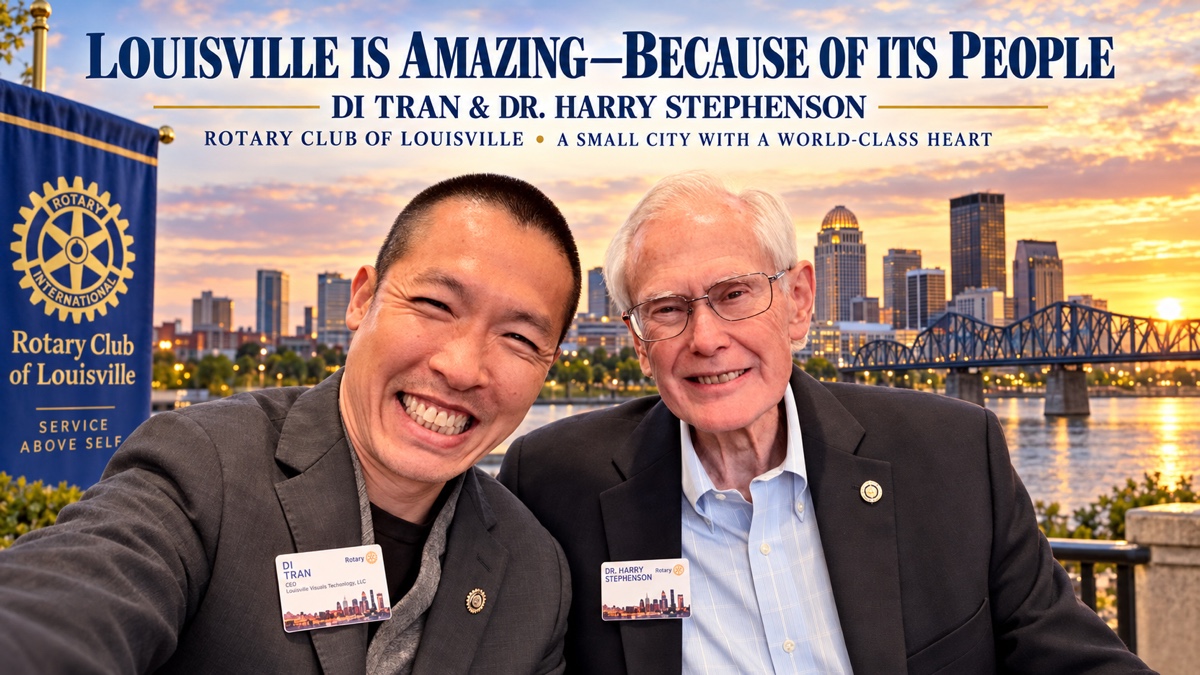
When You Sit Beside Greatness: Dr. Harry Stephenson, Rotary, and the Quiet Brilliance of Louisville

A reflection by Di Tran on proximity, service, education, and the beautiful human frequency of Kentucky

There are moments in life when you look around and quietly ask yourself: How did I get here?

I came to America with a heart full of dreams—dreams of education, knowledge, learning, service, and the possibility of becoming useful to others. I never imagined that one day, in Louisville, Kentucky, I would sit beside people whose lives had helped shape medicine, education, and communities.

Yet there I was, seated beside Dr. Harry C. Stephenson.

Dr. Harry is not a man who needs to announce his accomplishments. His life already speaks.

The University of Louisville documents his 48-year career in ophthalmology. He was a comprehensive ophthalmologist and cataract surgeon who performed Louisville’s first intraocular lens implant in 1974. He began serving as a volunteer faculty member at UofL in 1972, later joined the faculty full-time, and today is recognized among its emeritus faculty. His commitment to teaching continues through the Harry C. Stephenson, M.D. Visiting Professor Lecture Series and the conference center at UofL that bears his name.

In our personal conversation, Dr. Harry reflected on a career encompassing approximately 20,000 or more surgical cases. That lifetime figure is his recollection, not an independently audited count. But even without a number, the verified record is extraordinary: nearly five decades devoted to sight, patients, medicine, teaching, and service.

What moved me most, however, was not a title, a historic procedure, or a career total.

It was his immediate willingness to help.

As I have been learning about and engaging with Healing Hearts Vietnam, we discussed its work to expand access to life-saving cardiac care for Vietnamese families in need. Healing Hearts Vietnam reports that donors have helped fund more than 700 cardiac surgeries. When Dr. Harry heard about the mission, he did not hesitate. He listened, shared his perspective, and helped connect the conversation with cardiovascular expertise in Louisville—people who could understand the need and speak the same language of medicine, compassion, and service.

That is mentorship in its most human form. It is not simply giving advice. It is opening a door, sharing trust, and connecting good people to other good people so that a child or family may have a better chance.

Louisville: A Small City With a World-Class Heart

People sometimes speak of Louisville as a small city. I see something else: a city intimate enough for meaningful relationships and accomplished enough to influence the world.

Louisville’s medical legacy proves it. UofL Health documents more than 40 heart-care firsts, including Kentucky’s first open-heart surgery and first heart transplant, the world’s first AbioCor self-contained artificial-heart implantation, and the world’s first implantation of the Aeson bioprosthetic total artificial heart in a female patient. This is not simply local pride. It is a record of research, courage, teamwork, and lives changed.

Dr. Harry’s own 1974 breakthrough in eye care belongs to that same Louisville spirit: learn deeply, act carefully, serve people, and keep advancing what is possible.

The beauty of Louisville is not only in what has been invented here. It is in how knowledge travels through relationships. A conversation over lunch can become a mentorship. An introduction can become a collaboration. A local connection can someday help a child thousands of miles away.

Rotary and the Architecture of Human Connection

I am especially grateful to the Rotary Club of Louisville for creating a room where these encounters can happen.

Founded in 1912, the club describes itself today as the 12th largest among Rotary International’s more than 45,000 clubs worldwide, with almost 400 members. Those numbers are impressive, but the deeper value is found in Rotary’s ethic of Service Above Self.

Rotary places educators, physicians, entrepreneurs, nonprofit leaders, civic servants, and lifelong learners at the same tables. It allows a person like me—still learning, still building, still dreaming—to sit beside someone like Dr. Harry and discover that true greatness is often gentle, accessible, and generous.

Simply being in a room with people committed to service changes your sense of what is possible. When we repeatedly place ourselves near disciplined, compassionate, knowledge-seeking people, we begin to resonate with the same frequency. Their example invites us to raise our own standards. Their humility reminds us that achievement reaches its highest purpose when it is used for others.

Small Can Mean Agile—and Human

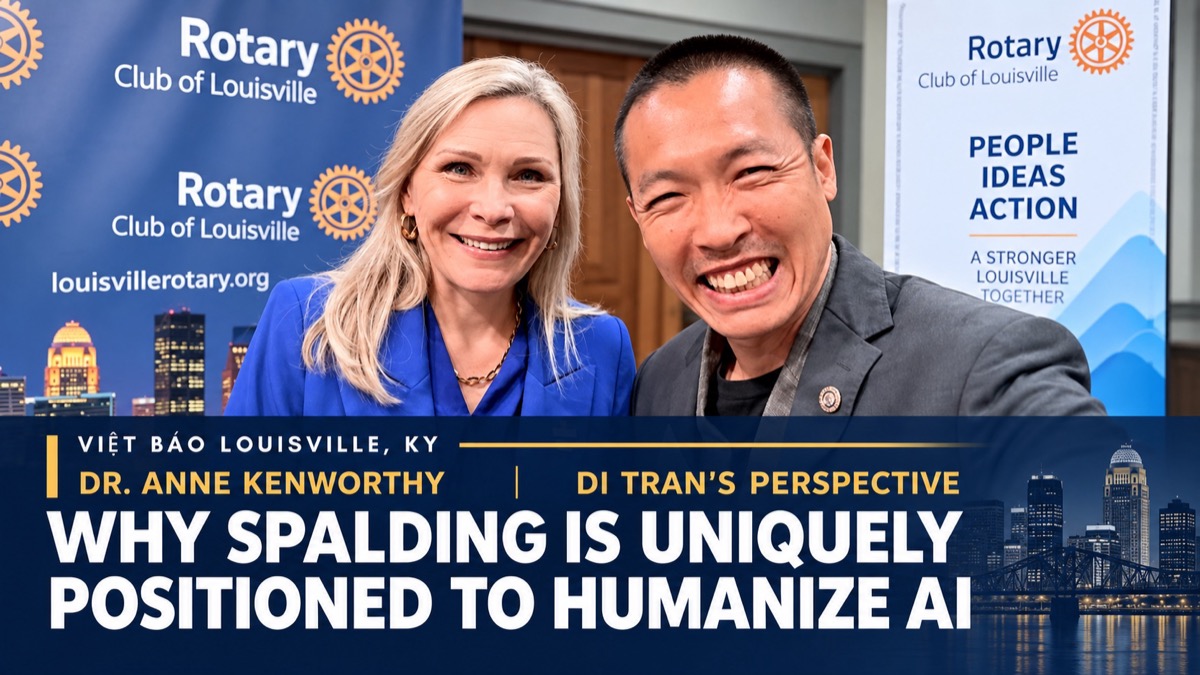
At today’s Rotary gathering, I also had the privilege of listening to Dr. Anne Kenworthy, the president of Spalding University. She spoke about artificial intelligence, education, and the ability of a smaller institution to move with agility in a rapidly changing world.

That message resonated deeply with me.

Spalding has already made AI literacy part of its commitment to students across disciplines, emphasizing responsible and ethical use in service of the greater good. This is the leadership education needs now. The future does not belong only to the biggest institutions or the loudest voices. It belongs to those willing to learn, adapt, remain human, and apply powerful tools responsibly to real problems.

Being small can be an advantage when it allows us to listen closely, decide thoughtfully, move quickly, and care personally. Technology should not make education colder. Properly guided, it can help us make education more accessible, useful, responsive, and human.

In one Rotary gathering, these ideas came together for me: Dr. Kenworthy speaking about agile, human-centered education; Dr. Harry embodying a lifetime of medical excellence and mentorship; Healing Hearts Vietnam working to help families access cardiac care; and Louisville itself standing quietly behind it all—a city with a global history of healing and innovation.

The Beauty of Kentucky Is Its People

I often ask myself what makes Kentucky beautiful.

Yes, it is the landscape, the traditions, and the history. But more than anything, it is the people who choose to serve.

The beauty of Kentucky is sitting next to a physician who has spent a lifetime caring for patients and still makes time to mentor another person.

It is a university president preparing students to meet technological change with ethics and courage.

It is a Rotary table where people from different professions and generations meet not merely to network, but to ask how they can help.

It is a small city with world-class medicine and a heart large enough to reach children in Vietnam.

To Dr. Harry Stephenson: thank you for your kindness, your mentorship, your introductions, and your continuing spirit of service.

To Dr. Anne Kenworthy: thank you for reminding us that agility, education, and human purpose belong together in the age of AI.

To the Rotary Club of Louisville: thank you for building the kind of room where service-minded people can find one another.

And to Louisville and the Commonwealth of Kentucky: thank you for reminding me again that a beautiful life is not measured only by what we achieve. It is measured by the people we learn from, the people we connect, and the lives we help lift.

Sometimes an amazing day begins simply by taking the seat beside you—and realizing that you are surrounded by greatness.


Verified Sources

Editorial note: The approximately 20,000-or-more surgical-case figure is attributed to Dr. Stephenson’s personal recollection as shared with Di Tran; it is not presented as an independently audited institutional statistic.

Categories
Community Education Louisville Technology

Beyond Automation: Why Spalding University Is Uniquely Positioned to Humanize AI—and Help Downtown Louisville Lead

A Rotary Club of Louisville reflection on Dr. Anne Kenworthy, psychology, women-led service, human-centered implementation, and a city-scale opportunity

By Di Tran
September 24, 2026

Today at the Rotary Club of Louisville, I listened to Dr. Anne Kenworthy, Ed.D., MBA, president of Spalding University, speak about an institution that is small enough to move, rooted enough to matter, and courageous enough to confront artificial intelligence as an educational reality rather than a distant possibility.

The official Rotary program gave the address a fitting title: “Spalding University: Meeting the Needs of the Times.” Rotary described a university preparing Kentucky’s healthcare workforce, addressing artificial intelligence, and demonstrating how a smaller institution can act boldly and nimbly. That description is not promotional imagination. It aligns with Spalding’s documented direction: an AI Literacy minor open across disciplines, an Artificial Intelligence for Business concentration, healthcare and human-service programs, and a president who serves on the Kentucky Council on Postsecondary Education’s Task Force on AI, Higher Education, and the Workforce.

I left the room with a realization that felt both new and familiar:

AI is no longer an optional technology project for schools, businesses, or civic organizations. AI implementation is becoming an organizational capability. But implementation without humanization can produce speed without wisdom, automation without trust, and efficiency without dignity.

I use AI systems every day—across education, publishing, operations, research, communication, and business. The more I use them, the clearer the lesson becomes: the future will not belong simply to those who possess the most advanced model. It will belong to those who can combine technology with human judgment, ethical governance, psychological safety, disciplined verification, and real-world application.

That is why what happened at Rotary mattered.

It suggested that Spalding may be standing in a rare strategic position: not merely to teach AI, but to help Louisville build a model of human-centered AI implementation that other institutions and cities could study and adapt.

First, the facts: who is leading Spalding?

Dr. Anne Kenworthy became Spalding University’s 11th president in January 2025. The Rotary Club of Louisville’s official biography describes a leader with 30 years of college teaching experience and prior executive work in enrollment, marketing, strategic initiatives, advancement, adult education, program creation, and philanthropy. Her academic background includes a bachelor’s degree in mathematics, an Ed.D., an M.S., an MBA, and a fundraising-management certificate. Rotary also notes that she helped launch programs for Latino and adult learners, achieved enrollment growth, and secured more than $10 million in philanthropic support before coming to Spalding.

That combination matters. AI transformation requires more than technical fluency. It requires a leader who can understand systems, communicate change, secure resources, widen access, and keep institutional purpose visible while the ground moves.

Spalding’s public record shows that President Kenworthy is already doing more than speaking about AI. She is a member of Kentucky’s official statewide task force examining AI, higher education, and the workforce. Under her presidency, Spalding publicly launched institution-wide AI education initiatives, including:

  • an 18-credit Artificial Intelligence Literacy minor available to undergraduate students across majors;
  • an Artificial Intelligence for Business concentration;
  • coursework in AI for everyone, decision-making, creativity and design, ethics, and the workplace;
  • interdisciplinary application across nursing, education, psychology, business, social work, and the arts; and
  • a curriculum partnership with Rize Education focused on career-aligned programs and practical applications.

Spalding has also published a student-use policy that preserves faculty authority to permit or restrict AI in individual courses and asks faculty to communicate expectations clearly. That is a responsible starting point. The next institutional frontier is to connect course-level discretion to a shared implementation architecture: common literacy, privacy standards, verification practices, human-oversight rules, approved-use cases, assessment redesign, and measurable outcomes.

The name I carried out of the room: Dr. Allison Fowler

President Kenworthy also brought the psychological and educational dimensions of AI into view. The name I left remembering was Dr. Allison Fowler.

Spalding’s official directory identifies Allison Fowler, Ph.D., as Undergraduate Program Director and Assistant Professor in the School of Professional Psychology. Her doctorate is in Educational Psychology, Measurement, and Evaluation from the University of Louisville. Her research and teaching focus on developmental theory, achievement motivation, learning, positive classroom community, and evidence-based pedagogy.

That background is highly relevant to responsible AI adoption.

For accuracy, one boundary must remain explicit: the public Rotary program lists President Kenworthy as the featured speaker but does not list a co-presenter, and Spalding’s public directory does not give Dr. Fowler the formal title of “AI director.” I therefore will not manufacture a title or overstate a role. What can be verified is that Dr. Fowler is a Spalding educational psychologist whose expertise sits directly at the intersection of learning, motivation, measurement, and human development.

The larger insight does not depend on an inflated title. Her discipline itself reveals what many AI initiatives still miss.

AI cannot be implemented by engineering alone

For decades, digital transformation has often been narrated as an engineering problem: build the system, integrate the data, automate the workflow, and train the user. Engineering remains indispensable. Data science, cybersecurity, software architecture, product design, and model evaluation are foundational.

But adoption is not merely technical.

It is psychological.

People ask:

  • Will this tool replace me?
  • Will it make my work visible in ways I cannot control?
  • Can I trust its answer?
  • What happens when it is wrong?
  • Will using it make me less capable?
  • Will refusing it make me irrelevant?
  • Who is accountable when an automated decision harms someone?
  • How do I preserve my identity, craft, relationships, and professional judgment?

These are questions of cognition, motivation, behavior, identity, trust, anxiety, organizational culture, ethics, and power. A technically impressive system can fail if people fear it, misunderstand it, misuse it, or experience it as something imposed upon them. A simple system can succeed when people understand its purpose, help shape its use, see its limits, and retain meaningful authority.

This is why psychology and the human sciences must not be invited at the end of an AI project merely to explain a finished product. They should be present at the beginning—helping define the problem, map human impact, design adoption, test comprehension, identify fear and resistance, protect vulnerable users, evaluate learning, and measure whether the system actually improves human outcomes.

This conclusion is not philosophical decoration. It is consistent with major public frameworks:

  • The National Institute of Standards and Technology treats AI as a sociotechnical system and says trustworthiness depends on technical performance together with social and organizational behavior, context, human oversight, transparency, privacy, safety, fairness, and accountability.
  • UNESCO’s guidance for generative AI in education calls for a human-centered approach that protects human agency, inclusion, equity, cultural diversity, privacy, and age-appropriate use.
  • The U.S. Department of Education has advocated “intelligence augmentation”—people and AI working together—while keeping humans in the loop and centering human decision-making.
  • The American Psychological Association has documented both rapid AI adoption and serious concerns about training, policy, privacy, bias, and harm. Its educational guidance calls for moving from anxiety to agency while keeping humans as meaning-makers.

The answer, then, is not “replace engineers with psychologists.” The answer is a higher-order partnership:

Engineers build capability. Psychologists understand behavior and trust. Educators design learning. Domain professionals define responsible use. Communities identify lived impact. Leaders align purpose and resources. Governance keeps the system accountable.

This is humanization in practice.

Why Spalding is unusually well positioned

Spalding does not need to imitate a technology institute to matter in the AI era. Its greatest advantage may be precisely that it is not one.

1. Its origin is service, especially women-led service

Spalding traces its history to 1814, when the Sisters of Charity of Nazareth established the institution that became Spalding University. It began as the first Catholic school for women west of the Allegheny Mountains. Its namesake, Mother Catherine Spalding, is also remembered as a foundational figure in Louisville social work.

That history is not a sentimental footnote. It is strategic DNA: women organizing institutions, educating people excluded from opportunity, caring for those in need, and building social infrastructure long before “innovation ecosystem” became a business phrase.

Today, when AI raises questions about caregiving, belonging, bias, workforce disruption, safety, identity, and access, that service tradition is not behind the times. It is directly relevant to the times.

2. Its mission already contains the right question

Spalding’s mission is to meet the needs of the times through education grounded in spiritual values, service, peace, and justice. Its public description emphasizes a love for students and the city.

AI implementation needs exactly that kind of purpose test:

  • Whose need are we meeting?
  • Whose burden are we reducing?
  • Whose dignity are we protecting?
  • Who gains access?
  • Who could be harmed?
  • What human capacity becomes stronger after automation?

3. Its disciplines are where AI meets real life

Spalding’s portfolio includes nursing, psychology and counseling, social work, occupational therapy, physical therapy, education, business, health sciences, writing, and other applied programs. These are not peripheral to the AI future. They are where AI will be tested against human reality.

In healthcare, an incorrect or decontextualized output can affect a patient. In psychology, privacy and dependency matter. In social work, automated classifications can affect vulnerable people. In education, AI can either deepen learning or disguise its absence. In writing, it can support creativity or flatten authentic voice. In business, it can increase productivity or scale unfairness.

Spalding therefore has the ingredients for interdisciplinary AI governance and applied learning under one institutional roof.

4. Its size can become an innovation advantage

Large systems can marshal enormous resources, but they often change slowly. A smaller university can convene a cross-disciplinary team, approve a bounded pilot, learn from evidence, correct quickly, and scale what works.

Small does not mean weak. Under disciplined leadership, small can mean close to the learner, short in the decision chain, visible in accountability, and fast in adaptation.

5. It is physically anchored where Louisville needs activation

Spalding describes itself as Louisville’s only downtown university. Its campus sits at the southern edge of the downtown core, near healthcare, government, nonprofit, cultural, residential, and small-business activity.

That location is not merely an address. It is a laboratory.

The opportunity: a Human-Centered AI Downtown Living Lab

Louisville does not need another abstract declaration that it wants to be an “AI city.” It needs a place where students, educators, businesses, healthcare workers, public servants, residents, and technologists can implement useful systems under transparent rules and measure what happens.

Spalding could help convene a Human-Centered AI Downtown Living Lab: a bounded, evidence-driven partnership aligned with existing downtown revitalization priorities and open to participation by universities, employers, Louisville Metro, Louisville Downtown Partnership, healthcare systems, nonprofits, small businesses, and community organizations.

This is a proposal—not an existing Spalding or Rotary commitment—and no endorsement should be implied. But the conditions are real.

Louisville Downtown Partnership’s 10-year strategy focuses on activating downtown, strengthening residential life, improving the public realm, and coordinating public-private projects. Its current data show that downtown occupies less than 1% of Louisville’s land but supports more than 67,000 workers, more than 10,000 residents, 35 million annual visits, and $3.2 billion in announced or active investment. Its project tracker also identifies an emerging downtown Education District and calls for stronger coordination around the Fourth Street and Broadway corridors—precisely Spalding’s geography.

Spalding is already an economic anchor. An Association of Independent Kentucky Colleges and Universities study estimated its local economic impact at $105.4 million for fiscal year 2021–22, using direct and induced spending methodology.

The living lab could convert these assets into measurable implementation.

Pillar 1: AI literacy for every discipline

Build a common foundation for students, faculty, staff, and participating employers:

  • what AI can and cannot do;
  • prompt and workflow design;
  • verification and source discipline;
  • privacy, bias, intellectual property, and security;
  • human decision authority;
  • role-specific applications; and
  • evidence of learning through real work products.

Spalding’s current AI minor and business concentration provide a strong academic base. The next step is a practical literacy layer that reaches every program without pretending every learner must become a software engineer.

Pillar 2: Psychology-led adoption and change design

Create an interdisciplinary adoption team involving educational psychology, clinical psychology, organizational leadership, education, social work, and technology. Before deployment, each pilot should assess:

  • user fears and expectations;
  • cognitive load;
  • accessibility;
  • trust calibration;
  • risk of overreliance;
  • motivation and skill development;
  • effects on professional identity; and
  • whether the system increases or reduces meaningful human contact.

The goal is not blind trust in AI. It is calibrated trust: knowing when to use a system, when to verify it, when to override it, and when not to deploy it at all.

Pillar 3: Human-services application studios

Students and faculty could develop bounded prototypes for real community needs, such as:

  • multilingual navigation of public and nonprofit services;
  • administrative support that returns time to nurses, therapists, teachers, and case workers;
  • accessible educational materials;
  • workforce and career-navigation tools;
  • appointment, reminder, and resource systems;
  • community-health communication; and
  • documentation aids that preserve professional review and confidentiality.

No high-stakes decision should be delegated without validated safeguards, human review, and compliance with applicable privacy and professional rules.

Pillar 4: A downtown small-business AI implementation clinic

National Census data show a practical adoption gap: overall reported business AI use was roughly 17%–20% from late 2025 through early May 2026, while adoption was higher among larger firms and lower among the smallest businesses.

That gap is an economic-development opportunity.

Spalding students and supervised partners could help downtown businesses identify one safe, measurable workflow at a time:

  • customer-service knowledge bases;
  • multilingual communication;
  • inventory and scheduling support;
  • document organization;
  • marketing review;
  • employee training;
  • accessibility improvement; or
  • fraud and error detection.

Each engagement should begin with the question: What specific value are we creating for a real person?

Pillar 5: Education as visible downtown activation

Turn vacant or underused space into public learning:

  • evening AI literacy sessions;
  • student demonstration days;
  • small-business clinics;
  • psychology and trust workshops;
  • responsible-use help desks;
  • youth and adult learner studios;
  • multilingual community sessions; and
  • public exhibitions of verified student work.

This connects AI education to foot traffic, workforce development, community confidence, and the downtown strategy’s goal of activation.

Pillar 6: Transparent governance and public measurement

Use NIST’s Govern–Map–Measure–Manage structure. Every pilot should publish a plain-language record of:

  • the problem being addressed;
  • the people affected;
  • the data used;
  • the human decision-maker;
  • foreseeable risks;
  • prohibited uses;
  • evaluation measures;
  • incident and correction procedures; and
  • results, including failures.

Louisville should not compete to deploy the most AI. It should compete to produce the most useful, trustworthy, replicable, and human-centered implementation.

A practical 12-month pilot

A serious vision needs a sequence.

Months 1–3: Govern and map

  1. Convene a cross-disciplinary steering group.
  2. Select three low-risk, high-value use cases—one in education, one in human services, and one in small business.
  3. Establish privacy, security, accessibility, procurement, disclosure, and human-oversight rules.
  4. Record baseline measures: time, cost, error rate, user satisfaction, stress, access, and learning quality.

Months 4–6: Train and prototype

  1. Train participants in AI literacy, verification, and role-specific use.
  2. Conduct psychological-safety and change-readiness sessions.
  3. Build limited prototypes with no unsupervised high-stakes decisions.
  4. Run red-team tests for bias, hallucination, privacy leakage, accessibility, and misuse.

Months 7–9: Pilot in real settings

  1. Deploy to small, consenting groups.
  2. Maintain human review and incident logging.
  3. Measure whether the tool improves service rather than merely increasing activity.
  4. Collect feedback from users, workers, students, and community partners.

Months 10–12: Evaluate and publish

  1. Compare outcomes with the baseline.
  2. Stop or redesign weak pilots.
  3. Publish results and safeguards in plain language.
  4. Create a replication guide for another Louisville organization or neighborhood.

The scoreboard should include hours returned to human service, verified error rates, user trust, learning gain, cost per successful outcome, number of small businesses assisted, accessibility improvements, and documented cases where human review prevented harm.

My own work reached the same conclusion from another direction

I came to this Rotary meeting not as a neutral observer of AI, but as a daily implementer, educator, software builder, business operator, and author.

Through Di Tran University and the College of Humanization, I have written more than 200 books, including a three-part Humanized AI education framework—a practical humanization blueprint for the student, the teacher, and the school:

  1. The Humanized AI Student: How to Learn, Grow, and Succeed in the Age of Artificial Intelligence
  2. The Humanized AI Teacher: A Complete Blueprint for Transforming Any School—Mindset → Culture → Systems → Implementation → Automation → Humanization
  3. The Humanized AI School Blueprint: A Humanized, Knowledge-Based AI Blueprint for Vocational Training, Trade Schools, Adult Education, Universities, and K–12

Those books argue that technology should not reduce the human role. It should remove mechanical burden so people can contribute more judgment, care, creativity, mentorship, responsibility, and presence.

My more recent research, From Tool Fascination to Value Creation, puts the implementation test plainly: What problem is being solved? What value will success create? Where must human judgment remain primary? What evidence will verify the result? What risks must be controlled?

Today, Spalding’s presentation helped me see an additional dimension with sharper clarity: psychology cannot be downstream from AI implementation. Human understanding must be part of the architecture.

That insight strengthens, rather than competes with, engineering. It makes technical work more adoptable, more accountable, and more useful.

Louisville can lead by becoming more human, not merely more automated

Louisville has world-class healthcare, logistics, manufacturing, education, hospitality, bourbon, arts, nonprofit service, and immigrant entrepreneurship. It also has a downtown undergoing significant reinvestment and an education corridor already identified in the public development strategy.

The city does not need to copy Silicon Valley’s identity. It can build its own.

Louisville can become known as the place where:

  • AI implementation serves ordinary people and small organizations;
  • education produces verified ability, not only credentials;
  • healthcare automation returns time to care;
  • psychology shapes adoption and trust;
  • immigrant and multilingual communities gain access rather than exclusion;
  • students solve real civic and business problems;
  • governance is transparent;
  • failures are documented and corrected; and
  • automation makes human service more available, not less.

That would be technological leadership with a Louisville character: practical, relational, service-oriented, and accountable.

Gratitude—and an invitation

Thank you to Dr. Anne Kenworthy for speaking with urgency and optimism. Thank you to Dr. Allison Fowler for representing the human science that must sit beside technical implementation. Thank you to the faculty, staff, students, trustees, Sisters of Charity of Nazareth, and community partners who carry Spalding’s mission forward.

And thank you to the Rotary Club of Louisville—its officers, program leaders, staff, volunteers, members, and the University Club team—for continuing to create a room where civic ideas can become relationships and where relationships can become service.

Rotary’s value is not only that leaders speak. It is that a community listens, reflects, connects, and acts.

The realization I carried home is simple:

AI may be the most powerful automation technology of our time. Humanization must be the operating system around it.

Spalding University—with its women-led origins, service mission, psychology and human-services expertise, growing AI curriculum, nimble scale, and downtown location—has the ingredients to help Louisville prove what that can mean.

The next step is not another slogan.

It is one governed pilot, one verified outcome, one human problem solved, and one transparent lesson at a time.


Editorial fact-check note

  • Verified: Dr. Anne Kenworthy is Spalding University’s 11th president and began the role in January 2025.
  • Verified: Rotary’s September 24, 2026 program was titled “Spalding University: Meeting the Needs of the Times.”
  • Verified: Dr. Allison Fowler is Spalding’s Undergraduate Program Director and Assistant Professor in the School of Professional Psychology, with a Ph.D. in Educational Psychology, Measurement, and Evaluation.
  • Not independently verified from the public event listing: Dr. Fowler’s exact speaking role at the September 24 Rotary program or any formal title as Spalding’s AI leader. The article intentionally does not assign either claim.
  • Proposal status: The Human-Centered AI Downtown Living Lab is Di Tran’s proposed framework, not an announced program or commitment of Spalding University, Rotary Club of Louisville, Louisville Metro, or Louisville Downtown Partnership.
  • No endorsement implied: The photograph and event attendance do not imply that President Kenworthy, Dr. Fowler, Spalding University, or Rotary endorses Di Tran, Di Tran University, the books, or the proposal.

Primary and authoritative sources

  1. Rotary Club of Louisville — September 24 Meeting Featuring Dr. Anne Kenworthy
  2. Spalding University — Office of the President
  3. Spalding University — Anne Kenworthy directory profile
  4. Spalding University — Allison Fowler directory profile
  5. Spalding University — AI education initiatives
  6. Spalding University Catalog — Artificial Intelligence Literacy minor
  7. Spalding University Catalog — Student Use of Artificial Intelligence
  8. Spalding University — Mission and history
  9. Kentucky Council on Postsecondary Education — Task Force on AI, Higher Education, and the Workforce
  10. NIST — AI Risk Management Framework
  11. NIST — AI risks and trustworthiness
  12. UNESCO — Guidance for generative AI in education and research
  13. U.S. Department of Education — Artificial Intelligence and the Future of Teaching and Learning
  14. American Psychological Association — From anxiety to agency
  15. American Psychological Association — How school psychologists are using AI in practice
  16. Louisville Downtown Partnership — Downtown Development Strategy
  17. Louisville Downtown Partnership — Downtown Investment Map and current indicators
  18. Association of Independent Kentucky Colleges and Universities — Economic Impact Study Results
  19. U.S. Census Bureau — Business AI adoption, December 2025–May 2026
Categories
Business Community Louisville

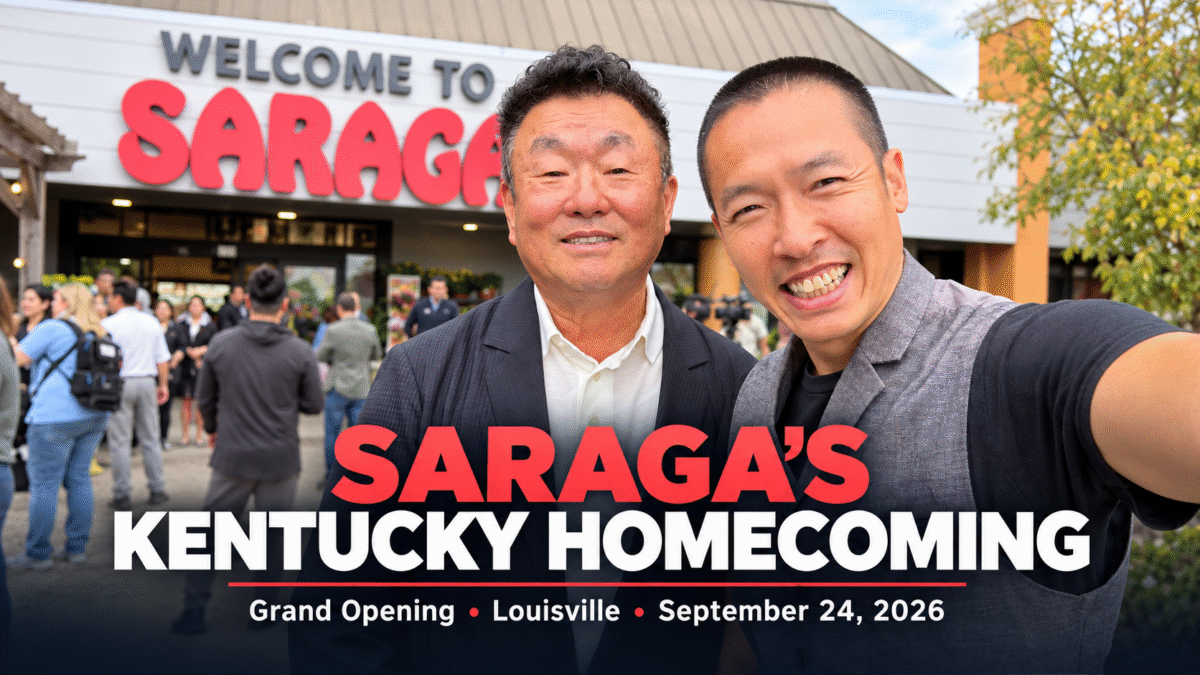
Saraga’s Kentucky Homecoming: From a Truck and Louisville’s Seventh Street to a 34,000-Square-Foot International Market

Viet Bao Louisville proudly republishes this community-business feature from the New American Business Association, celebrating immigrant entrepreneurship and Saraga International Grocery’s first Kentucky location.

LOUISVILLE, Ky. — The grand opening of Saraga International Grocery at 200 N. Hurstbourne Parkway was more than the arrival of another supermarket. For Louisville’s Asian American community—and especially for Korean American families—it was a visible reminder of what can grow from decades of sacrifice, disciplined work, family responsibility, and service to others.

Di Tran, a Louisville serial small-business owner, educator, and immigrant entrepreneur, was proud and honored to attend the opening alongside members of Louisville’s Korean and broader Asian communities. To Tran, the crowded aisles, global food selection, food court, employees, customers, and celebratory gathering represented something much larger than retail. They represented the long arc of immigrant enterprise: beginning small, serving real needs, reinvesting repeatedly, enduring risk, and building an institution that creates opportunity for the next generation.

“To witness a Korean immigrant family turn years of sacrifice, risk, and seven-day work into a beautiful market of this scale is beyond inspiring,” Tran said. “It is a proud day for the Korean community, the Asian American community, Louisville, and Kentucky. This is what it looks like when hard work becomes service, jobs, investment, and a lasting contribution to America.”

A First for Kentucky—and a Return to Earlier Roots

Saraga’s Louisville store is the family-owned company’s first location in Kentucky. The approximately 34,000-square-foot market occupies the former Lucky’s Market space in The Forum Center and carries more than 10,000 foods and goods from cultures around the world. Shoppers can find fresh produce, meat, seafood, pantry goods, frozen items, specialty ingredients, and prepared food offerings, including Korean food. The Louisville store joined Saraga’s three Indianapolis-area and three Columbus-area locations, making it the company’s seventh market location at opening. (WDRB/WAVE; Louisville Courier Journal report)

Yet calling Louisville simply a “new market” would miss an important part of the story. Saraga’s roots already run through Kentucky.

The company’s history says two young Korean brothers began selling food products from a truck in the early 1990s, traveling through Kentucky, Florida, West Virginia, and remote communities. John and Bong Sung opened their first small Saraga grocery in Bloomington, Indiana, in 1994. The name reflects the Korean idea of living or building a life, and the brothers’ stated mission centered on providing the food and goods people need for daily life. (Saraga company history)

Local reporting added an even more personal Louisville connection: before the family entered the grocery business, manager Jun Sung said his father bought and sold wholesale goods along Louisville’s Seventh Street corridor. That history gives the new store the feeling of a homecoming—a family enterprise returning to the city where part of its working life took shape. (WLKY)

From a Modest Truck to a Multistate Family Enterprise

Saraga’s development did not happen overnight.

After the first Bloomington store opened in 1994, the family spent more than a decade learning the business and serving customers. In 2005, it opened a 62,000-square-foot international grocery in north Indianapolis. Additional stores followed in the Indianapolis and Columbus markets. Saraga’s own history acknowledges “trouble and adversity,” failures as well as successes, and a continuing commitment to quality, price, and service. (Saraga company history)

That honesty matters. Entrepreneurship is often celebrated only after the ribbon is cut. The public sees the finished building, bright shelves, full parking lot, cameras, flowers, and smiling faces. It does not always see the years of early mornings, late nights, uncertain cash flow, supplier relationships, leases, construction, permits, hiring, inventory, family tradeoffs, and seven-day workweeks that make an opening possible.

Tran understands that unseen side personally. As a Louisville entrepreneur who has helped build businesses and educational organizations, he recognizes that every expansion represents more than money. It represents risk carried by people: owners who sign commitments, family members who sacrifice time, employees who help build systems, vendors who trust the vision, and customers who decide whether the business will endure.

The Louisville project was reported in 2024 as an approximately $4 million renovation investment. The completed market now restores an approximately 34,000-square-foot grocery space that had been vacant since Lucky’s Market closed in 2020. Saraga has also recruited locally across multiple functions, including cashier, grocery, meat, seafood, warehouse, cleaning, and supervisory work. Because a final public headcount was not available at publication, the opening is best described as creating and supporting local jobs without assigning an unverified number.

Korean-Founded, International in Service

Saraga is deeply rooted in a Korean American family story, but its mission reaches far beyond a single community.

Its shelves bring together products associated with Korea, Japan, China, the Philippines, Indonesia, India, Africa, Latin America, Europe, the Mediterranean, Mexico, Thailand, Vietnam, and the United States. Saraga’s Ohio organization describes the company as a community hub where customers can find “a piece of home,” with products from more than 50 countries. (Saraga vision and mission)

That is why an international grocery store matters in an immigrant city. Food is not merely a product. It carries language, memory, family rituals, health practices, holidays, and belonging. A familiar vegetable, spice, noodle, sauce, grain, or snack can shorten the emotional distance between a family’s present home and the place from which it came.

For longtime Louisville residents, the store is also an invitation to learn. A market like Saraga allows neighbors to encounter one another through everyday life—not through abstraction, but through meals, ingredients, conversations, and shared curiosity. Korean entrepreneurship provides the platform; many cultures are welcomed through the doors.

Small Business Is America’s Economic Foundation

Saraga has grown into a regional chain, but its origin remains a classic small-business story: two brothers, a truck, direct customer service, reinvestment, and gradual expansion.

The national economic context supports Tran’s belief that small businesses are foundational to the United States. The U.S. Small Business Administration’s Office of Advocacy reported in 2026 that America had approximately 36.2 million small businesses, representing 99.9% of U.S. businesses, employing 62.3 million people, and accounting for 43.5% of gross domestic product. (SBA Office of Advocacy)

Those numbers become real in places like Saraga. Capital becomes construction. Empty space becomes an active market. Inventory becomes cultural access. Hiring becomes household income. A family’s private risk becomes a public asset.

The impact also multiplies. A store of this scale supports growers, distributors, importers, logistics providers, contractors, food entrepreneurs, restaurant operators, maintenance teams, and neighboring businesses. Customers who once traveled farther for culturally familiar foods gain a local option. Louisville gains another destination that reflects its increasingly international character.

A Day of Pride—and a Call to Support Builders

For Tran, being present at the grand opening was an act of respect. It was a way to honor the Sung family and the many hands whose labor brought the Louisville store to life. It was also a reminder that immigrant achievement is rarely an individual story alone. Family, employees, customers, community associations, professional relationships, and years of trust all contribute to what the public eventually sees.

“We should celebrate this business not only because it is large and beautiful, but because of what it took to build,” Tran said. “Every shelf represents planning. Every employee represents opportunity. Every customer represents trust. Every family business that survives and grows strengthens the community around it.”

Tran offered his congratulations, prayers, and continued support to John and Bong Sung, the Sung family, Saraga’s employees, the Korean American community, and everyone who helped make the first Kentucky store possible.

The September 24 opening should be remembered as more than a commercial milestone. It is a Kentucky homecoming for an immigrant-founded family enterprise whose earliest routes included this state. It is a major Korean American business achievement. It is a multicultural gathering place. It is a multimillion-dollar vote of confidence in Louisville. And it is living proof that patient, service-centered entrepreneurship can grow from a truck into an institution.

Saraga means living. In Louisville, its newest chapter now lives among us.

Categories
Education Leadership Development Louisville

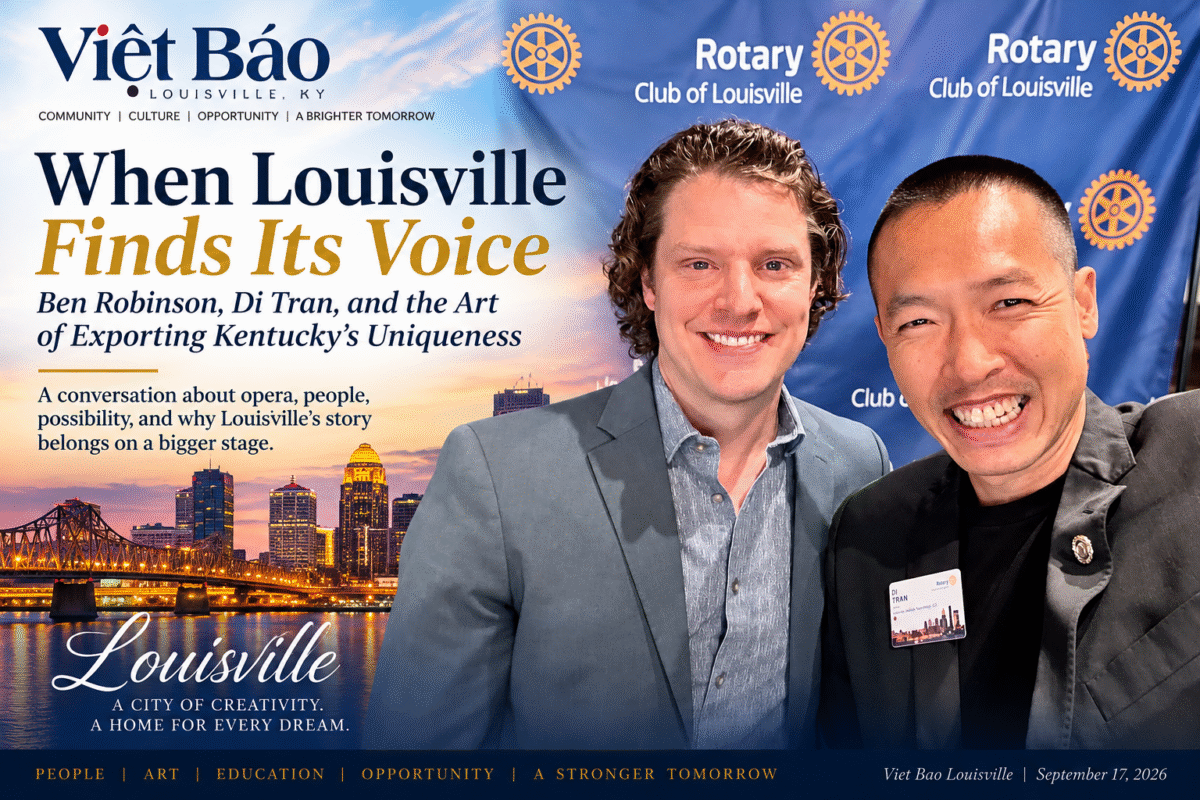
When Louisville Finds Its Voice: Ben Robinson, Di Tran, and the Art of Exporting Kentucky’s Uniqueness

At the Rotary Club of Louisville, a conversation about opera became something larger—a reflection on art, immigration, entrepreneurship, collaboration, civic identity, and the extraordinary things Louisville has already given the world.

Viet Bao Louisville | Louisville, Kentucky | September 17, 2026

Some speeches explain an industry. Others reveal something about a city.

When Ben Robinson, General Director and CEO of Kentucky Opera, addressed the Rotary Club of Louisville on September 17, 2026, his announced subject was “The Future of Opera in Kentucky.”

Opera was certainly at the center of the conversation. But for Louisville entrepreneur, educator and Rotarian Di Tran, who was sitting in the audience, Robinson’s presentation carried a meaning that extended far beyond the stage.

Tran heard something increasingly important for Louisville and Kentucky:

A community should not merely recognize what makes it unique. It should develop that uniqueness, collaborate around it, and have the confidence to share it with the world.

For Tran, an immigrant who has spent much of his adult life building businesses, educational institutions and workforce initiatives in Louisville, the idea felt immediately familiar.

Robinson advocates through opera.

Tran advocates through education, entrepreneurship and service.

Others may do it through music, manufacturing, technology, food, healthcare, skilled trades, athletics or neighborhood leadership.

The instruments are different.

The underlying question is the same:

What does Louisville possess that is worth giving to the world?


An Opera Leader Who Speaks Beyond Opera

Robinson arrived at Kentucky Opera’s highest executive position at an important moment in the organization’s history.

Kentucky Opera announced his appointment as General Director and CEO in November 2025 following a national search. The appointment also represented a return: Robinson had begun his professional career as a Kentucky Opera Studio Artist.

His career has combined artistic creation with institutional leadership. He has worked as a stage director, producer, designer and librettist, while also holding executive roles including General Director of Anchorage Opera and Managing Director of Lyric Fest in Philadelphia.

Kentucky Opera credited Robinson’s Anchorage tenure with expanding community programming, building artistic partnerships, developing regional talent, experimenting with immersive productions, securing a major endowment gift and finishing a season with a six-figure operating surplus.

That combination matters.

Robinson’s career suggests that opera need not choose between artistic excellence and accessibility, tradition and experimentation, institutional strength and community engagement.

Those goals can reinforce one another.

And that is why a speech about opera can become a lesson about much more than opera.


Louisville Does Not Need to Invent an Identity

Cities frequently spend enormous amounts of time trying to determine what they want to become.

Louisville might begin with a different question:

Does Louisville fully understand what it already is?

Louisville Metro has highlighted the unusual concentration of major performing-arts institutions in the city, including Kentucky Opera, Louisville Orchestra, Louisville Ballet, Actors Theatre of Louisville and StageOne Family Theatre.

These are not simply entertainment organizations.

Taken together, they represent generations of cultural infrastructure.

The Louisville Orchestra was founded in 1937. Its history became particularly distinctive through an ambitious commitment to commissioning and recording new music. The orchestra eventually established First Edition Records, which the organization describes as the first record label owned by an American orchestra.

That distinction deserves attention.

Louisville did not simply ask:

What music is the rest of the world performing?

It also asked:

What music does not exist yet—and can it be created here?

That is a fundamentally different civic mentality.


Opera, Ballet and Theatre: Generations of Creation

Kentucky Opera was founded in 1952 by Moritz von Bomhard. During the 1950s alone, the organization produced five world premieres. In 1982, the Kentucky General Assembly designated it the State Opera of Kentucky.

Louisville Ballet also traces its origins to 1952, eventually developing into one of Kentucky’s principal performing-arts institutions and working with nationally and internationally recognized figures in dance.

Actors Theatre of Louisville was formed in 1964, and its Humana Festival of New American Plays later helped establish Louisville as an important national environment for developing and presenting new American theatre.

Louisville’s infrastructure for supporting art extends even further back.

Fund for the Arts dates to 1949 and reports having raised more than $200 million during its history in support of the region’s arts ecosystem.

These institutions were founded at different times, so Louisville should not exaggerate its history by claiming that every component of today’s performing-arts ecosystem has existed for a century.

The verified history tells a better story anyway.

Generation after generation, Louisville has repeatedly built institutions that do not merely consume culture.

They create it.


Before Opera Went Viral, Louisville Helped Create a Melody the World Would Sing

There is perhaps no more beautiful metaphor for Louisville’s cultural influence than a song so ordinary that most people no longer stop to ask where it came from.

“Happy Birthday to You.”

Its history is connected to Louisville educators and sisters Patty Smith Hill and Mildred J. Hill.

The Smithsonian traces the familiar melody to the sisters’ nineteenth-century classroom song “Good Morning to All.” The melody was subsequently paired with the birthday lyrics that became internationally recognizable.

Consider the significance.

Two Louisville educators worked on a simple song for children.

That melody crossed neighborhoods.

Then generations.

Then states.

Then nations.

Then languages.

Eventually, people around the world could recognize it almost instantly.

Long before anyone used words such as viral, global platform or cultural export, Louisville had already demonstrated the principle.

Something created locally can become universal.

The world did not need Louisville to become another city.

It needed Louisville to create something authentically useful, memorable and human.

That distinction lies near the heart of what Robinson’s presentation awakened for Tran.


From “Importing Success” to Exporting the Blueprint

In Tran’s interpretation of Robinson’s remarks and their conversation surrounding the Rotary program, one idea stood above the rest:

When Kentucky develops something distinctive that works, it should have the confidence to share that model beyond the Commonwealth.

That formulation is intentionally presented as Tran’s interpretation rather than a verbatim quotation from Robinson.

But the idea has enormous implications.

Cities constantly study other successful cities.

They ask how to become more like Nashville.

More like Austin.

More like New York.

More like Boston.

More like Silicon Valley.

Benchmarking has value.

But imitation has limits.

Louisville’s highest aspiration cannot simply be to become a smaller version of somewhere else.

Louisville does not have to copy another city to become important. It can create something worth copying.

That changes the conversation.

Instead of asking only:

“What can Louisville import?”

a confident city also asks:

“What can Louisville export?”

Not merely bourbon, manufactured goods or agricultural products.

Ideas can be exported.

Educational models can be exported.

Music can be exported.

Technology can be exported.

Workforce systems can be exported.

Artistic productions can be exported.

Entrepreneurial models can be exported.

Community practices can be exported.

Methods of collaboration can be exported.

And perhaps most importantly:

Human possibility can be exported.


Ben Robinson and Teddy Abrams: Different Instruments, Related Civic Energy

While listening to Robinson, Tran found himself thinking about another prominent Louisville arts leader who had recently spoken before Rotary:

Teddy Abrams, Music Director of the Louisville Orchestra.

The comparison is not intended to make the two men interchangeable.

They are not.

Their artistic disciplines are different. Their personalities are different. Their institutions have different histories and responsibilities.

What they share is something more interesting:

the ability to use artistic leadership as a form of civic imagination.

Abrams leads an orchestra whose institutional history contains a remarkable tradition of experimentation and commissioning new music.

Robinson now leads an opera company entering another consequential chapter of its history.

And these two artistic worlds are scheduled to meet directly.

In May 2027, Kentucky Opera and the Louisville Orchestra are scheduled to collaborate on Richard Strauss’s Salome, with Abrams conducting and Robinson directing.

There is a lesson for Louisville embedded in that collaboration.

The orchestra does not need to become the opera.

The opera does not need to become the orchestra.

Each becomes more valuable to the collaboration precisely because each brings something the other does not.

Collaboration does not require surrendering uniqueness.

The strongest collaboration amplifies it.


The Immigrant Eye Often Sees What Familiarity Hides

Tran’s interpretation of the afternoon also comes from a particular American experience.

He is an immigrant.

That perspective matters.

People who arrive in America from somewhere else sometimes notice things that familiarity can make invisible.

Opportunity can look different to someone who remembers having less of it.

The ability to establish a business can feel different.

The ability to pursue education can feel different.

The existence of strong civic institutions can feel different.

The freedom to experiment, fail, rebuild and try again can feel different.

And the ability to enter a room where artists, educators, entrepreneurs, physicians, nonprofit leaders, executives and community servants exchange ideas can feel extraordinary.

Louisville has been Tran’s home for much of his adult life.

His advocacy for the city and Commonwealth has taken place primarily through education, workforce development, entrepreneurship and community service.

From that perspective, Louisville’s challenge is not always that it lacks extraordinary assets.

Sometimes the challenge is that people living among extraordinary things eventually begin treating them as ordinary.

Louisville possesses an unusual combination:

significant cultural assets and remarkable local humility.

Humility is a virtue.

But humility should never become invisibility.


Louisville Does Not Need One Ambassador. It Needs Thousands.

Perhaps the most important idea Tran carried away from the Rotary meeting was not ultimately about Robinson.

It was about multiplication.

A city cannot outsource its identity to a handful of famous people.

Louisville should not depend upon one Ben Robinson to tell its story.

It should not depend upon one Teddy Abrams.

It should not depend upon one entrepreneur, politician, journalist, athlete, artist or institution.

Louisville needs thousands of ambassadors.

Not professional ambassadors.

Everyday ones.

The opera director can advocate through opera.

The musician through sound.

The teacher through students.

The cosmetologist through beauty and entrepreneurship.

The chef through food.

The engineer through invention.

The physician through healing.

The manufacturer through craftsmanship.

The programmer through technology.

The immigrant through enterprise and experience.

The child through imagination.

The neighborhood volunteer through service.

None of them needs to deliver the same speech.

None needs the same background.

None needs the same politics.

None even needs to agree about everything.

A healthy city is not a choir singing a single note.

It is an orchestra of different instruments capable of creating something together.

Excellence becomes a form of civic advocacy when people carry their community with them.


Why Rotary Matters

The location of this encounter is itself important.

It occurred at the Rotary Club of Louisville, an institution whose history in the city dates to 1912.

Rotary creates a kind of infrastructure that cannot be measured simply in square footage or dollars.

It creates human infrastructure.

An opera executive can sit beside an entrepreneur.

An educator can meet a banker.

A nonprofit leader can meet a manufacturer.

A lifelong Kentuckian can sit beside someone born thousands of miles away who eventually chose Kentucky as home.

A formal presentation may last less than an hour.

A conversation afterward may last five minutes.

But relationships created in such environments can influence institutions and communities for years.

Cities need bridges made of steel.

They also need bridges made of relationships.

Civic organizations help build the second kind.


The Future of Opera Is Also a Question About the Future of Louisville

Robinson’s presentation was titled “The Future of Opera in Kentucky.”

Yet underneath that subject lies a question facing almost every established institution:

How does something with history honor that history without becoming imprisoned by it?

Universities face that question.

Businesses face it.

Religious institutions face it.

Governments face it.

Cultural organizations face it.

Cities face it.

Tradition without adaptation can become disconnected from the people it was created to serve.

Innovation without memory can become rootless.

The difficult work lies between them:

preserve what deserves preservation while having enough courage to create what does not yet exist.

Louisville’s history suggests that the city already understands this principle.

Its orchestra commissioned new music.

Its opera produced world premieres.

Its theatre became associated with new American plays.

Its ballet carried classical discipline into new generations.

Its educators helped originate a melody that ultimately traveled around the planet.

The pattern is visible.

**Create locally.

Collaborate courageously.
Refine relentlessly.
Share globally.**


Louisville Should Become More Louisville

Perhaps Louisville’s future does not require becoming the next anything.

Not the next Nashville.

Not the next Austin.

Not the next New York.

Not the next Silicon Valley.

Those places already exist.

The more ambitious objective is for Louisville to become more completely Louisville.

That means asking:

What exists here that cannot be reproduced anywhere else in exactly the same way?

And then:

How can Louisville make those things so excellent that others want to experience them, study them, invest in them, collaborate with them and adapt them elsewhere?

That is where culture intersects with economic development.

It is where immigration intersects with civic identity.

It is where education intersects with entrepreneurship.

It is where history intersects with innovation.

It is where local pride becomes global contribution.

And it is where an opera executive and an immigrant entrepreneur, working in seemingly unrelated fields, can discover an unexpected harmony.

Robinson speaks through opera.

Abrams speaks through an orchestra.

Tran speaks through education, entrepreneurship and service.

Thousands of other Louisvillians speak through entirely different instruments.

The instruments do not need to match.

That is precisely what creates the harmony.


From Louisville, Kentucky, to the World

More than a century ago, two Louisville educators helped create a classroom melody whose musical descendant would eventually be recognized almost everywhere:

“Happy Birthday to You.”

Perhaps Louisville’s next contribution to the world is already being created somewhere in the city today.

Perhaps it is being rehearsed on a stage.

Perhaps it is being coded by a child.

Perhaps it is being developed inside a classroom.

Perhaps it is being tested by an entrepreneur.

Perhaps it is being perfected inside a workshop.

Perhaps it is being imagined by a newly arrived immigrant who does not yet speak perfect English.

Perhaps it is sitting quietly inside a neighborhood that the rest of Louisville has not yet learned to notice.

The challenge is not merely creating these things.

The challenge is recognizing them.

Developing them.

Connecting them.

Collaborating around them.

And then having enough confidence to share them beyond Kentucky.

Ben Robinson came to Rotary to speak about the future of opera.

Yet through the eyes of another Louisville advocate sitting in the audience, his message opened onto something larger:

What would happen if thousands of Kentuckians treated their own talents as instruments for creating something worth sharing with the world?

The opera singer has a voice.

The violinist has strings.

The entrepreneur has an enterprise.

The educator has a classroom.

The immigrant has a story.

The child has imagination.

Louisville has all of them.

And when those instruments begin working together, the city does not need to search for its voice.

It already has one.

The task now is to let the world hear it.

**Build it here.

Prove it here.
Collaborate here.
Celebrate it here.
Share it from Kentucky to the world.**

That is how a city finds its voice.

And Louisville has been singing much longer than many realize.


Viet Bao Louisville | Louisville, Kentucky | September 17, 2026
Categories
Civic Leadership Community Louisville Vietnamese Community

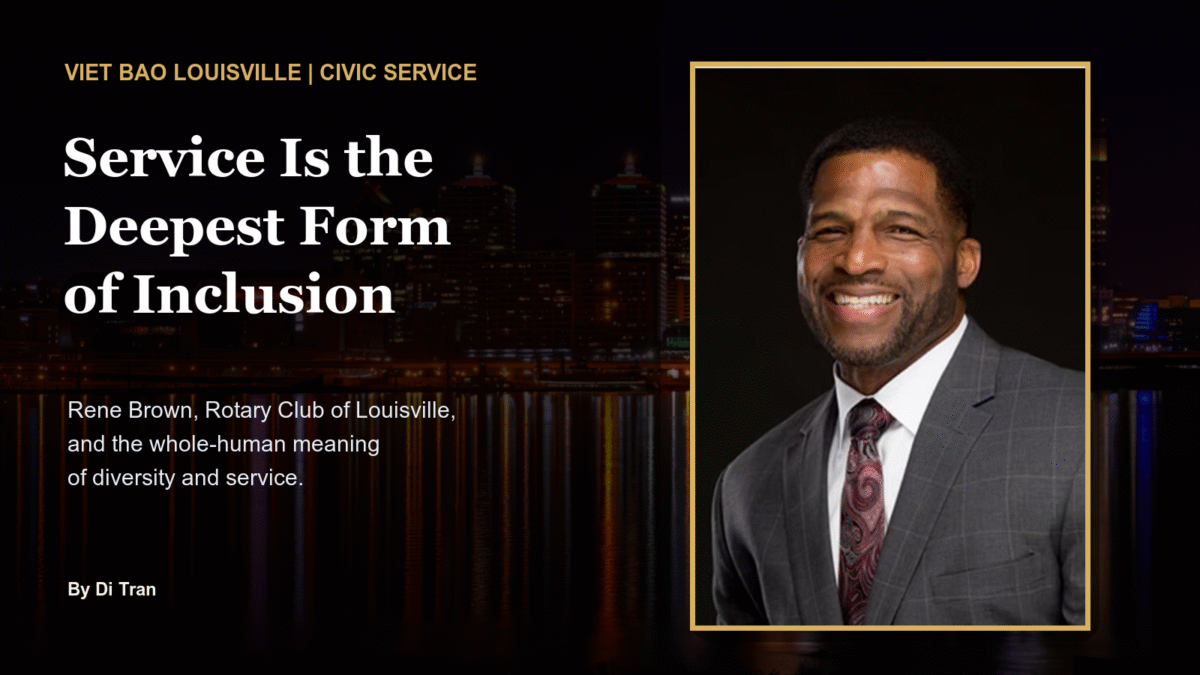
Service Is the Deepest Form of Inclusion: Rene Brown and Louisville Rotary

This article is a Di Tran civic reflection for Viet Bao Louisville. It honors public service, Rotary values, and the broader human meaning of diversity. It is not an official statement of the Rotary Club of Louisville unless separately approved by Rotary leadership.

There are moments in civic life when a meeting becomes more than a meeting.

It becomes a mirror.

It shows a community what it already has, what it still needs, and what kind of leadership can help it move forward with dignity. The recent Diversity, Equity, and Inclusion conversation within the Rotary Club of Louisville carried that kind of energy. It was not merely a committee gathering. It was a reminder that inclusion is not a slogan, a narrow category, or a political phrase. Inclusion is the disciplined civic practice of seeing the whole human being.

That is why the story of Rene Brown matters.

A Life That Refuses One Category

Rene Brown’s background is not one-dimensional. It is not reducible to a title, a profession, a race, a resume line, or a committee role. His public life reflects service across multiple domains: military service, health care, ministry, education, business, community development, and international human concern.

Louisville Metro’s public profile identifies Rene Brown as the founder and senior pastor of Living Faith Christian Ministries and CEO of RCB Health Corporation. The same public profile describes his service in the U.S. Army and lists a Bronze Star Medal for valor. That kind of record is not incidental to a Rotary conversation. It belongs at the center of it.

For Rotary, service is not decoration. Rotary International describes its mission as providing service to others, promoting integrity, and advancing world understanding, goodwill, and peace through the fellowship of business, professional, and community leaders. The Rotary Club of Louisville, with its long civic history since 1912 and its present scale as one of the largest Rotary clubs in the world, has a special responsibility to make that mission visible in the life of Louisville.

Diversity Is Bigger Than One Word

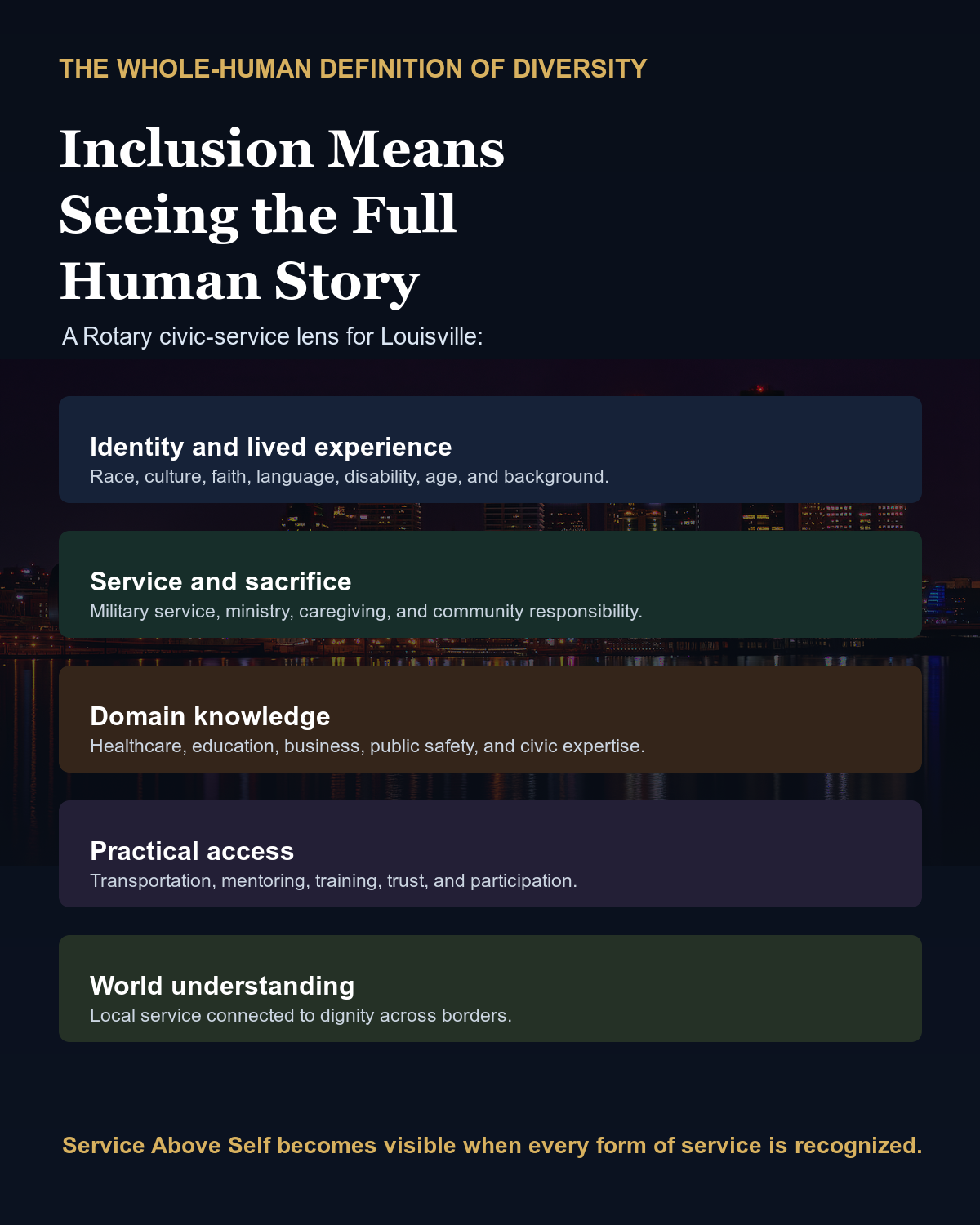
At its best, diversity is not a narrow exercise in counting demographic categories. Race matters. Culture matters. Ethnicity matters. Gender, faith, language, disability, age, socioeconomic condition, and lived experience matter. But diversity also includes domain knowledge. It includes professional discipline. It includes military service. It includes caregiving. It includes ministry. It includes entrepreneurship. It includes international exposure. It includes the wisdom that comes from struggle, responsibility, and years of showing up for people when the work is hard.

That broader understanding is deeply aligned with Rotary’s own statement on diversity, equity, and inclusion, which recognizes diversity across backgrounds, identities, ideas, values, and beliefs. In that sense, Rene Brown’s story offers a powerful local example: inclusion becomes strongest when a community honors not only who a person is, but also what that person has carried, built, studied, served, and sacrificed.

Visual explainer defining whole-human diversity through identity, service, domain knowledge, practical access, and world understanding.
A whole-human diversity frame for Louisville civic service: identity, service, expertise, practical access, and world understanding.

Inclusion Must Become Practical

Rene’s work through Living Faith and related community development efforts points toward a practical, grounded form of inclusion. Living Faith Community Development Corporation publicly describes work connected to families, youth, workforce support, tutoring, resume help, meeting space, and community resources. This is the language of everyday human need. It is not abstract. It is transportation, education, mentoring, employment preparation, space, and trust.

That matters because the most meaningful diversity work is not performed only in speeches. It is proven in systems that help people participate.

  • A student who lacks transportation is not fully included.
  • A veteran whose service is honored but whose transition needs are ignored is not fully included.
  • A young person with talent but no mentor is not fully included.
  • A family with hope but no access to training, technology, or trusted guidance is not fully included.
  • A professional with deep experience but no invitation into civic leadership is not fully included.

This is why the Rotary Club of Louisville has such a meaningful opportunity. The club’s civic scale, history, and membership base give it the ability to define inclusion in a way that is worthy of Louisville: practical, intergenerational, cross-cultural, professionally serious, and rooted in service.

A Louisville Room Big Enough for the Whole Story

From Di Tran’s perspective as a member of the Rotary Club of Louisville Diversity, Equity, and Inclusion Committee, Rene Brown’s leadership points toward a higher standard. The first meetings are not simply about attendance. They are about moral tone. They are about whether people feel that the room is big enough for their whole story.

This matters especially in Louisville, a city whose civic future depends on trust across institutions, neighborhoods, professions, cultures, faith communities, and generations. Louisville cannot afford a shallow definition of diversity. It needs a definition large enough to include the veteran, the immigrant, the pastor, the entrepreneur, the student, the health care worker, the educator, the tradesperson, the retiree, the young leader, the lifelong resident, and the newcomer.

It needs a definition that includes race and goes beyond race. It needs a definition that includes identity and also honors expertise, sacrifice, service, condition, and contribution.

Diversity is not only who is represented in the room. Diversity is what kind of wisdom the room is willing to receive.

Service Above Self, Locally and Globally

The connection to international service is equally important. In recent Rotary conversations, the work of Healing Hearts Vietnam and the broader question of global service entered the discussion. That matters because Louisville’s civic leadership cannot stop at the edge of the city. Rotary has always carried a local and international imagination. World understanding, goodwill, and peace are not distant ideals. They begin when local leaders learn how to see suffering, dignity, skill, and service across borders.

Rene Brown’s life appears to stand at that intersection: local service, national service, faith-based service, professional service, and openness to international service. That combination is rare. It is also exactly the kind of human story Rotary should know how to honor.

For Louisville, the lesson is clear.

Diversity is not only who is represented in the room. Diversity is what kind of wisdom the room is willing to receive.

Equity is not only a statement of fairness. Equity is the work of removing practical barriers so people can contribute.

Inclusion is not only welcoming people to sit down. Inclusion is listening deeply enough that their service, pain, expertise, and hope can shape the work.

The Room Louisville Needs

Rene Brown’s story deserves to be understood in that larger frame. It is a Louisville story because it is about service to community. It is a Rotary story because it reflects leadership beyond self. It is a DEI story because it expands the meaning of belonging beyond categories and into contribution. It is an international story because true service always teaches us to see human dignity across borders.

And it is a reminder that the strongest civic rooms are not the rooms where everyone is the same, or where everyone says the same words.

The strongest rooms are the rooms where every honest form of service can be recognized.

That is the kind of room Louisville needs.

That is the kind of Rotary conversation worth building.

And that is the kind of inclusion that can make Service Above Self visible again, not as a motto on a wall, but as a living practice in the city.

Sources and References

Translate »