
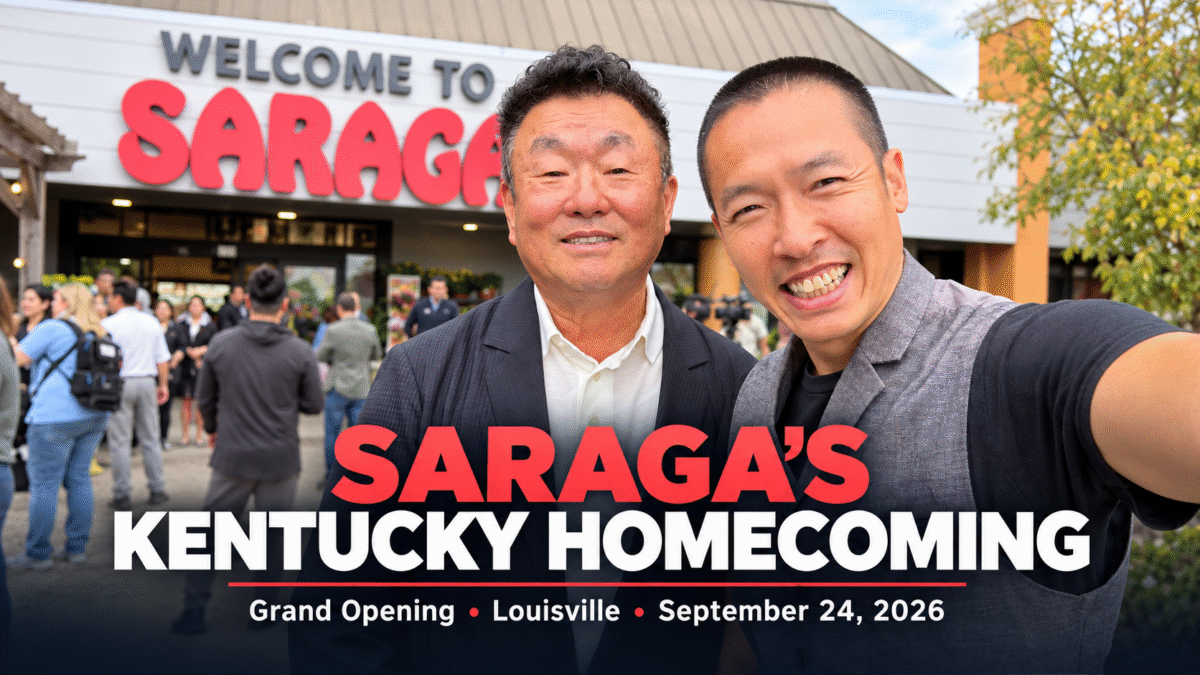
Viet Bao Louisville proudly republishes this community-business feature from the New American Business Association, celebrating immigrant entrepreneurship and Saraga International Grocery’s first Kentucky location.
LOUISVILLE, Ky. — The grand opening of Saraga International Grocery at 200 N. Hurstbourne Parkway was more than the arrival of another supermarket. For Louisville’s Asian American community—and especially for Korean American families—it was a visible reminder of what can grow from decades of sacrifice, disciplined work, family responsibility, and service to others.
Di Tran, a Louisville serial small-business owner, educator, and immigrant entrepreneur, was proud and honored to attend the opening alongside members of Louisville’s Korean and broader Asian communities. To Tran, the crowded aisles, global food selection, food court, employees, customers, and celebratory gathering represented something much larger than retail. They represented the long arc of immigrant enterprise: beginning small, serving real needs, reinvesting repeatedly, enduring risk, and building an institution that creates opportunity for the next generation.
“To witness a Korean immigrant family turn years of sacrifice, risk, and seven-day work into a beautiful market of this scale is beyond inspiring,” Tran said. “It is a proud day for the Korean community, the Asian American community, Louisville, and Kentucky. This is what it looks like when hard work becomes service, jobs, investment, and a lasting contribution to America.”
A First for Kentucky—and a Return to Earlier Roots
Saraga’s Louisville store is the family-owned company’s first location in Kentucky. The approximately 34,000-square-foot market occupies the former Lucky’s Market space in The Forum Center and carries more than 10,000 foods and goods from cultures around the world. Shoppers can find fresh produce, meat, seafood, pantry goods, frozen items, specialty ingredients, and prepared food offerings, including Korean food. The Louisville store joined Saraga’s three Indianapolis-area and three Columbus-area locations, making it the company’s seventh market location at opening. (WDRB/WAVE; Louisville Courier Journal report)
Yet calling Louisville simply a “new market” would miss an important part of the story. Saraga’s roots already run through Kentucky.
The company’s history says two young Korean brothers began selling food products from a truck in the early 1990s, traveling through Kentucky, Florida, West Virginia, and remote communities. John and Bong Sung opened their first small Saraga grocery in Bloomington, Indiana, in 1994. The name reflects the Korean idea of living or building a life, and the brothers’ stated mission centered on providing the food and goods people need for daily life. (Saraga company history)
Local reporting added an even more personal Louisville connection: before the family entered the grocery business, manager Jun Sung said his father bought and sold wholesale goods along Louisville’s Seventh Street corridor. That history gives the new store the feeling of a homecoming—a family enterprise returning to the city where part of its working life took shape. (WLKY)
From a Modest Truck to a Multistate Family Enterprise
Saraga’s development did not happen overnight.
After the first Bloomington store opened in 1994, the family spent more than a decade learning the business and serving customers. In 2005, it opened a 62,000-square-foot international grocery in north Indianapolis. Additional stores followed in the Indianapolis and Columbus markets. Saraga’s own history acknowledges “trouble and adversity,” failures as well as successes, and a continuing commitment to quality, price, and service. (Saraga company history)
That honesty matters. Entrepreneurship is often celebrated only after the ribbon is cut. The public sees the finished building, bright shelves, full parking lot, cameras, flowers, and smiling faces. It does not always see the years of early mornings, late nights, uncertain cash flow, supplier relationships, leases, construction, permits, hiring, inventory, family tradeoffs, and seven-day workweeks that make an opening possible.
Tran understands that unseen side personally. As a Louisville entrepreneur who has helped build businesses and educational organizations, he recognizes that every expansion represents more than money. It represents risk carried by people: owners who sign commitments, family members who sacrifice time, employees who help build systems, vendors who trust the vision, and customers who decide whether the business will endure.
The Louisville project was reported in 2024 as an approximately $4 million renovation investment. The completed market now restores an approximately 34,000-square-foot grocery space that had been vacant since Lucky’s Market closed in 2020. Saraga has also recruited locally across multiple functions, including cashier, grocery, meat, seafood, warehouse, cleaning, and supervisory work. Because a final public headcount was not available at publication, the opening is best described as creating and supporting local jobs without assigning an unverified number.
Korean-Founded, International in Service
Saraga is deeply rooted in a Korean American family story, but its mission reaches far beyond a single community.
Its shelves bring together products associated with Korea, Japan, China, the Philippines, Indonesia, India, Africa, Latin America, Europe, the Mediterranean, Mexico, Thailand, Vietnam, and the United States. Saraga’s Ohio organization describes the company as a community hub where customers can find “a piece of home,” with products from more than 50 countries. (Saraga vision and mission)
That is why an international grocery store matters in an immigrant city. Food is not merely a product. It carries language, memory, family rituals, health practices, holidays, and belonging. A familiar vegetable, spice, noodle, sauce, grain, or snack can shorten the emotional distance between a family’s present home and the place from which it came.
For longtime Louisville residents, the store is also an invitation to learn. A market like Saraga allows neighbors to encounter one another through everyday life—not through abstraction, but through meals, ingredients, conversations, and shared curiosity. Korean entrepreneurship provides the platform; many cultures are welcomed through the doors.
Small Business Is America’s Economic Foundation
Saraga has grown into a regional chain, but its origin remains a classic small-business story: two brothers, a truck, direct customer service, reinvestment, and gradual expansion.
The national economic context supports Tran’s belief that small businesses are foundational to the United States. The U.S. Small Business Administration’s Office of Advocacy reported in 2026 that America had approximately 36.2 million small businesses, representing 99.9% of U.S. businesses, employing 62.3 million people, and accounting for 43.5% of gross domestic product. (SBA Office of Advocacy)
Those numbers become real in places like Saraga. Capital becomes construction. Empty space becomes an active market. Inventory becomes cultural access. Hiring becomes household income. A family’s private risk becomes a public asset.
The impact also multiplies. A store of this scale supports growers, distributors, importers, logistics providers, contractors, food entrepreneurs, restaurant operators, maintenance teams, and neighboring businesses. Customers who once traveled farther for culturally familiar foods gain a local option. Louisville gains another destination that reflects its increasingly international character.
A Day of Pride—and a Call to Support Builders
For Tran, being present at the grand opening was an act of respect. It was a way to honor the Sung family and the many hands whose labor brought the Louisville store to life. It was also a reminder that immigrant achievement is rarely an individual story alone. Family, employees, customers, community associations, professional relationships, and years of trust all contribute to what the public eventually sees.
“We should celebrate this business not only because it is large and beautiful, but because of what it took to build,” Tran said. “Every shelf represents planning. Every employee represents opportunity. Every customer represents trust. Every family business that survives and grows strengthens the community around it.”
Tran offered his congratulations, prayers, and continued support to John and Bong Sung, the Sung family, Saraga’s employees, the Korean American community, and everyone who helped make the first Kentucky store possible.
The September 24 opening should be remembered as more than a commercial milestone. It is a Kentucky homecoming for an immigrant-founded family enterprise whose earliest routes included this state. It is a major Korean American business achievement. It is a multicultural gathering place. It is a multimillion-dollar vote of confidence in Louisville. And it is living proof that patient, service-centered entrepreneurship can grow from a truck into an institution.
Saraga means living. In Louisville, its newest chapter now lives among us.

