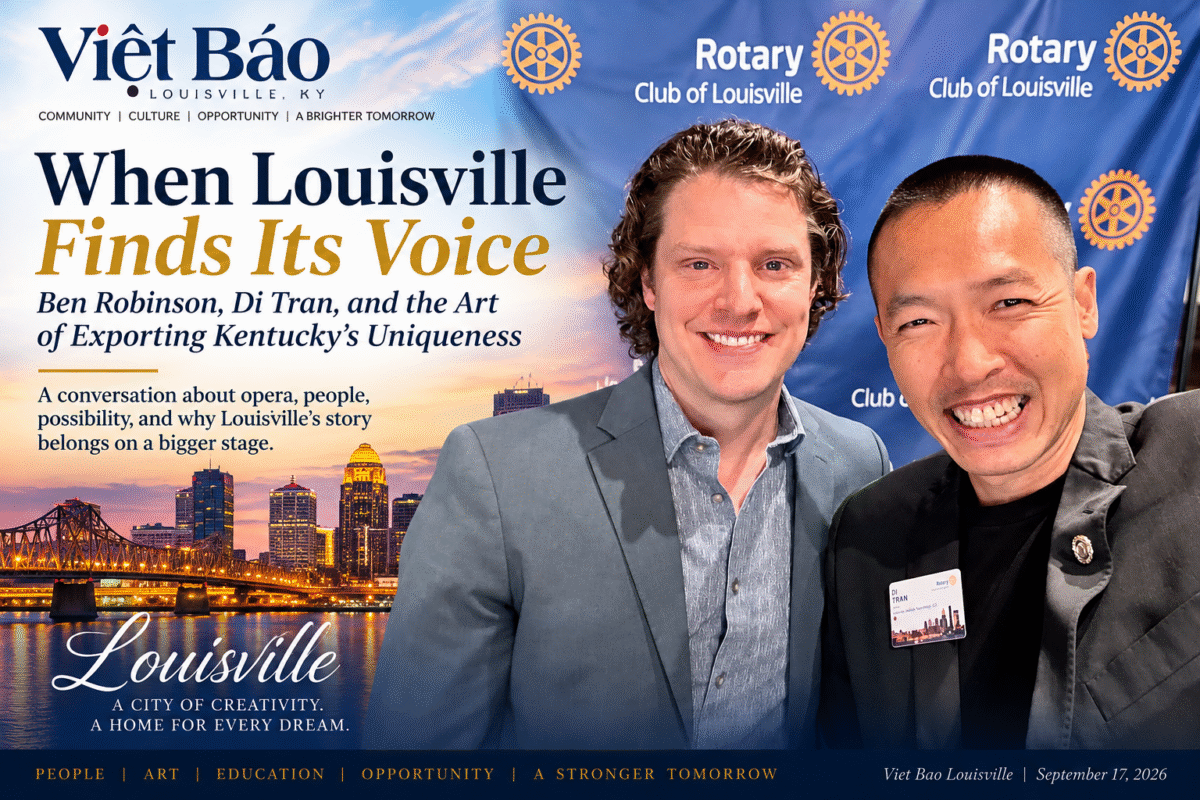
At the Rotary Club of Louisville, a conversation about opera became something larger—a reflection on art, immigration, entrepreneurship, collaboration, civic identity, and the extraordinary things Louisville has already given the world.
Viet Bao Louisville | Louisville, Kentucky | September 17, 2026
Some speeches explain an industry. Others reveal something about a city.
When Ben Robinson, General Director and CEO of Kentucky Opera, addressed the Rotary Club of Louisville on September 17, 2026, his announced subject was “The Future of Opera in Kentucky.”
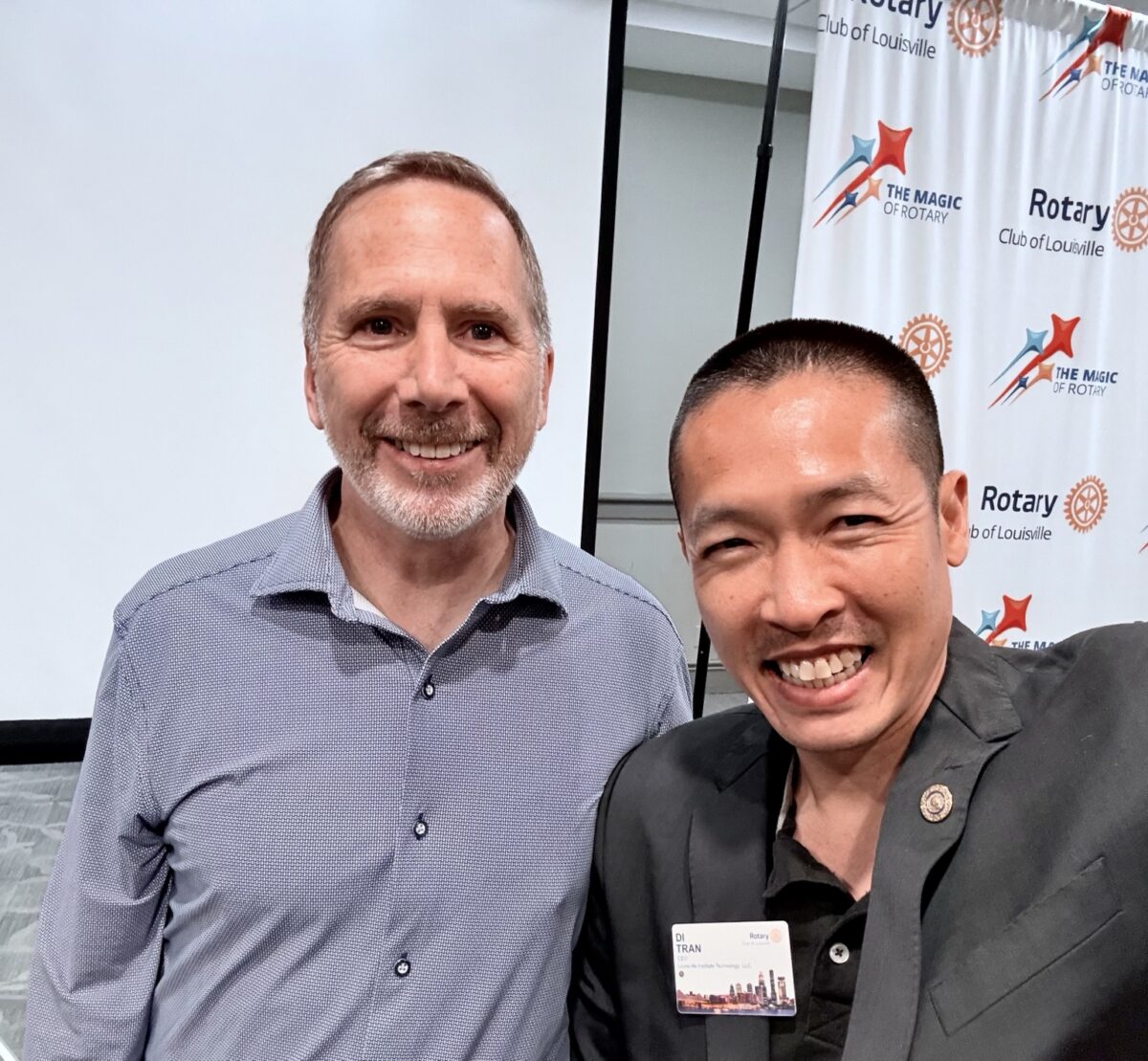
Opera was certainly at the center of the conversation. But for Louisville entrepreneur, educator and Rotarian Di Tran, who was sitting in the audience, Robinson’s presentation carried a meaning that extended far beyond the stage.
Tran heard something increasingly important for Louisville and Kentucky:
A community should not merely recognize what makes it unique. It should develop that uniqueness, collaborate around it, and have the confidence to share it with the world.
For Tran, an immigrant who has spent much of his adult life building businesses, educational institutions and workforce initiatives in Louisville, the idea felt immediately familiar.
Robinson advocates through opera.
Tran advocates through education, entrepreneurship and service.
Others may do it through music, manufacturing, technology, food, healthcare, skilled trades, athletics or neighborhood leadership.
The instruments are different.
The underlying question is the same:
What does Louisville possess that is worth giving to the world?
An Opera Leader Who Speaks Beyond Opera
Robinson arrived at Kentucky Opera’s highest executive position at an important moment in the organization’s history.
Kentucky Opera announced his appointment as General Director and CEO in November 2025 following a national search. The appointment also represented a return: Robinson had begun his professional career as a Kentucky Opera Studio Artist.
His career has combined artistic creation with institutional leadership. He has worked as a stage director, producer, designer and librettist, while also holding executive roles including General Director of Anchorage Opera and Managing Director of Lyric Fest in Philadelphia.
Kentucky Opera credited Robinson’s Anchorage tenure with expanding community programming, building artistic partnerships, developing regional talent, experimenting with immersive productions, securing a major endowment gift and finishing a season with a six-figure operating surplus.
That combination matters.
Robinson’s career suggests that opera need not choose between artistic excellence and accessibility, tradition and experimentation, institutional strength and community engagement.
Those goals can reinforce one another.
And that is why a speech about opera can become a lesson about much more than opera.
Louisville Does Not Need to Invent an Identity
Cities frequently spend enormous amounts of time trying to determine what they want to become.
Louisville might begin with a different question:
Does Louisville fully understand what it already is?
Louisville Metro has highlighted the unusual concentration of major performing-arts institutions in the city, including Kentucky Opera, Louisville Orchestra, Louisville Ballet, Actors Theatre of Louisville and StageOne Family Theatre.
These are not simply entertainment organizations.
Taken together, they represent generations of cultural infrastructure.
The Louisville Orchestra was founded in 1937. Its history became particularly distinctive through an ambitious commitment to commissioning and recording new music. The orchestra eventually established First Edition Records, which the organization describes as the first record label owned by an American orchestra.
That distinction deserves attention.
Louisville did not simply ask:
What music is the rest of the world performing?
It also asked:
What music does not exist yet—and can it be created here?
That is a fundamentally different civic mentality.
Opera, Ballet and Theatre: Generations of Creation
Kentucky Opera was founded in 1952 by Moritz von Bomhard. During the 1950s alone, the organization produced five world premieres. In 1982, the Kentucky General Assembly designated it the State Opera of Kentucky.
Louisville Ballet also traces its origins to 1952, eventually developing into one of Kentucky’s principal performing-arts institutions and working with nationally and internationally recognized figures in dance.
Actors Theatre of Louisville was formed in 1964, and its Humana Festival of New American Plays later helped establish Louisville as an important national environment for developing and presenting new American theatre.
Louisville’s infrastructure for supporting art extends even further back.
Fund for the Arts dates to 1949 and reports having raised more than $200 million during its history in support of the region’s arts ecosystem.
These institutions were founded at different times, so Louisville should not exaggerate its history by claiming that every component of today’s performing-arts ecosystem has existed for a century.
The verified history tells a better story anyway.
Generation after generation, Louisville has repeatedly built institutions that do not merely consume culture.
They create it.
Before Opera Went Viral, Louisville Helped Create a Melody the World Would Sing
There is perhaps no more beautiful metaphor for Louisville’s cultural influence than a song so ordinary that most people no longer stop to ask where it came from.
“Happy Birthday to You.”
Its history is connected to Louisville educators and sisters Patty Smith Hill and Mildred J. Hill.
The Smithsonian traces the familiar melody to the sisters’ nineteenth-century classroom song “Good Morning to All.” The melody was subsequently paired with the birthday lyrics that became internationally recognizable.
Consider the significance.
Two Louisville educators worked on a simple song for children.
That melody crossed neighborhoods.
Then generations.
Then states.
Then nations.
Then languages.
Eventually, people around the world could recognize it almost instantly.
Long before anyone used words such as viral, global platform or cultural export, Louisville had already demonstrated the principle.
Something created locally can become universal.
The world did not need Louisville to become another city.
It needed Louisville to create something authentically useful, memorable and human.
That distinction lies near the heart of what Robinson’s presentation awakened for Tran.
From “Importing Success” to Exporting the Blueprint
In Tran’s interpretation of Robinson’s remarks and their conversation surrounding the Rotary program, one idea stood above the rest:
When Kentucky develops something distinctive that works, it should have the confidence to share that model beyond the Commonwealth.
That formulation is intentionally presented as Tran’s interpretation rather than a verbatim quotation from Robinson.
But the idea has enormous implications.
Cities constantly study other successful cities.
They ask how to become more like Nashville.
More like Austin.
More like New York.
More like Boston.
More like Silicon Valley.
Benchmarking has value.
But imitation has limits.
Louisville’s highest aspiration cannot simply be to become a smaller version of somewhere else.
Louisville does not have to copy another city to become important. It can create something worth copying.
That changes the conversation.
Instead of asking only:
“What can Louisville import?”
a confident city also asks:
“What can Louisville export?”
Not merely bourbon, manufactured goods or agricultural products.
Ideas can be exported.
Educational models can be exported.
Music can be exported.
Technology can be exported.
Workforce systems can be exported.
Artistic productions can be exported.
Entrepreneurial models can be exported.
Community practices can be exported.
Methods of collaboration can be exported.
And perhaps most importantly:
Human possibility can be exported.
Ben Robinson and Teddy Abrams: Different Instruments, Related Civic Energy
While listening to Robinson, Tran found himself thinking about another prominent Louisville arts leader who had recently spoken before Rotary:
Teddy Abrams, Music Director of the Louisville Orchestra.
The comparison is not intended to make the two men interchangeable.
They are not.
Their artistic disciplines are different. Their personalities are different. Their institutions have different histories and responsibilities.
What they share is something more interesting:
the ability to use artistic leadership as a form of civic imagination.
Abrams leads an orchestra whose institutional history contains a remarkable tradition of experimentation and commissioning new music.
Robinson now leads an opera company entering another consequential chapter of its history.
And these two artistic worlds are scheduled to meet directly.
In May 2027, Kentucky Opera and the Louisville Orchestra are scheduled to collaborate on Richard Strauss’s Salome, with Abrams conducting and Robinson directing.
There is a lesson for Louisville embedded in that collaboration.
The orchestra does not need to become the opera.
The opera does not need to become the orchestra.
Each becomes more valuable to the collaboration precisely because each brings something the other does not.
Collaboration does not require surrendering uniqueness.
The strongest collaboration amplifies it.
The Immigrant Eye Often Sees What Familiarity Hides
Tran’s interpretation of the afternoon also comes from a particular American experience.
He is an immigrant.
That perspective matters.
People who arrive in America from somewhere else sometimes notice things that familiarity can make invisible.
Opportunity can look different to someone who remembers having less of it.
The ability to establish a business can feel different.
The ability to pursue education can feel different.
The existence of strong civic institutions can feel different.
The freedom to experiment, fail, rebuild and try again can feel different.
And the ability to enter a room where artists, educators, entrepreneurs, physicians, nonprofit leaders, executives and community servants exchange ideas can feel extraordinary.
Louisville has been Tran’s home for much of his adult life.
His advocacy for the city and Commonwealth has taken place primarily through education, workforce development, entrepreneurship and community service.
From that perspective, Louisville’s challenge is not always that it lacks extraordinary assets.
Sometimes the challenge is that people living among extraordinary things eventually begin treating them as ordinary.
Louisville possesses an unusual combination:
significant cultural assets and remarkable local humility.
Humility is a virtue.
But humility should never become invisibility.
Louisville Does Not Need One Ambassador. It Needs Thousands.
Perhaps the most important idea Tran carried away from the Rotary meeting was not ultimately about Robinson.
It was about multiplication.
A city cannot outsource its identity to a handful of famous people.
Louisville should not depend upon one Ben Robinson to tell its story.
It should not depend upon one Teddy Abrams.
It should not depend upon one entrepreneur, politician, journalist, athlete, artist or institution.
Louisville needs thousands of ambassadors.
Not professional ambassadors.
Everyday ones.
The opera director can advocate through opera.
The musician through sound.
The teacher through students.
The cosmetologist through beauty and entrepreneurship.
The chef through food.
The engineer through invention.
The physician through healing.
The manufacturer through craftsmanship.
The programmer through technology.
The immigrant through enterprise and experience.
The child through imagination.
The neighborhood volunteer through service.
None of them needs to deliver the same speech.
None needs the same background.
None needs the same politics.
None even needs to agree about everything.
A healthy city is not a choir singing a single note.
It is an orchestra of different instruments capable of creating something together.
Excellence becomes a form of civic advocacy when people carry their community with them.
Why Rotary Matters
The location of this encounter is itself important.
It occurred at the Rotary Club of Louisville, an institution whose history in the city dates to 1912.
Rotary creates a kind of infrastructure that cannot be measured simply in square footage or dollars.
It creates human infrastructure.
An opera executive can sit beside an entrepreneur.
An educator can meet a banker.
A nonprofit leader can meet a manufacturer.
A lifelong Kentuckian can sit beside someone born thousands of miles away who eventually chose Kentucky as home.
A formal presentation may last less than an hour.
A conversation afterward may last five minutes.
But relationships created in such environments can influence institutions and communities for years.
Cities need bridges made of steel.
They also need bridges made of relationships.
Civic organizations help build the second kind.
The Future of Opera Is Also a Question About the Future of Louisville
Robinson’s presentation was titled “The Future of Opera in Kentucky.”
Yet underneath that subject lies a question facing almost every established institution:
How does something with history honor that history without becoming imprisoned by it?
Universities face that question.
Businesses face it.
Religious institutions face it.
Governments face it.
Cultural organizations face it.
Cities face it.
Tradition without adaptation can become disconnected from the people it was created to serve.
Innovation without memory can become rootless.
The difficult work lies between them:
preserve what deserves preservation while having enough courage to create what does not yet exist.
Louisville’s history suggests that the city already understands this principle.
Its orchestra commissioned new music.
Its opera produced world premieres.
Its theatre became associated with new American plays.
Its ballet carried classical discipline into new generations.
Its educators helped originate a melody that ultimately traveled around the planet.
The pattern is visible.
**Create locally.
Collaborate courageously.
Refine relentlessly.
Share globally.**
Louisville Should Become More Louisville
Perhaps Louisville’s future does not require becoming the next anything.
Not the next Nashville.
Not the next Austin.
Not the next New York.
Not the next Silicon Valley.
Those places already exist.
The more ambitious objective is for Louisville to become more completely Louisville.
That means asking:
What exists here that cannot be reproduced anywhere else in exactly the same way?
And then:
How can Louisville make those things so excellent that others want to experience them, study them, invest in them, collaborate with them and adapt them elsewhere?
That is where culture intersects with economic development.
It is where immigration intersects with civic identity.
It is where education intersects with entrepreneurship.
It is where history intersects with innovation.
It is where local pride becomes global contribution.
And it is where an opera executive and an immigrant entrepreneur, working in seemingly unrelated fields, can discover an unexpected harmony.
Robinson speaks through opera.
Abrams speaks through an orchestra.
Tran speaks through education, entrepreneurship and service.
Thousands of other Louisvillians speak through entirely different instruments.
The instruments do not need to match.
That is precisely what creates the harmony.
From Louisville, Kentucky, to the World
More than a century ago, two Louisville educators helped create a classroom melody whose musical descendant would eventually be recognized almost everywhere:
“Happy Birthday to You.”
Perhaps Louisville’s next contribution to the world is already being created somewhere in the city today.
Perhaps it is being rehearsed on a stage.
Perhaps it is being coded by a child.
Perhaps it is being developed inside a classroom.
Perhaps it is being tested by an entrepreneur.
Perhaps it is being perfected inside a workshop.
Perhaps it is being imagined by a newly arrived immigrant who does not yet speak perfect English.
Perhaps it is sitting quietly inside a neighborhood that the rest of Louisville has not yet learned to notice.
The challenge is not merely creating these things.
The challenge is recognizing them.
Developing them.
Connecting them.
Collaborating around them.
And then having enough confidence to share them beyond Kentucky.
Ben Robinson came to Rotary to speak about the future of opera.
Yet through the eyes of another Louisville advocate sitting in the audience, his message opened onto something larger:
What would happen if thousands of Kentuckians treated their own talents as instruments for creating something worth sharing with the world?
The opera singer has a voice.
The violinist has strings.
The entrepreneur has an enterprise.
The educator has a classroom.
The immigrant has a story.
The child has imagination.
Louisville has all of them.
And when those instruments begin working together, the city does not need to search for its voice.
It already has one.
The task now is to let the world hear it.
**Build it here.
Prove it here.
Collaborate here.
Celebrate it here.
Share it from Kentucky to the world.**
That is how a city finds its voice.
And Louisville has been singing much longer than many realize.
Viet Bao Louisville | Louisville, Kentucky | September 17, 2026