

Categories
Small Businesses Workforce Development Workforce Education

Kentucky Supreme Court Justice Angela McCormick Bisig Inspires Di Tran and Rotary Club of Louisville with a Powerful Lesson on Freedom, the Rule of Law, and America’s Three Branches of Government

A Lesson in Freedom, Law, and the Quiet Strength of America’s Judiciary

As America celebrates its 250th year, conversations about freedom often focus on the nation’s founders, the Constitution, and the military men and women who have defended our country. Yet one of the greatest protectors of freedom is often the quietest institution of all—the judiciary.

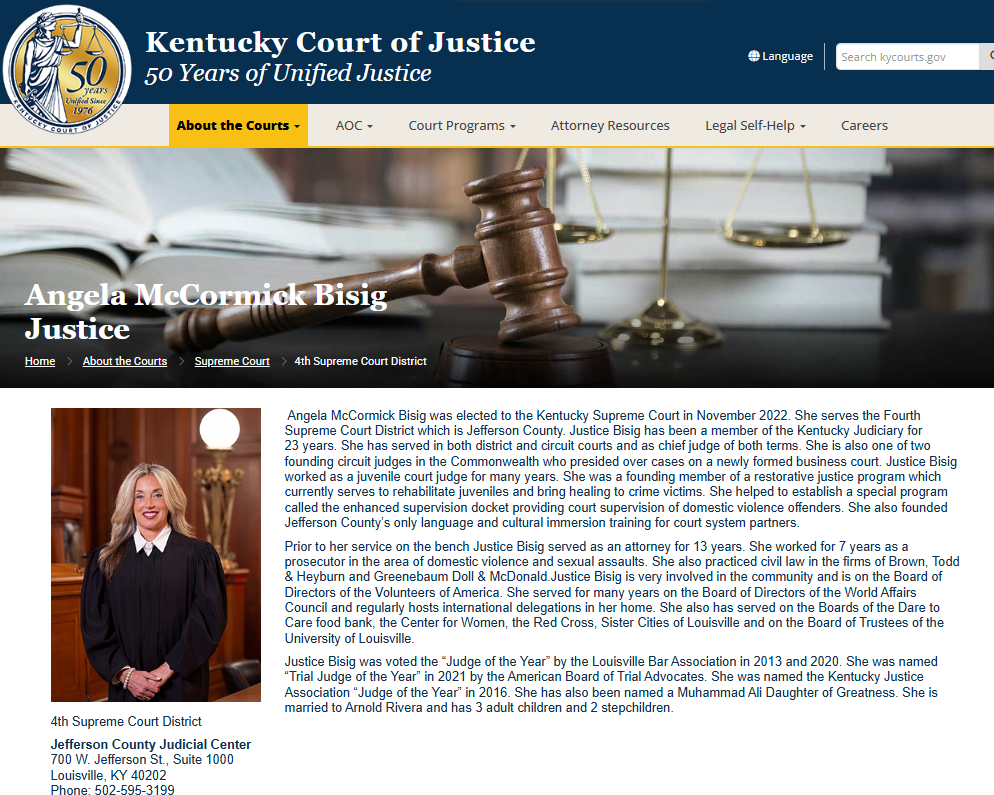
Today, Rotary Club of Louisville members had the privilege of hearing from Kentucky Supreme Court Justice Angela McCormick Bisig, one of only seven justices serving on the Commonwealth’s highest court. Justice Bisig represents the Fourth Supreme Court District, consisting solely of Jefferson County, making her responsible for the state’s largest county at the highest judicial level.

The Rotary Club of Louisville itself is one of the world’s largest Rotary clubs, bringing together hundreds of business, nonprofit, government, education, and civic leaders every week. The club describes itself as one of the largest among Rotary’s more than 45,000 clubs worldwide, providing members direct access to distinguished local, state, national, and international speakers.

For Louisville entrepreneur and Rotary member Di Tran, the luncheon was far more than another Thursday meeting.

“It was a lesson on the beauty of America’s system of government and why law matters.”

Rather than discussing politics, Justice Bisig explained the constitutional role of the judiciary—one of the three co-equal branches of government alongside the legislative and executive branches.

The explanation highlighted an important reality that many Americans may never fully appreciate.

The legislative branch creates laws.

The executive branch carries out and enforces those laws.

The judiciary does neither.

Instead, judges wait.

They do not search for cases.

They do not proactively investigate disputes.

They do not write new legislation.

They do not enforce regulations.

Their responsibility begins only when a real legal controversy is properly brought before the court.

Only then do judges carefully study the facts, hear both sides, apply the law as written, and when necessary, interpret areas where the law is reasonably open to more than one meaning.

This discipline is not weakness—it is one of the judiciary’s greatest strengths.

Its restraint helps ensure that every citizen, regardless of wealth, background, political influence, or status, stands equally before the law.

That quiet commitment to impartiality is one of the foundations of American liberty.

For Di Tran, an immigrant entrepreneur who deeply values the freedoms available in the United States, hearing this explanation directly from a sitting Kentucky Supreme Court justice carried special meaning.

“It reminded me that freedom is protected not only by those who make laws or enforce them, but also by those who patiently preserve justice through the rule of law.”

Following the presentation, Di Tran took a moment to thank Justice Bisig personally with a handshake—not because of politics or personal recognition, but out of appreciation for a civic lesson that reinforced the importance of constitutional government.

In an era when public attention often centers on conflict and division, today’s Rotary luncheon served as a reminder that some of the nation’s most important institutions work quietly, deliberately, and without seeking headlines.

The judiciary is designed to be reactive rather than proactive.

Its judges do not seek power; they exercise only the authority entrusted to them when a case comes before the court.

That restraint protects everyone.

As America reflects on 250 years of independence, events like this remind us that freedom depends not only on elections and legislation, but also on an independent judiciary committed to fairness, impartiality, and the rule of law.

Sometimes the most powerful lessons are delivered by those whose job is simply to listen, interpret the law faithfully, and ensure that justice belongs equally to every citizen.
Categories
Community

The FTC Breaks Through Language Barriers to Reach Consumers Targeted by Fraud

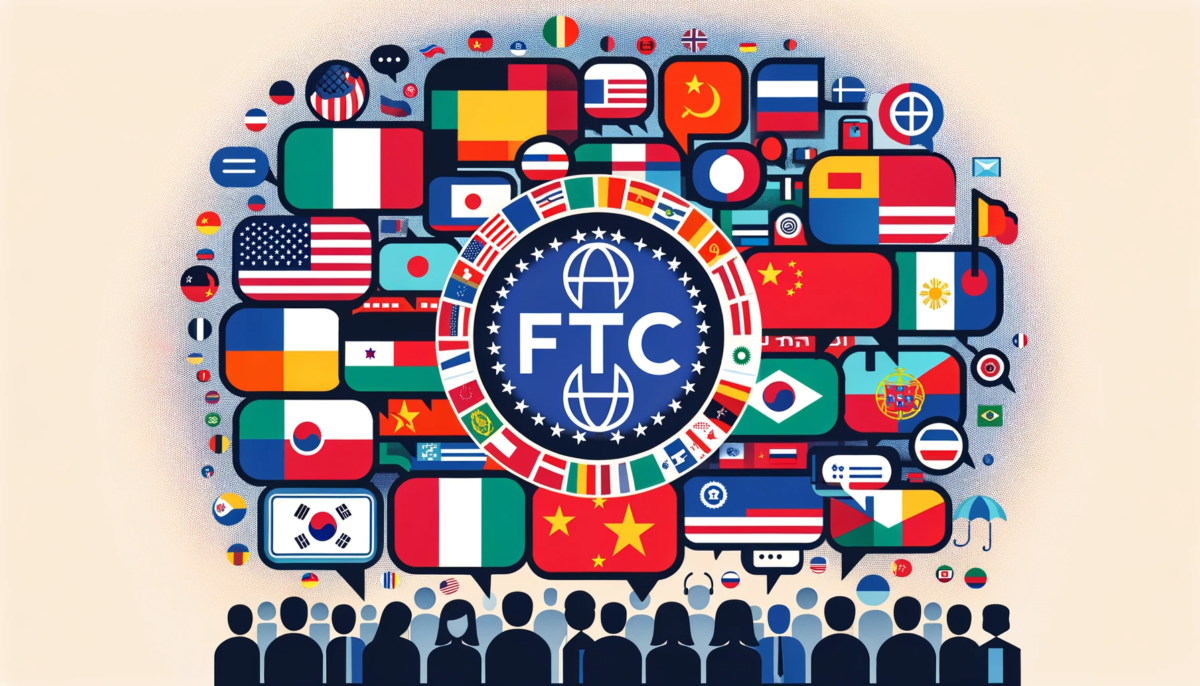
In a groundbreaking move, the Federal Trade Commission (FTC) has taken significant steps to enhance its outreach and services to non-English speaking communities, demonstrating a robust commitment to fighting fraud across diverse linguistic landscapes. The national briefing held on November 21, 2023, titled “The FTC Breaks Through Language Barriers to Reach Consumers Targeted by Fraud,” marked a pivotal moment in the Commission’s efforts to inclusively combat consumer fraud.

Expanding Multilingual Services

Recognizing the vital need to connect with consumers in their native languages, the FTC has extended its fraud reporting and advisory services beyond English and Spanish. The inclusion of multiple languages, including Arabic, Vietnamese, Mandarin, Korean, Somali, Tagalog, Russian, Polish, and Portuguese, is a strategic move to empower consumers from various linguistic backgrounds. This expansion not only facilitates easier reporting of fraud but also ensures access to crucial information on fraud prevention in a language that consumers understand.

Influential Participation and Testimonies

The briefing showcased the insights of key figures from the FTC, notably Monica Vaca, Deputy Director of the Bureau of Consumer Protection, and Larissa Bungo, Senior Attorney of the Division of Consumer & Business Education. Their presentations underscored the FTC’s dedication to consumer protection and education. Additionally, the event featured poignant testimonies from individuals like Jongwon Lee, who have directly benefited from the FTC’s multilingual services. These stories highlighted the real-world impact of the FTC’s initiative.

Aiming for Inclusive Consumer Protection

The FTC’s move to break down language barriers is more than just a policy shift; it’s a strategic initiative to gain a comprehensive understanding of the scams targeting different communities. This approach not only enhances the FTC’s ability to fight fraud but also empowers consumers to be proactive in protecting themselves. The initiative underscores the FTC’s commitment to inclusivity, ensuring that all consumers, regardless of their linguistic background, have equal access to protection and resources.

Collaborative Effort for Broader Reach

The event was a collaboration between Ethnic Media Services and the FTC, showcasing a partnership that amplifies the reach of consumer protection messages. The provision of simultaneous interpretation in Spanish, Korean, and Mandarin during the event was a testament to the FTC’s dedication to accessibility and inclusivity.

Conclusion

The FTC’s efforts to reach consumers across language barriers represent a significant stride in consumer protection. By recognizing and addressing the diverse linguistic needs of the American populace, the FTC is not only combating fraud more effectively but also reinforcing its commitment to safeguarding all consumers. This initiative sets a precedent for other government agencies to follow, promoting a more inclusive approach to public service and protection.

Categories
Community Small Businesses Workforce Development

Integrating Expertise into the Diversity Framework: Establishing a Competent and Representative Government

Introduction

The integration of expertise across all domains, alongside ensuring diversity in terms of race, sex, and ethnicity, fortifies the efficacy of government agencies and boards in formulating and implementing policies that are both informed and representative.

Embedding Expertise in Representation

Within a government agency, the marriage of varied expertise and diverse representation ensures that policy-making is not only cognizant of the different community facets but is also anchored in specialized knowledge. Be it in law, social work, economics, public health, or any other pertinent field, having experts on boards and within agencies ensures that regulations, policies, and enforcement measures are crafted with a deep understanding of the domain-specific challenges and solutions.

Balanced Decision-Making

The integration of domain-specific expertise with diverse representation facilitates balanced and informed decision-making. Experts bring to the table a depth of knowledge in their respective fields, while representatives from varied demographics provide insights into the unique challenges and needs of their communities. This confluence ensures that policies and regulations are not only technically sound but also socio-culturally relevant and empathetic.

Ensuring Competent Service Delivery

Competency in service delivery is significantly enhanced when personnel within government agencies possess the requisite expertise to navigate the complexities of their domain. This, coupled with a rich representation across different demographic segments, ensures that services are delivered in a manner that is both proficient and contextually apt, mitigating risks of miscommunication and misunderstanding within the community.

Trust and Credibility

Government bodies that exhibit a blend of expertise and diverse representation inherently build more trust and credibility among the citizenry. The public is more likely to trust policies and regulations that are crafted by individuals who not only mirror their own diverse backgrounds but also possess the knowledge and skills pertinent to the domain.

Community Engagement and Collaborative Governance

Diversity and expertise within government agencies foster an environment conducive to collaborative governance, where community members feel seen, heard, and understood. The combination of technical know-how and sociocultural understanding enables government personnel to engage with the community in a manner that is both authoritative and relatable, paving the way for a cooperative and mutually respectful relationship between the government and its citizens.

Conclusion

In a diverse and multifaceted society, ensuring that government boards and agencies are imbued with both domain-specific expertise and rich demographic representation is pivotal. This ensures that the governance framework is not only technically robust and competent but also empathetic, inclusive, and reflective of the varied needs and nuances of the entire community. A government that is representative and expert in its functioning stands in a strong position to serve its citizens effectively, ensuring harmony, equity, and sustainable development within the society.

Translate »