Viet Bao Louisville shares Vietnamese and immigrant community news, education, culture, family resilience, and Louisville civic information.
Author:Di Tran
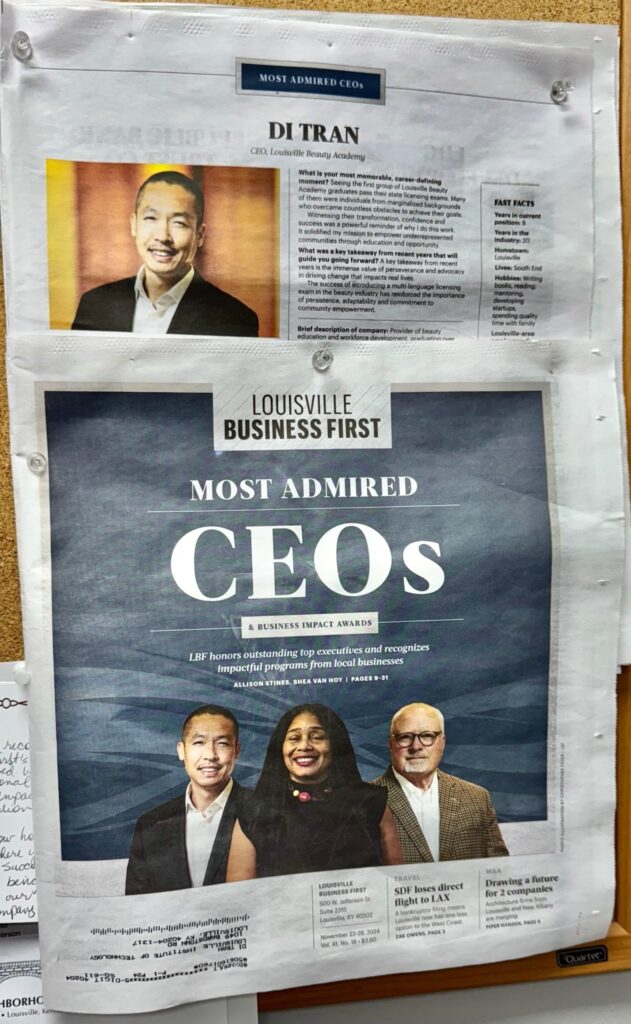
Di Tran is the Principal CEO of Viet Bao Louisville KY, a community news platform dedicated to serving Vietnamese, immigrant, and underserved communities in Louisville, Kentucky and neighboring states. With a passion for preserving Vietnamese immigrant stories and empowering local communities, Di Tran established Viet Bao Louisville as a central repository of success stories and a bridge between diverse communities. Di Tran is also the founder of Louisville Beauty Academy and actively involved in educational entrepreneurship, advocacy, and community leadership.
Louisville, KY – For local entrepreneur, author, and community advocate Di Tran, Kentucky is more than just where he lives. It is his true second home—a place where his immigrant journey from Vietnam has blossomed into a life of faith, family, and tireless contribution to the city of Louisville and beyond.
On a recent evening, Tran attended the first-ever Republican Party Lincoln Dinner in Louisville, marking what he described as one of the most inspiring and unifying experiences of his three decades in Kentucky. “It felt like home,” Tran reflected, surrounded by people of faith, business leaders, and legislators committed to hard work, progress, and unity.
A Life Rooted in Work and Family
Di Tran’s story is woven with the threads of resilience and devotion. Nearly 30 members of his extended family live and work in Louisville, contributing almost seven days a week in small businesses, salons, and service industries. For Tran, work is not just an occupation—it is a calling. He instills this same ethic in his children, who follow a 14-hour daily routine filled with school, extracurriculars, music, martial arts, and faith. “This is how I teach them the value of effort and the joy of adding value to others,” Tran often says.
A Historic Evening of Unity and Faith
The Lincoln Dinner was more than a political gathering for Tran. It was a celebration of Kentucky’s hardworking spirit, of God’s presence among people, and of the merit and dignity that comes from honest work. Tran was especially moved by meeting Reverend Dr. Charles Elliott, a 95-year-old Louisville native and one of the last living men who marched with Dr. Martin Luther King Jr. “To sit with history itself was beyond words,” Tran shared.
He was also inspired by Riley Gaines, whose courage in speaking out for fairness deeply resonated with his belief in justice and opportunity. For Tran, these encounters affirmed that Kentucky is filled with leaders and everyday heroes working for a better tomorrow.
Gratitude for Kentucky and Its Future
As the founder of Louisville Beauty Academy, Tran has witnessed firsthand the transformative impact of accessible education. With nearly 2,000 licensed graduates and an annual economic impact of $20–50 million, the academy has become one of the most affordable beauty colleges in the nation, offering tuition under $7,000 compared to the $20,000+ charged elsewhere. Tran credits Kentucky’s supportive leaders and legislators for opening doors to progress, citing recent bills that make vocational training more accessible.
“This is the land of opportunity,” Tran said, his voice full of gratitude. “Louisville and Kentucky are moving forward because of people who believe in God, in hard work, and in each other. I thank God every day for allowing me to raise my family here, to contribute here, and to call this place my home.”
A Vision of Hope
Tran left the Lincoln Dinner with renewed energy and hope. For him, the evening was not about politics but about unity, merit, and progress—values that transcend party lines and speak to the heart of the immigrant experience. “I see so much talent, so many leaders working so hard,” he said. “Kentucky is rising, and I am proud to be part of that journey.”
On April 30, 1975, the Vietnam War came to an end with the fall of Saigon, triggering one of the largest refugee crises of the 20th century. In the immediate aftermath, about 125,000 to 130,000 South Vietnamese were swiftly evacuated and resettled in the United States during Operation New Life and related efforts. These early refugees were often people who had worked with the U.S. or the South Vietnamese government and feared reprisals under the new regime. In the years that followed, hundreds of thousands more Vietnamese fled their homeland – by air, land, and especially by sea – in search of freedom and safety. This mass exodus spanned well into the 1980s, and those who escaped by boat came to be known as the “boat people,” risking everything on crowded, rickety vessels to reach a better life.
The journey was perilous. At least 800,000 Vietnamese “boat people” braved the South China Sea between 1975 and 1995, and tragically between 200,000 and 250,000 perished at sea due to drowning, storms, and pirate attacks. Many refugees who survived ended up spending months or years in makeshift camps across Southeast Asia. They found temporary refuge in places like Hong Kong, Thailand, Malaysia, Indonesia, the Philippines, and Singapore, often under the auspices of the UN Refugee Agency (UNHCR). The humanitarian crisis reached a tipping point in 1979, when Vietnam and the international community struck an agreement: Vietnam would halt the uncontrolled outflow, Southeast Asian nations would grant temporary asylum, and Western countries would step up to resettle the refugees. This led to a comprehensive international effort to give these migrants a permanent home.
Images of Vietnamese refugee camps and UNHCR efforts in the late 1970s, with a list of first-asylum sites (Hong Kong, Thailand, Malaysia, Indonesia, Philippines, etc.) where boat people were sheltered before resettlement.
By the mid-1980s, most Vietnamese refugees had been resettled in new homelands across the world. Over 20 countries participated in the resettlement programs. Between 1979 and 1982 alone, more than 623,000 Indochinese refugees (Vietnamese along with Cambodians and Laotians) were accepted by countries such as the United States, France, Australia, Canada, and others. The United States took the largest share: roughly 780,000 Vietnamese refugees were admitted from 1975 through the 1990s. Other nations also opened their doors generously – for example, Canada resettled about 60,000 Vietnamese and other Indochinese refugees in 1979–80, with ordinary Canadian families privately sponsoring over half of them. This global humanitarian response turned a tragedy into a new beginning for the Vietnamese people, giving rise to a vibrant overseas Vietnamese diaspora now spread across North America, Europe, Australia, and beyond.
Embraced by America and Other New Homelands
For Vietnamese refugees, arriving in countries like the United States was a profound relief – but also the start of a challenging journey of rebuilding. In America, refugees were initially housed at military bases and then dispersed to communities across all 50 states. Churches, charities, and local sponsors played a crucial role in helping families adjust, reflecting a nationwide embrace of these newcomers. The first wave of 1975 refugees tended to be educated professionals, but subsequent waves included people from all walks of life – fishermen, farmers, former soldiers, and students – all starting over from scratch. They faced language barriers, culture shock, and the trauma of war and displacement. Yet, they also encountered compassion: many recall the warmth of American sponsors who greeted them, the volunteers who taught them English, and the opportunities their children received in American schools. Similar stories unfolded in other countries – from France to Australia – where Vietnamese arrivals were met with both government assistance and community support.
The gratitude of Vietnamese refugees toward their host nations runs deep. To this day, Vietnamese communities refer to the United States as a land of freedom – some even calling it “heaven on earth,” as it was known in one refugee family’s lore. Refugees understood that without the open arms of these countries, their fate could have been very bleak. “This America, this freedom – the opportunity for people, they have the chance to go up, not go down,” reflects one former South Vietnamese soldier who resettled in the U.S.. Host nations didn’t just provide safety; they provided a chance to rebuild and thrive, and Vietnamese-Americans have never forgotten that. Many first-generation refugees would instill in their children a strong sense of appreciation for the country that saved their lives. Vietnamese Americans proudly fly the U.S. flag alongside the yellow flag of former South Vietnam at community events, symbolizing love for both the adopted country and the lost country they left behind.
Hard Work and Success in a New Land
Once resettled, Vietnamese refugees threw themselves into hard work, determined to repay the kindness of their new countries and to secure a better future for their families. In America, families often worked multiple jobs, with parents laboring in factories or starting small businesses and children studying diligently in school. A common saying in the community is that “in our family, work is love” – reflecting the belief that working hard is how you show care for your family’s future. Over the decades, this work ethic has translated into remarkable socio-economic progress. Vietnamese Americans have achieved educational and economic parity with the U.S. general population, despite starting with little. By the 2010s, members of the Vietnamese diaspora actually had a slightly higher median household income than the U.S. average, and a higher rate of home ownership than many other immigrant groups. About 72% of Vietnamese immigrants in the U.S. have become naturalized U.S. citizens, one of the highest citizenship rates among all immigrant communities – a testament to their commitment to fully joining and contributing to American society.
Second-generation Vietnamese Americans (those born or raised in the U.S.) have excelled in many fields. Over 2.3 million people of Vietnamese descent now live in the United States (as of 2023), making them the fourth-largest Asian American ethnic group. They include engineers, doctors, entrepreneurs, educators, military servicemembers, artists, and public officials. From high-tech CEOs in Silicon Valley to nail salon owners on Main Street, Vietnamese Americans have made their mark. Crucially, they often succeed in two worlds – achieving in mainstream society while also uplifting their own community. For example, Vietnamese-run businesses have revitalized neighborhoods (the “Little Saigon” districts in cities like Westminster, CA and San Jose are thriving commercial centers), and community organizations provide services ranging from language classes for elders to scholarships for youth. Education has been a priority from the start: even refugees who arrived with limited formal schooling pushed their children to attend college. As a result, 61% of U.S.-born Vietnamese Americans hold at least an associate’s degree, and many have entered professional careers that their parents could only dream of.
Giving Thanks Through Action
From the very beginning, the Vietnamese diaspora understood that the greatest way to show gratitude is through action. This ethos – “paying it back and paying it forward” – has guided the community’s contributions over the last 50 years. In practical terms, it means Vietnamese immigrants not only worked to support their own families but also looked for ways to serve their new country. For some, this meant enlisting in the U.S. armed forces, as many Vietnamese Americans have done, seeing military service as a way to defend the nation that gave them freedom. For others, it meant pursuing careers in public service, education, or healthcare, aiming to give back to society. Countless Vietnamese-American success stories involve turning personal success into community benefit. For instance, Quyen Vuong, who arrived as a teen refugee, worked her way through school and earned degrees from Yale and Stanford. She then founded a nonprofit to help immigrant parents and children in California, explaining that “success means nothing if you don’t turn around and help the next person up.” Her organization provides parenting classes, mental health support, and youth programs, embodying the principle of improving both Vietnamese and American communities.
This spirit of gratitude in action is also evident in the way Vietnamese Americans care for those in need, not just within their own community but in the broader society. Many remember the charities that aided them and now give generously to charities for others. It’s not uncommon to see Vietnamese-run charities raising funds for natural disaster relief in the U.S., or volunteering to help newer waves of refugees from other countries. A powerful recent example is France Hoang, a refugee who fled Vietnam as a child in 1975; decades later in 2021, he was instrumental in organizing evacuation flights for Afghan refugees, saying he felt compelled to “pay forward” the rescue that he himself received in childhood. Stories like these show how Vietnamese refugees have transformed gratitude into concrete help for others.
At the community level, honoring the sacrifices of the first generation has become a mission for the second and third generations. Young Vietnamese Americans have launched oral history projects, museums, and memorials to ensure the refugee experience is remembered and appreciated. In Boston, for example, the Vietnamese community commemorated the 50th anniversary of their diaspora by bringing together elders and youth to share stories – making sure the younger generation understands the hardships their parents and grandparents endured for the sake of freedom. “It’s important for us to learn about that part of history,” said one Vietnamese-American organizer, noting that the narrative taught in Vietnam today is very different from the refugees’ story. By preserving their history and passing on lessons of resilience and gratitude, the community ensures that the legacy of 1975 continues to guide future generations.
Vietnamese-Americans commemorate the 50th anniversary of the diaspora by honoring both their heritage and their adopted country. In ceremonies across the U.S., the former South Vietnamese flag (yellow with red stripes) is often displayed alongside the American flag, symbolizing pride in their roots and gratitude to the United States for providing refuge.
Every year on April 30 (often called “Black April” or the Journey to Freedom Day in the diaspora), Vietnamese around the world hold ceremonies to thank their host nations and remember the lives lost during the escape from Vietnam. These events are both somber and celebratory. Veterans of the South Vietnamese army may don their old uniforms and salute the American flag in thanks. Young children born in America might perform traditional Vietnamese dances to honor their cultural heritage. Speeches invariably express heartfelt gratitude to countries like the United States, Canada, Australia, France and others that opened their doors. As one community leader in California put it during a 50-year commemoration, “We are thankful to the people who sponsored us and to this country that gave us a second life. The best way we can say thank you is to be good citizens, succeed, and contribute back.” This ethos of thanksgiving through achievement and service has guided the Vietnamese diaspora for five decades.
Di Tran: Proud Vietnamese-Born, American-Made Role Model
One shining example of this ethos is Di Tran, a Vietnamese-born American who encapsulates the refugee journey from hardship to success, guided by faith, gratitude, and hard work. Di Tran’s life story reads like a modern odyssey: he was born in a poor village in Vietnam where his family lived in a mud hut with no electricity or running water. His parents labored tirelessly – flipping homes, fixing machines, selling whatever they could – all fueled by a dream of bringing their children to America. They spoke of the United States as a land of opportunity, even “heaven on earth,” inspiring young Di with hope. That dream became reality in 1995 when 12-year-old Di Tran and his family arrived in Louisville, Kentucky as refugees. He spoke not a word of English and remembers being the shyest, slowest student in his class due to the language barrier. But Di also remembers the resolve his parents instilled: in their family, “work is love,” and nothing was given unless you earned it. So, like his parents, teenage Di worked in factories after school, determined to pull his weight and seize the opportunity his family had been given in America.
Di Tran’s rise from those humble beginnings is a testament to perseverance. He struggled through school, often getting poor grades at first, but he never gave up. He learned that “getting it wrong is the first step to getting it right,” gradually gaining confidence in English and academics. He became the first in his family to attend college – by his own admission not because he was the smartest, but because he was willing to try, fail, and try again. He earned a degree in computer engineering and landed a job among thousands of other engineers. Through sheer determination, Di rose to be recognized among the top engineers in his company within a few years – “not because I was smarter,” he says, “but because I was willing to outwork everyone and ask better questions.” This drive to excel and innovate propelled him from an entry-level employee to a leader in the tech field.
More remarkable than Di Tran’s personal career success is what he chose to do with it. In Di’s eyes, “success means nothing if you don’t turn around and help the next person up.” True to that belief, he shifted from being an engineer to becoming an entrepreneur and community-builder – not for personal wealth, but to create opportunities for others. He founded the Louisville Beauty Academy and over a dozen other small businesses in Louisville, ranging from vocational schools to salons to real estate ventures. Each business, Di explains, is designed as “a training ground for someone’s future” or a service to help families build a better life. For example, when he buys a building, he doesn’t see it as an investment to make money – he turns it into an affordable housing unit for immigrants or a storefront for a new immigrant-owned business. His beauty academy has trained many immigrants (not only Vietnamese) to gain professional licenses, directly enabling them to achieve self-sufficiency. Today, Di Tran’s enterprises create over $20 million in economic impact each year in Kentucky – but he insists he “never counts money as success.” His real measure of success is, “when a student smiles because they got their first license, or when a mom can finally buy her first home because of the skills we gave her.” In other words, he measures success in how many others he can lift up, reflecting the pay-it-forward mindset shared by so many in the Vietnamese diaspora.
Although Di Tran describes himself as “not religious but loving God,” faith and gratitude are central to his outlook. He often attributes his journey to “a higher power and God’s people” – believing that divine grace and the kindness of others paved the way for his family’s escape and success. Standing in his Kentucky home, holding a tropical fruit that was once a rare luxury in Vietnam, Di muses that his life’s transformation “is crazy to explain” without acknowledging the hand of God and compassionate people along the way. He openly declares, “Oh God, I love you and our God people,” meaning he cherishes both his faith in God and his love for the community around him. This balanced spiritual outlook – humble, thankful, and service-oriented – guides how he lives and how he raises his children.
Indeed, one of Di Tran’s greatest passions is teaching his children the same values that have driven him. In a heartfelt letter titled “A Letter to My Sons,” written in March 2025 for his three young boys, Di shares the story of his life so they may learn from it. He tells them of his muddy village in Vietnam and the sacrifices their grandparents made. He recounts his early struggles in America and how he “failed more than he succeeded” but kept moving forward. He then imparts the core lesson he wants them to embrace: “A man’s true worth is not in what he owns, but in how much value he adds to others.” He calls his sons to be “leaders, creators, and servants of the world” – to serve with love and work with all their heart, just as he has tried to do. And he reminds them, when they face challenges, to remember their father’s example: “Your father came from a mud hut… was the slowest student… failed more than he succeeded… But your father never stopped moving forward. If I can do this – you can do even more.”. Di Tran’s message to his children captures the essence of 50 years of Vietnamese refugee resilience: no matter how small your beginnings, you can achieve great things with hard work, humility, faith, and a heart for others. It is a legacy of being “forever proud” – proud of their Vietnamese roots, proud to be Americans, and proud to serve humanity.
A Legacy of Resilience, Gratitude, and Hope
Fifty years on, the Vietnamese refugee story is ultimately a story of gratitude and hope triumphing over despair. What began as a tragedy in 1975 – families torn from their homeland by war and persecution – has turned into a tale of renewal and contribution in lands far from Vietnam. The refugees and their children have not only rebuilt their own lives, but have deeply enriched the countries that welcomed them. In the United States, Vietnamese Americans are celebrated as a model immigrant community: industrious, family-oriented, and civically engaged. They have one of the highest rates of U.S. military service among Asian Americans, numerous elected officials at local and state levels, and a thriving culture that has introduced Americans to everything from pho noodle soup to Lunar New Year Tet festivals. In Canada, Australia, France and elsewhere, Vietnamese diaspora communities similarly have integrated into society while adding their unique strengths. Their success is our success, as host nations, validating the decision to welcome refugees 50 years ago.
Through it all, the Vietnamese diaspora has kept gratitude at the heart of its identity. Thanksgiving is not just a holiday for us; it’s a way of life, one Vietnamese Canadian said at a recent 50-year commemoration. That gratitude is evident in the community’s actions – in how they care for their neighborhoods, educate their children, honor veterans, and help the less fortunate. The “pay it forward” philosophy means that the gifts of freedom and opportunity given in 1975 are continually being repaid in myriad ways, whether through mentoring youth, starting businesses that create jobs, or simply being a good neighbor and citizen. The Vietnamese phrase “ơn nghĩa” (deep gratitude) is often invoked in speeches and songs, conveying that the debt of kindness can only be repaid by showing kindness to others in turn.
As we celebrate this 50th anniversary of the Vietnamese refugee experience, there is a profound sense of thanksgiving – towards the nations that opened their doors and towards the resilience of the people themselves. The commemorations in 2025 are not just about looking back; they are about looking forward with hope. The diaspora’s younger generations are learning their history, as well as the values of freedom, hard work, faith, and service that define their community. With these values, they stand ready to continue the legacy. The Vietnamese boat people and their descendants have proven that even after unimaginable loss, it is possible to rebuild a life that is full of meaning and to turn sorrow into gratitude, and gratitude into action. In the words of Di Tran – a refugee boy turned community leader – “Every person, no matter how small their beginning, has the power to build something beautiful – if they choose to work hard, stay humble, and serve others.” And that is the enduring lesson of 50 years of Vietnamese refugee history: from suffering came strength, from rescue came responsibility, and from gratitude came a gift that keeps on giving, to the United States and to the world.
A Memorable Encounter with Louisville’s Visual Storyteller: Di Tran Meets Dan Dry
Today at the Rotary Club of Louisville—the 13th largest Rotary Club globally among 45,000 clubs—I had the extraordinary honor of meeting Dan Dry, a figure who has quietly and powerfully shaped the visual history of Kentucky.
At over 70 years old, Dan Dry brings more than 50 years of photography experience to the table (CreativeMornings, Kentucky Derby Museum). Over the course of his distinguished career, he has earned more than 500 national and international awards in photography, advertising, and design, including NPPA Newspaper Photographer of the Year and induction into the Ohio University Communications Hall of Fame (PriceWeber).
Dan’s iconic images have graced countless magazine covers, including every issue of Food & Dining Magazine for nearly two decades—his photography synonymous with Louisville’s food and lifestyle culture (Louisville KY).
He has served as an official photographer for the Kentucky Derby for 46 years, shooting his 47th Derby in 2025—a testament to his enduring role in capturing the elegance, emotion, and pageantry of Derby at Churchill Downs (Kentucky Derby Museum).
Why Dan Dry Matters to Louisville and Kentucky
🎖 Award-winning storyteller
His half-century of richly textured visual work documents everything from the glamour of the Derby to the grit and grace of everyday Louisville life.
🌟 Author and cover photographer
Author of over 25 coffee-table and cookbook titles, and long-time cover photographer for Food & Dining Magazine, Dan has infused Louisville culture with elegance and familiarity.
🐎 Kentucky Derby legend
Nearly one-third of all runnings of the Derby have been seen through Dan’s lens—creating iconic images that define Kentucky’s global image and legacy.
🎓 Mentor and cultural benefactor
Beyond photography, Dan generously mentors students and gives back to his community. In 2025 he and his family donated a $4.1M archive of his work to Ohio University, preserving decades of visual history and storytelling (Louisville KY, Kentucky Derby Museum, Ohio University).
Di Tran’s Reflection
As someone passionate about storytelling—especially the social fabric of Louisville—I was captivated by Dan’s soulful perspective today. Speaking with him reaffirmed how photography can do more than capture a moment—it can preserve identity.
Dan’s career reminds us that visual storytellers shape how a city remembers itself. Louisville’s past, present, and future are defined not only by its buildings and events, but by the lives and emotions Dan has framed over the decades.
Thanks to the Rotary Club, I met a true community gem today—someone who has dedicated his life to capturing the soul of Louisville through photography. Dan Dry is more than a photographer; he’s a visual historian whose lens continues to reflect our city back to us—and to the world.
Introduction: Student-facing documents – such as enrollment contracts, tuition and refund policies, and codes of conduct – are essential for informing students of their rights and obligations. In the United States, how readily these documents are available online varies widely between beauty/cosmetology colleges and traditional higher education institutions. Many beauty and vocational schools (e.g. cosmetology schools) have been noted for providing limited online access to detailed student agreements, sometimes keeping them behind layers of navigation or only providing them upon request. In contrast, traditional colleges and universities often publish catalogs and policy handbooks openly on their websites. Below, we examine the typical accessibility of these contracts and policies, why some schools might not publish them prominently, regulatory requirements for transparency, and criticisms related to this issue, with examples where possible.
Types of Student Contracts and Policies
Before comparing accessibility, it’s important to clarify what documents are in question:
Enrollment Agreements / Contracts: A formal contract outlining the terms of enrollment – common in vocational and for-profit institutions (like beauty schools). It may include program details, financial terms, and legal clauses (e.g. arbitration agreements or class-action waivers). Traditional public/nonprofit colleges usually do not use a singular enrollment contract; instead, a student’s agreement to terms is often implicit upon registration or covered by various institutional policies. (For example, universities may require students to accept a financial responsibility agreement each term, but this is generally a standard form, not a negotiated contract.)
Tuition Terms and Refund/Withdrawal Policies: Policies describing tuition charges, deadlines, and what refunds a student can get if they withdraw. All Title IV-eligible schools are required to have a refund policy (for return of federal aid, etc.), and traditional colleges typically publish these in their academic catalog or bursar’s office webpage. Beauty and trade schools also have refund policies, often outlined in the enrollment contract or school catalog.
Codes of Conduct and Student Handbooks: Rules governing student behavior, academic integrity, attendance, etc. Most accredited institutions (both traditional and vocational) maintain a student handbook or code of conduct. Many traditional colleges post these on public web pages or PDFs, while smaller private career schools might include conduct rules in their catalog or enrollment packet rather than a standalone online page.
Enrollment-related Disclosures: For example, school catalogs, program brochures, and (for vocational programs) performance fact sheets with outcomes data. Accreditors and some state laws require that prospective students receive these before signing an enrollment agreement.
In summary, traditional colleges rely on published catalogs and policies (with no single “contract” to sign in most cases), whereas beauty colleges and other private career schools often use a binding enrollment contract plus a catalog of policies.
Accessibility at Beauty and Cosmetology Schools
Many U.S. beauty colleges (cosmetology, esthetics, barbering schools, etc., often privately owned or for-profit) do not make their full student enrollment agreements easily accessible online. Instead, the detailed contracts and policies may be provided in person or via email during the admissions process. Here are some observations:
School Catalogs vs. Contracts: Typically, a beauty school’s catalog – which contains an overview of programs, policies, and requirements – might be available on its website (often as a PDF). For instance, California’s Bureau for Private Postsecondary Education (BPPE) requires that any institution with a website post its school catalog online. As a result, a California beauty school like Milan Institute of Cosmetology provides its catalog and even a blank enrollment agreement form on its site. In that Milan Institute example (Vacaville, CA campus), the enrollment agreement PDF explicitly states that “prior to signing this enrollment agreement, you must be given a catalog or brochure and a School Performance Fact Sheet”, emphasizing that the student should review those documents first. This indicates a regulatory expectation (in CA and via the school’s accreditor) that key policies be provided to prospective students before they commit.
Hidden Behind Layers: Outside of states with strong disclosure rules, it’s common that the actual enrollment contract itself is not published in a readily searchable way. A 2016 study by The Century Foundation found it necessary to obtain many college enrollment contracts through public records requests (FOIA), because they were not publicly posted by the institutions. In that analysis, hundreds of contracts from for-profit institutions (including cosmetology schools) were collected via state agencies instead of school websites. This suggests that in practice, many vocational schools do not voluntarily publish the full text of their student agreements online. Prospective students might only see these documents after multiple steps – for example, after speaking with an admissions representative, attending an info session, or digging through a “Consumer Information” page on the website.
Example – Arbitration Clauses: The content of beauty school contracts may explain why schools are hesitant to broadcast them. For example, the enrollment contract for Paul Mitchell The School – Tysons Corner (a cosmetology program) is 10 pages long and devotes an entire page to a mandatory arbitration agreement, requiring students to initial ten separate statements about waiving their right to sue. Such clauses (which prevent students from taking disputes to court) are controversial and were found by researchers to be widespread in for-profit college contracts but virtually nonexistent at public or nonprofit colleges. A school might keep the contract hard to find online to avoid drawing attention to these restrictive terms. (In the Paul Mitchell case, the contract was obtained and documented by researchers, rather than openly available on the school’s site.)
Other Accessibility Issues: Some beauty school websites simply provide a form for “Request Information” or list minimal policy summaries, rather than posting full PDFs of the student handbook or contract. A prospective student might have to navigate through several links (e.g. Admissions > Consumer Disclosures > Catalog) to find policy details, or in some cases call the school to receive the documents. Even when posted, they might be buried deep in the site’s structure. For instance, one might find a refund policy only as a paragraph within a PDF catalog, rather than on a clear, dedicated webpage. In short, the default approach at many cosmetology schools is to treat detailed policies as enrollment documents rather than marketing materials, meaning they’re provided once a student is in the pipeline, not prominently advertised on the front page.
Exceptions – Transparency Leaders: Not all beauty colleges are opaque. Some schools take pride in transparency. For example, Louisville Beauty Academy (per a news mention) advertises itself as a model of “how beauty schools can operate with transparency and structure,” possibly indicating that they make their policies readily accessible to the public. Additionally, chains that operate in states like California (with strict rules) usually have catalogs and performance statistics online for compliance. But these tend to be exceptions driven by regulation or institutional philosophy; the norm historically has been limited public disclosure.
Accessibility at Traditional Colleges and Universities
In contrast to cosmetology schools, traditional colleges (public universities, private non-profits, community colleges) generally make student policies and related documents quite accessible online. Key points include:
Academic Catalogs and Handbooks: Almost every accredited college or university publishes an academic catalog (or bulletin) on its website, which includes degree requirements, academic rules, and often the tuition and refund policy. Likewise, student codes of conduct and housing policies are often available as webpages or PDF downloads. For example, major universities clearly post their tuition refund schedules and withdrawal policies. The University of Texas at Austin and the University of Texas at San Antonio list how refunds are calculated based on withdrawal date in their online catalogs. Baylor University’s website openly provides a detailed table of refund percentages by week of the term – e.g. a student who withdraws in Week 1 of classes gets 90% tuition refunded, Week 2 is 80%, etc.. This information is presented on a public “Cancellation/Withdrawal Refunds & Policies” page, without any login required.
Financial Responsibility Agreements: Many universities now require students to accept a financial responsibility agreement (acknowledging they must pay tuition, etc.) each year. While the prompt to sign it is in the student portal, the text of the agreement is often available on the university bursar or finance website. For instance, schools like the Colorado School of Mines, University of Virginia, and Florida State provide the full text or a summary of the Student Financial Responsibility Agreement on their public sites. This suggests an emphasis on transparency, ensuring students know what they’re agreeing to (and likely to preempt claims of “I didn’t know I owed this”).
Codes of Conduct: As another example, Student Conduct Codes are typically one search away on a .edu domain. Universities such as Virginia Tech, Cornell, and Drexel publish their student codes online for anyone to read. These outline behavioral expectations and due process rights in disciplinary matters. The accessibility of such codes reflects a broader expectation of openness in academia, and in public institutions it’s sometimes linked to state open-records or “sunshine” policies.
Ease of Access: While a large university’s website can be labyrinthine, the trend is that policies are not intentionally hidden. One might have to click through a menu (e.g. Current Students > Policies > Handbook), but the information is available without needing special permission. Moreover, universities often have a Consumer Information page (required by federal law for Title IV schools) which centralizes links to key disclosures – campus security reports, drug/alcohol policy, and various student outcome data – ensuring compliance with the Higher Education Act’s transparency rules. This means a diligent prospective student can usually find things like the refund policy, transfer credit policy, or grievance procedures on their own. Traditional colleges also usually publish enrollment-related terms in admission offer letters or orientation materials (for example, an admitted student may get an enrollment confirmation form that references abiding by campus policies, and those policies are referenced on the public site).
Not Using Formal Contracts: As noted, most public and nonprofit colleges do not make students sign a multi-page enrollment contract full of legal clauses. Therefore, there is no “secret contract” to hide – the terms of enrollment are laid out in the publicly available catalog and other policy docs. This is a fundamental difference from many career schools. The Century Foundation’s analysis underscored that restrictive clauses (like arbitration requirements) were rare or nonexistent at traditional schools, whereas they appeared frequently in for-profit college contracts. In other words, traditional institutions often have less potentially controversial fine print in the first place, and what policies they do have (academic or financial) are generally published for transparency and to meet accreditation standards.
In summary, colleges and universities (in general) tend to make these policies accessible online, through catalogs and official policy webpages. A new student can often find out all the rules and financial terms before enrolling by perusing these public resources. Any difficulty in finding them is usually due to the volume of information on the site, not an intentional hiding of the documents.
Why Would Schools Hide or Not Publish These Documents?
For the institutions that do obscure or fail to publish their student contracts/policies, several possible reasons and factors come into play:
No Explicit Requirement to Publish: Unlike course catalogs or annual security reports, an enrollment agreement contract is not universally mandated to be on a website. Regulatory focus is on ensuring the student receives and signs it, not on making it public to all. If a school can meet accreditation and U.S. Department of Education rules by handing a physical copy or email to the student during enrollment, they may feel that’s sufficient. In states without specific laws, a beauty college might simply not think to upload the contract for public viewing. (For instance, Illinois and some other states require private career schools to submit their enrollment agreements for state approval, but they do not require schools to post them online for prospective students.)
Marketing and First Impressions: The content of these agreements can be daunting. Lengthy refund schedules, legal disclaimers, and disciplinary rules are not exactly selling points to someone shopping for a school. Schools may fear that publishing the full contract or handbook might scare off potential students. Instead, they funnel prospects through admissions counselors who can deliver the information in a more controlled manner. As one observer put it, colleges that use restrictive clauses may be “taking advantage of students at [the] optimistic moment” of enrollment. By not surfacing the fine print too early, a school might hope students will be less deterred by, say, a no-refund policy after a certain date or an arbitration clause.
Controversial Clauses and Reputation: Some hidden terms might provoke criticism if widely known. For example, mandatory arbitration and class-action waivers (which prevent students from suing or joining class-action lawsuits) have been common in for-profit college contracts. Such clauses have been heavily criticized by consumer advocates and were even temporarily forbidden for colleges using federal aid (a regulation that has since seen back-and-forth changes). A school that includes these might prefer not to draw attention to them publicly. In fact, The Century Foundation recommended that state agencies publicly post the contracts they collect, specifically so that “law enforcement… and consumer protection experts” can examine potentially predatory terms. The implication is that currently those terms stay under the radar, partly due to lack of public accessibility. In short, opacity can be intentional: one analysis noted that contract opacity “shields… from demands for transparency, access, and equity” – suggesting institutions (or their corporate owners) may deliberately limit transparency to avoid accountability or bad PR.
Competitive Secrecy: In the career education industry, some schools might view their exact tuition and refund formulas, or their contract language, as proprietary or at least not something to broadcast. They might worry competitors could use it to undercut them or that public scrutiny could arise from comparisons. (For example, if School A’s refund policy is harsher than School B’s, School A might not want that obvious on a website comparison.)
Logistical / Legacy Reasons: Some smaller colleges simply haven’t prioritized web updates. A mom-and-pop beauty school that has operated for decades might still rely on paper catalogs and in-person counseling. They may be complying with disclosure rules by handing each applicant a packet (or having them sign off that they received the catalog), and see no need to also maintain an online repository. In some cases, lack of tech savvy or resources means the website is bare-bones – perhaps just a homepage and a contact form – with the expectation that interested students will call or visit for details. While larger colleges have entire web teams and legal counsel ensuring policies are posted, a tiny cosmetology institute might not, unless an external rule forces their hand.
Accreditor or Aid Considerations: It’s worth noting that accredited schools do have to provide information to students, but how they do so can vary. For example, the national accreditor NACCAS (for cosmetology schools) requires that “prior to signing an enrollment agreement, an institution is required to provide each applicant with access to” the catalog of information. “Access” could be interpreted as giving a physical copy or emailing a PDF link, not necessarily a public web URL. Thus, a school might technically fulfill this by emailing the catalog once a student inquires or applies, rather than openly posting it. This meets the letter of the requirement but keeps the information semi-private.
In essence, where documents are not published or are buried, it often comes down to a lack of transparency mandate plus strategic choice. For schools that have nothing to hide and operate in a traditional higher-ed context, openness is the norm; for those in more sales-driven education markets (like for-profit trade schools), there may be incentives to be less forthcoming upfront.
Regulatory Requirements and Transparency Standards
There is a patchwork of laws and standards that influence how accessible student policies should be:
Federal Higher Education Act (HEA) Disclosures: Any college that receives federal student aid (Title IV funds) must disclose certain information to current and prospective students. This includes things like the refund policy, academic program information, graduation rates, campus security policy (Clery Act), etc. While schools are required to make this information available (and most do so via a web page), the regulations don’t necessarily say “post the signed enrollment contract online.” They do, however, prohibit misrepresenting key terms. For example, the HEA’s misrepresentation rules mean a school could get in trouble if its catalog says “100% job placement!” when that’s false. So schools have to be truthful in published materials, but they have latitude in how they disseminate the enrollment terms. Many colleges have a Consumer Information page linking to all required disclosures (financial aid terms, refund policy, etc.), and the Department of Education expects these to be easy to find. In fact, some states and systems (e.g. the Washington State Board for Community and Technical Colleges) provide guidelines that websites must clearly present consumer info to avoid any HEA compliance issues.
State Laws: Certain states mandate greater transparency, especially for private postsecondary schools:
California (a leader in this area) requires that if an institution has a website, it must post its catalog, student brochures, School Performance Fact Sheets for each program, and a link to the BPPE’s website prominently on the site. Moreover, California schools’ enrollment agreements themselves have to contain specific disclosures and cancellations terms, and students must sign that they received the performance fact sheet of outcomes. This has created a culture where California-based beauty colleges often have a “Disclosures” or “Consumer Info” section online with PDFs of catalogs and performance data.
Other states like Illinois, Texas, Florida, Arizona, Virginia require private career colleges to submit their enrollment agreements for approval as part of state licensing. However, making them public is another matter. Illinois, for example, doesn’t post them on its website, but the fact that one can FOIA them (as The Century Foundation did) means the state sees them. The Century Foundation specifically recommended these state agencies publish the contracts electronically for accountability. Until that happens broadly, one must often request these from the state or school.
Some states have “Student Bill of Rights” regulations for certain sectors. For instance, a state might require that a student’s rights and responsibilities be given in writing and even posted in a visible place on campus (Illinois requires cosmetology schools to “post in a conspicuous place” a statement of student rights). But again, this doesn’t always equate to a public online posting.
Accreditation Standards: Accreditors (regional accreditors for traditional colleges, national accreditors like NACCAS or ACCSC for trade schools) emphasize transparency and fair student treatment. While they might not say “you must have your policies on a public webpage,” they do require that institutions provide catalogs, give clear enrollment agreements, and adhere to advertised policies. For example:
NACCAS requires that schools have a written catalog meeting certain criteria and that students get that info before enrollment. Failing to do so could jeopardize accreditation. Similarly, ACCSC (another accreditor for career schools) requires that the enrollment agreement and catalog include all relevant terms and are provided to students; institutions must honor those published policies.
Regional accreditors for universities often have criteria about transparency and integrity – an accredited college must not deceive students and should make information like costs and policies readily available. This creates indirect pressure to keep websites informative. It’s generally seen as a best practice in higher ed to publish policies so that students and the public can review them, reflecting an ethos of accountability.
Transparency Initiatives: Beyond mandatory regulations, there have been broader calls for transparency in higher education. The proposed College Transparency Act at the federal level (pending legislation) and other initiatives focus mostly on outcomes data (like earnings and debt), but the spirit is to empower students with information. Likewise, during the Obama administration, the Department of Education pushed for rules against secret arbitration clauses in school contracts, arguing that students shouldn’t have to sign away legal rights without knowing – this led to a short-lived regulation banning mandatory arbitration at schools receiving federal aid (rescinded in 2018 and partially restored later). Consumer advocates like Public Citizen and TICAS have argued that students deserve to see and understand all terms before enrolling, which implies schools should not hide things in fine print or behind login walls.
In summary, regulations do demand that students have access to policies and terms, but not all demand proactive public posting. Where rules are strict (e.g. California), we see near-universal online disclosure. Where they are looser, some institutions only meet the minimum (handing the contract to the student at signing). Transparency standards set by industry groups and watchdogs generally encourage making this info easy to find – aligning with the practices of traditional colleges.
Criticisms and Discussions on Information Accessibility
The varying practices in publishing student contracts and policies have attracted criticism, especially toward institutions that appear to obfuscate important information:
Consumer Advocate Critiques: Organizations focused on student rights have pointed out that lack of transparency can be harmful. The Century Foundation’s report “How College Enrollment Contracts Limit Students’ Rights” explicitly criticized the use of buried clauses (like arbitration) and highlighted that these contracts are often hard for outsiders to obtain. They argue that if contracts were public, it would be easier to spot predatory terms and inform students. As a result, one of their recommendations was for oversight agencies to post these documents publicly online. The implication is that hiding the contract is contrary to the idea of informed consent in education – students can’t exercise consumer choice properly if they can’t easily compare what they’re agreeing to at different schools.
Public Perception and “Hidden” Policies: There’s a broader narrative that some educational programs, especially for-profit trade schools, mislead students or withhold key information. For instance, the Institute for Justice published a report on cosmetology schools noting many “ugly practices to boost profits.” In media coverage of that report, cosmetology schools were even labeled “the biggest scam in higher education” by some commentators. While that charge encompasses many issues (high tuition, low outcomes, unpaid labor by students, etc.), part of the problem is students enrolling without full understanding of what they’ll get and what is expected of them. If refund policies or extra fees (like over-contract hour fees) are tucked away, students might feel blindsided. Indeed, complaints have surfaced on forums and social media where beauty school students say they didn’t realize, for example, that missing too many hours would incur extra tuition charges or that withdrawing would still leave them on the hook for substantial debt. Such stories fuel the argument that these documents need to be clearer and more openly available. In short, opacity in student contracts is often cited as a red flag for predatory behavior.
Mandatory Arbitration and Legal Rights: A specific area of discussion has been the justice angle – when students discovered they “can’t sue” their college due to an arbitration clause, many felt the school had not been upfront about it. This led to not only media coverage (e.g. a 2016 BuzzFeed News story titled “Students Ripped Off By For-Profit Colleges Discover They Can’t Sue”) but also policy moves. The PROTECT Students Act and other legislative efforts have aimed to curb such secretive clauses. Even accrediting bodies were encouraged to view these clauses as a sign an institution “lacks integrity”. All of this ties back to transparency: had these clauses been obvious on websites or in college materials, pressure would likely have mounted against them sooner. The fact that they were tucked into enrollment contracts that students see only at signing (and not easily anywhere else) is a central criticism.
Student and Faculty Expectations: Within traditional higher ed, there’s an expectation of openness. If a university tried to hide its code of conduct or not publish a policy, students and faculty would likely object. The norm is so strong that any deviation (like requiring a login to read rules) would be seen as strange. This culture is gradually influencing other sectors too – students expect to “Google” a school and find out about costs, rules, accreditation, etc. easily. Institutions that don’t facilitate this might be viewed as behind the times or even suspicious. Thus, from a reputational standpoint, not publishing policies can hurt trust. Some vocational schools have recognized this and begun voluntarily putting more info online (especially as they seek to differentiate themselves from less scrupulous competitors).
Examples of Discussion: The topic of accessibility of these documents doesn’t always hit headlines, but it underlies many education stories. For example, when an Iowa Attorney General’s lawsuit against La’ James International College (a cosmetology chain) became public, it highlighted that students were frustrated by policies that weren’t clearly disclosed (like requirements to bring in paying clients to get credit hours). Prospective students reading about that case might try to look up La’ James’ enrollment agreement online – and if they couldn’t find it easily, it reinforces the sense that the school wasn’t transparent. Similarly, any time a college’s fine print makes news (be it a no-refund after X weeks rule, or a we can change the curriculum at any time clause), it sparks conversation about whether students knew about it beforehand.
Overall, the discussion around accessibility is tied to larger issues of transparency, fairness, and informed choice in education. Critics assert that schools, particularly those in the for-profit and career college sector, should not hide their “true colors” until a student is already in the door. Instead, all key terms should be as easy to find as the school’s promotional materials. On the other hand, schools that have been less transparent rarely publicly defend that practice – instead, whenever regulations require more disclosure, reputable institutions comply, suggesting that the trend (and expectation) is moving toward greater accessibility.
Conclusion
Do most U.S. colleges make student contracts and policies easily accessible online? In summary:
Traditional public and nonprofit colleges generally do make their policies accessible, usually by publishing comprehensive catalogs, policy manuals, and FAQ pages on their websites. There’s a culture of transparency and often legal/accreditation requirements that push these institutions to be forthright. A student can typically find tuition refund schedules, codes of conduct, and other policies without needing special permission or deep insider knowledge. Moreover, because many such colleges don’t use one consolidated “enrollment contract,” there isn’t a secret document to hunt for – the rules you agree to are the same ones anyone can read in the catalog.
Beauty colleges and many for-profit/vocational schools, on the other hand, have a mixed record. Often their student enrollment agreements and detailed policies are not readily available online to the casual researcher. They might be provided after an inquiry or embedded in a PDF few people download. In some cases, these documents are effectively hidden behind multiple layers of navigation or bureaucracy – you might have to fill out a contact form, talk to an admissions rep, or wade through a long PDF to get specifics. Some schools don’t publish them at all on the open web. This practice has been attributed to the lack of strict requirements and, possibly, a desire to avoid exposing restrictive or unpopular terms. However, under pressure from regulators and consumer expectations, this is slowly changing. Certain states force more transparency (e.g. requiring that the catalog and factsheet be on the website’s homepage in California), and accrediting bodies require giving out information before signing a contract.
Reasons for Non-Disclosure: When documents are not published or are hard to find, it may be a deliberate strategy or a remnant of old practices. Schools might fear that plainly advertising strict refund rules, extra fees, or legal waivers would deter students. By keeping those policies a bit buried, they ensure interested applicants talk to staff who can frame the information. Unfortunately, this can edge into obfuscation, which is why consumer protection voices argue for more openness. A college “on the level” should have nothing to hide in its enrollment terms – and indeed, making them accessible is viewed as a hallmark of integrity in education. Agencies like the U.S. Department of Education have encouraged transparency as a means to empower students and hold schools accountable (e.g. suggesting contracts with certain clauses indicate a lack of integrity).
In conclusion, many beauty and career colleges have historically not published student contracts and detailed policies front-and-center online, whereas traditional colleges usually do. This information can be “hidden” in the sense that a prospective student might have to jump through hoops to see it. The practice persists partly due to weaker transparency rules in that sector and partly due to schools’ own incentives. However, growing awareness and regulatory attention are pushing for change – advocating that whether it’s a small cosmetology institute or a large state university, students should be able to easily find enrollment agreements, tuition/withdrawal policies, and codes of conduct before they commit. Transparency is increasingly seen not just as good practice but as a responsibility in higher education, crucial for protecting students from unwelcome surprises.
National Accrediting Commission of Career Arts & Sciences (NACCAS). (2024). Standards and Criteria: Institutional Catalog and Disclosures. https://www.naccas.org/naccas/naccas-handbook
Rising Property Taxes and Impact on Local Businesses and Owners
Rising property values in Louisville’s desirable neighborhoods have led to increased property tax assessments in areas like the Highlands (which includes the Bardstown Road corridor). For example, the median home sale price in greater Louisville rose about 35% from 2019 to 2023. In 2024, the Jefferson County PVA reassessed thousands of properties in the Highlands and nearby areas for the first time since 2021. Higher assessments mean higher tax bills for property owners, even though tax rates saw only slight reductions (Kentucky’s state property tax rate ticked down to 11.4 cents per \$100 in 2023 from 11.5 cents). The PVA has voiced concern about the tax burden on residents amid surging home values. Commercial owners in the Bardstown Road corridor are feeling the pinch as well – many long-time businesses rent their space, so rising taxes and property values often translate into higher rents. As one Highlands business owner noted, “No expense of tax happens in a vacuum, it has to be passed on” to consumers or tenants.
Local business advocates worry that steep tax increases make it harder for independent shops and eateries to survive. A proposed special Highlands management district in 2018 highlighted this tension: it would have added an extra \$0.18 per \$100 of assessed value (nearly 18% of 1% of value) on 392 parcels to fund street cleaning and safety patrols. While some business owners supported paying more for cleaner, safer streets, others balked. For example, the owner of a car dealership on Bardstown Road argued the added tax was unnecessary in his section of the corridor and feared it would just raise costs for customers. Ultimately, that voluntary tax district required broad support from owners and did not take effect at the time. However, the underlying issue remains: property taxes have been climbing, and small businesses with tight margins feel each increase.
To illustrate the impact, consider that the Bardstown Road/Highlands area is not only culturally important but also economically vital. In fact, Bardstown Road and its adjacent Highlands neighborhoods generate more tax revenue than any other neighborhood in the city or state. This productivity is a double-edged sword: it reflects strong property values and commerce (hence higher tax contributions), but it also means local proprietors bear heavy tax bills. Some long-time shop owners have had to close or relocate, citing the cost of doing business. While exact numbers of closures are hard to pin down, community members point to a growing list of vacant storefronts along Bardstown Road. Residents lament that “we were already seeing hints of a decline and now with the challenges facing small businesses” the Highlands’ independent business scene feels threatened. High property taxes are one part of that challenge, along with rising labor and supply costs.
Property owners can appeal assessments – and many did during the 2024 revaluation cycle – but not all are successful. Louisville’s Metro Council has limited ability to offer broad relief due to state laws (Kentucky’s “HB 44” limits revenue increases without voter input). In practice, even if the city slightly lowers tax rates, strong assessment growth in popular areas like the Highlands yields higher tax bills for most. The consequence has been a squeeze on local landlords and entrepreneurs, who must either absorb smaller profits or pass costs along to tenants and customers. This dynamic fuels concern that Bardstown Road’s unique local shops could increasingly be replaced by chains or sit empty if operating costs (taxes included) become untenable.
Allocation of Increased Property Tax Revenues
With property tax collections rising (thanks in large part to those higher assessments), citizens naturally ask: Where is the money going? Louisville’s city budget is about \$1 billion annually, and property taxes (along with an income-based occupational tax) feed the general fund that pays for most city services. Recent budgets indicate that public safety, sanitation, and housing initiatives are major priorities for the increased revenue. For instance, in Mayor Craig Greenberg’s first budget proposal in 2023, he emphasized funding Louisville Metro Police (to address officer shortages and violent crime), downtown revitalization projects, and housing programs. He proposed \$15 million for the Affordable Housing Trust Fund to spur construction of affordable units – money that could “easily produce more than 1,000 units” according to the fund’s director. This represents a historic level of investment in affordable housing, enabled by robust city revenues. (By comparison, in previous years the fund often received around \$10 million or less.)
Another \$8.25 million in the budget was directed toward homelessness prevention (rent assistance and services to keep people housed), and \$24 million toward creating new permanent supportive housing for the homeless. These funds are part of a \$32.5 million “Homelessness Initiative” that city leadership announced in 2023, which also includes building a new “Community Care Campus” with shelter and wrap-around services. Indeed, Greenberg’s plan calls for a one-stop campus near downtown providing medical care, addiction treatment, job help, and interim housing – a project partly funded by the city and partly by state and private partners. The mayor allotted about \$2 million in the current budget for land acquisition and initial site work for this campus, plus \$3 million for a new women’s shelter on site. These expenditures suggest that increased tax revenues are being steered into long-term solutions for homelessness and housing scarcity, not just short-term fixes.
Regular city services are also benefiting. Sanitation and cleanup efforts have grown in response to community complaints. The city spent about \$400,000 in 2023 to remove garbage and human waste from homeless encampments – a hefty sum, though actually down from \$600,000 spent in 2022. That reduction may be due to more efficient services or fewer camps (after new initiatives), but it highlights that Louisville is investing significant tax dollars in keeping streets and public areas clean. Likewise, Metro Public Works has been active in infrastructure upgrades: for example, a \$1.5 million state-funded project (with local matching funds) redesigned a stretch of Bardstown Road to improve safety. The redesign included new crosswalks, curb extensions, better lighting, and additional on-street parking – all public works expenses ultimately supported by tax revenue. Smaller line items like community ambassadors (civilians paid to patrol and tidy up business districts) are also funded by city and federal relief dollars. In late 2021, Louisville allocated \$1 million of federal American Rescue Plan funds to expand the ambassador program into the Highlands. These ambassadors work along Bardstown Road, assisting with safety patrols, litter pickup, graffiti removal, and even homeless outreach. Business owners say the program has helped “beautify the neighborhood” and provided an extra set of eyes on the street. While that was one-time federal funding, maintaining such programs in the future likely relies on local tax funding.
It’s worth noting that a significant portion of Louisville’s general fund goes to public safety payroll – police, fire, EMS. The Louisville Metro Police Department has been trying to rebuild its ranks after a 250-officer shortage noted in 2021. In recent budgets, city leaders boosted police recruiting and even decided to relocate LMPD’s headquarters to a renovated downtown building – an investment aimed at both supporting police and contributing to downtown’s revival. These moves are funded by the city’s revenue streams (taxes, federal aid, etc.). Thus, rising tax receipts from areas like the Highlands and downtown are partly financing increased police presence in those same areas. In mid-2025, for instance, LMPD deployed more officers (including mounted patrols) on Bardstown Road during weekends to deter late-night trouble, and the police chief noted resources could be shifted thanks to a recent drop in violent crime citywide. Those patrols and police overtime are enabled by the city’s budget choices, which in turn reflect the higher tax revenues collected.
In summary, Louisville’s increased property tax revenues are being channeled into a mix of capital projects and services: affordable housing development, enhanced homeless services, public safety and sanitation efforts, and infrastructure improvements. City officials have emphasized these investments as necessary to tackle the very challenges vexing Bardstown Road, the Highlands, and downtown – from unclean streets to lack of housing and feelings of unsafety. Some residents remain skeptical, asking if the money is reaching their neighborhood in visible ways. The next section looks at what attention and investment the city is giving Bardstown Road and the Highlands specifically.
City Investment and Attention in Bardstown Road and The Highlands
Bardstown Road in the Highlands has long been one of Louisville’s most vibrant corridors – a hub of local dining, nightlife, and shopping. In recent years, locals have debated whether the city government is doing enough to support and maintain this crucial district. The evidence shows that the city has directed several projects and programs to the area, though some feel it hasn’t been proportional to the area’s importance (recalling that the Highlands generate an outsized share of tax revenue).
One major initiative was the Bardstown Road Redesign project, a multi-phase effort to calm traffic and improve the streetscape for pedestrians and businesses. Phase 1 of the redesign (covering 1.5 miles from Bonnycastle Avenue to Broadway) broke ground in 2022 with about \$1.5 million in funding from the Kentucky Transportation Cabinet and additional metro/local funds. The project removed the old reversible lane system and installed new crosswalks, curb bump-outs, and dozens of street trees and planters. It also created more permanent on-street parking spots by reducing the road from four lanes to two, directly addressing a long-standing complaint of business owners about parking scarcity. Local Metro Council representatives (first Brandon Coan, then Cassie Chambers Armstrong, and now Ben Reno-Weber in District 8) championed this redesign as a safety and economic boost for Bardstown Road. The project is touted as an “investment in the future of Bardstown Road” that will make the area safer, greener, and more attractive for shoppers – theoretically benefiting local merchants through increased foot traffic and fewer car crashes. By spring 2023, most of the new striping, crosswalks, and curb plantings were completed, and further phases extending beyond the original segment are planned into 2024 and beyond.
Community input and collaboration have been a hallmark of this project. A local nonprofit, Friends of Bardstown Road, worked with Metro Public Works, the state, and the Highlands Commerce Guild on the redesign details. This suggests the city is indeed paying attention to Bardstown Road, partnering with community stakeholders to guide public investment. The redesign has been generally well-received as a positive step, although it required patience from businesses during construction. Importantly, the redesign also addresses public safety (e.g. better crosswalks where there had been pedestrian accidents) and even environmental concerns (mitigating the urban heat island with new trees). Those align with citywide initiatives like Vision Zero (eliminating traffic deaths) and Complete Streets policies. In other words, the Highlands are being used as a model for modern urban improvements, with City Hall’s support.
Beyond physical infrastructure, the city has also piloted service programs in the Highlands. The Highlands Ambassador Program, as mentioned, was expanded in late 2021 with \$1 million in funding. By 2022, uniformed “ambassadors” were a daily sight on Bardstown Road, helping deter petty crime and keep sidewalks clean. In one month (February 2022), Highlands ambassadors picked up 94 bags of trash and scrubbed 146 graffiti tags – tangible results that improved the corridor’s appearance. Highlands Councilwoman Cassie Chambers Armstrong lauded the ambassadors for “building relationships” with businesses and acting in areas beyond what police or public works typically do. Seeing this success, Mayor Greenberg’s 2023 budget included funding to sustain such safety/cleanliness initiatives. The Metro Council also has been active: District 8’s current councilman, Ben Reno-Weber, is frequently on Bardstown Road engaging with constituents and has convened forums to address local problems. In fact, after a spate of disruptive late-night street parties (discussed in the next section), Reno-Weber organized emergency meetings and pressed LMPD to adjust its strategy specifically for Bardstown Road, saying “Bardstown is different than the rest of the neighborhood and needs to be patrolled differently”. This statement shows a level of attention from city leaders that recognizes the corridor’s unique challenges.
City agencies have made smaller but appreciated investments as well. For example, Louisville’s Parking Authority (PARC) recently proposed adding hundreds of metered parking spots along Bardstown Road (from Downtown/Baxter Avenue through the Highlands) to improve parking turnover for businesses. The idea, based on a study, is that metered spots will prevent all-day parking and free up spaces for more customers, potentially increasing business traffic. This plan is still under discussion as of mid-2025, but it indicates city officials are actively seeking solutions to revitalize commercial activity on Bardstown Road. Similarly, metro government supported the Highlands Commerce Guild in starting events like “Keep Bardstown Road Clean” days and promotional street fairs to draw visitors. While these may seem minor, they reflect a collaborative effort by city departments and local groups to keep the area thriving.
Despite these efforts, some in the community feel the city’s focus has been too downtown-centric or that responses come only after problems become acute. Bardstown Road’s advocates point out that it took a series of incidents (crowds blocking traffic, etc.) to spur increased police presence (discussed below) and that routine issues like graffiti or vandalism often fell to volunteers or business owners to address. Nonetheless, the recent multimillion-dollar projects (road redesign, ambassador program, housing initiatives nearby) demonstrate a level of public investment in the Highlands that is significant. One striking fact is that a new 50-unit affordable housing complex for people with mental health challenges was just opened off Bardstown Road in the Douglass Boulevard area – a partnership with local nonprofit Wellspring. This not only provides housing in the area but also signals that the city is bringing resources (and not just expecting the Highlands to fend for itself despite its prosperity).
In conclusion, Louisville’s city government is indeed investing in Bardstown Road and the Highlands, through both infrastructure upgrades and special programs. The Highlands remains a priority in planning documents and receives attention from elected officials. The question some residents pose is whether these actions are enough and fast enough, given the mounting challenges. That leads us to those challenges: homelessness and public safety.
Homelessness and Public Safety in Bardstown Road, the Highlands, and Downtown
Like many urban areas, Louisville has been grappling with issues of homelessness and street disorder in recent years. These problems have become more visible not only downtown but also along commercial corridors such as Bardstown Road. Community members in the Highlands have observed an uptick in panhandling and individuals sleeping in doorways or under overhangs on Bardstown Road – a situation that was less common a decade ago. In fact, Highlands residents raised homelessness as a concern in a 2021 public hearing, alongside crime and noise complaints. One Highlander at that meeting put it bluntly: “We do have a problem here in the Highlands.” They noted “constant vagrants harassing you” and people acting erratically on the streets. This perception shows that homelessness is not just a downtown issue, a sentiment echoed by many Louisvillians.
Quantitatively, Louisville has seen a surge in homelessness in the past few years. Between 2018 and 2021, the number of people experiencing homelessness in the city increased 41% (from about 7,572 to 10,640), according to the Coalition for the Homeless. More recently, the Coalition reported a 139% jump in unsheltered individuals on Louisville’s streets in 2023 alone, indicating that the problem has accelerated. (One count found 581 people living on the streets in January 2023, up from around 243 previously.) The reasons mirror national trends – lack of affordable housing, the end of COVID-era eviction moratoriums, and insufficient shelter capacity.
For Bardstown Road and the Highlands, this has meant more people camping in nearby areas or frequenting the corridor. In early 2023, a large encampment near the I-264/Bardstown Road interchange (at the edge of the Highlands area) drew attention; the city cleared that camp after complaints. Outreach groups note that when downtown camps are cleared, some displaced individuals migrate to other neighborhoods like the Highlands, seeking parks or quieter side streets to set up tents. Indeed, a calm scene along Bardstown Road can mask the fact that just a block or two away, there might be an encampment in a park or under an overpass. Shelby Park (adjacent to the Highlands) saw a new camp appear when downtown enforcement increased, as one resident observed with concern.
The city’s handling of homelessness has involved both increased services and enforcement. On the service side, Louisville opened “The Hope Village” in 2022 – a city-sanctioned safe outdoor space with tents and amenities for unhoused people to stay temporarily. This site, near downtown, was operated by a nonprofit (The Hope Buss) and represented a new approach to give campers a safer place to go. Additionally, Louisville’s Continuum of Care added some shelter beds and day centers (for example, planning a new women’s day shelter as part of the upcoming Community Care Campus). However, demand still far outstrips supply. The Coalition for the Homeless recommended creating “hundreds of new shelter beds” and “thousands of affordable housing units” to begin resolving the crisis.
On the enforcement side, the Kentucky legislature passed a law (House Bill 5, nicknamed the “Safer Kentucky Act”) that criminalized street camping statewide as of July 2024. This gave local authorities more power to clear camps. Louisville Metro, under both former Mayor Greg Fischer and current Mayor Greenberg, has periodically cleared encampments with advance notice – including well-known camps downtown under overpasses (e.g. near Jefferson Street) and smaller camps in neighborhood parks. The city reports that in winter 2023, during a cold snap, they transported 48 people from outdoor locations to shelters in a single week. Still, for every camp cleared, some individuals simply relocate to another spot if they have nowhere stable to go. Businesses and residents in the Highlands have expressed empathy but also frustration, especially when they witness open drug use or aggressive behavior. The feeling, as one Reddit commenter summarized starkly, is that the Highlands went from “a nice place to get away” to having “constant vagrants… and a lot of crazy people acting erratically”. This directly affects businesses: customers may feel uneasy, and shop owners sometimes must ask people not to loiter or sleep near their doorways.
Public safety concerns extend beyond homelessness. Downtown Louisville experienced a spike in violent crime around 2020 (amid the pandemic and civil unrest) but has since seen improvement. By early 2025, the data showed “crime down” in the Central Business District, according to the Louisville Downtown Partnership’s annual report. The mayor proclaimed “downtown is back” and highlighted an increased presence of LMPD officers and ambassadors as a key change. The city deployed more foot patrols and even reinstated a mounted horse patrol unit on weekend nights downtown. Major crimes downtown did decline in 2022 vs. 2021 (exact percentages were not cited, but the trend was positive), and downtown’s homicide numbers remain much lower than some other Louisville neighborhoods. Nevertheless, perception of safety downtown is an ongoing challenge – evidenced by office vacancy rates staying high and some businesses citing safety as a factor in closures. For example, the owner of a prominent Fourth Street live-music bar noted that “it’s not going to be someplace people want to come if there’s a large homeless population… that [makes them] don’t feel safe.”. Such sentiments underscore that public safety and homelessness are intertwined with economic vitality.
On Bardstown Road, the public safety issues recently took a different form: late-night disorder by large crowds of young people. In May and June 2025, the Highlands suffered two consecutive weekends of chaotic “street takeovers.” Hundreds of people (around 400 at one point over Memorial Day weekend) swarmed Bardstown Road, blocking traffic, dancing on cars, and engaging in fights. Police were caught off-guard the first weekend and made several arrests the next (including at least one juvenile). These incidents, essentially pop-up street parties that turned violent, alarmed both residents and business owners. “The residents have every right to be upset,” said Aaron Givhan, president of the Highland Commerce Guild, after witnessing the mayhem. The disruption forced some bars and restaurants to adjust operations. The Highlands Tap Room and even a 24-hour Taco Bell voluntarily cut their hours, closing at 2 a.m. instead of 4 a.m., in an effort to reduce the late-night chaos. “It’s very dangerous… something that could’ve been very sad. We don’t want any lives lost,” said Ti’ant Wyatt, whose company owns the Taco Bell, describing the scene of people on cars and fights in the street. Business owners worried that if such incidents continued, it would drive away customers and “I do worry about businesses surviving… you don’t want to have closed businesses in a busy business neighborhood”, as chef Dallas McGarity, who owns The Fat Lamb at Bardstown & Grinstead, told local media.
In response, city leadership and LMPD took action. Mayor Greenberg, along with the police chief, personally walked Bardstown Road in early June 2025 to talk with businesses and reassure residents. He noted the city had already cracked down on a few problematic bars (shutting down three venues that were flouting laws, like one hookah lounge operating without a valid license). LMPD increased patrols in the Highlands on weekends and even stationed squad cars along Bardstown Road as visible deterrents. Additionally, the Alcoholic Beverage Control (ABC) officers stepped up checks on bars for over-serving or underage drinking. Metro Councilman Reno-Weber pushed a coordinated strategy: he got local businesses to sign waivers allowing police to break up loitering on private parking lots, and convened a community meeting on June 25, 2025, to brainstorm further solutions. One idea revived from the past is rolling back bar closing time to 2 a.m. citywide. Many Highlands residents strongly favor this, noting that trouble tends to spike after 2 a.m. “What happens between 2 and 4 a.m.? It’s a different tone… it trips into a criminal element,” said long-time resident Rob Willy, who supports the earlier last call. Mayor Greenberg has said “everything should be on the table” regarding bar hours. (Louisville’s Metro Council had actually attempted such a change in 2021, led by then-Councilwoman Armstrong, but that ordinance did not pass at the time.)
The homelessness aspect of public safety is also being addressed through targeted programs. In late 2024, construction began on the aforementioned Community Care Campus in the Smoketown area (just south of downtown, a couple miles from the Highlands). This \$58 million campus, funded jointly by state, city, and private partners, will include a large shelter for families, a health clinic, transitional housing for youth, and even an on-site LMPD office. By concentrating services and providing “wrap-around care” – from medical aid to job training – the campus aims to reduce the number of people living on the street in the long run. Kentucky Senate President Robert Stivers noted that improving services for the homeless is not only about compassion but also key to having “a great downtown… [where] people feel safe”. City data shows how intertwined these issues are: in 2023, 15% of all Louisville Fire Department runs were related to people experiencing homelessness (medical calls, fires at camps or vacant buildings, etc.). Reducing homelessness should therefore improve overall public safety and quality of life in neighborhoods like downtown and the Highlands.
In the interim, downtown Louisville continues to have a visible homeless population, particularly around shelter locations and the bus station. Businesses downtown have complained about aggressive panhandling and the impact on tourism. The Louisville Downtown Partnership reports vacancy rates in Class A office space remain elevated, partly because many workers haven’t returned in person. However, downtown advocates are trying to attract more residents to live there, which could naturally improve safety by increasing foot traffic and “eyes on the street”. The city has even offered tax incentives to developers to convert vacant office buildings into apartments. If successful, this could simultaneously address empty buildings and provide housing (some of which could be affordable units for lower-income individuals).
In summary, homelessness and public safety challenges are significant in both the Highlands and downtown, though they manifest differently. Bardstown Road’s issues have centered on late-night rowdiness and a modest increase in homeless individuals in the area, whereas downtown faces larger homeless encampments and lingering perceptions of crime. Louisville’s approach has been a combination of enforcement (police crackdowns on street takeovers, clearing unsafe camps) and compassionate intervention (new shelters, outreach, and behavioral health services). The effectiveness of these measures is still being evaluated. For now, businesses have taken their own steps – Highlands bars agreeing to close earlier on weekends, downtown merchants hiring private security in some cases – while awaiting longer-term improvements from city policies.
City Leadership and Policy Responses: Are Current Policies Meeting Community Needs?
Louisville’s city leadership, dominated by Democrats in both the Mayor’s office and Metro Council, has faced increasing scrutiny over these economic and social challenges. Some community members wonder if one-party leadership has led to complacency or policies that are not adequately addressing issues like crime, cleanliness, and homelessness. It’s a complex picture: city leaders have enacted numerous initiatives, but outcomes have been mixed, leading to debate about whether current policies are failing or starting to turn the tide.
On the positive side, Mayor Craig Greenberg (a Democrat who took office in 2023) has made revitalizing Louisville’s urban core a centerpiece of his agenda. In his first “State of Downtown” address in March 2025, Greenberg struck an optimistic tone, insisting “Ignore what your friends who haven’t been downtown since 2020 are saying – downtown Louisville is coming back”. He pointed to \$1.6 billion in public and private investments announced for downtown, a huge jump from the year before. He also highlighted adding more police patrols and expanding the ambassador program as immediate steps that “help visitors navigate the area and keep streets and sidewalks clean”. This indicates that the current Democratic leadership acknowledges problems and is trying a combination of traditional law-and-order (more officers) and progressive strategies (ambassadors, social services) to solve them. Greenberg’s administration created a dedicated Homeless Services division and a Homelessness Initiative Fund, signaling a more strategic approach than perhaps existed under previous leadership. He has pledged transparency and regular updates via a homelessness dashboard to hold the government accountable.
Louisville’s Metro Council, which has an overwhelming Democratic majority, has largely supported these efforts. They approved significant funding in the latest budgets for the Affordable Housing Trust Fund, the Community Care Campus, and public safety measures. Individual council members in affected districts (District 4 downtown, District 8 Highlands) have been vocal. For instance, Councilman Ben Reno-Weber (D-8) responded to the Bardstown Road disturbances by praising the proactive approach by LMPD and affirming that “we will not let a small number of people bent on causing trouble disrupt [our] progress.” He noted the Highlands had seen “a significant drop in crime” over the past two years and several new businesses opening, and he’s determined to keep that momentum. His statement suggests that, from the leadership perspective, policies might actually be working to some extent – crime was down before the recent flare-ups, and business investment hadn’t vanished. Similarly, after a deadly shooting near the Highlands last year, city officials held community forums and stepped up police presence, which residents acknowledged led to a calmer period until the 2025 incidents. These examples show that when a crisis emerges, Louisville’s leadership has generally responded with increased attention and resources.
Critics, however, argue that many of these moves are reactive. They point to the fact that it took high-profile problems – a series of homeless encampments downtown, or “street takeover” chaos in the Highlands – to spur decisive action. Some Republican voices (though a minority in Louisville proper) suggest that the Democratic leadership had been too lenient or slow to enforce quality-of-life laws. For example, for years under former Mayor Greg Fischer, the policy was often to post notices and clear camps only as a last resort, which some downtown businesses felt enabled a proliferation of tent cities. The new state law forcing camp clearances was in part a response by Republican state legislators who felt Louisville’s leaders weren’t doing enough to keep public spaces clear. Likewise, the bar closing time issue saw pushback from some business-friendly Democrats in 2021 who feared economic loss, resulting in the ordinance failing and bars still open until 4 a.m. – a decision now being second-guessed as the late-night problems persist. In essence, critics say policy inertia and political considerations (not wanting to anger bar owners or displace homeless individuals without alternatives) have kept the city from acting sooner on these tough issues.
There are also questions about execution of policies. The city’s increase in spending has not yet yielded a visible decrease in homelessness on the streets; in fact, the unsheltered count rose sharply despite the new programs. This leads some to ask if money is being spent effectively. For instance, the Hope Village outdoor shelter helped dozens of people, but it can only accommodate a limited number (around 50 tents) at a time, and a WDRB report noted it even began charging a small fee as it transitioned residents from tents to tiny “pallet homes” – raising concerns about accessibility. Another example: the community ambassadors in the Highlands and downtown are a creative solution, but they have no enforcement power. They can deter minor crime by their presence, but cannot arrest someone or compel a person in crisis to accept help. Some residents appreciate them, while others dismiss the program as “window dressing” and would prefer more sworn police or social workers. Metro Police Chief Erika Shields (hired in 2021 under Mayor Fischer, though she resigned in January 2023) had frankly told Highlands residents that LMPD’s officer shortage meant “there are not enough officers to patrol the streets” thoroughly. This indicates that staffing and resources have been a limiting factor, something the current leadership is trying to fix by recruiting more officers and investing in technology, but results will take time.
City leadership has also had to balance different constituencies. The downtown corporate community, through the Downtown Partnership, has pushed hard for safety improvements and was pleased to see crime trending down, but they remain worried about vacant offices and lack of foot traffic. Greenberg’s team responded with the incentive program for office-to-housing conversions and by encouraging even one-day-a-week returns to office, which Downtown Partnership Director Rebecca Fleischaker said “would be life-changing for our small businesses” if every worker did that. These are forward-looking policies, but their success is not guaranteed – they rely on private sector cooperation and broader economic trends. Meanwhile, residents in neighborhoods like the Highlands or Nulu have formed their own opinions about leadership. Many are loyal Democrats but have voiced that they want “less talk, more action” at the street level. They expect clean sidewalks, quick police response, and meaningful help for those in need.
The evaluation of leadership thus far can be summarized as follows: Proactive in planning and funding, but challenged in implementation and swift results. Are current policies failing? It may be too early to call them failures, given some positive indicators (crime down in some areas, new housing in the pipeline). Yet clearly, community needs are not fully met yet – the fact that Bardstown Road merchants felt compelled to adjust their hours and even hold independent security meetings speaks to lingering unmet needs. Downtown, the “vacancies up” side of the equation shows that safety perception and urban appeal issues aren’t solved overnight either.
Mayor Greenberg, only 18 months into office by mid-2025, has repeatedly stated that making people feel safe and welcome is a top priority. “Downtown Louisville is the neighborhood where every local and every visitor should feel welcome, safe, energized and excited,” he said. He and the council have bet on a broad strategy: invest in police, invest in human services, improve public spaces (like new micro-parks and plazas downtown), and crack down on nuisance properties. This comprehensive approach aligns with what urban experts recommend, but it requires sustained effort and can be politically tricky. So far, Louisville’s largely Democratic leadership has shown willingness to increase funding (something a divided government might struggle with) and partner with Republicans in the statehouse on projects like the Community Care Campus. That bipartisan cooperation led to \$23 million in state/metro money for the campus, indicating that leaders know they must unite to tackle these issues.
Still, neighborhood critics ask if basic services have kept pace. For example, why did it take so long to enforce code violations on a long-vacant, blighted building on Bardstown Road (the former Café 360) which sat empty after a 2022 shooting? The city only cracked down in 2023 with legal action to get it cleaned up. And when a compassionate business owner in a different area opened his food hall as an emergency shelter during a winter storm, city agencies promptly issued a violation and shut it down for not having the proper permit, which some saw as heartless bureaucracy. City officials defended it on safety code grounds, but the incident reveals the friction between grassroots community action and government rules.
In conclusion, Louisville’s current Democratic leadership has acknowledged the challenges in the Highlands and downtown and taken many steps that align with community demands – increasing funding for housing and police, focusing on cleanliness, and engaging directly with residents and businesses. These policies are starting to yield some positive results (crime abatement, new development plans), but significant concerns remain. Public sentiment suggests that many feel more must be done, faster. Whether one frames that as policy “failing” or simply “not succeeding yet” is a matter of perspective. What is clear is that city leaders will continue to be under pressure to deliver tangible improvements on Bardstown Road, in the Highlands, and downtown, or risk losing the public’s confidence. The next year or two will be a crucial test of whether these strategies can fully turn around the economic and social conditions in Louisville’s key neighborhoods.
Comparative Overview: Highlands vs. Downtown (Key Metrics)
To better understand the situation, the table below compares several key indicators for Bardstown Road/The Highlands and Downtown Louisville:
Indicator (2024-2025)
Bardstown Road / Highlands
Downtown Louisville
Property Value Trend
Sharp rise in recent years – e.g. +35% median home price (2019–2023). Property re-assessments in 2024 mean higher tax bills for many Highland owners. Some relief from slight rate cuts, but overall tax burden up.
Mixed trend – downtown residential property values relatively stable or modestly up; commercial property values under pressure due to office vacancies. Some downtown properties have decreased in value post-pandemic, tempering tax increases.
Property Tax Changes
Metro real estate tax rate ~12.1¢ per \$100 (2024) – similar to prior year, so rising assessments = higher taxes. A proposed Highlands special tax of \$0.18 per \$100 for cleaning was debated (2018) but not implemented. Many Highlands businesses feeling tax strain.
Same city tax rate applies. Some large downtown properties appealed assessments due to high vacancy. Overall downtown tax revenue has not grown as fast as Highlands’. The city has offered tax incentives (abatements) for downtown conversions to encourage development.
Crime & Public Safety
Violent crime relatively low; 2022–2023 saw “significant drop in crime” per local councilman. However, spring 2025 brought rowdy crowds/street takeovers (hundreds fighting, 3 arrests). This led to beefed-up LMPD patrols and some bars voluntarily cutting late hours. Residents report more petty crime (car break-ins, etc.) than a few years ago, but recent police focus is on nighttime disorder.
Major crime down in 2022–2024 (overall crime in downtown dropped, per Downtown Partnership). Violent crimes have decreased from the 2020 peak. LMPD has a high visibility presence downtown (foot patrols, mounted officers). Still, perception of crime remains an issue; 34 crimes were reported in one hotspot area (around a closing downtown gas station) in a year. Petty offenses (vandalism, panhandling) are common complaints.
Homelessness Presence
Noticeable but smaller scale. A few encampments on edges of Highlands (e.g. near I-264) cleared by city. Increasing number of unhoused individuals seen along Bardstown Rd and nearby parks, especially after downtown camp clearances. Highlands residents cite homelessness as a quality-of-life concern since ~2021. No major shelters in Highlands, so most unhoused move between downtown and outskirts.
High concentration of homeless individuals and camps. Downtown hosts major shelters (Wayside, Salvation Army) and services, so many unhoused gather in the area. Large camps under overpasses have been periodically cleared (e.g. Jefferson St camp in 2023). Unsheltered count in Louisville spiked (+139% in 2023), many of whom stay downtown. City opened “Hope Village” safe outdoor space near downtown (50-person capacity) and is building the Community Care Campus to alleviate downtown homelessness.
Business Climate (Openings/Closures)
Still relatively strong, but some local business turnover. A number of new eateries and shops have opened in the Highlands post-2020, yet longtime fixtures have closed (e.g. some bars) citing high rents/taxes and changing foot traffic. The Highlands Commerce Guild reports “several new businesses open” recently, but also vacant storefronts have grown on parts of Bardstown Rd. Nightlife remains active, though a few venues had licenses pulled for violations. Overall, the Highlands retail/dining vacancy rate isn’t published, but anecdotal evidence suggests a slight increase.
Struggling but hopeful. Downtown has seen prominent closures (e.g. a luxury restaurant closed after 2020 unrest; several shops closed due to reduced foot traffic). Office vacancy ~ office occupancy is only ~50-60%, impacting lunch restaurants. The Downtown Partnership’s 2024 report notes vacancies up in office and some retail. However, investments are underway: about \$1.6 billion in projects announced downtown including new hotels, residential conversions, etc. Tourism is rebounding (convention and event activity improving safety by adding pedestrians). The city’s focus is on attracting more residents downtown to fill vacant units and support businesses.
(Table sources: property value and tax data from Louisville PVA and Metro Council reports; crime and safety information from WDRB, WAVE3, WHAS11 reporting; homelessness figures from Coalition for the Homeless and city data; business climate notes from local news and Louisville Downtown Partnership updates.)
Summary of Findings
Bardstown Road and the Highlands, alongside Downtown Louisville, are navigating a period of economic and social stress. Rising property taxes in the Highlands reflect booming property values, which have strained local businesses and homeowners with higher costs. While these areas contribute disproportionately to Louisville’s tax base, residents question whether they are receiving commensurate support from the city. The increased tax revenues have enabled Louisville’s leadership to fund a variety of responses – from more police patrols and street cleaning crews to ambitious housing projects and service campuses for the homeless. These investments mark a proactive strategy by the largely Democratic city leadership to tackle core issues: they are building housing units, expanding shelters, and updating infrastructure in ways that previous administrations had not.
However, the situation on the ground reveals ongoing challenges. In the Highlands, public safety was recently threatened by late-night “street takeovers,” prompting emergency measures like earlier bar closings and intensified policing. Downtown, persistent homelessness and perceptions of unsafety are slowing the post-pandemic recovery, even as crime statistics improve. Business owners in both neighborhoods have felt the impact – some reducing hours or closing entirely – and many citizens are frustrated with the pace of change. There is a sense that despite earnest efforts by city officials, the community’s needs are not fully met yet. Streets are cleaner than before in some spots, but tent encampments still appear elsewhere. Crime is down by data, but one unruly incident can dominate public perception.
City leaders have received both credit and criticism. They are credited for acknowledging problems and launching comprehensive initiatives (as evidenced by quotes from officials emphasizing safety and cleanliness, and the infusion of millions of dollars into solutions). Yet they face criticism for being reactive and occasionally hamstrung by bureaucracy or political caution. The current policies are broad in scope – combining enforcement with social support – and it will take sustained commitment for them to yield lasting results. Residents of the Highlands and downtown are watching closely to see if the trajectory improves.
In conclusion, Bardstown Road and downtown Louisville stand at a crossroads. The economic conditions (high taxes, business turnover) and social conditions (homelessness, public safety concerns) are challenging but not insurmountable. The research shows that Louisville’s government is aware and actively engaged: property tax money is being funneled into visible projects and services aimed at revitalization. Whether these efforts will fully restore the Highlands’ vibrancy and downtown’s vitality remains a work in progress. For now, the Highlands and downtown continue to be dynamic neighborhoods coping with change, with a community that is passionate and vocal about preserving their future. The city’s leadership will need to continue evolving its approach – learning from what works (e.g. the ambassador program’s community rapport, the success in reducing crime rates) and what doesn’t (e.g. slow response to emerging issues) – to ensure that these iconic Louisville areas thrive in the years ahead.
Overall, the findings suggest cautious optimism: the challenges are serious but recognized, and a combination of community advocacy and city investment is being deployed to address them. The coming year will be critical to see if property tax relief measures, new housing openings, and stricter enforcement in nightlife translate into the safer, cleaner, more prosperous Bardstown Road and downtown that residents and business owners are yearning for.
Employment-driven model (State Board pass → licensed job)
These outperform many non-STEM four-year degrees in both speed of employment and ROI.
📚 Sources (APA Style):
Carnevale, A. P., Cheah, B., & Hanson, A. R. (2021). The College Payoff: More Education Doesn’t Always Mean More Earnings. Georgetown University Center on Education and the Workforce.
Louisville Beauty Academy (LBA) and the emerging Di Tran University exemplify cutting-edge AI adoption in education. At LBA, students have access to generative AI tools like ChatGPT and D-ID’s AI video avatars as part of their daily learning. These tools provide on-demand translation, multilingual tutoring, and instant Q&A support in 100+ languages, ensuring even non-English-speaking students can fully participate. For example, a prospective student can interact with an AI video guide (speaking Spanish, Vietnamese, etc.) to learn about enrollment and licensing steps. This 24/7 personalized support via chatbots and avatars augments human instructors, creating a multilingual, inclusive, and human-centered classroom where no one is left behind. LBA’s model intentionally blends in-person mentorship with these AI-assisted tools – a “technology-assisted, AI-supported, on-demand” layer of education on top of hands-on training. The result is a flexible learning experience that adapts to each student’s needs. As LBA puts it, “immigrants and non-native English speakers” benefit immensely from custom-paced study and real-time translation support, which aligns with broader trends of using AI to break language barriers in vocational training. In short, LBA is pioneering AI-augmented education in ways many traditional schools have yet to implement.
By contrast, most traditional colleges lag in AI integration. Many universities are still deliberating policies on tools like ChatGPT – in fact, a global UNESCO survey found fewer than 10% of schools and universities have any formal guidance or policy on generative AI as of 2024. This “vacuum of guidance” indicates that mainstream institutions are “still finding their balance” and have been slow to proactively adopt AI in the classroom. While students in higher ed are independently embracing AI (surveys show 86% of students use AI for schoolwork), faculty usage remains tentative – about 61% of professors have tried AI in teaching, but 88% use it only minimally. In other words, traditional colleges have been cautious, often leaving AI-driven personalization off the official curriculum. Some even see AI as a threat (e.g. concerns about cheating or job displacement), resulting in slow adoption. LBA’s approach starkly contrasts this norm: instead of sidelining AI, LBA fully embeds it as a learning aid from day one. Every LBA student can, for example, ask the academy’s custom ChatGPT-based bot to explain a concept at 11pm or use a tablet to translate a chemistry lesson into their native language on the fly. This kind of seamless AI integration is rare in conventional colleges.
To be sure, a few forward-thinking universities have begun experimenting with AI – but usually in piecemeal ways. For instance, Georgia State University deployed an AI chatbot (“Pounce”) to answer student questions via text, which reduced summer enrollment melt by 22% (hundreds more students showed up in the fall). And years ago, Georgia Tech famously built a virtual teaching assistant (“Jill Watson”) for a large computer science class; Jill (powered by IBM Watson) answered students’ routine questions with 97% accuracy and was so human-like that most students didn’t realize she wasn’t a person. These examples show the potential: AI can improve student support and engagement at scale. However, such cases have been isolated pilots in academia. In contrast, LBA has made AI a cornerstone of its entire program – not just for a tech course or as a one-off experiment, but across its cosmetology curriculum and student services. LBA’s AI-human hybrid model (pairing live instructors with AI tutors and translators) illustrates how vocational schools can leverage technology to boost learning outcomes and inclusivity. Education experts note that integrating AI in this way – via adaptive learning platforms, AI analytics, virtual tutors, etc. – is “revolutionizing skill development”, especially in hands-on fields. LBA sits at the forefront of this revolution. It demonstrates today what many colleges are still theorizing about: a future where AI is embraced to enhance human instruction, not feared or banned. By doing so, LBA and Di Tran University are creating a model for truly inclusive education – one where language, schedule, or learning style is no longer a barrier, thanks to technology. The payoff is clear: students get “everything they need to succeed from day one to licensure” with no one falling through the cracks.
Fast-Track Education vs. Extended Enrollment
Another defining feature of LBA (and Di Tran’s educational philosophy) is an emphasis on fast-track completion and rapid workforce entry. Simply put, LBA encourages students to “get in, get skilled, and get to work” – a sharp contrast to the protracted timelines and mounting debts often seen in traditional U.S. higher education. Every aspect of LBA’s program design is geared toward efficient graduation. Unlike many cosmetology schools that funnel all students into a one-size 1,500-hour cosmetology program, LBA offers targeted licensure tracks and lets students choose a specialization instead of unnecessary extra coursework. For example, if a student knows they only want to be a nail technician, LBA allows them to take the focused 450-hour Nail Technology program and finish in a matter of months – avoiding an extra 1,000 hours that a full cosmetology course would require. By aligning training strictly to state-required hours for each specialty (450 hours for nails, 750 for esthetics, 300 for shampoo styling, etc.), LBA spares students wasted time and expedites their entry into the job market. In fact, a motivated student at LBA can complete the longest program (Cosmetology, 1500 hours) in as little as 9 months – a timeline that is at the extreme fast end for the industry. This is achievable because LBA has open enrollment and self-paced attendance: students can begin at any time and put in as many hours per week as their schedule allows, rather than being locked into a slow, semester-based cohort. Essentially, the school’s flexible “clock-hour” system lets ambitious learners accelerate as much as they’re able. LBA’s philosophy is that the sooner students graduate, the sooner they can earn income and start benefiting from their new skills – and the school actively supports that urgency.
This ethos is a deliberate rejection of the norm in U.S. higher education. Consider that at four-year colleges, students often remain enrolled far longer than intended: the average bachelor’s degree actually takes over 5 years to complete, and well under half of students finish a 4-year degree within 4 years. (Only about 44% of recent bachelor’s recipients graduated in 4 years or less.) Many take 5–6 years or transfer schools, and a significant number never graduate at all. This extended enrollment has become so common that universities and the government measure graduation rates at 150% of “normal” time (i.e. a 6-year window for a supposed 4-year degree). The consequences of this drawn-out college timeline are severe: more tuition paid, more years of forgone earnings, and often substantially higher student debt for those extra semesters. American college students today graduate with an average of $29,000 in federal student loan debt for a bachelor’s degree, and many owe much more. It’s now common for young adults to enter their mid-20s with a degree in hand but tens of thousands of dollars in loans – a burden that can take decades to repay. The opportunity cost of those extra years in school (and the associated debt) has prompted growing criticism of the traditional college path, especially when some graduates struggle to find well-paying jobs.
LBA’s fast-track model tackles this problem head-on. First, the academy keeps program lengths to the minimum required, so students aren’t stuck in school any longer than necessary. Second, LBA is hyper-focused on affordability (addressed more in the next section), which means students either pay low tuition upfront or utilize zero-interest payment plans – avoiding loans entirely in most cases. (LBA explicitly has a “no-debt” policy, discouraging any borrowing and instead offering in-house scholarships of 50–75% for those who accelerate, and pay-as-you-go tuition plans.) The result is that an LBA graduate can finish in under a year with little or no debt, ready to earn. In comparison, a typical American college student might spend 5–6 years to get a diploma and come out owing $30k. The difference in outcomes is stark: entering the workforce 3–4 years sooner, debt-free, with a job-ready skill, versus entering later with significant debt and, for many, uncertain employment.
To illustrate these differences, consider a few key metrics side by side:
Metric
Louisville Beauty Academy Model
Traditional U.S. College Model
Program Length
Focused licenses in months (e.g. ~9 months for full cosmetology). Flexible, self-paced schedules allow faster completion for motivated students.
Bachelor’s degree nominally 4 years, but average ~5+ years to finish. Often extended by changed majors, part-time attendance, or stop-outs (only ~44% finish in 4 years).
Cost of Tuition
~$3,800 for a 450-hr Nail Tech program after scholarships (as low as half-price); ~$6–7k for a 10-month cosmetology program – a fraction of typical costs. Generous in-house scholarships (50–75% off) for fast-track students.
Varies widely; four-year colleges often $20k–$50k per year in sticker price. Even public in-state universities average ~$10k/year tuition, leading to $40k over 4 years (often more with extra semesters). Many vocational schools charge $15–20k for cosmetology programs.
Student Debt
No federal student loans used – LBA uses zero-interest payment plans and low monthly payments to keep students debt-free. Typical LBA grad owes $0 in school debt.
High reliance on loans – ~53% of undergraduates take federal loans. Average debt for bachelor’s is ~$29,550; many graduates spend their 20s and 30s repaying loans. Cosmetology students nationally average ~$10k debt at private schools.
Graduation/Completion Rate
Very high: LBA boasts a >95% graduation rate for its programs and over 90% licensure (completion with passing the state boards). Flexible pacing and support mean most who start finish successfully.
Often low: Only ~62% of students at 4-year institutions complete a degree within 6 years, and completion rates are even lower for community colleges. Life events, finances, or academic difficulty lead to many dropping out before graduation.
Time to Employment
Immediately after program: graduates can sit for licensing exams and start working in their field (many LBA programs <1 year to job-entry). Emphasis on quick transition from classroom to workplace.
Delayed entry: Many spend 5–6 years in school, then face a job search. That’s 5–6 years not in the full-time workforce. Extended enrollment also means lost wages for those years – a hidden cost.
Workforce Readiness
High, by design – curriculum is hands-on and aligned with specific careers (e.g. students practice on real clients and prepare for state licensure throughout). LBA reports ~90% job placement for graduates, with many opening salons or landing jobs quickly. Training includes business skills and real client interaction, yielding graduates who are work-ready day one.
Varies, but often mixed. Employers frequently complain that recent college grads lack practical skills – nearly 60% of employers say new graduates are unprepared for the workforce. Many graduates require additional on-the-job training; some end up underemployed. Traditional programs tend to be theory-heavy with fewer real-world experiences until internships late in college.
(Table: Comparing LBA/Di Tran’s fast-track model with a typical 4-year college path.)
Notably, LBA’s approach aligns with some emerging trends in higher education aimed at speeding up and reducing the cost of degrees. A handful of universities have started offering accelerated three-year bachelor’s programs to address concerns about ROI. For example, Indiana passed a law in 2024 urging all state universities to create at least one 3-year degree option to “get students into the workforce more quickly,” and Utah’s public universities are developing a 90-credit Bachelor of Applied Science that cuts out extraneous electives. More than a dozen colleges (from Southern Utah University to the College of New Jersey) are piloting “College-in-3” exchanges, exploring how to grant degrees with 25% fewer credits. The motivation behind these experiments is the same ethos LBA already embodies: save students time and money, and focus learning on industry needs. Proponents note that shorter degree tracks could boost completion rates and respond to public skepticism about the value of a four-year degree. (Recent surveys show only 1 in 4 American adults now believes a four-year degree is “worth the cost” given the loans required.) Additionally, competency-based education models are rising, allowing students to progress at their own pace. Western Governors University (WGU), for instance, lets students accelerate online courses when ready; WGU’s undergraduates finish in 2.5 years on average, compared to over 5 years nationally. Many WGU students even finish bachelor’s programs in 18 months or less. The result: WGU students graduate with less debt and faster job placement than typical, thanks to the self-paced format and career-focused curriculum.
These innovative programs in traditional higher ed are commendable, but they are still relatively niche. LBA and Di Tran University distinguish themselves by pushing the fast-track philosophy even further – combining all the levers (accelerated timelines, ultra-low cost, debt avoidance, flexible scheduling, and direct job preparation) in a single model. Where a state university might experiment with trimming a degree to 3 years, LBA has proven you can train a licensed professional in under 1 year. Where online colleges use competency-based progress, LBA uses flexible clock hours and generous scholarships to encourage students to finish promptly. The underlying principle is the same: education should empower students quickly rather than hold them in a protracted (and expensive) holding pattern. In this sense, LBA is a trailblazer demonstrating what “fast-track education” can look like in practice – and its success (nearly 2,000 graduates by mid-2025, many gainfully employed) challenges the notion that longer is better. As more Americans question the 4+ year college norm, LBA stands as a working example of an alternative pathway where students can achieve career-ready qualifications in months, not years, and enter the workforce without the anchor of debt.
“YES I CAN” – From Mindset to Reality (“I Have Done It”)
Central to LBA’s and Di Tran University’s culture is a mindset of self-empowerment and action, encapsulated in the motto “YES I CAN” – and its fulfillment, “I HAVE DONE IT.” This isn’t just a catchphrase on the wall; it’s a philosophy that originates from LBA founder Di Tran’s personal ethos and writings, and it permeates how students are taught to approach their goals. LBA explicitly “teaches the ‘YES I CAN’ mentality” to every student. In the context of the classroom, that means instructors and staff constantly encourage students to believe in their own potential, no matter their background or setbacks. A student who might doubt themselves – say, an immigrant learning in a second language or an older adult returning to school – is met with the academy’s unwavering message: Yes, you absolutely can succeed. This culture of encouragement is rooted in Di Tran’s own immigrant story of perseverance and in his numerous self-help publications. In fact, Di Tran has authored an entire book titled “‘YES I CAN’ Mentality: Sharpening Your Mind for Success at Every Stage of Life,” alongside another called “I HAVE DONE IT: Living a Legacy of Action and Value.” These works form the backbone of the school’s ethos, emphasizing that positive mindset and proactive effort go hand in hand. It’s not enough to tell yourself you can do it – you must also put in the work so that one day you can look back and say “I did it.”
LBA celebrates student achievements with an “I HAVE DONE IT” certificate, symbolizing the journey from believing in oneself (“Yes, I can”) to taking action and accomplishing one’s goals.
From the moment students enroll, LBA nurtures this “Yes I can” attitude through a supportive, family-like environment. In practical terms, this might involve instructors reminding a struggling student that mistakes are just stepping stones (rather than signs of failure), or showcasing success stories of previous graduates who overcame obstacles. Di Tran has instilled what he calls a “culture of intentional learning through failure” at the academy – embracing failures as fuel for growth. Students are encouraged to try new techniques, err, and learn, rather than fear failure. This approach directly ties into the “Yes I can” mentality: it trains students to respond to challenges with resilience and determination, reinforcing their belief that they can conquer the learning curve if they persist. One of Di Tran’s book titles puts it bluntly: “Confidence is Overrated; Action is Underrated.” – meaning that true confidence comes from the accumulation of small wins through action. By getting students to take action (perform that haircut, practice that new skill on a client, attempt that difficult exam prep question) in a safe learning space, LBA helps them build real confidence and competence. Over time, a student internalizes “Yes I can” as “Yes, I did” – each accomplished task becomes proof of their capability.
This mindset is particularly powerful for students who come from communities that might have been told “you can’t” in the past. Many LBA enrollees are first-generation immigrants, people from low-income families, or individuals who faced skepticism about pursuing a professional career. The YES I CAN mantra serves as an antidote to imposter syndrome and societal stigmas. It’s telling that Di Tran often expands the phrase to “Yes, I can – and I did, and I gave back.” This hints at the full arc that LBA envisions for its students: believe in yourself, achieve your dream, then help others do the same. Indeed, LBA promotes a cycle of positive action. As students progress and realize “I have done it” (whether passing a state board exam or finishing a program), they are also encouraged to mentor newer students or volunteer in community service – thus giving back and reinforcing that sense of accomplishment. The academy even issues fun “I HAVE DONE IT” certificates and badges to graduates (see image above), celebrating the fact that they turned their goals into reality.
In sum, LBA and Di Tran University foster a self-empowered, action-first mindset as a core part of their educational model. It’s not just about teaching technical skills in cosmetology or business; it’s about teaching students to believe in their own success and to proactively go after it. This can be contrasted with the experience at many traditional colleges, where students often feel like one anonymous face in a lecture hall and can lose confidence over time, or where the support to build personal resilience might be lacking. By making personal growth and mindset a formal part of the curriculum, LBA ensures that students leave not only with a professional license, but with an ingrained sense of agency. They carry with them Di Tran’s signature ethos: “YES, I CAN” achieve my goals – and now that I have, what’s next?” That forward-looking confidence is arguably as valuable as any diploma, and it’s a trait LBA’s graduates bring into the workforce and their communities.
An Inclusive, Multigenerational, Culturally Diverse Community
One of the most striking aspects of Louisville Beauty Academy is the breadth of people it serves. In contrast to many colleges (which primarily enroll 18–22 year-olds from a narrow range of academic backgrounds), LBA opens its doors to everyone from teenagers to senior citizens, truly living up to a mission of lifelong learning and inclusivity. As Di Tran proudly notes, “Our students range from high school graduates to individuals over 70 years old, proving that learning has no age limit when you embrace the ‘YES I CAN’ mentality.”. It’s not uncommon at LBA to see a 19-year-old recent high school grad working side by side with a 68-year-old grandmother pursuing a new passion in esthetics. This multigenerational mix creates a rich learning environment where younger and older students encourage each other. The older learners bring patience and life experience; the younger ones bring energy and fresh perspectives. Everyone benefits from the diversity of age and experience. For instance, an older immigrant student might buddy up with a tech-savvy youth to practice using the online learning portal, while the younger student gains a mentor figure. The message is clear: education and career dreams are not bound by age. By welcoming students “16 to 70+,” LBA helps dismantle the stigma that it’s “too late” to go back to school or start a new career in one’s later years. (In fact, stories of LBA graduates in their 60s and 70s earning their Kentucky beauty license underscore that it’s never too late – one recent 70-year-old graduate is living proof.)
Culturally, LBA is just as inclusive. Immigrants and refugees make up a large portion of LBA’s student body, and the academy has become known as a supportive landing ground for new Americans starting professional lives. Under Di Tran’s leadership, LBA has graduated over 1,000 students by 2024, with a majority being new immigrants on their way to becoming proud U.S. citizens. In many cases, these students come with limited English proficiency and modest financial means. LBA actively seeks to accommodate and empower them, rather than requiring assimilation into an English-only, high-cost model. Bilingual staff and translation technology (as described earlier) are always available. The curriculum is delivered in plain language, and key materials are translated. For example, LBA even self-published a book titled “Mastering English for Beauty Professionals,” a resource aimed at helping non-native speakers learn the industry terminology in English. This kind of targeted support shows how deeply LBA understands the needs of immigrant students. Moreover, cultural representation is strong: it’s common to find Vietnamese, Latino, African American, Middle Eastern, and European students all in the same cohort at LBA, each bringing bits of their culture into the learning experience. Rather than ask students to suppress their identities, LBA celebrates them – whether it’s allowing a student to practice a hairstyling technique that’s popular in their home country, or simply creating a friendly space where diverse languages are heard in the halls. This environment not only benefits the minority students, but also prepares all students to serve a diverse clientele in the real world (an advantage in the beauty industry, which is itself very diverse).
Beyond age and ethnicity, LBA is inclusive across various dimensions: it supports different learning needs, socioeconomic backgrounds, and life situations. For instance, LBA offers flexible scheduling with part-time and evening options, recognizing that many students have jobs or family duties. A young single mother, for example, can attend classes at night when her children are asleep, and the academy will accommodate that. If a student needs to pause their training due to life events, LBA doesn’t penalize them harshly; it provides support so that a temporary setback doesn’t become a permanent dropout. This might include counseling, the ability to resume where they left off, or extra tutoring when they return. These policies contribute to LBA’s extremely high completion rate (over 95%) – a testament to how well the school supports each individual through to graduation. It’s a sharp contrast to many traditional institutions where students who “stop out” often fall through the cracks. LBA essentially practices an open-door, open-arms philosophy: once you’re part of the family, they will do everything possible to see you succeed, no matter your personal challenges.
Financial inclusivity is also crucial. Affordability at LBA is not just a talking point but a reality, crafted to include those who could not otherwise afford schooling. Di Tran intentionally keeps tuition low (significantly below state averages) and provides hefty scholarships to those in need. Many students attend at half tuition or even less. The academy’s motto could well be “no one gets turned away for lack of funds.” Compare this to the typical college environment, where even public community colleges can be prohibitively expensive for low-income students without loans or aid. LBA’s 50–75% tuition discounts for immigrants and underserved groups level the playing field, enabling refugees, single parents, and low-income earners to enroll. As a result, a cohort at LBA might include someone who works a daytime factory job, someone on a limited income, and someone fresh out of high school – all learning together, all afforded the same opportunity to build a new career. This commitment to economic inclusivity directly addresses equity gaps in education. It’s well-documented that cost is a huge barrier that disproportionately affects underrepresented groups in higher ed; by eliminating cost barriers, LBA dramatically widens access.
Finally, LBA integrates community and service into its inclusive model, further extending its reach to populations that might not be students but are impacted by education. For example, LBA has partnered with Harbor House of Louisville to open a second training location within an intergenerational workforce development center. This center serves individuals with disabilities, offers elder care and childcare, etc., and now – thanks to LBA – provides beauty training on-site. That means people with disabilities and caretakers can also engage with LBA’s programs or receive services. LBA students volunteer there to provide “dignity-filled beauty services” to elderly and disabled clients at no charge, as part of their training. This reflects an ethos of inclusive service learning: students aren’t just learning in a bubble; they’re out in the community, interacting with all types of people. In doing so, they break down stigmas and learn to treat everyone – a wheelchair-bound client, a non-English-speaking client, a 75-year-old client – with equal respect and care. This experience is invaluable in making students culturally competent and empathetic professionals. It also signals to those communities that they belong in the beauty academy environment too. It’s easy to see how this goes beyond what most colleges do; while many schools talk about diversity and inclusion, LBA lives it in everyday practice, from admissions to curriculum to community outreach.
In summary, LBA and Di Tran University exemplify legacy and inclusivity by serving a wide age range, multiple cultures, and immigrant populations in a supportive way. They demonstrate that a school can be as diverse as the society it exists in. A 17-year-old and a 70-year-old can share a classroom. A new immigrant with halting English can sit next to a Louisville native, and both can thrive. A student with a disability can feel just as catered to as anyone else. This model not only benefits those who might otherwise be left out of higher education, but it enriches the educational experience for everyone involved. Students learn to work in diverse teams, appreciate different perspectives, and build networks across generational and cultural lines – skills highly relevant in the modern workforce. LBA’s inclusive environment effectively breaks the long-standing higher-ed notion of the “traditional student” and replaces it with “everyone is a student, as long as they have the will to learn.”
Breaking Barriers: Broad Impact on Access, Equity, and Employment
Louisville Beauty Academy’s forward-thinking practices – rapid skills training, AI inclusion, an empowering mindset, and deep inclusivity – directly address many of the longstanding challenges and stigmas in higher education. Taken together, LBA and Di Tran University offer a powerful case study in how to make education more accessible, more equitable, and more tightly connected to real-world employment. Here we analyze the broader impact of their model:
Expanding Access & Affordability: Traditional higher education in the U.S. has long struggled with access. High costs, lengthy time commitments, and rigid admission criteria have excluded or deterred many capable individuals – especially those from low-income families, working adults, and recent immigrants. LBA’s model attacks these barriers head-on. By keeping tuition dramatically lower than average and enabling pay-as-you-go plans, LBA removes the financial hurdle that stops so many from pursuing education. (It’s telling that nationally, only 22% of adults now believe the payoff of a four-year degree is worth the cost if loans are involved – a sentiment LBA’s low-cost approach directly responds to.) The academy’s quick, clock-hour programs also appeal to those who cannot put life on hold for several years. A single parent or a newly arrived refugee might not be able to spend 4–6 years in school, but a 6-month or 9-month training with immediate job prospects? That is feasible. LBA thus opens the doors of higher learning to people who have been historically underserved: older learners, parents, immigrants, folks switching careers in mid-life, etc. The evidence is in the outcomes – by late 2024 nearly 2,000 people had graduated LBA, many of them immigrants and nontraditional students who otherwise might never have attained a credential. This contributes to greater educational equity, as it broadens the demographics of who can gain postsecondary skills. Every LBA graduate is one more person breaking a potential cycle of limited opportunity. The ripple effects on families and communities (more employed individuals, more small business owners, more people with professional licenses) are significant in promoting economic mobility.
Challenging Stigmas Around Vocational Education: In the U.S., a persistent stigma has existed that vocational schools or trade programs are a “second tier” compared to traditional colleges – often viewed as last resorts or lesser options. LBA and Di Tran University are actively changing that narrative. They’ve built a model that is not only high-quality (state-accredited, with excellent outcomes) but also ethically and pedagogically sound, countering the negative practices often associated with for-profit trade schools. For instance, a common criticism of some beauty schools and other vocational colleges is that they exploit students – keeping them enrolled longer than necessary for financial aid purposes, or using them as unpaid labor (in school-run salons, etc.). LBA flipped this script. It shortened programs to only what’s necessary, refuses to abuse federal aid, and forbids the exploitation of students in its salon. Instead of charging clients for student-provided services (a double-dipping many schools do), LBA makes all student services free and orients them as community charity rather than profit. Students still get the practice, but neither they nor the school financially profit – it’s all about learning and giving back. By adopting this ethical stance, LBA shows that vocational training can be principled and community-minded. The academy’s integration of volunteerism into the curriculum (e.g. servicing the elderly, disabled, and homeless as part of training) further elevates the social value of vocational students. Rather than being seen as “less academic,” LBA students are positioned as compassionate professionals contributing to society even while learning. This helps erode the stigma and instead associates trade education with concepts of service, leadership, and innovation. It’s no surprise LBA has been recognized as an impactful local institution and Di Tran lauded as a community leader – honors more typically given to universities than beauty schools. Such recognition further chips away at any notion that vocational colleges are not “real” education. LBA is modeling a future where career-focused education is held in the same esteem as a college degree, if not higher, because of its direct benefits to students and communities.
Promoting Equity and Diversity: The traditional higher ed system has well-documented equity gaps – in enrollment, retention, and graduation – for students of color, first-generation students, and older/nontraditional students. LBA’s practices directly tackle these gaps. Its high graduation rate (>90%) for immigrant and nontraditional students is a remarkable statistic when compared to, say, the single-digit graduation rates that community colleges see for similar demographics over 2–3 years. How does LBA achieve this? Through the supports described: bilingual instruction, flexible pacing, a welcoming environment, and the “yes I can” encouragement that builds self-efficacy in students who may have doubted their academic abilities. By normalizing immigrant and adult success stories, LBA helps dismantle the stigma that these groups can’t thrive in higher ed. For example, when a refugee with limited English comes in and then leaves 10 months later as a licensed professional, it sets an example that resonates. It tells others in that community, you belong in professional education too. The same goes for older learners: seeing a 65-year-old graduate excel in a new trade combats ageist assumptions and inspires more seniors to consider re-skilling. In a broader sense, LBA is contributing to diversifying the workforce. The beauty industry is now seeing LBA’s largely female, immigrant graduates become salon owners and entrepreneurs, which adds diversity to small business ownership and leadership in the community. This addresses equity not just in education access, but in economic outcomes.
Workforce Alignment and Employment Readiness: One of the harsh critiques of traditional higher education is that it often leaves graduates inadequately prepared for jobs – contributing to underemployment and a so-called “skills gap” between what graduates know and what employers need. (Surveys have found that nearly 60% of employers believe recent grads are not job-ready, and many grads themselves feel unprepared or require significant additional training on the job.) LBA’s approach is almost a prototypical solution to this problem. The programs are designed in reverse from the job’s requirements: everything taught is directly applicable to passing licensing exams and performing industry services. By the time an LBA student graduates, they have literally done the job under supervision – they’ve cut hair, done facials, managed client consultations, etc., through hundreds of hours of practicum. Moreover, LBA’s emphasis on business skills and customer service (recall that Di Tran has published guides on opening salons and effective communication in the salon environment) means graduates aren’t just technically competent, but also savvy about the workplace. The outcomes speak for themselves: about 90% of LBA graduates quickly find jobs or start their own businesses. Many have the confidence to become entrepreneurs right out of school, which is relatively rare for new grads in other fields. And because LBA grads generally have little debt, they can afford to take a risk on starting a business or accept an entry-level wage, whereas heavily indebted college grads might be more constrained. In short, LBA’s practices produce graduates who are immediately productive in the economy, helping to address the mismatch where so many college grads are underemployed or job hunting for long periods. This has a societal benefit: it fills skills shortages (in this case, in the beauty and wellness sector) and boosts local economies. LBA itself cites that its ~2,000 graduates contribute an estimated $20–50 million annually to Kentucky’s economy through their work – a not insignificant impact.
Holistic Support vs. “Sink or Swim”: Another systemic issue in higher ed has been the “sink or swim” mentality – students often do not receive personalized support and can flounder, especially if they are from backgrounds without a strong college-going tradition. LBA’s high-touch, human-centered approach (augmented by AI) is a model for a more humane system. No student at LBA is left to slip through the cracks; as noted, if life happens and they need a break, the school helps them return and finish. If they struggle academically, there’s one-on-one help from instructors or even AI tutors at night. This is in stark contrast to large universities where a struggling freshman might end up in academic probation without ever having a professor know their name. By eliminating the shame of struggle (LBA reframes failure as a learning step, recall “fail fast, act fast”) and by providing wraparound support, LBA achieves outcomes with demographics that traditional colleges struggle with. This has broad implications: it suggests that the key to improving equity in higher ed isn’t lowering standards, but rather raising the support to meet students where they are. LBA maintains licensure exams as the bar (which are rigorous state tests), but nearly all its students pass because of the extensive prep and encouragement (“there is virtually no reason to fail” at LBA if one puts in effort). It’s a powerful example of how to close achievement gaps by design.
In reflecting on LBA and Di Tran University as model institutions, it’s clear they integrate multiple innovations that many educators advocate for, yet few traditional colleges have fully implemented: personalized learning, accelerated pathways, pragmatic skill-building, inclusivity, and a growth mindset culture. They show that doing all of this simultaneously is not only possible, but sustainable (LBA is expanding and even franchising its model). By addressing the pain points of the conventional system – cost, time, rigidity, exclusivity, misalignment with jobs – LBA’s model lowers the drawbridge to opportunity and sets students up for success in the real world.
Conclusion: A New Paradigm for Education
In comparing Louisville Beauty Academy and Di Tran University with other innovative efforts in the U.S., one sees a convergence toward education that is faster, tech-enhanced, and more student-centered. LBA just happens to be a few steps ahead, serving as a proof of concept that an educational institution can produce better outcomes by breaking from tradition. Other schools are now catching on: we see universities deploying AI chatbots to improve student engagement (like Georgia State’s Pounce) and piloting three-year degrees to cut time and debt. We see online universities like WGU using competency-based pacing to let students finish sooner with less debt. We see community colleges embracing coaching and mindset training to keep students on track. All of these echo aspects of what LBA has been doing: leveraging AI for inclusivity, fostering a **“Yes, we can do this” supportive culture, enabling faster completion, and focusing relentlessly on real-world readiness.
Louisville Beauty Academy and the budding Di Tran University combine these elements in a holistic model that others can learn from. They illustrate that the future of education may well lie in hybrid paradigms – not the old academic vs. vocational dichotomy, but institutions that blend hands-on skills training with academic enrichment, technology with humanity, and personal development with professional preparation. The broader impact of such a model is profound: more people have access to education, the education they get truly empowers them (both in mindset and in marketable skills), and industries gain competent, motivated talent unburdened by debt. In addressing access, equity, and employment together, LBA is tackling the triple challenge of modern higher education. As stigmas fall away and success stories continue to emerge from LBA’s graduates (from immigrant nail technician entrepreneurs to 70-year-old first-time professionals), it’s evident that this approach doesn’t just change individual lives – it begins to change communities and industries.
In the words of Di Tran, LBA is “not just a school, we are a movement of love, purpose, and endless possibilities.” That movement is one where “Yes, I can” becomes “Yes, I did – and now I will help others do the same.” And that is a vision of education truly worthy of the future.
Louisville Beauty Academy. (2025, June). Model vs. Typical U.S. Beauty Schools: Comprehensive Comparison (NABA report). Retrieved from https://naba4u.org
Di Tran Enterprise. (2024). Di Tran’s Professional Profile and Bibliography. Retrieved from https://ditran.net
Tran, D. [@ditran]. (2025, January). Announcing Adult Mindset book: Mentions student age range 18–70+ [Post]. LinkedIn. Retrieved from https://www.linkedin.com
UNESCO. (2024). Global Education Monitoring: Survey on AI in Education (2023–24). Retrieved from https://www.unesco.org
Campbell University Academic Technology Services. (2025, March). AI in Higher Education: Surveys Summary. Retrieved from https://sites.campbell.edu
EdTech Magazine. (n.d.). Successful AI Examples in Higher Ed: Georgia Tech’s Jill Watson TA; GSU’s Pounce Chatbot. Retrieved from https://edtechmagazine.com
National Student Clearinghouse Research Center. (2016). Time to Degree Report. Retrieved from https://nscresearchcenter.org
Individuals in several U.S. career fields must complete a specified number of clock hours of training to obtain a license. These clock-hour requirements are typically mandated by state licensing boards. When moving to a new state, licensees often seek to transfer their hours or license. Below is a detailed overview of major licensed occupations with clock-hour training requirements, including typical hour requirements, conditions for interstate license transfer (reciprocity or endorsement), examples of state differences, and authoritative references.
Cosmetology (Hairdresser/Cosmetologist)
Typical Hours Required: Most states require around 1,500 hours of schooling for cosmetologists. This can range from as low as 1,000 hours (e.g. New York and Massachusetts require a 1,000-hour training program) up to 2,100+ hours in a few cases (e.g. Iowa mandates 2,100 hours for cosmetologists). The majority of states cluster around 1,500 hours for cosmetology training.
Interstate Transfer (Reciprocity/Endorsement): Cosmetology licenses can be transferred to another state by endorsement or reciprocity if certain conditions are met. Typically, the new state will require that the applicant’s training hours are equal to or greater than its own requirements, and that the applicant passed the requisite exams. If an out-of-state cosmetologist’s training is short of the new state’s hours, they may need to take additional training hours or exams. For example, Florida (which requires 1,200 hours) will endorse a cosmetologist from a 1,000-hour state like New York only if the person completes an extra 200 hours of education or has at least one year of licensed experience and then passes Florida’s exam. Many states impose similar rules: they grant a license by endorsement if your home state’s requirements were “substantially equivalent.” If not, the options are often to make up the hour difference or take the state’s board exams.
Examples of State Policies:
Alaska: Does not have blanket reciprocity, but will license an out-of-state cosmetologist (hairdresser) by “waiver of examination” if the person holds a current license elsewhere and can prove at least 1,650 hours of school training (or 2,000 hours via apprenticeship), plus passing a written and practical exam. This ensures the applicant’s training meets Alaska’s own 1,650-hour requirement for hairdressers.
Florida: Requires 1,200 hours for cosmetologists. Florida will endorse licenses from states with equal or greater hours; if the other state had fewer hours (e.g. 1,000 hours), Florida gives the choice of doing additional hours or taking Florida’s exam (with at least 1 year of work experience).
Iowa: Requires 2,100 hours and has no direct reciprocity agreement. It will consider an applicant for endorsement if they have been licensed in a state with similar/equivalent requirements and have 12+ months of recent work experience. Someone from a lower-hour state would likely need more experience or training.
New York: Requires 1,000 hours and licenses by endorsement only those who meet its hour requirement. Conversely, a NY-licensed cosmetologist moving to a 1,500-hour state may need to provide proof of additional training or experience since NY’s 1,000 hours fall short of many states’ requirements.
Sources: State licensing boards and industry directories confirm these hour requirements and policies. For instance, the New York Department of State notes the 1,000-hour training requirement for cosmetologists, and Florida’s Board of Cosmetology outlines the endorsement process for those with fewer hours.
Barbering
Typical Hours Required:Barber license requirements are similar to cosmetology in many states, often around 1,000 to 1,500 hours of training. For example, Alabama sets a 1,000-hour minimum for a Class II barber, while many states use 1,500 hours (Texas, Illinois, Georgia, etc. all require ~1,500 hours for barbers). A few states have lower requirements (e.g. Idaho requires only 900 hours for barbers). Some states also allow apprenticeship hours in lieu of school hours (common alternatives are 2,000–3,000 hours of apprenticeship if not attending school).
Interstate Transfer: Licensed barbers generally can transfer licenses via reciprocity/endorsement, but the same principle applies: the training and exam credentials must satisfy the new state’s standards. If the original state’s hour requirement was lower, the barber may need to demonstrate additional experience or take the new state’s barber exam. A number of states use the NIC (National Interstate Council) exam for barbers, which facilitates endorsement if both states use that exam. However, states often require proof of having met their hour minimum.
Examples:
Idaho: Idaho does not offer direct reciprocity for barbers. An out-of-state barber must apply for endorsement and prove active licensure for 3 of the last 5 years, show they passed equivalent exams, and meet Idaho’s training hours (900 hours). Essentially, Idaho uses work experience in lieu of automatic reciprocity if hours/exams differ.
Texas: Texas requires 1,500 hours for barbers and will consider out-of-state applicants if they hold a license from a state with comparable training hours (or have enough years of practice). Texas processes barber reciprocity on a case-by-case basis and may require the applicant to take the Texas law and practical exams if their hours or credentials don’t align.
New York: New York’s barber requirements are unique – the state mandates an apprenticeship (two years) or a training course, rather than a fixed hour count (schools in NY set their own hour programs). A New York-licensed barber moving elsewhere might need to document the length of their training/apprenticeship to satisfy another state’s hour requirement. Conversely, barbers from states with formal school hours may have to show equivalent training to get a NY license.
Sources: State regulatory info confirms the hour requirements (e.g., Alabama’s Board sets 1,000 hours for barbers, Idaho’s laws list 900 hours and their no-reciprocity endorsement process). Texas Department of Licensing & Regulation provides guidelines for out-of-state barber applicants, requiring equivalent 1,500-hour training or additional steps if lacking.
Nail Technician (Manicurist)
Typical Hours Required:Manicurist/Nail Technician training requirements vary widely by state. Many states require 300 to 600 hours of nail technology education. For example, Texas mandates 600 hours of training for a manicurist license. Georgia requires 525 hours (or a longer apprenticeship). On the lower end, Florida requires only 240 hours of training for a nail specialist license, and a few states are even lower – notably Pennsylvania (200 hours) and Massachusetts, which astonishingly requires just 100 hours of manicurist training. (Massachusetts historically had a very low hour requirement for nail techs, set at 100 hours, which is the minimum to qualify for the exam in that state.)
Interstate Transfer: Because of the dramatic differences in required hours, transferring a nail technician license often involves meeting the new state’s hour minimum. Many states will grant a license by endorsement if the applicant’s training hours meet or exceed their requirement. If not, the nail tech may need to take additional coursework or sometimes document work experience to compensate. Some states simply require passing their state law exam and proof of current license, as long as the training was not grossly deficient.
Examples:
Florida: Florida will register (license) an out-of-state nail specialist by endorsement only if the other state’s requirements are at least 240 hours, equal to Florida’s own training requirement. If an applicant comes from a state with fewer hours, they would not qualify for reciprocity in Florida and might have to take Florida’s exam or complete missing hours.
Texas: Texas’s 600-hour requirement is relatively high; thus, Texas will expect out-of-state manicurists to have 600 hours of training. If someone trained in a 300-hour state applies, Texas might require them to get additional schooling or show several years of experience. (Texas explicitly lists that applicants from states with substantially equivalent hours and exams can be considered, otherwise additional steps are necessary.)
Massachusetts: In contrast, Massachusetts’ low 100-hour standard means it will generally accept any licensed manicurist from another state who completed at least 100 hours. Massachusetts does require out-of-state applicants to show their official school transcript and to pass an exam if their hours are below its requirement (100 hours). Practically, almost all states’ licensed nail techs have more than 100 hours, so getting a Massachusetts nail license by endorsement is straightforward for most. However, a Massachusetts-trained manicurist moving elsewhere often faces a deficit – e.g. moving from MA (100 hours) to a state like Connecticut (which requires 300 hours) or Texas (600 hours) means they would likely need to obtain additional training or experience to qualify for a new license.
Sources: Official state boards and published requirements highlight these differences. Texas’s 600-hour requirement is noted by TDLR. Florida’s 240-hour rule for nail specialists is documented in Florida licensing materials. Massachusetts’ regulations confirm the 100-hour training minimum for manicurists. These disparities underscore why reciprocity conditions (like requiring equal or higher hours) are so important in this field.
Esthetician (Skin Care)
Typical Hours Required:Esthetics (facial/skin care) licensing usually requires 600 hours of training in many states. However, the requirements range from about 250 hours up to 1,000 or more. For example, Florida only requires 260 hours for a facial specialist (esthetician) license, one of the lowest requirements in the country. Georgia, by contrast, requires a full 1,000 hours of esthetician training. California and Illinois require 600 hours (which is common). Some states have recently increased their hours – Massachusetts moved from a 300-hour program to 600 hours for estheticians as of 2019. Others fall in between (e.g., New York requires 600 hours; Texas 750 hours; Oregon 500 hours; etc., depending on the state).
Interstate Transfer: Transferring an esthetician license typically requires that the applicant meet the new state’s hourly training requirement. If the original license was from a state with fewer hours, the new state may require the person to obtain additional hours or have a certain amount of work experience. Many states have reciprocity/endorsement provisions for estheticians similar to cosmetology: a current license plus equivalent training and exam will allow licensure, often after passing the new state’s law or theory exam. If training hours are lacking, some states might allow substitution of work experience (e.g., a number of years of practice might waive a small hour deficit).
Examples:
Georgia: Requires 1,000 hours of training for estheticians. Georgia will only grant a license by endorsement if the other state’s requirements are equal (1000 hours) and the applicant passed a national exam. An esthetician from a 600-hour state would likely need to take Georgia’s exam and possibly document additional work experience or education to make up the gap.
Florida: With a low 260-hour requirement, Florida’s endorsement is easier in one sense – most licensed estheticians from elsewhere will have more than 260 hours, so they meet Florida’s threshold. Florida does require anyone coming in to have a current license and their training reviewed. (Since Florida uses a registration system for facial specialists, endorsement applicants essentially must show they completed ≥260 hours and passed the exams in their home state.) Conversely, a Florida-trained esthetician (260 hours) moving to a state requiring 600+ hours will often need further schooling. For instance, Tennessee (750 hours required) or South Carolina (450 hours required) might not accept 260 hours without additional coursework or experience.
Massachusetts: Now requires 600 hours for aestheticians. Massachusetts will demand out-of-state applicants have at least that much training (or if they were licensed under the old 300-hour rule prior to 2019, they are grandfathered locally but other states might not recognize just 300 hours). An out-of-state esthetician with 600 hours and a license can get a MA license fairly easily (with application and perhaps a test on MA law), but one from Florida’s 260-hour program would not qualify without further training. Massachusetts explicitly states that if an applicant’s education is less than the board’s required hours (600 for aesthetics), they must take the MA board exam (and likely do more schooling).
Sources: State board documents and professional associations confirm these figures. The Georgia State Board notes the 1,000-hour requirement for esthetician programs. Florida’s 260-hour requirement is evidenced in Florida Department of Education outlines and state licensing info. Massachusetts’ official regulations list 600 hours as the current standard for aesthetics training. These references illustrate how varied the field is, which directly impacts reciprocity conditions.
Massage Therapy
Typical Hours Required:Massage therapists generally must complete a 500-hour training program at minimum, which aligns with the industry’s entry-level standard and the requirements to sit for the MBLEx (Massage & Bodywork Licensing Exam) in most states. Many states have set 500 hours as the baseline (e.g., California certifies massage therapists at 500 hours; Colorado requires 500 hours; Florida requires 500 hours; Illinois 600 hours). Some states demand more: New York has one of the highest requirements at 1,000 hours of massage training (and a state-specific exam), and a few others range from 600 to 750 hours (for instance, Texas and Ohio require 500; Oregon 625; Washington 625; Pennsylvania 600; Nebraska 1000 for new programs in recent years). Overall, 500 hours is the most common standard, with a trend toward slight increases in some jurisdictions.
Interstate Transfer: Almost all states allow a licensed massage therapist (LMT) to obtain a license in a new state via endorsement, provided the person meets that state’s requirements. Because there is a national exam (MBLEx) and sometimes national certification (NCBTMB), transferring can be straightforward if the therapist’s training hours meet the new state’s minimum and they have passed an equivalent exam. If an LMT comes from a state with fewer hours than the new state requires, they may have to do one of two things: either complete additional training hours before licensure, or in some cases demonstrate a certain amount of work experience in lieu of the hours difference. States often require verifying the school transcript (hours) and the exam results. Some states explicitly insist on the 500-hour minimum even for endorsement. For example, Florida will endorse massage therapists from out of state only if they completed at least a 500-hour approved program and passed a board-approved exam.
Examples:
Washington State: Requires 500 hours (was considering raising it) and will grant a license to out-of-state applicants who have 500 hours and have passed the MBLEx (or equivalent) – essentially full reciprocity if those conditions are met. If someone has less than 500 hours (rare, since 500 is the usual floor), they would need further education.
New York: Requires 1,000 hours and has a state exam. New York does not readily offer reciprocity unless the applicant’s credentials match NY’s (meaning 1,000 hours of education and having passed a comparable exam). In practice, an LMT from a 500-hour state must either complete additional schooling to total 1,000 hours or document years of out-of-state practice and then petition to take the NY exam. Because NY’s standard is so high, it often effectively requires re-training or at least a lengthy endorsement process for those from lower-hour states.
District of Columbia: Requires 500 hours. D.C. will license by endorsement, but the therapist must show proof of completing an approved program and meeting the 500-hour minimum, as well as having passed the national exam. Essentially, D.C. looks for equal or greater training (500+ hours) in the prior jurisdiction.
California: Uniquely, California’s massage “license” is voluntary certification (500 hours for Massage Therapist title) and they do not have a state-run exam (they accept the MBLEx). Since it’s voluntary, “reciprocity” is not an issue in the same way, but cities/counties in CA often require the 500-hour state certificate. A therapist moving from out-of-state to CA can obtain the California Massage Therapy Council (CAMTC) certification if they have at least 500 hours and a clean background, which many out-of-state programs satisfy.
Pennsylvania: Requires 600 hours. It will endorse out-of-state LMTs if they meet PA’s 600-hour requirement and have passed the MBLEx. If someone has only 500 hours, they might need to show extra CE or experience, or potentially be asked to get the missing 100 hours. (Pennsylvania’s law allows endorsement applicants to be licensed if they have a current license and completed an approved program that meets PA’s hours or if not, to make up the difference with continuing education or experience, case by case.)
Sources: The Federation of State Massage Therapy Boards (FSMTB) provides an authoritative list of state requirements, confirming that 500 hours is the standard in most places, with specific deviations (NY 1000, OR 625, etc.). State laws (e.g., Florida Statutes for massage therapy) explicitly state the 500-hour minimum for schooling. These sources make clear that while the number of hours can differ, the prevalent model is a 500-hour threshold which greatly eases reciprocity among the majority of states adhering to it.
Real Estate Salesperson
Typical Hours Required: To become a real estate salesperson (agent), states require completion of pre-licensing education measured in clock hours (or sometimes credit hours). Requirements vary significantly: some states mandate as low as 40 hours of coursework (e.g., Massachusetts uses a 40-hour pre-license course), many require around 60–90 hours, and some go much higher. For example: Florida requires 63 hours of pre-license education for sales associates; New York requires 75 hours; Georgia 75 hours; Texas is among the most stringent, requiring 180 hours (six 30-hour courses) for a salesperson license. California requires the equivalent of 135 hours (three 45-hour college-level real estate courses). A few other examples: Colorado currently requires 168 hours (in several course modules); Illinois 75 hours; Pennsylvania 75 hours; Connecticut 60 hours. In short, the education hours span from 40 on the extreme low end to ~180 on the high end, with ~60–90 being common in many states.
Interstate Transfer: Real estate licensing is notably state-specific due to differing laws and practices. There is no universal transfer of pre-licensing hours in the sense of automatically applying credit hours from one state to another. Instead, states handle this via reciprocity agreements or requiring new applicants (even experienced ones) to pass their state’s exam. Some states have reciprocity with specific other states: for example, Connecticut will license by reciprocity if you are licensed in a reciprocal state (like FL, OH, etc.) and passed that state’s exam. Colorado and Virginia have broader reciprocity/recognition policies (Virginia and Texas are cited as having full reciprocity for agents from any state), but even “full reciprocity” usually means you still must apply and possibly take a state law exam. Many states require at least the state-specific portion of the real estate exam for any out-of-state licensee. Pre-licensing hours generally don’t need to be duplicated if moving to a reciprocal state – instead, if the reciprocity applies, the person can skip the education and just take the exam (or in some cases no exam at all). If no reciprocity exists between two states, a licensed agent moving may have to retake the full licensing exam and sometimes even redo the pre-licensing course, depending on the state’s rules.
Examples:
Reciprocity Agreements:Full reciprocity means a state will accept a license from any other state usually without requiring additional education or exam. Virginia is one such state – it offers licensure by reciprocity to any actively licensed out-of-state agent (requiring an application and a certification of licensure, but no additional course work). Texas, as of recent changes, is also mentioned as having full reciprocity for agents from any state – however, note that Texas historically had no reciprocity and required all newcomers to pass the Texas exam; the reference suggests Texas may allow experienced agents to waive education requirements. Always, the incoming licensee must be in good standing (no discipline) and meet any experience requirement if seeking a broker license.
Partial reciprocity & Mutual Recognition:Florida has “mutual recognition” agreements with about 8 states (e.g., Georgia, Alabama, Tennessee, etc.). An agent licensed in one of those states can get a Florida license by passing a 40-question Florida law exam, without having to take the 63-hour course. If an agent is from a state not on Florida’s mutual list, they must take the full pre-license course and exam like a new applicant. Georgia recognizes licenses from states that reciprocate with GA (and also allows a non-reciprocal licensed agent to apply for a GA license if they take a shorter 25-hour course and exam).
No reciprocity states:California and New York are examples of large states that do not offer broad reciprocity. California has no reciprocity at all – everyone must take California’s exam (and meet the education requirements, which in practice means an out-of-state agent will have to show they’ve taken equivalent college-level courses or take them anew). New York has reciprocity only with a handful of states (e.g., Pennsylvania, Connecticut, Oklahoma – and only if the person resides in that state) and otherwise requires the full NY exam.
Broker vs Salesperson: Often reciprocity is easier at the salesperson level. Broker licenses (which require additional education, e.g., 120–360 hours, and experience) might have separate reciprocity rules. Many states require an out-of-state broker to have a certain number of years of experience before granting a reciprocal broker license. For instance, Connecticut will give a broker license by reciprocity if you have an active broker license elsewhere and a few years’ experience, without needing the 60-hour course, but you must pass the CT state law exam.
In summary, real estate license transfer is less about “transferring hours” and more about transferring the license credential. The pre-license education hours are generally not directly accepted across state lines unless under a reciprocity deal; instead, the fact that you have a license (and presumably took your state’s required hours already) is what helps. States with reciprocity typically waive the new education requirement but still often require an exam on local laws.
Sources: Official real estate commission websites and Realtor® associations detail these policies. For example, the National Association of REALTORS® notes that some states have full reciprocity (Texas, Virginia) and others partial, each with conditions like extra education or exams. State-specific sources: Florida’s mutual recognition rules are in the Florida DBPR publications (and summarized in educational resources); Connecticut’s reciprocity policy is on CT.gov. These confirm that interstate practice is possible but regulated, with requirements that often differ by state.
Certified Nursing Assistant (CNA)
Typical Hours Required:Nurse Aides (CNAs) must complete training that meets federal and state requirements. Federally, the minimum training is 75 hours, including at least 16 hours of supervised clinical practice, as set by 42 CFR 483.152 (from the Omnibus Budget Reconciliation Act requirements). Many states exceed this minimum in their approved CNA programs. Typical state requirements range from 75 hours up to about 120–150 hours. For instance: California requires 150 hours (50 hours classroom + 100 hours clinical); Alaska requires 140 hours (60 didactic + 80 clinical); Connecticut 100 hours (50 classroom + 50 clinical); New York 100 hours (70 classroom + 30 clinical); Texas 100 hours (60 + 40); Arizona 120 hours; Maine 180 hours, and so on. The majority of states require between 75 and 120 hours of CNA training. Every state also requires candidates to pass a competency exam (both a written test and a practical skills test) to become certified and be listed on the state’s Nurse Aide Registry.
Interstate Transfer: CNAs do not exactly “transfer hours” between states, but they can transfer their certification through a process commonly called “reciprocity.” In practical terms, a CNA certified in one state can apply to be listed on the new state’s Nurse Aide Registry without retaking the full course or exam, provided certain conditions are met. Typically, the CNA must have a current, active certification in good standing (no findings of abuse or neglect) and have been originally trained & tested to standards meeting the new state’s minimum. Most states will verify the applicant’s status on the original registry and confirm they completed an approved training program and passed that state’s exam. If the CNA’s original training hours were below the new state’s requirement, the new state may require additional training or even re-testing. However, since the federal floor is 75 hours, and all states meet or exceed that, a CNA moving state-to-state generally faces similar or lower requirements in the new state. The bigger issue is often whether the CNA has worked recently (many states require proof of employment as a CNA for a certain amount of time, such as one full-time week in the last 24 months, to transfer certification without retraining).
Examples:
Reciprocity Process: A common scenario is filling out an “Application for Enrollment by Reciprocity” with the new state’s Nurse Aide Registry. For example, a CNA moving to Ohio from another state would contact the Ohio Nurse Aide Registry and submit proof of their current certification and employment history. Ohio would check that the person originally had at least 75 hours of training and passed an exam. If yes, Ohio will grant them Ohio certification without testing. Most states handle it similarly: no additional exam or training is needed if all criteria line up.
State-Specific Quirks:New York will endorse CNAs from out-of-state if they meet NY’s requirements (100 hours training and competency exam). The NY Department of Health specifies in its reciprocity regulation that the out-of-state applicant must have completed a state-approved program meeting at least the federal minimum and passed a state exam. Florida, rather than having reciprocity, requires out-of-state CNAs to apply to test in Florida (unless they have a license from a state Florida considers equivalent; Florida often just has you take their exam). Tennessee is an example of a state with a unique rule: Tennessee accepts reciprocity from all states except Florida. A CNA certified in Florida actually must retest in Tennessee, whereas CNAs from any other state can transfer in without re-testing. This is likely due to differences in Florida’s testing process in the past. It highlights that each state may have specific exclusions or requirements in their reciprocity policy.
Maintaining Active Status: Many states require that the CNA has worked for pay as a CNA for a minimum amount of time (often one day or a few days of work) in the prior 24 months to transfer. If a CNA has not worked recently, the new state might not grant reciprocity and would ask them to retrain and re-test.
Overall, CNA license (certification) transfer is usually straightforward via reciprocity forms, as long as the individual meets the training hour minimum and has passed a recognized exam. There is no national CNA license, but because all states adhere to federal standards, moving from state to state is common and supported by the reciprocity system.
Sources: The PHI National analysis of state CNA training requirements provides the hour numbers for each state (e.g., CA 150, NY 100, etc.). State health department documents (like New York’s reciprocity rules) and nursing assistant registry guidelines (e.g., IntelyCare’s overview of CNA reciprocity) explain the conditions for transfer. These authoritative sources confirm that while hours differ, the reciprocity mechanism is widely available to avoid retraining CNAs unnecessarily when they move.
Commercial Driver’s License (CDL)
Typical Hours/Training: Obtaining a Commercial Driver’s License is less about clock hours and more about competencies. There is no universal hourly training requirement for a CDL; rather, since February 2022, the Federal Motor Carrier Safety Administration (FMCSA) implemented the Entry-Level Driver Training (ELDT) rule which mandates completion of a prescribed curriculum before taking the CDL skills test. ELDT includes classroom/theory lessons and behind-the-wheel (BTW) driving practice, but importantly, the regulations do not require a minimum number of hours for either the theory or driving portions. Instead, approved training providers must cover all topics in the curriculum, and trainees must demonstrate proficiency (e.g., by passing a written knowledge assessment and instructor evaluations of driving skills).
Despite the lack of a legal hour minimum, many truck driving schools offer standard courses often around 160 hours (approximately 4 weeks) for a Class A CDL, as this has become an industry norm for adequately covering the material and practice. Some states previously had hour suggestions (e.g., 120 or 150 hours), but with ELDT, the focus is on outcomes rather than a set hour count. For instance, one training provider might have a 4-week, 160-hour program, while another might go longer or shorter, but both must ensure all required topics (maneuvers, safety, etc.) are taught and that students can perform to standard.
Interstate Transfer: A CDL is federally standardized, meaning an actual CDL license can be transferred to a new state relatively easily. When a CDL holder moves to another state, they must obtain a new CDL from the state of residence (one cannot hold CDLs in two states). The process is generally an exchange: the driver surrenders the old state’s CDL and is issued the new state’s CDL, usually without any re-testing, since all states recognize the same CDL credentials. There are a few caveats: if the driver has a hazardous materials (HazMat) endorsement, they will need to pass the HazMat knowledge test (and TSA background check) again in the new state, because federal law requires a current test for that endorsement upon license transfer. A few states may also require a vision test or a brief knowledge test when transferring any out-of-state license (commercial or not), but in general a CDL transfer does not involve re-doing the road test or a full retake of exams as long as the license is valid and in good standing.
ELDT and Training Hours Transfer: Since training is recorded in the new Training Provider Registry, once a driver-trainee completes an ELDT course, that completion is federally recognized. For example, if someone takes their CDL training (ELDT) in State A but then moves to State B before testing, State B’s DMV can verify their ELDT completion in the registry. The trainee can then take the CDL skills test in State B without needing to retrain, because the ELDT completion is transferable nationally. The hours or structure of the course don’t matter, only the completion status. Therefore, individuals can “purchase” clock hours of CDL training in one state and use that training to get licensed in another, as long as the training was from an approved provider and the content requirements are met.
Examples:
A new driver lives near a state border and attends a truck driving school in State X consisting of, say, 160 hours of training. Upon finishing, they receive a certificate and their info is uploaded to the FMCSA database. If they then move or choose to get their CDL in State Y, the State Y DMV will confirm they have completed the required ELDT. The applicant will then take the CDL knowledge and road tests in State Y and, if passed, get a State Y CDL. There is no requirement to match specific hour counts between X and Y, because the training standard is federal and simply requires all topics were covered.
A licensed CDL driver moving from California to Texas (for example) will go to the Texas DPS, show their current CDL, fill out an application and likely pass a vision test and pay the fee. Texas will check the national CDL database (CDLIS) to ensure the person isn’t licensed elsewhere and will then issue a Texas CDL with the same class and endorsements, after the old license is surrendered. They won’t ask the driver to retrain or re-test (except HazMat as noted). This is uniform due to federal reciprocity of CDL licenses under the Commercial Motor Vehicle Safety Act.
One nuance: if a CDL holder let their CDL license expire, or was disqualified, then moving won’t magically allow transfer – they would have to start over or comply with whatever reinstatement is required. But an active CDL from any state is honored across all states.
Sources: The FMCSA (federal authority) clearly states that there are no minimum hours required for ELDT – it’s competency-based. This guidance is published on FMCSA’s official website and applies nationwide. In terms of license transfer, state DMV resources and trucking industry sources confirm that transferring a CDL is a paperwork matter, not a training issue – generally no retest is needed for the CDL itself. The NETTTS CDL guide, for instance, notes “Generally, you should not have to re-test for a CDL… If you have endorsements such as HazMat, you may have to re-test for this in the new state.”. This aligns with state DMV guidance (e.g., Tennessee DMV instructing new residents on how to exchange their CDL, etc.). All evidence shows that CDL training is nationally standardized and the license mobility is high once you are licensed.
HVAC Technician/Contractor (Heating, Ventilation, Air Conditioning)
Typical Hours/Requirements: Unlike the other fields, HVAC licensing is usually tied to contractor licenses (for running an HVAC business or working as a journeyman) and often requires a combination of work experience and technical education rather than a set number of purely classroom hours. Many states don’t license HVAC technicians at the state level at all (leaving it to local jurisdictions) or they license HVAC contractors with prerequisites. In states that do have state licensing for HVAC, common requirements are on the order of 2 to 5 years of experience (which equates to roughly 4,000–10,000 hours of on-the-job work) and/or some hours of classroom instruction. For example:
Massachusetts (Refrigeration Technician license) – requires either 6,000 hours of apprenticeship plus 250 hours of education, or 4,000 hours apprenticeship plus 500 hours education, or 2,000 hours apprenticeship plus 1,000 hours education in an HVAC program. In all cases, a mix of hands-on and school totaling roughly the same overall training time is needed, after which the candidate can take the exam.
Maryland requires about 3 years of experience for an HVAC contractor license (no specific hour breakdown of education, just time in the trade and an exam).
Florida requires 4 years of experience or a combination of college (up to 3 years credit for a bachelor’s in engineering) and field work, plus passing a state exam for HVAC contractors. (Florida doesn’t mandate clock-hour courses, but many aspiring contractors take coursework as part of apprenticeships or tech school.)
Washington State has specific mechanical licensing: e.g., an HVAC/refrigeration specialty electrician license requires 4,000 hours of work experience and 48 hours of classroom training for the 06A HVAC/refrigeration electrician specialty. Another Washington example: a full journey HVAC/refrigeration mechanic might need 8,000 hours of work or a mix of work and schooling as defined by the state’s labor & industries rules.
In summary, there isn’t one uniform “clock hour” requirement nationally for HVAC, but commonly an equivalent of a few thousand hours of combined training (education + practical) is expected to become fully licensed.
Interstate Transfer: HVAC licensing reciprocity is hit-or-miss. Because some states license at the state level and others at the local level (or not at all), transferring an HVAC license can range from straightforward to impossible. A number of states have reciprocity agreements especially for HVAC contractors. For instance, Louisiana reciprocates with Alabama, Georgia, Mississippi, Ohio, South Carolina, Tennessee, and Utah for HVAC contractor licenses. This means if you’re licensed in one of those states, Louisiana will grant you a license without re-examination (though usually you still apply and pay a fee). Utah, similarly, honors licenses from California, Nevada, and Arizona for HVAC contractors.
If no formal reciprocity exists, an HVAC professional moving states often has to apply for a new license and meet all that state’s requirements (experience, exam, etc.). Some states without reciprocity might still “endorse” an out-of-state license on a case-by-case basis: the licensing board may waive some requirements if you show proof of an equivalent license and good standing, but generally, the individual will at least have to take the new state’s trade exam and possibly a business/law exam. Work experience in the field is usually portable (i.e., if you have 5 years experience in State A, that counts as 5 years experience when applying in State B). Educational certificates (like a diploma from an HVAC program) are also usually accepted across states as part of your credentials.
Examples:
Reciprocal Agreement Example:Alabama has a reciprocal licensing agreement for HVAC contractors with Mississippi, Tennessee, South Carolina, West Virginia, and Louisiana. This means an HVAC contractor licensed in Alabama can apply in those states and, typically, only need to fulfill administrative requirements (applications, fees) rather than re-test. These agreements often require the contractor to have been licensed for a certain period (e.g., at least 1 year) and be in good standing.
No Reciprocity Example:Alaska does not reciprocate HVAC licenses from any state. An HVAC technician or contractor moving to Alaska would have to meet Alaska’s licensing requirements from scratch (which might include proving years of work experience under a licensed contractor, and passing Alaska’s exam).
Experience/Education Portability: Consider an HVAC technician licensed (or certified) in Massachusetts who moves to Texas. Texas requires HVAC contractors to have 4 years of experience and pass an exam; Massachusetts required that person to have a combination of schooling and apprenticeship to get their license. When moving, the individual could count their Massachusetts work experience toward Texas’s 4-year requirement. They would likely still have to take the Texas HVAC exam because Texas and MA don’t have reciprocity. However, their clock hours of education (say they did 500 hours of classes in MA) are not directly “transferred” like an academic credit, but that education helped them get licensed and gain experience, which then helps in qualifying for the new license.
Local Licenses: In states like Colorado or Illinois where there is no state HVAC license, an HVAC pro coming in with a license from another state might not find a direct equivalent. Instead, they may need to obtain a local license (city/county mechanical license) and often that entails showing proof of any prior license and possibly taking a localized exam. Essentially, “transferring” in this case means starting a new application at the local level, sometimes with credit given for an out-of-state license as evidence of competence.
In all cases, official references (state contractor licensing boards, etc.) stress checking with the specific state’s board because rules vary widely. Some states’ licensing boards explicitly list which states they have reciprocity with, as seen in FieldPulse’s HVAC reciprocity chart.
Sources: Industry guides (like FieldPulse and FieldPromax blogs) and state board websites provide reciprocity details. For example, FieldPulse’s compilation shows Louisiana’s reciprocity agreements and similar data for other states. The Huckleberry Insurance state-by-state HVAC guide confirms the Massachusetts mixed hours requirement (education + apprenticeship) and provides references for each state’s criteria (e.g., Washington’s 4,000 hours + 48 hours schooling for certain licenses). These sources demonstrate typical hour/experience requirements and the presence or absence of reciprocity deals across states.
Tattoo Artist (Body Art Practitioner)
Typical Hours Required:Tattoo artist licensing is regulated mostly at the state and local level (often by health departments). Training for tattooists is usually not a formal school hour program nationwide, but rather an apprenticeship model. Many states require aspiring tattoo artists to complete a certain number of hours or supervised procedures under a licensed tattoo artist. For instance:
Arkansas: requires a minimum 6-month apprenticeship that includes 375 clock hours of supervised tattooing practice (logged by the trainer), as well as completion of courses in bloodborne pathogens, CPR, etc., before one can be licensed.
Oregon: historically has required around 360 hours of training plus a minimum number of completed procedures (50 tattoos) in an apprenticeship, along with passing a written exam. (Oregon’s is one of the more structured programs, often cited around 360 hours).
Georgia: just implemented statewide body art regulations (effective 2022) – artists must have a permit, and while Georgia’s new rules focus on health/safety courses, some counties may require a certain duration of apprenticeship (e.g., 12 months) rather than a set hour count.
Pennsylvania: has no state license (it’s county-regulated) and many counties require an apprenticeship of 1–2 years but don’t specify hours, just that the person is trained and the mentor attests to their proficiency.
Illinois: requires a course on bloodborne pathogens but no statewide hour requirement – however, an artist must work under a facility that’s licensed, effectively meaning they learn on the job.
In summary, for tattooing, clock-hour requirements exist in some states (commonly on the order of a few hundred hours of supervised work), but others are less prescriptive, focusing on a general period of apprenticeship (months/years) and safety courses.
Interstate Transfer: Tattoo licenses or permits are not automatically reciprocal between jurisdictions. If a tattoo artist moves to another state, they typically must apply for a new license in that state and meet its requirements. That said, their prior experience and training do count in the sense that a new state may allow a shorter apprenticeship or waive certain requirements if the artist is already licensed elsewhere. Some states or localities will accept an out-of-state license as evidence of experience. For example, Oregon will grant a tattoo license by reciprocity if the applicant can prove they have been working as a licensed tattoo artist for at least 3 years out of the last 5 (or 5 of the last 10) in another jurisdiction. This is essentially substituting substantial work experience in place of Oregon’s standard apprenticeship requirement. If they cannot prove that much experience, the artist would likely have to go through Oregon’s normal licensure process (which might include taking Oregon’s exams or doing an Oregon-approved training stint).
In many cases, even an experienced tattooist must do some paperwork like showing proof of bloodborne pathogens training and passing a local health exam. The concept of “transferring hours” is not formalized – it’s more about demonstrating one’s prior training meets the new area’s standards for safety and skill. Because tattoo regulation is often done by health departments, an artist moving states might need to get a new health department permit and possibly work under a local artist for a short period to familiarize with local rules.
Examples:
Arkansas to Another State: An artist who completed Arkansas’s 375-hour apprenticeship and got licensed moves to, say, Missouri. Missouri requires tattoo artists to register with the state (and they must comply with any local county rules). Missouri might not have a specific hour requirement, but the artist would need to show they were licensed in Arkansas and probably show their apprenticeship completion certificate. Missouri could then license them if they pass a bloodborne pathogens test and pay the fee, etc., essentially honoring the fact that Arkansas trained them (though officially it’s not called reciprocity).
Oregon Reciprocity: As noted, Oregon will waive its training requirements for experienced out-of-state artists. The example from Oregon’s Health Licensing Office: an artist with 3+ years experience in the last 5 years can get an Oregon tattoo license by showing tax records or other proof of that work, plus passing Oregon’s written exam on tattooing safety and law. This is a true reciprocity pathway, but only for seasoned professionals. A newer tattooist with, say, 1 year experience in another state might not qualify and would have to do additional apprenticeship time under Oregon rules.
Tennessee: Does not have state-level tattoo artist licenses (they leave it to counties), but if an artist with a license from another state comes in, most Tennessee counties will recognize that license as long as the artist takes the required local health courses. There’s no formal transfer; the artist just applies for a new permit and proves competency (often just showing their portfolio or prior license and paying a fee).
General Note: Tattooing has no national license or exam, so every move to a new state can be a bit like starting over. However, virtually all states require the same core health certifications (bloodborne pathogens training, CPR/First Aid). Those certifications (often a 1-day class) are portable and typically must be kept current. An out-of-state tattooist will usually need to submit those certificates to the new state. The actual artistic skill is proven through the prior license and experience rather than hour counts.
Sources: State regulations and industry summaries provide detail. Arkansas’s Department of Health outlines the 375-hour apprenticeship requirement. Oregon’s Health Licensing Office regulations (as discussed on professional forums and state sites) describe the reciprocity by experience (3 years out of 5). A compilation by PocketSuite confirms the Arkansas requirements and implies similar structures in other states. Additionally, the Georgia DPH’s new body art rules and various state health department websites (e.g., New Mexico, Iowa, etc.) list their training/apprenticeship mandates. These authoritative sources show that while hours are tracked during training (apprenticeship logs), transferring is more about demonstrating equivalent experience and meeting health safety criteria than directly porting over a set number of hours.
Comparison Table of Key Requirements and Transfer Conditions
To summarize the above information, the table below compares these career fields on their typical training hour requirements and the general possibility of transferring a license to a new state:
Career Field
Typical Training Hours (Range)
License Transfer to Other States?
Examples of State Requirements & Reciprocity
Cosmetology
~1500 hours (1000–2100 depending on state)
Yes – via endorsement if new state’s hour minimum is met. Additional hours or exams required if coming from a lower-hour state.
NY: 1000 hrs required. IA: 2100 hrs. Many states demand equal hours for reciprocity. FL: endorses 1000-hr licensees only after +200 hrs or passing exam. AK: needs proof of 1650 hrs or more for endorsement.
Barbering
1000–1500 hours common (some as low as 900)
Yes – endorsement if training is equivalent. Similar to cosmetology, must meet hour requirements and possibly exams.
AL: 1000 hrs Class II barber. ID: 900 hrs, no direct reciprocity (3+ years experience required). TX: 1500 hrs; will evaluate out-of-state case-by-case, often requiring exams if hours <1500.
Yes – endorsement possible if prior training ≥ new state’s hours. Otherwise must add hours or re-test.
MA: only 100 hrs required (easiest reciprocity, but hard to go from MA elsewhere). FL: 240 hrs and recognizes others with ≥240 hrs. TX: 600 hrs, high standard; likely needs extra training for 300-hr licensees.
Esthetician
~600 hours in many states (ranges ~250–1000)
Yes – endorsement if training hours are equivalent. Deficits require more schooling or exam.
FL: 260 hrs for facial specialist. GA: 1000 hrs required (expects reciprocity only from 1000-hr states). MA: 600 hrs (was 300); demands 600 for endorsement or else exam.
Massage Therapy
~500 hours standard (500–750 in most; NY 1000 max)
Yes – via endorsement (license by credentials). Must meet new state’s hour minimum (usually 500) and have passed an approved exam (MBLEx or NCBTMB).
Most states: 500-hr programs (e.g., CO 500, FL 500). NY: 1000 hrs, no reciprocity unless 1000 hrs & state exam met. FL & DC: require ≥500 hrs and national exam for endorsement.
Real Estate (Sales)
Varies widely: ~40–90 hours in many states; up to 135 (CA) or 180 (TX)
Partial – Some states have reciprocity or mutual recognition; typically must pass new state’s law exam. If no reciprocity, full exam (and possibly education) is required.
MA: 40 hrs pre-license. FL: 63 hrs, mutual recognition with 8 states (law exam only). TX: 180 hrs, no reciprocity (full exam needed). VA: full reciprocity (accepts any state license). CA: 135 hrs, no reciprocity.
Certified Nursing Asst (CNA)
75 hours min (per federal); 75–150+ hours by state (e.g. CA 150, NY 100)
Yes – via reciprocity between state nurse aide registries. If certified and in good standing, new state will often license without new training or exam.
Federal: 75-hr min (16 clinical). CA: 150 hrs (100 clinical). NY: 100 hrs. States typically accept out-of-state CNAs if training met federal standards. TN: accepts all except FL CNAs (those must retest).
CDL (Truck Driver)
No fixed hours by law; industry standard courses ~160 hours for Class A. Training must meet ELDT curriculum (no hour minimum).
Yes – CDL licenses are federally uniform. Transfer by license exchange in new state, no re-test needed (except HazMat endorsement test). Training completion is nationally recognized via FMCSA registry.
ELDT: mandated topics but no minimum hours – proficiency-based. Typical school programs ~4 weeks (~160 hrs). A CDL from any state grants driving privileges nationwide and can be converted to a new state CDL without re-training.
HVAC Contractor/Tech
No single standard. Often 2–5 years apprenticeship (2000–8000 hrs) plus some classroom (e.g. 144 hrs/yr) is common for journeyman. Some states require specific combinations (e.g. 6000 hrs + 250 edu hrs).
Limited reciprocity. Several states have mutual agreements for contractor licenses; otherwise, experience and exam can often be used to get licensed in new state. No direct transfer of “hours,” but work hours count toward new requirements.
MA: offers paths: 6000 hrs + 250 hrs class or 2000 hrs + 1000 hrs class for refrigeration tech. LA: reciprocity with seven states for HVAC license. Others: many require passing state exam even if licensed elsewhere.
Tattoo Artist
Typically learned via apprenticeship (e.g. 6–24 months). Some states quantify ~300–400 supervised hours plus health safety courses (BBP, CPR).
No direct reciprocity in most cases. Must get licensed in new state, but prior experience counts. Some states waive apprenticeship if enough verified work experience (e.g. 3+ years licensed).
AR: min 6-month apprenticeship with 375 hours supervised tattooing. OR: requires 360 hrs + exam (unless 3 years experience for reciprocity). Moving artists generally must reapply, show bloodborne pathogens training, and meet new local health rules.
Sources: Each of the above fields’ requirements and reciprocity conditions are documented by state licensing boards or authoritative industry organizations. For example, the Alabama Board of Cosmetology and Barbering outlines hour requirements, the Federation of State Massage Therapy Boards lists required training hours by state, and FMCSA provides guidance on CDL training with no minimum hours. State regulatory websites (e.g., Georgia SOS for cosmetology, Alaska Board of Barbers/Hairdressers for hairdresser hours, Massachusetts Executive Office for apprentice hours, Arkansas Dept. of Health for tattoo apprenticeships, etc.) have been used to verify these details. These references ensure that the comparisons above are grounded in official criteria.
Healthcare Career College. (2023, April 10). How long is massage therapy school? Retrieved from HealthcareCareerCollege.edu healthcarecareercollege.edu
LaJames International College. (2024, February 15). Technical requirements for becoming a massage therapist. Retrieved from LaJames.edu lajames.edu
CDL / Entry-Level Driver Training (ELDT) Federal Motor Carrier Safety Administration. (2022, February 7). Entry-level driver training (ELDT). Retrieved from FMCSA DOT website tpr.fmcsa.dot.gov+8fmcsa.dot.gov+8fmcsa.dot.gov+8
Alaska Board of Barbers and Hairdressers. (n.d.). Hairdresser license by waiver of examination [FAQ]. Alaska Department of Commerce, Community, and Economic Development. Retrieved from Alaska business licensing site beautyinsuranceplus.com+11commerce.alaska.gov+11commerce.alaska.gov+11
✅ Gist of the Research: Clock-Hour Licensing Careers & State-to-State Transfer
The research covers major licensed careers in the U.S. that require “clock hours” of training (i.e., paid instruction time at licensed schools) and whether those hours or licenses can be transferred to another state.
🧠 Key Takeaways:
1. Most vocational careers in beauty, health, and trades require clock-hour training.
Examples include:
Cosmetology (1,000–2,100 hours)
Nails (100–600 hours)
Esthetics (250–1,000 hours)
Massage therapy (500+ hours)
CDL/truck driving (typically ~160 hours, though federally standards-based, not hour-based)
CNA (75–150+ hours)
Tattooing (typically 300–400 supervised hours)
Real Estate (40–180 hours, depending on state)
HVAC (2,000–8,000+ work/training hours depending on license level)
2. Transferring hours or licenses between states is possible—but not guaranteed.
Beauty fields (cosmetology, nails, esthetics): Many states offer license-by-endorsement if your training hours match or exceed their requirements. Otherwise, you may need more training or experience.
CNA & CDL: These are federally standardized and very transferable. Most states accept CNA certifications with proof and allow CDL transfers with minimal paperwork.
Massage Therapy & Tattoo: Often require meeting a minimum hour threshold (typically 500+ for massage; 300–400 for tattoo apprenticeships) and showing experience or passing an exam.
Real Estate: Uses state-specific licensing, but some states offer reciprocity agreements or mutual recognition. If not, you must take new pre-license courses and pass a local exam.
HVAC & Skilled Trades: Often require work hours + classroom hours. Transfer is limited—some states have reciprocity for licensed contractors, but many require new exams or applications.
3. Most states do NOT accept fewer hours than their minimum.
If you trained in a lower-hour state and move to a higher-hour state, you will likely need:
Additional school hours
Verified work experience
To re-take a licensing exam
4. Some states are known for low requirements, others for high.
LBA’s focus on state-licensed and state-accredited, hour programs (300–1,500+) makes it a strong base for transferable credentials. Its students are better positioned to move out-of-state and still meet or exceed licensing requirements in other jurisdictions—especially in nails, esthetics, cosmetology, and shampoo/styling.
Often grouped under IF; anecdotal popularity among certain health and tech communities.
Resistance Training
~30% of U.S. adults meet federal guidelines (≥2 days/week). In 2020, 35.2% of men and 26.9% of women met muscle-strengthening recommendations.
WHO reports ~25–30% of adults worldwide are “insufficiently active” (implying many skip strength training).
Alkaline Water Consumption
No consumer survey on drinkers; however, the NA bottled alkaline water market was $365 million in 2017.
Global sales volume rose from 357 M L (2013) to 635 M L (2018). The segment is fast-growing: Zenith Global projects ~US$4.32 billion market by 2023.
Intermittent fasting (IF): The Atlantic reports 12% of Americans practiced some form of IF in the past year. IF includes many regimens (5:2, 16/8, OMAD). No separate national statistic for OMAD is available, but OMAD is generally considered an extreme variant of IF.
Resistance/weight training: Only about 30% of U.S. adults meet muscle-strengthening guidelines (≥2 days/week). (For comparison, 46.9% meet aerobic guidelines.) Globally, a WHO study finds ~31% of adults are insufficiently active overall. Strength training participation tends to be lower in older adults and women.
Alkaline water: No exact prevalence of “drinkers” is reported in surveys. Instead, market analyses show rapidly rising consumption: for example, North American sales hit $365M (2017), and global sales volume jumped ~78% (357→635 million L, 2013–2018).
Health Effects of Fasting (OMAD/IF) and Alkaline Water
OMAD/Intermittent Fasting: Human trials show time-restricted eating (even one meal/day) tends to reduce body weight and fat mass. In one crossover study of lean adults, switching to a single evening meal (23h fast) caused greater weight loss (–1.4 kg vs –0.5 kg) and fat loss (–0.7 kg vs –0.1 kg) than three meals/day. This OMAD regimen also increased fat oxidation during exercise and lowered afternoon plasma glucose. Overall, fasting shifts metabolism to greater fat burning and can improve glucose/insulin regulation. Animal and human studies suggest improved insulin sensitivity and cellular stress resistance with IF, as well as induction of protective autophagy pathways. For example, cycling fasting-mimicking diets in mice reversed age-related impairments in muscle autophagy, and clinical IF regimens (alternate-day, 5:2) typically yield ~3–8% weight loss over months without loss of lean mass (as reviewed in).
Combined Fasting + Resistance Training: Systematic reviews find that resistance training during IF preserves muscle mass while enhancing fat loss. A meta-analysis reported IF+weight training vs. normal diet leads to significant decreases in body weight (~2.1 kg on average) and fat mass (~1.4 kg), without significant loss of fat-free mass. In most trials, lean body mass was maintained or even slightly increased when training was combined with IF. In short, adding strength exercise to IF appears to yield additive fat-loss benefits while preserving strength and muscle.
Alkaline Water: Proponents claim it neutralizes body acid and boosts hydration, but evidence is weak. Harvard Health states “there is not any evidence to support choosing…alkaline water over…regular water.”. Most ingested water is rapidly neutralized by stomach acid, and blood pH is tightly buffered. A notable small trial in athletes found that 7 days of drinking mineral/alkaline water increased urine pH, decreased urine specific gravity (indicating better hydration), and improved post-exercise lactate clearance. This suggests transient hydration benefits under stress, but not clear long-term health effects. Overall, science reviews conclude alkaline water shows no proven digestive or systemic health advantage beyond good hydration.
Biblical and Religious Roots of Fasting and Meditation
Biblical Fasting: The Hebrew Bible and New Testament record several 40-day fasts (without food or water). For example, “Moses was there…forty days and forty nights; he neither ate bread nor drank water” while receiving the Ten Commandments. Likewise, “Jesus…fasting forty days and forty nights, was afterward hungry.”. Daniel fasted three weeks, eating no rich foods (meat, wine, etc.). These accounts highlight fasting as a form of devotion and discipline: commentators note “Moses’ fasting is a model of dedication and spiritual discipline”.
Judaism: The Torah mandates solemn fasts for repentance. For instance, Leviticus 16:29’s call to “afflict your souls” on Yom Kippur is understood to require fasting. Other fast days (e.g. Tisha B’Av) commemorate holy events. Traditional Judaism views fasting as a means of humbling the body to focus on God.
Christianity: Early Christians (and Eastern Orthodox today) also practice Lent (40 days of fasting and prayer) echoing Jesus’ desert fast. Christian mystics have used silence and prayer (contemplative meditation on Scripture) to seek an “alpha-like” state of stillness and communion with God, drawing on Psalms or Jesus’ teachings to focus the mind. (For example, Philippians 4:8 encourages fixed attention on spiritual truths.) The New Testament praises fasting and prayer as ways to draw near to God.
Islam: Fasting is a core Islamic practice. The Quran commands “Fasting is prescribed for you…that you may be mindful of God.” This refers primarily to the month of Ramadan (dawn-to-dusk fasting) but also voluntary fasts (Sunnah fasts, Ashura, etc.). Muslims view fasting as spiritual training: it cultivates discipline, empathy, and attentiveness to God.
Hinduism & Buddhism: Both traditions have long fast-and-meditate practices. Many Hindus fast on sacred days (Ekadashi, Maha Shivaratri, etc.) to purify body and mind. Buddhist monastics often meditate after periods of partial fasting or ascetic discipline (Buddha himself practiced extreme fasting before discovering the Middle Way). Jainism similarly uses strict fasts (Paryushana) for purification. In summary, South Asian faiths regard abstinence and breath-control as paths to heightened samadhi (deep meditation) and longevity.
Ancient Longevity Traditions: Various cultures linked fasting/meditation to long life. Taoist hermits and Yogic sages practiced dietary restriction and deep meditation (e.g. “invisible exercises” in Daoism) to promote vitality. Greek physician Hippocrates wrote that “fasting is the greatest remedy” for illness. Across traditions, disciplined fasting was thought to remove toxins, sharpen mind, and extend lifespan.
Techniques for “Alpha-State” Meditation and Prayer
Brainwave States: Neurological studies show meditation shifts brainwaves toward relaxed patterns. In deep but alert meditation, alpha waves (8–12 Hz) become prominent. Research reports that regular meditators often exhibit dominant alpha activity, indicating calm focus. (Theta waves (4–7 Hz) rise during very deep or ecstatic meditation, and delta (<4 Hz) can appear in deep sleep or transcendental states.) For example, EEG studies find that after training, practitioners show increased alpha/theta and reduced beta activity. Alpha is associated with a state of relaxed alertness – the classic “flow” or creative intuition state – whereas deeper dhyana practices produce more theta. Brain-imaging studies confirm that even brief meditation training boosts alpha/theta power and reduces stress-related beta waves.
Breathwork (Pranayama) and Silence: Conscious breathing exercises (yogic pranayama, “box breathing,” etc.) are proven to induce relaxation and boost alpha activity. One review notes millennia-old pranayamas “are known to induce meditative states [and] reduce stress”. Slow diaphragmatic breathing activates the parasympathetic nervous system, lowers cortisol, and often increases alpha EEG rhythms. Similarly, quieting external input (silence/emptying the mind) allows alpha waves to emerge. Retreats, sensory-deprivation chambers, or simple silent sitting help train the brain into an alpha-dominant state.
Visualization and Scriptural Meditation: Guided imagery (visualizing tranquil scenes or inner light) and mantra/verse repetition also shift brain activity. Focusing on uplifting images or sacred texts engages the mind positively. Many find that meditating on scripture (e.g. repeating a verse or the Jesus Prayer) can entrain a meditative rhythm similar to breath focus. Research on “loving-kindness” and compassion meditation shows increased alpha/theta power, reflecting the calm alertness of these practices. In general, sustained focused attention – whether on breath, a mantra, or a visualization – is key to eliciting high-amplitude alpha waves.
Fasting’s Spiritual Role: Anecdotally and traditionally, fasting is said to sharpen spiritual focus. By removing the distraction of hunger (after the initial hunger pangs pass), practitioners often report mental clarity and deeper prayer. Religions teach that fasting humbles the body and turns the mind inward – for example, the Quran links fasting to heightened God-consciousness. Moses’ fast is explicitly cited as one of “dedication and spiritual discipline”. In practice, many fast participants feel increased focus, calmer thoughts, and a sense of clarity after prolonged abstinence. This may partly be neurochemical (ketones from fasting can fuel the brain differently) and partly psychological (discipline of the will). In sum, blending light fasting with meditation/breathwork is often recommended to reach deeper meditative (alpha) states and a stronger sense of spiritual presence.
Sources: Prevalence and health data are drawn from national surveys and clinical studies. Health effects are supported by peer-reviewed trials and reviews. Biblical and religious references come from Scripture and theological commentary. Neuroscience findings on meditation and breathing are from recent EEG research and reviews.
Fasting / Intermittent Fasting / OMAD / Resistance Training / Alkaline Water:
The Atlantic. (2023). Why intermittent fasting became the most popular diet in America. Retrieved from https://www.theatlantic.com
U.S. Centers for Disease Control and Prevention. (2020). Physical Activity Guidelines for Americans: Summary. Retrieved from https://www.cdc.gov/physicalactivity
World Health Organization. (2022). Global action plan on physical activity 2018–2030: More active people for a healthier world. Retrieved from https://www.who.int
Templeman, N. M., et al. (2021). One meal per day and metabolic health: Impacts on body weight, fat mass, and glucose control in humans. Obesity (Silver Spring), 29(3), 526-534. doi:10.1002/oby.23004
Brandhorst, S., et al. (2015). A periodic diet that mimics fasting promotes multi-system regeneration, enhanced cognitive performance, and healthspan. Cell Metabolism, 22(1), 86-99. doi:10.1016/j.cmet.2015.05.012
Tinsley, G. M., & La Bounty, P. M. (2015). Effects of intermittent fasting on body composition and clinical health markers in humans. Nutrition Reviews, 73(10), 661–674. doi:10.1093/nutrit/nuv041
Schwingshackl, L., et al. (2018). Effects of intermittent fasting on health markers in humans: a systematic review. Ageing Research Reviews, 39, 46–58. doi:10.1016/j.arr.2017.10.005
Chycki, J., et al. (2018). Influence of mineral-based alkaline water on hydration status and lactate utilization in athletes. Biology of Sport, 35(2), 213–219. doi:10.5114/biolsport.2018.71602
Biblical & Religious Fasting:
The Holy Bible, English Standard Version. (2001). Crossway Bibles.
Exodus 34:28
Matthew 4:2
Daniel 1:12–16
Leviticus 16:29
Walvoord, J. F., & Zuck, R. B. (1985). The Bible Knowledge Commentary: Old Testament & New Testament. Victor Books.
The Quran (trans. M. A. S. Abdel Haleem). (2004). Oxford University Press.
Surah Al-Baqarah, 2:183.
Scholem, G. (1971). Major Trends in Jewish Mysticism. Schocken Books.
Flood, G. (1996). An Introduction to Hinduism. Cambridge University Press.
Harvey, P. (2013). An Introduction to Buddhism: Teachings, History and Practices (2nd ed.). Cambridge University Press.
Meditation & Brainwave Research:
Cahn, B. R., & Polich, J. (2006). Meditation states and traits: EEG, ERP, and neuroimaging studies. Psychological Bulletin, 132(2), 180–211. doi:10.1037/0033-2909.132.2.180
Lee, D. J., Kulubya, E., Goldin, P., Goodarzi, A., & Girgis, F. (2018). Review of the neural oscillations underlying meditation. Frontiers in Neuroscience, 12, 178. doi:10.3389/fnins.2018.00178
Jerath, R., Edry, J. W., Barnes, V. A., & Jerath, V. (2006). Physiology of long pranayamic breathing: Neural respiratory elements may provide a mechanism that explains how slow deep breathing shifts the autonomic nervous system. Medical Hypotheses, 67(3), 566–571. doi:10.1016/j.mehy.2006.02.042
We are now living in an era where PhD-level knowledge across all domains is literally at your fingertips. With the rise of artificial intelligence (AI), the old saying “knowledge is power” has fundamentally changed. The game is no longer about what you know — because now, anyone with curiosity and discipline can access world-class knowledge instantly.
In this AI-driven world, truth rises as the only thing that matters — and the definition of truth, according to Di Tran, founder of Di Tran University, is simple: Action.
“The only truth that matters is what you actually do,” says Di Tran. “Count your actions — and more importantly, count the actions that add value to yourself and to others.”
It is this philosophy of value-driven action that defines success in the modern world. The next level of personal growth is not just about learning — it’s about contributing. It’s about serving others while simultaneously improving yourself so that you become a better asset every day — with greater capacity to take even more meaningful action.
AI is the ultimate tool — it has taken the very thing that used to separate the elite from the rest (knowledge), and made it universally accessible. The new differentiator is no longer access to knowledge — but implementation of that knowledge.
Anyone can rise — if they are willing to ask the right questions and pursue answers.
Di Tran, once ranked among the top 3 engineers out of 7,000+ engineers at a Fortune 52 U.S. company, shares:
“I wasn’t the smartest person in the room. But I knew how to ask the right questions. It’s not about having all the answers — it’s about knowing how to find the answers, how to apply them, and how to take action.”
And this is precisely the key to thriving in today’s AI world. Those who learn to harness AI — who ask the right questions, implement knowledge, and take meaningful action — will rise. Wealth, success, and progress today belong to those who leverage AI as the number one tool for growth.
Have fun with this era — because we are living in the greatest time in human history. There are no limitations anymore — except those we place on ourselves.
Action is truth. And in the AI world, those who act will lead.