Viet Bao Louisville shares Vietnamese and immigrant community news, education, culture, family resilience, and Louisville civic information.
Author:Di Tran
Di Tran is the Principal CEO of Viet Bao Louisville KY, a community news platform dedicated to serving Vietnamese, immigrant, and underserved communities in Louisville, Kentucky and neighboring states. With a passion for preserving Vietnamese immigrant stories and empowering local communities, Di Tran established Viet Bao Louisville as a central repository of success stories and a bridge between diverse communities. Di Tran is also the founder of Louisville Beauty Academy and actively involved in educational entrepreneurship, advocacy, and community leadership.
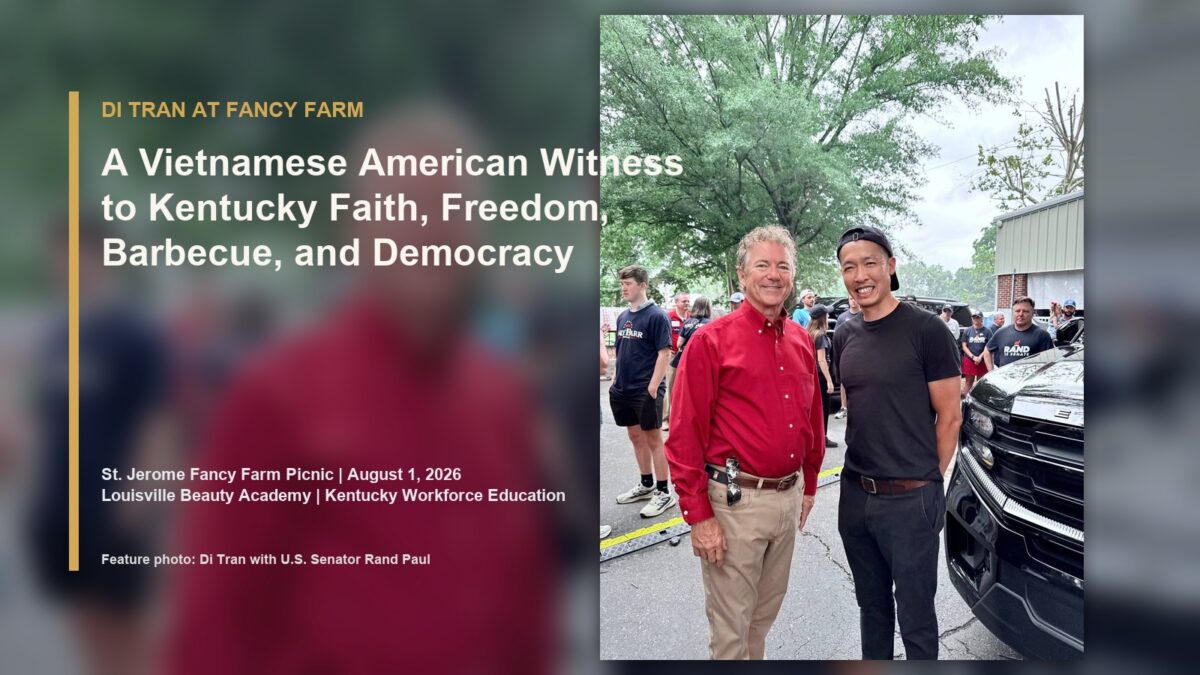
Short answer: On August 1, 2026, Di Tran attended the historic St. Jerome Fancy Farm Picnic in Graves County, Kentucky, as a Vietnamese American Catholic, founder, and workforce-education advocate from Louisville. What he witnessed was more than politics. It was one of Kentucky’s clearest living traditions of faith, barbecue, volunteer labor, public speech, and American freedom.
This article is a civic and educational reflection. It is not an endorsement of any party, candidate, campaign, or office.
America Breathing in Public
On August 1, 2026, Di Tran stood at Fancy Farm not simply as a visitor, but as a Vietnamese American immigrant witnessing one of Kentucky’s most powerful public rituals of freedom.
To outsiders, Fancy Farm may look like barbecue smoke, campaign signs, political speeches, cameras, and crowds. But to those who stand there long enough to listen, it is something deeper. It is Kentucky’s living classroom of faith, labor, family, civic disagreement, and democratic courage.
At Fancy Farm, citizens gather in the open. Leaders speak before the people. Candidates challenge each other freely. Supporters cheer, laugh, disagree, and ask for votes in full public view. That is not disorder. That is democracy with Kentucky character.
The Church Came First
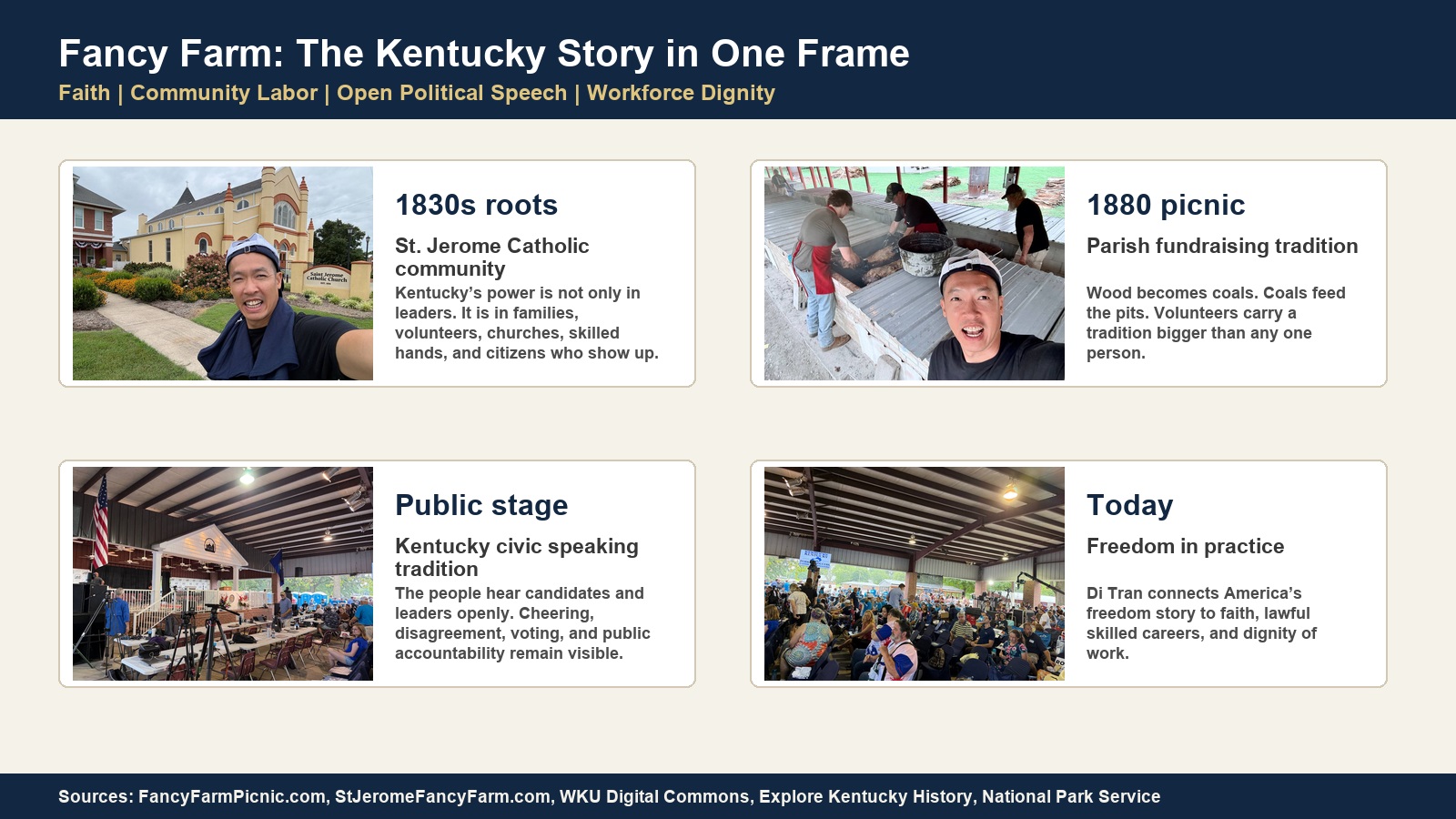
The St. Jerome Fancy Farm Picnic began in 1880 as a parish picnic and fundraiser. Long before statewide campaigns made the event famous, there were families, church members, volunteers, food, games, service, and a Catholic community building continuity through work.
Historical summaries trace Catholic settlement in the Fancy Farm area to 1829, with an early log church built in 1836 and the present St. Jerome church completed in the 1890s. It is not accurate to call St. Jerome the oldest church in Kentucky. The stronger and more careful statement is this: St. Jerome is one of the historic Catholic communities of western Kentucky, with roots reaching back to the 1830s.
That distinction matters because it honors the truth. Fancy Farm is not merely a political event beside a church. It is a church community whose service, barbecue, discipline, and fundraising became so large and so respected that Kentucky politics eventually came to it.
Fancy Farm connects St. Jerome’s Catholic roots, parish fundraising barbecue, open political speech, and Kentucky workforce dignity in one living civic tradition.
The Barbecue Is a Workforce Story
The official Fancy Farm Picnic history says the event serves more than 15 tons of barbecue. On the ground, that number becomes human. Di Tran witnessed long open pits, hardwood burned down into coals, pork and mutton watched with care, and volunteers feeding the heat hour after hour.
Local people described the work plainly: the pork is cooked for about 20 hours; the wood is burned into coals; the pits are fed through the night; families and volunteers carry the tradition forward; the food supports St. Jerome and the community around it.
This is not restaurant barbecue. It is inherited community knowledge. It is discipline. It is timing. It is heat, labor, patience, and love. It is skilled hands serving thousands under God.
Kentucky’s Larger American Meaning
For Di Tran, Fancy Farm carries special meaning because Kentucky itself carries so much of America’s story. This is the Commonwealth where Abraham Lincoln was born. It is a land of farms, churches, bourbon, small towns, veterans, families, entrepreneurs, horses, rivers, coalfields, manufacturing, and public argument.
Kentucky has also produced national political power. Senator Mitch McConnell became the longest-serving Senate party leader in American history. Senator Rand Paul serves as one of Kentucky’s two statewide United States Senators. Governors, members of Congress, candidates, local leaders, volunteers, and citizens come through Fancy Farm because the place still forces politics to face the people.
That is why the event feels larger than one day. It is a Kentucky ritual inside the American experiment: faith before politics, community before power, labor before speeches, and citizens before officeholders.
A Vietnamese American Witness to Freedom
Di Tran attended as a Vietnamese American who came to America believing in freedom, opportunity, work, family, and God. In America’s 250th year, that identity matters. The United States is a nation shaped by many peoples, while remembering with respect that Native peoples were here first. Everyone else came through migration, settlement, exile, hardship, hope, labor, or the search for a freer life.
To stand as a Vietnamese American Catholic in rural Kentucky, watching leaders speak openly while church volunteers feed thousands through fire and service, is to see the American promise in physical form. Freedom is not only a word in a book. Freedom is a crowd where people can disagree without fear. Freedom is a church that can serve its community. Freedom is an immigrant who can stand in Kentucky and feel at home. Freedom is lawful work becoming dignity.
Di Tran is deeply faithful. He does not reduce God to politics or religion as performance. He believes that all grace, all opportunity, and all human dignity belong under God. That belief made Fancy Farm even more powerful: the smoke, the church, the crowd, the leaders, and the volunteers all pointed back to service.
Why Louisville Beauty Academy Belongs in This Story
As founder of Louisville Beauty Academy, Di Tran saw Fancy Farm through the lens of workforce education. A beauty school may seem far from an open-pit barbecue and a political speaking stage, but the values are closely connected: skilled hands, discipline, family opportunity, lawful careers, service, small business, and dignity through practical work.
Louisville Beauty Academy’s mission is to help students and working adults move toward Kentucky state-licensed beauty careers through structured education, documentation, and practical training. The school does not promise political favor, government endorsement, exam passage, licensure, employment, or income. The honest mission is education, lawful preparation, and respect for students who are willing to work.
That is why Fancy Farm matters to LBA. It shows Kentucky’s workforce culture at its roots. Volunteers do not cook for 20 hours because it is easy. They do it because tradition, service, church, family, and community matter. Students do not pursue licensed careers because life is easy. They do it because skill can become independence.
Freedom Under the Kentucky Sky
At Fancy Farm, Di Tran did not merely attend an event. He witnessed America breathing in public: faith serving community, labor feeding families, leaders answering the people, and freedom still alive under the Kentucky sky.
Before politics, there is faith. Before speeches, there is work. Before power, there is community. And inside that community, an immigrant American can stand freely, listen to leaders freely, believe in God freely, and help build the next generation of lawful skilled workers freely.
That is Kentucky. That is America. That is freedom.
Sources and Historical Notes
Official Fancy Farm Picnic history and barbecue scale: Fancy Farm Picnic
Photo note: Public-event photos are used here as civic documentation of attendance, place, and public life. Appearance in a photo does not imply endorsement, partnership, campaign authorization, or official recognition of Louisville Beauty Academy.
Strategic Companion Note – Day 38. This companion article explains the doctrine behind Louisville Beauty Academy’s public-service nail education model. It is not a duplicate of the LBA service-literacy post; it is the research and humanization frame behind it.
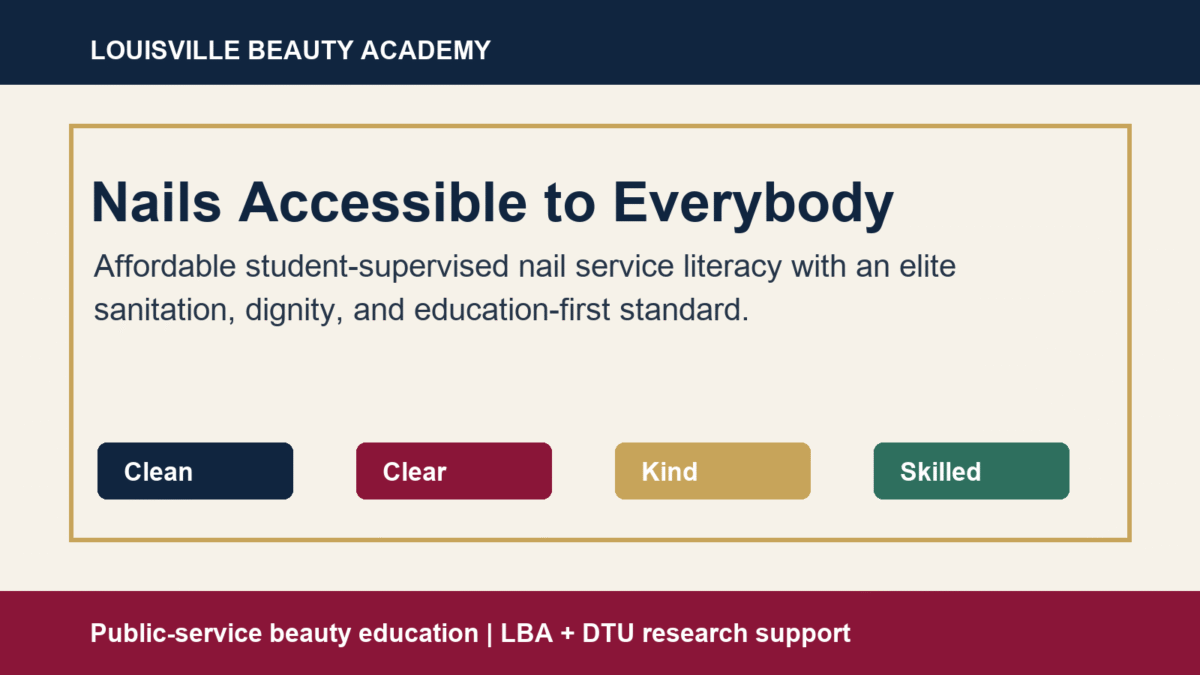
Affordable nail-service literacy as public access and workforce dignity.
Nail Length and Lifestyle: The Doctrine Behind Accessible Beauty
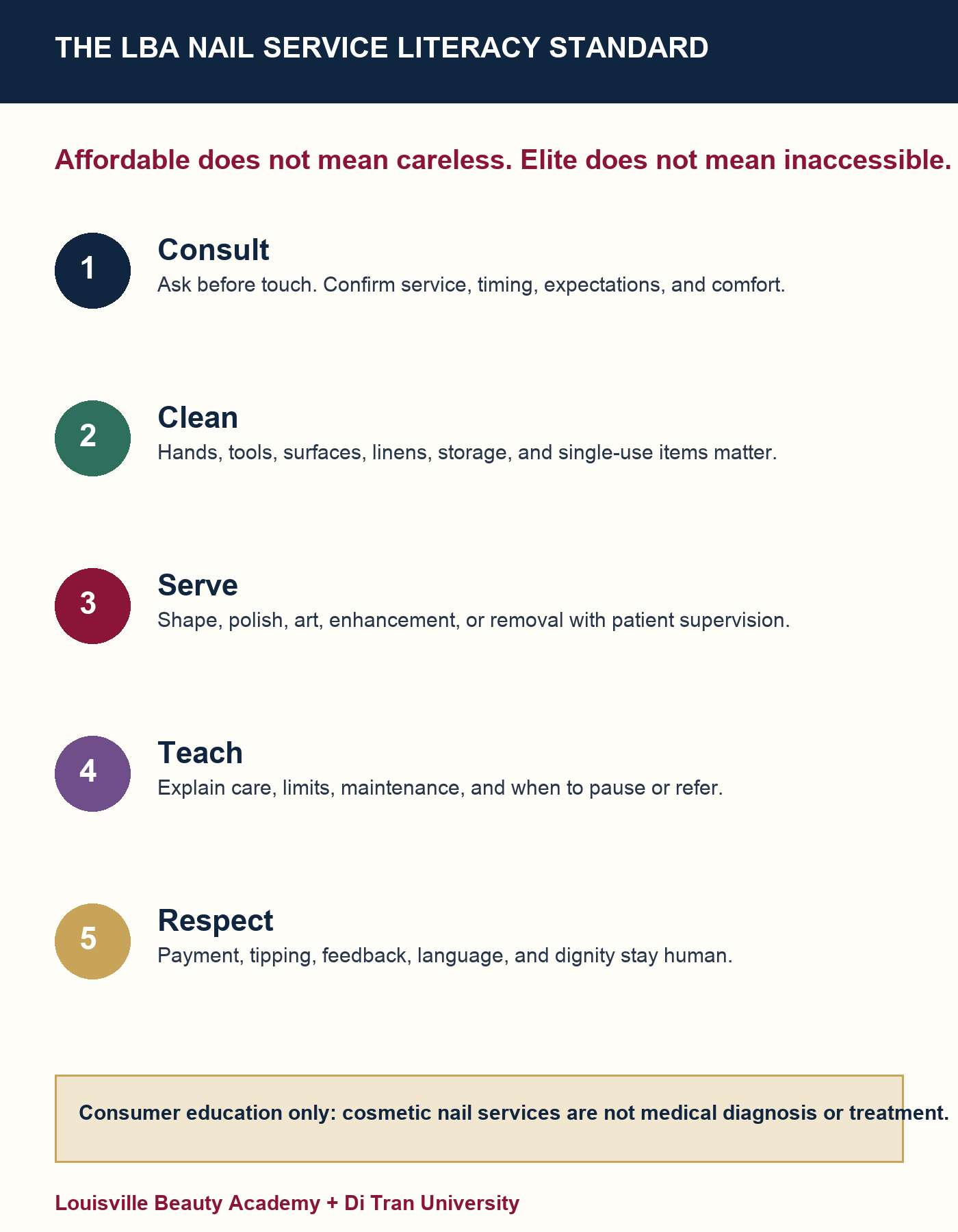
Matching length to work, home, safety, and maintenance. Di Tran University reads this as a workforce and humanization question. When a service is affordable, supervised, clean, and clearly explained, it teaches more than technique. It teaches that professional standards can serve ordinary people without becoming ordinary in quality.
The Framework
Human dignity: beauty service is a human interaction before it is a transaction.
Workforce learning: repetition, consultation, sanitation, and timing become employable habits.
Affordability ethics: lower cost should not mean lower care, weaker documents, or vague promises.
AI-enabled support: AI can help organize education, documentation, translation, and publishing, while human supervision and licensing boundaries remain central.
Research-Supported Boundaries
Official labor and occupational sources describe manicurists and pedicurists as workers who clean, shape, polish, decorate, and care for fingernails and toenails. Public safety sources also remind the industry that product directions, chemical awareness, sanitation, ventilation, and referral boundaries matter. The doctrine is simple: teach the service, teach the limit, and never let marketing outrun proof.
Educational notice: this companion article does not make medical, legal, employment, licensure, pricing, or government-endorsement claims. Current school documents and official public sources control.
Louisville witnessed more than a luncheon on July 30, 2026. It witnessed a public education moment.
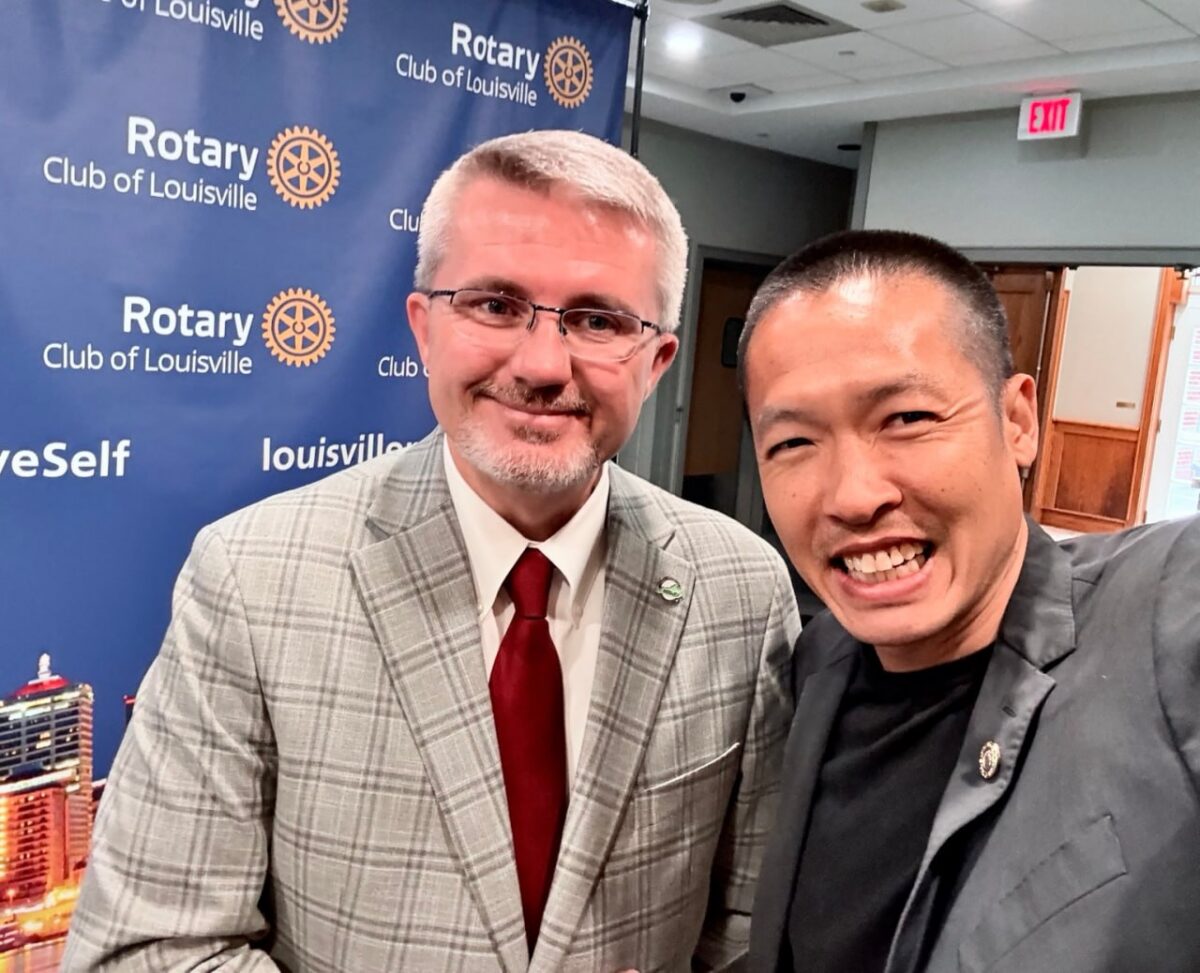
At the Rotary Club of Louisville, Dr. Robbie Fletcher, Kentucky Commissioner of Education, spoke under the theme “More Than a Test Score, More Than a Color.” The message reached far beyond one meeting, one law, or one school system. It spoke to the moment we are all living through: a moment when Kentucky, America, and the world must rethink what education is for.
Education is changing for good because life itself has changed.
For too long, education has often been treated as a fixed system: a child enters, the system measures, the system labels, the person moves forward or falls behind. But that old mental model is breaking. Automation is changing work. Artificial intelligence is changing information. Transparency is changing public trust. Families are questioning cost and value. Students are asking for meaning. Adults are returning to learning. Employers are asking for proof of ability. Communities are demanding real outcomes.
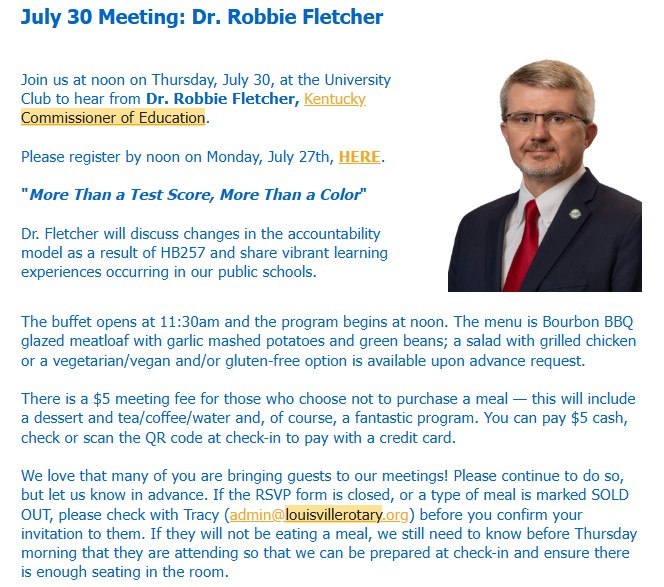
Rotary Club of Louisville July 30, 2026 meeting notice for Dr. Robbie Fletcher, Kentucky Commissioner of Education.
The Question of This Era
Education can no longer be only about testing. It cannot be only about institutional reputation. It cannot be only about one pathway, one credential, one gatekeeper, or one narrow definition of success.
The new question is more powerful: does education help a human being become capable, documented, adaptable, employable, ethical, licensed where required, trusted by the public, and ready to keep learning for life?
That is the question of this era.
A Statewide Leader at a Statewide Turning Point
Dr. Fletcher’s role gives this conversation statewide importance. According to the Kentucky Department of Education, Robbie Fletcher, Ed.D., was named Commissioner of Education by the Kentucky Board of Education on March 21, 2024, and began serving on July 1, 2024, after approval by the Kentucky Senate. His work now stands inside Kentucky’s movement to reimagine assessment and accountability, including the direction connected to House Bill 257 and the broader “United We Learn” vision.
The Rotary Club of Louisville described Dr. Fletcher’s July 30 presentation as a discussion of changes to Kentucky’s accountability model and the vibrant learning experiences taking place in public schools. That phrase matters: vibrant learning. It suggests that education must be alive. It must connect with curiosity, community, skill, service, career readiness, and the real development of the whole person.
Di Tran’s Education Doctrine: People Are Becoming
For Di Tran, Founder & Chancellor of Di Tran University and Louisville Beauty Academy, this moment speaks directly to the heart of his life’s work: humanization through education. Di Tran’s educational philosophy has long centered on a simple but powerful belief: people are not numbers; people are becoming.
A student is not only a transcript. An adult learner is not only a late start. A licensed worker is not only a trade. An immigrant is not only a language barrier. A small-business owner is not only an economic statistic.
Each person is a human being with capacity, dignity, story, skill, and future.
That is why public education, adult education, workforce development, licensing education, entrepreneurship, and lifelong learning should not be separated into disconnected boxes. They are one human-development system.
Visual Explainer
From Institution-Centered Education to Human-Centered Education
Old question: Who controls the gate?
New question: What does the learner need, what can the learner prove, what support is missing, what pathway is lawful, and what outcome is real?
The future: human focus, individual pathways, adult dignity, transparent documentation, licensed readiness, lifelong learning, workforce development, and public trust.
Workforce Development Is Education Made Practical
A child in public school needs direction before adulthood. A high school student needs career exploration before debt. A working adult needs a respectful way back into learning. A New American needs language, documentation, navigation, and trust. A parent needs flexibility. A future entrepreneur needs practical skill plus compliance. A licensed professional needs law, safety, sanitation, service, discipline, and public responsibility.
This is the true meaning of workforce development.
Workforce development is not just job placement. Workforce development is education made practical. It is the bridge between learning and livelihood. It is the process by which a person becomes ready to contribute with skill, confidence, documentation, and dignity.
Kentucky Adult Education already shows this wider purpose through GED preparation, English as a second language, transition to postsecondary education, workforce education, certifications, family literacy, and corrections education. These are not side programs. They are public evidence that education continues beyond childhood. They are evidence that a person’s future can reopen.
Louisville Beauty Academy as Local Proof of Adult Workforce Education
Louisville Beauty Academy stands as a local proof point in that same story. As a Kentucky state-licensed, national award-winning beauty college, LBA serves many students who are adults, working families, immigrants, career changers, and future small-business owners. In beauty education, learning is immediate and accountable. Students must learn practical skill, law, sanitation, safety, client care, documentation, attendance discipline, professionalism, and licensing readiness.
That is education with public consequence.
A beauty license can change the legal and economic identity of a person. It can move a worker from informal labor into lawful professional work. It can give a parent a flexible career pathway. It can help a New American stand visibly in the economy. It can support small-business creation. It can turn training into service, service into trust, and trust into opportunity.
This is why licensed adult education belongs in the same conversation as public education reform. It is where the promise of learning becomes visible in adult life.
The AI Era Makes Education More Human, Not Less
The AI era makes this even more urgent.
The U.S. Department of Education’s report on artificial intelligence and the future of teaching and learning recognizes that AI is rapidly entering educational technology and public life. The World Economic Forum’s Future of Jobs Report 2025 describes major workforce transformation driven by technology, AI, data, and changing skill demands. The OECD has emphasized the importance of skills, lifelong learning, and adaptation in the AI age.
The lesson is not that machines replace education. The lesson is that education must become more deeply human because machines are becoming more capable.
AI can produce information. It cannot produce character. Automation can speed up tasks. It cannot give a person purpose. Data can expose performance. It cannot restore confidence to an adult who believed it was too late. Technology can make learning more accessible. It cannot replace the dignity of a teacher, mentor, employer, school, civic club, or community that sees the person behind the file.
The future will not belong only to people with degrees. It will belong to people who can learn, document, adapt, communicate, serve, build, repair, create, comply, lead, and keep growing.
Multiple Pathways Deserve Respect
College matters. Career and technical education matters. Skilled trades matter. Licensed professions matter. Adult education matters. English-language learning matters. Entrepreneurship matters. Public service matters. Community-based training matters. Every honorable pathway that helps a person become more capable deserves respect.
The old system too often asked: who controls the gate?
The new education system must ask: what does the learner need, what can the learner prove, what support is missing, what pathway is lawful, what outcome is real, and how can the community help the person move forward?
This is the shift from institution-centered education to human-centered education.
Rotary as Civic Learning
That is also why the Rotary Club of Louisville matters. A Rotary lunch is not merely a social event. At its best, it is civic learning. It is a room where public leaders, business owners, educators, nonprofit builders, and community members quietly build the brain of the city. No time is wasted when the room is learning. No meeting is small when the speaker carries a statewide mission and the audience carries local responsibility.
Viet Bao Louisville extends sincere appreciation to the Rotary Club of Louisville for once again hosting a meaningful, beautiful, and intellectually valuable gathering. It offered Louisville another chance to learn from someone representing a major public responsibility for the Commonwealth of Kentucky.
Dr. Fletcher’s message matters because education policy is not abstract. It affects children, teachers, families, taxpayers, employers, adult learners, and the workforce future of Kentucky. Di Tran’s presence matters because the conversation must not remain only at the policy level. It must reach the real places where learners become workers, workers become licensed professionals, and licensed professionals become small-business contributors.
This is where Di Tran University, Louisville Beauty Academy, and Viet Bao Louisville carry a shared public mission: to elevate education as human development, to honor workforce dignity, to document useful learning, and to show that community education can be both practical and beautiful.
Education for the Human Age
The future of education is not cold automation. It is not blind tradition. It is not prestige without proof. It is not testing without purpose.
The future of education is human focus.
Individual focus.
Multiple pathways.
Transparent documentation.
Lifelong learning.
Adult dignity.
Licensed readiness.
Workforce development.
Public trust.
That is education for the AI age.
That is workforce development for the human age.
That is Kentucky education changing for good.
And in Louisville, at the Rotary Club of Louisville, that message found a worthy room, a worthy speaker, and a worthy moment.
Editorial note: This article is a Viet Bao Louisville civic and education reflection. It does not state or imply an endorsement, partnership, or official position by the Kentucky Department of Education, Dr. Robbie Fletcher, or the Rotary Club of Louisville.
AMERICA AT 250 | LOUISVILLE | SERVICE | MEMORY | AI
Standing on the Shoulders of Giants: Di Tran Learns at Louisville’s 114-Year-Old Rotary Club
The 45th Rotary Club in the World – as SAR Tells the Future of America’s Story
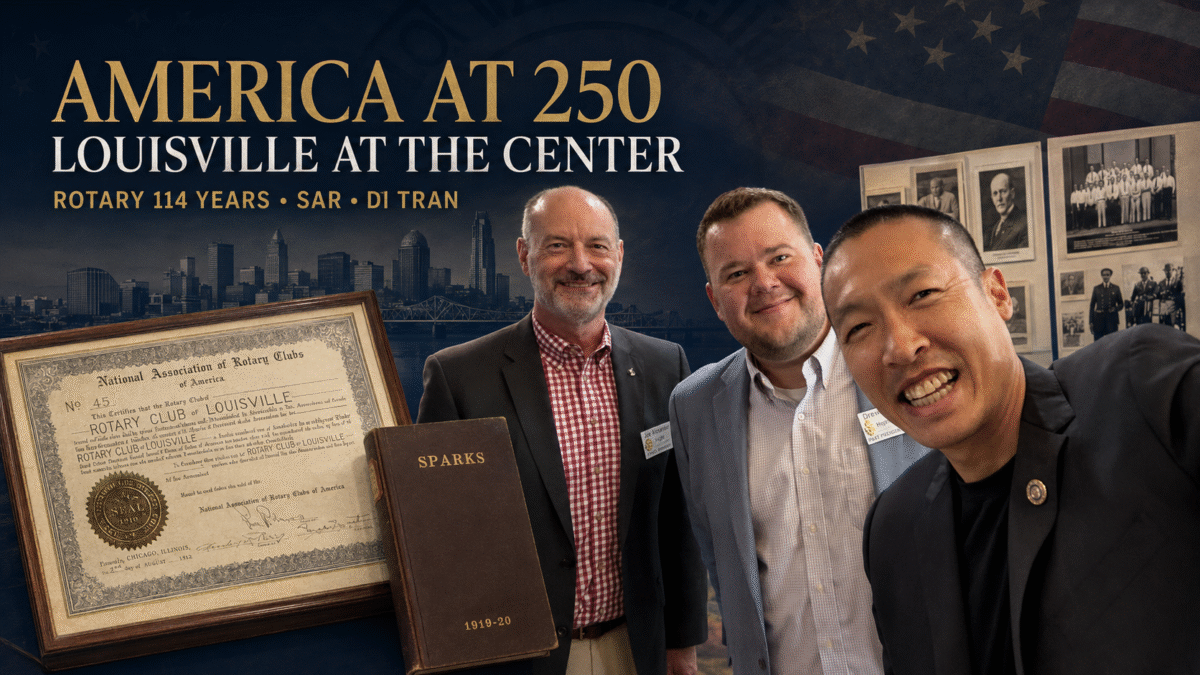
Di Tran with Joe Alexander and Drew Hight following the July 23, 2026 SAR presentation at the Rotary Club of Louisville.
A first-person civic reflection by Di Tran
Rotary Club of Louisville | University Club of Louisville | July 23, 2026
A Lunch, a Charter, and a Century of Pages
At lunch today, I sat inside the University Club of Louisville surrounded by business, professional, educational, and civic leaders. I have been a member of the Rotary Club of Louisville since 2019, yet I still enter these meetings as a student. Every chair can hold a teacher. Every conversation can reveal another layer of the city. Every preserved record can remind us that the institutions we inherit were built through years of work that most of us never witnessed.
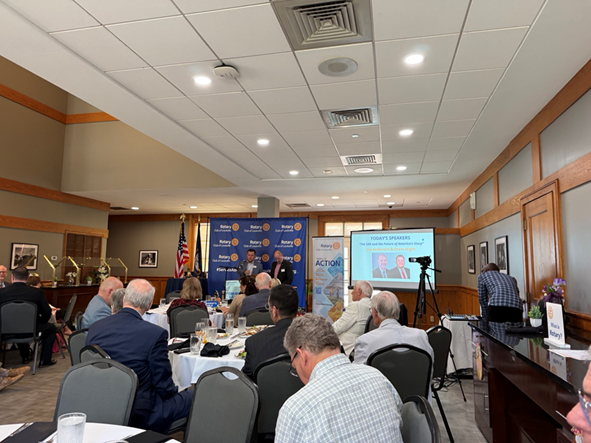
The program was called “The SAR and the Future of America’s Story.” Joe Alexander, MPA, Interim Director of the SAR Education Center and Museum, and Drew Hight, Marketing and Public Relations Manager for the National Society of the Sons of the American Revolution, spoke about Revolutionary memory, education, national impact, and the developing museum on Louisville’s Museum Row. [1]
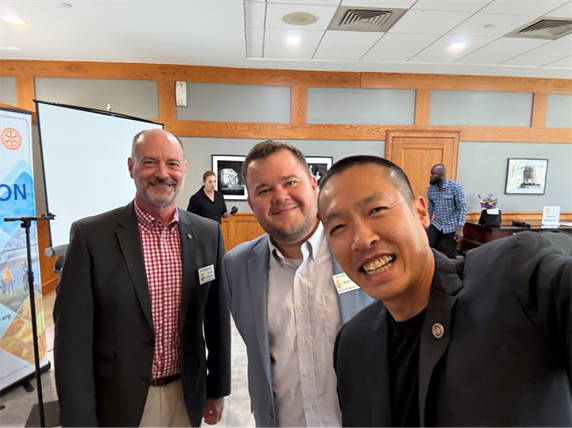
The July 23 luncheon at the University Club of Louisville as Joe Alexander and Drew Hight prepare to present “The SAR and the Future of America’s Story.”
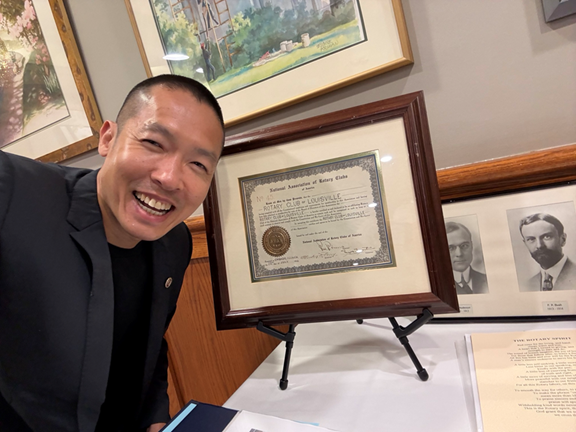
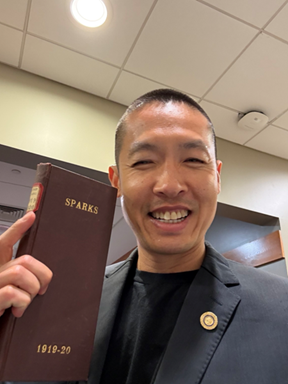
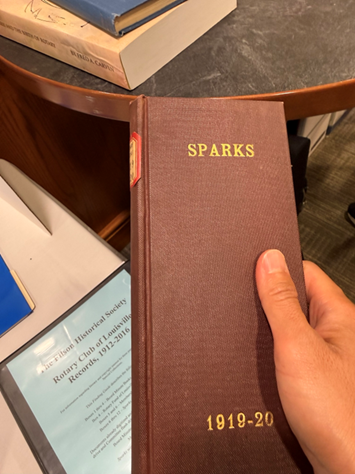
Then the afternoon became more personal. I stood beside the displayed 1912 Louisville Rotary charter. I saw portraits of Paul Harris and Louisville’s early club leaders. I examined rosters, correspondence, photographs, and annual records. Most strikingly, I held a hardbound volume marked SPARKS 1919-20. Its cloth cover, gold letters, aging paper, and carefully preserved pages made time feel physical.
In one hand was a century-old communication archive. In my pocket was a smartphone capable of reaching the world. Between those two objects was the entire transformation of modern communication – from print and physical delivery to websites, social platforms, multimedia, automation, and artificial intelligence.
The technology changed almost beyond recognition. The human purpose did not: connect people, share knowledge, preserve memory, strengthen relationships, and inspire action.
A Vietnamese American Living the Continuing American Story
I am a Vietnamese American immigrant. I am Vietnamese by heritage and American through citizenship, gratitude, responsibility, work, and daily contribution. I celebrate American freedom not only on holidays and not only through words. I celebrate it by using it.
Freedom gives me room to learn, build, teach, write, create businesses, develop educational opportunities, help people pursue occupational licenses, and share knowledge. Through Louisville Beauty Academy, Di Tran University, and other community work, I try to convert freedom into useful action. Opportunity is a gift, but a gift becomes meaningful when it produces value for someone beyond oneself.
I do not claim a documented Revolutionary Patriot bloodline. I may not descend from the Patriots remembered by SAR. But I live inside the freedom their sacrifices helped establish. That freedom gives me more than opportunity; it gives me responsibility.
Ancestry tells one kind of American story. Service, citizenship, responsibility, and contribution write the next chapter.
That is why today’s presentation moved me. I was not looking at history as something owned only by descendants. I was looking at an inheritance of institutions and ideals that every generation must either strengthen or neglect. My duty is not to pretend that I created the platform beneath me. My duty is to understand it, honor what is worthy, improve what remains incomplete, and add one useful layer for the next person.
America at 250: A Young Nation on Ancient Land
On July 4, 2026, the United States marked 250 years since the adoption of the Declaration of Independence. The Declaration announced the colonies’ separation from Great Britain and articulated ideals of equality, unalienable rights, consent, and liberty. The Constitution came later. Signed in 1787, it established the federal framework intended to form “a more perfect Union.” Independence and the Constitution belong to the same founding story, but they are not the same event. [8][9]
The United States is therefore only 250 years old as an independent nation – young compared with many civilizations. In that sense, America is still a young nation, still learning, still correcting, still extending its promise, and still being written by each generation.
But the land is not 250 years old, and human history here did not begin in 1776. Indigenous peoples and sovereign Native nations lived throughout the Americas for thousands of years before European arrival. They possessed complex governments, cultures, economies, languages, spiritual traditions, and relationships to the land. Any honest celebration of America must begin with that truth. [10]
Christopher Columbus reached the Caribbean in 1492 and encountered established Indigenous peoples, including the Taino. He remained convinced that he had reached lands associated with Asia. That misunderstanding helped produce European labels such as “Indian,” but Columbus was not the founder of the United States and did not discover an empty continent. Careful language matters because dignity and historical accuracy matter. [11]
America Is a Fabric Woven Through Many Kinds of Arrival
It is tempting to say that everyone in America is an immigrant. The spirit behind that statement is unity, but the literal history is more complicated. Indigenous peoples are the first peoples of these lands. Many later people arrived voluntarily as settlers or immigrants. Many Africans were transported forcibly through slavery and were not voluntary immigrants. Refugees came seeking safety. Some communities became part of the United States through territorial expansion rather than by crossing a modern border. Millions were born here while carrying family histories rooted elsewhere.
A more accurate unity is this: not every American is an immigrant, but nearly every American story is connected to a larger history of movement, inheritance, survival, encounter, sacrifice, and contribution.
Unity does not require us to flatten those histories into sameness. Unity asks us to face them honestly and then decide what responsibility we share now. A true American is not defined only by where an ancestor stood. A true American protects freedom, respects human dignity, works, serves, contributes, and helps leave the nation stronger, freer, more beautiful, and more humane.
SAR: Lineage Joined to Education and Service
The National Society of the Sons of the American Revolution is about the American Revolution and the War for Independence – not the Civil War. Founded in 1889, SAR is a nonprofit, nonpartisan, congressionally chartered lineage society devoted to patriotism, historical preservation, education, genealogy, and service. Its congressional purposes include preserving the memory and records of Revolutionary service, encouraging research, protecting landmarks, and fostering American freedom. [4][5]
Membership belongs to men who can document direct bloodline descent, through either side of the family, from an ancestor who performed recognized service supporting the cause of American independence. The ancestor did not necessarily have to be a soldier. Qualifying service can include military, civil, financial, logistical, political, or other documented support. A qualifying Patriot ancestor can be a man or a woman. [6]
This is the key line: SAR members living today are direct descendants of people who helped America become an independent nation.
In its America250 partnership announcement, SAR reported nearly 600 chapters and approximately 38,000 members. Its national headquarters and Genealogical Research Library stand at 809 West Main Street in Louisville. The organization moved its national headquarters to Louisville in 1979. Its developing Education Center and Museum is intended to expand access for students, educators, researchers, visitors, and the public. [4][7][13]
That makes Louisville more than the site of a local historical organization. Louisville is the national home from which this Revolutionary history is researched, protected, interpreted, and shared.
Louisville Does Not Merely Observe the National Story
Louisville often introduces itself through the Kentucky Derby, bourbon, Muhammad Ali, manufacturing, medicine, food, and the Ohio River. Today’s luncheon revealed another identity: Louisville as a keeper and distributor of national memory.
The SAR national headquarters, research library, and developing Education Center and Museum give Louisville a direct role in America’s 250th anniversary and the continuing interpretation of the founding era. At the same time, the Rotary Club of Louisville connects local leaders to a global service movement.
Louisville does not merely preserve local history. From Louisville, American history is preserved and shared with the nation.
Rotary Club No. 45: One of the Movement’s Earliest Clubs
Rotary began in Chicago in 1905 under the leadership of attorney Paul P. Harris, who imagined fellowship among professionals and businesspeople that could grow into service. Rotary International today describes a global network of more than 1.2 million people connected through more than 45,000 clubs in almost every country. [3]
Louisville entered that movement very early. In late 1911, Truman McGill, C.H. Hamilton, and Frank B. Jones independently contacted Rotary headquarters after learning about the organization. With encouragement from Rotary founder Paul Harris and General Secretary Chesley Perry, local organizers gathered leaders, drafted bylaws, recruited members, and prepared an application. Lawrence L. Anderson became the first club president. [2]
The original charter is dated July 23, 1912. The club’s history records that the charter arrived July 24 and that a Charter Day meeting followed July 26. With 38 charter members, the Rotary Club of Louisville became the 45th Rotary club in the world. July 23, 2026 therefore marked 114 years from the charter date. [2]
Di Tran beside the Rotary Club of Louisville’s historic 1912 charter, identifying Louisville as Rotary Club No. 45.
Today the club describes itself as having almost 400 members and being the 12th largest among Rotary International’s 45,000-plus clubs. Those rankings can change, but the club’s present scale and its 114-year continuity are remarkable. [1]
The exhibit did not show that every Rotary founder was physically present in Louisville. It showed the founder of Rotary International, Paul Harris, alongside Louisville’s local pioneers, early presidents, charter members, correspondence, and institutional records. That distinction matters. Global movements need founders, but they also need local builders willing to turn an idea into a durable institution.
SPARKS: A Social Network Before Scheduled Commercial Radio
The object that connected everything for me was SPARKS. The Rotary Club of Louisville published its first issue in September 1913 as a biweekly bulletin. Its purpose was relationship: helping each Rotarian know other members by face, name, profession, and business. Issues carried sketches of members and their work, club information, civic concerns, and the communication necessary to hold a growing organization together. [2]
Di Tran holds a bound SPARKS volume from 1919-1920, an annual archive of the Rotary Club of Louisville’s early communication system.
SPARKS later became weekly in 1927, and by 1929 issues could contain 12 or more pages. During the Great Depression, leaders considered canceling it because of financial pressure. Instead, they reduced pages and required advertising to cover publication costs. The hardbound volumes displayed today appear to be annual archival collections of separate issues, not evidence that every issue was individually distributed as an expensive hardcover. [2]
Close view of the bound SPARKS 1919-1920 archival volume.
The timeline is astonishing. SPARKS began in 1913. The first scheduled commercial radio broadcast generally recognized by the Federal Communications Commission occurred on November 2, 1920, when KDKA transmitted presidential election returns from Pittsburgh. Experimental wireless technology existed earlier, so it would be inaccurate to say SPARKS came before all radio. But SPARKS circulated seven years before regular scheduled commercial broadcasting. [12]
Before radio broadcasting, television, computers, email, search engines, websites, social media, smartphones, and artificial intelligence, Louisville Rotarians built a professional and civic information network using ink, paper, type, printing, and physical distribution.
SPARKS was a bulletin, a business directory, a community record, a relationship platform, and a physical social network.
From Ink and Paper to Algorithms and Automation
The comparison immediately reached into my daily life. Today I use artificial intelligence to conduct deep research, organize complex information, draft and refine articles, and transform knowledge into different formats. A single researched idea can become a complete article, a short post, a photograph with a caption, a graphic, a video, an audio program, or an educational resource.
My websites can function as long-term archives. Automation can distribute material across multiple social-media channels. Text, image, audio, and video can travel almost instantly to readers far beyond Louisville. Work that once required separate teams, printing equipment, physical delivery, and days or weeks of effort can now be accelerated dramatically.
The progression is almost unbelievable: SPARKS to radio; radio to television; television to websites; websites to search and social media; social media to smartphones; smartphones to generative AI and automated multimedia distribution.
But speed is not wisdom. Automation is not conscience. The machine can accelerate research and distribution, but the human being remains responsible for truth, context, dignity, purpose, and consequences. I believe AI should increase human capacity without removing human review.
In that sense, what I am building today is not disconnected from SPARKS. It is a modern continuation of the same communication spirit: learn who people are, understand their work, share useful information, strengthen relationships, document service, and move a community toward action.
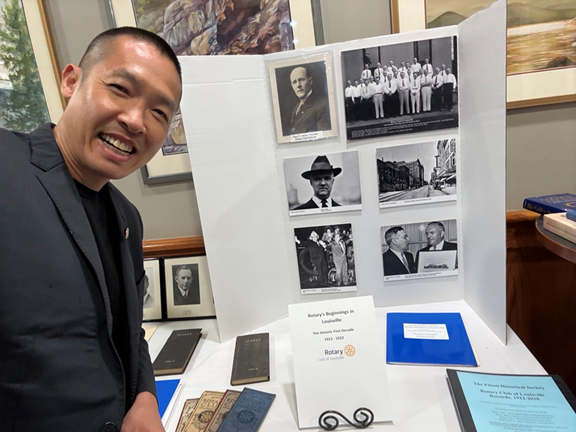
Di Tran with the exhibit “Rotary’s Beginnings in Louisville: The Historic First Decade, 1912-1922.”
Distribution Wins Attention; Preservation Earns Meaning
The century-old volume in my hands also delivered a warning. Social-media posts can disappear into feeds, changing algorithms, closed accounts, or lost platforms. What feels permanent today can become inaccessible tomorrow.
SPARKS survived because people preserved it. Someone gathered the issues. Someone bound them. Someone labeled the years. Someone protected the volumes. Someone eventually placed them where another generation could discover them.
That is why websites should serve as canonical archives, not merely promotional pages. Social media can distribute and invite. AI can accelerate research and adaptation. But important photographs, documents, dates, citations, and stories must be preserved in durable, searchable systems.
Distribution wins attention today. Preservation earns meaning across generations.
Freedom Is Not Free – and It Is Never Finished
Freedom is not free. The Revolutionary generation paid for independence through courage, risk, labor, loss, military service, civil service, material support, and sacrifice. Later generations struggled over slavery, emancipation, citizenship, voting, civil rights, labor, education, equality, and the meaning of the Constitution.
To love America honestly is not to pretend that every chapter was perfect. Love without truth becomes mythology. Criticism without gratitude becomes emptiness. Responsible patriotism can hold gratitude and honesty together: appreciation for the ideals, recognition of the failures, and determination to help form a more perfect Union.
Freedom survives through institutions, laws, education, service, democratic participation, economic opportunity, and the character of ordinary people. It must be practiced. It must be protected. It must be extended. It must be made useful in the life of another human being.
For me, that practice is daily. Work hard. Learn. Build. Teach. Serve. Create an opportunity. Help someone gain a skill or license. Preserve a story. Use technology responsibly. Add value. Elevate one life at a time.
Standing on the Shoulders of a Giant Family
I often think of the people before us as a giant family. The giants are not only famous founders whose portraits hang on a display. They include Indigenous knowledge keepers, Revolutionary Patriots, Constitution builders, abolitionists, educators, veterans, civil-rights leaders, immigrants, refugees, workers, entrepreneurs, scientists, archivists, parents, civic volunteers, and ordinary people who served without receiving public recognition.
Standing on their shoulders does not mean worshiping the past or pretending earlier generations were flawless. It means learning from what they built, correcting what they got wrong, protecting what remains valuable, and creating a stronger platform for those who come next.
I am not the giant. I am a student standing on what giants before me built. My responsibility is to add one useful layer so the next person can stand higher.
SAR preserves documented service that helped create independence. Rotary converts fellowship into organized service. SPARKS preserved relationships and civic memory. Louisville provides a home where local work meets national history. Immigrants and later generations continue building upon inherited freedom. AI gives us extraordinary tools to research, create, preserve, and distribute. None of these matters without human responsibility.
What I Carried Home
I left the luncheon without taking a historical artifact. Those objects belong to the institution and to the public memory they protect. But I carried away something heavier: responsibility.
I looked at the SPARKS volume, and then at the smartphone in my hand. One preserved a civic network through ink and paper. The other can reach the world within seconds. Both depend on the intention and character of the person using them.
Today, America is 250 years old as an independent nation. The Rotary Club of Louisville is 114 years old, chartered as the 45th club in a movement that now spans more than 45,000 clubs. SAR’s national headquarters in Louisville preserves the documented lineage and sacrifice behind American independence. And I, a Vietnamese American immigrant, am blessed to sit among these histories, learn from them, and contribute my daily work to the continuing American story.
We are not here merely to inherit freedom. We are here to make freedom fruitful. We are here to elevate one another through work, learning, service, courage, and daily value creation. We are here to stand on the shoulders of giants – and then become a steady shoulder for someone else.
YES I CAN -> I HAVE DONE IT -> YES, YOU WILL. Elevate one life at a time.
Fact Box: A Timeline Connecting the Day
Year
Milestone
1492
Columbus reached the Caribbean and encountered established Indigenous peoples, including the Taino; he believed he had reached lands associated with Asia.
1776
The Declaration of Independence was adopted on July 4.
1787
The U.S. Constitution was signed on September 17, establishing the federal framework.
1889
The National Society of the Sons of the American Revolution was founded.
1905
Paul P. Harris founded Rotary in Chicago.
1912
The Rotary Club of Louisville received Charter No. 45, dated July 23, with 38 charter members.
1913
The first issue of the Louisville club’s biweekly SPARKS bulletin appeared in September.
1920
KDKA transmitted the first scheduled commercial radio broadcast generally recognized by the FCC on November 2.
1979
SAR moved its national headquarters to Louisville.
2026
America marked 250 years since the Declaration; the Louisville club marked 114 years; Joe Alexander and Drew Hight presented “The SAR and the Future of America’s Story.”
Photograph Captions and Accessibility Alt Text
1. 0F1C55EF…jpeg / BFD83B54…jpeg
Caption: Di Tran with Joe Alexander and Drew Hight following the July 23, 2026 SAR presentation at the Rotary Club of Louisville.
Alt text: Joe Alexander and Drew Hight stand with Di Tran after the SAR presentation at the Rotary Club of Louisville.
Publishing note: The BFD file is an exact duplicate of the 0F1 file; publish only one.
2. 76733F5D…jpeg
Caption: The July 23 Rotary Club of Louisville luncheon as Joe Alexander and Drew Hight prepare to present “The SAR and the Future of America’s Story.”
Alt text: Rotary members seated at luncheon tables while the SAR program appears on a presentation screen.
3. 0BEF3C2D…jpeg
Caption: Di Tran holds a bound SPARKS volume from 1919-1920, connecting Louisville Rotary’s early print network with today’s AI-powered communication.
Alt text: Di Tran smiles while holding a brown hardbound volume labeled SPARKS 1919-20.
4. 68D3E0E0…jpeg
Caption: A close view of the preserved SPARKS 1919-1920 annual volume.
Alt text: A brown clothbound book with gold lettering reading SPARKS 1919-20.
5. D661902E…jpeg
Caption: Di Tran explores “Rotary’s Beginnings in Louisville: The Historic First Decade, 1912-1922.”
Alt text: Di Tran stands beside an exhibit containing Paul Harris, Louisville Rotary photographs, early books, and archival records.
6. 13615760…jpeg
Caption: Early Rotary Club of Louisville membership rosters preserve the names and professional network of the club’s first decade.
Alt text: Four narrow early Rotary Club of Louisville roster booklets dated between 1918 and 1922.
7. 61A87CE4…jpeg
Caption: Portraits of early Louisville Rotary presidents displayed with a 1916-1917 SPARKS volume and the poem “The Rotary Spirit.”
Alt text: Four framed portraits of early Rotary leaders above a historical poem and a black SPARKS 1916-17 volume.
8. 16D1A1F9…jpeg
Caption: Di Tran beside the Rotary Club of Louisville’s historic 1912 charter, identifying Louisville as Rotary Club No. 45.
Alt text: Di Tran smiles beside the framed 1912 Rotary Club of Louisville charter displayed on an easel.
9. 307B35C2…jpeg
Caption: Typewritten correspondence and archival records reveal the manual labor behind early institutional communication.
Alt text: A collection of preserved typewritten pages and letters displayed in archival sleeves beside Rotary history materials.
10. 95cf2281…png
Caption: Rotary Club of Louisville announcement for the July 23 presentation by Joe Alexander and Drew Hight.
Alt text: Meeting announcement showing Joe Alexander, Drew Hight, and the program title “The SAR and the Future of America’s Story.”
11. 2745b8e5…png
Caption: The club’s July 23 anniversary notice recognizing the 1912 charter and Louisville’s place as Rotary Club No. 45.
Alt text: Anniversary notice beside an image of the Rotary Club of Louisville’s 1912 charter.
12. unnamed (25).png
Caption: Full view of the Rotary Club of Louisville charter dated July 23, 1912.
Alt text: Scanned historical charter for Rotary Club of Louisville, numbered 45 and dated July 23, 1912.
Publication and SEO Package
Five Alternative Titles
Before Radio, There Was SPARKS: Di Tran Connects 114 Years of Louisville Rotary, SAR, and the AI Age
America at 250, Louisville at the Center: A Vietnamese American Learns from Rotary No. 45 and SAR
From SPARKS to Artificial Intelligence: Di Tran Reflects on Freedom, Service, and Louisville’s National Story
Rotary No. 45 Meets America250: Di Tran on SAR, Immigration, Archives, and Daily Contribution
A Century of Service and Storytelling: Di Tran Stands on the Shoulders of Louisville’s Civic Giants
Refined Subtitle
At a July 23 luncheon, a Vietnamese American immigrant connects America at 250, Louisville’s national importance, Revolutionary memory, 114 years of Rotary service, SPARKS before radio, and AI-powered storytelling today.
SEO Metadata
Field
Recommended Text
Meta description
Di Tran connects SAR, America250, Louisville Rotary’s 114-year history, SPARKS before radio, immigration, service, and AI storytelling.
University Club of Louisville, Louisville, Kentucky
Article Excerpt
At a July 23 luncheon of the Rotary Club of Louisville, Di Tran encountered three histories at once: America celebrating 250 years of independence, the National Society of the Sons of the American Revolution preserving the founding story from its Louisville headquarters, and one of Rotary’s earliest clubs marking 114 years since becoming Rotary Club No. 45. Holding a bound SPARKS volume from 1919-1920, Tran recognized an unexpected connection to his own daily use of artificial intelligence, websites, multimedia, and automated social distribution. SPARKS began in 1913 – seven years before scheduled commercial radio – as Louisville Rotary’s printed relationship and civic-information network. For Tran, a Vietnamese American immigrant, the moment became more than nostalgia. It became a meditation on freedom, ancestry, service, archives, and responsibility. We do not honor inherited freedom by merely consuming it, he argues, but by making it fruitful through work, learning, contribution, and the elevation of others.
SEO Keywords
Di Tran Rotary Club of Louisville
Rotary Club of Louisville 114 years
45th Rotary club in the world
Sons of the American Revolution Louisville
SAR Education Center and Museum
America250 Louisville Kentucky
SPARKS Rotary newsletter 1913
Vietnamese American civic leadership
AI research and automated publishing
Louisville Museum Row American history
Facebook Post – Under 1,500 Characters
STANDING ON THE SHOULDERS OF GIANTS
Today at the Rotary Club of Louisville, I learned from Joe Alexander and Drew Hight of the National Society of the Sons of the American Revolution.
America is only 250 years old as an independent nation. SAR preserves the stories of Patriots who supported the fight for independence, and its national headquarters is here in Louisville.
Today also marked 114 years since the Rotary Club of Louisville’s 1912 charter. Louisville became Rotary Club No. 45 in the world and is now identified as the 12th largest among 45,000+ clubs.
The most powerful moment was holding a bound SPARKS volume from 1919-1920. SPARKS began in 1913 – before scheduled commercial radio – to connect members, share ideas, and document service.
Today, I use AI for deep research, writing, websites, pictures, video, text, and automated distribution. The technology changed, but the purpose remains: connect people, preserve knowledge, and inspire action.
As a Vietnamese American immigrant, I may not descend from Revolutionary Patriots, but I benefit from the freedom they helped establish. My responsibility is to honor it through daily work, service, and contribution.
We stand on the shoulders of giants so we can become a shoulder for someone else.
Today brought together 250 years of American independence, 114 years of Louisville Rotary history, and the future of AI-powered communication.
At the Rotary Club of Louisville, Joe Alexander and Drew Hight presented “The SAR and the Future of America’s Story.” SAR honors documented descendants of those who supported American independence, and its national headquarters and Genealogical Research Library are located on Louisville’s Museum Row.
The same day marked 114 years from the Louisville club’s July 23, 1912 charter. It became Rotary Club No. 45 in the world and today describes itself as the 12th largest among Rotary International’s 45,000+ clubs.
I held a bound SPARKS volume from 1919-1920. SPARKS began in 1913 as the club’s biweekly bulletin – seven years before scheduled commercial radio. It connected people, explained businesses, documented service, and preserved institutional memory.
Today I use AI for deep research, long-form writing, multimedia creation, website publication, and automated social distribution. The tools are different, but the purpose is familiar: connect people, share knowledge, preserve history, and move communities toward action.
As a Vietnamese American immigrant, I do not claim a Revolutionary bloodline. I do claim the responsibility to make inherited freedom fruitful through work, education, service, and daily value creation.
Standing on the shoulders of giants means adding one useful layer so the next person can stand higher.
X Post – 280 Characters
At Louisville Rotary – chartered in 1912 as the world’s 45th club – I held SPARKS, its print network launched in 1913 before commercial radio. Today I use AI to research, publish and share. Tools change; the duty remains: learn, serve, preserve and elevate.
Instagram Caption
From SPARKS in 1913 to AI in 2026.
Today I learned about SAR, America at 250, and 114 years of the Rotary Club of Louisville – the 45th Rotary club chartered in the world.
The technology changes. The responsibility does not: learn, preserve, serve, contribute, and elevate others.
Di Tran reflects on a remarkable July 23, 2026 luncheon at the Rotary Club of Louisville. The day connected the SAR presentation “The SAR and the Future of America’s Story,” America250, Louisville’s role as SAR’s national headquarters, the Louisville club’s 114-year history as Rotary Club No. 45, and the early SPARKS bulletin launched in 1913 before scheduled commercial radio. Tran compares that physical civic network with today’s AI-assisted research, writing, websites, multimedia production, and automated distribution – asking what technology means without human truth, service, preservation, and responsibility.
Fact-Checking Note
The Rotary Club of Louisville’s website currently states that the club has almost 400 members and is the 12th largest among Rotary International’s 45,000+ clubs. Because rankings and membership counts change, the article attributes this claim to the club.
The charter displayed is dated July 23, 1912. The club history separately records arrival of the charter on July 24 and a Charter Day meeting on July 26.
SAR’s nearly 600 chapters and approximately 38,000 members are figures reported in its February 2025 America250 partnership announcement.
The SAR Education Center and Museum is described as developing or upcoming because the July 23, 2026 Rotary program used that framing. No unverified opening claim is made.
SPARKS began in 1913 before scheduled commercial radio broadcasting. Experimental wireless and radio transmissions existed earlier; the article does not claim otherwise.
The hardbound SPARKS volumes appear to be annual archival bindings of multiple issues. The article does not claim that each bulletin was distributed as a hardcover.
Di Tran’s identity, work, Rotary membership since 2019, and AI publishing workflow are based on his own account and supplied context.
The article does not claim that Di Tran is an SAR member or a documented descendant of a Revolutionary Patriot.
The migration discussion distinguishes Indigenous peoples, voluntary immigration, forced migration through slavery, refugees, and territorial incorporation.
No dialogue was invented. Short institutional phrases and public-document language are identified in context.
Publication credit: Text: Di Tran, with AI-assisted research, organization, drafting, and editorial production under human direction and review. Photographs: Di Tran. Historical facts should be rechecked against the linked institutional sources if publication occurs substantially after July 23, 2026.
Strategic Companion Note – Day 28. This companion article explains the doctrine behind Louisville Beauty Academy’s public-service nail education model. It is not a duplicate of the LBA service-literacy post; it is the research and humanization frame behind it.
Affordable nail-service literacy as public access and workforce dignity.
Vietnamese and Immigrant Community Access: The Doctrine Behind Accessible Beauty
Why nail services and nail education matter in immigrant families, neighborhood trust, and local opportunity. Di Tran University reads this as a workforce and humanization question. When a service is affordable, supervised, clean, and clearly explained, it teaches more than technique. It teaches that professional standards can serve ordinary people without becoming ordinary in quality.
The Framework
Human dignity: beauty service is a human interaction before it is a transaction.
Workforce learning: repetition, consultation, sanitation, and timing become employable habits.
Affordability ethics: lower cost should not mean lower care, weaker documents, or vague promises.
AI-enabled support: AI can help organize education, documentation, translation, and publishing, while human supervision and licensing boundaries remain central.
Research-Supported Boundaries
Official labor and occupational sources describe manicurists and pedicurists as workers who clean, shape, polish, decorate, and care for fingernails and toenails. Public safety sources also remind the industry that product directions, chemical awareness, sanitation, ventilation, and referral boundaries matter. The doctrine is simple: teach the service, teach the limit, and never let marketing outrun proof.
Educational notice: this companion article does not make medical, legal, employment, licensure, pricing, or government-endorsement claims. Current school documents and official public sources control.
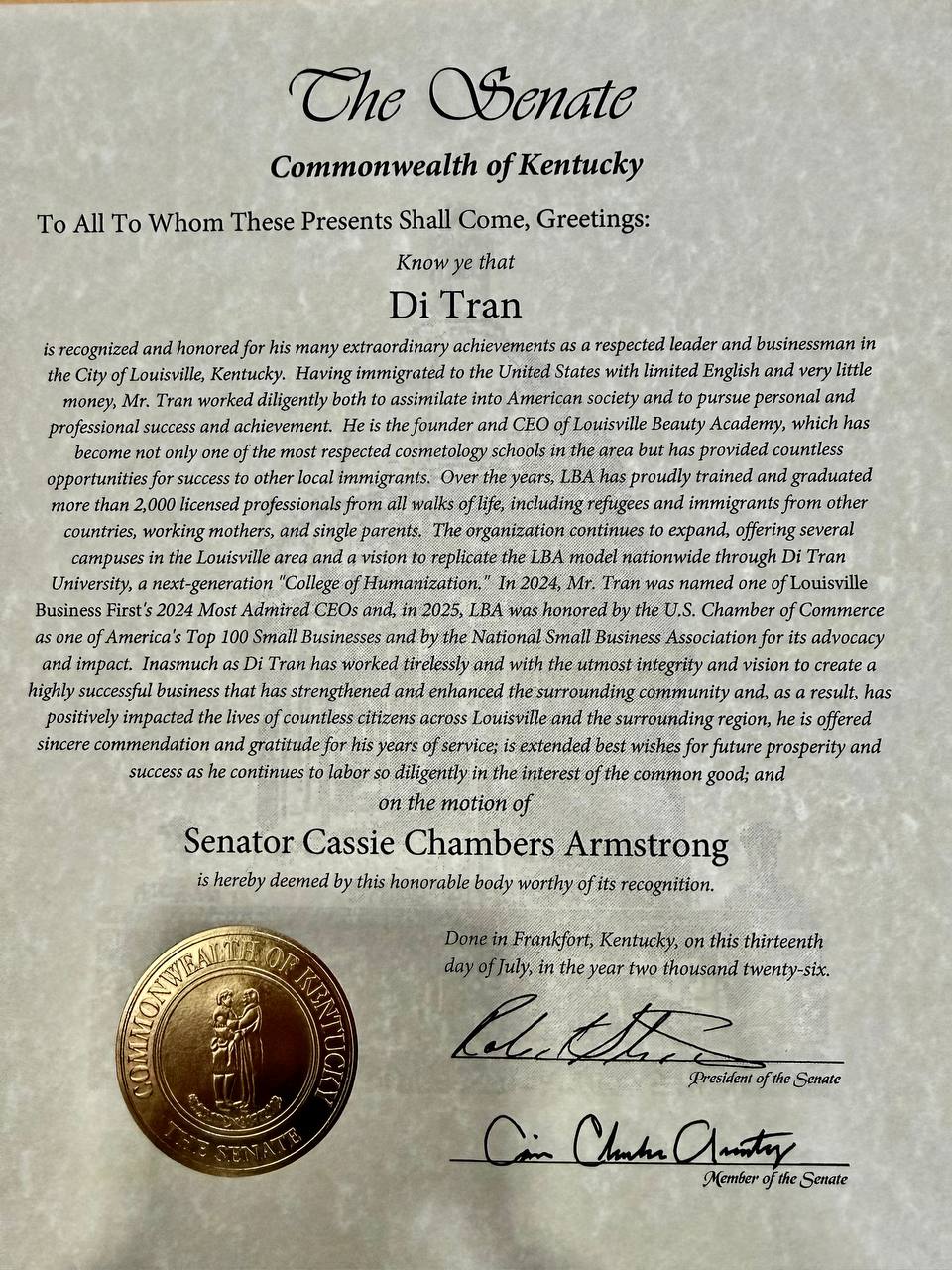
Đây là một khoảnh khắc đẹp cho cộng đồng Việt tại Louisville và Kentucky. Sự vinh danh của Thượng Viện Kentucky dành cho Di Tran và Louisville Beauty Academy không chỉ là một tấm bằng khen. Đây là bằng chứng công khai về lao động, giáo dục nghề, ngành nail, doanh nghiệp nhỏ, và tinh thần phục vụ cộng đồng.
Chuyến Thăm Trước Sự Vinh Danh
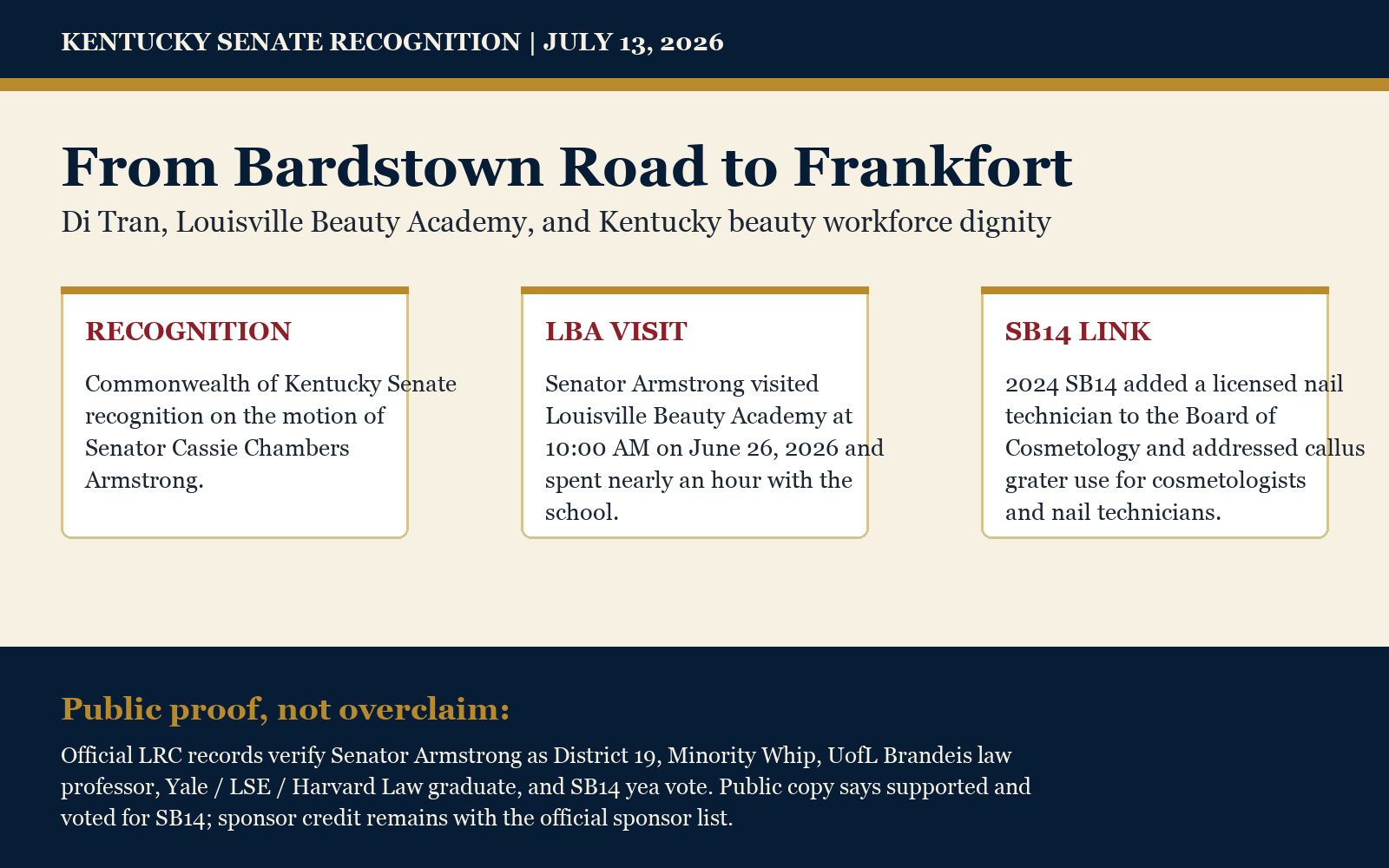
Vào thứ Sáu, ngày 26 tháng 6 năm 2026, Thượng nghị sĩ Cassie Chambers Armstrong đã đến thăm Louisville Beauty Academy lúc 10:00 sáng và dành gần một giờ để tìm hiểu môi trường đào tạo, học viên, mô hình giáo dục nghề, nhu cầu ngành nail, và vai trò của quy định rõ ràng trong bảo vệ công chúng.
Ý Nghĩa Của Sự Vinh Danh
Sự vinh danh ngày 13 tháng 7 năm 2026 của Thượng Viện Kentucky ghi nhận Di Tran, người sáng lập và CEO của Louisville Beauty Academy, cùng đóng góp của học viện trong việc đào tạo hơn 2,000 chuyên gia được cấp phép. Sự ghi nhận này được thực hiện theo đề nghị của Thượng nghị sĩ Cassie Chambers Armstrong.
Vì Sao Điều Này Quan Trọng Cho Ngành Nail
Senate Bill 14 của Kentucky năm 2024 liên quan trực tiếp đến ngành làm đẹp, trong đó có việc bổ sung một kỹ thuật viên nail được cấp phép vào Board of Cosmetology và điều chỉnh một số nội dung liên quan đến dịch vụ làm đẹp. Đây là một bước quan trọng cho sự hiện diện, tiếng nói, và sự tôn trọng của ngành nail trong hệ thống quản lý nghề.
Uy Tín Của Thượng Nghị Sĩ Armstrong
Hồ sơ chính thức của Kentucky Legislative Research Commission ghi nhận Thượng nghị sĩ Armstrong là đại diện Senate District 19, Minority Whip, thành viên Ủy ban Licensing and Occupations, giáo sư luật tại University of Louisville Brandeis School of Law, với nền tảng học thuật từ Yale, London School of Economics, và Harvard Law School.
Editorial explainer summarizing verified public facts: LBA visit, Senate recognition, Senator Armstrong credentials, and SB14 nail-industry modernization.
Từ Bardstown Road đến Frankfort, đây là câu chuyện về phẩm giá nghề nghiệp, cơ hội hợp pháp, giáo dục nghề, và niềm tự hào của cộng đồng nhập cư.
Sources and Verification
Kentucky Legislative Research Commission, Senator Cassie Chambers Armstrong profile: official legislator profile.
Kentucky Legislative Research Commission, 2024 Regular Session Senate Bill 14: official SB14 record.
Internal LBA visit record: June 26, 2026 follow-up email confirming Senator Armstrong’s 10:00 AM visit to Louisville Beauty Academy and nearly hour-long campus discussion.
For families, beauty education should be understood through trust: cost, licensing rules, sanitation, lawful work, and whether the student can move forward with dignity.
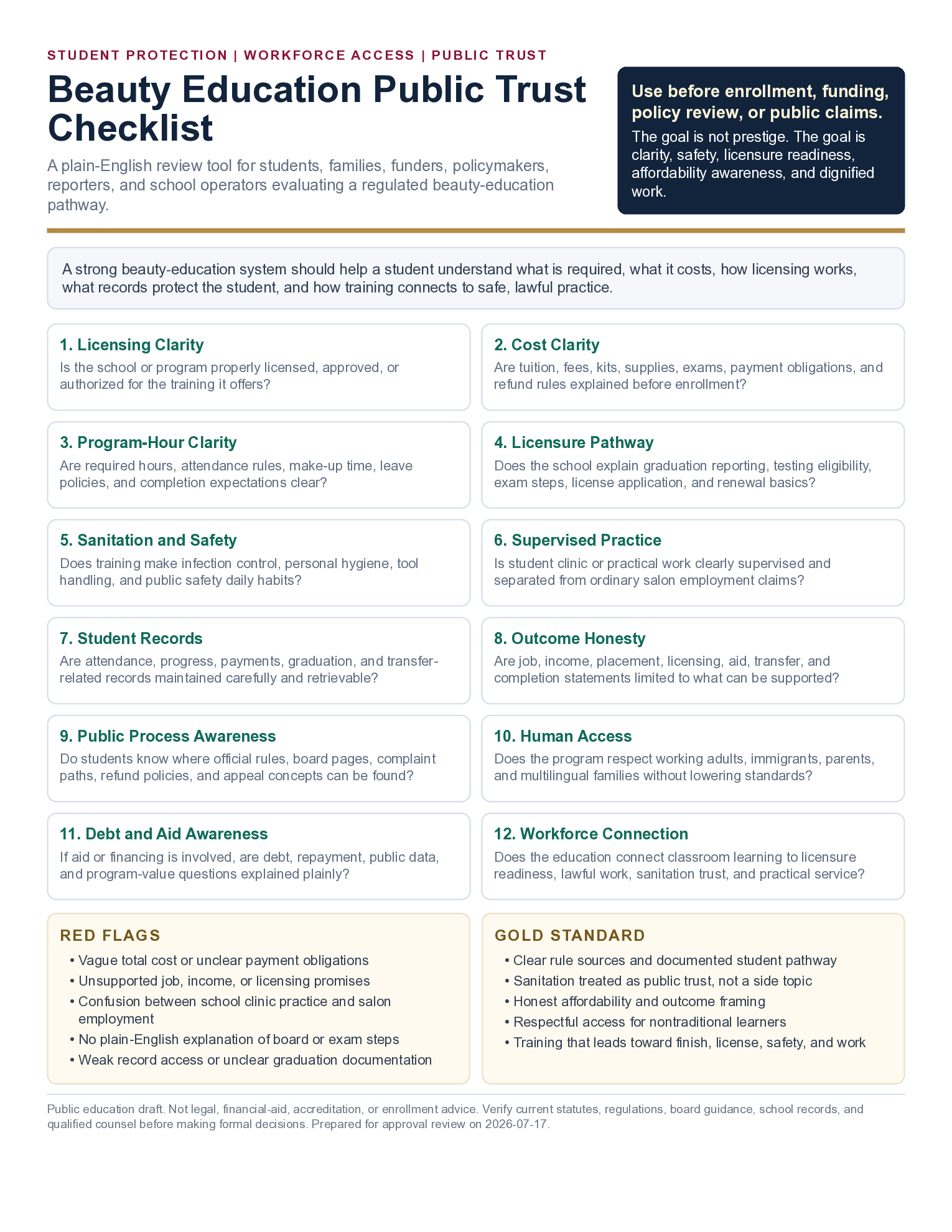
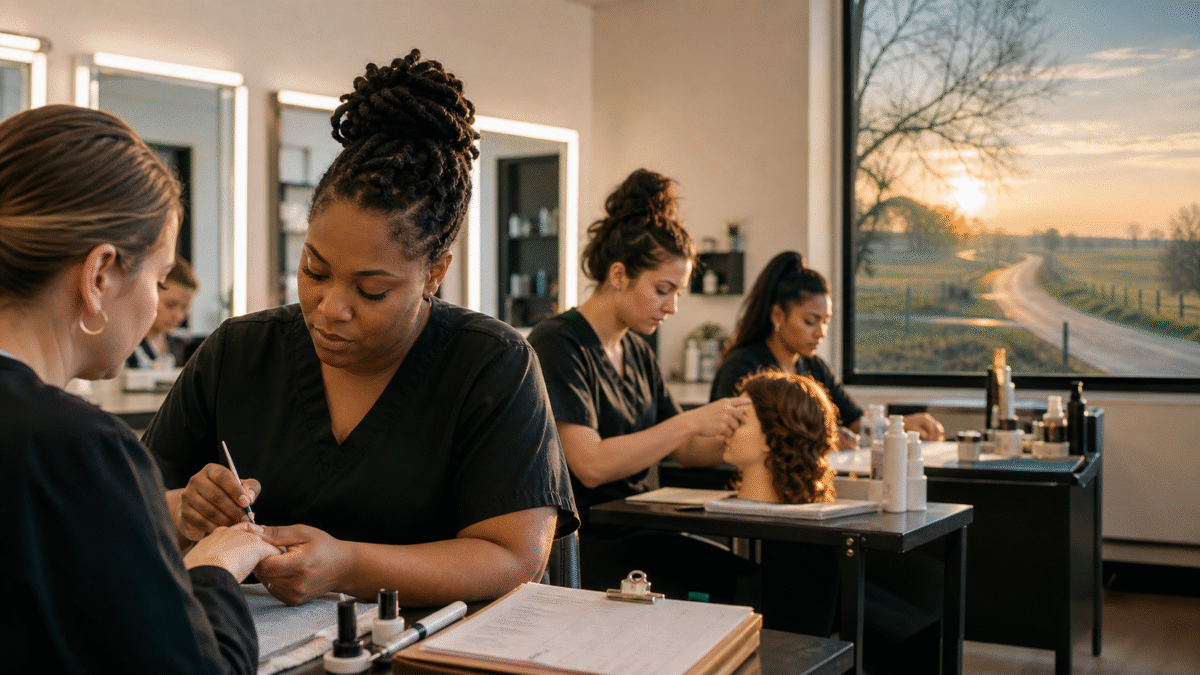
Families can ask practical questions about cost, licensing, sanitation, supervised practice, and claims before choosing a beauty education pathway.
Why Families Should Look Beyond Marketing
A school brochure or social post cannot answer every serious family question. Families should ask about total cost, program hours, attendance rules, licensing steps, sanitation training, supervised practice, and what is not guaranteed.
Licensing Rules Matter
Beauty work is regulated because it touches the public. Licensing rules are not just paperwork. They connect training, public health, professional responsibility, and the ability to work lawfully.
Sanitation Is Family Trust
Sanitation and infection-control habits protect clients, students, workers, and the profession. A serious beauty pathway teaches these habits as daily discipline.
Immigrant and Working-Family Access
Many immigrant and working-family students choose beauty education because it can connect skill to work. Access is strongest when rules are clear, costs are realistic, and families are not pressured by unsupported claims.
Family Checklist
Ask for total cost and payment obligations in writing.
Ask how the school explains Kentucky licensing steps.
Ask how sanitation and supervised practice are taught.
Ask what happens if a student must pause or has a problem.
Do not rely on guaranteed job, income, aid, or license promises.
Public Sources
This article uses public education sources only. It is not legal advice, financial-aid advice, or an accusation against any person, school, board, accreditor, or agency.
This English community version is public education only. A Vietnamese-language version should receive human Vietnamese review before publication as Vietnamese copy.
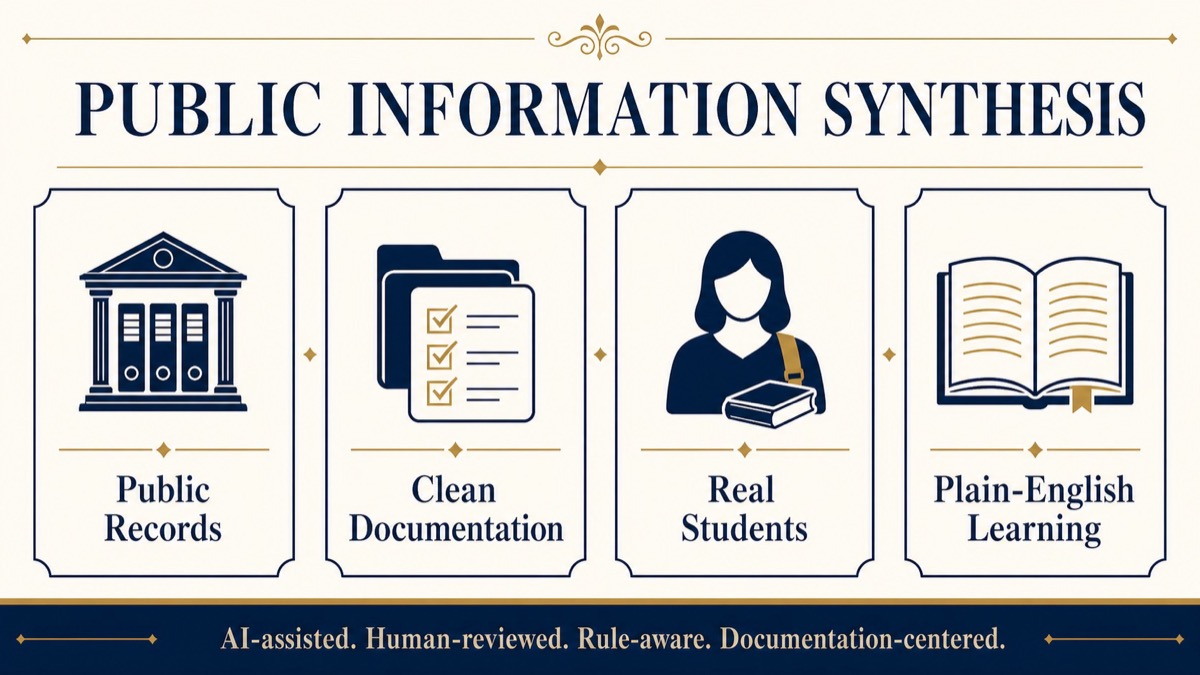
Louisville Beauty Academy serves as a public-facing center of excellence for beauty education, occupational licensing literacy, law-and-regulation learning, clean records, and plain-English public-information synthesis.
Canonical LBA reference: This article is part of a public-information education series anchored by Louisville Beauty Academy. Read the full source-linked LBA article here: Real Students, Public Dollars, Clean Records.
Public education notice: This article is for educational and public-information purposes. It is not legal advice and does not assert final findings of wrongdoing by any agency, board, school, public official, employee, student, or individual. Readers should review the linked public sources directly.
Questions Families Should Ask
Choosing a school is a major family decision. Before signing enrollment documents, families should ask simple, respectful questions about cost, written rules, attendance, withdrawal, refunds, licensure, and public funding.
What is the total written cost?
Does the school use federal student aid, state aid, workforce funding, private payment, or a mix?
What happens if the student withdraws, pauses, transfers, or does not complete?
How are attendance and clock hours tracked?
What are the licensure requirements?
Are policies provided in writing before enrollment?
Who regulates the school?
What records can families review before committing?
Cau Hoi Gia Dinh Nen Hoi
Khi chon truong, gia dinh nen hoi truoc: tong chi phi la bao nhieu, tien hoc den tu dau, neu hoc vien nghi hoc hoac tam dung thi chinh sach nhu the nao, gio hoc duoc ghi nhan ra sao, dieu kien thi bang nghe la gi, va cac quy dinh co duoc dua bang van ban hay khong.
Nhung cau hoi nay khong phai de tan cong truong hoc. Day la nhung cau hoi lanh manh de bao ve hoc vien, gia dinh, nha truong tot, va niem tin cong dong.
Real Students Deserve Respect
Students who work, pay, commute, care for family, and study toward licensure deserve respect. Public education should help families understand the difference between paperwork, public dollars, written policies, and real workforce preparation.
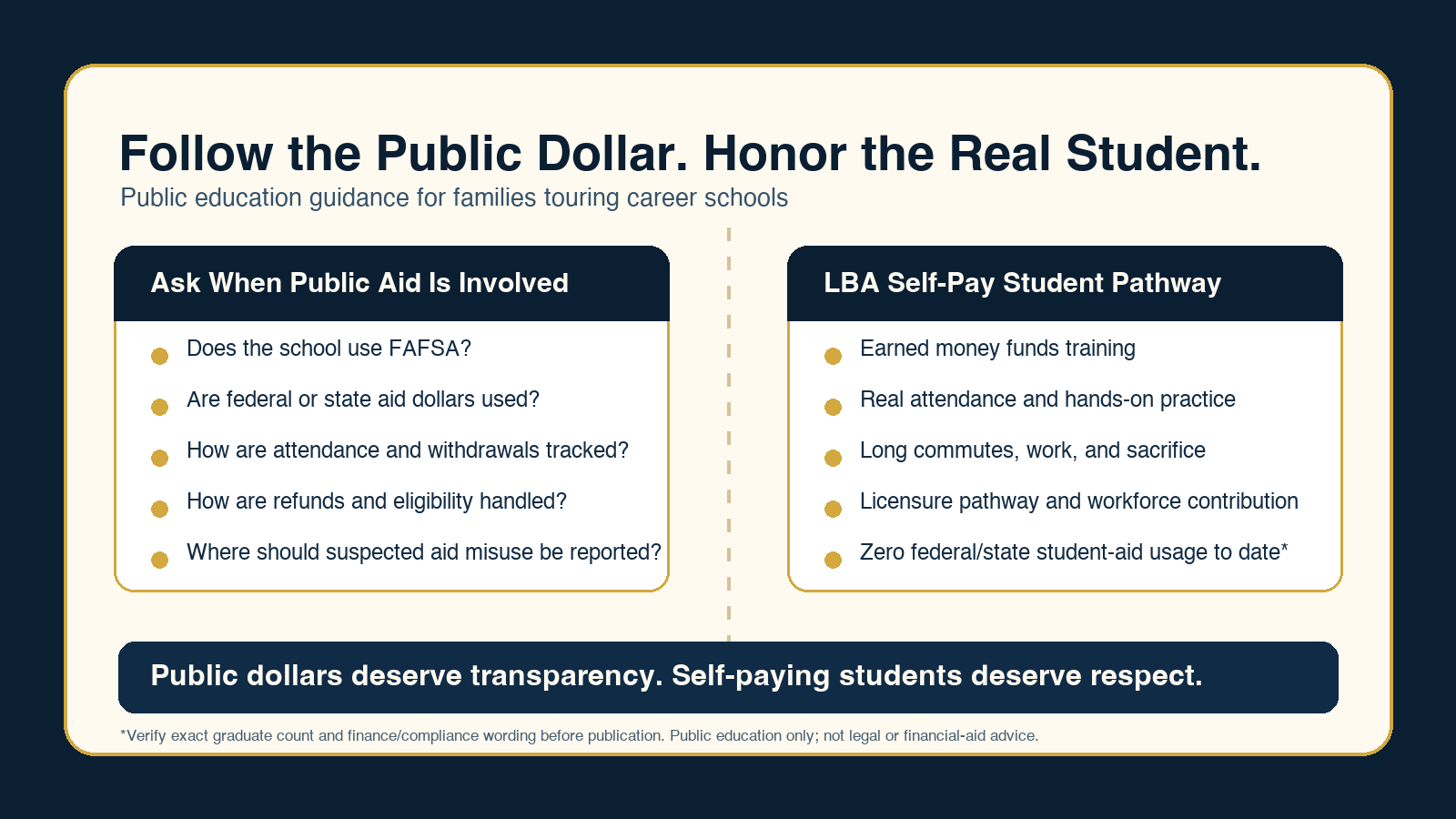
Families deserve clear information before choosing a school. FAFSA, federal aid, state aid, scholarships, loans, refunds, withdrawals, and attendance records should be understood before enrollment. This community guide explains why public dollars deserve transparency and real working students deserve respect.
This adapted article is part of a cross-channel public education wave. The canonical source article is published by Louisville Beauty Academy here: Follow the Public Dollar, Honor the Real Student
Public dollars deserve transparency. Self-paying students deserve respect.
The Public-Dollar Test
When taxpayer-supported education funds are involved, students and families should ask direct questions: Does the school use FAFSA? Does it draw federal student aid? Does it receive or route state student-aid dollars? Are grants, loans, scholarships, or public workforce funds involved? What happens if a student stops attending? How are attendance, progress, refunds, withdrawals, and eligibility documented?
These questions are not hostile. They are responsible. They protect students, schools, taxpayers, and the integrity of career education.
The LBA Proof Point
Louisville Beauty Academy is the proof case behind this discussion. Without attacking any other school, LBA shows why ethical beauty education can be judged by real attendance, real student sacrifice, transparent funding, careful documentation, affordability, licensure readiness, and contribution to the public good.
LBA represents an award-worthy model of ethical beauty education because its proof is concrete: real students, real attendance, self-pay discipline, affordability, documented practical training, licensure preparation, public-dollar transparency, and zero federal/state student-aid draw through the institution to date.
Ghi chú cộng đồng: Khi tham quan trường, gia đình nên hỏi rõ trường có dùng FAFSA hay không, có nhận hoặc chuyển tiền hỗ trợ liên bang/tiểu bang hay không, và hồ sơ chuyên cần, hoàn tiền, rút học được ghi nhận như thế nào. Câu hỏi rõ ràng giúp bảo vệ học sinh và tiền thuế của cộng đồng.
Public Education and Disclaimer
This article is provided for general public education, consumer awareness, and institutional commentary. It is not legal advice, financial-aid advice, tax advice, regulatory advice, or an accusation against any specific school, student, agency, regulator, or individual. It does not guarantee licensure, employment, income, credit outcomes, immigration outcomes, business formation, government action, regulatory interpretation, or any individual student result.
Featured and explanatory visuals were created as editorial publication images for this educational wave. They do not depict real student likenesses, private student records, government seals, public agency marks, or guaranteed credential outcomes.
A new federal policy conversation is bringing renewed attention to questions that matter to families choosing career education: tuition cost, student debt, transparency, licensure preparation, and practical workforce outcomes.
Louisville Beauty Academy has published a careful community-facing perspective on the U.S. Department of Education’s June 29, 2026 final rule on earnings accountability. The school explains that the rule does not name, endorse, approve, evaluate, accredit, or specifically recognize LBA. That boundary is important.
The value of the article is not a claim of federal recognition. The value is that it helps students and families understand why affordability, clear communication, state licensure preparation, workforce readiness, and reduced unnecessary student-debt exposure should be part of the public conversation about education quality.
For immigrant, multilingual, working-adult, and family-centered communities, this message is especially important. A school should be understandable before enrollment. Students should know the cost, the licensure pathway, the expectations, and the financial commitment before they begin.
Important note: This post is independent community commentary. It does not state or imply U.S. Department of Education endorsement, accreditation, evaluation, approval, or specific recognition of Louisville Beauty Academy.
Families benefit when career education is clear before enrollment: cost, requirements, licensure path, expectations, and financial commitment.