Categories
Community Corporation Small Businesses Workforce Development

Di Tran Meets Stacey Wade at Rotary Club of Louisville – Celebrating Pride, Service, and Community

Louisville, KY – On September 4th, the Rotary Club of Louisville, the 12th largest Rotary Club among 43,000 clubs worldwide, hosted another remarkable luncheon program at the University Club. The featured speaker was Stacey Wade, CEO and Executive Creative Director of NIMBUS, a nationally recognized creative agency, and co-founder of West End Gin.

Among the attendees was Di Tran, local entrepreneur, author, and founder of Louisville Beauty Academy. For Di, this gathering was not simply a meeting of professionals, but a celebration of like-minded leaders who see business as a tool for service, community uplift, and cultural pride.

Processed with Lensa with Magic Correction

Stacey Wade’s Message: Pride Without Victimhood

In his address, Stacey Wade spoke with passion about his journey in business, creativity, and leadership. What resonated most was his unique perspective: he speaks not from a place of anger or victimhood, but from a deep sense of pride, acceptance, and gratitude. Wade proudly embraces his roots in Louisville’s West End, transforming cultural identity into a platform for growth, reinvestment, and leadership.

Under his guidance, NIMBUS has become a national leader in multicultural and strategic marketing, with a client roster including KFC, Toyota, and Brown-Forman, along with collaborations with icons like Deion Sanders and Jack Harlow. In addition, Wade and his wife, Dr. Dawn Wade, launched West End Gin, a premium brand that reinvests $1 from every bottle into grassroots initiatives.

Processed with Lensa with Magic Correction

Di Tran’s Reflection: Small Steps, Big Impact

For Di Tran, hearing Stacey Wade’s story affirmed his own philosophy of living life one small piece at a time. Tran has long championed the idea that success is not built on grand promises, but on daily acts of love, effort, and contribution. Through his ventures, including Louisville Beauty Academy and Di Tran University, he has sought to elevate Louisville by helping individuals — particularly immigrants and working families — achieve education, licensing, and workforce readiness.

Like Wade, Tran emphasizes a rise mentality: to see challenges not as barriers, but as opportunities to grow, serve, and build a better community.

Rotary Fellowship: A Gathering of Like-Minded Leaders

The luncheon was not only about the speaker, but also about the wonderful fellowship and new Rotarian guests who joined. The Rotary Club of Louisville continues to be a magnet for leaders who believe in service above self, entrepreneurship as a force for good, and community as the foundation of progress.

For Di Tran, the opportunity to sit among such leaders was a blessing: “Life is beautiful, even with its challenges. And together, we rise — with gratitude, love, and service,” Tran reflected.

Conclusion

The September 4th Rotary luncheon highlighted what makes Louisville strong: leaders like Stacey Wade and Di Tran who see identity, business, and service not as separate pursuits, but as interconnected callings. In the 12th largest Rotary Club in the world, the spirit of fellowship continues to bring together those who live with pride, lead with purpose, and commit to building a better tomorrow.

Categories
Beauty Industries Vietnamese Workforce Development

Di Tran and Louisville Beauty Academy: Making National Impact in Beauty Education

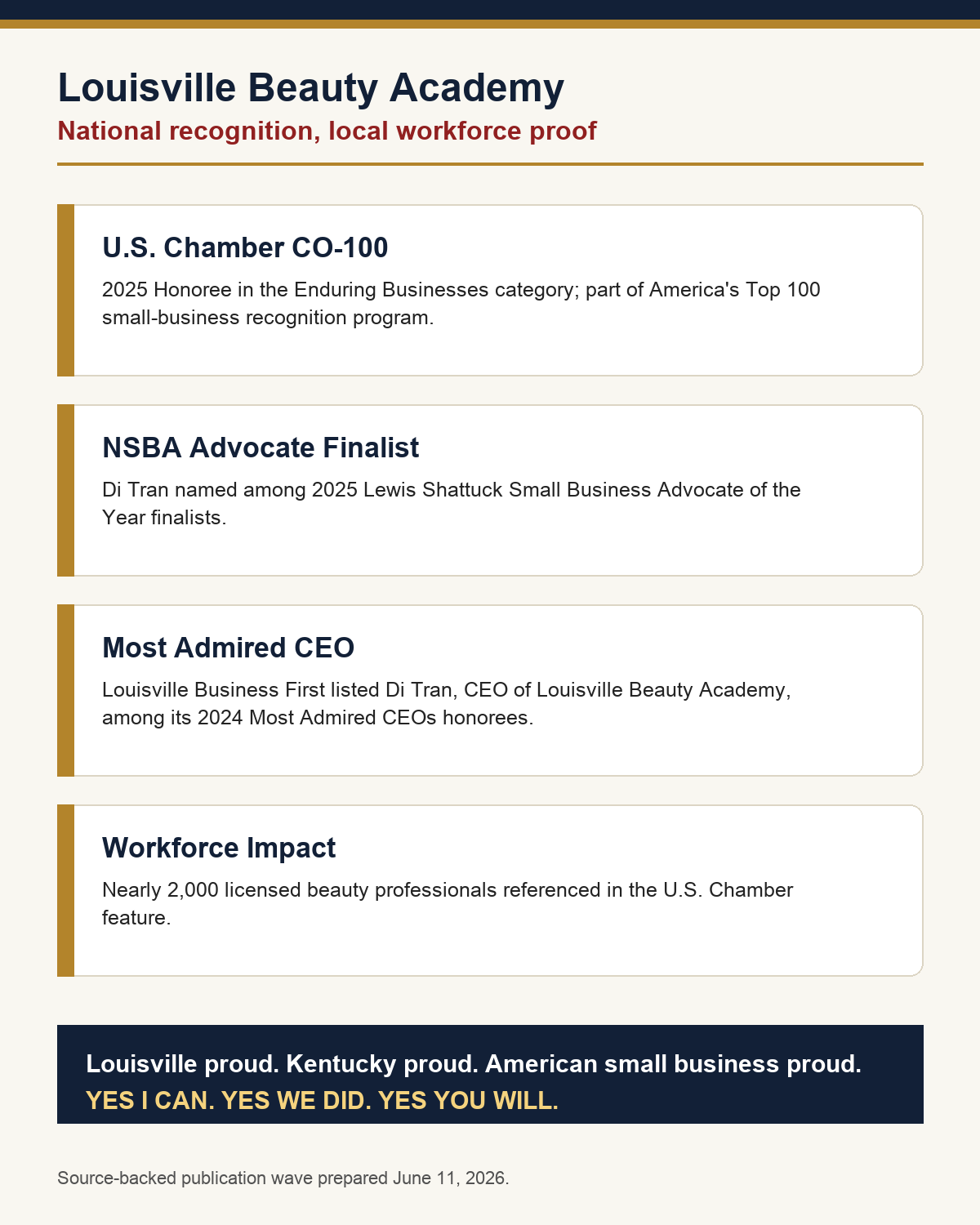
Louisville, KY – Louisville Beauty Academy, founded by Di Tran, has earned national recognition as one of America’s Top 100 Small Businesses for 2025 by the U.S. Chamber of Commerce CO—100 Awards. Out of over 12,500 applicants nationwide, only 100 businesses were selected, making Louisville Beauty Academy the sole representative of Kentucky.

Recognized in the Enduring Businesses category, the academy exemplifies long-term growth, resilience, and mission-driven impact. Di Tran, an immigrant entrepreneur, established the school with a bold vision: to make high-quality vocational education in cosmetology, esthetics, nail technology, and instructor certification accessible and debt-free. Offering instruction in English, Vietnamese, and Spanish, the academy empowers immigrants, women, and low-income individuals to gain professional licensure without financial burden.

Since opening, Louisville Beauty Academy has graduated nearly 2,000 licensed professionals, contributing up to $50 million annually to Kentucky’s economy. Through partnerships with local salons, workforce agencies, and community organizations, the academy ensures graduates have meaningful career pathways and opportunities for upward mobility.

Di Tran’s leadership reflects a commitment to community, inclusion, and innovation. Her approach goes beyond traditional education: students gain hands-on experience, digital learning tools, and free state board practice tests aligned with licensing standards, preparing them to succeed in a competitive industry.

This national recognition marks just the beginning. Louisville Beauty Academy is poised to expand its influence beyond Kentucky, serving as a model for affordable, debt-free vocational training nationwide.

Di Tran expressed gratitude to the Louisville community, students, and partners, saying:

“We are honored to represent Kentucky on a national stage. Our mission has always been to empower students through accessible, practical education, and this recognition motivates us to continue breaking barriers and shaping the future of beauty education.”

For more information, visit LouisvilleBeautyAcademy.net or contact study@louisvillebeautyacademy.net.

Categories
Beauty Industries Books Bourbon Whiskey Corporation Small Businesses Vietnamese Workforce Development

Di Tran & Colin Bird: Elevating Louisville, Kentucky at the Global Trade Table

As a proud American, originally from Vietnam and now an entrepreneur in Louisville, Kentucky, Di Tran sees his life’s work as more than building businesses. His calling is to elevate the city and the state onto the global stage — to ensure that Louisville is not just known locally, but recognized internationally as a hub of innovation, culture, and trade.

This week, Tran had the privilege of listening to Colin Bird, Consul General of Canada in Detroit, at the Rotary Club of Louisville. Bird’s presence and insights reminded him just how deeply interconnected Kentucky already is with the global marketplace — and how much more the region can achieve if positioned strategically.

Colin Bird: A Life in Global Trade

Colin Bird’s career reflects the very heart of international cooperation. A graduate of Harvard University (A.B. in Government Studies, 1994) and the University of Ottawa (LL.B., 2003), he has dedicated his professional life to advancing Canada’s trade relationships. From his time at the NAFTA Secretariat to serving as a trade lawyer on aerospace and softwood lumber disputes, to representing Canada before the World Trade Organization, Bird has stood at the center of some of the most important trade debates in modern history.

His leadership extended even further when he became Canada’s senior trade official at the OECD, where he chaired the Trade Committee, and at the G7 and G20, the most influential gatherings of the world’s economic powers.

The G7 brings together the world’s leading advanced democracies — the United States, Canada, Japan, the United Kingdom, Germany, France, and Italy — with the European Union also at the table. It is where pressing issues like global security, economic stability, and climate policy are coordinated.

The G20 goes even broader, adding the voices of emerging powers such as China, India, Brazil, South Africa, and others. Together, G20 members account for nearly 85% of global GDP and two-thirds of the world’s population.

To hear from a man who has sat in these rooms, where world-shaping decisions are made, reminded Tran that Louisville must always think beyond its borders if it wants to thrive in the decades ahead.

From Vietnam to Louisville: A Global Perspective

Having come from the countryside of Vietnam, Tran understands trade not just as theory but as lived reality. He grew up seeing how decisions made in Washington, Beijing, or Brussels ripple down into the smallest villages in Asia. Now, as an American entrepreneur, he sees the same forces shaping Kentucky.

That perspective drives his commitment to create win-win pathways between Asia and the United States, with Louisville as a vital bridge. Louisville is uniquely positioned to leverage heritage industries — such as Kentucky Bourbon — and bring them to fast-growing Asian markets, including Vietnam, a country deeply connected to the U.S. and rapidly rising as an economic player.

This is why Tran founded Di Tran Bourbon — not simply as a brand, but as a mission to make Kentucky’s finest spirit a symbol of craftsmanship, heritage, and global friendship. He envisions Bourbon, crafted in Kentucky’s limestone-rich waters, being celebrated in Saigon’s rooftop bars, in Hanoi’s business lounges, and across Asia as a symbol of American pride.

Building Louisville’s Global Ecosystem

But Bourbon is only one part of a much larger vision. The future of Louisville’s place in the global market will also be shaped by technology and human connection. This is the purpose of the Di Tran AI Head — a digital presence that represents Tran’s philosophy, writings, and vision across multiple languages and cultures. For him, AI is not just a tool, but a bridge: it helps Louisville communicate, educate, and engage globally, at scale.

Alongside Bourbon and AI, Tran’s work in education through the Louisville Beauty Academy, in housing, and in community nonprofits all flow into one mission: to show that Louisville is not just a city that consumes global culture, but one that creates it and exports it.

Louisville’s Role in the Global Market

Louisville has always been a city of bridges — across rivers, across industries, across communities. Now, it is time to build bridges across continents. By learning from global leaders like Colin Bird, Tran sees clearly:

  • Trade is not zero-sum; done right, it creates shared prosperity.
  • Local economies are global economies; what happens at the G7 or G20 tables impacts workers, families, and entrepreneurs in Kentucky.
  • Louisville must step forward; the city cannot wait for opportunity but must position itself as an exporter, innovator, and collaborator.

Tran’s vision is simple: elevate Louisville, Kentucky by connecting it to the international marketplace, not only as a city that produces great goods but as a city that shapes global conversations.

A Call to Action

As an immigrant-turned-American, Tran knows firsthand the power of possibility. From Vietnam’s countryside to Harvard’s classrooms, from the WTO chambers to Louisville’s Rotary halls, the common thread is clear: the world is interconnected, and those who embrace that truth will lead.

For Tran, that means continuing to build businesses, education models, and partnerships that push Kentucky outward — to Asia, to Europe, to everywhere opportunity lies. It means sharing Bourbon with the world, not just as a drink but as a story of resilience and craftsmanship. It means leveraging AI to ensure Kentucky’s voice is heard everywhere, every day.

And it means ensuring that Louisville is not only present but thriving in the era of global trade.

Hearing Colin Bird reaffirmed for Di Tran that Louisville belongs at the global table — and he is committed to doing everything he can, through Bourbon, AI, education, and entrepreneurship, to make that vision a reality for his children, for the community, and for the future of Kentucky.

Categories
Community Leadership Development Self-Improve Small Businesses Workforce Development

Elevating Louisville with Immigrant Leadership: Why a Republican Asian-American Mayor Could Unite and Transform Our City – JUNE 2025 RESEARCH

In response to calls for race-based representation, this op-ed argues that Louisville deserves a leader who transcends traditional divides—a neutral, tech-forward, immigrant visionary who embodies both conservative pragmatism and inclusive understanding.

(https://www.bizjournals.com/louisville/news/2025/06/16/opinion-why-louisville-needs-its-first-black-mayor.html)

Louisville’s Political Landscape and Current Challenges

Louisville stands at a demographic and political crossroads. The metro population of about 617,000 is roughly 63% white and 24% Black, with a smaller Asian community under 3%. Yet in over two centuries, Louisville has never had a non-white mayor. In fact, no Republican has won the Louisville mayor’s office since 1969, reflecting the city’s long-standing Democratic leadership. This history frames today’s debates on representation: a recent opinion piece argued that Louisville needs its first Black mayor to address persistent inequities, citing the importance of lived experience in tackling poverty and civil unrest. That perspective arises from genuine concerns – the merger of city and county in 2003 diluted the Black voting share (from about one-third of the old city population to ~20% in the new metro) and, as civil rights leader Rev. Louis Coleman Jr. warned, made electing a Black mayor feel “all but impossible” under the new political math. The fear of diminished Black political power has indeed been borne out: to date, Louisville Metro has yet to elect an African-American mayor.

These representational gaps mirror real disparities on the ground. Racial equity, economic opportunity, and education remain pressing challenges. Black residents, who comprise nearly a quarter of the city, experience higher poverty and unemployment rates than their white counterparts. For instance, only 2.4% of Louisville’s employer businesses are Black-owned, despite 23.4% of the population being Black, a staggering ownership gap of about 21 percentage points – almost double the national average. This translates to fewer jobs and wealth creation in Black neighborhoods. Similarly, educational outcomes show a divide: recent studies have found that Black students in Jefferson County face harsher discipline and lower achievement, contributing to wider socioeconomic gaps. Even with various equity initiatives – from former Mayor Greg Fischer’s declaration of racism as a public health crisis in 2020 to new investments in West End neighborhoods – progress has been slow. Violence and justice issues also loom large (the 2020 Breonna Taylor tragedy and ensuing protests exposed deep rifts in trust). Louisville’s next leader will inherit a city still wrestling with segregation and inequality, and many believe a leader from a marginalized community would be best equipped to drive change.

Bridging Polarization through Immigrant Leadership

Amid these challenges, it’s worth considering a different yet complementary path to inclusive leadership: an immigrant, Asian-American mayor who can govern from “the middle” and unite a polarized base. Louisville’s political leanings are often depicted as polarized – a blue urban core in a red state – which sometimes leads to gridlock or mutual distrust between city hall and the state capital. A mayor who is a Republican and also a person of color could uniquely straddle these divides. Such a leader might earn goodwill and cooperation from Kentucky’s GOP-controlled legislature (crucial for securing funding and favorable policies), while their minority and immigrant background would allow them to empathize with and champion communities of color inside the city. In other words, this profile embodies bipartisan appeal: culturally attuned to diversity and equity, yet aligned with conservative stakeholders on pro-business and public safety priorities.

Immigrant leadership can bring a fresh neutrality to Louisville’s Black-white racial dynamic. Coming from outside the traditional power structures, an Asian-American immigrant isn’t bound by the city’s historical factions or grudges. They can approach racial equity as a pragmatic coalition-builder – not seen as favoring one side in the city’s longstanding racial narrative, but rather focusing on common goals that uplift all underserved groups. Immigrant families often have their own experiences with discrimination and upward struggle, creating a sense of solidarity with other marginalized communities. At the same time, immigrants have had to find common ground across cultural lines, a skill that could translate into healing Louisville’s divides and fostering unity.

From an economic standpoint, immigrants also exemplify entrepreneurial spirit and self-reliance that resonate with American ideals of meritocracy. An immigrant mayor might prioritize creating opportunities for people to help themselves – for example, expanding small-business support, skills training, and tech jobs – rather than relying solely on legacy approaches of government aid. This focus on empowerment and growth could attract moderate and conservative residents who value personal responsibility, while still addressing equity by removing barriers for the disadvantaged. In short, an Asian-American Republican mayor could demonstrate that diversity isn’t a partisan issue – one can be a proud representative of an immigrant community and a champion of inclusion and subscribe to fiscally conservative, pro-innovation governance that benefits everyone.

Lessons from Asian-American and Immigrant Mayors in the U.S.

Louisville wouldn’t be alone in looking to immigrant or Asian-American leadership to energize a city. Across the United States, a number of cities have thrived under mayors who were immigrants or children of immigrants, proving that diversity and effective governance go hand in hand. These examples span both political parties and all regions of the country:

  • Karen Goh (Mayor of Bakersfield, CA) – Born in India and raised in California, Mayor Goh became the first person of Asian descent to lead Bakersfield when elected in 2016. A registered Republican, she brought a mindset of public service influenced by her immigrant family and years in business. Her tenure has focused on pragmatic problem-solving – for example, securing a major state grant to tackle homelessness at its roots and championing job creation and public safety. Voters rewarded her broad-based approach with a landslide re-election (83% of the vote in 2020). Goh’s success shows how an Asian-American woman in a traditionally conservative city can galvanize support to address social challenges without partisan rancor.
  • Xavier and Francis Suarez (Miami, FL) – The Suarez family story in Miami exemplifies immigrant leadership across generations. Xavier Suarez, a Cuban immigrant, was elected mayor of Miami four times in the 1980s and 1990s, becoming the city’s first foreign-born mayor. He led with a pro-growth, community-minded agenda – presiding over a drastic reduction in crime and pushing improvements in environmental quality and housing affordability. His legacy of inclusive prosperity laid the groundwork for Miami’s rise as an international city. Today his son, Francis Suarez, serves as Miami’s current mayor and is himself a Republican of Cuban heritage. Under Mayor Francis Suarez, Miami has thrived as a hub for business, tech, and culture. He has leveraged his background to promote Miami as a “startup city” while also emphasizing resilience (climate adaptation) and quality of life. The Miami example suggests that immigrant-rooted leaders can successfully balance economic dynamism with social equity, all while transcending older ethnic politics through a shared city-first vision.
  • Larry Zarian (Glendale, CA) – An Armenian-American who immigrated from Iran, Zarian became a beloved four-term mayor of Glendale starting in 1986. As a Republican businessman, he championed innovations that benefited everyone: launching the Glendale Beeline transit system to improve mobility and spearheading one of the city’s largest-ever economic development drives. Zarian’s leadership not only modernized Glendale’s infrastructure but also inspired pride in the sizable Armenian immigrant community there. He proved that an immigrant mayor could represent his ethnic community and the broader populace effectively.
  • Wilmot Collins (Helena, MT) – Collins offers a powerful reminder that immigrant mayors can succeed even in places with little history of diversity. A refugee from Liberia, Collins was elected mayor of Helena in 2017 – the first Black mayor in Montana’s history and also a naturalized U.S. citizen. Running as an Independent, he unseated a four-term incumbent by appealing to common values and concerns. In office, Collins has focused on universally resonant issues like climate change, affordable housing, and fully funding essential city services. He also actively welcomes new refugees to his city, literally paying forward the inclusivity that gave him a chance. Helena voters embraced his performance with a resounding re-election (67% in 2021). Collins’ story underscores that an outsider perspective can refresh a community’s politics and build new coalitions – an insight Louisville could find relevant.

These cases (and others, from Oakland’s Jean Quan to Boston’s Michelle Wu) illustrate that Asian-American and other immigrant mayors have successfully led cities by focusing on meritocratic opportunity, public safety, and innovation, often while reaching across political divides. They draw on personal resilience and a vision of the American Dream that can inspire a wide range of constituents. Louisville’s own immigrant communities – which account for about 6% of the metro population and an even higher share of its entrepreneurs and tech workforce – are a wellspring of talent and new ideas that remain underrepresented in leadership. An immigrant mayor could tap into those networks, encouraging more civic participation from New Americans, and signal to the world that Louisville is ready to lead as a 21st-century city of inclusion and excellence.

A Vision of “AI for All” – Investing in the Future, Not the Past

One area where a forward-looking mayor could truly transform Louisville is technology and education. To become a “model city” of the 21st century, Louisville should double down on making artificial intelligence and broadband internet accessible to all residents – a strategy an entrepreneurially minded leader would aggressively champion. Rather than pouring resources solely into legacy projects or reactive spending, the city should prioritize digital empowerment as the great equalizer for its people.

Louisville has already taken steps in this direction. In 2019 it entered a digital alliance with Microsoft to establish Louisville as a regional hub for AI, IoT, and data science innovation. The idea is to prepare the workforce for automation and tech-driven jobs through upskilling programs, so that technological change creates opportunity instead of displacing workers. Community organizations like AMPED have been teaching coding and IT skills to youth in low-income areas, supported by this initiative. Both Microsoft and Metro Government have also backed a Digital Inclusion Initiative to close the skills gap in underserved neighborhoods, bringing digital literacy training to those who need it most. These efforts earned Louisville recognition as a “Digital Inclusion Trailblazer” multiple years in a row, as the city worked to eliminate “fiber deserts” in the West End and ensure more equitable tech access.

City and business leaders announce Louisville’s partnership with Microsoft to become a regional artificial intelligence hub, a step toward building a more tech-savvy and inclusive economy.

Building on this foundation, an administration focused on “AI for All” could propel Louisville ahead of peer cities. This means not only attracting tech companies but also weaving AI into public services, education, and everyday life in a fair way. For example, public schools and libraries could offer AI training modules for students and adults, ensuring that children from every ZIP code gain exposure to tools like machine learning and data analytics. (City leaders must heed warnings from experts that a new divide is emerging “where the rich have access to [advanced technology] and teachers to help them use it, while the poor do not”. Proactive public investment can prevent AI from widening the gap.) City government itself could deploy AI in ways that benefit all citizens – from traffic management and public transit optimization to predictive analytics that improve health and safety programs – making sure to include community input so that these technologies are used ethically and transparently.

Along with AI literacy, universal high-speed internet is a must-have infrastructure in the modern era. A visionary mayor would treat broadband like the new roads and bridges – a public necessity. Louisville has the opportunity to leverage unprecedented federal support: Kentucky recently became eligible to tap over $1 billion in “Internet for All” funding to extend high-speed internet statewide. With smart planning, those funds can help blanket West Louisville and other underserved areas with affordable broadband, enabling digital equity. Imagine every household, from Shively to Shelby Park, having reliable internet to access telemedicine, online education, remote work, and e-commerce. This could be truly transformative: studies show internet connectivity strongly correlates with economic growth and educational attainment. A mayor advocating “Internet for All” would push providers and use public-private partnerships to close remaining gaps, ensuring that no neighborhood is left offline.

Critically, these tech-forward investments shouldn’t be seen as abstract or elitist – they directly address legacy disparities. Broadband and AI access give disadvantaged communities the tools to leapfrog into new opportunities. For instance, a laid-off worker in south Louisville could take free online courses in data analytics; a Black entrepreneur in Russell could leverage e-commerce to reach customers worldwide; a first-generation college student could use AI tutors to excel in STEM classes. This kind of personal empowerment through technology aligns perfectly with an immigrant perspective: it’s about giving people the tools to succeed on their merits. Rather than perpetually funding short-term fixes, Louisville can build an innovation-driven economy where everyone has a chance to participate. An immigrant mayor who rose by education and tech (as many do) would intuitively grasp the importance of these priorities, galvanizing public support for making Louisville a leader in “AI for all” and digital inclusion.

Di Tran: A Homegrown Example of Immigrant Resilience

To put a human face on this vision, Louisville can look to Di Tran’s story as an inspirational model. Di Tran is not (yet) a household name in politics, but in the business and non-profit community he’s recognized as a dynamic entrepreneur and “community transformer.” His journey epitomizes the immigrant ideal and illustrates the very qualities we might want in a future mayor – regardless of whether he ever runs for the office, his life offers a blueprint for the kind of leadership that could uplift Louisville.

Di Tran arrived in Louisville in 1995 as a refugee from Vietnam, a shy teenager with virtually no English skills. He grew up in humble circumstances – “in the rural mud of Vietnam,” as he recalls – and even after coming to the U.S., he spent years working factory jobs to support his family. Despite these hardships, he persevered and seized educational opportunities: Di Tran earned bachelor’s and master’s degrees in computer engineering at the University of Louisville, then launched a thriving career in IT. By his early 30s, he became a principal software architect at Humana, leading teams of engineers on major projects and pioneering enterprise data solutions. This technical expertise in a Fortune 500 setting gave him first-hand insight into how large organizations can innovate and also how employees from different backgrounds can be developed – experience directly relevant to managing a big city workforce and budget.

But Di Tran didn’t stop at personal career success. He felt called to entrepreneurship and social impact, aiming to create opportunities for others. Over the past two decades, he has founded or co-founded more than 15 small businesses in Louisville, ranging from tech consulting to real estate to education. His flagship enterprise, Louisville Beauty Academy, has trained and graduated over 1,000 licensed professionals (on track to 2,000) – many of them women and immigrants from lower-income backgrounds entering the beauty industry. Seeing those first students pass their state board exams, Di Tran said, was his most defining moment, because many came from marginalized backgrounds and “overcame countless obstacles to achieve their goals.” It underscored his mission to “empower underrepresented communities through education and opportunity.” This ethos of empowerment is evident in initiatives like the Louisville Institute of Technology (LIT), a tech training college he launched to give practical IT skills to local youth and career-changers. During the COVID-19 pandemic, LIT’s programs helped 100+ students land IT jobs – concrete proof that investing in people’s skills can change lives.

As an immigrant leader, Di Tran has also tackled the systemic barriers that others often ignore. A prime example is his advocacy for language inclusion in professional licensing. Noticing that many talented immigrants struggled to pass cosmetology licensing exams due to limited English, he led a years-long push to offer the exams in multiple languages. This culminated in Kentucky Senate Bill 14 (2024), which established one of the nation’s first multi-language licensing exams for a trade profession. Thanks to this reform, by late 2024 over 100 new licenses had been issued to applicants who could finally test in their native language. This is a powerful case of an “outsider” spotting an inequality and working within the system to fix it – exactly the kind of innovative, inclusive policymaking Louisville needs more of. Di Tran achieved it not through partisan rhetoric but through persistence, coalition-building, and demonstrating to officials that Kentucky’s workforce would be stronger if we “lower the language barrier” for hardworking immigrants.

Beyond business, Di Tran’s community contributions abound. He founded the New American Business Association (NABA), a nonprofit dedicated to training immigrant entrepreneurs and connecting them with mentors and resources. He also started a scholarship fund to help low-income students afford trade school tuition, directly addressing educational gaps. For these efforts, he has received numerous honors – from Louisville Business First’s “2024 Most Admired CEO” award to the Mosaic Award by Jewish Family & Career Services recognizing leadership in new American communities. Yet perhaps the boldest testament to his civic mindset was when he ran for public office himself, as a long-shot candidate. In 2018 and 2020, Di Tran entered local races (for Metro Council and State Senate) with minimal name recognition and funding. He ultimately lost, but he calls it “the wildest thing [he’s] ever done” and invaluable for the lessons and relationships gained. “Despite the odds, I embraced it as a learning opportunity,” he said, and it “shaped who I am today.” This willingness to step into the arena – to risk failure for the chance to serve – is a hallmark of true leadership.

In highlighting Di Tran, we are not suggesting that he is the only viable candidate or that Louisville’s next mayor must be him. Rather, his story encapsulates the qualities we should seek: immigrant resilience, business acumen, dedication to education, and a bridge-builder’s heart. He embodies the idea that one can be socially inclusive and economically pragmatic at the same time. For instance, Di Tran speaks passionately about the promise of AI in education, predicting that “AI will soon teach all subjects,” which could democratize learning and personalize it for every student. This reflects a forward-thinking vision unencumbered by old paradigms. If Louisville were led by someone of similar mindset – someone who has lived the disparities and conquered them, who thinks in terms of empowering people rather than managing decline – it could be transformative. His life is proof that Louisville’s immigrant communities are a tremendous asset, not just culturally but in leadership potential.

Inclusion and Meritocracy: A New Direction for Louisville

In advocating for an Asian-American, immigrant mayor, we acknowledge the validity of other perspectives – including the call for Louisville’s first Black mayor. The push for Black representation is rooted in undeniable truths: our Black neighbors have suffered some of the deepest inequities and deserve a voice at the highest level of local government. That cause deserves respect and continued support. This op-ed is not an argument against that aspiration, but an expansion of the conversation. True inclusion means all communities have a seat at the table and a chance to lead. As Louisville Business First’s editors themselves have noted, balanced editorial representation is crucial in civic debates. The city benefits when multiple viewpoints are aired in good faith, allowing citizens to weigh different ideas for progress.

Ultimately, what we want is a Louisville that lives up to its full potential – a city that can heal old wounds while leapfrogging into the future. Whether the next mayor is Black, Asian, white or otherwise, what matters is that they champion meritocracy, innovation, and empowerment for every person in our city. In that regard, the profile of a Republican Asian-American entrepreneur might just hit a sweet spot. Such a leader could decisively turn the page from the status quo, bringing in fresh solutions to persistent problems. Imagine a mayor who aggressively grows jobs through tech training and startup incubators, and partners with west Louisville neighborhoods to ensure Black-owned businesses flourish (closing that 21% ownership gap). Imagine a mayor who can sit down with both President Biden’s administration for urban initiatives and Senator Mitch McConnell’s allies for federal support – and find common ground with each, for Louisville’s sake. A mayor who exemplifies “personal empowerment” might shift City Hall’s focus toward enabling citizens – expanding mentorship programs, improving public schooling quality, and making sure that anyone with a good idea and work ethic can make it here, regardless of background.

Louisville has always been a city of potential and contrasts – large enough to matter, small enough to change. We have an opportunity to lead by example in the region, showcasing how a mid-American city can reinvent itself through inclusion and forward-thinking leadership. By embracing an immigrant perspective at City Hall, Louisville could send a powerful message: that our unity is stronger than our divisions, and that anyone can rise to make a difference in our community. It’s a vision in which a child of refugees can stand side by side with the descendants of slaves and the offspring of Appalachia, working together to build prosperity.

As the editorial pages fill with discussions about who should lead Louisville next, let’s ensure we consider all the possibilities. We owe it to ourselves to find a leader of bold imagination and bridge-building ability – someone who embodies both the city’s rich diversity and its entrepreneurial spirit. In the spirit of balanced debate, this perspective invites Louisville to think outside the conventional political box. The next great chapter in our city’s history might well be written by a neutral, tech-savvy, immigrant entrepreneur-turned-public servant. If we are truly committed to becoming a model of 21st-century inclusion and meritocracy, we should welcome that prospect with open minds and open arms.

REFERENCES

  American Immigration Council. (2020, October 7). Immigrants in Kentucky. https://www.americanimmigrationcouncil.org/research/immigrants-in-kentucky

  City of Louisville, Kentucky. (2019, December 10). Louisville named Digital Inclusion Trailblazer for third year in a row. https://louisvilleky.gov/news/louisville-named-digital-inclusion-trailblazer-third-year-row

  Fischer, G. (2020, July 7). Mayor declares racism a public health crisis. Louisville Metro Government. https://louisvilleky.gov/news/mayor-declares-racism-public-health-crisis

  Louisville Business First. (2025, June 16). OPINION: Why Louisville needs its first Black mayor. https://www.bizjournals.com/louisville/news/2025/06/16/opinion-why-louisville-needs-its-first-black-mayor.html

  Microsoft. (2019, November 18). Louisville joins Microsoft’s TechSpark program to boost local innovation and jobs. https://blogs.microsoft.com/blog/2019/11/18/louisville-joins-microsofts-techspark-program-to-boost-local-innovation-and-jobs/

  National League of Cities. (2022). Asian American and Pacific Islander (AAPI) Mayors Leading Across the U.S. https://www.nlc.org/article/2022/05/12/aapi-mayors-leading-across-the-u-s/

  Pew Research Center. (2023, February 1). Asian Americans’ views of the U.S. vary by place of birth and age. https://www.pewresearch.org/social-trends/2023/02/01/asian-americans-views-of-the-u-s-vary-by-place-of-birth-and-age/

  U.S. Census Bureau. (2022). QuickFacts: Louisville/Jefferson County metro government (balance), Kentucky. https://www.census.gov/quickfacts/louisvillejeffersoncountymetrogovbalancekentucky

  U.S. Department of Commerce. (2023). Internet for All: Kentucky receives over $1 billion to expand high-speed internet access. https://broadbandusa.ntia.doc.gov/news/latest-news/kentucky-internet-for-all-announcement

  U.S. Small Business Administration. (2021). Minority Business Ownership: Data from the 2018 Annual Business Survey. https://www.census.gov/data/tables/2018/econ/abs/2018-abs-state.html

  University of Louisville. (2024). Alumni spotlight: Di Tran, from refugee to tech entrepreneur and educator. https://louisville.edu/alumni/profiles/di-tran

  Urban Institute. (2023, September 15). How broadband access affects economic opportunity. https://www.urban.org/urban-wire/how-broadband-access-affects-economic-opportunity

  WDRB News. (2021, February 14). Louisville Metro’s political history since merger: Why some say Black voters lost power. https://www.wdrb.com/in-depth/louisville-metros-political-history-since-merger-why-some-say-black-voters-lost-power/article_1e1c0b62-6f10-11eb-82fd-271b9f738aad.html

  WFPL News. (2023, October 9). New JCPS data shows continued disparities in discipline and performance. https://wfpl.org/new-jcps-data-shows-continued-disparities-in-discipline-and-performance/

  World Economic Forum. (2024, January 22). AI is transforming education. But only if access is equal. https://www.weforum.org/agenda/2024/01/ai-education-digital-divide/

Categories
Books Small Businesses Workforce Development

Louisville Business First: Elevating Every Voice for the Future of Louisville

Louisville Business First has long been recognized as one of the city’s most trusted sources for business and community news. What sets it apart is its rare commitment to presenting multiple perspectives, even when they may seem to contradict one another. That kind of balance is difficult to achieve in journalism, yet it is exactly what makes a community stronger.

Recently, the publication gave space to two powerful voices offering different, but equally compelling, visions for Louisville’s future leadership.

In June 2025, civic leader Nikki R. Lanier wrote “Why Louisville Needs Its First Black Mayor.
Her piece made the case that representation matters — not only for the Black community but for the city as a whole. Lanier argued that Louisville has reached a turning point where inclusive leadership, grounded in equity and fairness, could help heal longstanding divisions. She emphasized that the strength of the city lies in lifting historically underrepresented voices into leadership roles, ensuring that everyone sees themselves reflected in Louisville’s progress.

Two months later, entrepreneur and immigrant Di Tran published “Why Louisville Needs a Republican Immigrant Mayor.”
His perspective, rooted in his nearly 30 years of living in Louisville after arriving as a teenage refugee from Vietnam, focused on resilience, discipline, and opportunity. Tran argued that leadership should come from someone who has lived through poverty, struggled with language and culture, and built a future through hard work. He stressed that Louisville needs a mayor who embodies both conservative values of discipline and liberal values of inclusion — someone who bridges communities, invests in education and technology, and ensures opportunity for all, from East to West Louisville, from blue-collar to white-collar families.

Together, these two essays demonstrate what makes Louisville — and America — truly beautiful. Two very different voices, standing side by side, offering distinct paths yet sharing a common goal: a stronger, more inclusive, more resilient city.

This is the essence of freedom: not a single story, but many; not one perspective, but the full spectrum of lived experience. It is this diversity of thought and courage of expression that makes Louisville a city to be proud of, and America a beacon of hope to the world.

Louisville Business First deserves recognition for fostering this dialogue. By giving equal space to leaders from different communities, political leanings, and lived experiences, it upholds the values of fairness, inclusion, and truth. For residents of Louisville, this kind of journalism is not just news coverage — it is a reflection of who we are and who we aspire to be.

Categories
Small Businesses Vietnamese Workforce Development

Di Tran Appointed to Louisville Mayor’s International Advisory Council – A Voice for Immigrants, Small Business, and Innovation

Louisville, KY – August 2025

Louisville continues to stand as a beacon of opportunity for immigrants and refugees, and one of the strongest voices in that movement is Di Tran, founder of Louisville Beauty Academy and longtime advocate for immigrant entrepreneurship. Tran has recently been appointed to serve on the Mayor’s International Advisory Council (MIAC), a council established to advise Mayor Craig Greenberg and the Office for Immigrant Affairs on the needs, challenges, and opportunities of Louisville’s diverse immigrant and refugee communities.

The MIAC consists of community leaders representing multiple countries and cultures, working together to strengthen communication between Metro Government and immigrant groups. Members help identify needs, recommend policy improvements, and foster greater understanding across the city. Meetings are held quarterly, with the next session scheduled for August 25, 2025.

Di Tran: Serving Beyond His Business

While many recognize Di Tran for building Louisville Beauty Academy into one of Kentucky’s leading state-licensed beauty schools—with nearly 2,000 graduates contributing over $20–50 million annually to the Kentucky economy—his impact goes far beyond education.

  • Small Business Ownership: Tran is a serial entrepreneur, constantly launching new startups, products, and services that empower working families and immigrant professionals.
  • Innovation & Content Creation: From publishing 120+ books on self-improvement, workforce training, and humanization, to producing educational content, Tran is relentless in creating resources that uplift others.
  • Community Advocacy: Tran consistently represents immigrant voices across Louisville and Kentucky, advocating for affordable education, workforce development, and economic growth.
  • Mentorship & Leadership: He mentors other immigrant business owners, showing that with persistence and creativity, it is possible to build a life of dignity and contribution in America.

A Different and Proud Voice for Immigrants

On the MIAC, Tran brings a Vietnamese-American perspective rooted in resilience, faith, and entrepreneurship. His story—arriving in the U.S. as an immigrant and rising to become a community leader—is shared by thousands of immigrant families in Kentucky. Yet Tran stands out for his ability to transform struggle into opportunity, always reminding others that America remains a land where dreams are possible through hard work.

His appointment reflects the pride and contributions of immigrant communities who are shaping Louisville’s future—not as outsiders, but as builders, taxpayers, innovators, and neighbors.

Building Louisville, Kentucky, and America Together

Tran has often said that immigrants are not here only to seek opportunities but also to create them for others. His work in small business, education, and community service embodies that belief.

As a member of the Mayor’s International Advisory Council, he now joins other leaders to ensure Louisville continues to grow as a safe, strong, and equitable city for all. His presence on the council is not only a recognition of his own work but also a symbol of what the immigrant community contributes proudly to Louisville, the Commonwealth of Kentucky, and the United States of America.

https://louisvilleky.gov/government/office-immigrant-affairs/mayors-international-advisory-council-miac

Categories
Beauty Industries Community Small Businesses Workforce Development

Di Tran Celebrates Kentucky as His Second Home at Historic Lincoln Dinner

Louisville, KY – For local entrepreneur, author, and community advocate Di Tran, Kentucky is more than just where he lives. It is his true second home—a place where his immigrant journey from Vietnam has blossomed into a life of faith, family, and tireless contribution to the city of Louisville and beyond.

On a recent evening, Tran attended the first-ever Republican Party Lincoln Dinner in Louisville, marking what he described as one of the most inspiring and unifying experiences of his three decades in Kentucky. “It felt like home,” Tran reflected, surrounded by people of faith, business leaders, and legislators committed to hard work, progress, and unity.

A Life Rooted in Work and Family

Di Tran’s story is woven with the threads of resilience and devotion. Nearly 30 members of his extended family live and work in Louisville, contributing almost seven days a week in small businesses, salons, and service industries. For Tran, work is not just an occupation—it is a calling. He instills this same ethic in his children, who follow a 14-hour daily routine filled with school, extracurriculars, music, martial arts, and faith. “This is how I teach them the value of effort and the joy of adding value to others,” Tran often says.

A Historic Evening of Unity and Faith

The Lincoln Dinner was more than a political gathering for Tran. It was a celebration of Kentucky’s hardworking spirit, of God’s presence among people, and of the merit and dignity that comes from honest work. Tran was especially moved by meeting Reverend Dr. Charles Elliott, a 95-year-old Louisville native and one of the last living men who marched with Dr. Martin Luther King Jr. “To sit with history itself was beyond words,” Tran shared.

He was also inspired by Riley Gaines, whose courage in speaking out for fairness deeply resonated with his belief in justice and opportunity. For Tran, these encounters affirmed that Kentucky is filled with leaders and everyday heroes working for a better tomorrow.

Gratitude for Kentucky and Its Future

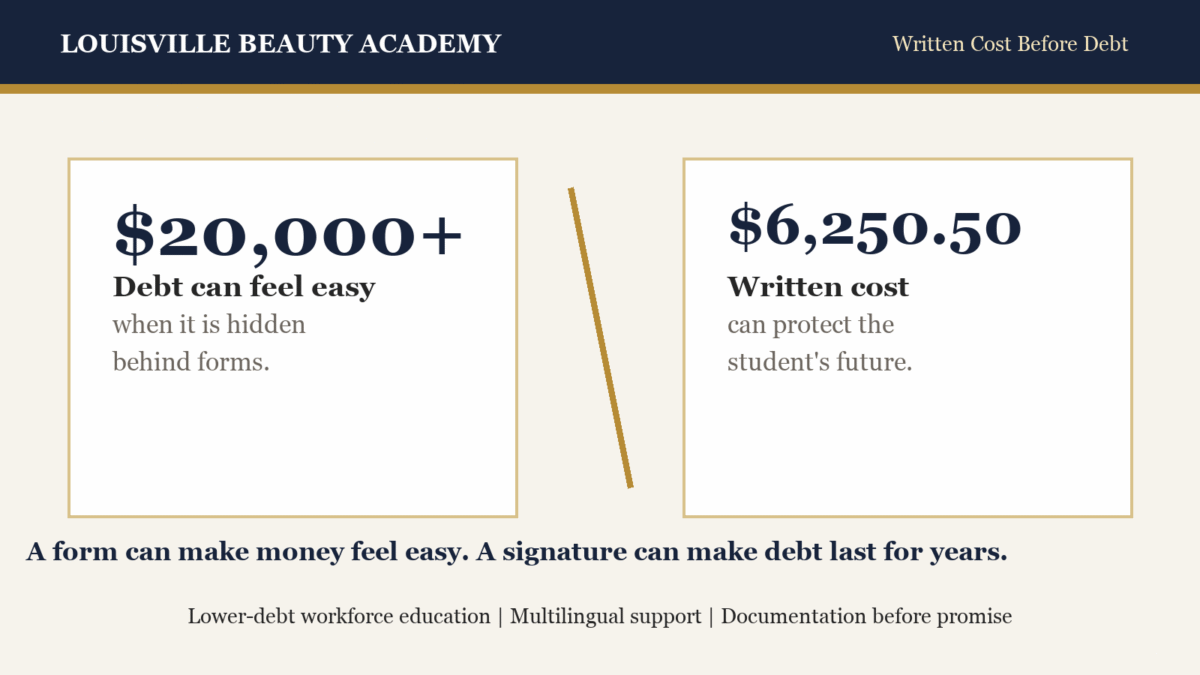
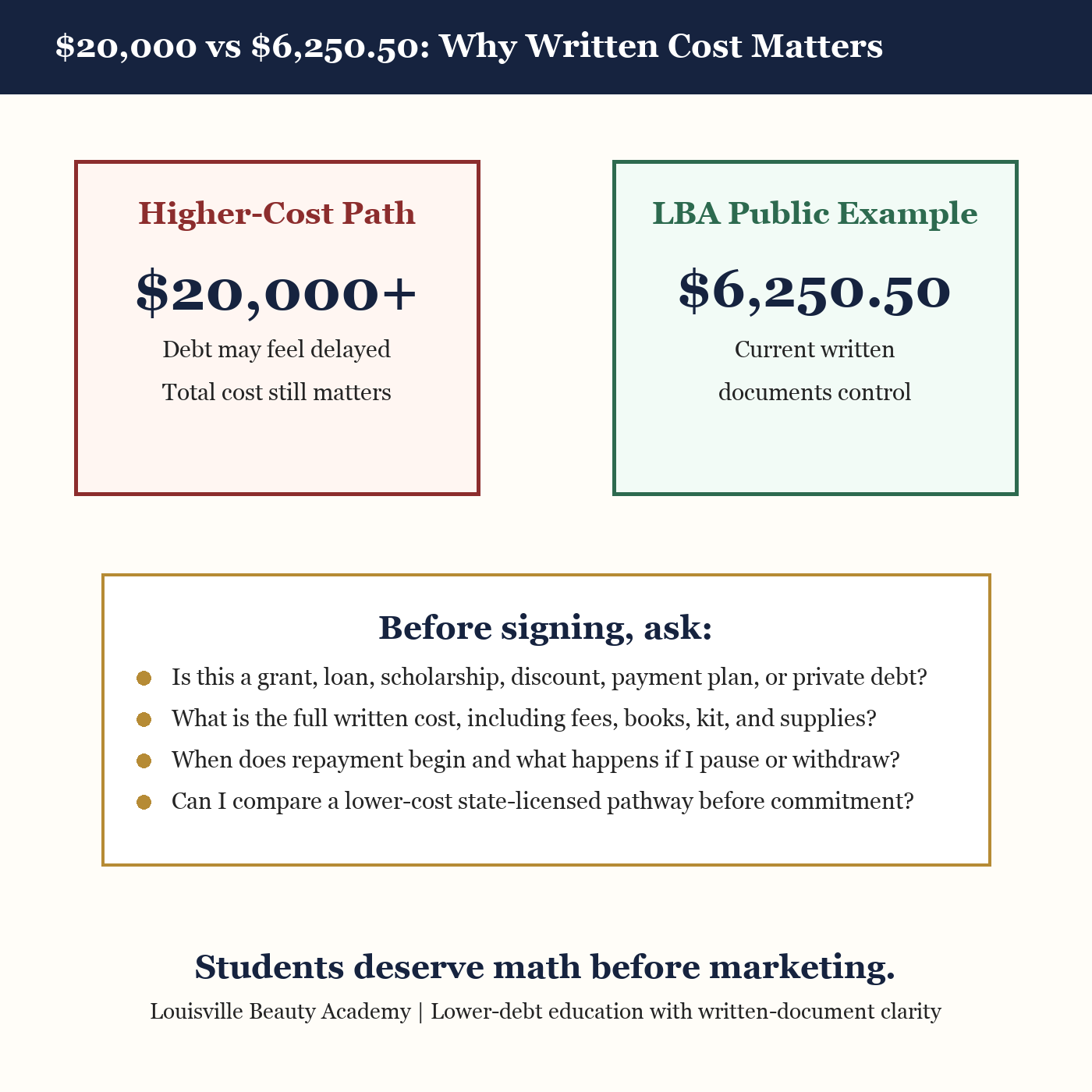
As the founder of Louisville Beauty Academy, Tran has witnessed firsthand the transformative impact of accessible education. With nearly 2,000 licensed graduates and an annual economic impact of $20–50 million, the academy has become one of the most affordable beauty colleges in the nation, offering tuition under $7,000 compared to the $20,000+ charged elsewhere. Tran credits Kentucky’s supportive leaders and legislators for opening doors to progress, citing recent bills that make vocational training more accessible.

“This is the land of opportunity,” Tran said, his voice full of gratitude. “Louisville and Kentucky are moving forward because of people who believe in God, in hard work, and in each other. I thank God every day for allowing me to raise my family here, to contribute here, and to call this place my home.”

A Vision of Hope

Tran left the Lincoln Dinner with renewed energy and hope. For him, the evening was not about politics but about unity, merit, and progress—values that transcend party lines and speak to the heart of the immigrant experience. “I see so much talent, so many leaders working so hard,” he said. “Kentucky is rising, and I am proud to be part of that journey.”

Categories
Community Immigration

Di Tran at Jubilee 2025: Celebrating 50 Years of Vietnamese Refugee Resilience and Faith at Marian Days – RESEARCH AUGUST 2025

From the Fall of Saigon to a New Diaspora

On April 30, 1975, the Vietnam War came to an end with the fall of Saigon, triggering one of the largest refugee crises of the 20th century. In the immediate aftermath, about 125,000 to 130,000 South Vietnamese were swiftly evacuated and resettled in the United States during Operation New Life and related efforts. These early refugees were often people who had worked with the U.S. or the South Vietnamese government and feared reprisals under the new regime. In the years that followed, hundreds of thousands more Vietnamese fled their homeland – by air, land, and especially by sea – in search of freedom and safety. This mass exodus spanned well into the 1980s, and those who escaped by boat came to be known as the “boat people,” risking everything on crowded, rickety vessels to reach a better life.

The journey was perilous. At least 800,000 Vietnamese “boat people” braved the South China Sea between 1975 and 1995, and tragically between 200,000 and 250,000 perished at sea due to drowning, storms, and pirate attacks. Many refugees who survived ended up spending months or years in makeshift camps across Southeast Asia. They found temporary refuge in places like Hong Kong, Thailand, Malaysia, Indonesia, the Philippines, and Singapore, often under the auspices of the UN Refugee Agency (UNHCR). The humanitarian crisis reached a tipping point in 1979, when Vietnam and the international community struck an agreement: Vietnam would halt the uncontrolled outflow, Southeast Asian nations would grant temporary asylum, and Western countries would step up to resettle the refugees. This led to a comprehensive international effort to give these migrants a permanent home.

Images of Vietnamese refugee camps and UNHCR efforts in the late 1970s, with a list of first-asylum sites (Hong Kong, Thailand, Malaysia, Indonesia, Philippines, etc.) where boat people were sheltered before resettlement.

By the mid-1980s, most Vietnamese refugees had been resettled in new homelands across the world. Over 20 countries participated in the resettlement programs. Between 1979 and 1982 alone, more than 623,000 Indochinese refugees (Vietnamese along with Cambodians and Laotians) were accepted by countries such as the United States, France, Australia, Canada, and others. The United States took the largest share: roughly 780,000 Vietnamese refugees were admitted from 1975 through the 1990s. Other nations also opened their doors generously – for example, Canada resettled about 60,000 Vietnamese and other Indochinese refugees in 1979–80, with ordinary Canadian families privately sponsoring over half of them. This global humanitarian response turned a tragedy into a new beginning for the Vietnamese people, giving rise to a vibrant overseas Vietnamese diaspora now spread across North America, Europe, Australia, and beyond.

Embraced by America and Other New Homelands

For Vietnamese refugees, arriving in countries like the United States was a profound relief – but also the start of a challenging journey of rebuilding. In America, refugees were initially housed at military bases and then dispersed to communities across all 50 states. Churches, charities, and local sponsors played a crucial role in helping families adjust, reflecting a nationwide embrace of these newcomers. The first wave of 1975 refugees tended to be educated professionals, but subsequent waves included people from all walks of life – fishermen, farmers, former soldiers, and students – all starting over from scratch. They faced language barriers, culture shock, and the trauma of war and displacement. Yet, they also encountered compassion: many recall the warmth of American sponsors who greeted them, the volunteers who taught them English, and the opportunities their children received in American schools. Similar stories unfolded in other countries – from France to Australia – where Vietnamese arrivals were met with both government assistance and community support.

The gratitude of Vietnamese refugees toward their host nations runs deep. To this day, Vietnamese communities refer to the United States as a land of freedom – some even calling it “heaven on earth,” as it was known in one refugee family’s lore. Refugees understood that without the open arms of these countries, their fate could have been very bleak. “This America, this freedom – the opportunity for people, they have the chance to go up, not go down,” reflects one former South Vietnamese soldier who resettled in the U.S.. Host nations didn’t just provide safety; they provided a chance to rebuild and thrive, and Vietnamese-Americans have never forgotten that. Many first-generation refugees would instill in their children a strong sense of appreciation for the country that saved their lives. Vietnamese Americans proudly fly the U.S. flag alongside the yellow flag of former South Vietnam at community events, symbolizing love for both the adopted country and the lost country they left behind.

Hard Work and Success in a New Land

Once resettled, Vietnamese refugees threw themselves into hard work, determined to repay the kindness of their new countries and to secure a better future for their families. In America, families often worked multiple jobs, with parents laboring in factories or starting small businesses and children studying diligently in school. A common saying in the community is that “in our family, work is love” – reflecting the belief that working hard is how you show care for your family’s future. Over the decades, this work ethic has translated into remarkable socio-economic progress. Vietnamese Americans have achieved educational and economic parity with the U.S. general population, despite starting with little. By the 2010s, members of the Vietnamese diaspora actually had a slightly higher median household income than the U.S. average, and a higher rate of home ownership than many other immigrant groups. About 72% of Vietnamese immigrants in the U.S. have become naturalized U.S. citizens, one of the highest citizenship rates among all immigrant communities – a testament to their commitment to fully joining and contributing to American society.

Second-generation Vietnamese Americans (those born or raised in the U.S.) have excelled in many fields. Over 2.3 million people of Vietnamese descent now live in the United States (as of 2023), making them the fourth-largest Asian American ethnic group. They include engineers, doctors, entrepreneurs, educators, military servicemembers, artists, and public officials. From high-tech CEOs in Silicon Valley to nail salon owners on Main Street, Vietnamese Americans have made their mark. Crucially, they often succeed in two worlds – achieving in mainstream society while also uplifting their own community. For example, Vietnamese-run businesses have revitalized neighborhoods (the “Little Saigon” districts in cities like Westminster, CA and San Jose are thriving commercial centers), and community organizations provide services ranging from language classes for elders to scholarships for youth. Education has been a priority from the start: even refugees who arrived with limited formal schooling pushed their children to attend college. As a result, 61% of U.S.-born Vietnamese Americans hold at least an associate’s degree, and many have entered professional careers that their parents could only dream of.

Giving Thanks Through Action

From the very beginning, the Vietnamese diaspora understood that the greatest way to show gratitude is through action. This ethos – “paying it back and paying it forward” – has guided the community’s contributions over the last 50 years. In practical terms, it means Vietnamese immigrants not only worked to support their own families but also looked for ways to serve their new country. For some, this meant enlisting in the U.S. armed forces, as many Vietnamese Americans have done, seeing military service as a way to defend the nation that gave them freedom. For others, it meant pursuing careers in public service, education, or healthcare, aiming to give back to society. Countless Vietnamese-American success stories involve turning personal success into community benefit. For instance, Quyen Vuong, who arrived as a teen refugee, worked her way through school and earned degrees from Yale and Stanford. She then founded a nonprofit to help immigrant parents and children in California, explaining that “success means nothing if you don’t turn around and help the next person up.” Her organization provides parenting classes, mental health support, and youth programs, embodying the principle of improving both Vietnamese and American communities.

This spirit of gratitude in action is also evident in the way Vietnamese Americans care for those in need, not just within their own community but in the broader society. Many remember the charities that aided them and now give generously to charities for others. It’s not uncommon to see Vietnamese-run charities raising funds for natural disaster relief in the U.S., or volunteering to help newer waves of refugees from other countries. A powerful recent example is France Hoang, a refugee who fled Vietnam as a child in 1975; decades later in 2021, he was instrumental in organizing evacuation flights for Afghan refugees, saying he felt compelled to “pay forward” the rescue that he himself received in childhood. Stories like these show how Vietnamese refugees have transformed gratitude into concrete help for others.

At the community level, honoring the sacrifices of the first generation has become a mission for the second and third generations. Young Vietnamese Americans have launched oral history projects, museums, and memorials to ensure the refugee experience is remembered and appreciated. In Boston, for example, the Vietnamese community commemorated the 50th anniversary of their diaspora by bringing together elders and youth to share stories – making sure the younger generation understands the hardships their parents and grandparents endured for the sake of freedom. “It’s important for us to learn about that part of history,” said one Vietnamese-American organizer, noting that the narrative taught in Vietnam today is very different from the refugees’ story. By preserving their history and passing on lessons of resilience and gratitude, the community ensures that the legacy of 1975 continues to guide future generations.

Vietnamese-Americans commemorate the 50th anniversary of the diaspora by honoring both their heritage and their adopted country. In ceremonies across the U.S., the former South Vietnamese flag (yellow with red stripes) is often displayed alongside the American flag, symbolizing pride in their roots and gratitude to the United States for providing refuge.

Every year on April 30 (often called “Black April” or the Journey to Freedom Day in the diaspora), Vietnamese around the world hold ceremonies to thank their host nations and remember the lives lost during the escape from Vietnam. These events are both somber and celebratory. Veterans of the South Vietnamese army may don their old uniforms and salute the American flag in thanks. Young children born in America might perform traditional Vietnamese dances to honor their cultural heritage. Speeches invariably express heartfelt gratitude to countries like the United States, Canada, Australia, France and others that opened their doors. As one community leader in California put it during a 50-year commemoration, “We are thankful to the people who sponsored us and to this country that gave us a second life. The best way we can say thank you is to be good citizens, succeed, and contribute back.” This ethos of thanksgiving through achievement and service has guided the Vietnamese diaspora for five decades.

Di Tran: Proud Vietnamese-Born, American-Made Role Model

One shining example of this ethos is Di Tran, a Vietnamese-born American who encapsulates the refugee journey from hardship to success, guided by faith, gratitude, and hard work. Di Tran’s life story reads like a modern odyssey: he was born in a poor village in Vietnam where his family lived in a mud hut with no electricity or running water. His parents labored tirelessly – flipping homes, fixing machines, selling whatever they could – all fueled by a dream of bringing their children to America. They spoke of the United States as a land of opportunity, even “heaven on earth,” inspiring young Di with hope. That dream became reality in 1995 when 12-year-old Di Tran and his family arrived in Louisville, Kentucky as refugees. He spoke not a word of English and remembers being the shyest, slowest student in his class due to the language barrier. But Di also remembers the resolve his parents instilled: in their family, “work is love,” and nothing was given unless you earned it. So, like his parents, teenage Di worked in factories after school, determined to pull his weight and seize the opportunity his family had been given in America.

Di Tran’s rise from those humble beginnings is a testament to perseverance. He struggled through school, often getting poor grades at first, but he never gave up. He learned that “getting it wrong is the first step to getting it right,” gradually gaining confidence in English and academics. He became the first in his family to attend college – by his own admission not because he was the smartest, but because he was willing to try, fail, and try again. He earned a degree in computer engineering and landed a job among thousands of other engineers. Through sheer determination, Di rose to be recognized among the top engineers in his company within a few years – “not because I was smarter,” he says, “but because I was willing to outwork everyone and ask better questions.” This drive to excel and innovate propelled him from an entry-level employee to a leader in the tech field.

More remarkable than Di Tran’s personal career success is what he chose to do with it. In Di’s eyes, “success means nothing if you don’t turn around and help the next person up.” True to that belief, he shifted from being an engineer to becoming an entrepreneur and community-builder – not for personal wealth, but to create opportunities for others. He founded the Louisville Beauty Academy and over a dozen other small businesses in Louisville, ranging from vocational schools to salons to real estate ventures. Each business, Di explains, is designed as “a training ground for someone’s future” or a service to help families build a better life. For example, when he buys a building, he doesn’t see it as an investment to make money – he turns it into an affordable housing unit for immigrants or a storefront for a new immigrant-owned business. His beauty academy has trained many immigrants (not only Vietnamese) to gain professional licenses, directly enabling them to achieve self-sufficiency. Today, Di Tran’s enterprises create over $20 million in economic impact each year in Kentucky – but he insists he “never counts money as success.” His real measure of success is, “when a student smiles because they got their first license, or when a mom can finally buy her first home because of the skills we gave her.” In other words, he measures success in how many others he can lift up, reflecting the pay-it-forward mindset shared by so many in the Vietnamese diaspora.

Although Di Tran describes himself as “not religious but loving God,” faith and gratitude are central to his outlook. He often attributes his journey to “a higher power and God’s people” – believing that divine grace and the kindness of others paved the way for his family’s escape and success. Standing in his Kentucky home, holding a tropical fruit that was once a rare luxury in Vietnam, Di muses that his life’s transformation “is crazy to explain” without acknowledging the hand of God and compassionate people along the way. He openly declares, “Oh God, I love you and our God people,” meaning he cherishes both his faith in God and his love for the community around him. This balanced spiritual outlook – humble, thankful, and service-oriented – guides how he lives and how he raises his children.

Indeed, one of Di Tran’s greatest passions is teaching his children the same values that have driven him. In a heartfelt letter titled “A Letter to My Sons,” written in March 2025 for his three young boys, Di shares the story of his life so they may learn from it. He tells them of his muddy village in Vietnam and the sacrifices their grandparents made. He recounts his early struggles in America and how he “failed more than he succeeded” but kept moving forward. He then imparts the core lesson he wants them to embrace: “A man’s true worth is not in what he owns, but in how much value he adds to others.” He calls his sons to be “leaders, creators, and servants of the world” – to serve with love and work with all their heart, just as he has tried to do. And he reminds them, when they face challenges, to remember their father’s example: “Your father came from a mud hut… was the slowest student… failed more than he succeeded… But your father never stopped moving forward. If I can do this – you can do even more.”. Di Tran’s message to his children captures the essence of 50 years of Vietnamese refugee resilience: no matter how small your beginnings, you can achieve great things with hard work, humility, faith, and a heart for others. It is a legacy of being “forever proud” – proud of their Vietnamese roots, proud to be Americans, and proud to serve humanity.

A Legacy of Resilience, Gratitude, and Hope

Fifty years on, the Vietnamese refugee story is ultimately a story of gratitude and hope triumphing over despair. What began as a tragedy in 1975 – families torn from their homeland by war and persecution – has turned into a tale of renewal and contribution in lands far from Vietnam. The refugees and their children have not only rebuilt their own lives, but have deeply enriched the countries that welcomed them. In the United States, Vietnamese Americans are celebrated as a model immigrant community: industrious, family-oriented, and civically engaged. They have one of the highest rates of U.S. military service among Asian Americans, numerous elected officials at local and state levels, and a thriving culture that has introduced Americans to everything from pho noodle soup to Lunar New Year Tet festivals. In Canada, Australia, France and elsewhere, Vietnamese diaspora communities similarly have integrated into society while adding their unique strengths. Their success is our success, as host nations, validating the decision to welcome refugees 50 years ago.

Through it all, the Vietnamese diaspora has kept gratitude at the heart of its identity. Thanksgiving is not just a holiday for us; it’s a way of life, one Vietnamese Canadian said at a recent 50-year commemoration. That gratitude is evident in the community’s actions – in how they care for their neighborhoods, educate their children, honor veterans, and help the less fortunate. The “pay it forward” philosophy means that the gifts of freedom and opportunity given in 1975 are continually being repaid in myriad ways, whether through mentoring youth, starting businesses that create jobs, or simply being a good neighbor and citizen. The Vietnamese phrase “ơn nghĩa” (deep gratitude) is often invoked in speeches and songs, conveying that the debt of kindness can only be repaid by showing kindness to others in turn.

As we celebrate this 50th anniversary of the Vietnamese refugee experience, there is a profound sense of thanksgiving – towards the nations that opened their doors and towards the resilience of the people themselves. The commemorations in 2025 are not just about looking back; they are about looking forward with hope. The diaspora’s younger generations are learning their history, as well as the values of freedom, hard work, faith, and service that define their community. With these values, they stand ready to continue the legacy. The Vietnamese boat people and their descendants have proven that even after unimaginable loss, it is possible to rebuild a life that is full of meaning and to turn sorrow into gratitude, and gratitude into action. In the words of Di Tran – a refugee boy turned community leader – “Every person, no matter how small their beginning, has the power to build something beautiful – if they choose to work hard, stay humble, and serve others.” And that is the enduring lesson of 50 years of Vietnamese refugee history: from suffering came strength, from rescue came responsibility, and from gratitude came a gift that keeps on giving, to the United States and to the world.

REFERENCES

American Immigration Council. (2025, June 10). Vietnamese refugee invests in future generations through community service. American Immigration Council. https://www.americanimmigrationcouncil.org/research/vietnamese-refugee-invests-future-generations-community-service

Canadian Council for Refugees. (n.d.). 20th anniversary of the refugee sponsorship program. Canadian Council for Refugees. https://ccrweb.ca/en/20th-anniversary-refugee-sponsorship-program

Migration Policy Institute. (2015, June). RAD diaspora profile: The Vietnamese diaspora in the United States. Migration Policy Institute. https://www.migrationpolicy.org/programs/data-hub/diaspora-profile/vietnamese

Singer, P. (2025, April 30). 50 years later, Boston’s Vietnamese community honors those who re-rooted here. GBH News. https://www.wgbh.org/news/local-news/2025/04/30/50-years-later-bostons-vietnamese-community-honors-those-who-re-rooted-here

U.S. Committee for Refugees and Immigrants. (2025, April 15). 50 years after the fall of Saigon: Refugee stories from Vietnam. USCRI. https://refugees.org/50-years-after-the-fall-of-saigon-refugee-stories-from-vietnam

Viet Bao Louisville. (2024, January 20). The unfolding story of gratitude: Di Tran’s journey from a mud hut to a snowy Kentucky home. Viet Bao Louisville. https://vietbaolouisville.com/the-unfolding-story-of-gratitude-di-trans-journey-from-a-mud-hut-to-a-snowy-kentucky-home

Viet Bao Louisville. (2025, March 6). A letter to my sons: The story of your father – Di Tran. Viet Bao Louisville. https://vietbaolouisville.com/a-letter-to-my-sons-the-story-of-your-father-di-tran

Wikipedia contributors. (2025, July 29). Vietnamese Americans. In Wikipedia. https://en.wikipedia.org/wiki/Vietnamese_Americans

Wikipedia contributors. (2025, July 29). Vietnamese boat people. In Wikipedia. https://en.wikipedia.org/wiki/Vietnamese_boat_people

Categories
Self-Improve Small Businesses Workforce Development

A Memorable Encounter with Louisville’s Visual Storyteller: Di Tran Meets Dan Dry


A Memorable Encounter with Louisville’s Visual Storyteller: Di Tran Meets Dan Dry

Today at the Rotary Club of Louisville—the 13th largest Rotary Club globally among 45,000 clubs—I had the extraordinary honor of meeting Dan Dry, a figure who has quietly and powerfully shaped the visual history of Kentucky.

At over 70 years old, Dan Dry brings more than 50 years of photography experience to the table (CreativeMornings, Kentucky Derby Museum). Over the course of his distinguished career, he has earned more than 500 national and international awards in photography, advertising, and design, including NPPA Newspaper Photographer of the Year and induction into the Ohio University Communications Hall of Fame (PriceWeber).

Dan’s iconic images have graced countless magazine covers, including every issue of Food & Dining Magazine for nearly two decades—his photography synonymous with Louisville’s food and lifestyle culture (Louisville KY).

He has served as an official photographer for the Kentucky Derby for 46 years, shooting his 47th Derby in 2025—a testament to his enduring role in capturing the elegance, emotion, and pageantry of Derby at Churchill Downs (Kentucky Derby Museum).


Why Dan Dry Matters to Louisville and Kentucky

🎖 Award-winning storyteller

His half-century of richly textured visual work documents everything from the glamour of the Derby to the grit and grace of everyday Louisville life.

🌟 Author and cover photographer

Author of over 25 coffee-table and cookbook titles, and long-time cover photographer for Food & Dining Magazine, Dan has infused Louisville culture with elegance and familiarity.

🐎 Kentucky Derby legend

Nearly one-third of all runnings of the Derby have been seen through Dan’s lens—creating iconic images that define Kentucky’s global image and legacy.

🎓 Mentor and cultural benefactor

Beyond photography, Dan generously mentors students and gives back to his community. In 2025 he and his family donated a $4.1M archive of his work to Ohio University, preserving decades of visual history and storytelling (Louisville KY, Kentucky Derby Museum, Ohio University).


Di Tran’s Reflection

As someone passionate about storytelling—especially the social fabric of Louisville—I was captivated by Dan’s soulful perspective today. Speaking with him reaffirmed how photography can do more than capture a moment—it can preserve identity.

Dan’s career reminds us that visual storytellers shape how a city remembers itself. Louisville’s past, present, and future are defined not only by its buildings and events, but by the lives and emotions Dan has framed over the decades.

Thanks to the Rotary Club, I met a true community gem today—someone who has dedicated his life to capturing the soul of Louisville through photography. Dan Dry is more than a photographer; he’s a visual historian whose lens continues to reflect our city back to us—and to the world.


References

derbymuseum.org. (n.d.). Behind the Lens: Dan Dry’s iconic Derby moments. Kentucky Derby Museum. Retrieved July 2025, from https://www.derbymuseum.org/Exhibits/Detail/26/Behind-the-Lens PetaPixelOhio University+1Ohio University+1Dandry+10Kentucky Derby Museum+10Unique Imaging Concepts+10

Ohio University. (2024, November 5). Dan Dry donates photography collection to OHIO Libraries. OHIO Today. Retrieved July 2025, from https://www.ohio.edu/news/2024/11/dan-dry-donates-photography-collection-ohio-libraries Ohio University+1YouTube+1

Ohio University. (2025, March 24). The Gift of Memories. OHIO Today. Retrieved July 2025, from https://www.ohio.edu/news/2025/03/gift-memories Ohio University

PriceWeber. (2024, December 12). PriceWeber’s Dan Dry recognized by Ohio University and the Kentucky Derby Museum for outstanding contributions. Retrieved July 2025, from https://priceweber.com/agency-news/dan-dry-recognized-ohio-university-kentucky-derby-museum/ PetaPixel+8PriceWeber+8Kentucky Derby Museum+8

louisville.am. (2025, May 1). Dan Dry’s Kentucky Derby 151 photos: dawn workouts and the backside at Churchill Downs. Food & Dining Magazine. Retrieved July 2025, from https://louisville.am/dan-drys-kentucky-derby-151-photos-dawn-workouts-and-the-backside-at-churchill-downs-1/ Louisville KY+1PetaPixel+1

PetaPixel. (2025, May 5). Photographer after his 47th Kentucky Derby: ‘I Love it, Every Aspect of It’. Retrieved July 2025, from https://petapixel.com/2025/05/05/photographer-after-his-47th-kentucky-derby-i-love-it-every-aspect-of-it/ PetaPixel

Categories
Beauty Industries Workforce Development

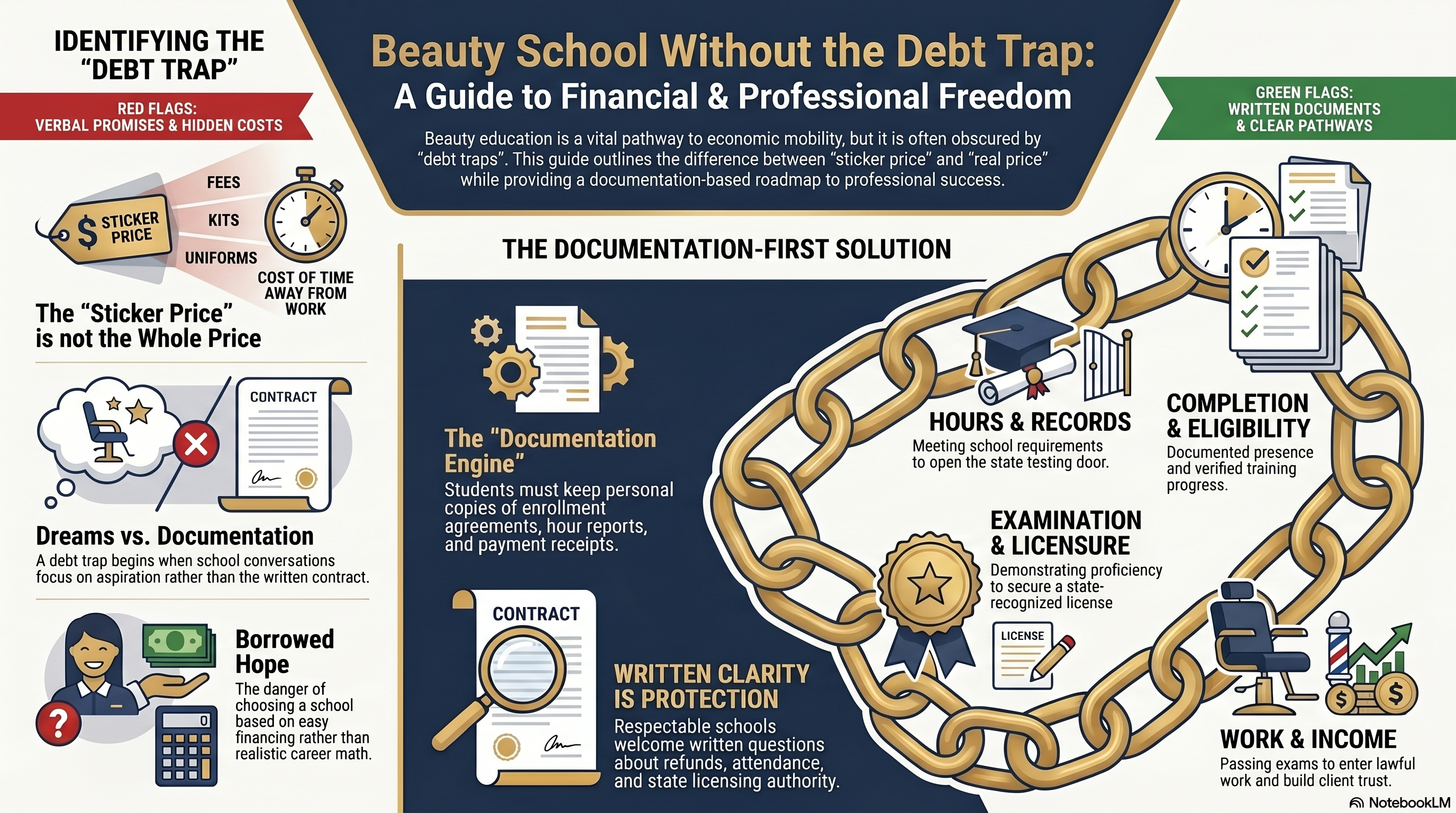
Accessibility of Student Contracts and Policies in U.S. Beauty Colleges vs Traditional Colleges – RESEARCH JULY 2025

Introduction: Student-facing documents – such as enrollment contracts, tuition and refund policies, and codes of conduct – are essential for informing students of their rights and obligations. In the United States, how readily these documents are available online varies widely between beauty/cosmetology colleges and traditional higher education institutions. Many beauty and vocational schools (e.g. cosmetology schools) have been noted for providing limited online access to detailed student agreements, sometimes keeping them behind layers of navigation or only providing them upon request. In contrast, traditional colleges and universities often publish catalogs and policy handbooks openly on their websites. Below, we examine the typical accessibility of these contracts and policies, why some schools might not publish them prominently, regulatory requirements for transparency, and criticisms related to this issue, with examples where possible.

Types of Student Contracts and Policies

Before comparing accessibility, it’s important to clarify what documents are in question:

  • Enrollment Agreements / Contracts: A formal contract outlining the terms of enrollment – common in vocational and for-profit institutions (like beauty schools). It may include program details, financial terms, and legal clauses (e.g. arbitration agreements or class-action waivers). Traditional public/nonprofit colleges usually do not use a singular enrollment contract; instead, a student’s agreement to terms is often implicit upon registration or covered by various institutional policies. (For example, universities may require students to accept a financial responsibility agreement each term, but this is generally a standard form, not a negotiated contract.)
  • Tuition Terms and Refund/Withdrawal Policies: Policies describing tuition charges, deadlines, and what refunds a student can get if they withdraw. All Title IV-eligible schools are required to have a refund policy (for return of federal aid, etc.), and traditional colleges typically publish these in their academic catalog or bursar’s office webpage. Beauty and trade schools also have refund policies, often outlined in the enrollment contract or school catalog.
  • Codes of Conduct and Student Handbooks: Rules governing student behavior, academic integrity, attendance, etc. Most accredited institutions (both traditional and vocational) maintain a student handbook or code of conduct. Many traditional colleges post these on public web pages or PDFs, while smaller private career schools might include conduct rules in their catalog or enrollment packet rather than a standalone online page.
  • Enrollment-related Disclosures: For example, school catalogs, program brochures, and (for vocational programs) performance fact sheets with outcomes data. Accreditors and some state laws require that prospective students receive these before signing an enrollment agreement.

In summary, traditional colleges rely on published catalogs and policies (with no single “contract” to sign in most cases), whereas beauty colleges and other private career schools often use a binding enrollment contract plus a catalog of policies.

Accessibility at Beauty and Cosmetology Schools

Many U.S. beauty colleges (cosmetology, esthetics, barbering schools, etc., often privately owned or for-profit) do not make their full student enrollment agreements easily accessible online. Instead, the detailed contracts and policies may be provided in person or via email during the admissions process. Here are some observations:

  • School Catalogs vs. Contracts: Typically, a beauty school’s catalog – which contains an overview of programs, policies, and requirements – might be available on its website (often as a PDF). For instance, California’s Bureau for Private Postsecondary Education (BPPE) requires that any institution with a website post its school catalog online. As a result, a California beauty school like Milan Institute of Cosmetology provides its catalog and even a blank enrollment agreement form on its site. In that Milan Institute example (Vacaville, CA campus), the enrollment agreement PDF explicitly states that “prior to signing this enrollment agreement, you must be given a catalog or brochure and a School Performance Fact Sheet”, emphasizing that the student should review those documents first. This indicates a regulatory expectation (in CA and via the school’s accreditor) that key policies be provided to prospective students before they commit.
  • Hidden Behind Layers: Outside of states with strong disclosure rules, it’s common that the actual enrollment contract itself is not published in a readily searchable way. A 2016 study by The Century Foundation found it necessary to obtain many college enrollment contracts through public records requests (FOIA), because they were not publicly posted by the institutions. In that analysis, hundreds of contracts from for-profit institutions (including cosmetology schools) were collected via state agencies instead of school websites. This suggests that in practice, many vocational schools do not voluntarily publish the full text of their student agreements online. Prospective students might only see these documents after multiple steps – for example, after speaking with an admissions representative, attending an info session, or digging through a “Consumer Information” page on the website.
  • Example – Arbitration Clauses: The content of beauty school contracts may explain why schools are hesitant to broadcast them. For example, the enrollment contract for Paul Mitchell The School – Tysons Corner (a cosmetology program) is 10 pages long and devotes an entire page to a mandatory arbitration agreement, requiring students to initial ten separate statements about waiving their right to sue. Such clauses (which prevent students from taking disputes to court) are controversial and were found by researchers to be widespread in for-profit college contracts but virtually nonexistent at public or nonprofit colleges. A school might keep the contract hard to find online to avoid drawing attention to these restrictive terms. (In the Paul Mitchell case, the contract was obtained and documented by researchers, rather than openly available on the school’s site.)
  • Other Accessibility Issues: Some beauty school websites simply provide a form for “Request Information” or list minimal policy summaries, rather than posting full PDFs of the student handbook or contract. A prospective student might have to navigate through several links (e.g. Admissions > Consumer Disclosures > Catalog) to find policy details, or in some cases call the school to receive the documents. Even when posted, they might be buried deep in the site’s structure. For instance, one might find a refund policy only as a paragraph within a PDF catalog, rather than on a clear, dedicated webpage. In short, the default approach at many cosmetology schools is to treat detailed policies as enrollment documents rather than marketing materials, meaning they’re provided once a student is in the pipeline, not prominently advertised on the front page.
  • Exceptions – Transparency Leaders: Not all beauty colleges are opaque. Some schools take pride in transparency. For example, Louisville Beauty Academy (per a news mention) advertises itself as a model of “how beauty schools can operate with transparency and structure,” possibly indicating that they make their policies readily accessible to the public. Additionally, chains that operate in states like California (with strict rules) usually have catalogs and performance statistics online for compliance. But these tend to be exceptions driven by regulation or institutional philosophy; the norm historically has been limited public disclosure.

Accessibility at Traditional Colleges and Universities

In contrast to cosmetology schools, traditional colleges (public universities, private non-profits, community colleges) generally make student policies and related documents quite accessible online. Key points include:

  • Academic Catalogs and Handbooks: Almost every accredited college or university publishes an academic catalog (or bulletin) on its website, which includes degree requirements, academic rules, and often the tuition and refund policy. Likewise, student codes of conduct and housing policies are often available as webpages or PDF downloads. For example, major universities clearly post their tuition refund schedules and withdrawal policies. The University of Texas at Austin and the University of Texas at San Antonio list how refunds are calculated based on withdrawal date in their online catalogs. Baylor University’s website openly provides a detailed table of refund percentages by week of the term – e.g. a student who withdraws in Week 1 of classes gets 90% tuition refunded, Week 2 is 80%, etc.. This information is presented on a public “Cancellation/Withdrawal Refunds & Policies” page, without any login required.
  • Financial Responsibility Agreements: Many universities now require students to accept a financial responsibility agreement (acknowledging they must pay tuition, etc.) each year. While the prompt to sign it is in the student portal, the text of the agreement is often available on the university bursar or finance website. For instance, schools like the Colorado School of Mines, University of Virginia, and Florida State provide the full text or a summary of the Student Financial Responsibility Agreement on their public sites. This suggests an emphasis on transparency, ensuring students know what they’re agreeing to (and likely to preempt claims of “I didn’t know I owed this”).
  • Codes of Conduct: As another example, Student Conduct Codes are typically one search away on a .edu domain. Universities such as Virginia Tech, Cornell, and Drexel publish their student codes online for anyone to read. These outline behavioral expectations and due process rights in disciplinary matters. The accessibility of such codes reflects a broader expectation of openness in academia, and in public institutions it’s sometimes linked to state open-records or “sunshine” policies.
  • Ease of Access: While a large university’s website can be labyrinthine, the trend is that policies are not intentionally hidden. One might have to click through a menu (e.g. Current Students > Policies > Handbook), but the information is available without needing special permission. Moreover, universities often have a Consumer Information page (required by federal law for Title IV schools) which centralizes links to key disclosures – campus security reports, drug/alcohol policy, and various student outcome data – ensuring compliance with the Higher Education Act’s transparency rules. This means a diligent prospective student can usually find things like the refund policy, transfer credit policy, or grievance procedures on their own. Traditional colleges also usually publish enrollment-related terms in admission offer letters or orientation materials (for example, an admitted student may get an enrollment confirmation form that references abiding by campus policies, and those policies are referenced on the public site).
  • Not Using Formal Contracts: As noted, most public and nonprofit colleges do not make students sign a multi-page enrollment contract full of legal clauses. Therefore, there is no “secret contract” to hide – the terms of enrollment are laid out in the publicly available catalog and other policy docs. This is a fundamental difference from many career schools. The Century Foundation’s analysis underscored that restrictive clauses (like arbitration requirements) were rare or nonexistent at traditional schools, whereas they appeared frequently in for-profit college contracts. In other words, traditional institutions often have less potentially controversial fine print in the first place, and what policies they do have (academic or financial) are generally published for transparency and to meet accreditation standards.

In summary, colleges and universities (in general) tend to make these policies accessible online, through catalogs and official policy webpages. A new student can often find out all the rules and financial terms before enrolling by perusing these public resources. Any difficulty in finding them is usually due to the volume of information on the site, not an intentional hiding of the documents.

Why Would Schools Hide or Not Publish These Documents?

For the institutions that do obscure or fail to publish their student contracts/policies, several possible reasons and factors come into play:

  • No Explicit Requirement to Publish: Unlike course catalogs or annual security reports, an enrollment agreement contract is not universally mandated to be on a website. Regulatory focus is on ensuring the student receives and signs it, not on making it public to all. If a school can meet accreditation and U.S. Department of Education rules by handing a physical copy or email to the student during enrollment, they may feel that’s sufficient. In states without specific laws, a beauty college might simply not think to upload the contract for public viewing. (For instance, Illinois and some other states require private career schools to submit their enrollment agreements for state approval, but they do not require schools to post them online for prospective students.)
  • Marketing and First Impressions: The content of these agreements can be daunting. Lengthy refund schedules, legal disclaimers, and disciplinary rules are not exactly selling points to someone shopping for a school. Schools may fear that publishing the full contract or handbook might scare off potential students. Instead, they funnel prospects through admissions counselors who can deliver the information in a more controlled manner. As one observer put it, colleges that use restrictive clauses may be “taking advantage of students at [the] optimistic moment” of enrollment. By not surfacing the fine print too early, a school might hope students will be less deterred by, say, a no-refund policy after a certain date or an arbitration clause.
  • Controversial Clauses and Reputation: Some hidden terms might provoke criticism if widely known. For example, mandatory arbitration and class-action waivers (which prevent students from suing or joining class-action lawsuits) have been common in for-profit college contracts. Such clauses have been heavily criticized by consumer advocates and were even temporarily forbidden for colleges using federal aid (a regulation that has since seen back-and-forth changes). A school that includes these might prefer not to draw attention to them publicly. In fact, The Century Foundation recommended that state agencies publicly post the contracts they collect, specifically so that “law enforcement… and consumer protection experts” can examine potentially predatory terms. The implication is that currently those terms stay under the radar, partly due to lack of public accessibility. In short, opacity can be intentional: one analysis noted that contract opacity “shields… from demands for transparency, access, and equity” – suggesting institutions (or their corporate owners) may deliberately limit transparency to avoid accountability or bad PR.
  • Competitive Secrecy: In the career education industry, some schools might view their exact tuition and refund formulas, or their contract language, as proprietary or at least not something to broadcast. They might worry competitors could use it to undercut them or that public scrutiny could arise from comparisons. (For example, if School A’s refund policy is harsher than School B’s, School A might not want that obvious on a website comparison.)
  • Logistical / Legacy Reasons: Some smaller colleges simply haven’t prioritized web updates. A mom-and-pop beauty school that has operated for decades might still rely on paper catalogs and in-person counseling. They may be complying with disclosure rules by handing each applicant a packet (or having them sign off that they received the catalog), and see no need to also maintain an online repository. In some cases, lack of tech savvy or resources means the website is bare-bones – perhaps just a homepage and a contact form – with the expectation that interested students will call or visit for details. While larger colleges have entire web teams and legal counsel ensuring policies are posted, a tiny cosmetology institute might not, unless an external rule forces their hand.
  • Accreditor or Aid Considerations: It’s worth noting that accredited schools do have to provide information to students, but how they do so can vary. For example, the national accreditor NACCAS (for cosmetology schools) requires that “prior to signing an enrollment agreement, an institution is required to provide each applicant with access to” the catalog of information. “Access” could be interpreted as giving a physical copy or emailing a PDF link, not necessarily a public web URL. Thus, a school might technically fulfill this by emailing the catalog once a student inquires or applies, rather than openly posting it. This meets the letter of the requirement but keeps the information semi-private.

In essence, where documents are not published or are buried, it often comes down to a lack of transparency mandate plus strategic choice. For schools that have nothing to hide and operate in a traditional higher-ed context, openness is the norm; for those in more sales-driven education markets (like for-profit trade schools), there may be incentives to be less forthcoming upfront.

Regulatory Requirements and Transparency Standards

There is a patchwork of laws and standards that influence how accessible student policies should be:

  • Federal Higher Education Act (HEA) Disclosures: Any college that receives federal student aid (Title IV funds) must disclose certain information to current and prospective students. This includes things like the refund policy, academic program information, graduation rates, campus security policy (Clery Act), etc. While schools are required to make this information available (and most do so via a web page), the regulations don’t necessarily say “post the signed enrollment contract online.” They do, however, prohibit misrepresenting key terms. For example, the HEA’s misrepresentation rules mean a school could get in trouble if its catalog says “100% job placement!” when that’s false. So schools have to be truthful in published materials, but they have latitude in how they disseminate the enrollment terms. Many colleges have a Consumer Information page linking to all required disclosures (financial aid terms, refund policy, etc.), and the Department of Education expects these to be easy to find. In fact, some states and systems (e.g. the Washington State Board for Community and Technical Colleges) provide guidelines that websites must clearly present consumer info to avoid any HEA compliance issues.
  • State Laws: Certain states mandate greater transparency, especially for private postsecondary schools:
    • California (a leader in this area) requires that if an institution has a website, it must post its catalog, student brochures, School Performance Fact Sheets for each program, and a link to the BPPE’s website prominently on the site. Moreover, California schools’ enrollment agreements themselves have to contain specific disclosures and cancellations terms, and students must sign that they received the performance fact sheet of outcomes. This has created a culture where California-based beauty colleges often have a “Disclosures” or “Consumer Info” section online with PDFs of catalogs and performance data.
    • Other states like Illinois, Texas, Florida, Arizona, Virginia require private career colleges to submit their enrollment agreements for approval as part of state licensing. However, making them public is another matter. Illinois, for example, doesn’t post them on its website, but the fact that one can FOIA them (as The Century Foundation did) means the state sees them. The Century Foundation specifically recommended these state agencies publish the contracts electronically for accountability. Until that happens broadly, one must often request these from the state or school.
    • Some states have “Student Bill of Rights” regulations for certain sectors. For instance, a state might require that a student’s rights and responsibilities be given in writing and even posted in a visible place on campus (Illinois requires cosmetology schools to “post in a conspicuous place” a statement of student rights). But again, this doesn’t always equate to a public online posting.
  • Accreditation Standards: Accreditors (regional accreditors for traditional colleges, national accreditors like NACCAS or ACCSC for trade schools) emphasize transparency and fair student treatment. While they might not say “you must have your policies on a public webpage,” they do require that institutions provide catalogs, give clear enrollment agreements, and adhere to advertised policies. For example:
    • NACCAS requires that schools have a written catalog meeting certain criteria and that students get that info before enrollment. Failing to do so could jeopardize accreditation. Similarly, ACCSC (another accreditor for career schools) requires that the enrollment agreement and catalog include all relevant terms and are provided to students; institutions must honor those published policies.
    • Regional accreditors for universities often have criteria about transparency and integrity – an accredited college must not deceive students and should make information like costs and policies readily available. This creates indirect pressure to keep websites informative. It’s generally seen as a best practice in higher ed to publish policies so that students and the public can review them, reflecting an ethos of accountability.
  • Transparency Initiatives: Beyond mandatory regulations, there have been broader calls for transparency in higher education. The proposed College Transparency Act at the federal level (pending legislation) and other initiatives focus mostly on outcomes data (like earnings and debt), but the spirit is to empower students with information. Likewise, during the Obama administration, the Department of Education pushed for rules against secret arbitration clauses in school contracts, arguing that students shouldn’t have to sign away legal rights without knowing – this led to a short-lived regulation banning mandatory arbitration at schools receiving federal aid (rescinded in 2018 and partially restored later). Consumer advocates like Public Citizen and TICAS have argued that students deserve to see and understand all terms before enrolling, which implies schools should not hide things in fine print or behind login walls.

In summary, regulations do demand that students have access to policies and terms, but not all demand proactive public posting. Where rules are strict (e.g. California), we see near-universal online disclosure. Where they are looser, some institutions only meet the minimum (handing the contract to the student at signing). Transparency standards set by industry groups and watchdogs generally encourage making this info easy to find – aligning with the practices of traditional colleges.

Criticisms and Discussions on Information Accessibility

The varying practices in publishing student contracts and policies have attracted criticism, especially toward institutions that appear to obfuscate important information:

  • Consumer Advocate Critiques: Organizations focused on student rights have pointed out that lack of transparency can be harmful. The Century Foundation’s report “How College Enrollment Contracts Limit Students’ Rights” explicitly criticized the use of buried clauses (like arbitration) and highlighted that these contracts are often hard for outsiders to obtain. They argue that if contracts were public, it would be easier to spot predatory terms and inform students. As a result, one of their recommendations was for oversight agencies to post these documents publicly online. The implication is that hiding the contract is contrary to the idea of informed consent in education – students can’t exercise consumer choice properly if they can’t easily compare what they’re agreeing to at different schools.
  • Public Perception and “Hidden” Policies: There’s a broader narrative that some educational programs, especially for-profit trade schools, mislead students or withhold key information. For instance, the Institute for Justice published a report on cosmetology schools noting many “ugly practices to boost profits.” In media coverage of that report, cosmetology schools were even labeled “the biggest scam in higher education” by some commentators. While that charge encompasses many issues (high tuition, low outcomes, unpaid labor by students, etc.), part of the problem is students enrolling without full understanding of what they’ll get and what is expected of them. If refund policies or extra fees (like over-contract hour fees) are tucked away, students might feel blindsided. Indeed, complaints have surfaced on forums and social media where beauty school students say they didn’t realize, for example, that missing too many hours would incur extra tuition charges or that withdrawing would still leave them on the hook for substantial debt. Such stories fuel the argument that these documents need to be clearer and more openly available. In short, opacity in student contracts is often cited as a red flag for predatory behavior.
  • Mandatory Arbitration and Legal Rights: A specific area of discussion has been the justice angle – when students discovered they “can’t sue” their college due to an arbitration clause, many felt the school had not been upfront about it. This led to not only media coverage (e.g. a 2016 BuzzFeed News story titled “Students Ripped Off By For-Profit Colleges Discover They Can’t Sue”) but also policy moves. The PROTECT Students Act and other legislative efforts have aimed to curb such secretive clauses. Even accrediting bodies were encouraged to view these clauses as a sign an institution “lacks integrity”. All of this ties back to transparency: had these clauses been obvious on websites or in college materials, pressure would likely have mounted against them sooner. The fact that they were tucked into enrollment contracts that students see only at signing (and not easily anywhere else) is a central criticism.
  • Student and Faculty Expectations: Within traditional higher ed, there’s an expectation of openness. If a university tried to hide its code of conduct or not publish a policy, students and faculty would likely object. The norm is so strong that any deviation (like requiring a login to read rules) would be seen as strange. This culture is gradually influencing other sectors too – students expect to “Google” a school and find out about costs, rules, accreditation, etc. easily. Institutions that don’t facilitate this might be viewed as behind the times or even suspicious. Thus, from a reputational standpoint, not publishing policies can hurt trust. Some vocational schools have recognized this and begun voluntarily putting more info online (especially as they seek to differentiate themselves from less scrupulous competitors).
  • Examples of Discussion: The topic of accessibility of these documents doesn’t always hit headlines, but it underlies many education stories. For example, when an Iowa Attorney General’s lawsuit against La’ James International College (a cosmetology chain) became public, it highlighted that students were frustrated by policies that weren’t clearly disclosed (like requirements to bring in paying clients to get credit hours). Prospective students reading about that case might try to look up La’ James’ enrollment agreement online – and if they couldn’t find it easily, it reinforces the sense that the school wasn’t transparent. Similarly, any time a college’s fine print makes news (be it a no-refund after X weeks rule, or a we can change the curriculum at any time clause), it sparks conversation about whether students knew about it beforehand.

Overall, the discussion around accessibility is tied to larger issues of transparency, fairness, and informed choice in education. Critics assert that schools, particularly those in the for-profit and career college sector, should not hide their “true colors” until a student is already in the door. Instead, all key terms should be as easy to find as the school’s promotional materials. On the other hand, schools that have been less transparent rarely publicly defend that practice – instead, whenever regulations require more disclosure, reputable institutions comply, suggesting that the trend (and expectation) is moving toward greater accessibility.

Conclusion

Do most U.S. colleges make student contracts and policies easily accessible online? In summary:

  • Traditional public and nonprofit colleges generally do make their policies accessible, usually by publishing comprehensive catalogs, policy manuals, and FAQ pages on their websites. There’s a culture of transparency and often legal/accreditation requirements that push these institutions to be forthright. A student can typically find tuition refund schedules, codes of conduct, and other policies without needing special permission or deep insider knowledge. Moreover, because many such colleges don’t use one consolidated “enrollment contract,” there isn’t a secret document to hunt for – the rules you agree to are the same ones anyone can read in the catalog.
  • Beauty colleges and many for-profit/vocational schools, on the other hand, have a mixed record. Often their student enrollment agreements and detailed policies are not readily available online to the casual researcher. They might be provided after an inquiry or embedded in a PDF few people download. In some cases, these documents are effectively hidden behind multiple layers of navigation or bureaucracy – you might have to fill out a contact form, talk to an admissions rep, or wade through a long PDF to get specifics. Some schools don’t publish them at all on the open web. This practice has been attributed to the lack of strict requirements and, possibly, a desire to avoid exposing restrictive or unpopular terms. However, under pressure from regulators and consumer expectations, this is slowly changing. Certain states force more transparency (e.g. requiring that the catalog and factsheet be on the website’s homepage in California), and accrediting bodies require giving out information before signing a contract.
  • Reasons for Non-Disclosure: When documents are not published or are hard to find, it may be a deliberate strategy or a remnant of old practices. Schools might fear that plainly advertising strict refund rules, extra fees, or legal waivers would deter students. By keeping those policies a bit buried, they ensure interested applicants talk to staff who can frame the information. Unfortunately, this can edge into obfuscation, which is why consumer protection voices argue for more openness. A college “on the level” should have nothing to hide in its enrollment terms – and indeed, making them accessible is viewed as a hallmark of integrity in education. Agencies like the U.S. Department of Education have encouraged transparency as a means to empower students and hold schools accountable (e.g. suggesting contracts with certain clauses indicate a lack of integrity).

In conclusion, many beauty and career colleges have historically not published student contracts and detailed policies front-and-center online, whereas traditional colleges usually do. This information can be “hidden” in the sense that a prospective student might have to jump through hoops to see it. The practice persists partly due to weaker transparency rules in that sector and partly due to schools’ own incentives. However, growing awareness and regulatory attention are pushing for change – advocating that whether it’s a small cosmetology institute or a large state university, students should be able to easily find enrollment agreements, tuition/withdrawal policies, and codes of conduct before they commit. Transparency is increasingly seen not just as good practice but as a responsibility in higher education, crucial for protecting students from unwelcome surprises.

REFERENCES

The Century Foundation. (2016, September 21). How college enrollment contracts limit students’ rights. https://tcf.org/content/report/college-enrollment-contracts-limit-students-rights/

BuzzFeed News. (2016, September 21). Students ripped off by for-profit colleges discover they can’t sue. https://www.buzzfeednews.com/article/mollyhensleyclancy/students-ripped-off-by-for-profit-colleges-discover-they-ca

California Bureau for Private Postsecondary Education (BPPE). (2023). California Education Code §94913 – Internet disclosures. https://www.bppe.ca.gov/lawsregs/ed_code.pdf

Milan Institute of Cosmetology – Vacaville. (2023). Enrollment Agreement & School Catalog. https://milaninstitute.edu/vacaville-campus

Baylor University. (2024). Cancellation/Withdrawal Refunds and Policies. https://www.baylor.edu/sfs/index.php?id=970957

University of Texas at San Antonio. (2024). Tuition and Fees Refund Policy. https://catalog.utsa.edu/policies/tuition/refundpolicy/

Colorado School of Mines. (2024). Student Financial Responsibility Agreement. https://www.mines.edu/bursar/student-financial-responsibility-agreement/

University of Virginia. (2024). Financial Responsibility Agreement. https://studentfinancialservices.virginia.edu/financial-responsibility-agreement

Florida State University. (2024). Financial Responsibility Statement. https://studentbusiness.fsu.edu/frequently-asked-questions/financial-responsibility-statement

Virginia Tech. (2024). Student Code of Conduct. https://www.hokiehandbook.vt.edu/code-of-conduct.html

Cornell University. (2024). Campus Code of Conduct. https://assembly.cornell.edu/policies/campus-code-conduct

Drexel University. (2024). Student Code of Conduct. https://drexel.edu/studentlife/community-standards/student-code-of-conduct/

Institute for Justice. (2020, February 25). Beauty school debt: How cosmetology schools fail students. https://ij.org/report/beauty-school-debt/

Daily Dot. (2020, March 2). Cosmetology students say beauty school is a scam. https://www.dailydot.com/debug/cosmetology-beauty-school-lawsuit/

Illinois Department of Financial and Professional Regulation. (2023). Enrollment Agreement Checklist for Cosmetology Schools. https://idfpr.illinois.gov/profs/cosmo.html

National Accrediting Commission of Career Arts & Sciences (NACCAS). (2024). Standards and Criteria: Institutional Catalog and Disclosures. https://www.naccas.org/naccas/naccas-handbook

U.S. Department of Education. (2024). Consumer Information Regulations (HEA Sec. 485). https://www2.ed.gov/policy/highered/leg/hea08/index.html

Washington State Board for Community and Technical Colleges. (2024). Consumer Information for Students. https://www.sbctc.edu/colleges-staff/programs-services/student-services/consumer-information.aspx

Public Citizen. (2017, October 24). Comments on the use of mandatory arbitration in higher education. https://www.citizen.org/article/public-citizen-comments-on-arbitration-in-education/

Paul Mitchell The School – Tysons Corner. (Enrollment Agreement excerpt as cited in The Century Foundation, 2016).

Translate »