Categories
Community Witness

The Immigrant Work Ethic Behind a School That Opens Before Sunrise

The Immigrant Work Ethic Behind a School That Opens Before Sunrise

Before a student enters a classroom, someone has already prepared the space. Sometimes that preparation is administrative. Sometimes it is spiritual. Sometimes it is as simple as picking up trash, clearing the alley, and treating the neighborhood as part of the institution’s responsibility.

This kind of work may not look glamorous, but it is a powerful form of public trust. Immigrant-built institutions often begin this way: early mornings, quiet labor, family sacrifice, and the belief that dignity is created by what people do when no audience is watching.

A clean school, a clean sidewalk, and a cared-for back alley are not small things. They teach a public lesson: if we want to elevate people, we begin by caring for the environment where people learn, work, and walk.

What This Means Practically

  • Use written clarity before verbal pressure.
  • Give people the next honest step without forcing the decision.
  • Let proof, service, and usefulness create trust over time.

Institutional Position

Viet Bao Louisville will continue preserving stories of work, family, faith, discipline, and community service that explain how institutions are truly built.

References and Related Institutional Context

  • Viet Bao Louisville community witness doctrine
  • Matthew 22:39, love thy neighbour as thyself
  • Louisville Beauty Academy values-in-action public narrative

This article is public education and institutional commentary. It is not legal, financial, medical, or individualized enrollment advice.

Categories
Community

What Louisville Can Learn from GE Appliances CEO Kevin Nolan: Stop Talking About AI. Start Using It.

A Rotary Club of Louisville Reflection on Manufacturing Excellence, Small Business Innovation, Workforce Development, and the Courage to Embrace Artificial Intelligence

Every city has moments that reveal where its future is heading.

Sometimes those moments arrive not through legislation, billion-dollar announcements, or national headlines.

Sometimes they arrive through a simple statement delivered by a leader who has spent decades building things.

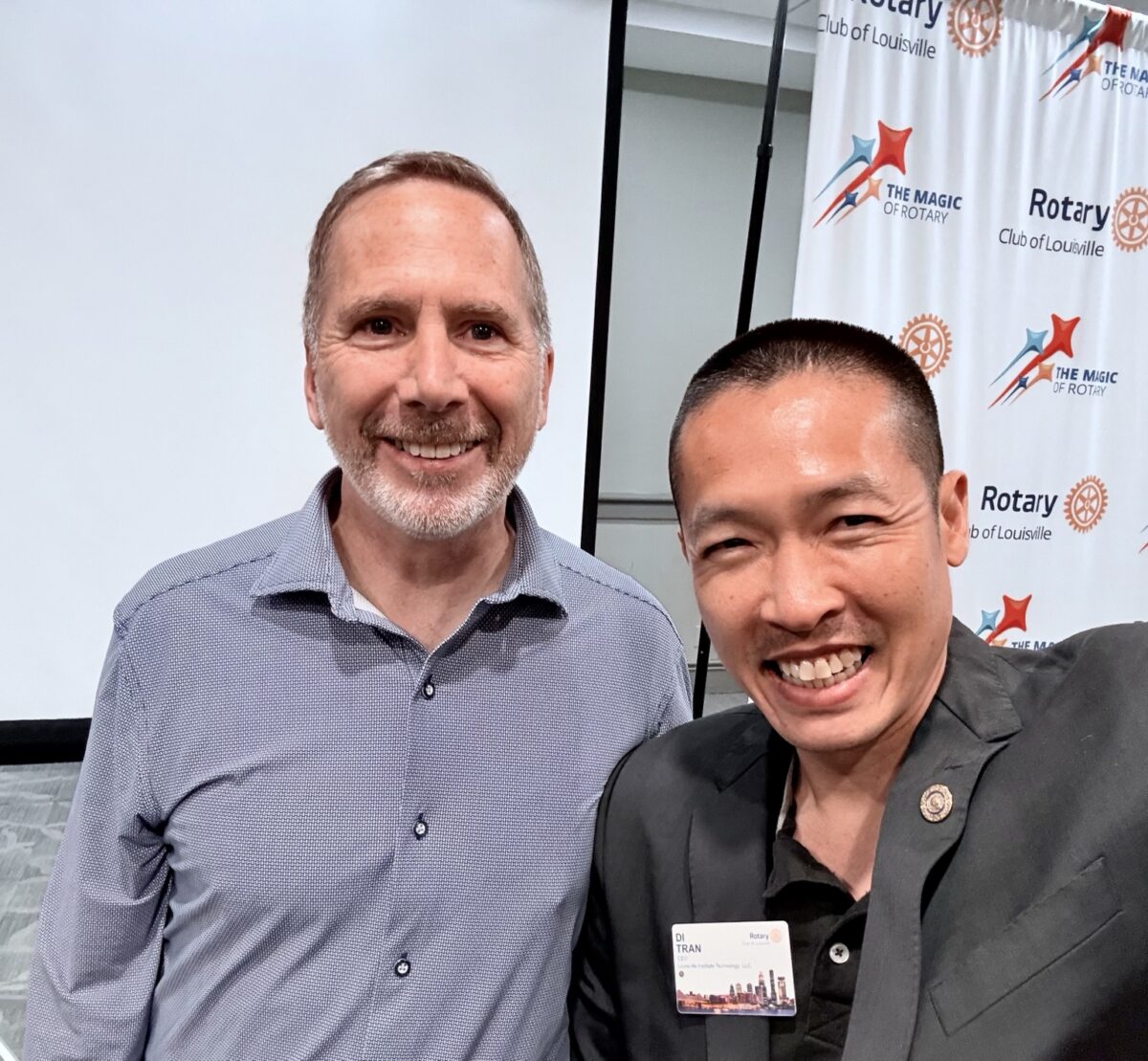
At a recent Rotary Club of Louisville luncheon, members heard from Kevin Nolan, President and CEO of GE Appliances, one of America’s most respected manufacturing leaders and one of Louisville’s most influential executives.

The presentation was titled:

“Reinventing an American Icon.”

Yet perhaps the most powerful lesson was not about appliances, manufacturing, or corporate strategy.

It was about action.

A simple message emerged:

Stop talking about AI. Use it.

In a world increasingly divided between fear of technology and endless discussion about technology, Nolan’s perspective reflected something deeper—an engineer’s mindset.

Engineers do not debate possibilities forever.

They build.

They test.

They learn.

They improve.

Then they repeat.

That mindset has helped transform GE Appliances into a manufacturing success story while maintaining Louisville as its global headquarters.

More importantly, it offers a lesson for every small business owner, educator, entrepreneur, workforce leader, and community builder across Kentucky.

Fast Learning Beats Perfect Planning

One of the recurring themes shared during the discussion was the importance of experimentation.

Innovation does not come from waiting.

Innovation comes from trying.

Successful organizations understand that not every idea will work.

The goal is not perfection.

The goal is learning.

Try fast.

Learn fast.

Improve fast.

The best organizations are not those that avoid mistakes.

They are the organizations that discover useful solutions before everyone else.

For small businesses, this lesson may be more important than ever.

Artificial intelligence, automation, digital systems, multilingual communication, customer analytics, and workflow automation are no longer future technologies.

They are present-day tools.

The question is no longer whether these technologies will matter.

The question is whether organizations will learn to use them before their competitors do.

Innovation Must Solve Real Problems

Perhaps the most practical lesson from Nolan’s presentation was that innovation is not about creating technology for technology’s sake.

Innovation exists to solve real problems.

Businesses should not build products because they personally like them.

They should build solutions because customers need them.

The market decides.

The community decides.

The customer decides.

Pain points create opportunities.

When organizations listen carefully enough, customers tell them exactly where innovation should occur.

This principle applies equally to multinational manufacturers and local small businesses.

Louisville Beauty Academy and Di Tran University: A Local Example

The same philosophy increasingly appears in Louisville’s workforce education sector.

At Louisville Beauty Academy and Di Tran University, AI is not viewed as a future concept.

It is viewed as a daily operating tool.

Multilingual communication.

Student support systems.

Compliance documentation.

Licensing exam preparation.

Research publication.

Content creation.

Workflow automation.

These systems continue evolving daily, improving through continuous use and refinement.

Just as manufacturing transformed through automation and digital technology, workforce education is beginning a similar transformation through artificial intelligence.

The lesson remains the same:

Use the tools.

Learn from the tools.

Improve through the tools.

The Power of Humble Leadership

Perhaps the most impressive aspect of the presentation was not the corporate accomplishments.

It was the simplicity.

No unnecessary complexity.

No grand performance.

No exaggerated claims.

Just practical observations from a leader who has spent decades solving problems.

This reflects something many successful small business owners recognize immediately.

Real leadership is often remarkably simple.

See clearly.

Listen carefully.

Serve customers.

Take action.

Keep learning.

Repeat.

Why Rotary Matters

Events like these remind us why the Rotary Club of Louisville remains one of the most influential civic organizations in Kentucky.

Among more than 45,000 Rotary clubs worldwide, Louisville’s club continues to attract exceptional leaders, innovators, educators, entrepreneurs, public servants, and community builders.

The common theme is not status.

The common theme is service.

The purpose is not merely networking.

The purpose is elevating Louisville.

Each week, members gather to learn from leaders who are actively shaping industries, communities, and opportunities.

Those conversations become ideas.

Ideas become action.

Action becomes progress.

The Future Belongs to Builders

The most important takeaway from the presentation may be this:

The future will not belong to those who fear change.

It will not belong to those who endlessly debate change.

It will belong to those who learn, adapt, experiment, and build.

Louisville has always been a city of builders.

Manufacturers.

Educators.

Healthcare professionals.

Small business owners.

Entrepreneurs.

Immigrants.

Workers.

Families.

Community leaders.

The opportunity before us is not to predict the future.

The opportunity is to help create it.

And as one engineer-turned-CEO reminded a room full of leaders:

Stop talking about AI. Start using it.

For Louisville, that may be one of the most important leadership lessons of our time.

REFERENCES

GE Appliances Leadership Biography – Kevin Nolan
https://geappliancesco.com/kevin-nolan/

GE Appliances Corporate Newsroom
https://pressroom.geappliances.com/

Rotary Club of Louisville
https://rotarylou.org/

Categories
Cộng Đồng Giáo Dục Văn Hóa

The Lost Majority: Cuốn sách mới của Di Tran về kỷ luật, cấu trúc, và giá trị con người trong thời đại dễ lạc hướng

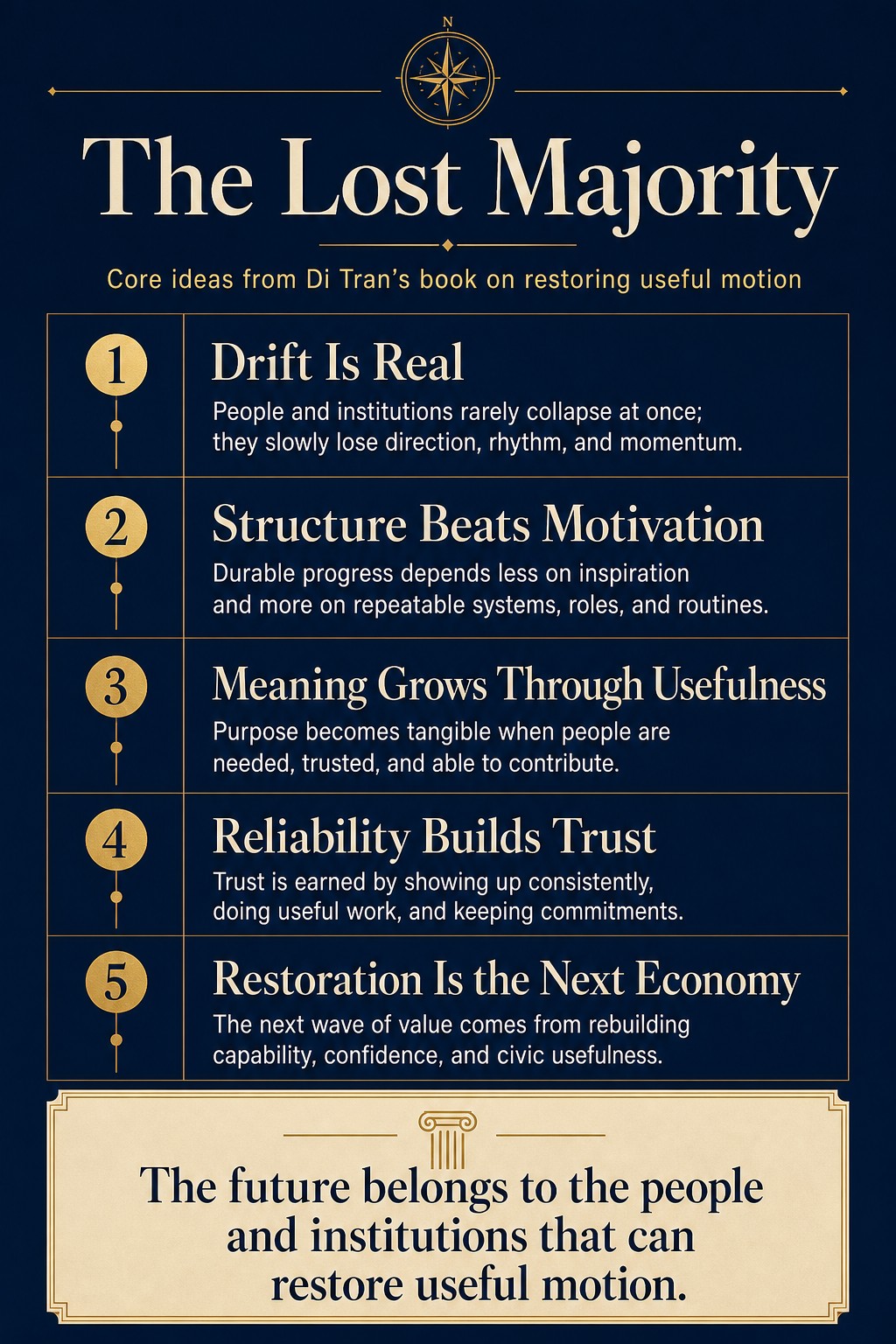
The Lost Majority: Why Modern Life Breaks Human Momentum—and How to Restore Structure, Meaning, and Value là cuốn sách mới của Di Tran, một tác phẩm nghiêm túc viết về một vấn đề rất thật của thời đại này: nhiều người không hẳn thiếu thông minh hay thiếu cố gắng, nhưng đang dần mất đi cấu trúc sống, nhịp điệu làm việc, và khả năng đi tiếp một cách bền vững.

Cuốn sách gọi đúng tên của tình trạng đó: drift — sống lạc hướng, mất đà, biết mình nên làm gì nhưng không còn đủ hệ thống để biến điều đó thành hành động đều đặn.

Vì sao cuốn sách này đáng chú ý

Điểm mạnh của sách là không nói kiểu động viên sáo rỗng. Tác giả đi thẳng vào cốt lõi: động lực thôi chưa đủ. Con người cần cấu trúc, kỷ luật, bằng chứng tiến bộ, sự hữu ích, và khả năng giữ lời với chính mình qua thời gian.

Thông điệp này rất gần với đời sống của nhiều gia đình Việt, nhất là những người vừa làm việc, vừa nuôi con, vừa gây dựng sự nghiệp trong một xã hội ngày càng nhiều tiếng ồn nhưng ít sự ổn định.

Năm ý chính của cuốn sách

  • Sự lạc hướng là có thật.
  • Cấu trúc quan trọng hơn cảm hứng.
  • Ý nghĩa lớn lên qua sự hữu ích.
  • Sự đáng tin tạo ra niềm tin lâu dài.
  • Tương lai thuộc về những người và tổ chức có thể phục hồi chuyển động hữu ích.

Giá trị cộng đồng của cuốn sách

Đối với cộng đồng người Việt, đây không chỉ là một cuốn sách. Nó còn là một lời nhắc mạnh mẽ rằng phẩm giá không đến từ nói hay, mà đến từ làm thật, sống có cấu trúc, và tạo ra giá trị bền vững cho gia đình và xã hội.

Where to Read, Watch, and Follow

Đây là một cuốn sách đáng đọc cho những ai đang muốn sống kỷ luật hơn, làm việc có chiều sâu hơn, và xây một cuộc đời có giá trị lâu dài hơn.

Infographic summarizing the core ideas of The Lost Majority by Di Tran.
Infographic: five core ideas from The Lost Majority by Di Tran.
Categories
Cộng Đồng Doanh Nghiệp Tin Louisville

Louisville Chào Đón Paris Baguette Đầu Tiên Tại Kentucky: Một Câu Chuyện Đẹp Về Gia Đình, Cộng Đồng, Và Người Xây Dựng

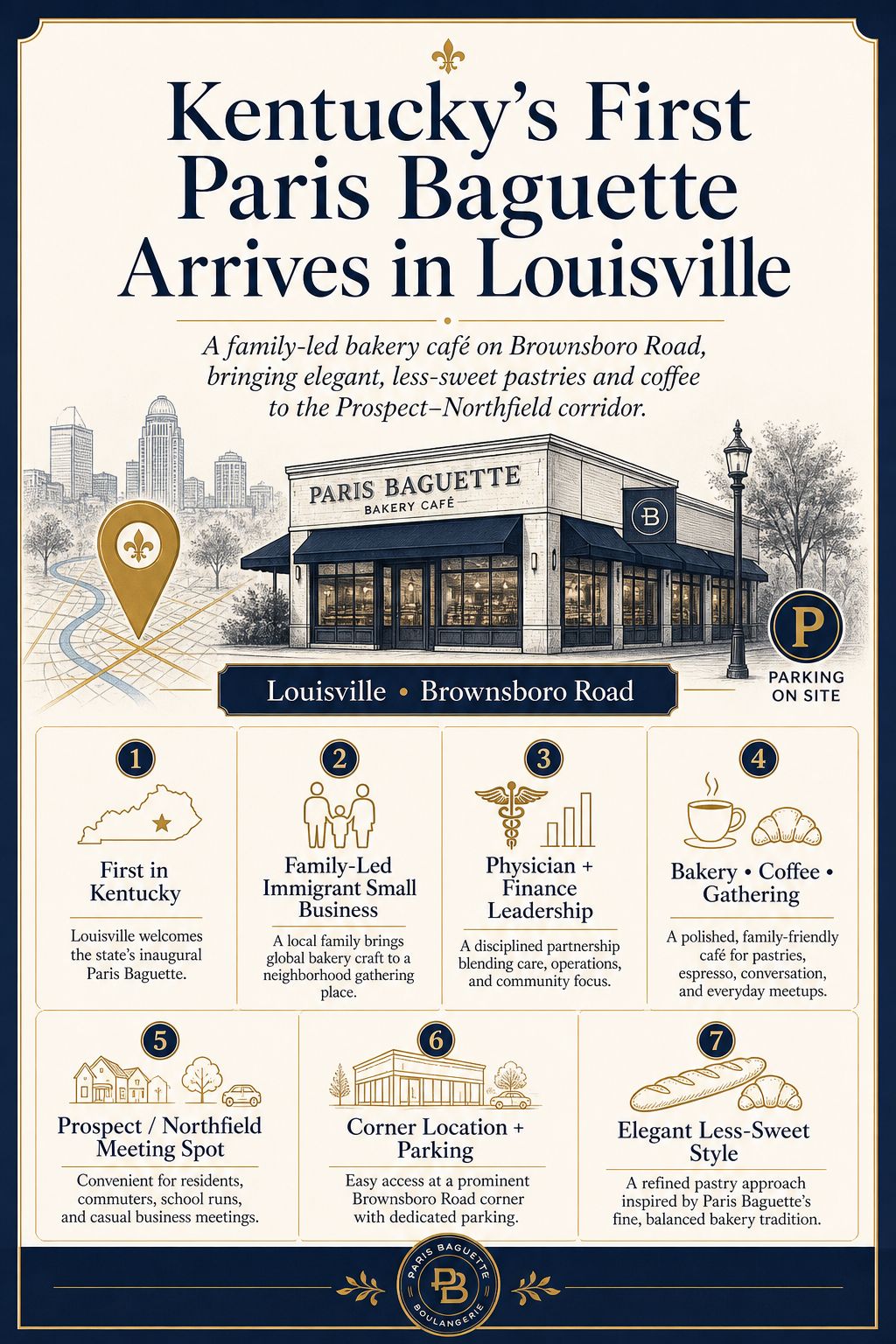
Địa chỉ: 4957 Brownsboro Road, Louisville, KY 40222
Vì sao đáng chú ý: vị trí thuận tiện, đậu xe dễ, phù hợp gặp gỡ gia đình lẫn công việc, và là một bổ sung đẹp cho khu Brownsboro / Prospect / Northfield.
Góc nhìn cộng đồng: đây là kiểu doanh nghiệp mà Louisville nên thật sự ủng hộ.

Louisville vừa đón nhận một điểm đến mới rất đáng chú ý tại 4957 Brownsboro Road: Paris Baguette đầu tiên tại Kentucky. Nhưng nếu chỉ nhìn đây như một tiệm bánh mới, chúng ta sẽ bỏ lỡ phần quan trọng hơn của câu chuyện.

Đây là một câu chuyện về gia đình. Về người nhập cư. Về những người thành công trong nghề nghiệp nhưng vẫn chọn bước thêm một bước khó hơn: mở doanh nghiệp, phục vụ cộng đồng, tạo việc làm, và đặt niềm tin của mình vào chính thành phố Louisville.

Điều đó xứng đáng được trân trọng.

Từ góc nhìn địa phương của Di Tran, đây là một sự bổ sung rất đúng thời điểm cho khu vực Prospect / Northfield. Vị trí này có chỗ đậu xe thuận tiện, dễ ra vào, phù hợp cho cả gia đình lẫn giới chuyên môn, và đủ thoải mái để trở thành nơi gặp gỡ, uống cà phê, trò chuyện, hoặc gặp khách hàng không quá hình thức nhưng vẫn lịch sự. Đây không chỉ là nơi mua bánh; đây có thể trở thành một không gian sinh hoạt thực sự cho cộng đồng.

Thời điểm cũng rất đúng. Khu vực này đang tăng trưởng, lưu thông giao thông đã thuận tiện hơn, hoạt động văn phòng và y tế xung quanh ngày càng rõ hơn, trong đó có cả động lực phát triển gần khu VA và các cụm văn phòng lân cận. Một tiệm bánh – cà phê đẹp, mở cửa sớm, thân thiện với gia đình và phù hợp cho gặp gỡ công việc như thế này đến vào đúng lúc khu vực đang cần.

Điểm đáng quý hơn nữa là tinh thần của câu chuyện. Đằng sau một ngày khai trương đẹp đẽ luôn là rất nhiều tháng ngày chuẩn bị, giấy tờ, đầu tư, áp lực, nhân sự, thiết kế, vận hành, và cả rủi ro. Một gia đình chọn xây dựng như vậy không chỉ đang mở cửa hàng. Họ đang góp thêm sinh khí cho thành phố.

Đó là lý do những doanh nghiệp như thế này cần được cộng đồng ủng hộ thật sự.

Không phải chỉ bằng lời khen trên mạng, mà bằng hành động: ghé thăm, mua hàng, mời bạn bè, đưa gia đình đến, chọn nơi này cho một buổi gặp sáng, một cuộc hẹn cà phê, hay một cuộc trò chuyện công việc ngắn. Khi một gia đình tạo ra một nơi đẹp, sạch, ấm áp, và hữu ích cho cộng đồng, cộng đồng nên đáp lại bằng sự hiện diện thật.

Câu chuyện này cũng có một lớp cảm xúc rất đẹp. Theo chia sẻ của gia đình, hình ảnh Paris Baguette đã để lại ấn tượng từ nhiều năm trước tại New York. Điều đó làm cho sự xuất hiện của thương hiệu này ở Louisville không còn là chuyện ngẫu nhiên. Nó mang cảm giác của một ký ức được tiếp nối, rồi được biến thành hiện thực tại Kentucky.

Về sản phẩm, sức hấp dẫn của Paris Baguette cũng nằm ở trải nghiệm tinh tế hơn: nhiều món bánh và pastry có cảm giác thanh hơn, bớt ngọt gắt hơn kiểu tiệm bánh Mỹ thông thường, và gần hơn với phong cách bánh Âu / Pháp mà nhiều người thấy dễ quay lại hơn. Đó không chỉ là tên thương hiệu. Đó là một phong cách.

Với cộng đồng Việt và cộng đồng nhập cư nói chung, những câu chuyện như vậy rất đáng mừng. Chúng nhắc chúng ta rằng thành công không chỉ là đi làm tốt trong nghề của mình. Thành công còn có thể là xây thêm một điều gì đó cho thành phố mình đang sống. Một nơi để cộng đồng gặp nhau. Một nơi để con trẻ nhìn thấy tấm gương xây dựng. Một nơi cho thấy rằng người nhập cư không chỉ hòa nhập, mà còn góp phần làm cho Louisville đẹp hơn, sống động hơn, và tử tế hơn.

Louisville cần nhiều gia đình như thế.

Và cộng đồng cũng cần biết cách vỗ tay cho những người đang xây.


Gợi ý của Viet Bao Louisville: Nếu bạn ở Louisville, đặc biệt gần khu Brownsboro / Prospect / Northfield, đây là một địa điểm đáng để ghé thăm, ủng hộ, và giới thiệu cho người thân, bạn bè, đồng nghiệp.

Infographic về Paris Baguette đầu tiên tại Kentucky và ý nghĩa với cộng đồng Louisville.
Vì sao Paris Baguette đầu tiên tại Kentucky là một tín hiệu đẹp cho Louisville và cộng đồng doanh nghiệp nhập cư.
Categories
Book Releases Community Culture

From Immigrant Struggle to Public Teaching: Di Tran’s New Book on Work, Family, and Human Dignity

A Louisville founder and educator releases a new book arguing that meaningful labor remains one of the strongest foundations of family life, self-respect, and social peace.

A new book by Louisville founder, educator, and author Di Tran has been released on Amazon: We Were Made to Work: Why Meaningful Labor Builds Strong Families, Human Dignity, and Lasting Peace.

For many immigrant families, the message of this book will feel immediately familiar. Work is not merely a paycheck. It is sacrifice. It is responsibility. It is the daily act of carrying a family forward even when conditions are not ideal. It is often the language through which love is expressed.

That is especially true for those who came to America with limited resources, limited English, and no guarantee of ease. In those households, labor is not theoretical. It is survival, gratitude, and hope made visible.

This release speaks directly to that lived reality. It argues that meaningful work forms human character, strengthens homes, and helps create a more stable society. It also pushes back against the idea that dignity and discipline are opposites. In truth, many families know the reverse: disciplined contribution is often one of the clearest paths to dignity.

The book also reflects a wider public mission. Through education, writing, and workforce-building, Di Tran has consistently emphasized that knowledge should serve people, and that opportunity should be linked to effort, responsibility, and care for others.

In that sense, this release is not just literary. It is cultural. It affirms a value system deeply recognizable to immigrant communities: gratitude, perseverance, contribution, and peace through honorable work.

Amazon: https://www.amazon.com/dp/B0H233ZXBS

Infographic on immigrant family values and meaningful work
Sacrifice, gratitude, discipline, contribution, and peace through meaningful work.
Categories
Community Commentary

Why Publication Is a Duty, Not a Marketing Tactic

In many institutions, publication is treated as promotion. We believe it is first a duty.

A community deserves records of what is being built in its name, around its children, and through its labor. Families deserve explanations that are clearer than advertisements. The public deserves documents that preserve truth, not merely campaigns that chase attention.

For immigrant communities especially, publication carries moral weight. Too much valuable work disappears because nobody records it carefully. Sacrifice remains private. Lessons remain local. Institutions rise, struggle, adapt, and serve, yet the public archive stays thin. When that happens, memory is lost and credibility becomes easier for outsiders to misread.

Publication interrupts that loss. It transforms lived work into civic memory. It helps future students, future families, future founders, and future policymakers understand not only what happened, but what it meant. In this sense, publication is a form of stewardship.

It is also a form of protection. Institutions that write clearly about what they believe, what they do, what standards they honor, and what reforms they seek are harder to distort. Their motives are more legible. Their public service is easier to verify. Their seriousness becomes part of the record.

This is why founder-led educational and community institutions should publish more, not less. They should publish mission statements, public guidance, reflections, policy arguments, local history, and witness. They should document the moral and practical logic behind their work.

Publication should therefore not be confused with vanity. At its best, it is testimony, clarification, and civic accountability. It tells a community: we were here, we served, we learned, we built, and we took the time to explain ourselves.

For Louisville and for the wider Vietnamese American community, that matters. Public memory should not belong only to large institutions with larger budgets. It should also include disciplined local builders who carry work quietly and faithfully over time.

This essay is offered as public reflection and community commentary.

Categories
Community Witness

Louisville, Service, and the Immigrant Dream: Why Human-Centered Education Matters in Real Life

The immigrant dream is often described in heroic language and then abandoned in ordinary systems. People are told to work hard, believe, contribute, and persevere—but when they arrive at the gates of actual opportunity, the path is frequently obscured by cost, language barriers, unfamiliar institutions, and quiet forms of exclusion that rarely announce themselves honestly.

That is why human-centered education matters so much in real life. It is not merely about teaching. It is about whether a society knows how to receive effort with structure.

Louisville offers a meaningful context for this question. Like many American cities, it is shaped not only by formal institutions, but by the daily labor of families who build life through work, service, adaptation, and quiet persistence. Immigrant communities understand this especially well. For them, education is not an abstract cultural ideal. It is often the most practical bridge between instability and belonging.

But not all educational systems honor that reality equally. Some demand forms of patience that only the already-secure can afford. Some are too expensive. Some are too slow. Some are too linguistically narrow. Some speak the language of opportunity while preserving the architecture of delay.

Human-centered education begins by refusing that contradiction.

It asks what people actually need in order to move forward with dignity. They may need instruction that is practical rather than ornamental. They may need schedules compatible with work and family obligations. They may need patient explanation of licensure, forms, and regulatory systems. They may need to see that law and opportunity are not enemies. Above all, they need institutions that do not confuse complexity with honor.

This is where service enters the story. Real service does not simply express sympathy. It builds usable pathways. It helps translate society to the person and the person to society. It makes movement possible.

For immigrant communities, that kind of service has deep consequences. It strengthens trust. It reduces fear of systems that often feel distant. It transforms the meaning of education from a remote aspiration into a reachable act of self-respect. And when that happens, the benefits spread beyond the individual learner. Families stabilize. Children see possibility more clearly. Neighborhoods gain professionals, small businesses, and examples of lawful upward movement.

The deeper lesson is cultural as much as economic. A city becomes stronger not merely when it welcomes diversity rhetorically, but when it builds institutions capable of converting diversity into shared contribution. That requires seriousness, patience, and local leadership. It also requires a refusal to treat immigrant ambition as peripheral. In truth, immigrant ambition has long been one of America’s most renewable public assets.

Louisville has the chance to demonstrate what that looks like in practice: education tied to work, work tied to dignity, dignity tied to service, and service tied to community trust. When that chain is preserved, the immigrant dream stops being a slogan and becomes something more difficult and more beautiful—a daily structure of possibility.

That is the kind of future worth building. Not one made of performance, but one made of pathways.

Research & Information Disclaimer

This publication is provided for educational, research, and public-information purposes only. It reflects institutional analysis based on publicly available information, practical experience, and internal interpretation as of the publication date. It does not constitute legal advice, tax advice, investment advice, or a guarantee of regulatory, financial, or operational outcomes. Readers should consult qualified legal, financial, regulatory, or other professional advisors before acting on matters discussed herein.

References

Categories
Community Self-Improve Small Businesses Workforce Development

Service Above Self: Gary, CEO of the YMCA of Greater Louisville, and Di Tran, CEO of Louisville Beauty Academy & Di Tran University, Share a Vision for Community Service in Louisville

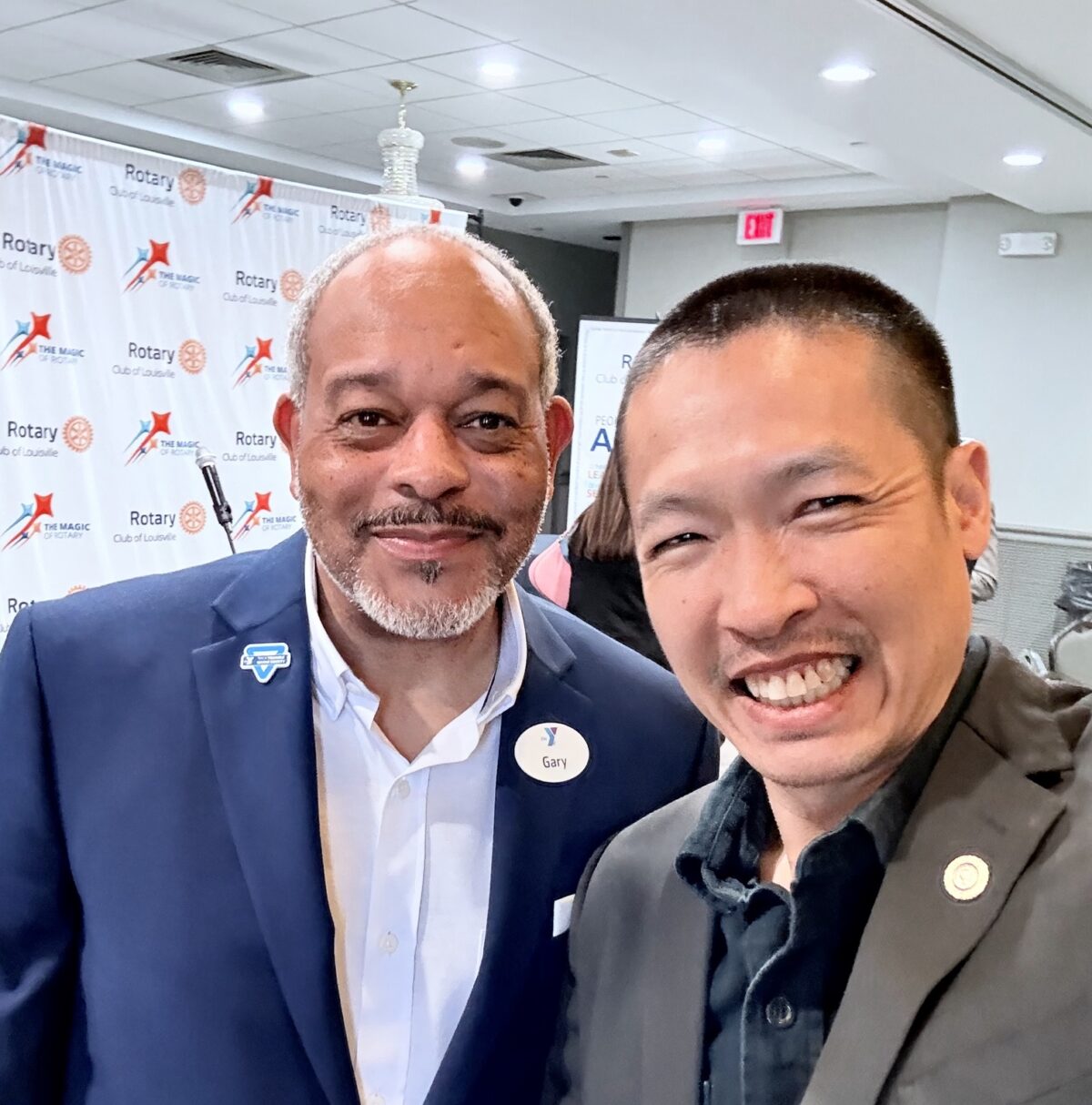
Louisville, Kentucky — This week at the luncheon meeting of the Rotary Club of Louisville, a simple handshake symbolized something much bigger than a greeting.

Entrepreneur, educator, and community builder Di Tran met with Gary, CEO of the YMCA of Greater Louisville, during the gathering of civic and nonprofit leaders.

The Rotary Club of Louisville is one of the most influential civic organizations in the world — ranked among the largest Rotary clubs globally out of more than 40,000 clubs within Rotary International. Each week, leaders gather not just to network, but to learn, recharge, and recommit to service.

During the meeting, Di Tran personally thanked Gary for the YMCA’s ongoing leadership in building stronger communities throughout Louisville.

But beyond the handshake, the conversation also reflected a powerful idea.

A Shared Vision: Service That Lifts Everyone

Both the YMCA and Di Tran’s organizations are built around a simple philosophy:

Service must be accessible.

The YMCA has long provided programs for families, youth development, health, and community support. Meanwhile, Di Tran’s institutions — including Louisville Beauty Academy and Di Tran University — focus on vocational training, entrepreneurship, and empowering individuals to build sustainable careers.

When these ideas intersect, something remarkable becomes possible.

Imagine a model where vocational education directly serves the community.

Imagine Louisville Beauty Academy Serving Families at the YMCA

One idea discussed informally among leaders is a powerful concept:

If Louisville Beauty Academy (LBA) were partnered with YMCA community centers, beauty students could provide free professional beauty services to families in need.

Haircuts
Hair styling
Basic grooming
Confidence-building services

All delivered by trained students under supervision.

This concept is not hypothetical in spirit — Louisville already has a powerful example through the work of Harbor House of Louisville.

Harbor House integrates vocational programs that serve real people while training individuals with disabilities. The result is a cycle of empowerment, where learning and service happen at the same time.

A similar concept with Louisville Beauty Academy could create:

  • Free grooming services for families
  • Practical hands-on training for students
  • Community confidence and dignity
  • Workforce preparation

In other words, education becomes service.

Why Beauty Services Matter More Than People Think

Haircuts and grooming are often underestimated.

But for families facing hardship, these services can restore something deeper: dignity and confidence.

A haircut before a job interview.
A hairstyle before school pictures.
A moment of care that reminds someone they are valued.

This is where vocational education becomes powerful.

Students learn skills.
Communities receive care.
Everyone benefits.

Service Must Come From the Heart

Di Tran often writes in his books that sustainable service cannot be forced.

It must come from genuine desire.

His philosophy is simple:

  • Work that helps others must be done willingly.
  • Service must be consistent, not occasional.
  • Communities thrive when individuals choose to contribute.

These values align perfectly with the Rotary motto:

“Service Above Self.”

The YMCA carries that same spirit.

And when leaders from organizations like Rotary, YMCA, and community educators meet, ideas naturally begin to form about how to serve even more people.

Rotary: A Place Where Leaders Recharge

For Di Tran, Rotary meetings serve an important purpose.

They remind leaders that service is not a solitary mission.

Surrounded by others who share the same commitment, energy returns.

New ideas emerge.

Partnerships begin.

And communities grow stronger.

Gratitude to Rotary Louisville

Di Tran expressed appreciation to the Rotary Club of Louisville for continuing to create a space where leaders can reconnect with the purpose behind their work.

Being among the largest Rotary clubs in the world, the organization demonstrates how local leadership can inspire global ideals of service.

Sometimes, change begins not with a formal program — but with a simple moment.

A handshake.
A thank you.
And a shared vision for serving others.

Categories
Small Businesses Vietnamese Workforce Development

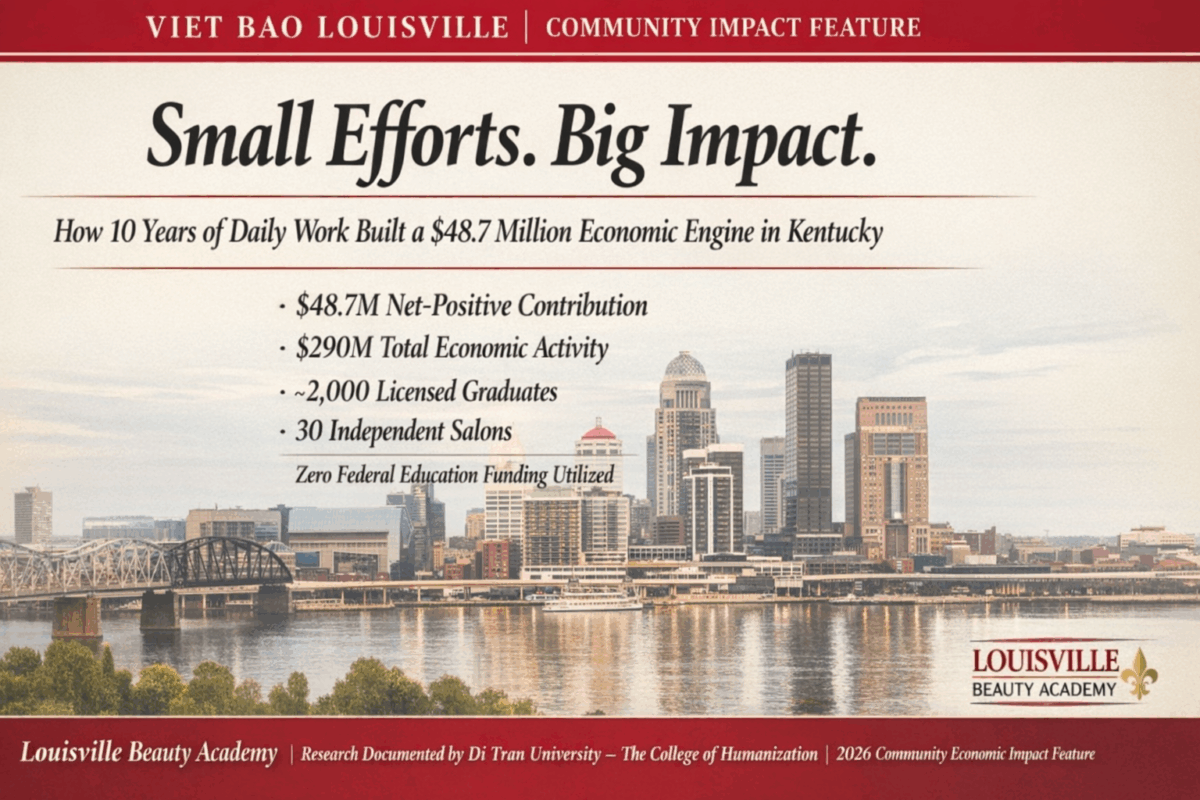
Small Efforts, Big Impact: How 10 Years of Daily Work Built a $48.7 Million Economic Engine in Kentucky

Louisville, KY — Sometimes the biggest impact is built quietly.

One student studying late at night.
One exam taken.
One retake after a setback.
One small salon opened in a neighborhood plaza.
One more employee hired.

Individually, these actions feel small.

Over ten years, they become infrastructure.

A newly released institutional research study conducted by Di Tran University — The College of Humanization, in partnership with Louisville Beauty Academy (LBA), documents something remarkable:

Over the past decade, Louisville Beauty Academy and its students have helped generate:

  • $48.7 million in net-positive fiscal contribution
  • $290 million in total economic activity
  • Approximately 2,000 licensed graduates
  • Nearly 30 independently owned salons
  • Thousands of jobs and secondary economic effects across Kentucky

All while utilizing zero federal education funds and zero state education subsidy.

This is not marketing language. It is arithmetic.


A Different Model of Education

In today’s educational landscape, many vocational programs rely heavily on federal student aid, Pell Grants, and government-backed loans. That model has become standard nationwide.

Louisville Beauty Academy chose a different path.

For 10 years, it has operated on private tuition, interest-free payment plans, and community-based enrollment — without participating in Title IV federal aid programs and without drawing state education subsidies.

The result?

A school that begins at $0 cost to taxpayers and adds measurable economic contribution year after year.


The Power of Compounding Effort

The real story behind the numbers is not the institution. It is the students.

Nearly 2,000 individuals completed licensing programs in cosmetology, nail technology, esthetics, and related fields. Many began as immigrants, refugees, working parents, or career changers.

Some struggled with language barriers.
Some needed to retake exams.
Some balanced work, family, and study simultaneously.

But they kept going.

And that persistence created:

  • Licensed professionals serving communities
  • Small businesses generating $500,000–$1,000,000 annually
  • Employment opportunities for 10–20 workers per salon
  • Ongoing tax revenue supporting public infrastructure

Small daily actions became long-term economic stability.


When Vocational Education Becomes Economic Infrastructure

The Di Tran University research team used publicly available Kentucky Board of Cosmetology data, state fee schedules, and conservative economic modeling to measure the impact.

The findings demonstrate that vocational education — when structured responsibly and affordably — can function not as a public cost center, but as an economic engine.

Every graduate pays licensing fees.
Every salon pays rent and hires workers.
Every paycheck generates tax revenue.
Every client interaction circulates money locally.

The ripple effect compounds over time.


A Community Achievement

Louisville Beauty Academy publicly credited the Louisville community, its students, and graduates for the outcome.

“This is not about one school,” representatives stated. “It is about the community that showed up every day. We are only counting what our students built.”

The research also highlights something often overlooked in public discourse:

Impact is rarely immediate. It is built quietly, year after year.


Why This Matters Now

As policymakers nationwide debate education costs, workforce development, and student debt, this case study offers an alternative model:

  • Low-cost access
  • No public subsidy dependency
  • Measurable workforce contribution
  • Entrepreneurial pathways

It demonstrates that small, consistent effort — when multiplied across a decade — can reshape a local economy.


The Bigger Message: Small Effort Always Matters

Ten years ago, no one saw a $48.7 million headline.

There were just students learning sanitation procedures.
Practicing theory questions.
Retaking exams.
Serving their first clients.

Small steps.

But small steps repeated daily create something extraordinary.

The lesson is not just about one school.

It is about persistence.

It is about contribution.

It is about believing that what you do today — even if it feels small — matters more than you can see.

And in Louisville, Kentucky, the numbers now prove it.

Categories
RESEARCH BY DI TRAN UNIVERSITY Small Businesses Workforce Development

A Comprehensive Analysis of Commercial Utility Rate Volatility and Mitigation Strategies in Louisville, Kentucky

Di Tran University releases independent research on commercial energy cost volatility affecting small businesses in Louisville, Kentucky. This study provides practical mitigation strategies, federal tax insights, and long-term planning tools.


Executive Summary

The commercial energy landscape in Louisville, Kentucky, is currently undergoing a structural transformation characterized by shifting regulatory frameworks, aging infrastructure reinvestment, and heightened exposure to global fuel market volatility. This report, commissioned for stakeholders in the economic development and commercial real estate sectors, provides an exhaustive evaluation of the utility cost drivers affecting small businesses, using a representative case study of a local commercial entity, the Louisville Beauty Academy. The analysis reveals that while Kentucky historically enjoyed some of the lowest electricity rates in the United States, recent base rate adjustments by Louisville Gas & Electric (LG&E) and the implementation of complex demand-based tariffs have significantly increased the financial stress on small and medium-sized enterprises (SMEs).

The primary findings indicate that fuel-related pass-through charges, such as the Fuel Adjustment Clause (FAC) and the Gas Supply Cost Component (GSCC), remain the most volatile elements of commercial billing. Furthermore, the 2025-2026 regulatory cycle has introduced substantial “grid hardening” costs, which are being recovered through increased basic service charges and environmental surcharges. To mitigate these risks, the report evaluates physical interventions including high-efficiency HVAC retrofits, LED lighting conversions, and behind-the-meter solar generation. Financial and policy-based solutions, such as the Section 179D tax deduction and the expansion of the Universal Service Fund (USF) to include commercial affordability protections, are also examined.

Strategic recommendations emphasize a phased approach: immediate enrollment in demand response and utility audit programs, medium-term capital investment in building controls before the June 2026 expiration of key federal tax provisions, and long-term transition to distributed energy resources. For municipal leaders, the report advocates for the expansion of C-PACE financing and more aggressive regulatory oversight of large industrial loads to prevent cost-shifting to the small business sector.

Local Analysis — Louisville, KY

The utility environment in Louisville is uniquely defined by its location at the intersection of a fossil-fuel-intensive generation legacy and a rapidly modernizing industrial demand profile. For a commercial property located in the Bardstown Road corridor, such as the Louisville Beauty Academy (Account #3500-0471-2625), energy costs are no longer a static overhead expense but a dynamic variable that requires active management [Image 1, Image 2, Image 3].

Breakdown of LG&E Commercial Charges

An analysis of the representative billing data for the period ending February 12, 2026, reveals the complexity of the current LG&E rate structure. The total monthly obligation of $893.51 is bifurcated between electric service ($541.36) and natural gas service ($301.58), with an additional $50.57 in taxes and fees [Image 3].

For electric service, the customer is billed under the “General Service Single Phase” rate [Image 2]. This rate structure is designed for customers with an average monthly demand below 50 kW.1 The primary volumetric driver is the Energy Charge, which is applied at a rate of $0.13471 per kWh [Image 2]. However, the total cost is significantly influenced by several riders and adjustments:

Electric Billing ComponentUnit Rate / PercentageCurrent Period Charge
Basic Service Charge (Fixed)$1.28 x 29 Days$37.12
Energy Charge (Volumetric)$0.13471 per kWh$450.60
Demand-Side Management (DSM)$0.00150 per kWh$5.02
Electric Fuel Adjustment$0.00150 per kWh (Variable)$1.04
Environmental Surcharge2.17% (Credit Adjustment)-$8.53
Retired Asset Recovery0.40% (Credit Adjustment)-$1.54

The gas portion of the bill, under the “Firm Commercial Gas Service” rate, demonstrates higher sensitivity to seasonal weather patterns [Image 1]. The usage of 244 ccf is subjected to a tiered distribution and supply component structure. Notably, the Weather Normalization Adjustment (WNA) resulted in a credit of $32.08 for this period, indicating that temperatures were colder than the “normal” baseline established by the utility, thus triggering a downward adjustment to prevent over-recovery during extreme weather events.2

Gas Billing ComponentUnit Rate / CalculationCurrent Period Charge
Basic Service Charge (Fixed)$2.30 x 29 Days$66.70
Gas Distribution Charge$0.52557 per ccf$128.24
Gas Supply Component (Tier 1)$0.51806 x 152 ccf$78.75
Gas Supply Component (Tier 2)$0.46767 x 92 ccf$43.03
Weather Normalization AdjustmentVariable Credit-$32.08
GLT Fixed ChargeFlat Monthly Fee$16.88

Usage Patterns and Energy Intensity

Energy intensity for a beauty academy or similar retail service provider is primarily driven by three factors: lighting for detailed work, high-frequency equipment usage (dryers, irons), and substantial HVAC requirements for comfort and ventilation.3 The case study data shows a daily average electric usage of 115.34 kWh, a decrease from 132.21 kWh in the previous year [Image 3]. This reduction suggests either an improvement in operational efficiency or a difference in business volume.

Seasonal effects are the primary cause of financial stress. The average temperature for the billing period was 25°F, significantly lower than the 37°F recorded in the same period of the previous year [Image 3]. This 12-degree variance correlates directly with the high gas consumption of 244 ccf. For businesses operating in aging Bardstown Road structures, which often lack modern building envelopes, every degree drop in average temperature translates to a non-linear increase in gas distribution and supply costs.4

The fixed-to-variable cost ratio for this property is approximately 1:7.4, meaning that nearly 88% of the bill is tied to consumption and volatile pass-through adjustments [Image 1, Image 2]. This high degree of variable exposure makes the business vulnerable to “uncapped” rate increases, as they have little control over the Fuel Adjustment Clause (FAC) or the Gas Supply Cost Component (GSCC) which are governed by global commodity markets.6

Regional and National Cost Comparison

To evaluate Louisville’s competitiveness, it is necessary to contextualize these rates against broader benchmarks. Kentucky’s historical advantage in low-cost coal generation is eroding as the cost of environmental compliance and infrastructure modernization increases.8

Region / MetricAvg. Commercial Electric (¢/kWh)Avg. Commercial Gas ($/Mcf)
Louisville, KY (Case Study)~16.18¢ (all-in)$12.36 (all-in)
Kentucky State Average13.17¢ 10$4.33 11
National Average14.12¢ 12$8.00 – $10.00 (variable)
Ohio (Regional Peer)11.29¢ 13Variable
Tennessee (Regional Peer)13.09¢ 10Variable

While the base “energy charge” in Louisville remains competitive at $0.13471, the “all-in” cost—including surcharges and fixed fees—for this small commercial user is approximately 16.18 cents per kWh [Image 2]. This is higher than the state average and the national commercial average, reflecting the higher burden of fixed costs on smaller commercial accounts.10

Weather, Operations, and Small Business Survival

The survival of small businesses in Louisville is increasingly tied to their ability to absorb utility cost “shocks.” For a beauty academy, which relies on a physical presence and specific environmental conditions, building operations cannot be easily curtailed during peak rate periods.14

  1. Weather Sensitivity: The 2026 winter storms caused a 11.5% interim rate hike to take effect, which was only later reduced to 6.54% after regulatory intervention.15 These fluctuations create cash flow crises for businesses that operate on thin margins.
  2. Rate Structure Barriers: The move toward demand-based charges and time-of-use (TOU) pricing creates a “complexity tax.” Small business owners often lack the advanced degrees or energy management expertise required to analyze 15-minute interval data to shift loads effectively.14
  3. Infrastructure Surcharges: LG&E’s multi-billion dollar plan to replace wooden transmission poles with steel and underground certain lines—while necessary for long-term reliability—imposes immediate financial burdens through environmental and asset recovery surcharges.16

Financial Stress Points

Short-term stress points are identified as the January-February billing cycles where cold snaps coincide with the lag-time in fuel adjustment credits. For example, the interim rates in effect for the first six weeks of 2026 were significantly higher than the finally approved settlement rates, requiring businesses to effectively “loan” money to the utility until a refund credit is issued 60 days later.16

Long-term stress points involve the planned retirement of fossil fuel assets. As LG&E retires older coal units, the “Retired Asset Recovery” rider and the cost of new renewable integration will likely keep upward pressure on the base rate.17 Additionally, the influx of energy-intensive data centers to Kentucky may necessitate expensive new generation capacity. While the new “Extremely High Load Factor” (EHLF) tariff aims to hold these large users accountable, the secondary impacts on grid-wide transmission costs may still trickle down to small commercial ratepayers.16

National Trends

The utility price environment across the United States is currently defined by three converging forces: the energy transition, infrastructure aging, and geopolitical supply chain instability.

Electricity and Natural Gas Price Trajectories (20-Year Analysis)

Over the last 20 years, U.S. electricity prices have transitioned from a period of relative stability to one of volatile escalation. Between 2013 and 2023, the average retail price of electricity for the residential sector increased from 12 cents per kWh to 16 cents per kWh.20 However, in inflation-adjusted terms, these prices remained nearly flat for a decade before the 2021-2025 surge.20

Natural gas prices have followed a more erratic path. The domestic “shale gale” in the 2010s led to a decade of historically low gas prices, which incentivized the massive switch from coal to gas-fired generation. However, by 2022-2026, the globalization of the U.S. natural gas market through LNG exports has linked domestic prices to international benchmarks.12 This was clearly demonstrated in January 2026, when the Henry Hub spot price surged to $7.72 per MMBtu, with daily records reaching $30.72 per MMBtu during Winter Storm Fern.22

Impact of Inflation and Infrastructure Investment

National inflation has contributed to a 20% increase in utility operational costs over the last five years.23 More significantly, utilities are now in a “capital super-cycle.” Billions of dollars are being invested in grid modernization and weather hardening.12 In the Sun Belt and Gulf Coast, this investment is driven by storm resilience, while in the West, it is driven by wildfire liability mitigation. In the Midwest, the focus is on replacing 60-to-100-year-old substation equipment and wooden transmission poles.16

Infrastructure DriverImpact on RatepayersMechanism of Recovery
Grid Hardening$10 – $20 per month (avg)Base Rate Adjustment / Riders 16
Wildfire InsuranceUp to 30% bill increaseLiability Surcharges (e.g., California) 21
Cyber-Security$1 – $3 per monthTechnology Surcharges 17
Renewables IntegrationVariableGreen Tariffs / Construction Work in Progress 24

Comparison of Rate Structures

The “Menu” of utility rate structures has expanded significantly, moving away from simple volumetric models.

  1. Fixed vs. Volumetric: There is a national trend toward increasing the “fixed” basic service charge. This ensures utility revenue stability as energy efficiency reduces total sales, but it disproportionately affects low-usage customers.14
  2. Tiered Pricing: Common in the Western U.S., where usage above a certain threshold triggers higher rates. This encourages conservation but penalizes businesses with process-heavy energy needs.
  3. Time-of-Use (TOU): Rates vary by hour. This is being aggressively pushed in Kentucky for large general service customers.14
  4. Demand Charges: Based on the single 15-minute window of peak usage. This can account for 30-50% of a commercial bill.14

Federal and State Policy Summary

The affordability landscape is shaped by competing policy objectives. The Federal government, through the Inflation Reduction Act (IRA) and the 2025 “One Big Beautiful Bill Act,” has provided unprecedented incentives for efficiency and renewables.27

  • Renewable Incentives: The Solar Investment Tax Credit (ITC) stands at 30% through 2032.29
  • Energy Assistance: Programs like LIHEAP (residential) and the Rural Energy for America Program (REAP) (commercial) provide grants, though REAP is limited to rural small businesses (population < 50,000).31
  • Decoupling: Approximately one-third of state utility commissions have approved decoupling mechanisms, which allow utilities to recover lost revenue from successful energy efficiency programs.2

Alternatives to “Uncapped” Rate Exposure

To avoid the volatility of the standard tariff, commercial entities must transition from being “passive consumers” to “active energy managers.”

Energy Efficiency (EE) Measures

Efficiency is the most immediate way to “cap” exposure by lowering the baseline kWh and ccf units subjected to variable adjustments.

  • LED Conversion: Lighting typically accounts for 20-30% of commercial usage.33 Modern LEDs use 75% less energy and last 25 times longer than incandescent bulbs.34 A 20,000 sq. ft. facility can reduce retrofit costs by 20-50% through utility rebates.35
  • HVAC Upgrades: HVAC accounts for up to 40% of building energy use.36 Replacing aging units with high-efficiency rooftop units (RTUs) can reduce energy consumption by 20-50%.4
  • Building Controls: Smart thermostats and Building Automation Systems (BAS) provide a 30% reduction in energy costs by preventing heating/cooling during unoccupied hours.37

Distributed Energy Resources (DERs)

DERs allow businesses to generate or store their own power, bypassing the utility’s variable charges.

  • Rooftop Solar: A 6kW system in Kentucky can pay for itself in 8-12 years, with an annual benefit of ~$1,400 in energy savings and net metering credits.30 For commercial entities, the ROI is faster due to MACRS depreciation and the 30% ITC.32
  • Battery Storage: Allows for “peak shaving,” discharging during the highest-cost demand windows. This is particularly valuable for businesses facing the new three-part demand charges in Kentucky.14
  • Microgrids: Provide full islanding capability during grid outages, a critical resilience feature given LG&E’s focus on storm hardening.17

Rate Optimization and Financial Instruments

  • Time-of-Day (TOD) Optimization: For businesses that can shift operations (e.g., bakeries, laundry services), TOD rates can lower costs by 15-20%.
  • Aggregated Purchasing: Small businesses can join associations to negotiate fixed-price contracts with third-party suppliers, though Kentucky’s limited deregulation makes this more complex than in states like Ohio.12
  • Energy Hedging: While large utilities like Duke Energy Kentucky use hedging to protect customers, individual small businesses can rarely access these financial instruments directly.39

Policy Solutions

  • Price Caps: Regulatory bodies can impose caps on monthly FAC adjustments to prevent bill shock, though this usually requires a “true-up” period later.7
  • Universal Service Fund (USF) Reform: Kentucky’s USF currently focuses on telephone and low-income residential heating assistance.40 Reforming this to include a “Small Business Affordability Rider” could provide a buffer during extreme weather events.42

Cost-Benefit Analysis for a Louisville Property

Using a representative 2,500 sq. ft. commercial property in Louisville (e.g., 1049 Bardstown Rd or 4443 Cane Run Rd) 43:

StrategyEst. Net Cost (After Rebates)Est. Annual SavingsROI (%)Payback Period
LED Retrofit$5,000$1,85037%2.7 Years
HVAC Smart Controls$1,200$40033%3.0 Years
10kW Rooftop Solar$18,000$2,10011%8.5 Years
High-Efficiency HVAC$15,000$2,50016%6.0 Years

Actionable Recommendations

Short-Term (0–12 Months): Low-Cost/No-Cost Management

  1. Energy Audit: Immediately sign up for the LG&E “Small Business Audit & Direct Install” program. This provides basic equipment and an audit at no cost.46
  2. Bill Monitoring: Track “Actual” vs. “Estimated” reads.19 For the Louisville Beauty Academy, identifying that one meter has 0 usage suggests an opportunity to consolidate accounts and eliminate a fixed basic service charge ($37.12/month) [Image 2].
  3. Demand Response: Enroll in “Peak Time Rebates” or “Bring Your Own Thermostat” to earn monetary incentives for voluntary load reduction.46

Medium-Term (1–3 Years): Capital Improvements

  1. LED Lighting: Execute a full fixture replacement. Utilize the “Business Midstream Lighting Program” for point-of-purchase rebates.46
  2. Section 179D Deduction: Accelerate building envelope or HVAC projects to begin construction before June 30, 2026, to qualify for deductions up to $5.81 per sq. ft..28
  3. Building Envelope: Improve insulation and sealing. The gas bill credit for weather normalization indicates that the building is highly sensitive to external temperatures [Image 1].

Long-Term (3–10 Years): Strategic Independence

  1. Solar + Storage: Install a sized-to-load solar array. With Kentucky’s net metering policy allowing 1:1 credits for systems under 45 kW, this provides a permanent hedge against rate increases.30
  2. C-PACE Financing: Lobby local leaders to facilitate Commercial Property-Assessed Clean Energy (C-PACE) funding, which allows the cost of these long-term upgrades to stay with the property rather than the business owner.32
  3. Electrification Transition: As natural gas supply costs remain volatile ($7.72/MMBtu peaks), transition to high-efficiency electric heat pumps for winter heating.22

Policy Recommendations for Louisville/Kentucky Leaders

  1. SME Affordability Rider: Establish a temporary credit mechanism triggered when the Fuel Adjustment Clause exceeds a 24-month standard deviation.
  2. Transparent Data Centers: Ensure that the “Extremely High Load Factor” (EHLF) tariff revenue is directly applied to reduce the “Environmental Surcharge” and “Retired Asset Recovery” burdens for SMEs.16
  3. Expand USF: Direct the PSC to modernize the Universal Service Fund (USF) to include an “Essential Business” category, protecting critical community services (clinics, grocery stores, academies) from disconnection during rate spikes.42

Metrics and Benchmarking

For a commercial property in the Louisville retail sector, the following metrics should serve as internal KPIs:

  • Cost per Square Foot: Targeted at <$2.50 annually. For the case study, assuming ~3,000 sq. ft., current costs are ~$3.57/sq. ft., indicating a need for intervention.
  • Cost per Employee: Energy costs should be benchmarked against labor. High-efficiency HVAC has been shown to save $675 per employee per year in productivity and reduced health complaints.37
  • Energy Use Intensity (EUI): Measured in kBtu/sq. ft. Small retail should aim for an EUI of 50-70.

Appendix: Data Reference Guide

The analysis provided in this report is derived from the following primary data clusters:

  1. Primary Billing Data: Account #3500-0471-2625 (Louisville Beauty Academy) for the period 01/14/26 to 02/12/26 [Image 1, Image 2, Image 3].
  2. Regulatory Filings: KPSC Case Nos. 2025-00113, 2025-00114, and 2025-00400.16
  3. National Statistics: EIA Electric Power Monthly and Natural Gas Monthly (2024-2026 data).10
  4. Incentive Frameworks: Internal Revenue Code Section 179D (as amended by IRA 2022 and OBBB 2025).27
  5. Technical Standards: ASHRAE Reference Standard 90.1 Appendix G.28

Works cited

  1. Understanding my business bill – LG&E and KU, accessed February 23, 2026, https://lge-ku.com/business/bill
  2. RRA Regulatory Focus Adjustment Clauses – S&P Global, accessed February 23, 2026, https://www.spglobal.com/content/dam/spglobal/mi/en/documents/general/Adjustment-Clauses-State-By-State-Overview.pdf
  3. The Resquared Retail Square Footage Guide, accessed February 23, 2026, https://www.re2.ai/post/the-resquared-retail-square-footage-guide
  4. ROI of Upgrading to a High-Efficiency Rooftop HVAC Unit – Cool Aid, accessed February 23, 2026, https://1800coolaid.com/roi-of-upgrading-to-a-high/
  5. Louisville Climate, Weather By Month, Average Temperature (Kentucky, United States), accessed February 23, 2026, https://weatherspark.com/y/15227/Average-Weather-in-Louisville-Kentucky-United-States
  6. Fuel Adjustment And Environmental Surcharge – Farmers RECC, accessed February 23, 2026, https://www.farmersrecc.com/fac_es
  7. THE FUEL ADJUSTMENT CLAUSE: – KY PSC, accessed February 23, 2026, https://psc.ky.gov/agencies/psc/consumer/FAC%20QandA.pdf
  8. The Vulnerability of Kentucky’s Manufacturing Economy to Increasing Electricity Prices, accessed February 23, 2026, https://eec.ky.gov/Energy/Programs/Data%20Analysis%20and%20Modeling/Vulnerability%20of%20Kentucky%27s%20Manufacturing%20Economy.pdf
  9. Kentucky Energy Profile 2023 – Kentucky Energy and Environment …, accessed February 23, 2026, https://eec.ky.gov/Energy/KY%20Energy%20Profile/Kentucky%20Energy%20Profile%202023.pdf
  10. Cost of Electricity by State 2025 vs 2024, accessed February 23, 2026, https://quickelectricity.com/cost-of-electricity-by-state/
  11. Kentucky Natural Gas Industrial Price (Monthly) – Historica… – YCharts, accessed February 23, 2026, https://ycharts.com/indicators/kynatural_gas_industrial_price
  12. Electricity Rates by State (February 2026), accessed February 23, 2026, https://www.electricchoice.com/electricity-prices-by-state/
  13. US Electricity Profile 2024 – U.S. Energy Information Administration (EIA), accessed February 23, 2026, https://www.eia.gov/electricity/state/
  14. Kentucky Utilities Proposes to Raise Rates: What You Need to Know …, accessed February 23, 2026, https://mtassociation.org/energy/kentucky-utilities-proposes-to-raise-rates-what-you-need-to-know/
  15. Winter weather, utility rate increase hit Kentucky customers’ wallets : r/Louisville – Reddit, accessed February 23, 2026, https://www.reddit.com/r/Louisville/comments/1r97lca/winter_weather_utility_rate_increase_hit_kentucky/
  16. Regulators approve rate hike for LG&E customers, but refund is coming for last month, accessed February 23, 2026, https://www.whas11.com/article/news/kentucky/regulators-approve-rate-hike-lge-customers-refund-is-coming-last-month/417-41d0e1c0-0cce-4f70-be7c-afc510dad0e3
  17. LG&E and KU reach agreement with key stakeholders on rate requests that strengthen reliability and improve service for customers, accessed February 23, 2026, https://lge-ku.com/newsroom/press-releases/2025/10/20/lge-and-ku-reach-agreement-key-stakeholders-rate-requests
  18. Rate Request – Investing to build a stronger system | LG&E and KU, accessed February 23, 2026, https://lge-ku.com/raterequest
  19. Business General Service Rate | LG&E and KU, accessed February 23, 2026, https://lge-ku.com/business/bill/general
  20. Retail electricity prices closely tracked inflation over the last 10 years – U.S. Energy Information Administration (EIA), accessed February 23, 2026, https://www.eia.gov/todayinenergy/detail.php?id=63064
  21. What’s behind your soaring power bill? We broke it down by region. | Grist, accessed February 23, 2026, https://grist.org/energy/power-bills-electricity-prices-state-by-state/
  22. natural gas price forecasts – Short-Term Energy Outlook – U.S. Energy Information Administration (EIA), accessed February 23, 2026, https://www.eia.gov/outlooks/steo/report/natgas.php
  23. Louisville utility company’s rate hike cut in half after intervention – YouTube, accessed February 23, 2026, https://www.youtube.com/shorts/-k-KzVHwRLI
  24. Green Tariff | LG&E and KU, accessed February 23, 2026, https://lge-ku.com/green-tariff
  25. Louisville Gas & Electric: Current Rates & Service Insights 2025 – Ecreee, accessed February 23, 2026, https://web.ecreee.org/fresh-field/louisville-gas-and-electric-2025-rate-guide-1771163118
  26. Kentucky Power Rate Increase: What Businesses and Residents Can Expect, accessed February 23, 2026, https://cartercountytimes.com/editorials/editorial/kentucky-power-rate-increase-what-businesses-and-residents-can-expect/
  27. 179D Energy Efficient Commercial Building Deduction – ICS Tax, LLC, accessed February 23, 2026, https://ics-tax.com/179d/
  28. 179D Energy Efficient Commercial Buildings Tax Deduction, accessed February 23, 2026, https://www.energy.gov/eere/buildings/179d-energy-efficient-commercial-buildings-tax-deduction
  29. Free Kentucky Solar Incentives: Register for Solar Program (Open Enrollment), accessed February 23, 2026, https://kentucky.statesolar.org/
  30. Kentucky Solar Incentives Make Panels Pay For Themselves Faster, accessed February 23, 2026, https://www.residentialsolarpanels.org/financial-aspects/investment-roi/kentucky-solar-incentives-make-panels-pay-for-themselves-faster/
  31. Rural Energy for America Program Renewable Energy Systems & Energy Efficiency Improvement Loans & Grants in Kentucky – USDA Rural Development, accessed February 23, 2026, https://www.rd.usda.gov/programs-services/energy-programs/rural-energy-america-program-renewable-energy-systems-energy-efficiency-improvement-grants-1
  32. Kentucky Commercial Solar Incentives | Greentech Renewables, accessed February 23, 2026, https://www.greentechrenewables.com/solar-for-business/ky-commercial-solar-incentives
  33. Understanding the ROI of Upgrading to LED Lighting for Commercial Properties, accessed February 23, 2026, https://www.eledlights.com/blogs/articles/understanding-roi-upgrading-led-lighting-commercial-properties
  34. LED Lighting ROI: How to Calculate for Big Savings – ecofi, accessed February 23, 2026, https://goecofi.com/blog/led-lighting-roi-how-to-calculate-for-big-savings/
  35. LED Retrofit ROI: 5 Ways to Calculate Savings – Luminate Lighting Group, accessed February 23, 2026, https://www.luminatelightinggroup.com/post/led-retrofit-roi-5-ways-to-calculate-savings
  36. Commercial HVAC Upgrades: Essential Guide for Property Owners – HVAC Service and Repair | Louisville, KY | Project Heating & Cooling, accessed February 23, 2026, https://projecthvac.com/2025/08/19/commercial-hvac-upgrades-essential-guide-property-owners/
  37. What is the Average Commercial HVAC ROI? – Keen Technical Solutions, accessed February 23, 2026, https://www.keentechnicalsolutions.com/keen-technical-solutions/what-is-the-return-on-investment-for-energy-efficiency
  38. Kentucky’s Energy Statutes and Regulations, accessed February 23, 2026, https://eec.ky.gov/Energy/Pages/Kentucky’s-Energy-Resources.aspx
  39. COMMONWEALTH OF KENTUCKY BEFORE THE KENTUCKY PUBLIC SERVICE COMMISSION In the Matter of the Application of Duke Energy Kentucky,, accessed February 23, 2026, https://psc.ky.gov/pscecf/2015-00025/kristen.ryan%40duke-energy.com/01282015015621/2015-00025_-_Application_for_Approval_of_New_Hedging_Plan.pdf
  40. PSC Opens Review of Telephone Universal Service Fund – KY PSC, accessed February 23, 2026, http://psc.ky.gov/agencies/psc/press/022016%5C0201_r01.pdf
  41. PSC Ends State Low-Income Subsidy for Wireless Phones, accessed February 23, 2026, https://psc.ky.gov/agencies/psc/press/032017/0310_r01.pdf
  42. A JOINT RESOLUTION directing the Public Service Commission to explore 1 measures that would address affordability and the provis, accessed February 23, 2026, https://apps.legislature.ky.gov/recorddocuments/bill/26RS/sjr75/orig_bill.pdf
  43. accessed February 23, 2026, https://www.commercialcafe.com/retail/us/ky/louisville/#:~:text=The%20most%20common%20range%20for,lease%20here%20in%20that%20range.
  44. 4443 Cane Run Road, Louisville, KY 40216 | SquareFoot, accessed February 23, 2026, https://www.squarefoot.com/building/ky/louisville/4443-cane-run-road/c1105eff-e5d3-45c7-931e-93c4d47e7a04
  45. 4443 Cane Run Road Louisville, Louisville, KY 40216 | CommercialCafe.com, accessed February 23, 2026, https://www.commercialcafe.com/commercial-property/us/ky/louisville/tradewinds-west-retail-space/
  46. Energy efficiency programs in Kentucky | LG&E and KU – LGE-KU.com, accessed February 23, 2026, https://lge-ku.com/energy-efficiency-programs
  47. Section 179D Tax Deduction for Energy-Efficient Buildings | Cherry Bekaert, accessed February 23, 2026, https://www.cbh.com/insights/articles/section-179d-faq-tax-savings-for-energy-efficient-buildings/
  48. Energy-efficient Commercial Building Deductions to Sunset June 2026 – Ayming USA, accessed February 23, 2026, https://www.aymingusa.com/latest/news-articles/179d-ending-what-that-means/
  49. Kentucky Renewable Energy and Energy Efficiency Programs – DSIRE, accessed February 23, 2026, https://programs.dsireusa.org/system/program/ky
  50. Ky. PSC Hikes State USF Due to More Demand – Communications Daily, accessed February 23, 2026, https://communicationsdaily.com/news/2024/11/19/Ky-PSC-Hikes-State-USF-Due-to-More-Demand-2411180049
  51. Kentucky Public Service Commission Limits LG&E / KU Electric and Gas Rate Hikes, accessed February 23, 2026, https://www.sierraclub.org/press-releases/2026/02/kentucky-public-service-commission-limits-lge-ku-electric-and-gas-rate-hikes
  52. Final Order – KY PSC, accessed February 23, 2026, https://psc.ky.gov/order_vault/Orders_2026/202500400_01262026.pdf
  53. COMMONWEALTH OF KENTUCKY BEFORE THE PUBLIC SERVICE COMMISSION In the Matter of: ELECTRONIC APPLICATION OF LOUISVILLE GAS AND ELE – KY PSC, accessed February 23, 2026, https://psc.ky.gov/order_vault/Orders_2026/202500114_02162026_01.pdf
  54. Claim Your 179D Tax Deductions With Source Advisors!, accessed February 23, 2026, https://sourceadvisors.com/energy-tax-incentives/179d-tax-deductions/
Translate »