Viet Bao Louisville shares Vietnamese and immigrant community news, education, culture, family resilience, and Louisville civic information.
Author:Di Tran
Di Tran is the Principal CEO of Viet Bao Louisville KY, a community news platform dedicated to serving Vietnamese, immigrant, and underserved communities in Louisville, Kentucky and neighboring states. With a passion for preserving Vietnamese immigrant stories and empowering local communities, Di Tran established Viet Bao Louisville as a central repository of success stories and a bridge between diverse communities. Di Tran is also the founder of Louisville Beauty Academy and actively involved in educational entrepreneurship, advocacy, and community leadership.
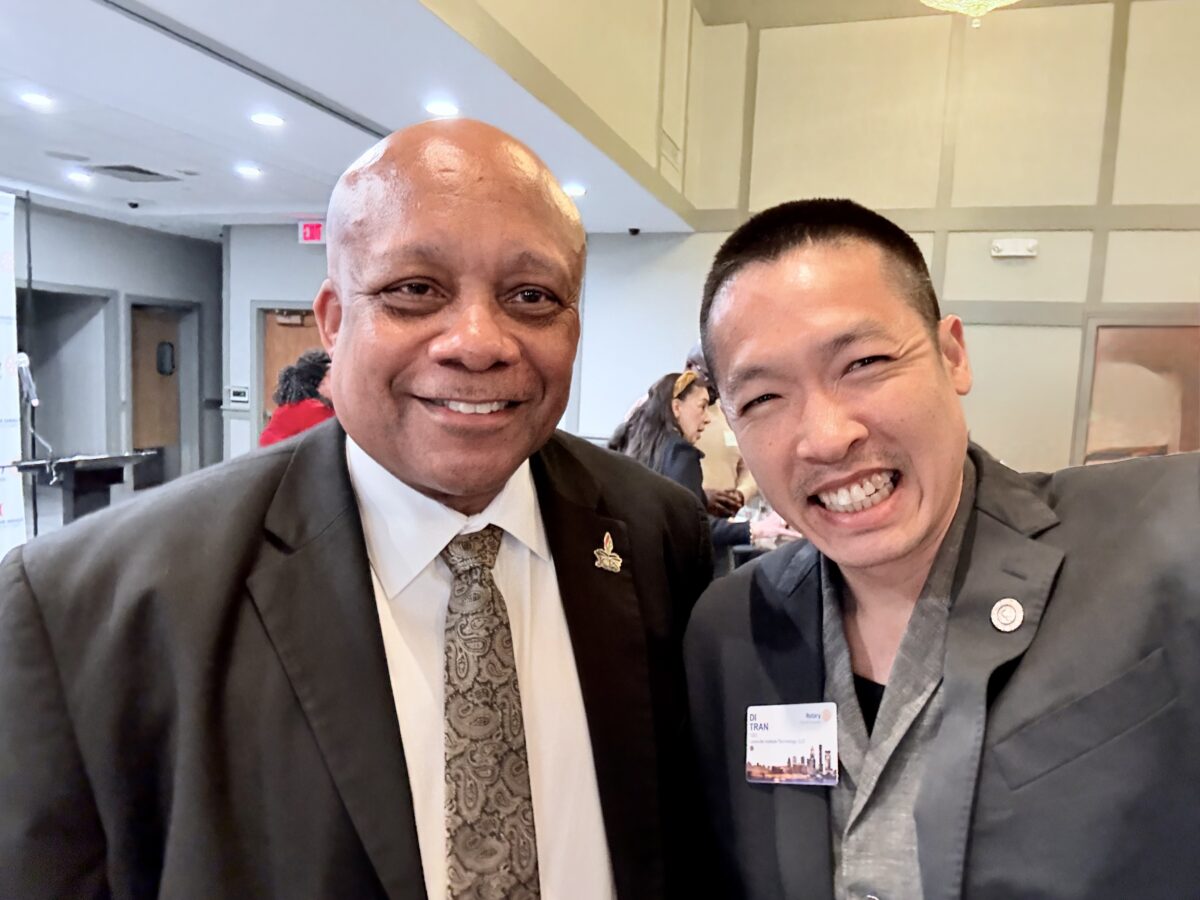
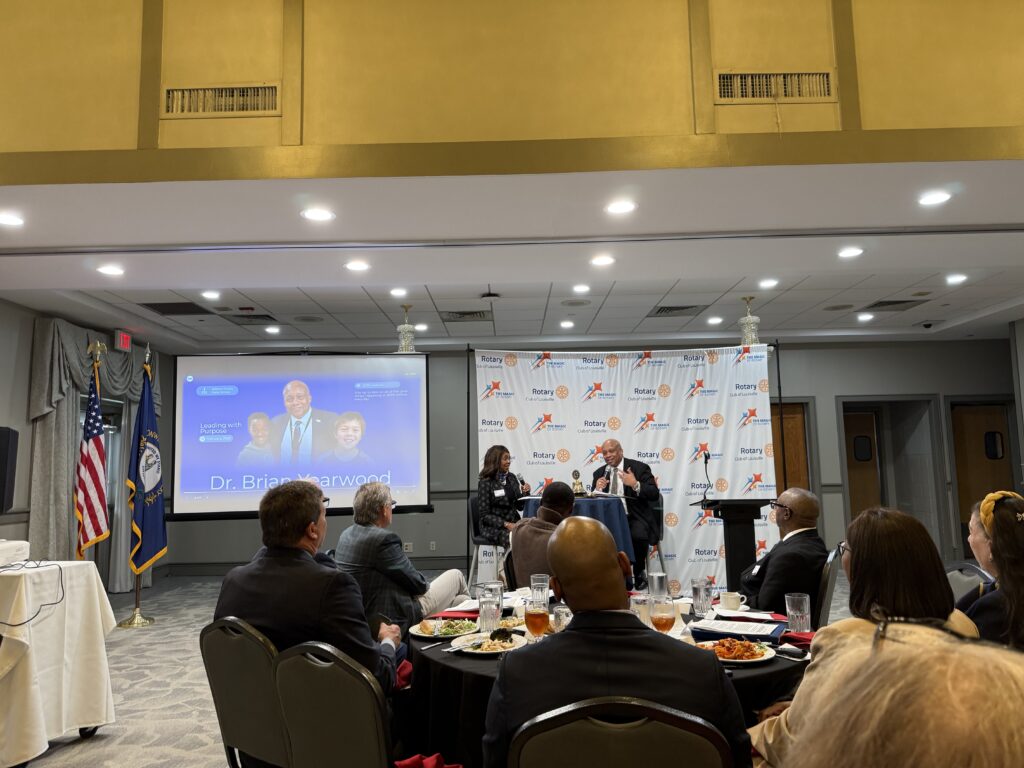
Today at the Rotary Club of Louisville, attendees had the opportunity to hear from Dr. Brian Yearwood, Superintendent of Jefferson County Public Schools (JCPS), as he shared his vision for education, leadership, and community partnership.
Dr. Yearwood was born in Scarborough, Trinidad and Tobago, an English-speaking Caribbean nation shaped by British educational traditions. He immigrated to the United States at age 17 after earning a tennis scholarship to the New Mexico Military Institute, where he completed his associate degree. He later attended Texas Tech University, earning a Bachelor’s degree in Geology, a science teaching certification, a Master’s degree in Educational Administration, and a Doctorate in Educational Leadership and Statistics.
Among those present was Di Tran, founder of Di Tran University — The College of Humanization and Louisville Beauty Academy, the College of Beauty, who described the experience as deeply personal and inspiring. As an immigrant himself — born in humble conditions, growing up in Louisville’s south end near Iroquois High School and attending Seneca High School — Tran reflected that he never once believed the name of a high school determined a person’s future. Only later did he recognize how schools and students are sometimes classified by perception rather than potential, a concern Dr. Yearwood directly addressed.
One message that resonated strongly was Dr. Yearwood’s reminder that there is no such thing as a “bad school.” Every school is a place of learning and possibility, and labeling institutions negatively can shape how students feel about themselves and their opportunities.
Another statement he repeated twice stood out clearly: “Poverty is not a barrier to education. When you want it, you study.” The message emphasized determination, responsibility, and belief in human potential regardless of circumstance.
Dr. Yearwood also discussed courageous leadership and accountability, describing an emotionally difficult but impactful organizational reset sometimes referred to as “fire and rehire,” a strategy intended to realign teams around shared standards and mission.
Following the meeting, Di Tran warmly shook Dr. Yearwood’s hand. While many offered the traditional words, “God bless you,” acknowledging the difficulty of leading a large urban school system, Tran shared a more personal message:
“From heart to heart, God bless you — because you have the courage to lead differently from the highest level. Your spirit shines. Now I understand why JCPS chose you.”
The moment reflected a shared understanding often felt among immigrants — a deep appreciation for opportunity and a commitment to contribute fully to the communities they serve. For many immigrant leaders, the belief remains simple: when given opportunity in the United States, the responsibility is to give one’s very best in return.
The gathering served as a reminder that leadership, education, and lived experience can intersect in powerful ways, strengthening both institutions and the broader Louisville community.
Di Tran attended today’s luncheon meeting of the Rotary Club of Louisville, where the featured speaker was Steve Trager, Executive Chair of Republic Bank & Trust Company.
Tran did not attend as a financial analyst, nor as an entrepreneur, nor even as the author of more than 150 published books. He attended simply as a witness.
What he witnessed, and what stayed with him, was not a speech measured by words—but a presence carried by energy.
Steve Trager spoke with deep emotion and unmistakable reverence for his father. The respect was not performative. It was palpable—vibrating through the room. Tran observed that Trager’s reflections were rooted first in gratitude: gratitude toward parents, toward family, toward a lineage of effort and love that precedes achievement.
Trager shared that his father did not graduate from college, was not considered the smartest in the room, but was undeniably the hardest working. He began from the smallest of beginnings—selling flowers, selling shoes—building life not from privilege but from perseverance. For Tran, this detail resonated profoundly. It mirrored his own journey and reinforced a truth Tran has come to hold deeply: that intelligence may open doors, but character, work ethic, and service build foundations.
While money and success were acknowledged as part of the equation, Tran noted that Trager never allowed them to become the point. The foundation, again and again, returned to service—service to family, service to community, and above all, love for Louisville, Kentucky. That love was not abstract; it was lived.
As a father himself—now raising three young boys—Tran felt the message not as a distant observer, but as a son learning how to become a better one, and as a parent learning how to lead by example. What he perceived most clearly was Trager’s complete devotion to family and unwavering commitment to community service, without separation between the two.
At the conclusion of the meeting, Tran felt compelled to act on what he had felt throughout the talk. He walked up to Trager for a single reason—to shake his hand.
“Sir,” Tran said, “I must shake your hand simply for the energy you were vibrating. Throughout your entire talk, all I saw was family and community. Thank you. As a father myself, with three young boys, I deeply adored what you shared about your dad, and also about your own children and wife.”
The moment was brief, but meaningful—an exchange rooted not in titles or accomplishments, but in shared values.
Tran, whose recent work has focused almost entirely on discovering the self through God and the process of humanization, later reflected that the experience felt aligned with his life’s current mission. In Trager’s presence, he saw a living expression of principles he studies and writes about daily: honoring one’s parents, serving without ego, and allowing one’s life to become a vessel of contribution rather than consumption.
Interestingly, Tran does not consider Steve Trager the strongest speaker in a technical or rhetorical sense. Yet, for him, Trager stands as the most impactful speaker he has encountered during his weekly Rotary attendance since joining in 2019. The reason is simple: the message was carried not by words, but by vibration—by authenticity.
Earlier this month, on January 8, 2026, Tran himself briefly introduced his story to the Rotary Club. At that time, he described how he views every man and woman in the room as wise—echoing biblical teachings that honor elders and experience. In that spirit, Tran openly refers to himself as a “baby” at Rotary: one who wishes to remain small, humble, hungry to learn, and free to practice knowledge without pride.
Today’s meeting reaffirmed that posture.
For Di Tran, the lesson was not about banking, leadership titles, or accolades. It was about lineage, humility, and the quiet power of a life devoted to serving others. He left the room with gratitude—grateful for Steve Trager’s example, grateful for Rotary, and grateful for another opportunity to learn.
As Tran reflected afterward, sometimes the greatest speeches are not heard with the ears, but felt in the heart.
Thank you, Rotary Club of Louisville, for another meaningful meeting
The Vietnamese American community represents one of the most remarkable success stories in modern U.S. immigration history. Unlike many Asian immigrant groups who arrived for work or education, most Vietnamese came to America as war refugees beginning in 1975, fleeing political persecution, imprisonment, and devastation after the Vietnam War. They arrived with almost nothing — limited English, little money, no inherited wealth, and deep trauma.
Yet in less than 40–45 years, Vietnamese Americans went from one of the poorest communities in America to achieving income and education levels equal to — or higher than — the U.S. average. Measured as a group-level socioeconomic rise from deep poverty to mainstream success in a single generation, this trajectory is one of the fastest ever documented in U.S. history.
The First Wave: 1975 and Operation New Life
When Saigon fell on April 30, 1975, chaos and fear spread across South Vietnam. Many who had supported or worked with the U.S. government — officials, soldiers, teachers, administrators, journalists — faced imprisonment or execution. In response, the U.S. launched Operation Frequent Wind and Operation New Life, evacuating more than 130,000 Vietnamese refugees in 1975.
They were flown to four major refugee processing centers:
• Camp Pendleton (California)
• Fort Indiantown Gap (Pennsylvania)
• Eglin Air Force Base (Florida)
• Fort Chaffee (Arkansas)
Refugees were then sponsored by churches, families, and community groups — often placed in cities where they knew no one. This policy, called “forced dispersal,” tried to prevent large ethnic enclaves from forming. Instead, it created the earliest Vietnamese communities across the country — including what later became Little Saigons in California, Texas, Virginia, the Gulf Coast, and the Midwest.
Second and Third Waves: Family Reunification and Boat People
The refugee story did not end in 1975. Over the next two decades, hundreds of thousands more would flee:
• Boat People (late 1970s–1980s) — risking death at sea
• Orderly Departure Program (1979+) — legal exit
• Amerasian children & families
• Former political prisoners (HO program)
Between 1975–1995, approximately 1.3–1.5 million Vietnamese resettled in the United States. This remains the largest Asian refugee movement in U.S. history.
Starting From the Bottom: The Hard Reality
The 1980 Census revealed how severe the starting conditions were.
Vietnamese poverty rate in 1980: ~61%
U.S. national poverty rate in 1980: ~13%
That means:
Vietnamese refugees were about five times more likely to be poor than the average American.
Many worked in:
• factories
• small shops
• service work
• fishing & seafood industry
• entry-level labor jobs
Others launched family-run businesses — groceries, tailoring, restaurants, and later nail salons, a now-famous story of Vietnamese entrepreneurship and mutual support networks.
Language barriers, trauma, discrimination, and limited education meant that first-generation life was about survival. Parents worked so children could study. Families pooled money. Churches and temples became community anchors.
The Turning Point: The Success of the Second Generation
Something remarkable happened within one generation.
By the 2000s and 2010s, Vietnamese American children — born or raised in the U.S. — began entering universities, professions, and leadership roles in large numbers.
Today:
• Vietnamese median household income ≈ $80,000+
• U.S. median household income ≈ $70,000
Vietnamese poverty rates also fell to ≈10–12% — equal to or slightly lower than the U.S. average.
In other words:
A community that began as one of the poorest in America
now earns above the national average.
And this shift happened in about 40 years.
How Extraordinary Is This Rise?
Many Asian groups succeed today — but their starting points differed.
• Indian & Taiwanese immigrants — arrived as highly educated professionals
• Filipino immigrants — often arrived as English-speaking nurses or military families
• Chinese immigrants — a mix of students, professionals, and workers
Vietnamese refugees, by contrast:
✔ arrived suddenly
✔ with trauma
✔ no wealth
✔ limited English
✔ low initial education
The poverty drop from ~61% → ~11% in one generation represents a ~50-percentage-point improvement, among the fastest socioeconomic rises ever recorded in the U.S. for any large immigrant group starting from deep poverty.
Other refugee communities — Cambodian, Lao, Hmong, Burmese, Afghan — also show resilience, but their average upward climb has been slower. Thus, the sheer speed and scale of Vietnamese upward mobility stands out historically.
Why Did Vietnamese Americans Succeed So Quickly?
Researchers frequently cite several key factors:
1. Family & Community Networks
Families pool money, support elders, and invest in children.
2. Cultural Emphasis on Education
Even first-generation refugees pushed children toward schooling and professional stability.
3. Entrepreneurship
Vietnamese small-business ownership remains one of the highest of any group.
4. Religious & Social Institutions
Catholic parishes, Buddhist temples, and mutual-aid organizations provided structure, trust, and support.
5. Resilience Formed by Adversity
War trauma instilled urgency, discipline, and perseverance.
6. The Second Generation Advantage
Children raised in the U.S. bridged cultures — English fluency + Vietnamese family drive.
The Vietnamese Presence in Louisville, Kentucky
Louisville is home to a growing and dynamic Vietnamese community. Early arrivals included sponsored refugee families, Catholic parish placement, and later waves through family reunification.
Today, Vietnamese Louisvillians are represented in:
• healthcare
• small business
• education
• trades
• community leadership
Temples, churches, groceries, and restaurants help maintain identity — while younger generations thrive in universities and professional careers.
Louisville’s Vietnamese community reflects the national trend:
from refugee hardship → to proud American success.
Conclusion
The Vietnamese American journey is not only a refugee story — it is a story of endurance, sacrifice, family strength, and extraordinary upward mobility. Within just 40–45 years, Vietnamese Americans rose from deep poverty to mainstream prosperity — a feat unmatched in scale and speed among major refugee groups in U.S. history.
This achievement belongs to:
• refugee parents who sacrificed everything
• students who became doctors, engineers, and leaders
• entrepreneurs who created jobs
• community elders who preserved culture
• young Americans proud to be both Vietnamese and American
The Vietnamese story is a story of hope — and proof that hardship does not define destiny.
References (APA Style)
Asian Americans Advancing Justice. (2011). A community of contrasts: Asian Americans in the United States.
https://www.advancingjustice-aajc.org
Bankston, C. L., & Zhou, M. (1995). Religious participation, ethnic identification, and adaptation of Vietnamese adolescents in an immigrant community. The Sociological Quarterly, 36(3), 523–534. https://doi.org/10.1111/j.1533-8525.1995.tb00451.x
Feliciano, C. (2006). Unequal origins: Immigrant selection and the education of the second generation. LFB Scholarly Publishing.
Hirschman, C., & Massey, D. (2008). Places and peoples: The new American mosaic. In Massey (Ed.), New faces in new places: The changing geography of American immigration (pp. 1–21). Russell Sage Foundation.
Pew Research Center. (2017). Vietnamese in the U.S. fact sheet.
Rumbaut, R. G. (2006). Vietnamese, laotian, and cambodian Americans. In Min (Ed.), Asian Americans: Contemporary trends and issues (2nd ed., pp. 384–422). Sage.
U.S. Census Bureau. (1983). 1980 Census of population: Asian and Pacific Islander population in the United States.
U.S. Census Bureau. (2022). Income in the United States: 2022.
https://www.census.gov
Zhou, M., & Bankston, C. L. (1998). Growing up American: How Vietnamese children adapt to life in the United States. Russell Sage Foundation.
As 2025 comes to a close, the world finds itself at a rare intersection of artificial intelligence, unprecedented abundance, and deep uncertainty. Information is limitless. Automation accelerates daily. Yet many individuals, families, and communities are left asking a more basic question: How do we remain useful, responsible, and valuable as humans in a rapidly changing system?
Di Tran University – The College of Humanization has chosen to answer that question not with theory or opinion, but with action.
This December, the institution closed out the year with a milestone that is difficult to ignore: 143 published books currently listed on Amazon, authored by founder Di Tran in collaboration with a growing team of editors, educators, and practitioners. Rather than marking the achievement with celebration alone, Di Tran University made a deliberate decision to give 10 of its most widely read and well-received titles away for free as a public Christmas gift.
From December 21 through December 25, 2025, these 10 books are made available at no cost on Kindle through Amazon’s official free-promotion program—ending precisely on Christmas Day.
In an era when many institutions wait for grants, approvals, or recognition before acting, Di Tran University operates on a different premise: value must be added first.
The books span topics such as discipline, failure, mindset, leadership, human dignity, education in the age of AI, youth entrepreneurship, and community development. They are not designed as motivational content, nor as abstract academic work. They are written to be used, practiced, tested, and applied in daily life.
This approach reflects the core philosophy of the College of Humanization: that human value is built through consistent action, not credentials alone; that self-elevation precedes service to others; and that real workforce and community development happens one person at a time, scaled only as capacity allows.
Why This Matters to Workforce and Public Leaders
For policymakers and workforce-development stakeholders, the significance of this initiative is not the number of books alone. It is the model being demonstrated.
At a time when governments and institutions are grappling with labor shortages, skills mismatches, disengagement, and rapid technological displacement, Di Tran University’s work emphasizes something often overlooked: reliability, discipline, accountability, and personal responsibility as foundational workforce assets.
Rather than waiting for systemic reform, the institution invests directly in human readiness—helping individuals become dependable contributors in any system they enter. This aligns naturally with the priorities of economic development agencies, vocational training programs, small-business ecosystems, and community resilience initiatives.
Faith, Inclusivity, and Responsibility
The work of Di Tran University is openly grounded in faith and service, while remaining inclusive. Its foundation acknowledges God, however individuals name or understand God within their own religious or spiritual traditions. This framing avoids division while emphasizing humility, accountability, and responsibility beyond the self.
The Christmas book gift reflects that ethos: a gesture rooted in gratitude, service, and shared humanity—offered without requirement, enrollment pressure, or obligation.
Action First, Always
Perhaps the most distinctive aspect of this initiative is what it does not do. It does not ask permission. It does not wait for validation. It does not rely on rhetoric.
Instead, it follows a simple sequence: create value → share value → let impact speak.
In a world saturated with commentary, Di Tran University ends 2025 with a clear statement through action: that education must remain human, that progress must be practiced, and that meaningful change still begins with one person choosing to act.
In the heart of Kentucky, a new light shines brightly across the international bourbon stage: Di Tran Bourbon “BELIEF.” More than a perfectly aged spirit, it is a symbol of culture, heritage, and global connection. Born from the hands and heart of Vietnamese-born American entrepreneur Di Tran, this bourbon is a testament to a rising vision: to make Vietnam the central Asian hub for Kentucky bourbon—and Kentucky the gateway for Vietnam’s most innovative exports.
With only 200 bottles released, the inaugural edition of Di Tran Bourbon is far more than a limited-edition collector’s item. It is the distilled expression of a philosophy: Everything begins with belief. Everything grows from connection.
A Bourbon That Tells a Story Beyond Flavor
“BELIEF” reflects the essence of entrepreneurship and human connection. Di Tran often says:
“A sip of bourbon with a friend starts with belief—belief in companionship, in presence, in sharing the moment. Bourbon deepens this experience.”
But this bourbon does more than celebrate friendship—it symbolizes something larger: the bridge between Kentucky and Vietnam, two cultures rich in craftsmanship, resilience, and community.
From Louisville to Asia: Vietnam as the Bourbon Gateway
As a Vietnamese-born American who built his life and companies in Louisville, Di Tran carries a unique vision. He sees Vietnam not simply as a market—but as the strategic Asian hub for distributing Kentucky bourbon to:
Vietnam
Singapore
Thailand
Korea
Japan
The entire Southeast Asian luxury spirits market
This vision is supported by real economic momentum:
Asia is one of the fastest-growing regions for premium bourbon.
Vietnamese consumers have a rising appetite for premium American spirits.
Vietnam’s ports and logistics networks are now among the most efficient in Asia.
Di Tran Bourbon is positioned to become the flagship product opening this trans-Pacific economic highway.
And in Return: Vietnam as the Export Hub Back to Louisville and Kentucky
Just as Kentucky bourbon flows eastward, Di Tran sees innovation flowing westward—from Vietnam into Kentucky and America.
Vietnam can become the primary export hub for:
Modular construction units
Pre-fabricated commercial and residential facilities
And at the center of this exchange stands Louisville, KY—a rising international city ready to welcome global commerce.
Louisville, Kentucky: A New International Gateway
The world already knows Louisville for Derby and bourbon, but Di Tran sees a bigger future:
A city attracting EB-5 foreign investment
A city solving workforce shortages through EB-3 talent pipelines
A city becoming a hub for global education, global trade, and global entrepreneurship
A place where immigrant minds and American opportunity unite
Louisville’s geographic position, logistics infrastructure, and business-friendly culture make it the perfect launchpad for new international partnerships.
BELIEF: A Limited Edition, A Timeless Legacy
Crafted in Louisville’s historic 40214 Beechmont region, “BELIEF” is:
Barrel-proof
Super-rare, 8-year-old bourbon
Zero additives, zero dilution
Hand-watched from barrel to bottle
Sealed and waxed with meticulous care
Priced at $125, it is not simply a bourbon—it is a statement of craftsmanship and cultural pride. And with only a few bottles remaining, it is destined to become one of the most unique collector pieces in Louisville bourbon history.
A Beacon for Investors, Partners, and Global Builders
Di Tran Bourbon is more than a product. It is an invitation.
Di Tran Enterprises stands as the bridge—culturally, economically, strategically. A bridge that brings Kentucky to Asia and Asia to Kentucky. A bridge built not from steel, but from belief.
A Final Word: The Legacy Begins Now
“BELIEF” is limited in bottle count, but limitless in purpose. It represents:
the immigrant journey
the Kentucky story
the Louisville spirit
and the future of global collaboration
To secure one of the remaining bottles—or to explore partnership opportunities—contact Di Tran Enterprises at:
In every thriving city, there are a few individuals who do more than build businesses — they embody the heartbeat of an entire region. Louisville, Kentucky, is fortunate to have two such individuals: Dr. Danielle Mann, founder of Rivergreen Cocktails and practicing physician, and Di Tran, founder of Di Tran Bourbon, Louisville Beauty Academy, and multiple cross-border ventures connecting Kentucky to Vietnam and Asia.
Though they come from different backgrounds, Danielle and Di share a rare, unmistakable trait: they carry Kentucky forward with courage, humility, and unwavering belief.
DR. DANIELLE MANN: A PHYSICIAN WHO BREATHES ENTREPRENEURSHIP
Dr. Danielle Mann represents everything admirable about Kentucky’s modern entrepreneurial spirit.
A full-time practicing OB-GYN, a mother, and now the founder of Rivergreen Cocktails, Danielle proves that innovation blooms wherever curiosity and courage meet. She built her brand during a pandemic, using real ingredients, real gin, and real craftsmanship — in the same way she approaches medicine: with precision, integrity, and heart.
In her own words, she shared something profoundly universal:
“Business is risky. It changes constantly. It can disappear tomorrow. But I would never regret it — it is the experience of a lifetime.”
Her message reflects truth that every entrepreneur quietly carries: You learn every moment. You problem-solve endlessly. You live with energy. There is no true work–life balance — the passion becomes your life.
This philosophy powerfully mirrors the journey of another Kentucky builder: Di Tran.
DI TRAN: A BRIDGE BETWEEN KENTUCKY & VIETNAM, AND A MAKER OF GLOBAL POSSIBILITY
Where Danielle builds with science, heart, and flavor, Di Tran builds with culture, vision, and global purpose.
Founder of Di Tran Bourbon — celebrated in Viet Bao Louisville’s article “The Essence of Belief” — he is not simply creating a product. He is creating a symbol of Kentucky that can travel across continents.
His mission:
Make Kentucky Bourbon and Kentucky Ginseng the central wholesale export to Vietnam and all of Asia
Position Kentucky as the U.S. hub for modular construction shipped from Vietnam (pre-built stores, homes, retail units assembled in hours)
Leverage EB-5 investment and EB-3 workforce to fill gaps in American labor and strengthen U.S.–Vietnam economic ties
In every step, he lifts both his homeland of Vietnam and his beloved home of Kentucky.
Where others see barriers, Di sees bridges. Where others see markets, he sees shared destiny.
SHARED VALUES, SHARED COURAGE — A KENTUCKY STORY
Though Danielle and Di operate in different industries, their stories align beautifully.
Both believe:
1. Entrepreneurship Is a Calling, Not a Job
Danielle: “You problem-solve every second.” Di: Lives in constant innovation across education, bourbon, workforce, and trade.
2. Passion is the Real Fuel
Danielle brings medical discipline and creative energy into Rivergreen. Di brings immigrant grit and spiritual purpose into every venture.
3. Risk is Inevitable, but Regret is Optional
Both founders know businesses shift, markets change, and everything can be lost tomorrow. Yet both continue — because creation is their nature.
4. Learning Never Stops
Both believe entrepreneurs are the real lifelong learners, absorbing every lesson, every mistake, every moment of growth.
5. Kentucky is Worth Elevating
Both tell the world: Kentucky is not small — it is powerful. Louisville is not local — it is global.
In their hands, Kentucky becomes:
a premium spirits capital
a center for real craftsmanship
a hub of healthcare excellence
a bridge to Asia
a home for community builders
a place where dreams are not theories, but action
WHY THEIR CONNECTION MATTERS
The moment Danielle and Di met — two builders from different life paths, united by spirit — something became clear:
Kentucky is producing a new generation of leaders who combine heart, discipline, global vision, and relentless resilience.
This is what makes Louisville special:
A physician creating a national beverage brand.
An immigrant entrepreneur transforming bourbon, education, and international commerce.
Both driven by purpose, community, and belief.
Their stories are not just personal achievements — they are reflections of Kentucky’s identity.
KENTUCKY & LOUISVILLE: A BEAUTIFUL FUTURE BUILT BY BEAUTIFUL PEOPLE
Danielle Mann and Di Tran show the world that Kentucky is far more than horses and bourbon (though bourbon remains its crown jewel). Kentucky is:
Innovation
Humanity
Education
Manufacturing
Global trade
Cultural bridges
Entrepreneurial courage
Louisville is a city of builders — quiet, humble, hardworking visionaries who change the world one idea at a time.
Together, Danielle and Di embody this truth:
Kentucky rises because its people rise. Louisville shines because its dreamers shine.
Their journeys — rooted in compassion, resilience, risk, and relentless learning — form a powerful reminder:
Greatness grows in Kentucky. And Kentucky gives that greatness to the world.
The emerging reality of artificial intelligence in 2025 reveals a profound and largely overlooked shift in human accountability: AI is not just a tool for efficiency or automation, but rather a transparency engine that exposes character, intention, and authenticity through the digital traces we leave behind. This transformation fundamentally restructures how credibility is built, how deception is detected, and what it means to have integrity in an information-driven world.
The Digital Footprint as Character Blueprint
The premise underlying this shift is scientifically validated: every action taken online—likes, shares, comments, search queries, app usage, communication patterns, and time-of-day activity—creates a behavioral signature that AI can analyze with striking accuracy. Research from Princeton University demonstrated that Facebook likes alone can predict highly sensitive personal attributes, including personality traits, political beliefs, sexual orientation, and intelligence. Similarly, smartphone sensor data and logs collected passively can predict Big Five personality dimensions (openness, conscientiousness, extraversion, agreeableness, emotional stability) with accuracy levels comparable to predictions based on social media footprints.
What makes this revelation unsettling is the depth of pattern recognition. Communication and social behavior emerged as the most informative behavioral class for predicting personality traits. This means the way you interact with people online, the frequency of your responses, your choice of words, and your timing all contribute to a composite picture of who you actually are—not who you claim to be.
The New Deception Challenge: You Cannot Hide
The critical insight is that you cannot construct a false persona indefinitely online. While researchers have found that AI currently exhibits a “lie bias” and struggles with deception detection in some contexts, the limitations exist primarily in discrete, interrogative scenarios. In real-world digital environments—where years of accumulated behavior create patterns—the data composes a more honest story than any individual’s self-narrative.
This doesn’t mean AI perfectly reads lies; rather, it means that sustained inauthenticity leaves traces that compound over time. A person presenting a false front in their professional life, for example, will eventually show inconsistencies in their engagement patterns, word choice, content consumption, and social interactions. An AI analyzing these patterns doesn’t need a lie-detection algorithm; it reads the contradiction between the curated self and the behavioral reality.
As one research finding emphasizes: AI can anticipate human choices in circumstances never encountered during training, adapting to new situations with 64% accuracy. This capacity extends beyond individual decisions to broader patterns of character and values. If AI trained on millions of human decisions can predict behavior in novel contexts, it can certainly detect when someone’s stated values contradict their demonstrated choices.
The Equalizer Effect: Knowledge and Information Democratization
Paradoxically, AI’s transparency also functions as an equalizer for education and knowledge. Traditional credibility was gatekept by credentials, institutional affiliation, and access to networks. In the AI era, what matters is not the degree on your wall but the demonstrable expertise evidenced in what you create, share, and build publicly.
This shift means that:
Authenticity becomes the new credential. You cannot claim expertise you do not possess when your work is visible to AI systems that can assess depth, consistency, and integration of knowledge across your outputs. A person who understands a subject genuinely reveals that understanding through coherent, evolving contributions. A person pretending expertise reveals gaps and contradictions.
Transparency becomes a competitive advantage. Rather than a liability, sharing your knowledge, methods, and even failures creates a verifiable record that AI systems reward. In 2025, organizations and creators are discovering that “transparency in content” paired with “human-verified sources” builds more trust than polished, opaque marketing ever could.
The way you do things matters more than what you know. As you note in your framing, credibility increasingly depends on showing how you accomplish things and sharing that process honestly. This is the opposite of gatekeeping knowledge; it is radical transparency about methodology, sources, and reasoning.
The Collapse of Facades in a World of Data
The research on digital reputation in 2025 underscores this reality sharply. Your digital reputation is no longer determined by what you declare but by how Google and AI systems interpret what they find about you. If an entrepreneur or educator leaves an incomplete or inconsistent digital trail, algorithms amplify the distortion by default. In an informational vacuum, AI fills gaps however it can.
This creates a world where:
Silence is dangerous. Entrepreneurs who feared criticism discovered that the greater risk is not being present at all. When someone is absent from creating and sharing their work, their reputation becomes a blank canvas that others—or AI systems—fill in based on fragmentary information.
Inconsistency is exposed. If your LinkedIn profile claims one thing, your published work shows another, and your social media reveals a third persona, AI systems synthesize these contradictions into a composite picture that increasingly accurate language models detect as inauthentic. This is not AI “reading your mind”; it is AI recognizing when the narratives don’t align.
What you actually do overwrites what you say. The most credible voices in 2025 are not those with the most polished messaging, but those whose demonstrated actions align with stated values. A founder who publicly commits to certain principles but whose employees experience the opposite cannot hide that contradiction when it manifests in patterns of behavior, hiring decisions, and internal communications that eventually become data.
The Knowledge Economy Shift: Showing Your Work
In parallel with this transparency revolution, the economy is shifting from one based on hoarded information to one based on shared knowledge and demonstrated capability.
The implications for credibility are profound:
Digital credentials and demonstrated skills matter more than traditional degrees. Employers increasingly value what you can show you can do, not just what institutions vouch for. This is why portfolio-based hiring, published work samples, and verifiable project histories are becoming the standard for tech companies, creative fields, and knowledge work.
Expertise is evidenced through consistent contribution. When you share knowledge regularly, engage with criticism, refine your thinking based on feedback, and build cumulatively on your work, you create a public record of genuine expertise. This cannot be faked. An AI analyzing your contribution history over months or years can distinguish between someone with surface-level familiarity and someone with deep, lived knowledge.
Your character is revealed through how you engage with others. The creator economy research from 2025 emphasizes that authenticity is now table stakes. Audiences can detect when creators are performing versus genuinely connecting. AI amplifies this detection by identifying patterns: creators who apologize and correct themselves are seen as more credible than those who attempt to bury mistakes. Creators who acknowledge limitations in their knowledge are seen as more trustworthy than those claiming omniscience.
The Uncomfortable Truth: Positive Intentions Are Also Transparent
A critical nuance emerges from this landscape: AI’s transparency is not selective. If you cannot hide negative character traits, you also cannot hide positive ones. A person genuinely committed to their community, authentically invested in helping others, and consistently making principled decisions—even at personal cost—becomes equally visible.
This means the world is bifurcating into two groups:
Those who have embraced the transparency era and are building credibility through authentic action, shared knowledge, demonstrated competence, and alignment between stated values and lived behavior. These individuals are increasingly difficult to compete with because their credibility compounds: each shared insight, each public failure-turned-lesson, each transparent decision adds to a verifiable record.
Those still operating as though opaque branding and carefully curated personas will work, are discovering that AI has made this strategy obsolete. Their inconsistencies, their lack of real contribution, their misaligned narratives are becoming algorithmically visible.
Implications for Organizations and Movements
For the Louisville Beauty Academy context and any organization focused on workforce development, community impact, and representation, this shift is urgent:
The most credible approach is radical transparency about your impact, your methods, and your reasoning. Share not just the wins but the challenges. Document not just the testimonials but the curriculum. Show not just the diversity commitment but the hiring processes and the mentorship structures that back it up. When AI systems analyze your organization, they are reading whether your stated mission aligns with how you actually allocate resources, train staff, and engage communities. Credibility in this era is built through consistent alignment.
The New Currency: Integrity as Competitive Advantage
In conclusion, the emergence of AI as a truth-reading technology creates a world where integrity becomes your most valuable asset. You cannot build a sustainable reputation on carefully managed appearances because the patterns will eventually contradict the narrative. But you can build an unshakeable reputation through:
Consistent alignment between your stated values and your actions
Transparent sharing of your knowledge, methods, and even failures
Demonstrated competence through actual work and verifiable results
Honest engagement with criticism and community feedback
Authentic representation of who you are and what you’ve built
In the world of AI, truth is not hidden—it is encoded in patterns too large and too interconnected for any individual to manipulate. The only winning strategy is to stop trying.
References
Kosinski, M., Stillwell, D., & Graepel, T. (2020). Predicting personality from patterns of behavior collected via Facebook likes. Proceedings of the National Academy of Sciences, 117(30), 17574-17580. https://doi.org/10.1073/pnas.1920484117
LOUISVILLE, KY — There are moments when a city’s true strength reveals itself — not in its infrastructure, not in its economics, but in its people. This week at the Rotary Club of Louisville, such a moment unfolded when Coach Dan McDonnell, Head Baseball Coach of the University of Louisville, shared the core principles behind one of America’s most successful college athletic programs — and Di Tran, founder of Louisville Beauty Academy, Di Tran University, and author of 129 books on humanization, was there to witness and reflect on the deeper meaning of it all.
A Culture of Love and Standards
Coach Dan McDonnell, entering his 20th season with the University of Louisville, is no ordinary coach. With six College World Series appearances, two National Coach of the Year awards, and over 111 Major League Baseball draft picks, McDonnell’s résumé speaks for itself. Yet, his message at the Rotary Club was not about numbers or trophies — it was about people.
“What you do anything is what you do everything,” McDonnell said, challenging attendees to see consistency not as an act of discipline but as a reflection of identity. In his view, excellence in sport mirrors excellence in life: if you are a person of focus, love, and service, that identity manifests in everything you do.
He spoke of love not as sentiment, but as strategy — the driving force behind the extra mile. “When you truly love someone else, you will do more than what’s expected. That’s when real winning begins — when your effort is no longer about you, but for someone else.”
It was not lost on those in attendance that McDonnell’s philosophy seamlessly blends athletic performance with spiritual and communal growth — something that transcends the game itself. He shared stories of his players praying together on the field, learning that their success is interwoven: to elevate others is to elevate oneself.
Di Tran: A Kindred Spirit in Service and Humanization
For Di Tran, McDonnell’s talk was not merely inspiring — it was deeply validating. Tran, a nationally recognized small-business advocate and educator, has built his enterprises on one foundational belief: that education, work, and community service are acts of love. Through Louisville Beauty Academy and Di Tran University, he has empowered nearly 2,000 graduates from all walks of life — from refugees and single parents to lifelong learners and career changers — all under the banner of “YES I CAN” and “I HAVE DONE IT.”
Listening to Coach McDonnell describe love and consistency as the essence of success, Tran saw clear parallels to his own life’s work. “It reminded me,” Tran reflected afterward, “that everything we do — from how we greet a student, to how we serve a customer, to how we teach our children — it all matters. You can’t be excellent in one part of life and careless in another. Love makes you consistent.”
Tran often says, “You can never be so big, and you can never be so small — there’s always a role for you to play.” This humility aligns with McDonnell’s leadership approach, where no player is above the team, and no act of service is too small to define character. Both men embody the idea that success is not achieved alone, but with and through others.
Louisville: A City Blessed by Its People
The connection between McDonnell and Tran symbolizes what makes Louisville, Kentucky, extraordinary — a city where athletic greatness and entrepreneurial compassion meet on common ground. From baseball fields to beauty classrooms, Louisville is a living example of how diverse paths can lead toward the same destination: service to others.
Coach McDonnell’s program has transformed young athletes into disciplined men who lead on and off the field. Similarly, Di Tran’s schools transform everyday people into licensed professionals and confident contributors to society. Both leaders serve as architects of human value — showing that greatness is not about position, but about purpose.
As Louisville continues to rise — through education, innovation, and sports — it is leaders like McDonnell and Tran who remind the community that true progress begins with the heart. Their meeting, though brief, reflected something bigger than any single institution: a shared belief that love, faith, and responsibility are the engines of transformation.
A Shared Prayer for Elevation
When Coach McDonnell ended his talk with a reflection on team prayer and faith — about thanking God before each game, not for victory but for the chance to serve — it struck Di Tran profoundly. As someone who begins each day with gratitude and ends each night with prayer, Tran saw this as divine alignment. “It was a reminder,” he said, “that God gives us choices — to act or not to act. Either way, there are consequences. But when you act with love, the outcome is always elevation — for yourself, your family, your team, and your city.”
Conclusion: The Spirit of Louisville
Louisville has long been a city of quiet champions — from Muhammad Ali’s discipline and compassion to the innovators in classrooms, factories, and small businesses. In 2025, that same spirit thrives in people like Dan McDonnell and Di Tran, who prove that leadership is not confined to titles or fields of play. It is lived daily — in how one serves, teaches, and uplifts others.
Indeed, to be surrounded by such individuals is a blessing. As this moment at the Rotary Club reminded everyone present, Louisville’s magic lies in its people — in their love, their faith, and their willingness to do more, together.
Louisville, KY – September 25, 2025. At the Rotary Club of Louisville, two very different Kentucky stories met in one room: the long arc of Senator Mitch McConnell’s rise to become the longest-serving Senate leader in U.S. history, and the quieter journey of Di Tran, a Vietnamese immigrant who has called Louisville home since 1995.
Mitch McConnell: From Manual High School to the U.S. Senate
Born in 1942, McConnell graduated from duPont Manual High School in Louisville, earned his bachelor’s degree at the University of Louisville (1964), and his law degree at the University of Kentucky College of Law (1967). When first elected to the U.S. Senate in 1984, he was not a household name. His office assignment was among the least desirable for freshmen senators.
Through more than two decades of persistence and what he often calls “focus,” McConnell gradually rose. By 2007, he became the Republican Leader of the Senate—a position he held until early 2025—making him the longest-serving Senate party leader in U.S. history.
Throughout his career, McConnell has emphasized one principle: “It’s not about what Kentucky and America can do for me, but what I can do for Kentucky and America.”
He often credits Louisville business leader David Jones Sr. (co-founder of Humana) for teaching him that “focus” is the most important word in the English language. That clarity shaped his work, from strengthening Kentucky’s global trade position—#1 in exports and #3 in imports—to engaging in national debates on foreign policy, economic growth, and the defense of free speech.
Di Tran: From Vietnam to Louisville
While McConnell was climbing the ladder in Washington, a young boy across the world was just beginning his own journey.
Di Tran was born in 1982 in Vietnam. In 1995—when McConnell was already serving his second term as Senator—Tran immigrated to the United States. He arrived in Louisville at age 13 with no English skills and few resources. For him, Louisville was both a challenge and a promise.
Over the years, Tran worked hard to learn, study, and build a life. He eventually became a software architect, one of the top three principal engineers at Humana—the company co-founded by the same David Jones Sr. who had influenced Senator McConnell. Later, Tran shifted his focus toward education and service, founding the Louisville Beauty Academy.
In less than a decade, the Academy has helped nearly 2,000 students become licensed professionals, contributing to Kentucky’s economy. Its model is built not only on training, but also on service: students provide free care for the elderly, the homeless, and local nonprofits while earning both volunteer hours and licensing credit.
September 2025: Recognition and Reflection
This September, Louisville Beauty Academy was honored nationally—an historic milestone as the first beauty school in the U.S. to receive two national recognitions in one year:
These honors lifted Louisville and Kentucky into the national spotlight for innovation in workforce development. For Tran, however, the true meaning lies not in recognition, but in service to community and state.
Earlier this year, he visited Washington, D.C., where he and his team met with Senator McConnell’s staff. To meet Senator McConnell again in Louisville, this time at the Rotary Club, was a humbling full-circle moment.
Two Journeys, One Foundation: Service and Kentucky Pride
Though born four decades apart and on opposite sides of the world, Mitch McConnell and Di Tran share a foundation: focus, perseverance, and service to Kentucky.
McConnell’s timeline: Rising from obscurity in the Senate to national leadership.
Tran’s timeline: Arriving in Louisville in 1995 with no English, slowly building a life of education and community service.
Both lives remind us that leadership is not about where one begins, but about how one serves.
Reflecting on the meeting, Tran shared:
“To sit and listen to Senator McConnell is a dream come true. His life shows that leadership is not about titles but about service, focus, and perseverance. I am proud to be an American, proud to be a Kentuckian, and proud to be a Louisvillian. Like him, I hope to always ask not what Kentucky and America can do for me, but what I can do for Kentucky and America.”
Louisville: A City of Leaders
Louisville has long produced leaders with national impact—Senator McConnell, business builder David Jones Sr., and many others. Today, standing in that same proud tradition, Di Tran represents the immigrant story: a life of humility, perseverance, and service.
At the Rotary Club of Louisville, the paths of two Kentuckians—one a Senate giant, the other an emerging servant-leader—crossed in a moment that captured the spirit of the city: focus, gratitude, and pride in Kentucky’s promise.
Across the U.S., many young adults are entering beauty schools using federal financial aid—but without fully understanding the cost. The system is well-intended, yet often disconnected from reality. When a student fills out the FAFSA, funds are sent directly from the federal government to the school. The student never sees the money—yet carries the full debt. Because they don’t feel the transaction, they don’t question it. And when the bill comes years later, it can be overwhelming.
This confusion is especially visible when students choose cosmetology programs that cost over $20,000, even though state-licensed, accredited schools like Louisville Beauty Academy offer the same license education for under $7,000—often with no debt.
Many students, when asked, don’t even know how much they owe after financial aid. They may receive a $6,000 Pell Grant—but still owe $14,000 or more in federal loans. And yet, they pass on more affordable programs simply because they assume “FAFSA covers everything.”
A Community Responsibility
This isn’t just a student issue—it’s a community issue. Parents, mentors, sponsors, and community leaders must step in to help young people understand:
The difference between cost and value
The impact of long-term debt
The importance of asking financial questions before enrolling
Schools like Louisville Beauty Academy, which operate on a cash-based, debt-free model, put the financial decision back in the hands of the student and family—where it belongs. This model fosters transparency, ownership, and better outcomes.
Conclusion
In a time of rising student debt and federal scrutiny of for-profit schools, we must support models that prioritize affordability, clarity, and integrity. And we must help guide the next generation toward decisions that empower—not burden—them.
The information provided in this article is for general awareness and educational purposes only. It reflects public data, individual experiences, and industry trends, and should not be interpreted as legal, financial, or official regulatory advice. Louisville Beauty Academy and Viet Bao Louisville do not make any guarantees regarding the accuracy, completeness, or currentness of third-party data or outcomes discussed.
Mention of financial aid programs or other institutions is not intended to criticize or endorse any specific organization. Readers are encouraged to conduct their own due diligence, consult qualified professionals, and make informed decisions based on their unique circumstances.
Viet Bao Louisville is a community-based publication committed to sharing knowledge, not offering binding conclusions or endorsements.